
Organic Electronics Market Snapshot

Key Players

  • Polymer Vision (Netherlands)
  • Sigma-Aldrich Co. (USA)
  • BASF SE (Germany)
  • Bayer MaterialScience AG (Germany)
  • E Ink Holdings (Taiwan)
  • Samsung Display Co. Ltd. (South Korea)
  • LG Display Co. Ltd. (South Korea)
  • Philips Electronics N.V (Netherlands)
  • OSRAM Licht AG (Germany)
  • Novaled AG (Germany)

Market Size

Base Year 2024
$76.48 Bn
CAGR
18.62%
Forecast 2034
$421.82 Bn

Market Segments

By Component
  • Active Components
  • Passive Components
By Material
  • Conductors
  • Dielectric Materials
  • Luminescent Materials
  • Electrochromic Materials
By Application
  • Organic Light-Emitting Diode (OLED) Lighting
  • Solar Batteries
  • Displays
  • Memory Devices
  • Photovoltaic Cells

Market Dynamics

Drivers
  • Growing environmental awareness
  • Advances in biodegradable materials technology
Restraints
  • High production costs
  • Limited product lifespan
Opportunities
  • Rapid environmental awareness growth
  • Emerging wearable technology demand

Market Size

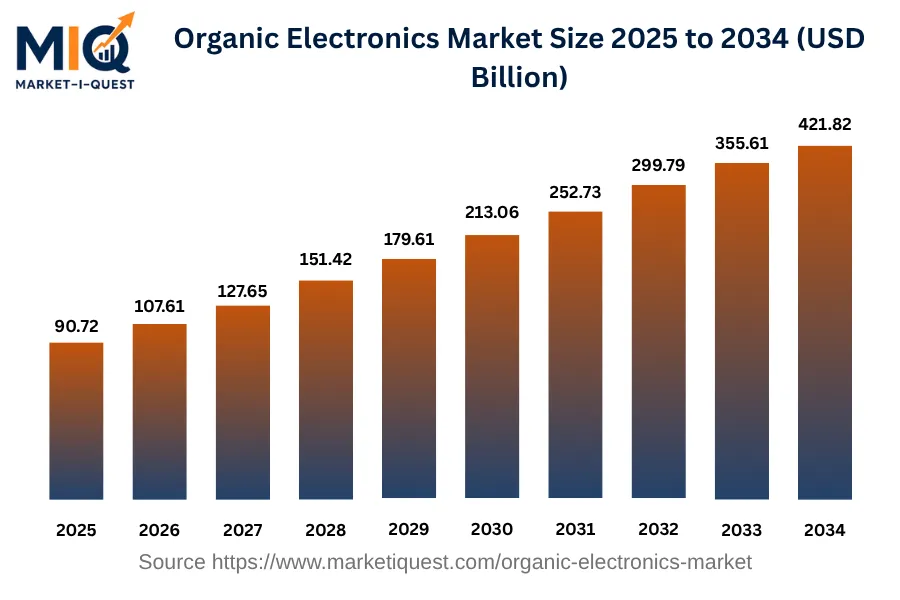
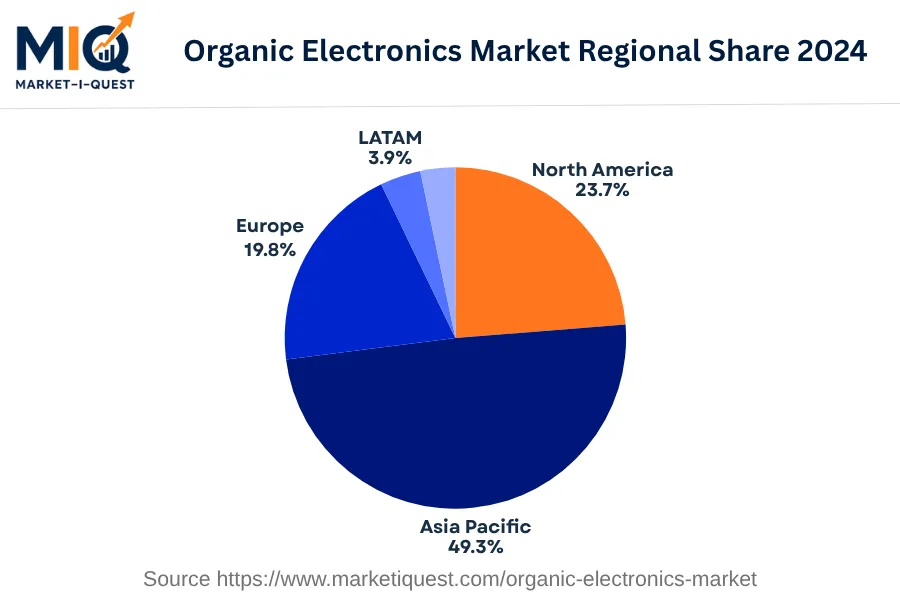
The Organic Electronics Market was worth USD 90.72 billion in 2025, and it will grow to USD 421.82 billion by 2034, with a CAGR of 18.62% over the period. This consistent upswing from the market value of USD 76.48 billion in 2024 is due to the expanding applications of organic electronics in several industries. Besides, technological advancements have facilitated market growth by improving the efficiency and performance of organic electronic products. Meanwhile, the regional market shares in 2024 were distributed as follows: Asia Pacific held the majority position at 49.3%, followed by North America and Europe with 23.7% and 19.8% respectively. Meanwhile, LATAM and MEA maintained smaller shares of the market at 3.9% and 3.3% respectively.

Key Takeaways

  • By Component - Active Components dominated accounting for a significant share in the base year.
  • By Material - Conductors took the lead holding a substantial percentage in the latest period.
  • By Application - Displays led the segment achieving a strong market hold in recent years.
organic-electronics-market market size

Key Driving Factors

Rapid Advancements in Flexible Displays

The continuous advancements in flexible displays play a crucial role in driving the organic electronics market. This technology, which is heavily dependent on organic materials, has been increasingly adopted by smartphone manufacturers for their newest models. The evolution from rigid to bendable screens demands active and passive organic elements, creating considerable market need. Additionally, flexible displays are making a significant impact on the television and digital signage industries, which highly value superior visual experiences. This thirst for better displays directly stimulates the development and growth of the organic electronics market, as these businesses constantly demand innovative, high-quality organic materials to meet their product specifications.
Stringent Environmental Regulations Implementation

The implementation of stringent environmental regulations by several governments worldwide is another key driver of the organic electronics market. Organic electronics components are biodegradable and recyclable. This significantly reduces the environmental footprint of electronic products, which is a key concern following the massive rise in e-waste. Regulations like the European Union's Restriction on Hazardous Substances (RoHS) and Waste Electrical and Electronic Equipment (WEEE) Directives are compelling electronic manufacturers to opt for eco-friendly alternatives — promoting the use of organic materials in electronic components. These legislative pressures are accelerating the shift towards organic electronics, thus enhancing the market growth.

Market Evolution by Timeline

2019-2023
During this period, the main buyers in the organic electronics market were consumer electronics manufacturers, particularly in Asia-Pacific region, fueled by increasing consumer interest in flexible and wearable devices. Organic photovoltaics were widely shipped, with slight supply constraints stemming from high manufacturing costs and integration challenges. The European Union initiated the Horizon 2020 Program, setting regulations for the adoption of organic electronics in energy sectors. Pricing usually followed a premium model, given the novelty of the technology. Major partnerships, like Samsung and Stanford University collaboration in organic LED technology were typical. Possible risks included manufacturing complexity and the availability of alternative low-cost inorganic electronics.
2024
The adoption of organic electronics reportedly spiked in 2024. This growth was driven primarily by increased demand from automotive and medical sector in North American market, especially in smart sensors and displays. Significant breakthroughs in organic semiconductor and OLED technologies improved supply; however, protection and lifetime issues remained considerable challenges. ISO developed standard ISO/TC 206 for organic electronic materials and devices. Flexible payment structures entered contracts as a new trend. Yet, potentially high price due to evolving technology and patent issues posed significant risk, but were often mitigated by long-term strategic partnerships.
2025-2029
By 2025 to 2029, organic electronics further permeated the energy sector with organic solar cells being extensively used globally, particularly in off-grid and portable applications. The technology matured, overcoming most of the early adoption issues and the supply chain network witnessed expansion. Europe introduced a REACH regulation for organic electronics, aiming at reducing the environmental impact. As technology evolved, a shift towards a cost-driven pricing model was evident. However, recycling and disposal of organic electronic products raised considerable sustainability concerns, prompting companies to adopt circular economy practices and stricter regulations.
2030-2034
In 2030 to 2034, demand for organic electronics remained strong across multiple sectors such as consumer electronics, energy, and automotive. Supply was boosted considerably with the advent of new manufacturing processes and technologies, although cost remained an issue. In terms of policy, the global community was undergoing a shift towards climate-friendly organic electronics. Fair pricing and wider distribution networks marked the commercial model whereas the implementation of stringent waste disposal regulations acted as a deterrent. Companies hence started viewing waste reduction as a primary risk mitigation strategy.

Future Market Outlook

Future Opportunities

The current landscape for organic electronics indicates a fertile ground for future growth opportunities, particularly in sustainable product development. Companies such as Tesla are actively investigating organic battery technologies, fueled by rising global concerns about the environmental impact of traditional batteries, as highlighted by international climate agreements like the Paris Accord established in 2015. Additionally, the rise in demand for Internet of Things (IoT) devices opens pathways for organic sensors due to their lightweight and flexible characteristics. For example, various startup firms focused on organic electronics, like Organic Photonic Technologies, are working on developing low-cost sensors for smart agriculture, potentially changing farming practices by 2025. Efforts toward standardization, like the IEEE 802.15.4e for low-rate wireless personal area networks announced in 2019, pave the way for greater adoption of organic devices in communication fields. Consequently, as major electronics manufacturers, including Samsung, establish partnerships with startups focused on organic electronics, they are broadening their product offerings and enhancing market penetration. Investment in research and development remains crucial, evidenced by the European Commission's Horizon Europe program announced in 2021, which provides funding for sustainable technologies. This collective momentum indicates that organic electronics will witness expansive applications across industries like healthcare, automotive, and consumer goods, fostering increased collaboration, innovation, and diversification in the years ahead.

Segmentation Analysis

By Component

The market is divided into subsegments including Active Components and Passive Components, with Active Components accounting for the largest revenue share while Passive Components are expected to grow at the fastest CAGR during the forecast period.

Largest Revenue Share

Active Components

Market Share Leader

Active Components subsegment secured the highest revenue share in the base year 2024. This leading position can be attributed to a context of technological advancements fueled by increasing demand in various applications ranging from consumer electronics to automotive and industrial sectors. This segment's constituents, such as transistors and diodes, find extensive applications due to their capability to control the electron flow and thus play a pivotal role in the functioning of most electronic devices. Geographically, this subsegment's leading status has been reinforced by demand generated chiefly from developed markets like North America and Western Europe. These regions are known for high consumption rates driven by a continuously evolving tech landscape coupled with substantial purchasing power. Regulatory influence also feeds into this leading status as active components often meet more stringent safety and performance standards. The purchasing criteria for active components, such as durability, performance, and cost, further consolidate this subsegment's superior revenue position. High switching costs related to these components, given their embeddedness in electronic appliances, makes it challenging for customers to opt for alternatives once they decide on a specific product.

Fastest CAGR

Passive Components

Forecast Period Growth Leader

Passive Components, despite having a smaller revenue share in 2024 compared to Active Components, are forecasted to grow at a higher CAGR during the projection period. Key growth drivers for this subsegment include their indispensable role in electronic circuitry and a rise in the adoption of IoT devices. Passive components like resistors, capacitors, and inductors are critical in the functioning of essentially all electronic devices. Furthermore, advances in technology and increased penetration of high-speed internet are leading to a surge in IoT devices, creating an additional demand catalyst for Passive Components. Partnerships between component manufacturers and IoT device makers, alongside high capital expenditure in the electronics manufacturing sector, are expected to further boost this growth. Potential adoption barriers might stem from the lower switching costs associated with passive components. They are less integral to the functioning of the final product, and substitutions could be made more seamlessly, causing potential volatility in demand. However, the pervasive need for Passive Components across an array of electronic devices suggests underlying market stability.

By Material

The market is divided into subsegments including conductors, dielectric materials, luminescent materials, and electrochromic materials. Conductors accounted for the largest revenue share while electrochromic materials are expected to grow at the fastest CAGR during the forecast period.

Largest Revenue Share

Conductors

Market Share Leader

Conductors form the backbone of modern electronic and power transmission systems, leading to the high revenue realization within this subsegment. This substantial revenue share can be attributed to key factors such as high demand in diverse industries ranging from electronics, power transmission, to automotive. Its robust performance in terms of high electric and thermal conductivity underpins its widespread adoption. Moreover, the high market penetration of conductive materials is supported by their versatile use in the growing renewable energy sector. Factors such as the continuous expansion of electronic systems, the growth of electric vehicles along with the need for efficient power grids have intensified the demand for conductors. The increasing digitalization, greater technological advancements, and expansion in the electrical and electronics industry have also accelarated the demand. Consumer preference for safety and efficiency and stringent regulatory norms for material standards and usage have further propelled the market dynamics in this segment's favor.

Fastest CAGR

Electrochromic Materials

Forecast Period Growth Leader

While conductors hold the largest market revenue share, electrochromic materials register the fastest CAGR growth. This rapid growth in the electrochromic materials subsegment is credited to their unique characteristics such as the ability to change color upon exposure to electric voltage, a feature that's gaining striking adoption across various industries. The most notable application and growth catalyst is the smart glass sector where such materials are extensively utilized due to their exceptional properties of solar control and privacy. Additionally, their budding use in rearview mirrors in automotive, and in displays, notably e-readers, smartwatches, and mobile screens, suggests a flourishing growth path. The potential setbacks such as high initial costs and a complex manufacturing process are being balanced out by major innovations and partnerships. Furthermore, increasing policy push towards energy efficiency along with tech advancements are expected to remove adoption barriers in the near-term thereby paving the way for significant growth opportunities.

By Application

This market is divided into subsegments including Organic Light-Emitting Diode (OLED) Lighting, Solar Batteries, Displays, Memory Devices, and Photovoltaic Cells. Among these, Displays accounted for the largest revenue share while Organic Light-Emitting Diode (OLED) Lighting is expected to grow at the fastest CAGR during the forecast period.

Largest Revenue Share

Displays

Market Share Leader

The Displays subsegment leads in revenue generation predominantly due to the wide application across various sectors like technology, entertainment, and advertising. As a central component of consumer electronics such as smartphones, tablets, TVs, and laptops, the demand for displays has been robust. The spread of internet connectivity and the advent of digital transformation across industries have further fueled the demand. Additionally, the emergence and growth of the remote working trend due to the current global conditions have added impetus to the segment growth. Displays are an integral part of these modifications, thus leading to more investments and revenue growth. With regulatory landscape supporting the technology-intensive environment, the geographic accessibility and demand across regions also contribute to the higher revenue of this subsegment.

Fastest CAGR

Organic Light-Emitting Diode (OLED) Lighting

Forecast Period Growth Leader

The Organic Light-Emitting Diode (OLED) Lighting subsegment is projected to be the fastest-growing, spurred by factors such as technological advancements, energy efficiency, and sustainability. This innovative lighting solution offers benefits over traditional lighting systems such as a thinner, lighter structure, enhanced light quality, and energy savings, which adds to its attractiveness for various applications from automotive to architectural lighting. However, challenges such as high production costs and limited lifespan as compared to LED lights may pose as adoption barriers. Partnerships and collaborations for advancement in OLED technology, coupled with supportive policies and increased capital investments, could be potential catalysts for growth. Near-term risks include the possible fluctuations in raw material prices and the speed of technology adoption across developing regions.

Competitive Analysis

Key Market Players

Manufacturers / OEMs

Sumitomo Corporation
Japan
Heraeus Holding
Germany
BASF SE
Germany

Key Suppliers & Raw Materials

Covestro AG
Germany
DuPont de Nemours, Inc.
US
Merck KGaA
Germany

Distributors, Integrators & Channel Partners

Eastman Kodak Company
US
Fujifilm Holdings Corporation
Japan
LG Display Co. Ltd
South Korea

Porter’s Five Forces Analysis

The analysis investigates key competitive factors impacting the Organic Electronics Market.

Supplier Bargaining Power

Medium

Key organic material suppliers control costs and influence product innovation, driving moderate power.

Buyer Bargaining Power

High

Due to multiple vendors and low switching cost, buyers control pricing and terms.

Threat of Substitutes

High

Standard electronics are viable substitutes, creating high threat level with lower costs.

Threat of New Entrants

Medium

Moderate due to reducing technology cost, but knowledge and expertise are entry barriers.

Competitive Rivalry

High

Numerous established players and aggressive competition result in a high rivalry level.

Regional Analysis

Geographic market dynamics and growth opportunities across key regions

Global Market Outlook

organic-electronics-market market regional share

North America

The organic electronics market in North America, in the base year of 2024, displayed significant growth, steered by several key drivers and trends. Regulatory encouragement to reduce carbon footprint drove increased adoption of these products, particularly in sectors such as utilities and manufacturing. Renewable energy commitments across the U.S, Canada, and Mexico also shaped the demand dynamics, with increased investment in organic photovoltaic technology. Furthermore, advancements in flexible electronic devices fostered widespread applications in sectors like healthcare and retail, thus boosting supply dynamics.

Moreover, consumer preferences for eco-friendly, energy-efficient products led to a more inclination towards organic electronic products. Shifts in product design, focusing on biodegradability and low-cost processing, stimulated the market. Omni-channel retailing also evolved as a significant trend, with consumers seeking an integrated shopping experience through physical stores and digital platforms. There were several key policy enforcements which backed the growth of this market, such as the Lead-Free Solder Law in electronics manufacturing. Concurrently, we observed partnerships and M&A activity centered around enhancing product capabilities and expanding market presence. For example, major tech companies collaborated with material science firms to improve organic light-emitting diode (OLED) technologies. This has set the stage for healthy competition and innovation in this space, shaping the North American organic electronics market landscape in 2024.

Asia Pacific

In the base year 2024, the Organic Electronics Market in Asia Pacific witnessed significant momentum due to substantial drivers and changing trends within the region. Increase in demand, attributed to technology adoption in sectors like healthcare, governments, retail, and manufacturing, specifically within China, Japan, and South Korea, significantly propelled the market. Moreover, favourable regulations in India and key ASEAN markets catalysed investments, further facilitating market growth. In Australia, advanced supply dynamics, driven by investment in research and technological innovation, reinforced market expansion.

Concurrently, buyer behaviour also transformed, with rising predilection towards organic, eco-friendly electronics, particularly in Japan and Australia. There was a palpable shift towards more flexible and light-weight products profiting industries like retail and manufacturing. The dynamics of channel distribution underwent significant evolution with a boost in online sales across the region, especially in China and South Korea, because of digitization. Strategic partnerships and mergers, like Samsung's agreement with Chinese OLED manufacturers, enhanced market competitiveness and product diversity. Moreover, the reinforcement of green standards and policies by governments across the region, including India's e-waste management norms, nurtured an environment conducive to the growth of the Organic Electronics Market.

Europe

In 2024, the European organic electronics market saw substantial expansion. The environmental sustainability awareness was a key driver, with initiatives like Germany's "Green Electronics 2024" mandate prompting industries to adopt eco-friendly organic products, stimulating the demand. Additionally, investors demonstrated increased interest due to soaring returns on organic electronic components, particularly in the UK and France. Integrating this technology within existing digital infrastructure became more prevalent, spurred by its performance, cost, and energy-efficiency advantages. Supply chains also improved due to robust manufacturing capabilities, like those in Italy and Spain, supporting market growth.

Customer behaviour shifted noticeably toward organic electronics due to increasing environmental consciousness, which was a major trend. Innovations such as organic LEDs, finding applications in automotive and consumer electronics sectors, were preferred over traditional products due to their superior features and less environmental impact. Digital transformation also drove greater adoption of these products, with sectors like retail, healthcare and utilities extensively digitising their operations. Strategic partnerships and M&A activities increased too, with Scandinavian technological companies collaborating with Central & Eastern European firms to develop next-gen organic electronic solutions. Furthermore, implementation of stringent environmental regulations, such as the EU's "Eco-design Directive 2009/125/EC", reinforced the organic electronics market's upward trajectory in 2024.

Latin America

In 2024, the Organic Electronics Market in Latin America (LATAM) saw significant growth. This expansion was driven largely by increased consumer demand for energy efficient and flexible electronic devices, especially in Brazil and Mexico. Growing investment in research and development, particularly in Argentina, also fueled the market's progress. Additionally, policy-level encouragement for greener technology adoption, such as Chile's National Plan for Green Growth, was a significant demand-side lever.

Several prevailing trends underscored the market dynamics in 2024. Shifts in buyer behavior were evident, with more LATAM consumers prioritizing sustainable and environmentally friendly products, evident particularly in Colombia's burgeoning retail sector. There was a marked shift towards organic Photovoltaic (OPV) technology from traditional silicon-based solutions due to its flexibility and efficiency. In the realm of channel dynamics, direct-to-consumer online sales vastly grew in popularity, notably in Peru. Partnerships and M&A activity escalated, largely seen in Argentina and Brazil's tech sectors, driving the strategic consolidation in LATAM's Organic Electronics Market.

Finally, the market also witnessed rigorous policy enforcement for standardizing and regulating organic electronic products. Primarily seen in Mexico and Chile, these policies were targeted towards distinct sectors such as utilities, manufacturing, and healthcare, shaping the overall market ecosystem.

Middle East & Africa

In 2024, the organic electronics market in the Middle East and Africa witnessed significant growth, predominantly underpinned by technological advancements and expanding application sectors. Key market drivers included burgeoning demand for cost-effective and environment-friendly organic electronics products across various industries such as healthcare, telecom and manufacturing, particularly in countries like Saudi Arabia, UAE, and South Africa. Regulations that encouraged green technology adoption also acted as a catalyst, especially in Israel and Egypt where government policies supported organic electronic product applications. Investment in organic electronics R&D in technologically advanced regions like UAE and Israel stimulated market growth.

Regarding trends, consumer preference for energy-efficient electronic devices had a noticeable effect on the market, with demand being particularly noticeable in the telecom sector in Saudi Arabia, UAE, and Qatar. Furthermore, key players were observed investing in partnerships and joint ventures to enhance their product portfolio, exemplified by ongoing collaborations in the Nigerian and Kenyan markets. Finally, there was an increasing shift towards the standardization in the manufacturing process of organic electronics in South Africa, primarily influenced by stringent policy enforcement to promote sustainable practices.

Recent Industry Developments

Latest market innovations, product launches, and strategic initiatives

June 2026

Additive electronics innovator Electroninks introduced its EI-1169 polymer-free, UV-curable silver conductive ink. Formulated as a metal-organic decomposition (MOD) liquid, the material provides low-temperature curing and stable jetting for printed flexible circuit boards, organic thin-film devices, and high-density electromagnetic interference (EMI) shielding layers.

December 2025

Electroninks launched an advanced metal-organic decomposition (MOD) spray metallization process based on its EI-1200 series ink. The technology enables direct, recon-free sidewall coating on organic substrates and molding compounds, reducing process water and power consumption by over 99% compared to conventional physical vapor deposition (PVD) methods.

Frequently Asked Questions