Flexible Electronics Market Snapshot

Key Players

  • E Ink Holdings Inc. (Taiwan)
  • Samsung Electronics Co.
  • Ltd. (South Korea)
  • LG Display Co. Ltd. (South Korea)
  • 3M (United States)
  • DuPont (United States)
  • FlexEnable Limited (United Kingdom)
  • PragmatIC Printing Ltd. (United Kingdom)
  • Kolon Industries Inc. (South Korea)
  • Cymbet Corporation (United States)
  • Novaled GmbH (Germany)

Market Size

Base Year 2024
$27.83 Bn
CAGR
10.4%
Forecast 2034
$74.85 Bn

Market Segments

By Component
  • Displays
  • Batteries
  • Sensors
  • Memory Devices
  • Others
By Application
  • Consumer Electronics
  • Automotive
  • Healthcare
  • Industrial
  • Others

Market Dynamics

Drivers
  • Increasing demand for compact electronics
  • Advent of wearable technology
Restraints
  • High production costs
  • Technological complexities
Opportunities
  • Evolving wearable technology demand
  • Increasing IoT applications

Market Size

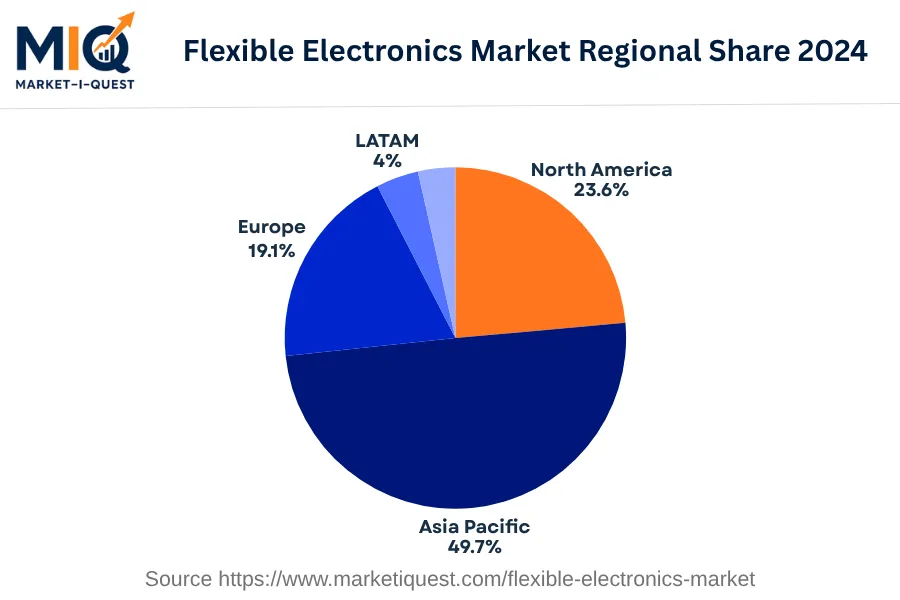
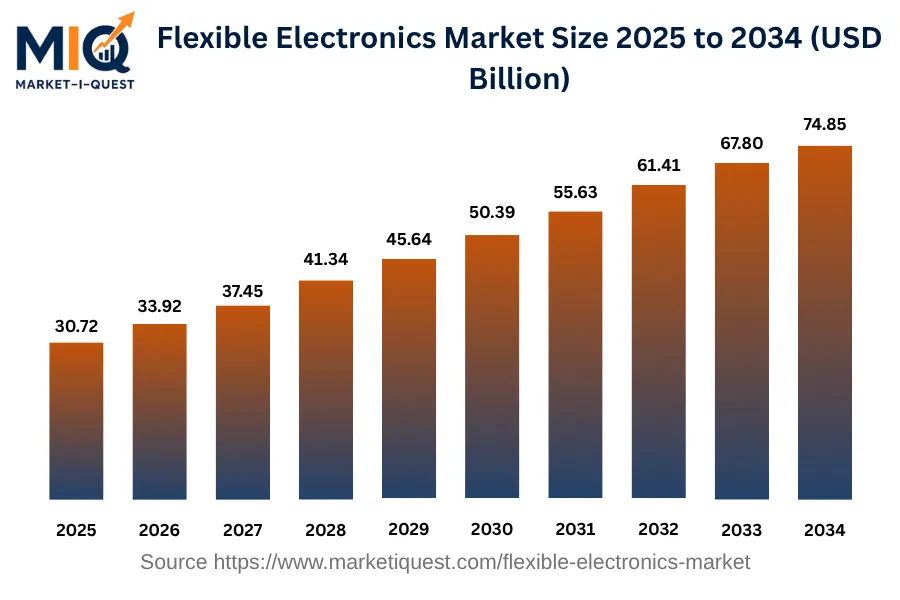
The Flexible Electronics market is slated to grow in size from USD 30.72 billion in 2025 to USD 74.85 billion in 2034, equating to CAGR of 10.4% across the given period. From an approximate value of USD 27.83 billion in 2024, the market is expected to see an immediate growth of roughly USD 2.89 billion within the following year, demonstrating the initial upward trajectory. Over the subsequent nine years, the market will then expand further by approximately USD 44.13 billion, following the established growth rate. The distribution of this market across various regions in 2024 offers an insight into the geographical market landscape: Asia Pacific dominates with 49.7% of the shares, followed by North America and Europe with 23.6% and 19.1% of the shares, respectively. Completing the global picture, LATAM and MEA maintain comparatively minor shares with 4.0% and 3.5%, respectively.

Key Takeaways

  • By Component - Memory Devices held the dominant position accounting for a significant market share in 2024.
  • By Application - Consumer Electronics led the market with a hefty stake in 2024.
flexible-electronics-market market size

Key Driving Factors

Adoption of Wearable Technology

One of the major driving forces in the flexible electronics market is the adoption of wearable technology by consumers. Flexible electronics facilitate the design and implementation of lightweight, compact, and rollable electronic devices that can be easily integrated into wearable items. Wearables such as smartwatches, fitness bands, and health monitoring devices rely heavily on flexible electronics for their core functionality. As consumers increasingly demand personal health and wellness tracking capabilities, manufacturers of these devices are compelled to invest in flexible electronic components. This demand has created a thriving flexible electronics market.

Evolution Toward Thinner Display Screens

The trend towards thinner and lightweight display screens in the consumer electronics industry is another significant driver of the flexible electronics market. Consumers progressively prefer televisions, computers, and mobile devices with thin, light, and high-definition display screens, and these design requirements demand flexible electronic solutions. Manufacturers in the television and smartphone industries are aggressively investing in technologies that reduce the form factor without compromising on screen size or image quality. Subsequently, this has fostered innovation and growth in the flexible electronics market, creating a landscape where flexible display components are essential.

Market Evolution by Timeline

2019-2023
During 2019-2023, flexible electronics saw increased adoption by telecom, consumer electronics, and automotive industries. The demand was driven by flexible screens technology on smartphones, TV and wearable devices. In North America, increased interest in flexible solar panels significantly drove market growth. Suppliers, majorly from Asia-Pacific region, witnessed integration of nanotechnology in production processes. However, complexity in manufacturing flexible electronics remained a constraint. No rigid regulations concerning flexible electronics publication were in place, enabling competitive pricing strategies. The risks during this period mostly revolved around production challenges, and suppliers responded by investing in research and development.
2024
In 2024, the healthcare industry emerged as a key buyer, utilizing flexible electronics in medical and healthcare devices. Moreover, the military also explored flexible electronics for wearable gadgets with environment sensing abilities. The supply side saw improvements with printing technology making manufacturing simpler. The EU's Horizon 2020 R&D program initiated in 2014 continued to boost the market. The commercial model tilted towards long-term partnerships with significant focus on intellectual property rights. The major risk in 2024 revolved around privacy and data security concerns, with companies investing heavily in data protection.
2025-2029
During 2025-2029, demand segmented into industries like automotive, aerospace, and retail, all interested in flexible electronic sensors and touchscreens. Asian countries notably China, India, and Japan drove the supply with large-scale production. Challenges posed by miniaturization of flexible circuits became prominent in this period, but research developments in nanotechnology provided some resolution. The commercial contracts primarily revolved around technology transfers and joint ventures. The primary risks revolved around maintaining product quality and ensuring durability - addressed by setting high manufacturing standards and quality checks.
2030-2034
In 2030-2034, the demand for flexible electronics showed expansion into various wearable technology applications. Energy storage and climate control electronics became prominent use-cases. The United States and Europe also became significant suppliers during this period. The period marked the development of reliable automated production processes that boosted supply. Supranational frameworks emerged under the UN's sustainability program, emphasizing green production methods for flexible electronics. The risk of e-waste generated by flexible electronics was mitigated by integrating recycling measures in production plans and responsible e-waste management and disposal regulations.

Future Market Outlook

Future Opportunities

The opportunities within the flexible electronics market are being shaped by current technological and societal trends. In 2023, the Wearable Technology Association launched a campaign to advance the adoption of flexible sensors in health monitoring devices, reflecting the growing consumer focus on health and fitness. Concurrently, Apple has been investing in flexible semiconductor technology, hinting at future integration of flexible circuits in devices like the iPhone and Apple Watch. The demand for flexible displays is expected to increase, as the global shift towards remote work amplifies the need for portable devices. Proposals for building smart city infrastructure in Singapore include integrating flexible electronics for enhanced interconnectivity and smart transportation solutions, indicating potential for scaling these technologies. Furthermore, the recent introduction of regulations such as the EU’s Restriction of Hazardous Substances directive highlights a commitment to sustainability, which may propel manufacturers to innovate in eco-friendly materials and production processes. Partnerships between companies like Samsung and various universities are facilitating research into novel flexible electronic applications, especially in the automotive sector, which is increasingly adopting various driver assistance systems. The convergence of flexible electronics with emerging technologies such as the Internet of Things offers extensive possibilities for personal and industrial applications, setting the stage for future developments that align with market needs and regulatory requirements.

Segmentation Analysis

By Component

The market is divided into subsegments including Displays, Batteries, Sensors, Memory Devices and Others. Memory Devices accounted for the largest revenue share while Sensors is expected to grow at the fastest CAGR during the forecast period.

Largest Revenue Share

Memory Devices

Market Share Leader

Memory Devices come out as a leading subsegment in terms of revenue, primarily due to the increasing dependence on tech products in various industries. From computing systems to portable electronics and complex machinery, the use of memory devices has been expanding considerably. The need for efficient, high-capacity storage solutions is paramount in several sectors including IT, telecommunication, and consumer electronics, driving the growth of this subsegment. Multiple geographies also play a significant role in strengthening the revenue pool for memory devices. Asian markets, for instance, exhibit a strong demand owing to the presence of numerous manufacturing and IT majors. The stringent regulations and the need for data security further impel the adoption of these components, reinforcing their revenue influx. The purchasing decision is often governed by the durability, capacity, and speed of these devices. Existing contracts and the high switching costs spurn additional demand, benefiting the memory devices subsegment.

Fastest CAGR

Sensors

Forecast Period Growth Leader

Despite not leading in total revenue, Sensors presents a promising future by demonstrating the fastest growth rate. This rapid growth is attributed to technological advancements and the accompanying rise of the Internet of Things (IoT). As industries like healthcare, automotive, and consumer electronics increasingly adopt smart and connected technologies, sensors are becoming a key component for these applications. Their capability to convert physical parameters into signals propels their integration into various devices. The concentration of key sensor manufacturers and favourable government policies concerning IoT implementation in many developed economies provide a significant boost to this subsegment. However, they still face challenges pertaining to accuracy, calibration and power consumption that might hinder their growth. Investment in R&D and forming strategic partnerships with tech companies could be potential catalysts for overcoming these barriers and sustaining the high growth rate.

By Application

The market is divided into subsegments including Consumer Electronics, Automotive, Healthcare, Industrial, and Others, with Consumer Electronics accounting for the largest revenue share, while Healthcare is expected to grow at the fastest CAGR during the forecast period.

Largest Revenue Share

Consumer Electronics

Market Share Leader

The Consumer Electronics segment emerged as the major revenue contributor in 2024 due to increasing consumer spending on electronics. As consumers have become more tech-savvy, the demand for advanced and innovative electronic products has driven significant market growth. Coupled with the proliferation of smartphones and the increasing use of high-end technology in various consumer electronics, like AI and IoT, the market has seen substantial revenue generation from this segment. Region-wise, Asia-Pacific, led by the robust electronics industry in countries such as China and India, forms a key driving force due to rising disposable incomes and the boom in the middle-class population. Additionally, the increase in R&D investments by major players in the market to improve product quality and innovation complements market growth in this segment. Invariably, the emergence of online retail channels has further stimulated revenue growth by broadening the customer base and making products readily accessible.

Fastest CAGR

Healthcare

Forecast Period Growth Leader

Projected to be the fastest-growing segment, Healthcare is likely to witness significant CAGR in the forecast period. Increasing usage of technology in critical care, coupled with the growing trend of telehealth and remote patient monitoring systems due to the pandemic, has accelerated market growth in this segment. Moreover, advanced technologies like AI are being adopted more widely in healthcare operations, thus pushing the overall market growth. On the policy front, government initiatives promoting digital health solutions, including electronic health records and e-prescriptions, have acted as catalysts. Challenges pertaining to stringent regulations and the nascence of this technology in emerging economies pose potential restraints to growth. However, potential collaborations between healthcare providers and tech companies would potentially bridge these gaps and facilitate growth. The North American region, with its well-established healthcare infrastructure and tech adoption, is anticipated to be a key contributor to this accelerated growth.

Competitive Analysis

Key Market Players

Manufacturers / OEMs

Samsung Electronics
South Korea
LG Display Co. Ltd.
South Korea
FlexEnable Ltd.
UK

Key Suppliers & Raw Materials

Dupont
US
BASF SE
Germany
Heraeus Holding GmbH
Germany

Distributors, Integrators & Channel Partners

Arrow Electronics, Inc.
US
Avnet, Inc.
US
Future Electronics
Canada

Porter’s Five Forces Analysis

An analysis of the competitive forces in the Flexible Electronics Market.

Supplier Bargaining Power

Medium

Limited number of suppliers and complex manufacturing process give some power to suppliers.

Buyer Bargaining Power

High

High competition and availability of alternatives give bargaining power to buyers.

Threat of Substitutes

Medium

Ongoing technological advancements might introduce potential substitutes in the future.

Threat of New Entrants

Low

High investment in R&D and manufacturing infrastructure deter new entrants.

Competitive Rivalry

High

Market is highly competitive with numerous key players and rapid innovation.

Regional Analysis

Geographic market dynamics and growth opportunities across key regions

Global Market Outlook

flexible-electronics-market market regional share

North America

In 2024, North America’s flexible electronics market noted significant growth, driven by various factors and characterized by particular trends. Advances in materials science paved the way for increased robustness and longevity, fostering broad adoption across numerous industries. Tech behemoths like Apple and Google further drove demand by integrating flexible electronics into products, attracting significant investments. Additionally, regulatory support, especially in the U.S., for replacing traditional electronics with green alternatives propelled the market.

Consumer preference for compact, lightweight devices accelerated the shift towards flexible electronics, influencing buyer behavior. Continuous innovation, particularly in wearable tech and IoT devices, was a crucial market trend, with widespread applications in sectors like healthcare, manufacturing, and retail. Moreover, an uptick in partnerships and mergers, such as Apple’s agreement with LG for OLED panels, underscored industry dynamics and tech shifts. Stricter enforcement of e-waste management policies also steered enterprises towards sustainable options, affirming flexible electronics as an environmentally-friendly choice. Different sectors showed varying levels of engagement. The healthcare industry utilized flexible electronics for monitoring devices and wearable tech for patient care and telehealth services. In contrast, retail focused on integrating this technology into smart labels and inventory tracking systems. Governments leveraged flexible electronics in infrastructure, particularly smart grids, while manufacturers incorporated them into versatile and efficient production lines.

Asia Pacific

In 2024, the Flexible Electronics Market in Asia Pacific experienced significant growth due to various demand factors and technology adoption. Drivers included rising consumer demand for wearable and portable devices in markets such as China and India, with consumers prioritizing flexibility and durability. Governments across Japan, South Korea, and key ASEAN markets implemented favorable policies, accelerating the development and adoption of flexible electronics in sectors such as healthcare and utilities. Massive investments were directed towards R&D and capacity enhancement, especially in Australia, easing supply woes and reducing production costs.

Trends influencing the market comprised evolving buyer behavior towards sustainable and energy-efficient electronics, particularly among enterprise customers. Shifts were observed in technology, with a notable pivot towards Organic Light Emitting Diodes (OLEDs) over traditional LED for display applications, owing largely to the former's design flexibility. Channel dynamics also changed with e-commerce becoming a preferred mode of purchase thanks to its convenience and extensive options. Strong collaborative moves in the form of partnerships and mergers were seen within manufacturers to leverage shared technology and resources. Regulations such as Japan's Act on Promotion of Green Purchasing played a vital role in ensuring these electronics met sustainable standards. Such government policies are increasingly stringent, propelling manufacturers to continuously innovate and adhere to energy-efficiency standards.

Europe

In 2024, Europe's Flexible Electronics Market witnessed significant growth powered by advanced technological adoption and favorable regulatory landscape. The increased demand for wearable devices, flexible displays, and thin film solar cells in key domains including healthcare, automotive, and retail propagated the market expansion. Regulations promoting sustainability and energy efficiency, such as EU's Ecodesign Directive, further stimulated investment in flexible photovoltaic panels. Technological advancements broadening the horizons of printable electronics sparked noteworthy development and adoption rates in Central and Eastern Europe.

Concurrently, specific trends were observed in buyer behavior and product shifts. Consumers showed heightened preference for lightweight, energy-efficient electronics across UK, Germany and France, transforming the manufacturing and design dynamics. The idea of integrating electronics with textiles caught momentum, paving path for next-gen device development in Italy and Spain, particularly in the fashion industry. Partnerships and mergers were observed in the Nordics, accelerating R&D progress in organic light-emitting diode (OLED) technology. Lastly, Benelux saw an enforcement of stricter standards for material safety and device flexibility, establishing a benchmark for future electronic product developments. As the flexible electronics domain matures, 2024 stood out as a year of remarkable industry progress across the European market.

Latin America

In the base year of 2024, the flexible electronics market in Latin America displayed firm growth, buoyed by increasing demand and beneficial regional trends. Drivers include surging interest from major sectors like healthcare, retail, and manufacturing, particularly in countries such as Brazil, Mexico, and Argentina, where the adoption of cutting-edge technology is progressive. Government regulations that promote sustainable electronics manufacturing have further provided impetus to this burgeoning market. Investments into the development of more durable, resilient, and efficient flexible electronics have considerably augmented supply dynamics.

On the trend front, customer preferences began to incline towards more compact and energy-efficient devices, boosting the market for flexible electronics. Technology shifts such as the proliferation of Internet of Things (IoT) devices and wearable technology significantly impacted product design and functionality. Increased partnerships and M&As became noticeable, particularly in Colombia, Chile, and Peru, as organizations aimed to leverage shared resources advancing in the niche sector. A notable increase in policy enforcement related to electronic waste disposal standards impacted the market dynamics, pushing manufacturers towards producing more environment-friendly flexible electronics. Overall, the LATAM flexible electronics market's robust growth in 2024 was steered by a combination of demand fluctuations, regulatory controls, and evolving technological trends.

Middle East & Africa

In 2024, the Flexible Electronics Market experienced tangible growth in the Middle East and Africa region driven by keen interest from Saudi Arabia, South Africa, and Israel. Investment in new technology adaptation, a relaxed regulatory environment and the ongoing digital transformation trend across major industries were key drivers of this expansion. High-tech adoption by government sectors for infrastructure modernization in Saudi Arabia and South Africa resulted in increased demand for flexible electronics. Further, Israel's progressive technology environment fostered product innovation and uptake, contributing to market growth.

Several trends characterizing this market in 2024 included discernable shifts in buyer behavior towards customized technology solutions, an increased emphasis on research partnerships and mergers among regional tech firms, and a rise in regulatory oversight for technology imports particularly in the United Arab Emirates and Egypt. These trends reflected in industries such as telecom, manufacturing and financial services, with emerging demand also signaled from healthcare and retail sectors in Nigeria, Kenya, and Qatar. The popularity of flexible electronics in these sectors was largely attributed to their adaptable characteristics and potential for facilitating streamlined operations. Overall, the implementation of flexible electronics improved efficiency in numerous sectors within the Middle East and Africa, marking the region as a promising player in the global market. This was brought to light more intensely in the aforementioned nations in the base year 2024.

Recent Industry Developments

Latest market innovations, product launches, and strategic initiatives

December 2025

Fulanke invested RMB 25 million in TacSense (October 2025), followed by the joint establishment of Hyperbola Intelligent Robotics in December 2025, with Fulanke holding 60% controlling stake. The company announced plans to invest up to RMB 850 million in IT equipment including servers to build computing infrastructure supporting tactile AI algorithm training.

March 2026

Ningbo City published its "2026 Emerging Future Industries Industrialization Project Key Segments and Key Products Catalogue," listing flexible electronics as a priority segment including flexible substrate materials, flexible circuit boards, flexible luminescent materials, flexible display modules, flexible display substrates/covers, and flexible sensors (electronic skin).

June 2026

Fulanke (605566) subsidiary Hyperbola Intelligent Robotics held a new product launch in Hangzhou on June 5, debuting novel flexible sensing products featuring 4th-generation ionic tactile sensing technology, targeting robotics, health monitoring, consumer electronics, and automotive smart cockpit applications.

Frequently Asked Questions