Flexible Substrate Market Snapshot

Key Players

  • DuPont (United States)
  • 3M (United States)
  • Schott AG (Germany)
  • Indium Corporation (United States)
  • Corning (United States)
  • Nippon Electric Glass (Japan)
  • Nitto Denko (Japan)
  • Kolon Industries (South Korea)
  • Beneq OY (Finland)
  • FlexEnable (United Kingdom)

Market Size

Base Year 2024
$23.8 Bn
CAGR
8.7%
Forecast 2034
$54.81 Bn

Market Segments

By Substrate Type
Plastic Films, Metal Foils, Paper, Textiles, Glass
By Form Factor
Roll-to-Roll, Sheet-to-Sheet, Stackable
By Manufacturing Process
Coating, Printing, Laminating, Etching
By Application
Displays, Sensors, Solar Cells, Packaging, Medical Devices, Others

Market Dynamics

Drivers
  • Rising demand for compact electronic devices
  • Growing use in solar energy systems
Restraints
  • High production costs
  • Limited technological advancements
Opportunities
  • Emerging wearable technology demand
  • Rising IoT applications

Market Size

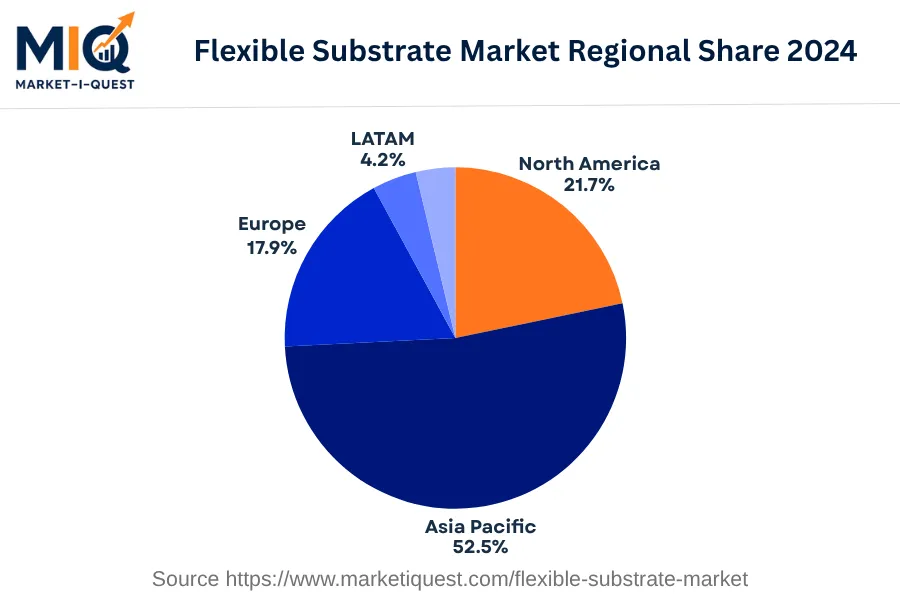
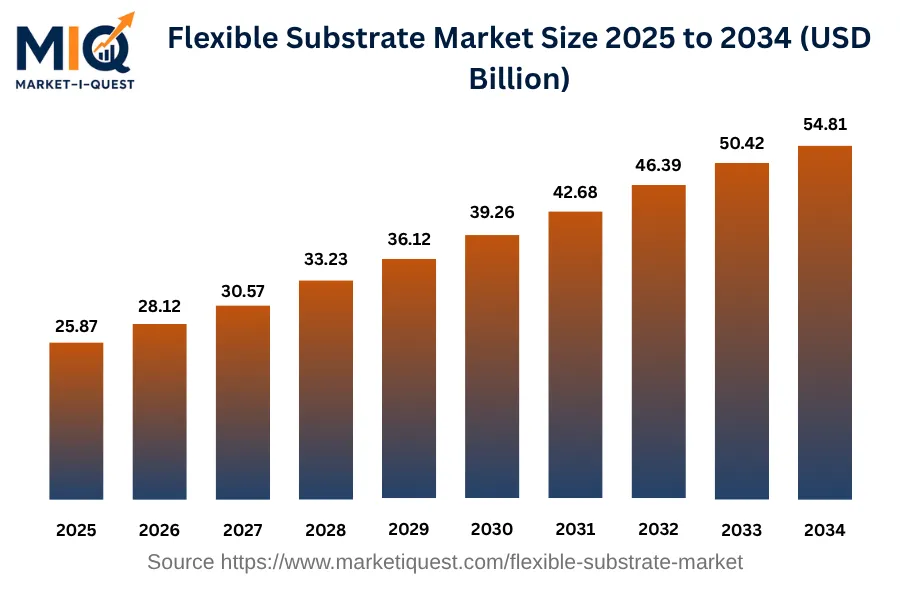
The Flexible Substrate Market size was valued at $25.87 billion in 2025 and is projected to expand to $54.81 billion by 2034, growing at a CAGR of 8.7%. This strong growth pattern was initiated from a market size of $23.8 billion in 2024, reflecting a significant expansion in just one year, and it is consistently increasing over a 10-year period till 2034, with a stable annual growth rate of 8.7%. The adoption of flexible substrates in numerous industries due to its benefits such as lightweight, bendability, and ruggedness has been key to this growth in market value, coupled with advancements in technology aiding in the improvement of flexible substrate materials. Furthermore, in 2024, the regional market shares for the Flexible Substrate Market were distributed as follows: North America held 21.7%, Asia Pacific dominated with 52.5%, Europe contributed 17.9%, LATAM accounted for 4.2% and MEA comprised 3.7% of the global market.

Key Takeaways

  • By Substrate Type - Plastic Films held the leading position accounting for a substantial market share in 2024.
  • By Form Factor - the Roll-to-Roll segment led representing a notable portion of the market in 2024.
  • By Manufacturing Process - Coating was the most dominant accounting for a significant percentage in 2024.
  • By Application - Displays held the largest market share in 2024.
flexible-substrate-market market size

Key Driving Factors

Rapid Adoption of Wearable Technology

An increasing focus on health and fitness among consumers worldwide is triggering a boom in the wearable technology market, directly driving the flexible substrate market. Wearable devices like smartwatches, fitness bands, and medical monitors require flexible circuits and substrates for their operation. These wearable devices need to be lightweight, bendable, and body-conforming. Flexible substrates, providing these properties, are hence becoming the material of choice for these devices. The increasing adoption of, and innovation in, wearable technology is thus giving a substantial push to the flexible substrate market.

Evolution in Display Technology

The transition from hard, flat screens to flexible, foldable displays in smartphones, tablets, and televisions is another influential factor driving the flexible substrate market. Leading consumer electronics manufacturers are focusing on offering products with a flexible, immersive user interface. Thus, they are turning to flexible substrate materials to preserve the integrity of their products while incorporating flexible display technology. By contributing to improved aesthetics, durability, and user experience, flexible substrates are gaining considerable traction in the display technology market. The increasing use of, and developments in, flexible displays is consequently triggering a surge in the flexible substrate market.

Market Evolution by Timeline

2019-2023
During this period, electronics and medical industries were the primary buyers of flexible substrates for use cases like wearable devices and medical sensors. Particularly in Asian countries like China and Japan, the adoption of these materials was notable. Significant technological improvements allowed for better compatibility with various devices and the production scale was steadily gaining. Still, some constraints emerged due to issues with durability under harsh conditions. As for policies, the EU's RoHS set rules for reducing hazardous materials, which indirectly promoted flexible substrates due to their typically benign material composition. Commercially, most transactions were carried out via direct sales, with few notable long-term partnerships. Risks included uncertainties in material consistency as well as potential regulatory changes influencing manufacturing standards.
2024
In 2024, the automobile sector started using flexible substrates for instrument panel applications. Solar cell manufacturers also began adopting flexible substrates, chiefly in Europe and North America. OLED panels reached commercialization stage, expanding the scope of flexible substrates significantly. Production met demand comfortably due to improved manufacturing processes, but cost issues remained a major challenge. The EU and the United States introduced recycling rules affecting disposal and usage of flexible substrates. Commercial models saw a rise in supplier-buyer partnerships, especially for tailored solutions. The year was marked by the need for improved cost-efficiency to meet price-sensitive demands from new buyer segments.
2025-2029
The demand for flexible substrates skyrocketed with the growth in global wearable and IoT market. Consumer electronics companies, particularly those based in South Korea and the United States, became key buyers. Technological norms gravitated towards more durable substrates with the introduction of new material variations. Yet, production costs were still a bottleneck for mass adoption. Regulatory focus expanded into safety standards requiring better fire resistance. Commercial models evolved to include collective procurement and shared supply agreements. The critical risks during the period revolved around procurement complexities and the rapidly changing demand profile.
2030-2034
Buyers now encompass diverse sectors from fashion to aerospace. The role of flexible substrates in smart textiles emerges as a major trend, especially in high-fashion markets in Milan and Paris. Technological progress aims at improving environmental tolerance, thereby widening the application scope. Production costs seem to remain a key concern, straining relationships between suppliers and end-user industries. No major regulatory changes, but tighter enforcement of existing laws expected, especially in Europe. Commercial landscape altered by growing preference for performance-based contracts, while the risk horizon is primarily dominated by potential supply chain disruptions.

Future Market Outlook

Future Opportunities

As the global demand for lightweight and portable devices increases, opportunities in the flexible substrate market are also evolving. The ongoing trend toward sustainability drives significant interest in transparent conductive materials, like graphene, which are gaining traction in solar panel applications. As of 2023, major automotive manufacturers such as Tesla are experimenting with flexible electronics for in-vehicle displays and controls, signaling potential growth avenues in the automotive sector. In Europe, the European Commission has announced initiatives to promote flexible electronics in smart packaging, set to be implemented by 2025, providing avenues for growth in the food and beverage industries. Furthermore, regulatory bodies such as the U.S. Environmental Protection Agency are focusing on electronic waste management, prompting manufacturers to seek out biodegradable flexible substrates for eco-friendly products. Collaborations are emerging between technology firms and healthcare organizations, particularly in North America, to integrate flexible sensors into wearable health-monitoring devices. These partnerships are expected to expand into telehealth applications, enhancing remote patient monitoring capabilities. As industries shift toward more adaptable electronic solutions, the potential for integrated smart fabrics in clothing is gaining momentum, suggesting that the flexible substrate market is likely to see diversified applications across various sectors, underscoring its relevance in the evolving technological landscape.

Segmentation Analysis

By Substrate Type

The market is divided into subsegments including Plastic Films, Metal Foils, Paper, Textiles, and Glass. Plastic Films accounted for the largest revenue share while Textiles is expected to grow at the fastest CAGR during the forecast period.

Largest Revenue Share

Plastic Films

Market Share Leader

The Plastic Films subsegment leads the market primarily due to its extensive use in various industries such as packaging, agriculture, medical, and consumer goods owing to its cost-effective nature, versatility, and lightweight properties. Additionally, rising environmental concerns have led to the development of bio-based plastic films, which are expected to act as a growth driver. Also, the increase in demand for convenience food, medical products, and consumer durables have accelerated the need for sophisticated packaging solutions, thereby propelling the market for plastic films. However, the stringent regulation for plastic use in several countries could affect the demand pattern to some extent but innovation is likely to mitigate these restrictions.

Fastest CAGR

Textiles

Forecast Period Growth Leader

The Textiles subsegment is anticipated to witness the fastest growth due to the increasing demand in the clothing industry. The evolving fashion trends, advent of e-commerce platforms, and growing middle-class population across the globe are major factors fueling this expansion. Allied with technology advancements such as smart textiles and wearable tech, textiles are finding new application areas. However, key constraints could be the environmental concerns regarding the high water consumption and chemical use within the textile manufacturing process. Stakeholders would need to negotiate these challenges while advancing towards the potential opportunities in the category. Finally, collaborations and partnerships across the value chain could act as key catalyst for this growth.

By Form Factor

The market is divided into subsegments including Roll-to-Roll, Sheet-to-Sheet, and Stackable. Roll-to-Roll accounted for the largest revenue share while Sheet-to-Sheet is anticipated to grow at the fastest CAGR during the forecast period.

Largest Revenue Share

Roll-to-Roll

Market Share Leader

In the base year of 2024, the Roll-to-Roll subsegment commanded the most substantial revenue portion. This is attributable to its inherent benefits such as high production speed, cost-effectiveness, and compatibility with flexible substrates which are pivotal for a plethora of industries including electronics, printing, and photovoltaics. High-volume manufacturers prefer Roll-to-Roll processes due to their capability of producing large quantities of material in a single batch, thereby driving down unit costs and driving revenues. Different geographical regions have also contributed to its growth, with Asia-Pacific leading the charge owing to its expansive electronics manufacturing sector. Furthermore, industry-specific regulations encouraging the use of efficient manufacturing processes have also been a driver for its dominance in revenue share. Another significant factor has been the reliability and high demand of this form factor from major customers, which provides a consistent and dependable revenue source for companies in this market sector.

Fastest CAGR

Sheet-to-Sheet

Forecast Period Growth Leader

The Sheet-to-Sheet subsegment is projected to register the fastest growth during the forecast period. This can be attributed to the increasing demand for precision and superior control in manufacturing processes across various applications including semiconductors, photovoltaics, and biomedical devices. Although the initial capex for Sheet-to-Sheet machinery tends to be higher compared to Roll-to-Roll, the superior substrate handling, processing control, and product quality justify the investment, especially in sectors where defect rates have to be kept at a minimum. These benefits are catalysing R&D investments and partnerships among major companies to leverage this technology further. However, the higher switching costs and the requirement for skilled labor pose near-term adoption barriers. In the longer term though, the industry's continual progress towards high-precision manufacturing is expected to alleviate these hurdles and galvanize the uptake of the Sheet-to-Sheet form factor.

By Manufacturing Process

The Manufacturing Process market is divided into subsegments which include Coating, Printing, Laminating and Etching. While the Coating subsegment accounted for the largest revenue share in 2024, the Printing subsegment is expected to grow at the fastest CAGR during the forecast period.

Largest Revenue Share

Coating

Market Share Leader

The Coating subsegment leads the market due to a combination of factors both on supply and demand sides. Among such factors are the steady demand from multiple industries and the evolution of coating technologies, resulting in better product performance and greater efficiencies in the manufacturing process. On the customer front, a wide range of industries such as automotive, construction, electronics, and aerospace, has boosted their demand for the Coating process due to its excellent ability to prevent corrosion, reduce friction and enhance product appearance. In terms of geography, the Asia-Pacific region, with its robust manufacturing sector, contributes significantly to this subsegment. On another hand, regulatory norms promoting the use of eco-friendly coatings have steered the market towards more environmentally sustainable solutions, bolstering the market for the Coating process.

Fastest CAGR

Printing

Forecast Period Growth Leader

The Printing subsegment is projected to witness the fastest CAGR growth. A key growth driver is the rapid adoption of advanced printing technologies such as 3D printing, especially in the healthcare, automotive, and aerospace industries. Also, significant technological innovations coupled with decreased operational costs have led to an increased rate of adoption among SMEs. However, initial setup costs and lack of skilled labor could pose as barriers to growth. In terms of risks, intellectual property rights in areas like 3D printing remain a significant concern, possibly slowing down the adoption rate among potential users. Partnerships between manufacturing firms and tech companies are likely to act as a catalyst, providing momentum for the subsegment's growth. Finally, capital expenditures in research and development are crucial in fostering innovation and ensuring continuous growth for this subsegment.

By Application

The market is divided into subsegments including Displays, Sensors, Solar Cells, Packaging, Medical Devices, and Others. Of these, Displays accounted for the largest revenue share while Medical Devices are expected to grow at the fastest CAGR during the forecast period.

Largest Revenue Share

Displays

Market Share Leader

Display technology dominates the application market in terms of revenue in the base year 2024. This is primarily driven by the high consumption in the electronics industry where displays are an indispensable component for a myriad of electronic devices like smartphones, tablets, laptops, and televisions. Technology progression in the electronics sector is rapidly increasing, with a shift towards energy-efficient and high-definition displays, further fueling the demand. The growth in the automotive sector is another contributing factor. A modern car's infotainment system, navigation, and advanced driver assistance system (ADAS) are reliant on high-quality displays. Global digitization trends are also accelerating the growth of this segment as more and more sectors incorporate digital displays in their services. This, combined with the wide geographic presence and market acceptance, makes the display subsegment a leader in revenue generation.

Fastest CAGR

Medical Devices

Forecast Period Growth Leader

Medical devices are expected to grow at the fastest CAGR during the forecast period. The healthcare industry is undergoing a digital transformation, and with the outbreak of the COVID-19 pandemic, this transformation has been expedited. Increased healthcare expenditure and the shift towards more personalized and efficient healthcare solutions fuel this growth. Medical devices segment has seen the adoption of advanced technologies such as AI, IoT, and wearables, which has led to the emergence of more effective diagnostic and therapeutic devices. Simultaneously, policy initiatives to encourage the adoption of remote monitoring devices and the rise of telehealth services are potential catalysts for this segment's growth. However, concerns related to data privacy and stringent regulatory frameworks could be potential barriers to adoption. Yet with the right partnerships and strategies, these barriers can be overcome, making this an attractive segment for future growth.

Competitive Analysis

Key Market Players

Manufacturers / OEMs

3M Company
US
Dupont
US
LG Display
South Korea

Key Suppliers & Raw Materials

Schweitzer-Mauduit International
US
Kuraray Co. Ltd.
Japan
Kolon Industries Inc.
South Korea

Distributors, Integrators & Channel Partners

BenQ Materials Corp.
Taiwan
Toray Industries Inc.
Japan
Nissha Co., Ltd.
Japan

Porter’s Five Forces Analysis

This analysis evaluates the competitive forces in the Flexible Substrate Market.

Supplier Bargaining Power

Medium

Suppliers gain power due to specialized knowledge and the high cost of switching technologies.

Buyer Bargaining Power

High

Customers have high bargaining power due to the wide range of providers and the absence of substantial switching costs.

Threat of Substitutes

Medium

Threat from substitutes exists, although specialized applications of these products limit its impact.

Threat of New Entrants

Low

High capital expenditure, technological expertise, and patents create barriers for new entrants.

Competitive Rivalry

High

Intense competition exists due to numerous manufacturers and low product differentiation.

Regional Analysis

Geographic market dynamics and growth opportunities across key regions

Global Market Outlook

flexible-substrate-market market regional share

North America

In 2024, the Flexible Substrate Market in North America was driven by advancements in electronics and rapid demand for lightweight and flexible devices in industries such as healthcare, retail, and manufacturing. Higher investments in research and development by significant electronics manufacturers and stricter regulations implemented by the U.S. government emphasizing industry standards played a significant role in shaping Market Dynamics. The market drivers included increasing consumer preference for lightweight and flexible electronics in the U.S. and Canada, fueling demand for flexible substrate in the production of these devices. Furthermore, stricter industry standards in the U.S., enforced stronger compliance with device durability and flexibility, intensifying market demand. In Mexico, government investments in the electronic industry and focus on technological advancement were supporting market growth.

The key trends shaping the market included shifts in buyer behavior, with an increased interest in durable electronics; partnerships and mergers between electronic manufacturers, and adherence to strict production standards enforced in the U.S. and Canada. The U.S. military, seeking durable and lightweight devices, contributed to increased purchases of such products. Meanwhile, in the retail sector, the rising popularity of smart packaging applications reinforced demand. Lastly, the shift towards environmentally-friendly solutions within the manufacturing sector drove demand for biodegradable flexible substrates.

Asia Pacific

In 2024, the Flexible Substrate Market in the Asia Pacific witnessed significant traction, spearheaded by China, India, and Japan. On the drivers front, demand was primarily fueled by the escalating requirement for lightweight, flexible electronic devices, particularly in China and India's burgeoning consumer electronics sectors. Regulatory support, especially Japan's measures promoting miniaturized electronics, further stimulated the market. Investments in advanced technology, such as South Korea's spending on organic light-emitting diode (OLED) production technology, also played a crucial role. Simultaneously, competitive pricing strategies, most notable in key ASEAN markets, underscored the supply dynamics.

Turning to trends, changes in buyer behavior revealed a strong preference for compact, high-performance electronics, especially within Australia's enterprise sector, propelling flexible substrate innovation. There was a noticeable shift towards using eco-friendly materials in substrate production, following tighter environmental regulations in several markets. Additionally, partnerships, specifically between manufacturing and retail sectors within China and India, were observed to enhance product availability and reach. Enforcement of standardized manufacturing in Japan further molded the market structure. The Flexible Substrate Market was thus invigorated by a constellation of drivers and trends in 2024 within the Asia Pacific region, shaped primarily by the burgeoning needs of the consumer electronics sector and propelled by regulatory support and innovative technology adoption.

Europe

In 2024, the Flexible Substrate Market in Europe experienced significant dynamics driven by various factors and industry trends. High demand for flexible and lightweight materials in electronics, automotive, and healthcare sectors, predominantly prompted technology adoption. Regulatory initiatives aimed at environmental sustainability further spurred the material shift towards flexible substrates in manufacturing industries, particularly Germany and Benelux's advanced manufacturing sectors. Lastly, investment directed at enhancing flexible substrate supply chains improved market accessibility, especially in Central & Eastern Europe.

Trends that marked this market pivoted on evolving buyer behavior and shifts in product technology. Increased consumer preference for compact and lightweight devices propelled demand for flex circuits in the retail segment, notably in the UK and France. Concurrently, advancements in flexible solar cell technology boosted uptake in the utilities sector, particularly within Spain and Italy. Partnerships within the industry, particularly M&A activities in the Nordics, reinforced technology innovation. The enforcement of standardization policies relating to flexible substrate usage further streamlined market operations and improved quality assurance across European regions. Hence, the overall flexible substrate market in Europe in 2024 exhibited a robust landscape, fuelled by tech adoption, diverse demand, and industry-specific regulations and trends.

Latin America

In 2024, the Flexible Substrate Market in Latin America witnessed some notable trends and drivers. A push for more sustainable practices propelled the demand for these lighter, bendable materials in sectors such as electronics, solar energy, and healthcare. Brazil's adoption of regulations facilitating the use of flexible substrates in medical devices boosted investments in this segment. Furthermore, Mexico's commitment to green energy solutions led to higher usage in the solar cell industry, since flexible substrates significantly enhance the efficiency of photovoltaic cells. In Argentina, enhanced technology adoption fueled by domestic tech companies’ investment, pushed up the demand for flexible substrates in the electronic sector.

The market also saw some key trends in 2024. A shift towards miniaturization was evident in sectors such as electronics and healthcare as businesses like retail and manufacturing companies sought to leverage compact, flexible technology. In Colombia, government enforcement of sustainable policies led to increased partnership and M&A activities among enterprises seeking to gain a foothold in this evolving market. In Chile and Peru, an influx of international certifying standards imposed on export goods saw a shift in channel dynamics as enterprises sought compliance. Overall, governmental policies, green energy commitments, and advancements in technology shaped the Flexible Substrate Market in Latin America in 2024.

Middle East & Africa

In 2024, the Middle East and Africa Flexible Substrate Market thrived due to technological integration and growing investments. Major market drivers included Saudi Arabia's booming electronic sector that induced high demand, rapid technology adoption in Israel's telecommunications sector, and the increased manufacturing expenditure in Egypt to incorporate flexible substrates in advanced product designs. The UAE and Qatar witnessed strategic government investments focusing on innovation in the utilities and oil & gas sectors respectively, bolstering the market growth. In terms of trends, South Africa's retail sector experienced massive transformation as businesses shifted towards flexible substrates for next-generation display systems. Enhanced product standards in Nigeria's healthcare sector became prominent, demanding high-tech flexible electronic medical devices. Additionally, Kenya saw an increased demand for flexible solar panels utilized in renewable energy projects.

The trend of partnerships and M&A activities largely impacted the regional market, especially in the UAE and Saudi Arabia's manufacturing and telecom sectors. Policy enforcement supporting technology integration played a key role in Israel, influencing their national defense and aerospace industries. Furthermore, increased adoption within the telecom sector in Egypt underscored the significance of these materials in the global market. Thus, the Middle East and Africa Flexible Substrate market's dynamism in 2024 was significantly shaped by technological adoption, strategic investments, policy enforcement, and industry standards.

Recent Industry Developments

Latest market innovations, product launches, and strategic initiatives

June 2026

Coveris announced the acquisition of GEFO Folienbetrieb GmbH, a German producer of cast polypropylene (CPP) films, expanding its CPP extrusion capabilities to meet growing demand for recyclable mono-material packaging solutions and supporting compliance with upcoming European Packaging and Packaging Waste Regulation (PPWR) requirements.

March 2026

ProAmpac completed its acquisition of TC Transcontinental Packaging (TCP), combining TCP's manufacturing footprint and advanced coating capabilities with ProAmpac's material science expertise to develop new flexible and fiber-based packaging formats

Frequently Asked Questions