Flexible Display Market Snapshot

Key Players

  • Samsung Electronics (South Korea)
  • LG Display (South Korea)
  • Sony Corporation (Japan)
  • BOE Technology Group Co. (China)
  • Sharp Corporation (Japan)
  • Universal Display Corporation (United States)
  • Apple Inc (United States)
  • Corning Inc. (United States)
  • Kyocera Corporation (Japan)
  • FlexEnable (United Kingdom)

Market Size

Base Year 2024
$34.72 Bn
CAGR
27.85%
Forecast 2034
$405.12 Bn

Market Segments

By Display Type
  • Bendable
  • Rollable
By Application
  • Smartphone
  • Tablets
  • Laptops
  • Smartcards
  • TV
  • Wearable Displays
  • Digital Signage
  • E-Reader
  • Electronic Shelf Label
  • Others

Market Dynamics

Drivers
  • Increasing demand for OLED displays
  • Rapid advancements in technology
Restraints
  • High production cost
  • Technological complexities
Opportunities
  • Emerging smart device industry
  • Potential wearable technology growth

Market Size

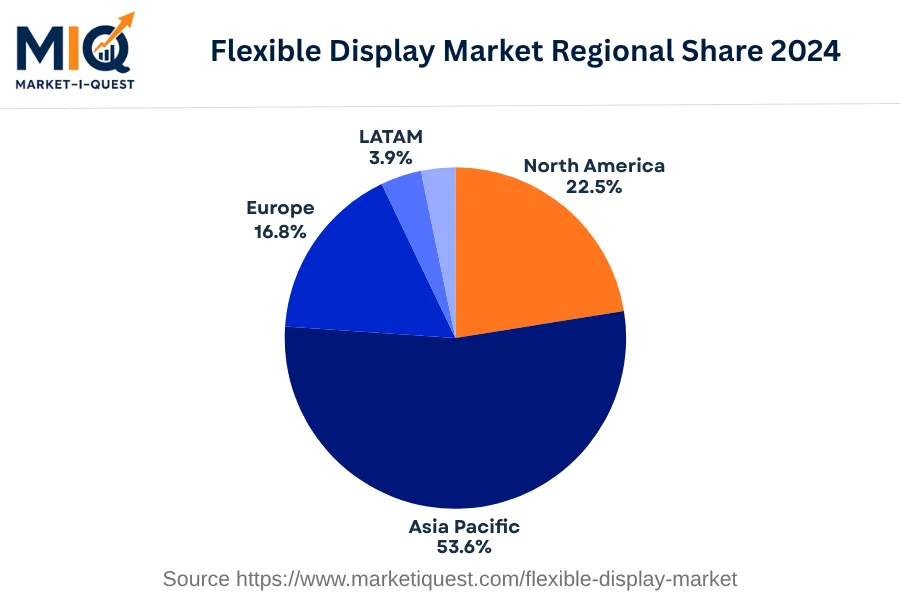
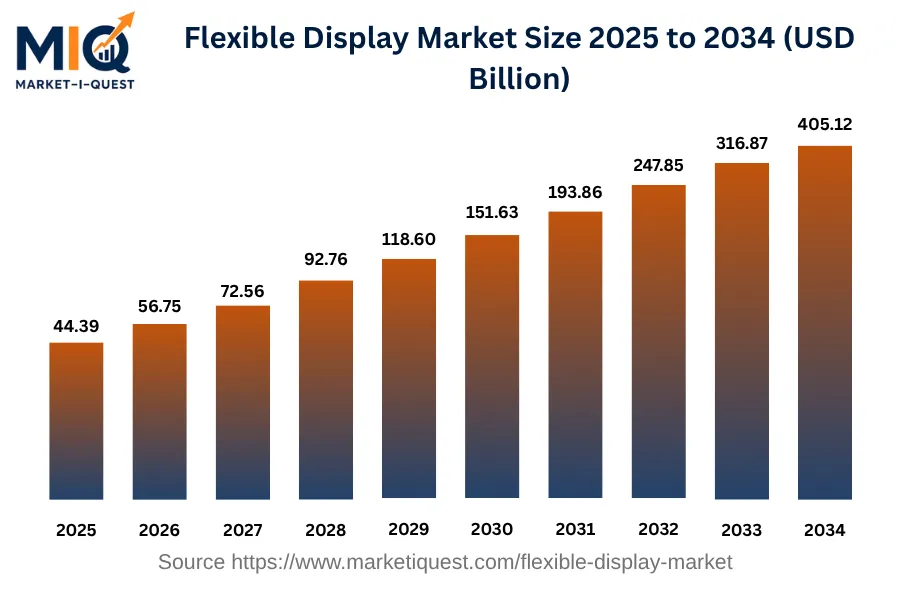
The Flexible Display Market is projected to expand substantially from USD 44.39 billion in 2025 to USD 405.12 billion by 2034, highlighting a Compound Annual Growth Rate (CAGR) of 27.85%. This surge in market value is primarily due to increased consumer demand for new technologies, as well as major advancements in the development and implementation of flexible display technologies. The market is anticipated to undergo significant growth and transformations during the ten-year period. With respect to regional market shares in 2024, Asia Pacific represented over half the market with a share of 53.61%. North America followed with a share of 22.46%, while Europe constituted 16.82% of the market. The shares of LATAM and MEA were comparatively lower, standing at 3.86% and 3.25% respectively.

Key Takeaways

  • By Display Type - Bendable led the market accounting for the highest share in the base year.
  • By Application - Smartphone was dominant holding the major market share in the base year.
flexible-display-market market size

Key Driving Factors

Increasing use of Flexible Displays in Automotive Industries

Over the past few years, the automotive industry has seen a significant shift in its use of display technologies. Automakers are increasingly integrating flexible display technologies into their vehicle designs to enhance both aesthetic appeal and user interface. These displays are used in various car components like instrument clusters, infotainment screens, and other interior surfaces. The added flexibility allows for more creative design expressions. It can conform to non-planar surfaces and improve the driver's experience with more intuitive and immersive interfaces, thus pushing the adoption of flexible displays in the sector. Considering the high potential of this application, many flexible display manufacturers target automakers, leading to growth in the market.

Proliferation of Wearable Technologies

The emergence and adoption of wearable technologies present a significant driving factor for the flexible display market. Devices like smartwatches, fitness bands, and other wearable electronics often require displays that can adapt to unique shapes and sizes. The inherent flexibility and lightweight nature of flexible displays make them an ideal choice for these devices. Consumers' preference for thin, lightweight, and aesthetically pleasing wearable devices has particularly fueled the demand for flexible displays. As companies strive to innovate and differentiate their wearable products, the use of flexible display technology is expected to escalate, amplifying market growth.

Market Evolution by Timeline

2019-2023
During the period 2019–2023, smartphone manufacturers such as Samsung and Huawei from Asian regions became major buyers of flexible displays. Advanced device functionality and improved user experience were identified as key buyer reasons. OLED was the most widely utilized technology, although its manufacture faced constraints of higher production costs and concerns regarding screen burn-in. No major policies or regulations significantly influenced adoption; nevertheless, commercial partnerships between flexible display manufacturers and smartphone companies were common. Volume-based pricing model dominated, wherein discounts were offered on bulk orders. A key risk remained production inefficiency, to which manufacturers responded by streamlining processes and investing in technology upgrades.
2024
By 2024, the flexible display adoption spiked in the automobile sector, particularly in Germany and Japan for dashboard redesign. Samsung's UTG (Unbreakable Display Technology) became a popular technology despite being more expensive due to its durability and high-end performance. The US DoE's Energy Star Program prompted this shift towards energy-efficient flexible displays in public infrastructure projects. A Mixed-ownership model with leasing arrangements gained popularity among smaller businesses due to cost advantages. Nonetheless, the volatility of raw material prices posed a significant risk, promoting players to diversify supply chains and pursue long-term contracts with suppliers.
2025-2029
Between 2025–2029, wearable device manufacturers, mainly in US and China, sought flexible displays to enhance aesthetic appeal and portability. The MicroLED display technology was promoted owing to its superior battery efficiency and brightness. However, it faced output constraints due to complex manufacturing processes. The RoHS directive in the European Union encouraged the production of environmentally friendly displays. Subscription-based models prevailed, offering regular updates and maintenance in the package. The threat of patent infringement loomed, leading companies to invest more in R&D and patent filing.
2030-2034
In 2030–2034, the flexible display market underwent broad adoption across multiple sectors including healthcare, and e-learning tools globally. Demand notably increased from developing regions such as Africa and Southeast Asia. QD-OLED technology was the most sought-after due to its better color contrast and low power consumption. However, difficulties in Quantum Dot deposition on flexible substrates posed a challenge in production. ISO 14001 environmental standards governed manufacturing procedures. There was a noticeable shift towards as-a-service purchasing model with end-to-end solutions provided. Rising e-waste was a significant concern, leading to industry-wide initiatives for encouraging recycling and disposal of old displays.

Future Market Outlook

Future Opportunities

The future of the flexible display market offers multiple avenues for growth tied closely to current technology and strategic partnerships. In 2022, Microsoft entered into an agreement with leading display manufacturers to integrate flexible screens into their Surface product line, highlighting the potential for versatile applications in computing. The automotive sector is also adapting, with major automakers like Mercedes-Benz showcasing concepts for flexible OLED displays within vehicle interiors at the International Motor Show 2023, indicating an opportunity for wider adoption in transportation. Another domain escalating rapidly is wearables; companies such as Fitbit launched devices with flexible displays in early 2023, demonstrating how fitness technology can utilize this feature to enhance user interaction. Regulatory changes spearheaded by the European Commission in 2023 also promote sustainability by encouraging the use of recyclable materials in electronics, positioning eco-friendly flexible displays as attractive options for manufacturers. Moreover, as the 5G network rolls out globally, the demand for mobile devices with adaptable interfaces is expected to rise significantly, encouraging advancements in miniaturization and energy efficiency. Collaborative efforts among different sectors, such as health technology combining flexible displays in medical devices, provide further prospects for development, thus reinforcing the flexible display industry's relevance across diverse applications and consumer segments.

Segmentation Analysis

By Display Type

The market is divided into subsegments including bendable and rollable display types, with bendable displays accounting for the largest revenue share while rollable displays are expected to grow at the fastest CAGR during the forecast period.

Largest Revenue Share

Bendable

Market Share Leader

The bendable display subsegment currently generates the highest revenue in the display market. It can be attributed to several influencing factors. The primary driver being the increasing demand from smartphone manufacturers who are continuously innovating their product design to gain a competitive advantage. Bendable displays offer flexibility in design, thereby satisfying the ongoing trend of slim and sleek devices. Additionally, bendable display technology is robust, being resistant to damages caused by drops and hits, significantly reducing the replacement cost. It's also noticed that user preference for a sophisticated and high-end look that bendable displays offer is a factor contributing to revenue growth. The markets in North America and Asia-Pacific regions, having a high concentration of tech-savvy customers and major smartphone manufacturers, respectively, contribute significantly to sales numbers. Regulatory facilitation and supplier capacity have kept pace with the demand so far, providing a conducive environment for this subsegment's growth. However, it is critical to address potential challenges such as high production cost and purchasing hesitations due to relatively higher prices compared to conventional displays.

Fastest CAGR

Rollable

Forecast Period Growth Leader

The rollable display subsegment, while not currently leading in terms of revenue, is projected to be the fastest-growing in the coming years. Primary growth drivers include advancements in technology that make these displays more reliable and adaptable to various devices. Compared to bendable, rollable displays offer even greater flexibility and portability, opening up potential applications in emerging product categories such as smart watches, e-readers, and other wearable devices. However, several barriers to adoption persist, including higher production costs resulting from the complexity of the technology and relative novelty of the product itself, which could potentially limit its market penetration. To propel growth, manufacturers need to focus on strategic partnerships, scaling up production, and investment in research and development. Risks in the near term include possible resistance to adoption due to price sensitivity and the untested longevity of these new technology products. Nonetheless, the unique features provided by rollable technology make it an appealing candidate for future adoption.

By Application

The market is divided into subsegments including Smartphones, Tablets, Laptops, Smartcards, TV, Wearable Displays, Digital Signage, E-Reader, Electronic Shelf Label, and others. Among these, the Smartphone subsegment accounted for the largest revenue share while the Wearable Displays subsegment is predicted to showcase the fastest growth rate during the forecast period.

Largest Revenue Share

Smartphone

Market Share Leader

In the base year of 2024, Smartphones largely dominate the market, driving the highest revenue in the segment. This scenario can be explained by the growing ubiquity of smartphones globally and their integral role in everyday lives. The vast customer base, coupled with frequent upgrades led by technology advancements, fuels high revenue generation. Various geographical markets, especially developed and developing economies with high smartphone proliferation, add to its revenue. Moreover, regulatory policies supporting digitalization and connected societies further foster the penetration and adoption of smartphones. With the need for communication, information access, entertainment, and digital services at one's fingertips, smartphones are an essential purchase for customers. However, the choices may vary based on factors like price, specifications, brand value, after-sale services, etc. Retail and online channels contribute significantly to the high sales volume, with each channel offering competitive pricing strategies and deals.

Fastest CAGR

Wearable Displays

Forecast Period Growth Leader

Despite the Smartphones' leading revenue, the Wearable Displays segment expectedly showcases the fastest growth rate. The fundamental growth drivers include the rise in fitness consciousness and technology trends such as IoT, leading to wearables' adoption. Advanced features for health monitoring clubbed with attributes like convenience and portability bolster the popularity and demand of wearable devices. However, high prices and lack of consumer awareness might pose as adoption barriers in some regions, especially the lesser developed ones. Technological advancements, industry consolidation, strategic partnerships among tech giants, and favorable policies at the governmental level are promising catalysts for this segment's dynamism. Future risks may entail compliance with health and safety regulation considering wearables' proximity to the human body. The industry thus has to ensure a steady balance between innovation and safety.

Competitive Analysis

Key Market Players

Manufacturers / OEMs

Samsung Electronics
South Korea
LG Display
South Korea
AU Optronics
Taiwan

Key Suppliers & Raw Materials

Corning
US
Polymer Vision
Netherlands
DuPont Displays
US

Distributors, Integrators & Channel Partners

WiseChip Semiconductor
Taiwan
Futaba Corporation
Japan
Sony Corporation
Japan

Porter’s Five Forces Analysis

An analysis of competitive forces and strategic considerations impacting the flexible display market.

Supplier Bargaining Power

Medium

Limited suppliers of flexible display technology and high production cost exert moderate influence.

Buyer Bargaining Power

Low

Unique technology with less alternatives leads to low buyer power.

Threat of Substitutes

Low

Few alternatives for the sophisticated flexible display technology reduce substitution threats.

Threat of New Entrants

Medium

High entry barrier due to steep R&D costs and patent protection restrict new entrants.

Competitive Rivalry

High

Intense competition among existing companies, driven by fast-paced tech advances.

Regional Analysis

Geographic market dynamics and growth opportunities across key regions

Global Market Outlook

flexible-display-market market regional share

North America

In 2024, North America's Flexible Display Market experienced dynamic activity, effectuated by changing consumer preferences, technological advancements, and evolving industrial needs. Driving forces primarily comprised escalating demand in tech-savvy sectors -consumer electronics, automobile, and healthcare. Consumer inclination towards flexible, durable, and lightweight devices, automobile industry’s adoption of curved and bendable displays for enhanced aesthetics and user-friendliness, and an increased use of flexible OLED displays in healthcare for data visualization and patient tracking spurred the market surge. Additionally, heavy investments in R&D, especially by US corporations, and favorable pricing intensified market momentum.

Significant trends encompassed a shift towards organic light-emitting diode (OLED) and electronic paper display (EPD) technologies, with OLED enjoying wider popularity due to its improved quality of display, lightweight, and ultra-thin features. A rise in strategic collaborations and acquisitions, like the Samsung and Royole Corp's venture, vied for more market share. Retail and e-commerce channels marked an exponential growth in flexible display sales. Environmental safety standards and waste management regulations, particularly in the U.S and Canada, wizened manufacturers to utilize eco-friendly production techniques. As corporate sustainability in manufacturing, many opted for solar-powered flexible displays in 2024.

Asia Pacific

In 2024, the Flexible Display Market in Asia Pacific was marked by significant technology penetration and widespread adoption. Key drivers involved the increased demand for wearable devices in countries like China and South Korea, fuelling industry growth. India's government regulations supporting digitization in public and private sectors also accelerated the market. Investment in technology development, especially in OLED displays and foldable smartphones, was prominent in Japan and South Korea. Furthermore, economies of scale in manufacturing sectors, experienced prominently in China, brought down the pricing of flexible displays.

Trends recognized in 2024 included an evident shift towards flexible OLED displays over LCDs, influenced by consumer preferences for lightweight and more durable devices. China and India saw an uptick in online buying patterns, contributing to dynamic sales channels. Partnerships and M&A activities, especially between Chinese and Korean companies, emerged to expand market shares and meet the rising regional demand. An increased standardization in manufacturing and treatment of displays was noted, primarily across ASEAN markets, resulting from policy enforcement favoring environment-friendly practices. Key sectors utilizing flexible displays spanned from consumer electronics to automotive, and included industries such as enterprise, retail and healthcare, particularly notable in markets like Australia and Japan.

Europe

In the base year of 2024, the Flexible Display Market in Europe is in a state of growth, spurred by multiple factors. First, demand has escalated substantially not only for smartphones and wearable electronics in regions such as Germany, United Kingdom, Spain, Italy, and France, but also for interior design applications in the automotive sector, boosting technological adoption across the continent. Second, various European governments have introduced policies that promote digital transformation across sectors, catalyzing investment in new technology including flexible displays. Third, advancements in OLED technology and the reductions in production cost have increased the supply and made flexible displays more affordable.

Pertaining to the evident trends, consumer behavior is shifting towards bendable and foldable electronics, with manufacturers such as Samsung and LG catering to this demand. In terms of product shifts, the focus towards OLED technology for its energy efficiency and superior visual output sees a rise in Nordics, Benelux, and Central & Eastern Europe. Moreover, partnerships and mergers are intensifying as companies strive for innovation and competitive edge. For example, BOE, a leading company in the flexible display industry, has partnered with several European tech firms. Finally, policy enforcement related to e-waste management has led to enhanced manufacturing standards and reshaped product lifecycle.

Latin America

In 2024, the flexible display market in LATAM exhibited significant expansion, underpinned by a combination of factors. Accelerated technology adoption, particularly in Brazil and Mexico, drove demand, influenced by increased investment in research and development and a digital transformation across sectors. Regulatory policies favoring digitalization, exemplified by Argentina's Digital Transformation Strategy, further propelled market growth. Supply dynamics also revealed a positive trend, with Colombia's commitment to building local manufacturing capacities for flexible displays, thereby stabilizing pricing in the region.

Pertaining to trends, changing consumer behavior, especially in the retail and advertising sectors, advocated the uptake of flexible displays. Technological advancements in the form of flexible OLEDs permeated markets, influenced by partnerships and mergers, such as Chile's national telecom company Entel's tie-up with global OLED manufacturers. Channel dynamics witnessed traditional electronics distributors losing ground to digital platforms, which offered greater variety and competition. Increased enforcement of energy efficiency standards in Peru's manufacturing sector also boosted the use of flexible displays, known for their energy-saving attributes. Overall, the LATAM flexible display market in 2024 was characterized by strong growth drivers and new market trends, demonstrating a positive outlook for the technology's maturity in the region.

Middle East & Africa

In 2024, the Flexible Display Market witnessed substantial growth and transformations in the Middle East and Africa. Economic diversification strategies, increased investment towards technology development, and the escalating demand for sophisticated display devices, primarily in Saudi Arabia, the United Arab Emirates, Qatar, and Israel, energized the market dynamics. Simultaneously, Nigeria, Kenya, South Africa, and Egypt facilitated market maturation through increased adoption in sectors like telecom, healthcare, and retail. Complementing this scene, the emergence and acceptance of advanced technologies stimulated the consumer behavior across the region. A perceptible shift towards flexible screens in devices like smartphones, televisions, and wearables, led by technology giants Samsung and Huawei, showed a distinct trend. The rapid growth of e-commerce channels, accompanied by strategic partnerships among manufacturers and regional distributors, served to strengthen market penetration and supply chain efficiency. Robust policy enforcement around electronic waste and recycling, particularly within South Africa, added to the market's evolving nature.

The surge in digital services, specifically in financial services and government sectors, due to the need for efficient consumer engagement platforms, motivated the Flexible Display Market's progress. In the oil and gas industry, the utilization of flexible displays for sophisticated control systems was notable, given the industry's significant relevance within the region's economic structure. As such, the state of the Flexible Display Market in 2024 confirmed an upward trajectory with an amalgam of drivers and trends.

Recent Industry Developments

Latest market innovations, product launches, and strategic initiatives

June 2026

BOE Technology Group began mass production at its Gen-8.6 AMOLED production line in Chengdu, China's first next-generation flexible display production line with a $9.3 billion investment and 32,000 glass substrates per month capacity; at full capacity, Chengdu-made flexible displays are expected to account for over 20% of global market share.

March 2026

Samsung Display acquired German OLED display startup Cynora GmbH for approximately $300 million to advance foldable smartphone screen technology.

Frequently Asked Questions