
E-waste Management Market Snapshot

Key Players

  • Sims Metal Management (Australia)
  • Electronic Recyclers International (US)
  • Stena Metall AB (Sweden)
  • Boliden Group (Sweden)
  • Enviro-Hub Holdings Ltd (Singapore)
  • Waste Management Inc (US)
  • Umicore (Belgium)
  • Tetronics Ltd. (UK)

Market Size

Base Year 2024
$83.8 Bn
CAGR
11.78%
Forecast 2034
$255.20 Bn

Market Segments

By Material
  • Metal
  • Copper
  • Steel
  • Pneumatic Jacks
  • Others
By Source
  • Industrial Electronics
  • Consumer Electronics
  • Household Appliances
By Application
  • Disposal
  • Recycle

Market Dynamics

Drivers
  • Rapid technological advancements
  • Increasing environmental concerns
Restraints
  • High initial investment costs
  • Lack of e-waste recycling awareness
Opportunities
  • Rising Environmental Awareness
  • Increasing Technological Advancements

Market Size

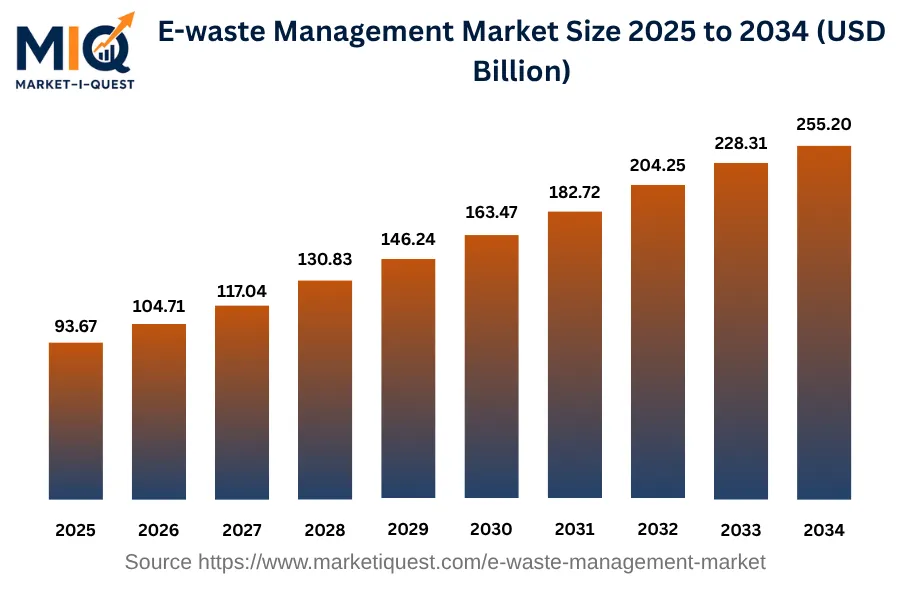
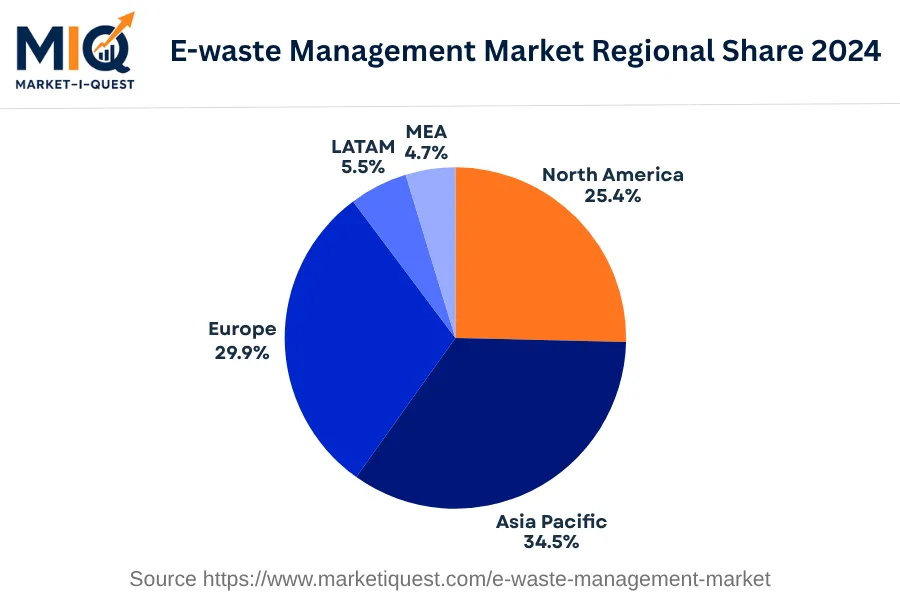
The E-waste Management Market size in 2025 is projected at the value of $93.67 billion, from $83.8 billion in 2024. By 2034 the market is projected to reach $255.20 billion, with a CAGR of 11.78%. This continuous enhancement in market is likely due to various factors including growing production of electronic waste combined with a increasing demand for effective waste management solutions. With increased governmental regulations and initiatives for promoting sustainable e-waste disposal and recycling further contribute to this upward trajectory. Regional distribution in 2024, Asia Pacific held the largest share of 34.49%, followed by Europe with 29.91% and North America with 25.37%. Sharing a market were LATAM and MEA, with respective regional shares of 5.52% and 4.71%.

Key Takeaways

  • By Material - Steel led in the E-waste Management Market accounting for a significant share in the base year.
  • By Source - Consumer Electronics held the majority stake underlining its dominance in the E-waste Management Market.
  • By Application - Disposal held the principal position substantiating the market's primary option for E-waste.
e-waste-management-market market size

Key Driving Factors

Strict Regulatory Frameworks on E-waste Disposal

Increased enforcement of legislative requirements such as basel convention, an international treaty designed for reducing movements of hazardous waste between nations is driving e-waste management market. Under treaty's framework, countries are forced to ensure environmental management of electronic waste. Businesses are therefore seeking services that facilitate compliancy with these regulations for avoiding penalties. Significantly resulting surge in demand for innovative e-waste management services. Regulations limit informal handling of e-waste and promote safer disposal practices, which further spurs the growth of formal e-waste management sectors.
Rising Environmental Awareness among Consumers

Due to the increased consumer consciousness regarding environmental impact of e-waste is a significant factor pushing the growth of e-waste management market. Whereas end-users typically as households and businesses are likely to simply dispose of their electronic devices along with waste. Meanwhile, within this period increased climate change awareness and spurred by institutional eco-initiatives with conscious efforts to discard their electronic waste responsibly. Thus, this changing perspective and behavior of consumers has contributed to the expansion of e-waste management services.

Market Evolution by Timeline

2019-2023
Within 2019 and 2023, demand from Asian markets primarily in China and India, dominated the E-waste management market due to rapid digitization and increasing household electronic waste. Suppliers including Enviro-Hub Holdings Ltd. offered waste recycling services and communication asset recovery services. The government regulations such EU's Waste Electrical and Electronic Equipment (WEEE) Directive drove for responsible e-waste recycling and disposal methods. Thus, common commercial model involved partnerships between e-waste management companies and electronic manufacturers for safe disposal of end-of-life products.
2024
In 2024, the demand from various businesses in North America drove due to robust IT sector and office electronic waste. The supply met by offering increasingly advanced e-waste processing methods. Notably by ERI, specializing in data destruction along with recycling. The U.S. Resource Conservation and Recovery Act regulated e-waste management, aiming for landfills elimination. Thus, a common commercial model was subscription-based, offering regular e-waste pick up services from offices.
2025-2029
This period included both individuals and business across multiple regions, due to the common electronic usage. EcoATM notably piloted kiosk-based e-waste collection, resolving common storage issues. Integration of e-waste management with smart city initiatives represented the new norm. Policies such as India's 'E-Waste Management Rules 2016' strengthened for reducing informal e-waste recycling. The emerging commercial model based on providing incentives for e-waste recycling to consumers such as gift cards. Thus, this period is likely to play a major role for growth of the market.
2030-2034
By 2030 to 2034, evolving consumer electronics are likely to fuel global demand. Significant technology developments will include machine learning implementation for efficient e-waste sorting. The United Nations Basel Convention controlled regional e-waste movements and promoting environmental management. The dominant commercial model will shift from service-based to technology-as-a-service, giving e-waste management companies technology ability. Thus, this is likely to make significant progress in this market.

Future Market Outlook

Future Opportunities

The e-waste management market is expected to experience future opportunities driven by current trends and regulatory frameworks aiming to enhance sustainability. The European Union's Circular Economy Action Plan, encourages member states to invest in recycling infrastructures for electronics, creating opportunities for firms specializing in recovery technologies. In 2023, Australia initiated a national strategy to phase out hazardous e-waste and streamline collection and recycling processes, setting the stage for more robust local markets. Furthermore, emerging markets, particularly in Africa and Southeast Asia, are witnessing increased investment in e-waste recycling facilities, as highlighted by partnerships established in 2022 between local governments and international firms like EcoATM. The shifting consumer attitudes towards sustainable products present a market landscape ripe for innovation in product lifecycle management and refurbishment services. An increase in urban mining initiatives is observed as companies recognize the value in recovering materials from landfills; this trend is currently gaining traction through advancements exemplified by recent pilot projects in Germany. As digitalization continues to proliferate, new categories of e-waste will arise, providing market players opportunities to develop tailored solutions to manage these increasing waste streams effectively. Collaboration between tech companies and recycling entities will be crucial in establishing frameworks to drive circularity in the electronics supply chain, indicating a responsive and evolving market.

Segmentation Analysis

By Material

The market is divided into subsegments including Metal, Copper, Steel, Pneumatic Jacks, and Others, with Steel accounting for the largest revenue share, while Copper is expected to grow at the fastest CAGR during the forecast period.

Largest Revenue Share

Steel

Market Share Leader

The steel subsegment's significant revenue share is majorly driven due to its widespread applications from construction to automobile manufacturing, indicating robust demand. Steel is preferred by both customers and manufacturers for its durability, resistance to corrosion and cost-effectiveness. Geographically, regions with growing construction and automobile sectors such as Asia-Pacific and North America with considerable contribution to the increased demand for steel. Regulatory norms regarding to the usage of materials in construction and manufacturing also plays a crucial role in enhancing the steel market. High infrastructure spending in developed and developing countries further boosts market growth. Thus, steel is easier to gain than other materials due to the well-established supply chain significantly reducing the cost of switching for buyers.

Fastest CAGR

Copper

Forecast Period Growth Leader

The copper sub-segment is forecasted to grow at the fastest CAGR within the period. The growth is majorly driven due to the increasing demand for copper in electrical and electronics manufacturing. Moreover, emerging technologies such as electric vehicles and renewable energy systems with the requirement of copper for their operations are acting as significant drivers for the market growth. Governments and companies are forming partnerships, offering support and incentives for driving the market. Thus, boosting the policy-driven initiatives promoting the use of environment-friendly materials, further creating a favorable business landscape for copper.

By Source

The market is divided into subsegments including Industrial Electronics, Consumer Electronics, and Household Appliances. In 2024, Consumer Electronics accounted for the largest revenue share while Industrial Electronics is expected to grow at the fastest CAGR during the forecast period.

Largest Revenue Share

Consumer Electronics

Market Share Leader

The subsegment with the most significant revenue is Consumer Electronics. Whereas, consumer electronics has seen a rapid growth of interest and investment. This growth is largely driven due to the widespread adoption and popularity of consumer tech products such as smartphones, digital television sets and personal computers. Technological advancements and innovations such as Internet of Things (IoT) and Artificial Intelligence (AI) integrated devices have also led to an increase in the demand. Geographically, North America and Asia-Pacific regions with high purchasing power and rapid tech adoption, significantly contribute to the revenue. Corporate strategies such diversification of product portfolios, strategic partnerships and intensive marketing campaigns by key players in the industry have also contributed to the dominance of Consumer Electronics in the market.

Fastest CAGR

Industrial Electronics

Forecast Period Growth Leader

Projected to exhibit the fastest CAGR, Industrial Electronics shows immense potential for growth. Industry 4.0 or the fourth industrial revolution, which optimizes computerization with IoT and cloud technology, is serving as a primary growth catalyst. Improvements in industrial processes via automation and digital transformation are driving adoption. Firms are investing heavily in automated machinery, control systems and instrumentation, creating high demand for Industrial Electronics. However, supportive government policies, grants, and initiatives aimed at promoting industrial automation, especially in highly industrialized regions, are expediting the adoption process. The current focus on converting conventional industrial setups into smart factories to improve operational efficiency, reduce downtime, and increase production quality, are likely to ensure steady demand for Industrial Electronics.

By Application

The market is divided into subsegments including Disposal and Recycle. Disposal accounted for the largest revenue share while Recycle is expected to grow at the fastest CAGR during the forecast period.

Largest Revenue Share

Disposal

Market Share Leader

The Disposal subsegment has held the largest revenue share in the application segment. This can be attributed to several key factors. With the increasing demand for products and services for effective disposing remains a constant requirement across several industries. The frequency and demand are driven due to regulatory structures which necessitate safe and efficient disposal of waste products, driving purchasing decisions within this subsegment. Moreover, consumer consciousness on environmental sustainability has seen markets heavily promoting their disposal methods. Favorable regions, accessing to transportation routes and availability of specialized equipment have also made disposal a more accessible and profitable option for many businesses. Economic factors such as the high costs associated with improper disposal and potential fines have also made this subsegment very attractive for investment, thus increasing revenue generation.

Fastest CAGR

Recycle

Forecast Period Growth Leader

Recycle subsegment is projected to grow at the fastest CAGR, the recycle subsegment is defined by a combination of stipulating policy changes, technological advancements and strategic partnerships. With regulatory bodies promoting recycling increasingly, installments of supportive policies. The technological advancements simplifying recycling processes and output quality have reduced adoption barriers. It's transformative in the sense of being cost-effective and sustainable which equals a longer-term advantage. Businesses and government organizations are increasingly investing more resources to establish strategic partnerships with recycling companies. Additionally, with growing consumer awareness about sustainable practices and their demand also serve as catalysts, while ensuring brand reputation and customer retention. Thus, with combining all these making it a fastest growing subsegment.

Competitive Analysis

Key Market Players

Manufacturers / OEMs

Sims Recycling Solutions
US
Electronic Recyclers International
US
Stena Technoworld AB
Sweden

Key Suppliers & Raw Materials

Umicore
Belgium
Enviro-Hub Holdings Ltd
Singapore
Boliden Group
Sweden

Distributors, Integrators & Channel Partners

Veolia
France
TES
Singapore
Waste Management Inc.
US

Porter’s Five Forces Analysis

This is an analysis of the competitive forces within the E-waste Management Market.

Supplier Bargaining Power

Medium

Suppliers have medium power due to the need for specialized machinery and disposal techniques.

Buyer Bargaining Power

High

Buyers have high power due to the increasing number of e-waste management firms and government regulations.

Threat of Substitutes

Low

Low threat due to the lack of efficient and environmentally friendly alternatives for e-waste management.

Threat of New Entrants

Medium

Entry barriers exist due to regulatory compliance requirements and technological investments, presenting a medium threat level.

Competitive Rivalry

High

High competition due to companies efforts to gain advantage by offering enhanced recycling processes and technology.

Regional Analysis

Geographic market dynamics and growth opportunities across key regions

Global Market Outlook

e-waste-management-market market regional share

North America

In 2024, the North American E-waste Management Market evidenced a significant surge attributable to increased societal reliance on electronic devices, stringent regulatory mandates, and proactive technological interventions. The region witnessed a mounting e-waste accumulation upsurge primarily originating from the United States due to its voluminous electronics market followed by Canada and Mexico. Enhanced regulatory pressure such as the U.S. Resource Conservation and Recovery Act, coupled with escalating awareness campaigns concerning the detrimental impact of improper e-waste disposal, significantly increased demand for effective e-waste management strategies.

Innovative technologies like hydrometallurgical recovery systems indigenous to Canada were progressively adopted, compelling investments from major electronic manufacturers. Meanwhile, reduced prices attributed to supply dynamics fostered the market growth. On the contrary, sustainability drives steered buyer behavior as more consumers in the region sought environmentally friendly electronic disposal mechanisms. Additionally, numerous technology shifts, facilitated by augmented partnerships and M&A activities, transformed the e-waste market landscape. A trend towards rigorous policy enforcement was apparent as authorities aimed to curtail the environmental and health hazards linked to e-waste. Sectors such as healthcare, manufacturing, utilities, and retail displayed notable e-waste generation, contributing to the burgeoning need for robust e-waste management solutions. Consequently, in the base year 2024, the North American e-waste management market portrayed remarkable expansion and diversification underscored by escalating e-waste production and increased emphasis on sustainable disposal mechanisms.

Asia Pacific

In the base year 2024, the E-waste Management Market in the Asia Pacific was notably active, driven primarily by China, India, Japan, South Korea, Australia, and key ASEAN markets. Increasing consumer electronic adoption created a surge in obsolete devices, stimulating demand for E-waste services. Regulatory measures, such as the 'Clean India' initiative and China's 'Circular Economy Law', aimed at reducing waste, positively influenced market behavior. Technological advancements in E-waste management processes bolstered capacities, attracting investment from both private entities and government agencies.

Trends in 2024 included the rising consumer preference for certified E-waste recyclers, a shift driven by growing environmental awareness. Technological leaps included the use of AI and IoT in waste segregation and processing, adopted by leading members of the sector including enterprise, healthcare, utilities, and retail. Partnerships and M&A activities bloomed as regional players sought to streamline their supply chains and navigate policy enforcement more efficiently. Governments were increasingly enforcing E-waste management standards, with ad-hoc audits and hefty penalties for violations. Such was the case with Australia's 'Product Stewardship Act,' which shaped the behavior of manufacturers in the country towards responsible E-waste management.

Europe

In 2024, E-waste management emerged as a pivotal sector in Europe due to surging electronic consumption and regulatory focus. Driving this attention were demand pressures from the growing awareness around electronic waste's distressing environmental impact. The implementation of stringent regulations, such as the EU's revised Waste Electrical and Electronic Equipment Directive, contributed to market momentum too. Investment in modern recycling technologies, such as hydrometallurgical processes, underscored the sector's dynamic growth in key markets like Germany, the United Kingdom, and France.

Concurrently, several trends shaped waste management practices. A discernible shift towards circular economy models, with enterprises and governments pushing to reduce waste, was evident. Manufacturers and retailers across Italy, Spain, Benelux, and Central & Eastern Europe started prioritizing E-waste reduction, encouraging customers to return used electronics for responsible disposal. There was also a noticeable increase in partnership-based initiatives. For example, France expanded its "Eco-systems" program, involving major manufacturers in the collection and recycling process. Adherence to environmental standards escalated, driven by stricter policy enforcement. Notably in the Nordics, the adoption of ISO 14001 - Environmental Management became a norm among utilities and manufacturing companies, bolstering the comprehensive approach to E-waste management.

Latin America

In 2024, the E-waste Management Market in Latin America reflected a marked increase in sustainability awareness. Novel regulations enforced by governments, such as the 'National Policy on Solid Waste in Brazil' stimulated the need for e-waste management, boosting investment into efficient recycling technologies. This surge in demand was also fuelled by growing consumer electronics consumption and the commensurate increase in discarded waste, particularly in populous nations like Mexico and Brazil. Notably, Argentina's secure e-waste treatment and recycling facilities saw higher investment specifically in the tech sector, indicating a shift towards effective waste disposal methods.

On-ground trends painted a shift towards green consumerism- backed by governmental and corporate pressure. For instance, the PERU LIMPIO policy focussed on major urban areas, which drove demand for sustainable waste management methods. Channel dynamics changed as well, with traditional waste disposal methods being pushed out by integrated e-waste management solutions. Concurrently, retail and manufacturing sectors leveraged partnerships to improve their e-waste management, while leveraging emerging technologies to minimize waste creation. The government sector initiated significant policy enforcement campaigns in various countries like Chile, urging enterprises to adopt eco-friendly practices. The healthcare sector observed increased accountability in e-waste management, in accordance with stringent biohazard disposal guidelines.

Middle East & Africa

The E-waste management market in the Middle East and Africa experienced significant dynamics in 2024. Drivers included increased e-waste generation in wealthier nations like Saudi Arabia, United Arab Emirates, and Qatar as consumers' tech usage grew. Additionally, regulations pertaining to e-waste management such as Kenya's E-Waste Management Regulations 2013, and rising environmental awareness stimulated activities in this sector. Investments in E-waste management grew in countries like Israel, reflecting interest in tech-compatible waste management solutions.

Trends revealed an increased shift towards formal e-waste recycling, spearheaded by countries like South Africa and Nigeria. Product changes were seen in the form of more eco-friendly electronics entering the market, particularly in retail and telecom sectors. In terms of channel dynamics, partnerships flourished between governments and private entities to manage the e-waste challenge, especially in Egypt. Enforcement of existing policies was strengthened, barring unregulated e-waste disposal practices particularly in oil and gas and the manufacturing sectors.
The E-waste management market in the Middle East and Africa in 2024 was driven by increased e-waste production, encouraging policies, and an upward trend in investments. Significant market trends included a shift towards formalized recycling, intensified collaborations for e-waste management, and aggressive policy enforcement. These activities dominated sectors like telecom, retail, manufacturing, and oil and gas.

Recent Industry Developments

Latest market innovations, product launches, and strategic initiatives

June 2026

IIT Madras officially unveiled an indigenous e-waste recycling pilot plant located at the BHEL facility. This installation serves as a scalable blueprint for localized processing, capable of handling 100 tonnes of printed circuit boards annually using a zero-discharge, single-acid method to safely extract heavy metals.

December 2025

Attero finalized a ₹150 crore capital expansion to drastically scale its extraction infrastructure. This specific development builds out new, localized processing facilities in Pune, Bengaluru, and Faridabad, collectively adding roughly 100,000 tons of annual recycling capacity dedicated to e-waste and copper recovery.

June 2025

The government formally announced the development of a dedicated e-waste eco-park in Holambi Kalan. Spanning 11.4 acres, the project is structured as a 15-year public-private partnership designed to process up to 51,000 tons of electronic waste annually while integrating informal sector recyclers into a compliant ecosystem.

Frequently Asked Questions