
Conductive Ink Market Snapshot

Key Players

  • Sun Chemical Corporation (United States)
  • Dupont (United States)
  • Henkel AG & Co. KGaA (Germany)
  • Heraeus Holding (Germany)
  • Johnson Matthey (United Kingdom)
  • Mitsubishi Chemical Corporation (Japan)
  • Fuji Pigment Co. Ltd (Japan)
  • Applied Ink Solutions (United States)
  • Creative Materials Inc. (United States)
  • Parker Chomerics (United States)

Market Size

Base Year 2024
$3.18 Bn
CAGR
7.8%
Forecast 2034
$6.74 Bn

Market Segments

By Type
  • Silver Inks
  • Copper Inks
  • Conductive Polymer Inks
  • Carbon/Graphene Inks
  • Others
By Technology
  • Screen Printing
  • Flexographic Printing
  • Inkjet Printing
  • Gravure Printing
By Application
  • Photovoltaics (Solar Panels)
  • Flexible Displays & Touchscreens
  • Printed Circuit Boards (PCBs)
  • RFID Tags & Smart Packaging
  • Automotive Sensors
  • Bio-Sensors & Medical Devices
  • Others

Market Dynamics

Drivers
  • Increasing demand in printed electronics
  • Advancements in miniaturization technology
Restraints
  • High production cost
  • Limited durability in harsh conditions
Opportunities
  • Rising demand in printed electronics
  • Emergence of flexible and miniaturized devices

Market Size

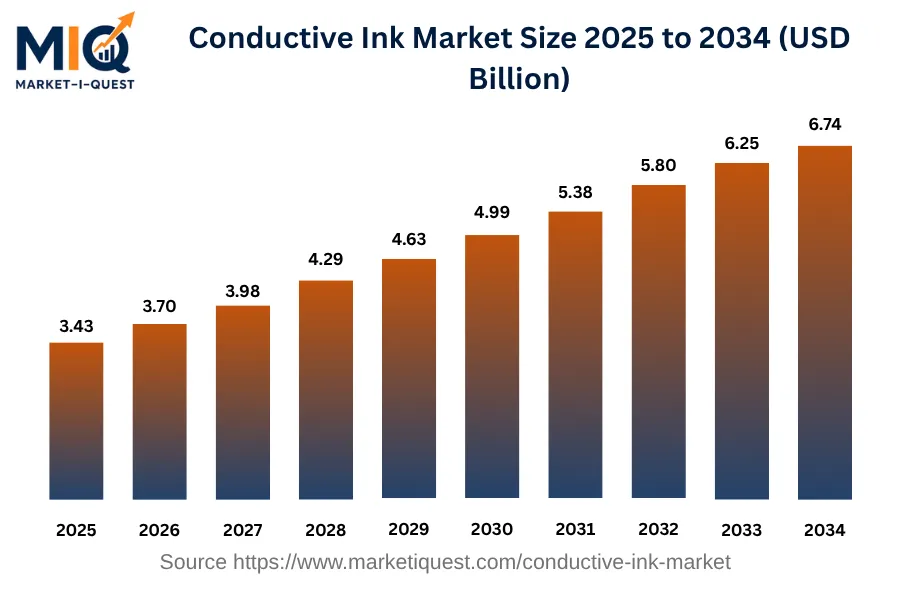
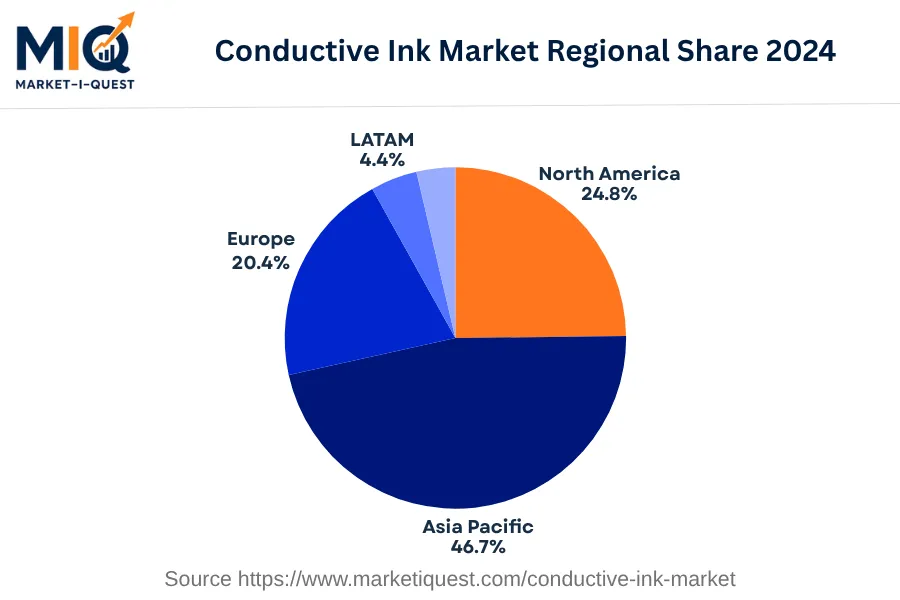
The Conductive Ink Market size in 2025 is estimated to be USD 3.43 Billion, showing an increase from the 2024 value of USD 3.18 Billion. By the year 2034, the market is projected to expand significantly to approximately USD 6.74 Billion. This growth pattern is represented by a CAGR of 7.8% from 2025 to 2034. The increment in the market scale over these years is attributed to several factors driving the demand and application of conductive ink in various sectors. Furthermore, the regional share in 2024 is distributed among five global areas; North America held a 24.8% share, Asia Pacific had a dominant 46.7% share. Europe represented 20.4% of the total share, whereas LATAM and MEA held smaller shares of 4.4% and 3.7%, respectively. This regional share dispersion is a reflection of the market consumption and implementation of conductive inks across these geographical zones.

Key Takeaways

  • By Type - Copper Inks held the significant share in the Conductive Ink Market in 2024.
  • By Technology - Inkjet Printing led the market by Technology indicating a notable position in 2024.
  • By Application - Photovoltaics (Solar Panels) were the largest in the Application segment accounting for a significant market share in 2024.
conductive-ink-market market size

Key Driving Factors

Emergence of Printed Electronics

The emergence of printed electronics has been driving the conductive ink market significantly. Customized mass production and the flexibility of printing on diverse substrates are key features of printed electronics that hinge on using methods like screen printing, inkjet printing, and flexographic printing. These methods necessitate conductive inks, ensuring a robust demand in this market. Especially pivotal are the industries dealing in electronics such as consumer electronics, automotive industry, and Internet of Things (IoT) where there is a continuous demand for next-gen devices. The pivotal role played by conductive inks in flexible and foldable printed electronics is further fueling the industry.
Increasing Usage in Photovoltaic Cells

The application of conductive inks in photovoltaic cells is a significant driver in the conductive ink market. Solar panels, constituting photovoltaic cells use silver conductive inks for improving the cells' efficiency. This demand is reinforced by regulatory pushes worldwide towards renewable energy sources and governmental policies favoring solar energy adoption. Additionally, the market is getting a push from enterprises working toward sustainable energy sources impacting the supply-chain procurement trigger. As solar energy is viewed as a long-term cost-effective solution, the usage of conductive inks in photovoltaic cells is expected to continually sustain and boost the conductive ink market.

Market Evolution by Timeline

2019-2023
In this timeline, the demand for conductive ink primarily evolved from sectors like printed electronics, photovoltaics, and automotive. With the rise in flexible and wearable electronics in industries and consumer segments, the need for efficient conduits like conductive ink increased. Key regions showing growing consumption were Asia-Pacific, North America, and Europe. On the supply front, silver-based conductive inks dominated the market, considering their high conductivity, despite their high cost. However, the pressures of cost-efficiency led to the exploration of alternative materials like copper. Regulatory influence was observed in environmental guidelines limiting the use of certain materials in conducting inks. The commercial model involved direct sales and long-term contracts, with key market players often engaging in partnerships for improved technology. The high price of silver, a key raw material, was a significant risk factor.
2024
This year was significant for the transition towards low-cost alternatives. Carbon nanotubes and graphene-based inks gained prominence due to efficiency and cost-effectiveness. Demand from the semiconductor and healthcare sectors was high, including in telehealth applications. North America and Asia-Pacific continued to lead in consumption. As per policy, consumer product safety standards impacted the industry, particularly in electronics and healthcare applications. Commercially, there was a noticeable trend towards customized solutions, with suppliers providing tailor-made inks for specific applications. Risk factors included potential health hazards associated with carbon nanotubes and graphene inks, and also constraints in mass production.
2025-2029
In this period, innovations in conductive ink technology moved towards the use of silver nanoparticles, offering benefits like lower sintering temperatures and improved flexibility. Demand was driven by fields like Internet of Things, renewable energy, and e-textiles, with Asia-Pacific and Europe majorly contributing. Compliance with REACH regulations became increasingly important to align with European Union environmental standards. Commercial models shifted towards licensing technologies and joint ventures, following increasing collaboration between ink developers and application manufacturers. Risks included the challenge of maintaining product quality while lowering production cost and limiting environmental impact.
2030-2034
The demand for conductive inks was marked by the evolution of smart cities, requiring integrated technologies in signage, security, and infrastructure. Buyers from the construction sector significantly increased. The regions of North America, Asia-Pacific, and the Middle East showed strong consumption patterns. Supply-wise, issues around availability and high cost of silver started encouraging the development of hybrid inks, using a mix of silver and copper. Regulations moved towards sustainability, with policies encouraging the development of bio-based conductive inks. The commercial model witnessed a trend towards a circular economy, with initiatives focusing on recyclability and reusability. The risks in this timeframe comprised scalability of production of new technologies and alignment with swiftly changing market needs.

Future Market Outlook

Future Opportunities

Looking ahead, the conductive ink market presents numerous opportunities, particularly as industries continue to seek efficiencies in product design and manufacturing. The shift towards sustainable practices has led organizations like the Sustainable Electronics Initiative, established in 2020, to advocate for the use of environmentally friendly conductive inks made from biodegradable materials. In the aerospace sector, NASA is exploring the use of ultra-lightweight conductive inks for improving flight-essential monitoring systems in its lunar missions scheduled for 2024. Partnerships are also forming; for instance, in 2023, researchers at the University of Massachusetts collaborated with leading textile manufacturers to develop smart fabrics embedded with conductive inks that facilitate body temperature monitoring. As electric vehicle production ramps up globally, companies such as Tesla are investigating the integration of conductive inks for internal circuits, positioning them to capitalize on this burgeoning market. Moreover, the deployment of 5G technology in the telecommunications industry is expected to drive demand for more sophisticated communication devices, leveraging conductive inks in antennas and other components. In healthcare applications, with an increasing emphasis on remote monitoring, startups like HealthPatch have emerged, focusing on wearable devices that utilize conductive inks for real-time health tracking. These combined efforts signify a proactive approach to leveraging conductive inks, ultimately enhancing product functionality and sustainability across multiple industries.

Segmentation Analysis

By Type

The market is divided into subsegments including Silver Inks, Copper Inks, Conductive Polymer Inks, Carbon/Graphene Inks, and Others. Copper Inks accounted for the largest revenue share while Conductive Polymer Inks are expected to grow at the fastest CAGR during the forecast period.

Largest Revenue Share

Copper Inks

Market Share Leader

Copper inks, due to their unique properties and versatile applications, have emerged as the top revenue earner in the market. The dominant revenue share of copper inks can be attributed to their increased use in a variety of industries such as electronics, decorative purposes, and solar photovoltaics. Copper's high electrical conductivity, cost efficiency compared to other metallic alternatives like silver, and broad range compatibility with various substrates have led to its widespread adoption. Furthermore, the booming electronics industry, particularly in emerging economies, has seen a spike in the demand for efficient and cost effective conductive inks, thereby escalating the revenue contribution from this subsegment. Additionally, shifts towards green energy and the growing solar cell industry is driving the demand for copper inks, strengthening their position further in the market. Lastly, technological advances in the manufacturing process of copper inks have improved their efficiency and broadened their potential applications, further contributing to their leading revenue share.

Fastest CAGR

Conductive Polymer Inks

Forecast Period Growth Leader

Conductive Polymer Inks are expected to display the most rapid growth in the market. This stems primarily from their unique properties including flexibility, biocompatibility, and the ability to be processed at room temperature, which opens up possibilities in a myriad of novel applications. These unique applications include wearable electronics, sensors, and biomedical devices, all major aspects of the burgeoning field of IoT and smart device technology. There are yet challenges impeding the full adoption of conductive polymer inks such as their lower conductivity than their metallic counterparts. Despite this, technological advancements and heavy investments in Research & Development are improving the performance of conductive polymer inks, mitigating their drawbacks and offering cost-effective solutions. Furthermore, policy initiatives aimed at promoting green and sustainable practices are playing a significant role in driving the growth of this sector, as conductive polymer inks are more eco-friendly due to their organic nature. However, there are potential risks from cost fluency and reliable sourcing of raw materials which the sector needs to address for its sustained growth.

By Technology

The market technology segment is divided into subsegments including Screen Printing, Flexographic Printing, Inkjet Printing, and Gravure Printing. Of these, Inkjet Printing accounted for the largest revenue share while Flexographic Printing is expected to grow at the fastest CAGR during the forecast period.

Largest Revenue Share

Inkjet Printing

Market Share Leader

Inkjet Printing has emerged as the subsegment with the highest revenue in the technology market, led by advances in technology along with growing demand by both commercial and individual users. Inkjet printers are known for their adaptability, reliability and significant advancements in color quality and fidelity, which make them appealing to a range of sectors, including advertising, publishing, and home office printing. The ease of use, and its compatibility with various types of media also adds to its substantial revenue. Inkjet printing's high quality output has resulted in strong demand from photography and design professionals, reinforcing its position in high-revenue markets. Finally, the presence of leading manufacturers in developed economies supports a mature distribution network and customer base, leading to significant revenue generation.

Fastest CAGR

Flexographic Printing

Forecast Period Growth Leader

Flexographic printing subsegment is predicted to grow at the fastest CAGR during the forecast period. Among the drivers for this growth are improved print quality, enhanced production speeds and reduction in production costs, making Flexography a favorable choice for package and label printing. Furthermore, a shift towards environment-friendly printing trends is bolstering flexographic printing's growth, as it uses water-based inks that are less harmful to the environment. Expanding packaging industry globally, especially in emerging markets such as Asia, is providing a boost to the adoption of flexography. However, it is faced with challenges such as high initial setup cost and rigorous maintenance. Nevertheless, collaborations and partnerships among leading players for technological advancements can serve as potential catalysts for overcoming these obstacles, setting up Flexographic Printing for the fastest growth rate.

By Application

The market is divided into subsegments including Photovoltaics (Solar Panels), Flexible Displays & Touchscreens, Printed Circuit Boards (PCBs), RFID Tags & Smart Packaging, Automotive Sensors, Bio-Sensors & Medical Devices and Others. In 2024, Photovoltaics (Solar Panels) accounted for the largest revenue share while Bio-Sensors & Medical Devices is expected to grow at the fastest CAGR during the forecast period.

Largest Revenue Share

Photovoltaics (Solar Panels)

Market Share Leader

Photovoltaics (Solar Panels) accounted for the most significant revenue share in 2024 due primarily to the robust growth in renewable energy requirements. Supported by continuous progress in solar cell technology and grid infrastructure, solar has become an increasingly viable option for utility-scale power generation. The market for solar panels is also propelled by its falling price, due in part to economies of scale, technological advancements and the advent of advanced manufacturing techniques. Moreover, policy incentives and regulatory support from governments around the world play an essential role in fostering the photovoltaic market. Importantly, commercial customers, residential customers, and utility companies are major buyers whose adoption of photovoltaics is catalyzed by concerns over energy security, trends towards decentralization, and an impetus to reduce carbon footprint.

Fastest CAGR

Bio-Sensors & Medical Devices

Forecast Period Growth Leader

Expected to exhibit the fastest growth during the forecast period is the Bio-Sensors & Medical Devices subsegment. Critical drivers of this growth include rapid advancements in biotechnology, increasing adoption of home and point of care testing, and rising demand for fast detection of diseases. Furthermore, the growing prevalence of chronic diseases, enhanced patient awareness, and the increasing elderly population worldwide are catalyzing the demand for bio-sensors in medical devices. Moreover, continuous innovation and investments in R&D from leading companies, aimed at developing smaller, faster and more cost-effective bio-sensors, are accelerating the subsegment's growth rate. Potential headwinds include regulatory hurdles and the complexity in integration of biosensors with assorted devices, which may temporarily slow down adoption rates.

Competitive Analysis Conductive Ink Market

Key Market Players

Manufacturers / OEMs

Dupont
US
Henkel AG & Co. KGaA
Germany
Applied Ink Solutions
US

Key Suppliers & Raw Materials

BASF SE
Germany
Johnson Matthey
UK
Sun Chemical Corporation
US

Distributors, Integrators & Channel Partners

Technic Inc.
US
Fujikura Ltd.
Japan
Advanced Nano Products Co. Ltd.
South Korea

Porter’s Five Forces Analysis

Analysis of the conductive ink market with respect to Porter's five competitive forces.

Supplier Bargaining Power

Medium

Reliance on specialty raw materials limits supplier power, resulting in a medium impact.

Buyer Bargaining Power

High

Buyers can easily switch between different vendors, increasing their bargaining power.

Threat of Substitutes

Low

Absence of high-performing alternatives reduces the threat of substitutes.

Threat of New Entrants

Medium

Relatively low entry barriers but significant R&D costs create a medium-level threat.

Competitive Rivalry

High

High diversity of providers and competitive pricing leads to high rivalry.

Regional Analysis

Geographic market dynamics and growth opportunities across key regions

Global Market Outlook

conductive-ink-market market regional share

North America

In 2024, the conductive ink market in North America continued to evolve, influenced by technological innovation, sustainability concerns, and proliferating end-use applications. Demand drivers included the advent of printed electronics, emerging green energy policies, and burgeoning investment in R&D. Technological strides led to wider adoption of conductive ink technologies, particularly in sectors such as consumer electronics, automotive, and healthcare. Regulatory mandates for renewable energy spurred demand in photovoltaic sector, simultaneously stimulating supply dynamics. Volatile silver prices, a key ingredient, impacted cost structures and market operations.

Buyer behavior trends pivoted towards environmentally-friendly inks, accompanied by a shift to more advanced products such as nanoparticle-based inks. Technology shifts were noticeable with increased integration of IoT devices, rising need for sophisticated electronics, propelling conductive inks usage. Channel dynamics identified e-commerce as the preferred purchase platform, mirroring broader retail trends. High-profile partnerships dominated the corporate landscape, as manufacturing firms collaborated with tech innovators to jointly exploit market potential. Policy enforcement came into play as U.S. standards for electronic device safety reinforced the industry’s focus on quality. Canada displayed growth in the healthcare sector use, while Mexico's electronics manufacturing industry drove its regional market. These diverse influences underpinned North America's conductive ink landscape in 2024.

Asia Pacific

In 2024, the Conductive Ink Market in the Asia Pacific was significantly dynamic, powered by various drivers and trends. Market growth was galvanized by increased demand in China and India for photovoltaic applications, reflecting their respective national renewable energy goals. Moreover, South Korea's robust electronics manufacturing industry propelled the requirement for conductive ink, while the introduction of Australia’s electronic waste management regulations shaped the supply dynamics, steering careful disposal and potential ink harvesting. Price competition between Japanese and ASEAN manufacturers gave an additional layer to the market landscape.

Changing buyer behavior markedly influenced market trends, particularly a shift towards sustainable and environmentally friendly products in markets like Australia and Japan. The incorporation of conductive ink in high-resolution printed electronics, for instance, in retail touch screens and wearable healthcare devices, intensified in India and China. Partnerships and mergers between major electronics manufacturers in Japan, South Korea, and key ASEAN markets lead to discernible changes in channel dynamics. Regulatory enforcements surrounding electronic wastes in China and Australia enforced stringent standards for conductive ink usage. Enterprises in these countries, particularly those from manufacturing, retail, and healthcare sectors, increasingly sought out eco-friendly conductive inks that complied with these policies.

Europe

In 2024, Europe's Conductive Ink Market witnessed substantial movement driven by several key factors and trends within the region. Increased demand for smart packaging in sectors like retail and manufacturing drove the adoption of conductive inks, specifically in countries like Germany and the United Kingdom. Regulatory changes in Benelux and France promoting recyclable electronics also expanded the market. In addition, the growth of printable electronics and rapid technology adoption, particularly in Central and Eastern Europe, fueled the industry. Italian investments in nanotechnology, coupled with favourable pricing dynamics, further stimulated conductive ink sales.

Simultaneously, notable trends shaped the industry throughout 2024. The United Kingdom witnessed a shift towards bio-based conductive inks due to environmental concerns. In Spain, enterprises engaged substantially in partnerships and mergers to secure supplies and establish market dominance. In Germany, significant technology shifts towards wearable devices led to a surge in demand for flexible conductive inks. Meanwhile, countries in the Nordics enforced stricter policies on electronic waste disposal, driving a rise in eco-friendly technology and thereby impacting the conductive ink market. Overall, 2024 saw the European Conductive Ink Market influenced by demand dynamics across different sectors, technology adoption, regulatory changes, and significant industry trends in key European markets.

Latin America

In 2024, the Conductive Ink Market was a prominent sector in LATAM, principally influenced by increasing demand, regulatory dynamics, and technology adoption. With robust growth in electronics manufacturing in countries including Brazil, Mexico, Argentina, Colombia, Chile, and Peru, the demand surged notably for conductive inks. Regulations favoring green and sustainable manufacturing techniques led to the enhanced use of conductive inks in the photovoltaic industry, particularly in Brazil and Chile. Moreover, the rapid adoption of advanced printing technology for electronic device production significantly bolstered the market.

Market trends dominated in 2024 included shifting buyer preferences, technological advancements, and strategic alliances among market players. LATAM consumers displayed a growing inclination towards smart and wearable electronic devices, fueling the demand for conductive inks used in their manufacture. The emergence of nanotechnology-based conductive inks facilitated miniaturization in electronics design, redefining product and technology shifts. In response to competitive dynamics, key enterprises engaged in strategic collaborations to consolidate market share, particularly observed in Mexico and Argentina. Enhanced policy enforcement to boost domestic manufacturing across the region also fueled market dynamics, with enterprises and government bodies being the primary customers for conductive inks.

Middle East & Africa

In 2024, the Conductive Ink Market in the Middle East and Africa experienced substantial growth with key activity in Saudi Arabia, UAE, Qatar, Egypt, South Africa, Nigeria, Kenya, and Israel. Drivers behind this growth included escalating demand from the consumer electronics sector, notably in Saudi Arabia and UAE, where advanced devices requiring conductive ink were in high demand. Increased investment, particularly in South Africa's manufacturing sector, boosted the local conductive ink industry. The adoption of advanced technology in Israel further propelled market growth as conductive ink leveraged in high-tech applications for improved conductivity and flexibility.

Trends that shaped the conductive ink market included a shift towards smarter, lighter, and more portable devices in countries like Egypt and Qatar, increasing the need for conductive ink. A noticeable surge in partnerships and acquisitions were observed, particularly in Kenya and Nigeria, aimed at widening the product portfolio and geographic reach. Regulations promoting the usage of environment-friendly inks in Saudi Arabia and UAE triggered a shift toward sustainable solutions within the conductive ink sector. Significant consumer sectors included government, manufacturing, retail, and telecommunication. The telecom sector, notably in Israel, exhibited a prominent surge in the demand for conductive ink for the manufacturing of various telecom components.

Recent Industry Developments

Latest market innovations, product launches, and strategic initiatives

June 2026

Electroninks released a new silver conductive ink that hardens under UV light rather than requiring a high-heat baking process. This allows manufacturers to print circuits directly onto cheaper, heat-sensitive plastics without melting them.

February 2026

Henkel introduced a new silver-plated copper ink during the LOPEC trade show. This development was a direct response to record-high silver prices, giving electronics manufacturers a cheaper material alternative that still conducts electricity effectively.

May 2025

Heraeus rolled out updated silver materials specifically designed for printing the electrical lines on solar panels. The primary goal of this release was to reduce the total amount of silver required per panel, directly cutting production costs for solar manufacturers.

Frequently Asked Questions