
Energy Security Market Snapshot

Key Players

  • BAE Systems (United Kingdom)
  • Thales Group (France)
  • Lockheed Martin (USA)
  • Siemens AG (Germany)
  • Honeywell International Inc. (USA)
  • ABB Ltd (Switzerland)
  • General Electric Company (USA)
  • Boeing (USA)
  • Toshiba Corporation (Japan)
  • Kaspersky Lab (Russia)

Market Size

Base Year 2024
$17.97 Bn
CAGR
8.37%
Forecast 2034
$40.15 Bn

Market Segments

By Source
  • Fossil Fuels
  • Renewable Energy
  • Nuclear Energy
  • Others
By Infrastructure
  • Power Plants
  • Transmission Lines
  • Distribution Networks
  • Storage Facilities
  • Others
By Cybersecurity
  • Physical Security
  • Cybersecurity Measures
  • Data Protection
  • Others

Market Dynamics

Drivers
  • Increasing energy consumption
  • Advancements in technology
Restraints
  • Regulatory compliance challenges
  • High initial investment costs
Opportunities
  • Emerging renewable technologies
  • Increasing energy demand

Market Size

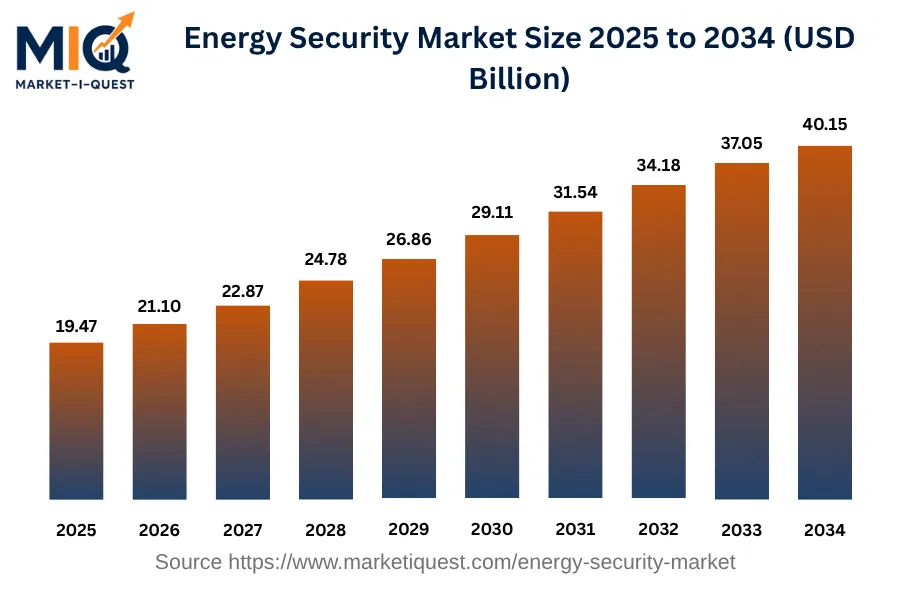
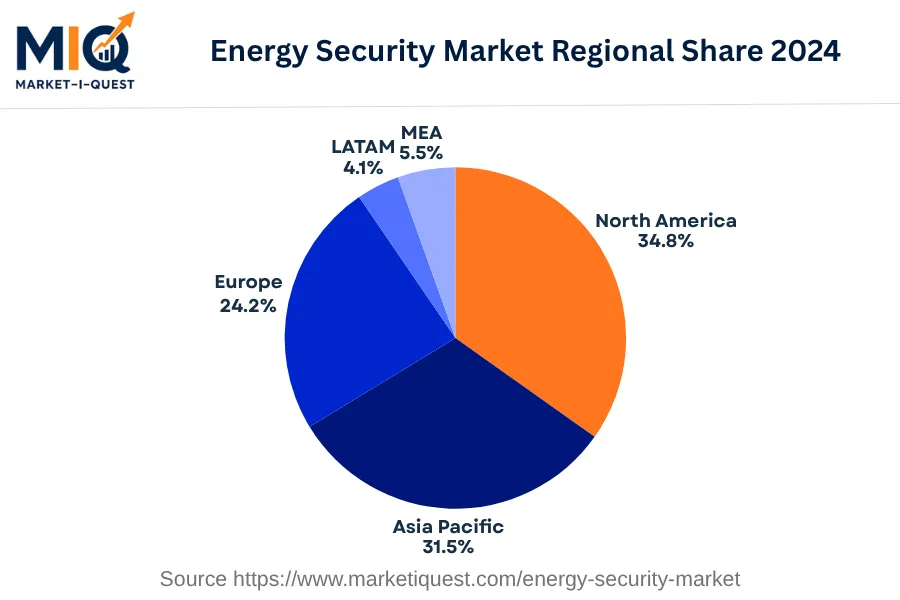
The Energy Security Market was valued at $19.47 billion in 2025, subsequently rising to an impressive $40.15 billion by 2034, recording a CAGR of 8.37%. The growth trajectory of this market indicates an increasing trend in value, from $17.97 billion in 2024 to nearly doubling by 2034. This rising curve highlights a market that is expanding steadily over a ten-year period. In a geographic breakdown of the market, in 2024, North America held the largest regional share of 34.8%, closely followed by Asia Pacific with a 31.48% share. Europe followed behind with a significant yet lesser share of 24.16%, whilst Latin America and the Middle East and Africa accounted for smaller proportions at 4.07% and 5.47% respectively. This regional distribution underscores the fact that the influence of the Energy Security Market is global, with significant involvement from North America and Asia Pacific regions.

Key Takeaways

  • By Source - Fossil Fuels held the dominant position accounting for a significant market share in the base year.
  • By Infrastructure - Power Plants emerged accounting for a significant proportion of the Energy Security Market.
  • By Cybersecurity - Data Protection maintained the top spot reflecting a major contribution towards market growth.
energy-security-market market size

Key Driving Factors

Government Initiatives for Renewable Energy

The Energy Security Market is experiencing significant growth due to the increased emphasis on renewable energy sources by various governments worldwide. Policymakers are setting ambitious targets for renewables in a bid to lessen reliance on fossil fuels, thus tightening energy security. For instance, the European Union's 'Green Deal' aims to make Europe the first climate-neutral continent. This requires significant upgrades to energy infrastructure to sustain renewable energies like wind, solar, and biomass. Such policies not only diversify countries' energy mix but also stimulate demand in the energy security market as both public and private sectors need novel solutions to transform the existing energy systems without compromising security.
Increasing Cyber Threats to Energy Infrastructure

The increasing sophistication of cyberattacks on energy infrastructure is another major driving factor for the Energy Security Market. The trend towards digitalization has made the energy sector more vulnerable to cyber threats, risking both operational continuity and security of supply. This is especially evident in highly digitized nations like the U.S., where ransomware attacks on critical infrastructure are commonplace. As a result, businesses and governments are investing heavily in cybersecurity measures for energy systems, creating surges in the Energy Security Market. The need to protect the grid from potential attacks, ensure reliable energy supply, and instill public trust necessitates robust security solutions, thereby driving the market growth.

Market Evolution by Timeline

2019-2023
In this period, buyers were primarily governments seeking stable energy supplies. Reasons for purchases included diversification of energy sources and the need for secure supplies. Major regions of purchase were Asia, particularly China and India, and Europe. On the supply side, both traditional and renewable energies were being traded, with integration into national grids gradually improving. Constraints included geographic limitations and political tensions. The Paris Agreement influenced adoption, setting goals for renewable energy use. Commercial models often involved long-term contracts and partnerships with governments. Prices generally remained steady, except for spikes due to geopolitical events. Risks were typically political, particularly in regions with high tensions such as the Middle East.
2024
In 2024, there was a push from corporations, particularly tech companies, as buyers. Purchases, largely from the USA and EU, emphasized renewable energies in anticipation of strict environmental regulations. Available technology was predominantly solar and wind power, with integration becoming smoother due to software advancements. Policy influences included the Green New Deal, encouraging renewable energy. Commercial dealings usually featured power purchase agreements offering fixed, long-term rates. Threats included doubts about the dependability of renewable energy sources and the need for efficient energy storage solutions.
2025-2029
From 2025 to 2029, buyers were increasingly cities committed to becoming carbon neutral. Predominately, this was seen in developed nations like Japan, Germany, and Canada. Energy supply technology diversified, with advancements in hydropower and geothermal methods. The United Nations' Sustainable Development Goals prompted greater adoption, calling for clean and affordable energy. Commercial models reflected a growing trend for microgrids, giving urban areas control over their energy. Risks revolved around the high initial costs of setting up clean energy infrastructure.
2030-2034
In 2030–2034, households started to become significant buyers as home-based renewable energy generation became viable. Key regions were the USA and Australia, spurred by policies supporting decentralized energy structures. Technology centering around residential solar panels and home-based wind turbines became popular. The Energy Independence Standards, focusing on decentralized structures, influenced adoption. Commercial models often involved leasing equipment and selling excess energy back to the grid, with key players like Tesla entering partnerships. Risks included still-evolving regulatory environments around decentralized power generation, with tariffs and subsidies in constant change.

Future Market Outlook

Future Opportunities

Looking ahead, multiple avenues for growth are emerging within the energy security market, driven by existing regulatory frameworks and technological advancements. For instance, the Energy Policy Act of 2005 in the United States has paved the way for increased investments in smart grid technologies, which enable more efficient energy distribution and management. Collaborations between major energy companies, such as Duke Energy and Google, underscore the potential for leveraging artificial intelligence in predictive analytics to enhance grid operations. Globally, the International Renewable Energy Agency's focus on integrating diverse energy solutions stresses the necessity for hybrid systems that combine renewables and conventional energy sources, offering a promising approach to meeting energy demands. In March 2023, the U.S. Secretaries of State and Energy outlined a partnership initiative aimed at bolstering international collaboration on energy resilience, highlighting opportunities for multinational engagement in clean energy technology. Furthermore, the recent 2023 summit hosted by the United Nations on climate resilience emphasized investments in decentralized energy systems, presenting favorable conditions for companies specializing in microgrid technology. As countries worldwide prioritize energy independence, emerging markets, particularly in Southeast Asia, present significant potential for advancements in energy storage and management solutions, driven by anticipated demand for more resilient infrastructure.

Segmentation Analysis

By Source

The market is divided into subsegments including Fossil Fuels, Renewable Energy, Nuclear Energy, and Others. Fossil Fuels accounted for the largest revenue share while Renewable Energy is expected to grow at the fastest CAGR during the forecast period.

Largest Revenue Share

Fossil Fuels

Market Share Leader

Despite the global shift toward sustainable and cleaner energy sources, fossil fuels, including coal, oil, and natural gas, continue to dominate the energy landscape, accounting for the highest revenue shares in 2024. This prominence is driven by multiple factors. Firstly, fossil fuels are deeply ingrained in the global economy, with many industries, such as the petrochemicals and transportation, reliant on these energy sources. The existing infrastructure for extraction, production, distribution, and consumption further reinforces the dominance. Secondly, the demand from developing and emerging economies, where renewable energy adoption is still nascent, contributes to a sizable portion of the revenue. Finally, policies and regulatory environments in some jurisdictions favor fossil fuels, ensuring stable supply and demand dynamics. It is also worth noting the purchasing criteria revolving around energy reliability and cost-effectiveness often tilt the scale towards fossil fuels, despite environmental implications.

Fastest CAGR

Renewable Energy

Forecast Period Growth Leader

Contrasting the revenue scenario, renewable energy signifies the fastest CAGR in anticipation, driven by an evolving mix of technological advancements, capital investments, policy initiatives, and strategic partnerships. Technological breakthroughs in areas like solar photovoltaics, wind turbines, and battery storage systems have improved efficiency, reducing the cost of renewable energy, now often directly competitive with fossil fuels. Policies favoring renewable energy, including subsidies, tax rebates, and regulatory mandates, are stimulating adoption in different geographies, overcoming obstacles like high upfront costs and intermittent supply. Moreover, capital flows toward renewable energy projects, both in terms of private equity and public funding have increased dramatically. Partnerships between governments, NGOs, and private businesses are aiding this transition. Notwithstanding, near-term risks include potential policy reversals, economic slowdowns, and technical barriers in grid integration and energy storage.

By Infrastructure

The market is divided into subsegments including Power Plants, Transmission Lines, Distribution Networks, Storage Facilities, and others. Power Plants accounted for the largest revenue share while Distribution Networks are expected to grow at the fastest CAGR during the forecast period.

Largest Revenue Share

Power Plants

Market Share Leader

Power Plants represent the subsegment with the highest revenue in 2024, driven by increasing energy consumption globally. Key drivers for this include the rising population, increased urbanization, and rapid industrialization. The demand for electricity drives the need for power plant infrastructure and equipment. Developing countries in particular are investing heavily to construct and update power plants in an effort to meet this growing demand. Power Plants are also essential in developed markets where aging infrastructure is often replaced or upgraded to comply with tightened regulations and to utilize more efficient and cleaner technology. Customers of Power Plants include both private and public utility companies, and these investments generally have high switching costs due to the long life-span of this type of infrastructure. Revenue is primarily derived from major projects commissioned by these entities, usually following public tender processes. The geographical scope is global, given the universal demand for electricity.

Fastest CAGR

Distribution Networks

Forecast Period Growth Leader

Distribution Networks are poised for the fastest growth over the forecast period. This growth is driven by the push towards electrification of various sectors, increasing consumption of electricity, and the growing adoption of renewable energy sources. Distribution Networks encompass the infrastructure that brings electricity from the grid to end-users, a critical aspect of any energy system. As the shift towards decentralized, renewable energy generation accelerates, upgrades to Distribution Networks are needed to accommodate these changes. The adoption of smart grid technologies for better management of energy use and integration of renewable sources is also a significant trend driving demand for advanced Distribution Networks. Potential risks could include policy changes, funding constraints, or broader economic factors impacting infrastructure investment. Nonetheless, the paradigm shift in the energy industry and the critical role played by Distribution Networks in ensuring reliable electricity supply underpins this positive growth outlook.

By Cybersecurity

The Cybersecurity market is divided into subsegments including Physical Security, Cybersecurity Measures, Data Protection, and Others. In 2024, the Data Protection subsegment accounted for the largest revenue share while Cybersecurity Measures is expected to grow at the fastest CAGR during the forecast period.

Largest Revenue Share

Data Protection

Market Share Leader

Currently, Data Protection holds the largest revenue share in the Cybersecurity market primarily due to the proliferation of digital transformations, which has led to a momentous increase in data generation. With the upsurge in data comes an increased need for its protection, making it an imperative part of the Cybersecurity landscape. The burgeoning regulations and compliance mandates regarding data privacy strengthen the revenue impact of this subsegment. Companies are more inclined towards investing in robust data protection solutions to avoid hefty penalties and reputational damage associated with data breaches. Besides, geographical factors also contribute. In regions with high digital adoption such as North America and Europe, businesses are realizing the importance of data protection, which significantly drives the revenue for this subsegment. Furthermore, the escalating trend of remote working due to the COVID-19 pandemic has further emphasized the necessity for data protection, enhancing its market worth in 2024.

Fastest CAGR

Cybersecurity Measures

Forecast Period Growth Leader

The Cybersecurity Measures subsegment is expected to grow at the fastest CAGR. The projected growth is propelled by several factors. Primarily, a global rise in cybercrime activities, from ransomware attacks to phishing scams, has increased the necessity for more robust cyber-defense mechanisms. Organizations across verticals are adopting advanced cybersecurity measures at a prolonged pace to protect their IT landscapes from such threats. Moreover, technological advancements like AI and Machine Learning are being increasingly deployed for cybersecurity, opening new avenues for developments in cybersecurity measures. Potential barriers to adoption, such as lack of trained personnel and high implementation cost, are being gradually mitigated with partnerships between cybersecurity providers and other organizations. Such endeavours lower adoption cost and provide cybersecurity training, thereby catalyzing growth. However, rapidly evolving cyber threats present near-term risks that might stifle the speed of adoption. Despite this, the subsegment's growth outlook remains promising.

Competitive Analysis for Energy Security Market

Key Market Players

Manufacturers / OEMs

Thales Group
France
Siemens AG
Germany
ABB Ltd.
Switzerland

Key Suppliers & Raw Materials

Honeywell International Inc.
US
Lockheed Martin Corporation
US
Cisco Systems, Inc.
US

Distributors, Integrators & Channel Partners

Schneider Electric
France
General Electric
US
Sophos Ltd
UK

Porter’s Five Forces Analysis

This analysis encapsulates the competitive environment within the Energy Security Market.

Supplier Bargaining Power

Medium

Providers of energy security solutions have moderate power due to their specialized knowledge and technologies.

Buyer Bargaining Power

High

Consumers hold high power with the ability to switch providers and the growth of renewable energy alternatives.

Threat of Substitutes

Medium

Alternative renewable energy sources serve as moderate substitutes, but infrastructure and availability are limiting factors.

Threat of New Entrants

Low

High capital costs, complex regulations, and technical expertise barriers deter new entrants.

Competitive Rivalry

High

Fierce competition due to the presence of numerous players offering similar energy security solutions.

Regional Analysis

Geographic market dynamics and growth opportunities across key regions

Global Market Outlook

energy-security-market market regional share

North America

In 2024, North American’s Energy Security Market was dominated by initiatives aimed at reducing reliance on foreign oil, transitioning to renewable resources, and strengthening energy infrastructure. High demand for energy security solutions arose from increasing energy consumption due to expanding industrial and residential sectors, particularly in the U.S. and Canada. Regulatory policies, such as the U.S.'s Energy Independence and Security Act (EISA) and Canada's Clean Fuel Standard, incentivized investment in energy-efficient systems and renewable energy technologies. These policies, coupled with significant advances in energy storage tech and smart grids, led to the heightened adoption of energy security solutions, especially in the utilities and manufacturing sectors.

Concurrently, trends observed in buyer behavior indicated a preference for self-sufficient energy systems, driven by growing concerns around energy availability and volatility in fossil fuel prices. This led to a noticeable shift towards renewable energy tech, including solar and wind, across enterprise and government sectors. In the face of this tech evolution, alliances and acquisitions grew among energy security providers to leverage combined capabilities. Finally, strict policy enforcement solidified the role of energy security in North American markets, particularly in the U.S., facilitating industry-wide standards that further bolstered the market's performance.

Asia Pacific

In 2024, the Energy Security Market in Asia Pacific reflects its strategic position in global energy planning. Drivers include China's ambitious clean energy policies stoking demand for secure energy, India investing heavily in smart grid infrastructure promoting stability, and Japan's regulatory environment pivoting towards renewable energy. Additionally, South Korea's rapid adoption of smart energy technologies and Australia’s robust supply dynamics, exemplified by an uptick in liquefied natural gas (LNG) exports, pave the way for a robust energy security market in the region. Trends surfacing in this market comprise China's shift toward electric mobility in transport, South Korea's push for hydrogen fuel cell technology, and ASEAN markets' increased integration of renewables into energy systems. Japan's partnerships with private enterprises for energy storage innovations and Australia's rigorous policy enforcement uphold energy security principles.

These trends and drivers affect diverse sectors across the region. For instance, manufacturing industries, government entities, and healthcare establishments in India are notably investing in energy security solutions to maintain operations and fulfill growing energy requirements. Similarly, utilities in China are also incorporating energy security services due to increasing regulatory pressures and burgeoning demand from expanding urban landscapes. Overall, these developments define a dynamic and important Energy Security Market in the Asia Pacific region in 2024.

Europe

In 2024, Europe's energy security market was characterized by a clear shift towards cleaner and more sustainable sources of energy. Driven by stringent EU regulations on carbon emissions and the Energiwende policy in Germany, major investments were directed towards renewable technologies, notably wind and solar power. Further, increasing adoption of digital technologies for better energy efficiency created ripple effects, with numerous IT enterprises aligning their services to cater to this demand. Volatile oil prices also fueled the need for sustainable, cost-effective energy alternatives, highlighting energy security's critical purpose in Europe's markets.

The energy security market witnessed a rise in strategic M&As aimed at consolidating market shares and expanding renewable energy portfolios, such as Shell's acquisition of Ubitricity in the UK, the largest public electric vehicle charge network. Consumer preferences were evidently shifting, with buyers increasingly favouring energy suppliers who offered green options and transparency in carbon footprint reporting. Policy enforcement around sustainable energy use was particularly crucial in sectors like manufacturing and healthcare where energy requirements are high. Furthermore, the Central and Eastern Europe regions demonstrated substantial progress in adopting renewable energy solutions, encouraged by government support and incentives. Europe's commitment to energy security in 2024 was thus marked by regional collaboration, technology innovation, and policy enforcement.

Latin America

In 2024, the energy security market in Latin America (LATAM) underwent significant evolution due to varied regulatory and market dynamics. Drivers of this shift included government initiatives such as Proyecto de Ley de Transición Energética in Mexico and RenovaBio program in Brazil, stimulating investment in renewable energy infrastructure. These programs combined with advancements in technology propelled the market, notably in Argentina, with a substantial increase in the uptake of energy efficient equipment. Further, an increasing demand for cleaner energy in key LATAM countries, namely Mexico and Colombia, bolstered the development of renewable energy resources. The surge in crude oil prices also played a crucial role, prompting consumers to turn towards alternative, locally sourced energy solutions.

Trends noticed in 2024 featured a growing sensitivity towards environmental consciousness in the region. As a result, consumers in the LATAM countries, particularly in Chile and Peru, increasingly embraced energy-efficient products and services. Channel dynamics shifted towards digital mediums, with the implementation of smart grids across utilities sector becoming more common. Additionally, a notable increase in partnerships and mergers and acquisitions in the energy sector was observed, with companies collaborating to enhance energy security. Lastly, the enactment of stricter energy policies and standards across the region emphasized renewable energy implementation and marked 2024 as a transformative year for LATAM's energy security market.

Middle East & Africa

In 2024, the Energy Security Market in Middle East and Africa demonstrated increasing resilience owing to geopolitical shifts and technological innovation. Economic diversification efforts, particularly in Saudi Arabia and the United Arab Emirates, boosted investments in renewable energy and nuclear power, enhancing regional energy security. Technological adoption, as exemplified by Israel's development of advanced cybersecurity measures for power grids, addressed threats to energy infrastructure. Regulatory reforms in Egypt and South Africa incentivized local and foreign investments in their energy sectors, further strengthening the market.

In terms of trends, buyer behavior towards renewable and clean energy solutions evolved, with Nigeria and Kenya significantly increasing their solar and wind energy capacities. The telecom and utilities sectors showed heightened interest in secure, sustainable energy sources to ensure uninterrupted services, primarily in Qatar and the UAE. Moreover, collaborations flourished, as seen in the agreement between South Africa's Department of Mineral Resources and Energy and international stakeholders to advance its Integrated Resource Plan. Policy enforcement was key in Saudi Arabia, where the government's strict adherence to its “Saudi Vision 2030” strategy translated into substantial gains in energy security. Overall, the year echoed positive developments for these nations in achieving energy security and sectoral integrity.

Recent Industry Developments

Latest market innovations, product launches, and strategic initiatives

July 2026

Aditya Birla Renewables (ABReN), a part of the Aditya Birla Group, signed a definitive agreement to acquire Sprng Energy from Shell in a deal valued at INR 17,200 crore (~$1.8 billion). The acquisition adds a contracted renewable energy portfolio of approximately 5 GWp to ABReN's platform, increasing its total renewable portfolio to 9.3 GWp from about 4.3 GWp.

March 2026

The Government of India notified the Natural Gas (Supply Regulation) Order, 2026, facilitating the expansion of piped natural gas (PNG) networks, improving last-mile connectivity, and promoting a shift toward cleaner fuels, thereby strengthening energy security and supporting India's transition to a gas-based economy.

Frequently Asked Questions