Conductive Polymers Market Snapshot

Key Players

  • 3M (United States)
  • BASF SE (Germany)
  • Covestro AG (Germany)
  • Cabot Corporation (United States)
  • Heraeus Holding GmbH (Germany)
  • Agfa-Gevaert N.V. (Belgium)
  • Celanese Corporation (United States)
  • Polyone Corporation (United States)
  • H.C. Starck GmbH (Germany)
  • Solvay SA (Belgium)

Market Size

Base Year 2024
$5.24 Bn
CAGR
8.6%
Forecast 2034
$11.91 Bn

Market Segments

By Product
  • ABS
  • Polyphenylene-based Resins
  • Polycarbonates
  • Inherently Conductive Polymers (ICP)
  • Nylon
  • Others
By Application
  • Actuators & Sensors
  • Anti-static Packaging
  • Batteries
  • Capacitors
  • Solar Energy
  • Others

Market Dynamics

Drivers
  • Increasing demand in electronics
  • Technological innovations in polymer development
Restraints
  • High production costs
  • Stability issues
Opportunities
  • Emerging green energy applications
  • Unexplored biomedical fields

Market Size

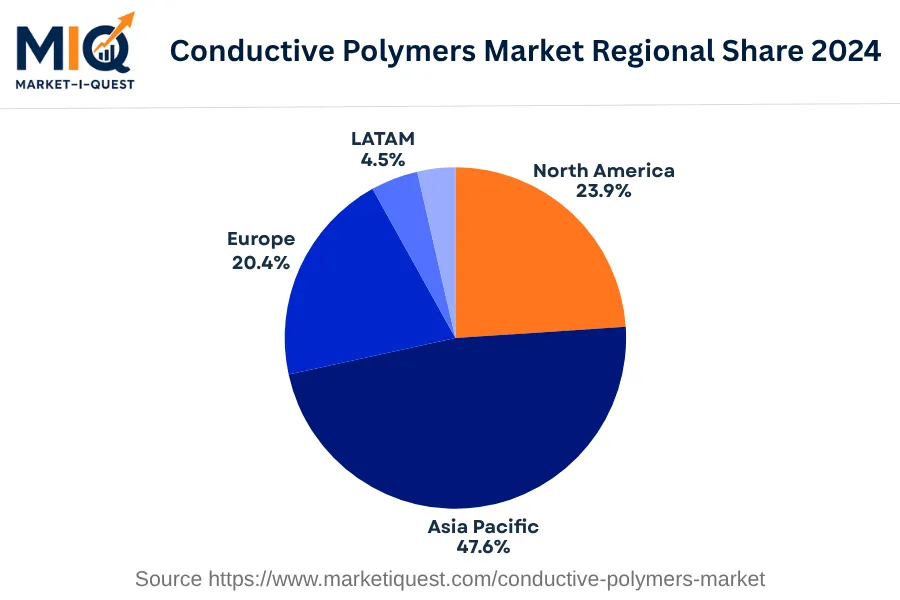
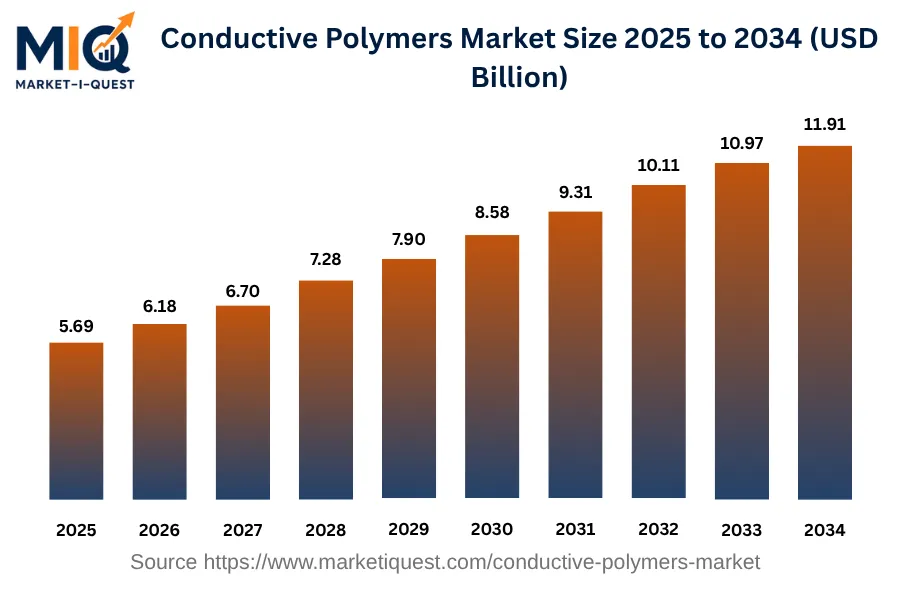
The Conductive Polymers Market in 2025 stands at a size of $5.69 billion, following a value of $5.24 billion in 2024. By the end of 2034, the market is expected to grow substantially, reaching a value of $11.91 billion. This growth translates to a CAGR of 8.56% from 2025 to 2034, signifying a comprehensive expansion over the decade. On a regional basis in 2024, the market demonstrated a diverse mix of shares, with the Asia Pacific commanding the largest share at 47.6%. This was followed by North America with a 23.9% share, and Europe with a 20.4% share. LATAM and MEA covered the remaining shares with 4.5% and 3.6% respectively, pointing towards a fragmented yet influential presence in these regions.

Key Takeaways

  • By Product -Nylon led the Conductive Polymers Market in terms of demand accounting for a significant share in the base year.
  • By Application - Solar Energy held a dominant position in the Conductive Polymers Market driven by their widespread use across numerous industries.
conductive-polymers-market market size

Key Driving Factors

Emergence of Electric Vehicles (EVs)

The automotive industry's pivot towards electric vehicles (EVs) is significantly influencing the conductive polymers market. EV manufacturers are seeking lightweight materials to enhance vehicle efficiency and range. Conductive polymers are notably lighter than traditional metals and have excellent electrical and thermal conductivity; making them ideal for EV battery technologies. They are incorporated into lithium-ion battery separators to accelerate ion transport and improve safety. With more automakers committing to an all-electric future, the demand for conductive polymers in the EV battery industry is expected to drive the conductive polymers market in the near term.

Stringent Environmental Regulations

The shift in the conductive polymers market is also driven by strict environmental regulations aimed at reducing the emissions and waste generated by industries. For instance, regulations from the Environmental Protection Agency (EPA) and equivalents in other countries necessitate industries to minimize the use of heavy metals such as lead and mercury, which are often used in electrical and electronic components. Conductive polymers present an environmentally friendly alternative being lead-free and recyclable. They also consume less energy during production, further reducing the overall environmental impact. Consequently, industries compelled by these regulations are increasingly opting for conductive polymers, fostering a sustainable growth trajectory for the conductive polymers market.

Market Evolution by Timeline

2019-2023
Buyers during this period included electronics and automotive industries, motivated by the need for lightweight and cost-effective materials. The regions of Asia Pacific and North America had a high demand due to the propelling industries located there. Conductive polymers were being shipped largely in the form of polyaniline and polyphenylene based products, with widely varying maturity of integration into various end-products. There were no significant regulatory influences during this period. With prices showing a steady downward curve, majority of transactions were purchase orders without long-term contracts. Product quality concerns were prominent, leading to recall risks and resulting in quality control measures being beefed up by suppliers.
2024
The marginally increased demand from Asia Pacific region this year was typically due to the growth in electronics and automotive industries. The supply side saw an increase in capabilities with conductive polymer composites becoming more mature. This technology shift was facilitated by the absence of stringent regulations inhibiting the use of conductive polymers. The contractual nature of commercial deals remained largely unchanged, with purchase orders being the dominant type. The risks shifted away from product quality to supplier reliability as concerns about raw material shortages became apparent.
2025-2029
This period saw a slight flattening in demand. The growth of electronics sector in Africa led to an increased regional demand. Different polymers, such as conductive polystyrene, were explored, signalling a diversification in the technology applied. There was a noticeable shift towards sustainable sourcing policies for manufacturers. Commercially, long-term contracts started becoming more prevalent due to the increased confidence in the stability of raw material prices. Supplier reliability continued to dominate the risk landscape due to explorations in new technology.
2030-2034
The period witnessed technology advancements as major suppliers started integrating more AI-based quality control systems into their production lines. This increased the supply of high-quality conductive polymers. Major industry players started partnering with universities and research institutions to explore innovative uses for conductive polymers. European Union's regulations for more biodegradable alternatives led to a surge in demand for bio-conductive polymers. Automated contract negotiations between buyers and sellers became more common, boosting the efficiency of commercial transactions. The switch from non-renewable energy sources to renewable energy posed a risk to manufacturers.

Future Market Outlook

Future Opportunities

The ongoing research and investment in the conductive polymers market suggest significant future opportunities across various sectors. For example, in 2023, the National Renewable Energy Laboratory in the United States identified potential applications of conductive polymers in solar cell technology, which could enhance energy efficiency and durability. The healthcare sector is also making strides; companies like Philips have initiated projects focused on using conductive polymers in smart medical implants, leading to improved patient outcomes. This trend aligns with global health initiatives that encourage the integration of technology into patient care, providing a direct pathway for the growth of conductive polymers in medical applications. Additionally, the automotive industry is being influenced by recent regulatory changes, such as the European Union's Framework 2050 that targets emissions reductions, which could drive demand for lightweight materials in electric vehicles, reinforcing the role of conductive polymers. Areas like robotics and artificial intelligence may also see increased integration of conductive polymers, as shown by research at MIT that focuses on soft robotics which utilize these materials for enhanced sensing capabilities. Furthermore, as manufacturers seek to comply with sustainability mandates, interest in recycling and repurposing conductive polymers is expected to rise, particularly in regions such as Scandinavia, which have proactive recycling programs. These trends indicate that as existing technologies mature, companies will have opportunities to innovate and apply conductive polymers in diverse and emerging applications.

Segmentation Analysis

By Product

The market is divided into subsegments including ABS, Polyphenylene-based Resins, Polycarbonates, Inherently Conductive Polymers (ICP), Nylon, and Others. Among all, Nylon accounted for the largest revenue share while Inherently Conductive Polymers (ICP) are expected to grow at the fastest CAGR during the forecast period.

Largest Revenue Share

Nylon

Market Share Leader

Robust demand for Nylon can be attributed to its versatile properties such as high tensile strength, abrasion resistance, and thermal stability, which makes it a preferred choice among sectors like automotive, electronics, and textiles. The growing automotive industry, where Nylon is extensively used in tire cords, airbags, and other components is a key growth driver. Its usage in high-speed machines and equipment due to its thermal stability potential is another incentive for industries to choose Nylon. Further, cities with an emerging textile scope, owing to the rise in living standards and increase in disposable income, have significantly driven the demand for Nylon. Cost-effectiveness is another contributory factor for Nylon’s widespread use. With increasing adoption of Nylon in these sectors, there exists high switching costs as shifting to alternative products might lead to trade-off in terms of their efficiency and productivity. Therefore, these solidified customer channels have propelled Nylon to be the subsegment with the largest revenue share.

Fastest CAGR

Inherently Conductive Polymers (ICP)

Forecast Period Growth Leader

Inherently Conductive Polymers (ICP) are projected to grow at the fastest pace considering their rising adoption for an array of applications including organic solar cells, organic light-emitting diodes, and sensors, primarily due to their properties like electronic conductivity and photoluminescence. The rapid advancement in electronics and renewable energy sectors is significantly driving the demand for ICP. Barriers to adoption are reducing with the resolution of technical challenges related to processability and stability through focused research and development efforts. The announcement of government policies in multiple countries to boost renewable energy sector is a major catalyst for growth. On the other hand, high price compared to conventional polymers and dependency on petroleum feedstock for production present some near-term risks. Still, those risks appear manageable given the strong momentum for more sustainability in material science and electronics industry. The growth outlook of ICP is further powered by strategic partnerships amongst key players, focusing on expansion of production capacities and technological advancements.

By Application

The market is divided into subsegments including Actuators & Sensors, Anti-static Packaging, Batteries, Capacitors, Solar Energy, and Others, with Solar Energy accounting for the largest revenue share while Actuators & Sensors is expected to grow fastest in the forthcoming years.

Largest Revenue Share

Solar Energy

Market Share Leader

In the base year 2024, Solar Energy is considered the largest revenue contributor among other subsegments. This is traced back to the accelerating demand for clean and renewable energy sources globally as people become more environment-conscious. Global initiatives and regulations to lower the dependency on fossil fuels have promoted the use of solar energy. Plus, governments' favorable policies, incentives, and tax benefits for solar power adoption in numerous countries have also served to propel the revenue for this subsegment. Running costs for solar energy are relatively low, and along with the falling cost of solar panels, these aspects have pushed the large-scale adoption of solar energy systems. Hence would explain why it holds the major revenue share.

Fastest CAGR

Actuators & Sensors

Forecast Period Growth Leader

Actuators & Sensors is predicted to be the fastest-growing subsegment. The escalating growth rate can be associated with the growing implementation of smart devices and systems, led by the wave of digitalization. These components play a critical role in providing intelligence to these devices, in turn, driving its demand. Advancements in technology have resulted in these components becoming more accurate, reliable, smaller, and economically viable – directly influencing their adoption rate. However, technological complexity and implementation costs could pose as barriers to adoption. Nevertheless, collaborations between hardware manufacturers and software developers can lower these barriers, further boosting the growth rate of this subsegment.

Competitive Analysis

Key Market Players

Manufacturers / OEMs

Agfa-Gevaert N.V.
Belgium
Panasonic Corp.
Japan
3M Company
US

Key Suppliers & Raw Materials

Covestro AG
Germany
PolyOne Corporation
US
Celanese Corporation
US

Distributors, Integrators & Channel Partners

RS Components
UK
Johs Rasmussen Hamburg GmbH
Germany
Manuco Electronics (Asia) Pte Ltd
Singapore

Porter’s Five Forces Analysis

This analysis provides insights into the competitive dynamics within the conductive polymers market.

Supplier Bargaining Power

Medium

Driven by their ability to determine raw material prices and control key polymer types.

Buyer Bargaining Power

High

Buyers can switch suppliers due to low switching costs and standardization of polymers.

Threat of Substitutes

Low

Conductive polymers have unique properties which limit the availability of viable substitutes.

Threat of New Entrants

Medium

Technological know-how and capital investment act as substantial barriers to entry.

Competitive Rivalry

High

The conductive polymers market is highly competitive with numerous established players.

Regional Analysis

Geographic market dynamics and growth opportunities across key regions

Global Market Outlook

conductive-polymers-market market regional share

North America

In 2024, the North American conductive polymers market thrived, influenced by dynamics in demand factors, regulations, and technology developments. Key drivers included the growing demand in industries such as electronics, automotive, and aerospace due to their superior electrical conductivity, thermal stability, and mechanical strength. The regulatory push in the U.S., Canada, and Mexico, focusing on eco-friendly and energy-efficient materials, also spurred the conductive polymers market. Additionally, significant investments in R&D by major market players like Solvay and Lubrizol boosted technological advancements, contributing to the market growth.

The market landscape was shaped by distinct trends during this period. The increasing shift toward miniaturization of electronic devices drove the demand for conductive polymers in the electronics sector, particularly in the U.S., given its robust electronics industry. There was a growing preference for conductive polymers in photovoltaic applications in Mexico and Canada due to its lightweight and flexible property, reflecting a substantial shift in buyer behavior. Strategic partnerships aimed at enhancing production capabilities, like the collaboration between PolyOne Corporation and BASF, were evident in 2024. Balancing these dynamics, enforcement of stringent quality standards was observed, impelling the manufacturers to meet set specifications. Sectors like government, utilities, healthcare, and retail also demonstrated an increased uptake of conductive polymers across North America in 2024.

Asia Pacific

In 2024, the Asian Pacific Conductive Polymers market displayed robust growth driven by key sectors - electronics, automotive, and healthcare. Demand hike was led by China and Japan investing heavily in nanotechnology, while India's stringent regulations against static electricity in explosive manufacturing increased the demand in safety-sensitive industries. Parallelly, Australia's adoption of conductive polymers in solar cell technology demonstrated an imperative push towards renewable energy.

Market trends were characterized by changes in buyer behavior and technology advancements. China's consumer electronics sector primarily dictated this, favoring lightweight conductive polymers over conventional materials. A significant shift was observed in South Korea and Japan, where high-end automotive manufacturers increasingly used conductive polymers for anti-static applications, underlying their aesthetic versatility and lightweight nature. Regulatory enforcement was prominent in the ASEAN market to curb pollution caused by heavy metals used in conductivity applications.

Commendably, healthcare emerged as a significant customer, propelled by India’s adoption of conductive polymers in biomedical applications, driven by policy enforcement to upgrade healthcare standards. Australia saw an increase in partnerships between local conductive polymer manufacturers and global product innovators. The drive towards sustainability was further supported by India and China's growing e-retail channels supplying green conductive polymers. Understanding and responding to these drivers and trends will be critical for those looking to compete and grow in this market.

Europe

In the base year 2024, the conductive polymers market emerged as a notable sector in Europe's high-performance materials industry. The market’s growth was propelled by increased demand due to its benefits for weight reduction, fuel efficiency, and corrosion resistance in automotive and aerospace sectors. Stricter EU regulations promoting environmental sustainability and reduction of carbon emissions have favored the adoption of these polymers. Investment influx from key sectors like consumer electronics and renewable energy industries also spurred the market.

The primary trends within the market include a notable shift towards bio-based conductive polymers in response to heightened environmental consciousness in countries like Germany, the UK, and Italy. The burgeoning electric vehicle manufacturing in these nations demanded high-quality, lightweight and efficient conductive polymers. Increased usage in healthcare, specifically in drug delivery systems and biosensors, was also observed in France and the Benelux countries.

The market saw several strategic alliances and M&A activities, which were pronounced within Central and Eastern Europe, as companies aimed to enhance their reach and product portfolio. Finally, high standards and policy enforcement by EU regulatory bodies ensured the quality, safety, and eco-friendliness of these polymers. Overall, the conductive polymers market in Europe demonstrated significant growth and adaptability in response to evolving demands and policies.

Latin America

In 2024, the conductive polymers market in Latin America evidenced a substantial growth, driven by increasing technological adoption, favorable investment climate, and regulatory shifts. The demand for conductive polymers ballooned in end-user sectors like electronics, automotive, and healthcare in countries such as Brazil, Mexico, Argentina, Colombia, Chile, and Peru, largely due to the rise in local telecom and IoT manufacturing. Mexico and Brazil, with their robust automotive industry, also spurred the market expansion, particularly leveraging on conductive polymers to curb electromagnetic interference.

Importantly, the pro-innovation government policies across LATAM provided an impetus, fostering more investments into conductive materials research, and their industrial-scale production. For example, Argentina's creation of the National Industrial Technology Institute helped foster this expansion.

In terms of trends, a shift towards sustainable materials was evident, predominantly steered by environmental regulations and a growing consumer preference for green products. This impacted buyer behavior and influenced significant moves within the market as firms invested heavily in R&D to develop bio-based conductive polymers. Additionally, numerous partnerships and mergers were noted as firms sought to consolidate their market position and broaden polymers portfolio; notable was Brazil's Braskem partnership with U.S-based ALLR-EL to produce bio-based polymers. Lastly, the market saw an influx in e-commerce channels for distribution, favored by the region's growing digitization trends, making online the prime platform for customer engagement and product sales.
Middle East & Africa

In 2024, the Middle East and Africa Conductive Polymers Market experienced increased dynamism due to several key drivers and trends. The demand for conductive polymers surged across sectors like telecommunications, healthcare, and manufacturing, underpinned by the enhancement of powers infrastructure in Saudi Arabia, UAE, Qatar, and Israel. Manufacturers in these countries were locally sourcing conductive polymers, decreasing import reliance and boosting the industry.

Favourable government policies and investments in Egypt and South Africa further sustained the sector's growth. Nigeria adopted advanced technologies expediting conductive polymer production, showcasing increased industrial digitization. A rise in polymer price in Kenya indicated the tightening supply dynamics, concurrently demonstrating augmented local consumption.

Emphasizing trends, conductive polymers' incorporation into renewable energy projects rose greatly within Egypt and South Africa due to their superior conductivity and efficiency. Partnership agreements between local and international players, most noticeably in UAE and Israel, were entered into to pursue enhanced polymer production techniques. Furthermore, regulatory policies in Saudi Arabia and Qatar enforced stringent standards on conductive polymer quality, signifying a shift towards sustainability. In retail sectors of Nigeria and Kenya, customer preference trended towards locally produced, high-grade conductive polymers, emphasizing the rise in consumer awareness on product quality. The 2024 market for conductive polymers in the Middle East and Africa was indeed reflective of evolving industrial practices and consumer tendencies.

Recent Industry Developments

Latest market innovations, product launches, and strategic initiatives

May 2026

PolyJoule launched a new type of conductive polymer battery cell. It uses a specialized plastic-based component and a fire-resistant liquid, aiming to provide safer energy storage for homes and businesses without relying on traditional lithium.

September 2025

The Council for Scientific and Industrial Research (CSIR) partnered with Filament Factory to introduce a new reinforced conductive polymer. This material is specifically designed to block unwanted electronic interference and improve the reliable flow of electricity inside modern electronic devices.

Frequently Asked Questions