
Actuators Market Snapshot

Key Players

  • Emerson Electric Co (United States)
  • Honeywell International Inc (United States)
  • Siemens AG (Germany)
  • ABB Group (Switzerland)
  • Johnson Controls (Ireland)
  • Schneider Electric (France)
  • SMC Corporation (Japan)
  • Bürkert Fluid Control Systems (Germany)
  • Rotork Plc (United Kingdom)
  • Cameron International Corporation (United States)

Market Size

Base Year 2024
$68.48 Bn
CAGR
4.3%
Forecast 2034
$104.33 Bn

Market Segments

By Type
  • Electric Actuators
  • Pneumatic Actuators
  • Hydraulic Actuators
  • Mechanical Actuators
  • Smart Actuators
By Sales Channel
  • Original Equipment Manufacturers (OEMs)
  • Aftermarket
By End Use Industry
  • Manufacturing
  • Oil & Gas
  • Automotive
  • Food & Beverage
  • Aerospace
  • Processing
  • Pharmaceuticals
  • Water Treatment
  • Chemical
  • Power Generation
  • Mining
  • Others

Market Dynamics

Drivers
  • Rising automation trends
  • Increasing industrial applications
Restraints
  • High production cost
  • Technological complexities
Opportunities
  • Advancements in smart technologies
  • Growing automation industries

Market Size

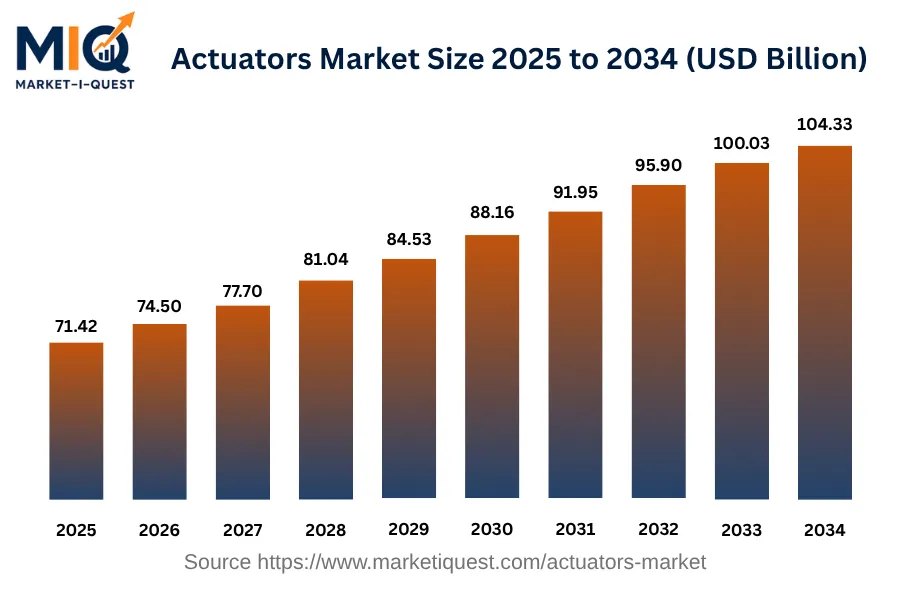
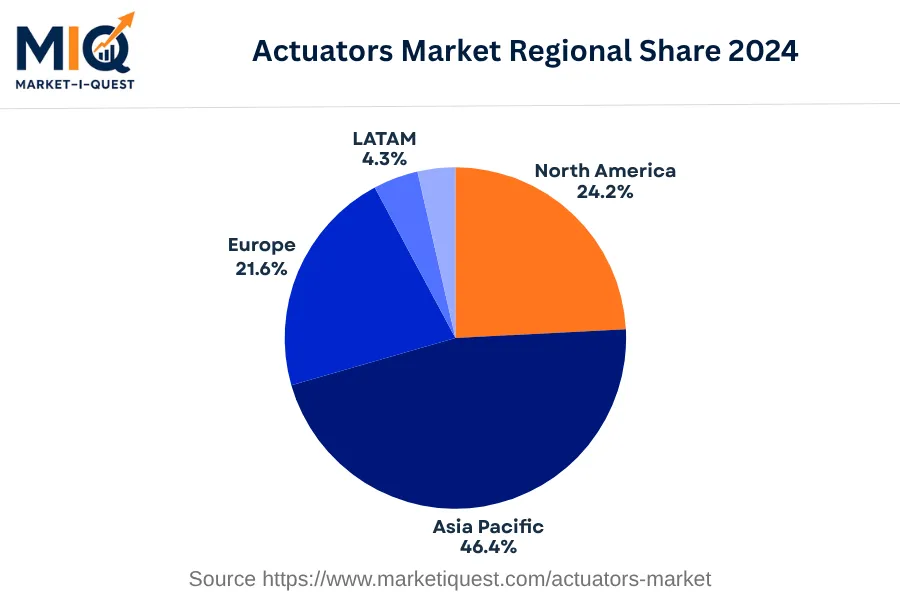
The Actuators Market in 2025 is valued at 71.42 billion USD, increasing from a size of 68.48 billion USD in 2024. It will further grow up to 104.33 billion USD by 2034, demonstrating a CAGR of 4.3%. The consistent growth from 2025 to 2034 mirrors the ongoing expansion in the industry. Factors contributing to this growth trajectory include technological advancements and rising demands in different sectors such as automation, healthcare, and automotive. Globally, the regional share breakdown during the start year of 2024 signifies a diverse distribution within the market. While the Asia Pacific region constitutes the majority share with 46.4%, North America follows with 24.2%. Europe accounts for 21.6%, whereas, LATAM and MEA represent 4.3% and 3.6% respectively of the global Actuators Market shares, adding variety to the global market distribution.

Key Takeaways

  • By Sales Channel - Original Equipment Manufacturers held the dominance of this segment in the market.
  • By End Use Industry - Manufacturing led the charge in terms of usage of actuators.
  • By Type - Hydraulic Actuators held the largest share of the segment.
actuators-market market size

Key Driving Factors

Adoption of Smart City Infrastructure

Around the world, cities are embracing Smart City initiatives to improve efficiency, convenience, and quality of life for their citizens. This involves a transition to systems that are interconnected, data-driven, and automated - a shift that heavily relies on the use of actuators. Actuators function as the 'muscle' in smart systems, converting the digital control signals (the 'brain') into physical action, thus making the whole smart infrastructure function. They are used in intelligent traffic systems, asynchronous public services, automated energy management, etc. Even though 'Smart City' itself is a broad concept, these diverse applications of actuators across different sectors within it is what's driving spend and adoption in the actuator market.
Stricter Emission Regulations in Automotive Industry

Regulations such as EU6 in Europe and Tier 3 in the United States require automotive manufacturers to significantly reduce vehicle emissions. One effective strategy to meet these standards is using advanced actuators that control engine functions more precisely for optimal fuel combustion, reducing both fuel consumption and harmful emissions. In addition, these regulations also pertain to the development and production of electric and hybrid vehicles, which utilize a higher number of actuators compared to conventional vehicles. The need for manufacturers to adhere to these stringent emission standards is causing a surge in the procurement of advanced actuators, thereby driving the market growth of actuators.

Market Evolution by Timeline

2019-2023
Major players in automation, aerospace, and defense sectors dominated the demand for actuators. High usage was seen in regions, including Asia Pacific and North America. Technology advanced towards miniaturization and efficient power consumption. Supply chain focused on digital actuator technologies and piezoelectric type. Initial steps towards industry standardization were seen with initiatives like ISO 16330 for aircraft actuators by ASA. Contractual partnerships grew with technology firms and raw material suppliers focusing on long-term deals. Pricing relied heavily on material costs affecting value proposition. However, scarcity of skilled professionals and high production costs were major risks. Responses included training programs and cost-optimization techniques.
2024
A year marked by increased demand from the automotive industry, particularly for electric vehicles in Europe. Additionally, end-users started to prefer smart actuators, leading to a technology shift towards integrating IoT capabilities. Challenges emerged regarding infrastructure development and data security. Regulatory policies urged manufacturers to comply with safety standards, where ISO 26262 became effective. The commercial models leaned towards fixed pricing contracts and end-users started to favor suppliers offering installation services and maintenance contracts. Risks included competition from low-cost producers. Firms typically responded by investing in R&D to keep their technological edge.
2025-2029
During this period, demand for miniature actuators amplified from the medical sector across developed nations for precision movement in medical devices and surgical robotics. The technology matured with stronger integration of AI into actuator systems. Constraints included power consumption and durability issues. The policy landscape largely revolved around health and safety standards, with ANSI/AAMI ES60601-1 gaining significance. The commercial model saw a shift towards contractual pricing with flexible payment terms. Single-use disposables also became common. Risotec was one potential risk due to contamination. Most manufacturers responded by implementing rigorous quality assurance processes and rigorous sterilization procedures.
2030-2034
A surge in demand witnessed from space and undersea applications across countries including USA, China, and Russia. Actuator technology leaned towards developing lightweight materials and high-resilience designs. Major supply constraints included the hardness of materials and extreme pressure handling capacities. Regulations such as MIL-STD-801G were key for standardizing military-grade actuator products. Commercially, pricing became competitive and firms looked for sustainable procurement models. Strategic alliances flourished with material suppliers and R&D institutions. Major risks emerged from long design phases and rigorous testing requirements. Common responses were increased project timelines and allotting separate budgets for prototyping.

Future Market Outlook

Future Opportunities

Looking ahead, the actuators market is poised for growth driven by increased demand for automation technologies across multiple industries. In 2023, the push for digital transformation in manufacturing has prompted companies like Rockwell Automation to explore new actuator solutions integrated with robotics for enhanced operational efficiency, especially in Asia-Pacific regions. Additionally, regulations set out by the European Union’s Machinery Directive have compelled manufacturers to invest in more sophisticated actuators, driving opportunities for companies producing compliance-ready technologies. Remote access and monitoring capabilities offered by smart actuators present new prospects, particularly in the oil and gas sector where companies like Chevron are experimenting with remote-controlled actuators for pipeline management. The trend toward renewable energy infrastructure, exemplified by the U.S. government's increased funding for wind and solar projects, indicates a rising need for actuators designed specifically for renewable applications. Furthermore, advancements in microelectromechanical systems (MEMS) present opportunities for compact and efficient actuators applicable in the consumer electronics space—an area being actively explored by tech giants like Apple. As industries increasingly prioritize sustainability and operational efficiency, opportunities to develop energy-efficient and functional actuator solutions across production lines and smart devices will increasingly arise, marking a significant shift in the landscape of actuator technology globally.

Segmentation Analysis

By Type

The market is divided into subsegments including Electric Actuators, Pneumatic Actuators, Hydraulic Actuators, Mechanical Actuators, and Smart Actuators. Hydraulic Actuators accounted for the largest revenue share while Smart Actuators are expected to grow at the fastest CAGR during the forecast period.

Largest Revenue Share

Hydraulic Actuators

Market Share Leader

Hydraulic actuators dominate the market due to their high force output, paired with precise control, making them ideal for industrial heavy-duty applications. This segment experiences robust demand across verticals such as construction, manufacturing, and mining where heavy lifting and movement are typical. Emergence from recessions across core geographies, alongside positive economic trends, increases infrastructure investments leading to steady demand for hydraulic actuators. Regulations demanding safety in the workplace further drive the need for reliable, robust actuators like hydraulics. Purchasing criteria tend to center on performance and reliability, in which hydraulic actuators typically excel. Companies often face high switching costs when moving away from hydraulic actuators due to the need for significant re-engineering. Traditional distribution channels, complimented by strong online sales, contribute to the wide availability and high revenue generation of these devices. High durability results in longer replacement cycles, adding to their continued market dominance.

Fastest CAGR

Smart Actuators

Forecast Period Growth Leader

Market demand for smart actuators is on the rise, projected to be the fastest growing sub-segment. The primary driver is the ever-growing adoption of automation technology across various industries. With advancements in IoT and AI, smart actuators have become more sophisticated, enabling their integration into the highly digitized industrial environments. The incorporation facilitates enhanced process control, reduces human error and optimizes energy consumption, delivering cost efficiency over time. Policy initiatives towards digitization and industry 4.0 provide further impetus. However, high upfront capex can be a barrier for smaller operations. Rapid advances in technology call for consistent investment in design updates, increasing partnerships between actuator manufacturers and automation technology firms. Tasked with staying ahead of evolving roadblocks - such as data security in IoT enabled devices - these partnerships may also create near-term risks alongside opportunities.

By Sales Channel

The market is bifurcated into subsegments including Original Equipment Manufacturers (OEMs) and Aftermarket, wherein OEMs account for the largest revenue share, while Aftermarket is forecasted to grow at the fastest CAGR during the projection period.

Largest Revenue Share

Original Equipment Manufacturers (OEMs)

Market Share Leader

The Original Equipment Manufacturers (OEMs) accrue the largest revenue share in 2024 due to several factors. OEMs typically have longstanding relationships with large industrial enterprises, which offer steady, high-volume sales and recurring revenue from lifecycle management contracts. This relationship is built on trust in quality and reliability, which justifies a price premium and discourages switching. The OEM model is widely spread over diverse geographies, reducing exposure to regional economic downturns. Regulatory factors also play a role. The sophistication of the products they manufacture requires stringent quality control both in production and across the supply chain, creating significant barriers for new entrants. In addition, the continuing trend towards digitization and automation in various industries prompts businesses to rely heavily on OEMs for high-end, complex solutions which makes the position of OEM segment stronger in terms of revenue.

Fastest CAGR

Aftermarket

Forecast Period Growth Leader

The Aftermarket segment, although not leading in revenue, is poised to grow at a faster rate. The capacity for growth is largely driven by improved technology and changes in consumer behaviour. Recent advancements provide the potential for enhanced product performance, creating both new entrants and growth opportunities within existing firms in this segment. Customers, particularly in developed markets, are showing a greater willingness to replace or upgrade specific components rather than replacing entire systems, which may be a more economical choice. Barriers to entry, while lower than in the OEM segment, shift more towards competitive positioning and brand awareness. However, risks do exist. If economies shrink or stagnate, customers may postpone discretionary replacements and upgrades, temporarily slowing growth in this segment. In addition, partnerships with reliable suppliers are essential to maintain quality and competitive price points.

By End Use Industry

The end use industry, segment_3, is divided into subsegments including Manufacturing, Oil & Gas, Automotive, Food & Beverage, Aerospace, Processing, Pharmaceuticals, Water Treatment, Chemical, Power Generation, Mining, and Others. In 2024, the Manufacturing subsegment dominated the market in terms of revenue share, whereas the Power Generation subsegment is anticipated to grow at the fastest CAGR.

Largest Revenue Share

Manufacturing

Market Share Leader

The Manufacturing subsegment reaping the largest share of the revenue can be attributed to several factors. It is an industry that is globally widespread, hence serving as a significant stakeholder in many economies. Furthermore, the recent developments in automation technologies such as Robotics and Artificial Intelligence have increased the efficiency and productivity levels, thus leading to a higher demand for manufacturing activities. Furthermore, the Manufacturing subsegment marries well with today's digital era, as new digital solutions have opened up opportunities for value added services. While the manufacturing industry's growth is reliant on policy support, consumer demand and the overall health of the economy, the continuous advancements in technology are expected to drive its future growth, thereby contributing to its substantial revenue in 2024.

Fastest CAGR

Power Generation

Forecast Period Growth Leader

Although the Power Generation segment does not boast of the most substantial revenue, it is estimated to grow at the fastest CAGR. This growth can be attributed to the global shift towards renewable energy, prompted by the pressing threat of climate change and environmental deterioration caused by non-renewable sources of energy. Governments across the globe have implemented constructive policies and have devised incentives to encourage the adoption of clean energy. Besides, impressive advances in technology, coupled with heavy capital investment in R&D activities, have led to efficiency improvements and cost reductions, making renewable power generation increasingly competitive. Despite these growth drivers however, various adoption hurdles do exist, including high initial setup cost and land use concerns. Collaboration with private entities and extensive research are needed to circumnavigate these barriers.

Competitive Analysis

Key Market Players

Manufacturers / OEMs

Honeywell International Inc.
US
Siemens AG
Germany
Emerson Electric Co.
US

Key Suppliers & Raw Materials

Bosch Rexroth AG
Germany
Schneider Electric
France
Rockwell Automation, Inc.
US

Distributors, Integrators & Channel Partners

W.W. Grainger, Inc.
US
MSC Industrial Supply Co.
US
Fastenal Company
US

Porter’s Five Forces Analysis

This analysis provides insights about the competitive landscape of the Actuators Market.

Supplier Bargaining Power

Medium

Major suppliers maintain bargaining power due to specialized manufacturing processes and intellectual property.

Buyer Bargaining Power

High

Numerous providers and variations of actuator technologies increase buyers' options and negotiation power.

Threat of Substitutes

Medium

Although substitutions exist, the complexity and performance requirements limit their efficacy.

Threat of New Entrants

Low

High entry barriers exist due to the technical expertise required and substantial capital investment.

Competitive Rivalry

High

There is high rivalry due to the presence of several established global players with similar offerings.

Regional Analysis

Geographic market dynamics and growth opportunities across key regions

Global Market Outlook

actuators-market market regional share

North America

In 2024, North America's actuators market experienced notable dynamism due to a multitude of drivers and trends. Sector-wide surge in automation, predominantly in the United States and Canada, led to escalated demand for actuators, stimulating the market's progression. The implementation of stringent environmental and safety regulations drove the uptake of advanced actuator technologies that ensure compliance and promote efficient operation. Additionally, significant investment in modernizing industrial infrastructure, with Mexico being a case in point, has catalyzed actuator adoption, while continued technological development bolstered supply enabling cost-effective solutions.

Market trends exhibited a clear inclination towards energy-efficient and IoT-enabled actuators, aligning with the ongoing digital transformation across enterprises. End-user behavior showed a substantial shift towards actuators with predictive maintenance capabilities, a response to the growing prerogative attached to downtime reduction in manufacturing and utilities sectors. Partnerships and mergers & acquisitions were pursued vigorously as market players sought to enhance their offerings, a standout example being acquisition strategies of prominent U.S. firms. Progression towards standardization, necessitated by policy enforcement on uniform operational norms, also formed a key trend in the market. These dynamics shaped the North American actuators market of 2024, demonstrating an intrinsic link between demand drivers, evolving trends, and industry developments.

Asia Pacific

In 2024, the Asia Pacific actuators market exhibited a dynamic landscape characterized by significant technology adoption and investment. Several drivers were behind this performance, including the rising demand for advanced automation in various industrial sectors such as manufacturing and utilities, particularly in China and Japan. Increased regulatory support from governments like India, aiming to boost domestic manufacturing capabilities, resulted in higher investments in actuator technologies. Additionally, the aggressive adoption of IoT and AI across key ASEAN markets contributed to the changing supply dynamics and pricing mechanisms in the market.

Notable trends affecting the actuators market in 2024 included shifts in buyer behavior towards energy-efficient and low maintenance electric actuators. This was especially apparent in Australia's utilities sector. Collaborative efforts and partnerships were evident in markets like South Korea, where local enterprises and their international counterparts collaborated on technological advancements. Digitalization and Industry 4.0 in manufacturing saw a move towards smart actuators across China and Japan. The influence of strict policy enforcements to reduce carbon footprint was recognized across India, reflecting on their preference for eco-friendly actuators.

The Asia Pacific actuators market in 2024 was navigated by these key drivers and trends, showing an environment of progressive investment, technology adoption, and policy-driven initiatives.

Europe

In 2024, Europe's actuators market witnessed significant traction due to varied driving factors and evolving trends. On one hand, factors like increased demand from end-use sectors, including utilities, manufacturing, healthcare, and government, enhanced technological adoption, and robust investment in R&D propelled the market. Specifically, Germany's upgraded regulatory framework advocated for energy-efficient actuators, adding a new dimension to the market dynamics. Meanwhile, in the UK and France, the adoption of smart actuators showed an upward trend driven by their integration into IoT-enabled applications.

Conversely, trends asserting their influence included a noticeable shift towards electromechanical actuators in the automotive and aerospace sectors, primarily in Italy and Spain. This reflected the industries' growing preference for an environmentally friendly, energy-efficient option. Partnerships and mergers became commonplace in the market, especially within Central and Eastern Europe, opening up new avenues for product innovation and market expansion. Benelux, on the other hand, saw an increased policy enforcement aimed at standardizing actuator specifications to ensure uniformity and compatibility. Additionally, changing buyer behavior was evident through a notable rise in online sales of actuators across the Nordics, reflecting both the growth of digital channels and the buyers' evolving preference. Overall, the European actuators' market in 2024 was shaped by a blend of driving factors and emerging trends.

Latin America

In the base year of 2024, the Actuators market in Latin America has established growth across countries like Brazil, Mexico, Argentina, Colombia, Chile, and Peru. A variety of drivers, including increased demand for industrial automation, technological advancements in actuators within the automotive sector, infrastructure development, and more favorable regulations, have promoted market expansion. Specifically, a heightened emphasis on reducing manual labor in the manufacturing sector has fueled investment in advanced and compact actuators. Meanwhile, in Argentina, government regulations designed to achieve energy efficiency have prompted the adoption of electric actuators in utilities and other sectors.

Among key trends, customer behavior showed a preference for energy-efficient and reliable actuators, especially within the thriving automotive industry in Brazil and Mexico. Rapid digitalization and the adoption of IoT devices lead to the proliferation of smart actuators across various sectors, including healthcare and retail. Furthermore, partnerships and mergers and acquisitions noticeably impacted the actuator market landscape, such as the notable alignment choice between major actors in Colombia's manufacturing sector. Finally, increased policy enforcement in Chile and Peru revolving around industrial safety standards encouraged the utilization of high-quality, dependable actuators. These observed drivers and trends provided a vital underpinning for the Actuators market in the Latin American region in 2024.

Middle East & Africa

In 2024, the Actuators Market in the Middle East and Africa intensified its demand dynamics, driven by a surge in manufacturing and utilities sectors, especially in nations like Saudi Arabia, UAE, Qatar, Israel, Egypt, Kenya, South Africa, and Nigeria. High-level investments in automation technologies accelerated the market, prompting innovative application of actuators in healthcare and retail sectors. Enforced environmental regulations in South Africa and UAE strengthened the shift towards energy-efficient actuators, impacting supply and pricing.

Customer behavior shifted towards Internet of Things-enabled smart actuators, predominantly in the telecom sector of Israel and Saudi Arabia, stimulating technological advancements in the market. Partnerships, particularly between manufacturing entities and actuator suppliers, became more prominent, especially in Egypt, leading to competitive market dynamics. Heavy policy enforcement in energy sectors of Nigeria and Qatar compelled industries to adapt to high-quality actuators, creating a standardization drive across the region.

Despite the lack of clear governmental directives, the utility and oil and gas sectors in Saudi Arabia and UAE became significant customers for actuators, aligning with the global industrial shift towards automation. The market, remarkably observed across these specific regions, signified distinct demand and consumption behavior patterns influenced by sectoral growth, aiding in further development and prevalence of actuators in the Middle East and Africa for the base year.

Recent Industry Developments

Latest market innovations, product launches, and strategic initiatives

December 2025

New Scale Technologies launched its DART Smart Linear Actuators and Stages, a new product line designed to operate without the need for external controllers.

August 2025

PHD Inc. introduced its new Series ESU Electric Ball Screw Linear Actuator, expanding the hardware options available for general industrial automation and machinery.

March 2025

Servomech officially launched its new High Performance Actuators (HPA) Series during the MECSPE manufacturing exhibition, focusing on combining high load capacities with smaller physical dimensions.

Frequently Asked Questions