Carbon Nanotubes Market Snapshot

Key Players

  • Nanocyl SA (Belgium)
  • Arkema SA (France)
  • Showa Denko K.K. (Japan)
  • Cnano Technology Limited (United States)
  • Kumho Petrochemical Co. Ltd. (South Korea)
  • Thomas Swan & Co. Ltd. (United Kingdom)
  • Nanoshel LLC (United States)
  • Klean Industries Inc. (Canada)
  • Nanoshell Co. Ltd. (China)
  • Nano-C Inc. (United States)

Market Size

Base Year 2024
$6.42 Bn
CAGR
16.53%
Forecast 2034
$29.64 Bn

Market Segments

By Type
  • Single-Walled Carbon Nanotubes (SWCNTs)
  • Multi-Walled Carbon Nanotubes (MWCNTs)
By Method
  • Chemical Vapor Deposition
  • High-Pressure Carbon Monoxide Disproportionation
  • Arc Discharge
  • Laser Ablation
  • Others
By End Use Industry
  • Aerospace & Defense
  • Electrical & Electronics
  • Automotive
  • Energy
  • Sports
  • Others

Market Dynamics

Drivers
  • Rising nanotechnology research
  • Increasing electronics industry demand
Restraints
  • High production cost
  • Strict environmental regulations
Opportunities
  • Expanding electronics sector
  • Improved manufacturing technologies

Market Size

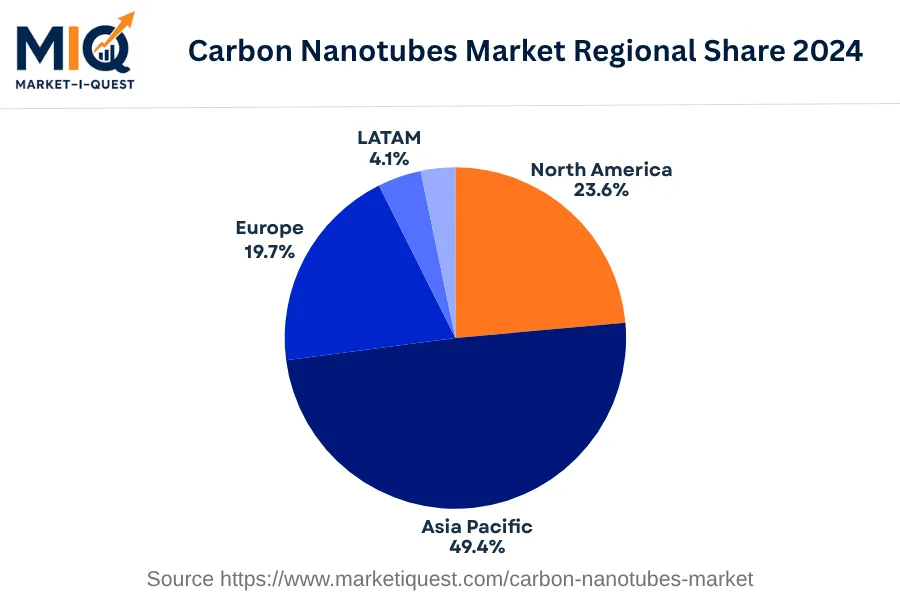
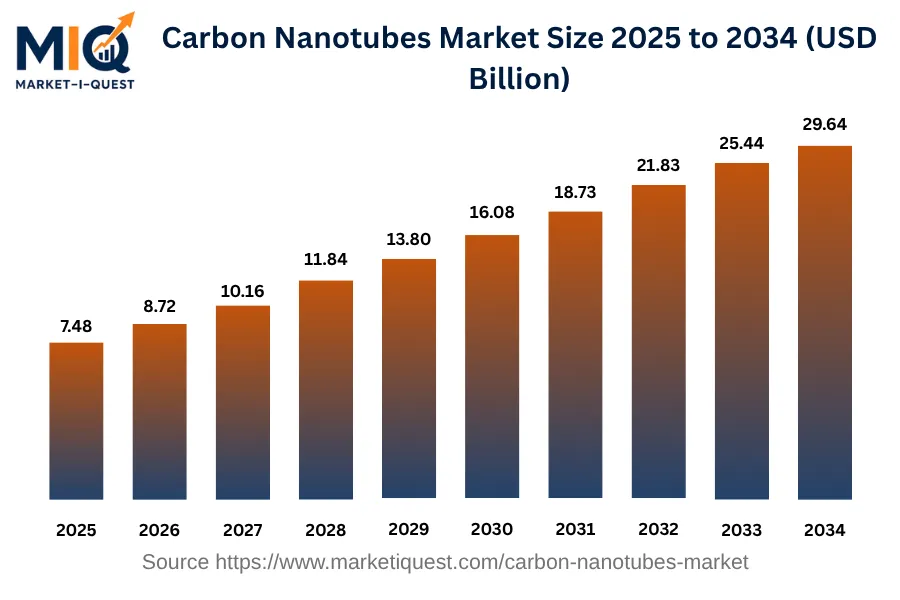
The Carbon Nanotubes Market size in 2025 is slated to sit at 7.48 billion USD, marking a significant increase from 2024's 6.42 billion USD valuation. Projecting further growth, the market will expand to a value of 29.64 billion USD by the year 2034, achieving a compound annual growth rate (CAGR) of 16.53%. This market expansion occurs over the course of a decade, primarily driven by a steady rise in the global demand for these nanotubes. Looking at the regional share distribution in 2024, the Asia Pacific region dominated the market with a 49.36% stake. North America followed with a 23.57% share. Meanwhile, Europe held a 19.68% portion of the market. Less significant market shares were observed in Latin America at 4.12% and the Middle East & Africa region at 3.27%. This data clearly shows the dynamic geographical differences in market stake, with the Asia Pacific region maintaining a considerable lead.

Key Takeaways

  • By Type - Multi-Walled Carbon Nanotubes (MWCNTs) held a dominant position in the market.
  • By Method - High-Pressure Carbon Monoxide Disproportionation led the Carbon Nanotubes Market with a significant share.
  • By End User - Automotive accounted for the largest market share.
carbon-nanotubes-market market size

Key Driving Factors

Regulatory Push for Lightweight Materials in Automotive and Aerospace Industries

Stricter regulations governing CO2 emissions are propelling car and aircraft manufacturers to embrace lightweight construction materials, drastically altering procurement triggers in these industries. One solution manufacturers are turning to is carbon nanotubes due to their impressive lightness and strength. For example, the European Union's policy on vehicular emissions reduction compels automakers to engineer lighter cars that burn less fuel and produce fewer emissions. Similarly, the Federal Aviation Administration in the U.S. is pushing for lighter aircraft to decrease fuel consumption. To meet these requirements, there's a surge in demand for carbon nanotubes in both automotive and aerospace industries, in turn driving the market.

Adoption in Semiconductor Industry due to Miniaturization Trend

As the semiconductor industry progressively shrinks electronic components, manufacturers face a significant challenge to continue reducing the size while maintaining performance and integrity of devices. Carbon nanotubes, with their high conductivity, mechanical and thermal stability, have emerged as compelling solutions for downsizing components without sacrificing their capability. Specifically, global chip manufacturers working under the International Technology Roadmap for Semiconductors are incorporating carbon nanotubes into their processes as a way to push forward with miniaturization. This progression is creating a solid demand for carbon nanotubes, acting as a considerable driver of the market.

Market Evolution by Timeline

2019-2023
There was a high demand for carbon nanotubes in the electronics industry and automobile sector, primarily driven by buyers in North America and the Asia-Pacific region. Manufacturers produced multi-walled nanotubes in bulk. However, production of single-walled nanotubes was still challenging. No comprehensive regulations concerning carbon nanotubes existed, although the NIOSH suggested exposure limits to ensure worker safety. Pricing varied significantly based on quality - lower-grade nanotubes were cheaper, while high-purity nanotubes sold for much higher prices. Commercially, partnerships between materials manufacturers and technology developers were common. Defects in production were a primary risk, often resulting in reduced quality of final products.
2024
In 2024, the medical sector increasingly implemented carbon nanotubes for drug delivery and tissue engineering. Supply had become more reliable, with the creation of single-walled nanotubes becoming more widespread. The EPA began setting regulations concerning the disposal of products containing carbon nanotubes due to growing environmental concerns. There was a rise in long-term contracts between suppliers and buyers to ensure consistent supply. Quality assurance in production remained a significant challenge, leading to a focus on R&D for better production processes.
2025-2029
Between 2025 and 2029, defense industries became significant customers, with the United States purchasing carbon nanotubes for armor applications. Pilot programs for producing single-walled nanotubes at a higher volume were initiated. There were stricter environmental and safety regulations set by the EPA and NIOSH, respectively. Carbon nanotubes' pricing became more competitive, driven by the entry of new manufacturers into the market. The risk of market oversaturation surfaced as new suppliers without unique value propositions began to increase.
2030-2034
From 2030 to 2034, the demand for carbon nanotubes expanded to new sectors like energy storage in Asia and Europe. Carbon nanotube suppliers had flourished, and the technology had matured enough to produce high-quality nanotubes on a large scale. The international industry standards on safety and quality, such as ISO/TC 229, were implemented more broadly. Carbon nanotubes sold primarily through direct sales from manufacturer to end-user. One major risk was the reliance on carbon-based raw materials, whose prices were likely to fluctuate, affecting the end cost of production.

Future Market Outlook

Future Opportunities

Future opportunities in the carbon nanotubes market are closely linked to the expanding applications of CNTs in various industries. The automotive sector is seen as a promising area, particularly with the push for lightweight materials to enhance fuel efficiency. In 2021, Ford initiated a pilot program incorporating CNTs in vehicle components to reduce weight without compromising durability. Likewise, advancements in energy storage technologies, particularly in lithium-ion batteries, could present opportunities, as researchers at Georgia Tech reported in 2023 how CNT-enhanced electrodes made batteries more efficient. Moreover, regulations such as REACH, effective from 2024, are expected to impact the manufacturing processes of CNTs, increasing compliance and monitoring opportunities for producers. Additionally, the growing interest in nanotechnology-based solutions for environmental remediation provides a unique avenue; universities like the University of California have initiated projects exploring CNTs for water purification. The increasing demand for advanced materials in renewable energy technologies, especially in wind turbines and solar panels, presents another avenue for growth, as seen with Siemens Gamesa's 2022 focus on advanced materials. This multifaceted approach indicates that embracing innovation in CNT applications can lead to enriched market dynamics, fostering strategic collaborations and technological progress across diversified sectors.

Segmentation Analysis

By Type

The market is distinguished by two key subsegments, namely Single-Walled Carbon Nanotubes (SWCNTs) and Multi-Walled Carbon Nanotubes (MWCNTs). Of the two, MWCNTs garners the largest revenue share, while SWCNTs is anticipated to display the fastest growth rate in the approaching years.

Largest Revenue Share

Multi-Walled Carbon Nanotubes (MWCNTs)

Market Share Leader

Multi-Walled Carbon Nanotubes (MWCNTs) accounts for the lion's share of the market's revenue owing to multiple factors. The MWCNTs' high thermal and electrical conductivity makes them highly desirable in cutting-edge electronics and energy sectors. The large-scale industrial applications of MWCNTs, in sectors like electrical and electronics, energy storage, and automotive, ensure a steady demand. In the context of the automotive industry, regulations are progressively emphasizing the production of lightweight vehicles to improve fuel efficiency. MWCNTs find themselves integral in creating light, strong material to meet these demands. Additionally, MWCNTs are sold through diverse channels such as online and offline modes, enhancing the ease of purchase which renders significant revenue. Their relatively easier and abundant production compared to SWCNTs also propels growth. However, this claim is made on the assumption that market dynamics align with common market structure.

Fastest CAGR

Single-Walled Carbon Nanotubes (SWCNTs)

Forecast Period Growth Leader

Though currently not the segment commanding the largest revenue, Single-Walled Carbon Nanotubes (SWCNTs) are tipped to exhibit the fastest growth. Key growth drivers include the surge in technology advancements and research and development activities. Their highly customizable properties make SWCNTs useful in highly specialized fields like nanotechnology, bioengineering, and advanced materials. Technological advancements are enhancing SWCNT manufacturing methods, driving down costs, and widening the range of feasible applications, which in turn catalyzes adoption. Government policies and investment in nanotechnology research also serve as catalysts. However, there exist certain adoption barriers such as considerations concerning the environmental impact and human health due to liberation of nanotubes. This segment's growth is also at risk from potential regulatory changes and the ability of manufacturing processes to deliver quality at scale. This prediction is made assuming the market follows usual patterns of technology product life cycle.

By Method

The market is divided into subsegments including Chemical Vapor Deposition, High-Pressure Carbon Monoxide Disproportionation, Arc Discharge, Laser Ablation, and Others. High-Pressure Carbon Monoxide Disproportionation accounted for the largest revenue share while Chemical Vapor Deposition is expected to grow at the fastest CAGR during the forecast period.

Largest Revenue Share

High-Pressure Carbon Monoxide Disproportionation

Market Share Leader

In 2024, the High-Pressure Carbon Monoxide Disproportionation segment commanded the largest share in terms of revenue. This dominance can be attributed to the broad application range of this method in various industries namely electronics, energy, and automotive. Characterized by relative operational ease and higher yield, High-Pressure Carbon Monoxide Disproportionation is preferred for large scale production. More so, the capacity of this method to produce a diverse range of carbon materials has bolstered its acceptance hence driving its revenue growth. Geographically, Asia-Pacific and North America contribute significantly to the adoption of this method due to high industrialization rate and advanced technology adoption. Finally, evolving regulatory requirements promoting eco-friendly methods further bolster the revenue share of this segment.

Fastest CAGR

Chemical Vapor Deposition

Forecast Period Growth Leader

Chemical Vapor Deposition is projected to register the fastest CAGR during the forecast period. This growth can be primarily attributed to its unique ability to deposit thin layers of material with extreme precision, a key demand across sectors like semiconductor and electronics. This method is being increasingly adopted due to its potential to manufacture high-quality, high-performance materials. The barriers include high capital investment and technical complexities. However, with the advent of technology and increased R&D efforts, these obstacles are being addressed, paving a way for its accelerated adoption. Partnerships and collaborations for technical advancements act as significant catalysts for growth in this segment. However, near-term risks, such as safety concerns and environmental regulations need to be carefully navigated for sustained growth in this segment.

By End Use Industry

The market is divided into subsegments including Aerospace & Defense, Electrical & Electronics, Automotive, Energy, Sports and others. Among these, the Automotive subsegment accounted for the largest revenue share while the Electrical & Electronics subsegment is projected to grow at the fastest CAGR during the forecast period.

Largest Revenue Share

Automotive

Market Share Leader

The Automotive subsegment holds the largest market share primarily because its broad consumer base, which consistently demands an extensive range of products and services. The emergence of electric, connected, and autonomous vehicles have opened up a whole lot of fresh opportunities for the sector in 2024. Market expansion is also driven by legislation aimed at enhancing car safety and reducing carbon dioxide emissions. Buyers are increasingly prioritizing efficient, innovative, and easier access to mobility, further driving revenue growth in this segment. The ongoing efforts to optimize supply chain and distribution channels to accommodate the increasing global demand have also given a significant boost to this subsegment. Demand for automotive products is particularly high in rapidly growing economies, an important revenue generator for this subsegment.

Fastest CAGR

Electrical & Electronics

Forecast Period Growth Leader

The Electrical & Electronics subsegment is anticipated to register the highest CAGR, backed by an increasing demand for intelligent and energy-efficient electronic devices. The rapid adoption of IoT and artificial intelligence technologies, alongside the digitalization of industries, is expected to spur the growth in this sector. Existing partnerships and collaborations with tech giants are vital in leveraging these technological advancements. Policies supporting the development and research of emerging technologies also cater to the growth of this segment. The rise in capital expenditure on electronic devices in the domestic and industrial sectors potentially increases adoption rates, thereby driving the growth. Risks to consider include the susceptibility to fluctuations in raw material supplies and prices, causing possible disruptions in the supply chain. However, the robust growth drivers are expected to outweigh the risks, leading to sustainable market growth in the near term.

Competitive Analysis

Key Market Players

Manufacturers / OEMs

Nano-C Inc.
US
Arkema S.A.
France
Showa Denko K.K.
Japan

Key Suppliers & Raw Materials

Thomas Swan & Co. Ltd.
UK
Kumho Petrochemical Co., Ltd.
South Korea
FutureCarbon GmbH
Germany

Distributors, Integrators & Channel Partners

Cheap Tubes Inc.
US
Nanoshel UK Ltd.
UK
SES Research Inc.
US

Porter’s Five Forces Analysis

A strategic analysis of the competitive dynamics in the Carbon Nanotubes Market.

Supplier Bargaining Power

Medium

Limited suppliers with unique technology control, but market competition hinders exclusive pricing power.

Buyer Bargaining Power

Low

Carbon nanotubes are advanced materials with few substitutes, lowering buyers' power and tapping into premium pricing.

Threat of Substitutes

Low

The unique properties and versatile applications of carbon nanotubes dampen the threat of substitutes.

Threat of New Entrants

High

Technological advances and growing demand invite new entrants, despite initial high capex.

Competitive Rivalry

High

Market fragmentation and constant technological evolution fuel intense competitive rivalry.

Regional Analysis

Geographic market dynamics and growth opportunities across key regions

Global Market Outlook

carbon-nanotubes-market market regional share

North America

In 2024, the North American carbon nanotubes market experienced dynamic growth due to technological innovations and expanding applications across diverse sectors. Dominant drivers included heightened demand for lightweight, strong materials in manufacturing, the aerospace industry, and electronics sectors in countries like the U.S., Canada, and Mexico. Investment in research and development was substantial, spurred by governmental regulations encouraging the adoption of nanotechnology. Supply dynamics were significantly shaped by the competitive pricing strategies of key market players.

Market trends in 2024 largely revolved around shifts in buyer behavior, particularly towards environmentally sustainable materials, propelling the adoption of carbon nanotubes in the renewable energy sector. Technological advancements facilitated the incorporation of nanotubes into sophisticated electronic devices, solidifying their foothold in the tech industry. The market also witnessed strategic partnerships and mergers aiming to secure access to proprietary technologies. Regulatory standards and policy enforcement by entities like the U.S. Food and Drug Administration and Environment Protection Agency greatly influenced market conditions, encouraging compliance and safe practices. Prominent sectors driving demand included automotive, energy storage, textiles, medical and healthcare services. Key consumers encompassed a diverse range, from research institutes and government entities to commercial and industrial enterprises.

Asia Pacific

In 2024, the carbon nanotubes market in Asia Pacific emerged as a significant sphere in the global context. Key drivers included the rising demand for lightweight materials in China and Japan's automotive and aerospace sectors, incentivised by stringent carbon emission regulations. In India, increased investment in clean energy projects stimulated demand for carbon nanotubes in solar panel manufacturing, while technological advancements in South Korea spurred the production of high-quality carbon nanotubes, reinvigorating supply dynamics. Throughout Australia and key ASEAN countries, competitive pricing strategies catalysed market penetration.

Trends included discernible shift towards eco-friendly products, evident in buyer behavior across the region, particularly in China and Japan's enterprise sector. New technological advancements facilitated the development of multi-walled carbon nanotubes, leading to their increased adoption in the electronics sectors of South Korea, altering product dynamics. Additionally, strategic partnerships, such as those between key manufacturers in China and local government bodies, enabled the establishment and enforcement of novel standards in manufacturing processes. Equally notable was the intensified application of carbon nanotubes in healthcare sectors across India and Australia, and retail channels in ASEAN markets, following policy enforcement on product quality and safety.

Europe

In 2024, Europe's Carbon Nanotubes (CNT) market experienced notable development across several segments. Key drivers were increased demand in the electronics sector specifically in Germany and the United Kingdom, government regulations promoting advanced materials in France and Spain, as well as significant investment in nanotechnology research in Italy and the Nordics. Increased adoption of CNT in the manufacturing sector, stretching from aerospace in the UK to automotive industry in Germany pushed the supply dynamics forward. Cost-effective production methods witnessed in Benelux and Central & Eastern Europe provided favourable pricing conditions.

Trends in 2024 saw changes in buyer behavior with increased preference for high efficiency, lightweight and durable products in the consumer goods sector, notably in France and Italy. Technology shifts were observed with the UK and Germany increasingly using CNT in battery production and energy storage systems. Distribution channels expanded with robust partnerships, and mergers and acquisitions among major players. High standards of policy enforcement in Scandinavia promoted environmental sustainability, thus realigning the market. The European Union's Graphene Flagship Project, aimed to take graphene and related materials from academic laboratories to society, has cemented Europe’s position in the global CNT market within the base year.

Latin America

In 2024, the Carbon Nanotubes (CNT) market in Latin America was significantly influenced by various factors driving its growth and presenting new trends. Enhanced technological adoption across sectors, particularly in manufacturing and healthcare, was a key driver of demand for CNT in Brazil and Mexico. Strong interest from investors in Argentina, advocating for advanced materials research, pushed supply dynamics positively. Cost-effective production in Peru ensured competitive pricing in the region, while Colombia’s supportive regulatory landscape for nanotechnology adoption stimulated market expansion. Additionally, Chile’s initiatives to incorporate CNT in utilities also fueled growth.

Trending is the increasing preference for high-quality CNT in healthcare applications due to their superior properties. In Mexico and Brazil, growing penetration of advanced technologies led to a shift towards adoption of CNT in various products. Channel dynamics shifted, with a marked rise in online sales across countries, in response to customer preferences. Increased partnerships, especially in Argentina, have transformed the market landscape. In Colombia, standardization of nanotechnology use enforced by regulatory bodies has become a significant trend. The presence of a diverse customer base, ranging from enterprises in manufacturing to government utilities and retail, also played an essential role in shaping the LATAM CNT market in 2024.

Middle East & Africa

In 2024, the Carbon Nanotubes (CNT) Market in the Middle East and Africa experienced a paradigm shift courtesy of several key factors. This was spurred by the growing demand for lightweight and durable materials in industries like telecom, manufacturing, healthcare, and notably oil and gas sector, under the influence of emerging economies like Saudi Arabia, UAE and Qatar. Government investments in nanotechnology, especially in Israel and South Africa, bolstered this trend alongside the adoption of advanced technology in these regions.

The market dynamics were shaped by significant trends. A pivot towards clean energy projects in Egypt and Nigeria, favoring CNT for solar cells, characterized buyer behavior. In Kenya, a technology shift, which saw a growing dependence on CNTs in electronics manufacturing due to their exceptional conductivity, redefined product preference. Moreover, heightened R&D collaborations, like between UAE and Saudi Arabian universities on nanotechnology, reflected an uptick in partnerships. Compliance with government-incited green initiatives across the region also impacted the market, as manufacturers increasingly integrated CNTs into production for their energy-efficiency. In the realm of pricing, cheaper supply of raw materials in resource-rich countries like South Africa and Nigeria allowed advantageous manufacturing conditions, inciting growth in the CNT market across the diversely industrial Middle East and African region.

Recent Industry Developments

Latest market innovations, product launches, and strategic initiatives

January 2026

LG Chem commissioned its fourth dedicated carbon nanotube facility in South Korea, boosting its total annual production capacity from 2,900 to 6,100 tons. The increased output is fully allocated to supply tier-1 battery manufacturers with high-purity CNT conductive additives.

December 2025

Mitsubishi Chemical, Toray Industries, and Arkema launched coordinated capacity expansions at their global conductive carbon nanotube (CNT) dispersion facilities. The investments directly support production scaling for next-generation EV battery anodes and lightweight automotive composites.

November 2025

OCSiAl expanded its European manufacturing footprint by launching TUBALL BATT, a joint venture with Green Energy Origin. Based out of its production hub in Serbia, the expansion localizes the supply of sustainable carbon nanotube dispersions for European battery gigafactories.

Frequently Asked Questions