
Organic Solar Cell Market Snapshot

Key Players

  • Heliatek GmbH (Germany)
  • OPV Tech SAS (France)
  • Solarmer Energy Inc. (United States)
  • Neojoule (India)
  • ARMOR SA (France)
  • BELECTRIC OPV GmbH (Germany)
  • G24 Power Ltd. (United Kingdom)
  • Sumitomo Chemical Co. Ltd. (Japan)
  • Eight19 Limited (United Kingdom)
  • InfinityPV ApS (Denmark)

Market Size

Base Year 2024
$0.34 Bn
CAGR
19.86%
Forecast 2034
$2.08 Bn

Market Segments

By Material Composition
Polymer Materials, Small Molecule Materials, Hybrid Materials
By Deployment Method
Building-Integrated Photovoltaics (BIPV), Stand-Alone Systems, Grid-Connected Systems
By Technology Type
Small Molecule Organic Solar Cells, Polymer Solar Cells, Perovskite Solar Cells
By Application Sector
Residential, Commercial, Utility Scale

Market Dynamics

Drivers
  • Increasing environmental awareness
  • Technological advancements in solar cell production
Restraints
  • High production costs
  • Limited efficiency levels
Opportunities
  • Increased awareness of renewable energy
  • Growing environmental concerns

Market Size

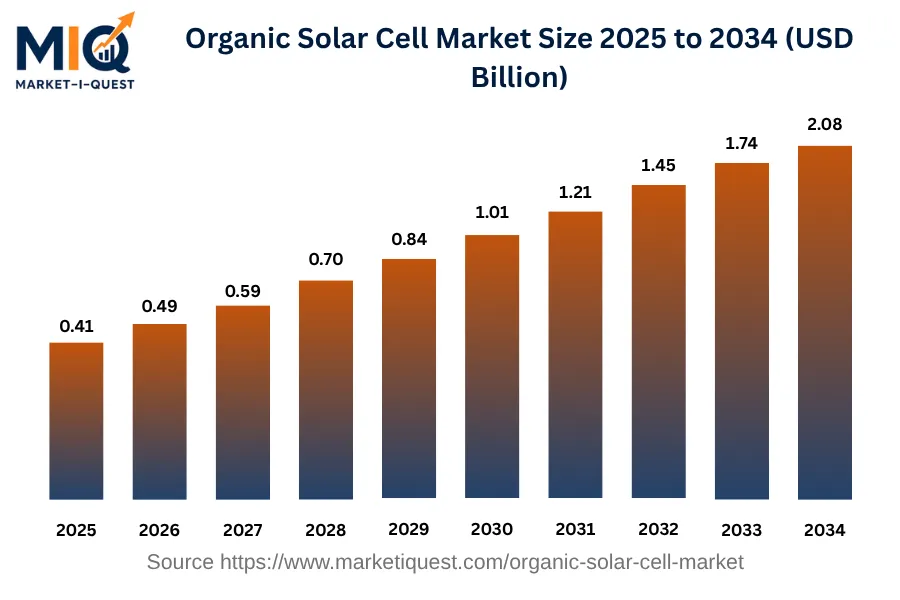
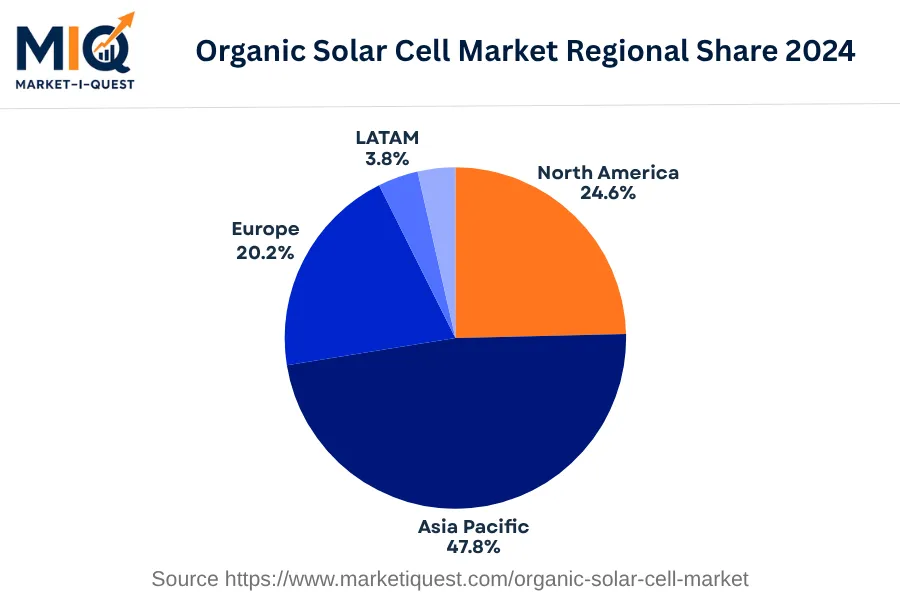
The Organic Solar Cell Market, sized at USD 0.41 billion in 2025, is slated to grow considerably to reach USD 2.08 billion by the end of 2034. It is worth noting that the market begins its journey from a size of USD 0.34 billion in 2024, making considerable strides along the way, representing a CAGR of 19.9% from 2025 to 2034. This substantial growth in market size over the ten-year span is primarily attributed to technological advancements in organic solar cell sciences and sustained research and development efforts in the field. Looking at the regional shares in 2024, the Asia Pacific held the largest share with 47.8%, followed by North America (24.6%), Europe (20.2%). LATAM and MEA regional markets accounted for 3.8% and 3.6% respectively.

Key Takeaways

  • By Material Composition - Polymer Materials led the market holding the highest share in 2024.
  • By Deployment Method - Grid-Connected Systems held a dominant position accounting for the largest market share.
  • By Technology Type - Polymer Solar Cells led the market accounting for the highest share in 2024.
  • By Application Sector - Commercial segment held the leading position with the majority market share.
organic-solar-cell-market market size

Key Driving Factors

Proliferation of Green Building Certification Standards

One driving factor of the Organic Solar Cell market is the increased adoption of green building certification standards like Leadership in Energy and Environmental Design (LEED) and Building Research Establishment Environmental Assessment Method (BREEAM). These certification protocols give preference to energy-efficient and renewable energy sources with small carbon footprints. Buildings adhering to these protocols adopt organic solar cell systems to increase their eco-friendliness. Besides, organic solar cells can be integrated into building materials, providing aesthetic appeal while maintaining architectural design, which is highly valued in the 'green' building industry. Therefore, the propagation of green building standards is driving the growth of the Organic Solar Cell market.
Governmental Support Through Policies and Incentives

A second driver is the robust governmental support for renewable energy sources. A significant number of governments worldwide, including those in the EU, China, Canada, and the USA, have implemented support schemes for renewable energy. These supports, like the US Investment Tax Credit (ITC), provide substantial economic incentives for entities to invest in and deploy renewable energy technologies, including organic solar cells. For instance, EU's 2020 target for all new buildings to be nearly zero-energy buildings creates measureable demand for highly efficient renewable energy technologies like organic solar cells. Hence, such policies and incentives are significantly driving the market forward.

Market Evolution by Timeline

2019-2023
In this time period, the organic solar cell market was marked by an increase in demand from the residential and commercial industries, specifically in developed regions like Europe and North America. Manufacturers worked to improve efficiency and lifespan, but limitations in technology and high production costs posed challenges. Regulatory bodies, particularly within the European Union, incentivised adoption through policy programs like the European Green Deal. Pricing remained high due to manufacturing costs, and many companies entered partnerships to share research and development expenses. Uncertainty in the performance of organic solar cells in comparison to their inorganic counterparts was a practical obstacle, prompting research into long term reliability.
2024
In 2024, the automotive sector saw an increase in interest in organic solar cells, especially in solar-powered electric vehicles. Tech advancements led to moderate efficiency improvements, making these cells more viable for integration in vehicles. Policy-wise, countries like Japan and Germany laid out goals to increase utilization of renewable energy in vehicles which indirectly influenced the market. This caused a shift in the pricing dynamics, a movement towards cost-per-function pricing instead of traditional price-per-watt. However, issues like limited heat resistance kept the market growth in check.
2025-2029
From 2025 to 2029, an accelerated decline of the cost of organic solar cells led to stronger demand in emerging markets like India and Africa. This was furthered by more advanced organic solar cell technology becoming commercially available, tackling efficiency and stability issues. The Paris Agreement-induced policies targeted at renewable energy adoption helped this cause. More companies began offering pay-as-you-save contracts, supporting greater adoption of these solar cells. Supply chain disruptions due to geopolitical tensions posed a risk, leading to new partnerships for domestic supply chain development.
2030-2034
In the period between 2030 and 2034, demand for organic solar cells grew in the electronics industry, typified by portable devices and IoT applications. There were substantial improvements in energy conversion efficiency and longevity, pushing the organic solar cell technology towards maturity. There was a marked increase in investment in renewable energy to support strategic plans initiated by governments worldwide, such as China's Renewable Energy Law. Dynamic pricing models based on the lifetime value of products gained adoption. The risk of unmet mandates and targets put strain on market, propelling efforts for further technological advancements.

Future Market Outlook

Future Opportunities

In 2023, the global drive toward sustainability has opened substantial opportunities for organic solar cell development. Major initiatives led by entities like the United Nations Environment Programme have identified organic photovoltaics as key components in achieving carbon neutrality by mid-century. Partnerships in the Asia-Pacific region highlight this trend, where companies are collaborating to integrate organic solar technologies into urban infrastructures. Additionally, advances in material science have enabled the usage of organic cells in unconventional applications, such as portable solar chargers, which have gained traction in countries with limited access to traditional energy sources, such as rural India. The continued research and investment by companies like Heliatek and Organic Solar Technologies in scalable manufacturing processes indicate a market increasingly focused on reducing production costs while enhancing performance. Furthermore, agreements implemented by the European Commission on climate neutrality have set a legislative backdrop, encouraging innovation in sustainable materials like organic solar cells. Beyond urban environments, applications in agriculture, including agrivoltaics, are emerging, allowing farmers to generate energy while maximizing land usage. As sustainable infrastructure development accelerates globally, the combination of technological advancement and supportive regulatory frameworks will likely forge a path for organic solar cells into diverse markets, creating new revenue opportunities and changing how energy is consumed in daily life.

Segmentation Analysis

By Material Composition

The market is divided into subsegments including Polymer Materials, Small Molecule Materials, and Hybrid Materials. Polymer Materials accounted for the largest revenue share while Small Molecule Materials is expected to grow at the fastest CAGR during the forecast period.

Largest Revenue Share

Polymer Materials

Market Share Leader

Polymer Materials dominate the market due to their widespread use and versatile properties. This subsegment's dominance can be attributed to a variety of factors. Primarily, Polymer Materials are more readily accessible and offer greater flexibility in design, hence they are preferred in numerous applications across the industry. Their broad spectrum of physical properties, combined with their durability and adaptability across varying temperature ranges, make them suitable for uses in diverse industries including automotive, construction, and packaging. Further fueling their demand is their cost-effectiveness, as they are generally less expensive to produce than their counterparts. The user-friendly nature of Polymer Materials coupled with their ability to be tailored to meet specific needs gives them a competitive edge. These materials are supplied through various channels to their end-users, allowing for a streamlined supply chain, although strict regulations surrounding their production may limit growth in certain geographies.

Fastest CAGR

Small Molecule Materials

Forecast Period Growth Leader

Small Molecule Materials are anticipated to witness the fastest growth, buoyed by advances in technology and evolving industry needs. Several factors serve as catalysts for their accelerated growth rate. Firstly, Small Molecule Materials facilitate advanced functionalities, making them suitable for use in sophisticated applications in industries like pharmaceuticals and electronics. The rise in partnerships between leading manufacturers and innovators has further propelled research in this subsegment, leading to breakthroughs in technology and product offerings. Their utility in high-capex projects is another key driver of their growth, reflected in their increasing demand by big-budget projects. However, adoption barriers such as high costs and engineering complexities may pose near-term risks for their market growth. On balance, the potential of Small Molecule Materials appears promising, given their innovative capabilities and diverse application potential in the face of growing industry demand.

By Deployment Method

The market is divided into subsegments including Building-Integrated Photovoltaics (BIPV), Stand-Alone Systems, and Grid-Connected Systems. Grid-Connected Systems accounted for the largest revenue share while Building-Integrated Photovoltaics (BIPV) is expected to grow at the fastest CAGR during the forecast period.

Largest Revenue Share

Grid-Connected Systems

Market Share Leader

Grid-Connected Systems represent the subsegment with the most significant revenue stream in the base year 2024. This is attributable to several interrelated factors. First, these systems directly connect to a power grid, allowing surplus energy to be sold back to the utility. This feature creates an economic incentive for both individuals and businesses to install these energy solutions. Secondly, policy regulations in many parts of the world favor grid-connected systems, making them the preferential choice. Additionally, the grid-connected photovoltaic power system does not require expensive battery storage systems as it relies on the grid for power when solar power is insufficient. This system's cost-effectiveness has further fueled its adoption. Lastly, the presence of a mature supply chain has drives the demand for grid-connected systems.

Fastest CAGR

Building-Integrated Photovoltaics (BIPV)

Forecast Period Growth Leader

Building-Integrated Photovoltaics (BIPV) is projected to be the fastest-growing subsegment. The growth is fueled by advances in technology and the increasing focus on energy efficiency and sustainability in construction. BIPV systems generate electricity while also serving as part of a building's envelope, offering a cost- and energy-efficient solution. On the regulatory front, stringent building codes emphasizing green building principles act as catalysts for the adoption of BIPVs. Further, the decreasing price of photovoltaic cells also is a crucial driver for its adoption. However, the initial capital outlay for these systems remains a hurdle to quicker adoption. Hence, partnerships with financial institutions are important to enable attractive financing options. Near-term risks include changes in government subsidy policies and the challenge of integrating these systems seamlessly into existing architectural designs.

By Technology Type

The market by technology type is divided into subsegments including Small Molecule Organic Solar Cells, Polymer Solar Cells, and Perovskite Solar Cells. In the base year of 2024, Polymer Solar Cells accounted for the largest revenue share while Perovskite Solar Cells are projected to register the fastest growth during the forecast period.

Largest Revenue Share

Polymer Solar Cells

Market Share Leader

Polymer Solar Cells as a subsegment of the solar cell technology market generates the most revenue, thanks to several driving factors. Its cost-effectiveness and simple manufacturing processes increase its appeal to solar cell manufacturers. Companies are increasingly incorporating this technology due to its excellent properties such as being lightweight, flexible, and capable of semi-transparency. Its flexibility makes it ideal for various applications across diverse sectors ranging from electronics to construction. In terms of geography, the adoption of Polymer Solar Cells is high in regions with substantial investment in renewable energy, such as North America and Europe. Regulatory support for clean energy in these regions has boosted the market for this subsegment immensely. Additionally, the rising awareness of sustainability and the need for clean energy further drives the demand.

Fastest CAGR

Perovskite Solar Cells

Forecast Period Growth Leader

Perovskite Solar Cells are anticipated to be the fastest-growing subsegment in the technology type market. While they are relatively new to the scene, they have shown immense promise thanks to their high efficiency and low production cost. The unique properties of perovskite material, such as its excellent light absorption and charge transportation capabilities, are seen as potential catalysts for growth. There is also increasing interest from both academia and industry to overcome adoption barriers such as stability issues and lead content. Partnerships among manufacturers, researchers, and policymakers are fueling innovations and improvement in this area. On a geographical level, Asia-Pacific is playing a significant role in the rapid growth of this subsegment, largely driven by ambitious solar energy targets and progressive policies. Despite the optimistic growth outlook, a near-term risk includes regulatory changes relating to environmental concerns due to the use of lead in these cells.

By Application Sector

The market, divided into Residential, Commercial, and Utility Scale subsegments, shows substantial variation in revenue share. While the Commercial sector accounted for the largest revenue share, the Residential sector is expected to grow at the highest CAGR during the forecast period.

Largest Revenue Share

Commercial

Market Share Leader

In the base year 2024, the Commercial subsegment led in terms of revenue share. The dominance of the Commercial sector can primarily be attributed to several determining factors. Commercial premises tend to require more significant energy usage due to their substantial scale and continuous operational hours as compared to residential units. Also, numerous businesses are choosing renewable energy sources to improve their corporate image, operational efficiency, and sustainability initiatives. Additionally, governments globally are encouraging the adoption of renewable energy in the commercial sector through various incentives and tax rebates. Markets in developed nations with mature infrastructures, like the USA and Europe, are primary contributors. Furthermore, the higher purchasing power, facilitated by commercial lending and leasing options, elevates the demand from this subsegment.

Fastest CAGR

Residential

Forecast Period Growth Leader

The Residential subsegment, despite not commanding the largest revenue share in 2024, is anticipated to demonstrate the fastest growth during the forecast period. The continued decline in the costs of renewable energy sources and technological advancements provides an affordable and efficient solution for homeowners, aiding the high growth prediction. Embracing home energy generation also allows households to be less affected by fluctuations in energy prices, inciting further adoption. Moreover, various government policies and incentives make renewables more accessible for individual homeowners, enhancing the attractiveness of this sector. The emergence of innovative business models, such as Power Purchase Agreements (PPAs) and leasing, also simplifies the financing of home renewable energy installations. However, market barriers such as regulatory hurdles and high initial costs could still limit the pace of adoption.

Competitive Analysis

Key Market Players

Manufacturers / OEMs

Heliatek GmbH
Germany
ARMOR Group
France
BELECTRIC OPV
Germany

Key Suppliers & Raw Materials

Dupont
US
Sigma-Aldrich
US
BASF SE
Germany

Distributors, Integrators & Channel Partners

Konarka Technologies Inc
US
Sunew
Brazil
Eight19
UK

Porter’s Five Forces Analysis

This analysis explores the competitive intensity within the Organic Solar Cell Market and its profitability landscape.

Supplier Bargaining Power

Medium

Market depends on suppliers for high-quality organic materials, while the limited number of suppliers increases their influence.

Buyer Bargaining Power

High

Buyers such as solar product manufacturers have extensive choice among organic solar cell producers.

Threat of Substitutes

Low

Although conventional solar cells are available, the unique advantages of organic cells minimize substitution threats.

Threat of New Entrants

Medium

Capital requirements and regulatory complexities moderate the threat of start-ups, though tech innovation could change the landscape.

Competitive Rivalry

High

Competition is intense due to the large number of players and fast-paced technology development.

Regional Analysis

Geographic market dynamics and growth opportunities across key regions

Global Market Outlook

organic-solar-cell-market market regional share

North America

In 2024, the North American Organic Solar Cell Market was shaped by a dynamic interplay of demand, innovation, and regulatory forces. Investment in clean energy technology fueled research and development, resulting in increased production efficiency that positively influenced supply dynamics. American tech-driven startups led this adoption axis, with substantial support being seen from both the Canadian and Mexican governments.

Simultaneously, stringent carbon reduction regulations in North America propelled the uptake of renewable energy technologies, making organic solar cells a viable energy solution for a range of sectors including manufacturing and utilities. In addition, price competitiveness, facilitated by the maturation of organic solar cell manufacturing technologies, created an affordable and sustainable energy solution in the U.S.

Among the notable market trends, utility companies exhibited a strong inclination towards the adoption of organic solar cells, driven by a reduction in their energy production costs. Hybridization of organic solar cells with other clean energy technologies gained momentum in the Canadian market, adding value to both product and technological advances.

While there was an uptick in partnerships and mergers across the U.S., Mexico saw its local businesses actively engage with American and Canadian industry leaders. These cross-border alliances contributed to the standardization of organic solar cells across the region. Enforcement of clean energy policies across all three countries further fortified this uniform adoption approach, engraving a resilient footprint for the North American Organic Solar Cell Market in 2024.

Asia Pacific

The Organic Solar Cell market in Asia Pacific demonstrated significant momentum in 2024 underpinned by favorable policies, influential technology adaptation, and growing demand. Drivers of this include government investment promoting renewable energy in China and India, triggering a surge in demand for organic solar cells. In Japan and South Korea, rapid technology adoption spurred by increased automation in manufacturing sectors heavily influenced the market. The ASEAN market—with consideration given to Thailand's solar power project—also experienced a supply boost, indicative of the region's investment in clean energy.

Trends within 2024 spotlighted changes in buyer behavior with Australia led in policy enforcement advocating household usage of renewable energy, fostering strong demand for organic solar cells. Product advancements were also evident in South Korea and Japan, where solar tech integration became a mainstay in utilities and enterprise realms. China saw significant partnerships and M&A, especially among its retail giants like Alibaba, integrating organic solar cells into physical infrastructure. Lastly, the implementation of the ASEAN Plan of Action for Energy Cooperation championed regional standards, which contributed positively to the organic solar cell market. This collective movement towards renewable energy options epitomizes the recognition of organic solar cells as not just a future solution, but a present requirement.

Europe

In the base year 2024, the Organic Solar Cell market in Europe exhibited significant growth due to advancements and widespread adoption in renewable energy solutions. Drivers for this growth included increasing demand for clean energy, substantial investment in research and development, as well as favorable government policies such as the EU's Renewable Energy Directive that encouraged the use of renewable energy sources. Germany and the United Kingdom, in particular, were leading in technology adoption, spurred by regulatory bodies and incentives for green technology implementation.

Trending in this space was buyer preference for renewable and environment-friendly energy solutions, seen in sectors like utilities and manufacturing. A notable shift towards partnerships and mergers and acquisitions was observed, for instance, between major technology providers and manufacturing firms, promoting the shared objective of green manufacturing. Governments across Europe, notably in France, Italy, and Spain, were seen enforcing policy measures aimed at increasing the use of renewable energy sources. Initiatives by the Nordics and Benelux nations to promote organic solar cell technology played a crucial role in shaping the market landscape. A distinctive trend seen in Central and Eastern Europe was the growing number of enterprises investing in clean energy solutions, a response to increasing awareness about sustainability and environmental responsibility.

Latin America

In 2024, the Organic Solar Cell market in Latin America experienced significant growth due to various factors. Key drivers included increased investment in clean energy technologies by nations like Brazil, Argentina, and Mexico, where the government mandates favored renewable energy resources. Regulatory frameworks such as Mexico’s Energy Transition Law served as a catalyst for technology adoption in the market. Strong economic growth in countries like Colombia and Chile further spurred demand, while improved efficiencies and decreased production costs for organic solar cell technology boosted supply dynamics.

Several trends punctuated the LATAM Organic Solar Cell market during this period. Consumers and enterprises gravitated towards more sustainable energy options with organic solar cells gaining traction for their flexibility and affordability. The tech shift was noticeable in the utilities and manufacturing sectors, as businesses sought to reduce carbon footprint and operational costs. Notably, numerous partnerships and M&A activities occurred within the sector, including Mexico's largest utility company, CFE, partnering with local manufacturers to expand its organic solar cell capacity. Additionally, governments enforced policies to support renewable energy, most recognizably Argentina’s RenovAr program, enhancing organic solar cell adoption nationwide. Thus, in 2024, the organic solar cell market in Latin America was characterized by accelerated adoption, technology advancements, regulatory support, and strategic collaborations.

Middle East & Africa

In 2024, the Organic Solar Cell market in the Middle East and Africa showed significant activity. This growth was driven by increased demand for renewable energy solutions, spurred by regulatory incentives such as Egypt’s Feed-in Tariff program. Both governmental and private investments in solar technology have escalated, aiding in the adoption of organic photovoltaic technology. Additionally, favorable pricing due to increased supply and advancements in organic photovoltaic technology boosted market expansion.

Notably, a trend of governments in Saudi Arabia and South Africa taking the lead in instituting renewable energy policies has spurred the adoption of organic solar cells. There was a shift in buyer behavior, particularly in the utilities and manufacturing sectors, towards greener energy options. Increased partnerships, such as Qatar's deal with SolarWorld AG and the African Renewable Energy Fund's investments across Kenya, Nigeria, and South Africa, accelerated industry growth. Stricter policy enforcement, as seen through Israel's Renewable Energy Law, further drove market uptake.

Specifically, sectors such as government, utilities, and manufacturing exhibited increased demand for organic solar cells. The telecommunications sector in the United Arab Emirates also showed a shift towards organic photovoltaic technology, reflecting the broader market trend of seeking sustainable, low-cost energy alternatives. In all, the year was marked by robust growth and a shift towards more sustainable energy strategies across the region.

Recent Industry Developments

Latest market innovations, product launches, and strategic initiatives

November 2025

Swedish solar innovator Epishine partnered with Google reference supplier Ohsung Electronics to integrate printed indoor organic photovoltaic (OPV) cells into Google TV’s G32 remote control. The light-energy harvesting (LEH) technology converts ambient indoor light into power, eliminating the need for disposable batteries.

March 2025

Germany-based Heliatek successfully obtained UL safety certification for its HeliaSol organic solar films. The certification validates that the ultra-lightweight, flexible OPV modules meet North American safety and quality standards for commercial building-integrated photovoltaics (BIPV).

Frequently Asked Questions