Energy Harvesting Market Snapshot

Key Players

  • EnOcean GmbH (Germany)
  • Microchip Technology Inc. (USA)
  • Mide Technology Corporation (USA)
  • Fujitsu Limited (Japan)
  • Cymbet Corporation (USA)
  • Stmicroelectronics N.V. (Switzerland)
  • Laird PLC (UK)
  • Alta Devices (USA)
  • Enocean Inc. (Canada)

Market Size

Base Year 2024
$0.785 Bn
CAGR
9.75%
Forecast 2034
$1.99 Bn

Market Segments

By Energy Source
  • Chemical
  • Mechanical
  • Electrical
  • Nuclear
By Technology
  • Electrodynamic
  • Photovoltaic
  • Thermoelectric
By Application
  • Consumer Electronics
  • Industrial
  • Automotive
  • Healthcare
  • Others

Market Dynamics

Drivers
  • Increasing demand for power-efficient devices
  • Rapid technological advancements in energy harvesting
Restraints
  • High initial cost
  • Technological complexity
Opportunities
  • Emerging IoT applications
  • Renewable energy initiatives

Market Size

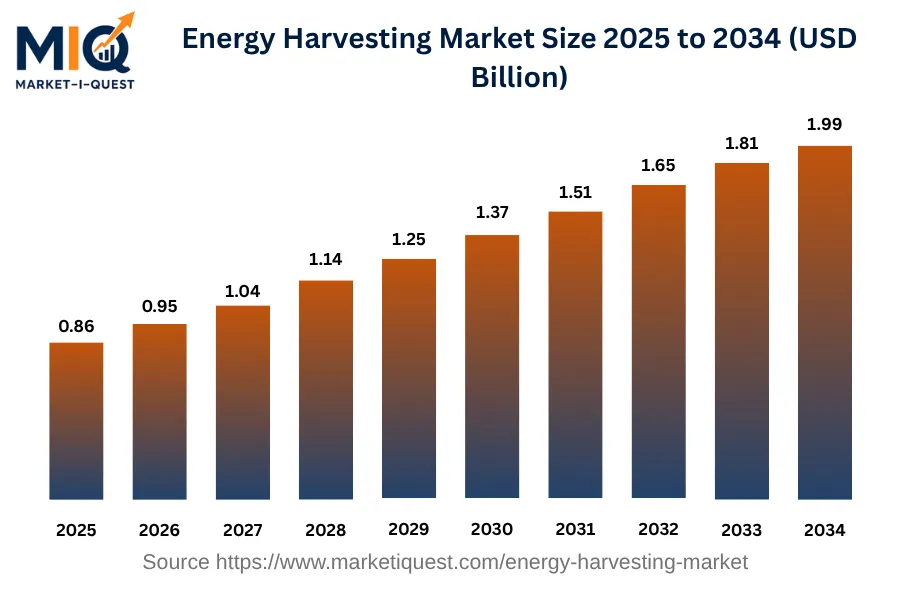
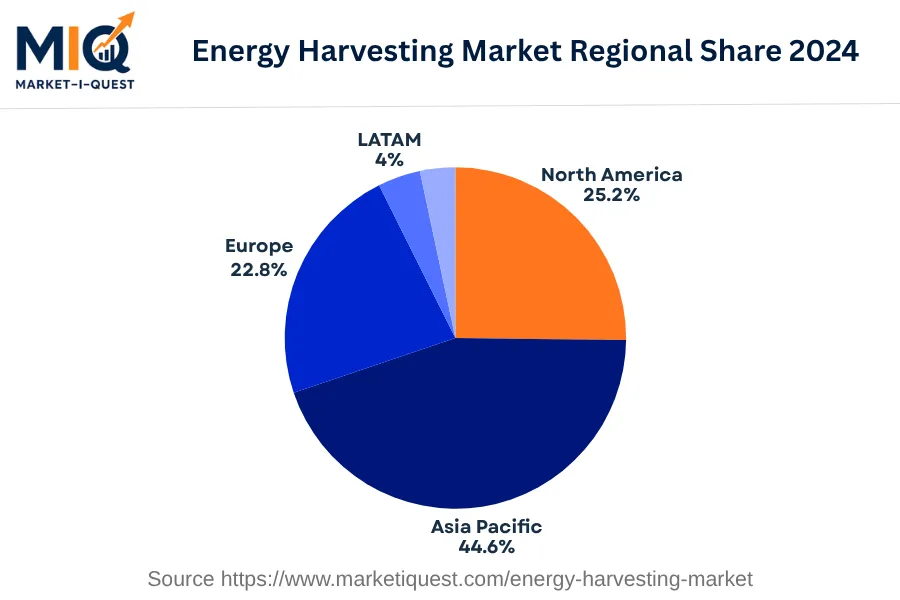
The Energy Harvesting Market was valued at $0.79 billion in 2024 and grew to $0.86 billion in 2025. By 2034, the market size is projected to reach $1.99 billion, representing a compound annual growth rate (CAGR) of 9.8%. This consistent increase in market size from 2025 to 2034 highlights a sustained period of growth, the value nearly tripling in just under a decade. Region-wise in 2024, Asia Pacific held the largest share of the market at 44.6%, followed by North America with 25.2%, and Europe closely behind at 22.8%. The smallest shares of the Energy Harvesting Market were Latin America and Middle East & Africa, accounting for just 4.0% and 3.3% respectively.

Key Takeaways

  • By Energy Source - Electrical led the market accounting for the highest share in 2025.
  • By Technology - Electrodynamic held the dominant position contributing to significant market growth during 2025.
  • By Application - Consumer Electronics shows strong growth dynamics taking a leadership position in 2025.
energy-harvesting-market market size

Key Driving Factors

Implementation of IoT in Industries

The escalating manufacturing sector's inclination towards Industrial Internet of Things (IIoT) acts as a prominent driver for the energy harvesting market. It is a trend that involves embedding devices with sensors to enhance manufacturing and industrial procedures. The surge in energy requirement for these sensors has plunged the necessity for constant power supply, pushing them towards energy harvesting technologies. As the IIoT model thrives, self-sufficient, low-maintenance energy harvesting systems, capable of powering the increasing number of wireless sensor networks, are increasingly desirable. The extended service life and reduced maintenance of these systems are key aspects that make energy harvesting more appealing for IIoT applications, thus driving the market.
Global Push Towards Sustainable Development

The global push for sustainable development and reducing carbon footprint is a significant factor propelling the energy harvesting market. Energy harvesting technologies are designed to harness small-scale energy from naturally occurring phenomena and waste energy in the environment, offering an alternative to fossil fuels. International bodies such as the United Nations and numerous government entities worldwide are mandating Green energy policies and building regulations that favor renewable energy technologies. This acceleration towards sustainable goals opens up enormous opportunity for the growth of energy harvesting technologies. Thus, the global movement towards sustainability directly amplifies the demand and ensuing development within the energy harvesting market.

Market Evolution by Timeline

2019-2023
During this period, the demand for energy harvesting was led by governments and large corporations needing to reduce their carbon footprint, particularly in Europe and North America. IoT devices were the main use case, integrated with energy harvesting technologies like solar and thermoelectric. Though systems integration was in a maturing phase, constraints like efficient conversion and storage limit wider adoption. There was considerable influence from regulations such as the EU's renewable energy directive. Commercially, cost-plus contracts with technology suppliers were prevalent. However, the high initial costs posed risks and deterred smaller enterprises.
2024
By 2024, buyers expanded to include small and medium enterprises typically involved in remote monitoring of off-grid applications like oilfields across the Middle East and Africa. Kinetic energy harvesting systems, being in pilot phase, were shipped for niche markets. Regulatory standards such as the IEEE 802.15 standard for Wireless Personal Area Networks fueled adoption. The market also witnessed the shift towards performance-based contracts with firms collaborating with energy service companies. The risk of technology obsolescence was duly addressed through such contract structures.
2025-2029
Within this timeframe, Asian markets, particularly India and China, were significant buyers, largely driven by industrial IoT applications in smart factories. Hybrid energy harvesting technologies commenced shipping, mitigating energy stability issues. The IEEE's P2418.5 - Standard for Energy Harvesting Interfaces was prominent in this period. Companies favored leasing models to curb high upfront costs and partnered with local suppliers to handle maintenance and reduce costs. However, complex integration with existing systems caused hesitation among some potential adopters.
2030-2034
The consumer electronics industry typically marked high demand due to the surge in wearable technology in this period. Nano energy harvesting was shipping with high efficiency but at a steep price, hence its utility was primarily in high-value applications. Policy standards such as the '2035 Carbon Neutrality Goal' played a considerable role in driving adoption rates. Companies often opted for joint ventures to pool resources and share risks. The main risk was still the disparity between the high cost of this technology and available funding for implementation.

Future Market Outlook

Future Opportunities

The potential for energy harvesting technologies is expanding considerably due to ongoing developments in environmental regulations and energy policies. Countries like Germany are pursuing ambitious goals for energy transition, as outlined in their Energy Efficiency Strategy in 2021, which aims for a significant reduction in carbon emissions. This regulatory emphasis creates opportunities for energy harvesting solutions in sectors such as industrial automation and smart building technologies. Moreover, partnerships have been formed; for instance, in early 2023, power harvesting company Powercast collaborated with semiconductor manufacturers to develop integrated solutions. The growing focus on energy independence and sustainability is likely to further encourage the adoption of energy harvesting systems across various sectors. This is evident in the increased integration of these technologies into wearable electronics, propelled by consumer demand for eco-friendly devices. Notably, the U.S. Department of Energy has been funding research into energy harvesting for smart grid applications, emphasizing resilience in energy systems. As environmental awareness continues to rise, driven by both consumer preferences and regulatory pressures, the demand for energy harvesting technologies is expected to shape a more sustainable future. Consequently, companies actively innovating and collaborating on energy harvesting technologies can expect to navigate an evolving market landscape ripe for growth and development.

Segmentation Analysis

By Energy Source

The market is divided into subsegments including Chemical, Mechanical, Electrical, and Nuclear, among which the Electrical segment accounted for the largest revenue share while the Nuclear one is expected to grow at the fastest CAGR during the forecast period.

Largest Revenue Share

Electrical

Market Share Leader

The Electrical subsegment leads the market in terms of revenue due to several determining factors. Primarily, the proliferation of electrical energy use in both residential and commercial sectors drive much of its dominant market share. Demand for more energy-efficient systems and renewable energy projects also heavily favor this segment. The advent of technologies like advanced energy storage systems, smart grids, and electric vehicles promises continued growth. Since the ability to generate, distribute, and control electrical energy efficiently is a critical factor for almost all sectors and geographies, these underpin the strong performance of the electrical segment. Regulatory trends favoring clean energy global transition, and resilient energy infrastructure formulation further solidify its position. Despite considerable switching costs involved in energy generation and infrastructure, established channels ensure steady revenue flow due to long-term contracts with utilities and large commercial enterprises.

Fastest CAGR

Nuclear

Forecast Period Growth Leader

The Nuclear subsegment is projected to be the fastest-growing sector during the forecast period. The prediction is based on the increasing global demand for scalable, clean, base-load power generation. The nuclear energy arena is going through significant developments with advances in reactor designs, notably the small modular reactors that promise enhanced safety and cost-effectiveness. This, paired with commitments from various countries to reduce carbon footprints, forms a compelling argument for nuclear power. However, the capital-intensive nature and complex regulatory environment surrounding nuclear energy remain significant barriers to adoption. Encouragingly though, partnerships between private and public entities, coupled with policy support for clean energy adoption in many countries, are helping mitigate these challenges. Note, we must take into consideration possible near-term risks, such as regulatory uncertainties and public perception towards nuclear energy, which could affect the growth rate predictions.

By Technology

The market is divided into subsegments including Electrodynamic, Photovoltaic, and Thermoelectric. In this division, Electrodynamic accounted for the largest revenue share while Photovoltaic is expected to grow at the fastest CAGR during the forecast period.

Largest Revenue Share

Electrodynamic

Market Share Leader

The Electrodynamic technology subsegment now leads the market in revenue - a product of several interplaying factors. To start, its widespread application, particularly in the industrial sector for processes like welding, metal refining, and medical therapeutics largely fuels demand. This subsegment also benefits from an affluent customer base distributed globally, but with notable concentration in developed geographies such as the US and EU, attributable to large-scale manufacturing and industrial activities. Regulatory support further propels the Electrodynamic subsegment - for instance, Europe's urbanisation policy encourages use of Electrodynamic equipment in construction. On the supply side, the subsegment is buttressed by established channels, such as distributor networks, enabling broad market reach. The buying decision in this market is largely driven by equipment reliability, energy efficiency and durability, which the Electrodynamic technology provides in spades, cementing its dominance.

Fastest CAGR

Photovoltaic

Forecast Period Growth Leader

Despite the strong foothold of the Electrodynamic subsegment, the Photovoltaic technology is now trending and poised as the fastest growing subsegment. This promising growth outlook is largely driven by global transition towards renewable resources and increased interest in solar energy utilisation. Adoption of Photovoltaic systems nails on the growing urgency to curb carbon emissions - a reality that's led to supportive policy measures and hefty investment in PV technology development. From a customer's standpoint, reducing energy costs provides a strong impetus for adopting Photovoltaic systems, especially among residential and commercial building owners who spend quite a chunk on electricity. However, this subsegment is not without its setbacks - initial capital expenditure for Photovoltaic systems is relatively high, but the advent of solar leasing companies and financing options are starting to tear down this barrier, thereby catalysing growth in this subsegment.

By Application

The market is divided into subsegments including Consumer Electronics, Industrial, Automotive, Healthcare, and Others. Of these, the Consumer Electronics subsegment accounted for the largest revenue share while the Healthcare subsegment is expected to grow at the fastest CAGR during the forecast period.

Largest Revenue Share

Consumer Electronics

Market Share Leader

The Consumer Electronics subsegment enjoys the position of the most revenue-driven sector due to a multitude of reasons. Primarily, the upsurge in disposable income and the resultant increase in purchasing power has boosted the demand for consumer electronics. Moreover, rapid urbanization has resulted in a surge in the number of modern homes that demand smart electronics. This transitioning lifestyle, coupled with the growing interest in the use of smart devices owing to their convenience and efficiency, has significantly propelled the sales in this segment. In addition, technological advancements and continuous innovation in consumer electronics like smartphones, laptops, and smart home appliances have further driven the market growth. The presence of major global manufacturers in regions such as Asia-Pacific and North America also contributes to the significant revenues of this sector. However, globally, the customer preferences and rapidly changing technology invoke manufacturers' need to continuously stay updated and innovative.

Fastest CAGR

Healthcare

Forecast Period Growth Leader

The Healthcare subsegment is projected to register the fastest growth. Growth in this sector is predominantly catalyzed by the increasing adoption of technology in healthcare, necessitated by the evolving disease profile and aging populations. This has driven the adoption of advanced equipment for diagnosis and treatment, accelerating the segment growth rate. Developing countries, especially, have seen a significant increase in healthcare spending, which further accentuates the growth in this sector. Policies supporting the modernization of healthcare infrastructure in these regions have created lucrative opportunities for the market. Furthermore, collaborations between giants in the tech and healthcare industries have fast-tracked the introduction of advanced and efficient medical equipment. However, the high cost of healthcare electronics and lack of skilled labor to handle advanced devices might hamper the growth to some extent. Despite this, the continued innovation and investments in healthcare technology predict a promising growth trajectory for this subsegment.

Competitive Analysis

Key Market Players

Manufacturers / OEMs

EnOcean
Germany
Arveni
France
Fujitsu
Japan

Key Suppliers & Raw Materials

Digi-Key Electronics
US
RS Components
UK
Mouser Electronics
US

Distributors, Integrators & Channel Partners

Kinetic Energy Corporation
US
Siemens
Germany
Schneider Electric
France

Porter’s Five Forces Analysis

Analysis of competitive intensity in the energy harvesting market using Porter’s Five Forces Framework.

Supplier Bargaining Power

Medium

Driven by dependency on certain specialized equipment manufacturers and raw materials.

Buyer Bargaining Power

High

Buyers have numerous suppliers, low switching cost, impacting supplier choice.

Threat of Substitutes

Medium

Substitution threat present with alternative energy solutions, but contingent on cost-effectiveness.

Threat of New Entrants

Low

High initial capex and technical expertise required limit market entry.

Competitive Rivalry

High

Intense competition among established companies to innovate and control market share.

Regional Analysis

Geographic market dynamics and growth opportunities across key regions

Global Market Outlook

energy-harvesting-market market regional share

North America

In 2024, the North American energy harvesting market is dynamically contested due to various drivers and evolving trends. A rise in energy consumption across industries like healthcare, manufacturing, and retail resulted in elevated demand for energy harvesting technologies. Increased investment from both public and private sectors, particularly in the U.S., further solidified the market's growth. North American players, championed by broad acceptance of new technology, showed significant adoption of self-powered, energy-harvesting systems. An upswing in regulations, particularly in Canada, aimed to heighten corporate social responsibility around energy use has also encouraged market growth. The rise in stringent emission standards, primarily from the United States Environmental Protection Agency (EPA), acted as a compelling driver pushing companies toward energy-efficient solutions, thereby inflating energy-harvesting demands.

Changing buyer behavior highlighted an escalated preference for green and sustainable products, with businesses investing in energy conservation to not only adhere to regulations but also respond to consumer expectations. The market also experienced technological shifts, notably seen in increased partnerships between technology companies and utilities for energy-harvesting initiatives. Meanwhile, a surge of mergers and acquisitions reshaped competitive landscapes, particularly within the U.S., further heightening market dynamism. In summary, the North American energy harvesting market in 2024 presents a vibrant scene, given the amalgamation of market drivers and trends.

Asia Pacific

In 2024, the Asia Pacific Energy Harvesting Market demonstrated significant growth, led by China, India, Japan, South Korea, Australia and key ASEAN countries. Market Drivers included increased investment in renewable energy in China due to its national energy policy, the adoption of advanced energy harvesting technologies in Japan, fueled by government initiatives to promote energy efficiency, and regulatory support in India for clean energy solutions, which stimulated market expansion. South Korea's focus on reducing dependence on imports increased demand for locally produced energy harvesting devices. Australia's fluctuating energy prices spurred demand for sustainable energy harvesting techniques. Supply dynamics within ASEAN countries reflected prioritized investments in renewable energy sources.

Trends observed within the market comprised ongoing digital transformation in industries like utilities and manufacturing, elevating demand for advanced energy harvesting solutions. M&A activity within energy technology companies heightened, exemplified by Australia's energy retail sector, where businesses sought to attain competitive advantage through innovative energy harvesting technologies. Policy enforcement, such as India's commitment to the UN's Sustainable Development Goals, significantly influenced market dynamics, pushing towards robust, efficient, and clean energy technologies. Specific sectors prominently featuring energy harvesting solutions were utilities, where grid optimization via renewable sources was vital, along with manufacturing industries, seeking enhanced operational efficiency via energy conservation and smart technology adoption.

Europe

In 2024, the energy harvesting market in Europe reflected substantial growth in response to rising energy demand and efficiency concerns. Key drivers include stringent government regulations for energy efficiency, particularly in Germany and the United Kingdom, advocating for the implementation of energy harvesting technologies. Investment in renewable energy strategies in Italy and Spain similarly stimulated market growth, as these nations embraced self-powering, off-grid solutions. Additionally, the advancement and adoption of nanotechnology, particularly within Benelux, presented new opportunities for kinetic energy harvesting, disrupting traditional supply dynamics. Consumer tendencies toward sustainable practices significantly impacted the market. In France, buyer behaviour shifted toward energy-efficient homes equipped with photovoltaic systems, pushing the residential sector's demand for energy harvesting technologies. Enterprises throughout the Nordics, driven by sustainability targets, likewise adapted their manufacturing practices to incorporate energy recovery solutions.

Partnerships also played a prominent role, particularly in the utilities sector; for example, the alliance of Central & Eastern Europe-based energy companies to innovate ambient energy harvesting technologies. Lastly, policy enforcement of the EU's Energy Efficiency Directive strongly swayed the market's direction. Industries, from healthcare to retail, faced increased pressure to implement energy harvesting technology to comply and contribute to the EU's broader environment and climate goals. The market, thus, captured a landscape where regulatory forces and sustainability trends played leading roles.

Latin America

In 2024, the Energy Harvesting Market in Latin America (LATAM) saw considerable expansion due to several factors. One economic driver was increased infrastructure investment, particularly in major markets such as Brazil and Mexico, which stimulated the demand for renewable energy technologies. Regulatory changes also played a role, most notably in Argentina and Chile, where authorities implemented policies promoting the use of energy harvesting systems. Significant technology adoption, particularly in utilities and manufacturing sectors across Colombia and Peru, further fueled market growth.

In terms of market trends, the increased interest in sustainability among LATAM businesses led to significant changes in buyer behavior. Many companies, primarily in the enterprise and retail sectors, began to prioritize energy-efficient solutions. Furthermore, there was a noticeable shift towards solar and wind energy harvesting technologies, as they became more accessible and cost-effective. Channel dynamics saw increased focus on direct sales, as manufacturers sought to engage customers directly. As for partnerships and acquisitions, many foreign and domestic firms recognized the potential of the LATAM market and formed strategic alliances to expand their footprint. Finally, enforcement of energy efficiency standards across the region, particularly in Brazil and Argentina, continued to shape the market, underscoring the growing commitment to renewable energy.

Middle East & Africa

In 2024, the Energy Harvesting Market experienced substantial growth in the Middle East and Africa. The rapid urbanization in countries like Saudi Arabia, UAE, and Qatar, coupled with increased construction activities, drove the demand for energy-efficient solutions, accelerating the market growth. Strict energy regulations in these countries also boosted the adoption of energy harvesting systems. Furthermore, substantial investments in renewable energy in countries like Egypt, Nigeria, and Kenya stimulated the market expansion. One significant trend in this market in 2024 was the shift towards solar and wind energy harvesting, particularly observed in UAE, Saudi Arabia, and South Africa, with wide acceptance in both governmental and industrial sectors. The emergence of IoT in industries like telecom and healthcare also encouraged the use of energy harvesting, as seen predominantly in Israel.

Another trend was new partnerships or M&A to enhance technological capabilities and market reach, with numerous examples from South Africa and Egypt. The enforcement of policies encouraging green energy further spurred the market growth. The primary customers of this market comprised sectors such as government, oil and gas, utilities, telecom, healthcare, manufacturing, and financial services, with distinct preferences and adoption rates varying by region and sector. Notably, telecom and healthcare sectors showed a great interest in energy harvesting technologies due to their continuous power requirements.

Recent Industry Developments

Latest market innovations, product launches, and strategic initiatives

January 2026

Silicon Labs' xG22-EK8200A Energy Harvesting Explorer Kit began shipping through Mouser Electronics, enabling evaluation of energy-harvesting-powered devices with Bluetooth® LE and Zigbee® Green Power for industrial automation, smart home, and building applications.

June 2025

Siemens announced a strategic partnership with EnOcean to integrate EnOcean's energy-harvesting wireless sensors into Siemens Building Technologies' portfolio, enabling self-powered field devices for smart buildings and reducing maintenance costs.

Frequently Asked Questions