
Wireless Sensor Network Market Snapshot

Key Players

  • Texas Instruments Inc. (United States)
  • Huawei Technologies Co. Ltd. (China)
  • STMicroelectronics N.V. (Switzerland)
  • Honeywell International Inc. (United States)
  • NXP Semiconductors N.V. (Netherlands)
  • Omron Corporation (Japan)
  • Endress+Hauser Management AG (Switzerland)
  • Sick AG (Germany)
  • Analog Devices Inc. (United States)
  • Freescale Semiconductor Ltd. (United States)

Market Size

Base Year 2024
$26.73 Bn
CAGR
17.94%
Forecast 2034
$139.19 Bn

Market Segments

By Component
Hardware, Software, and Services
By Sensor Type
MEMS Sensors, CMOS-based Sensors, LED Sensors, Motion and Position Sensor
By Application
Home and Building Automation, Industrial Automation, Military Surveillance, Smart Transportation
By End-Use Industry
Automotive and Transportation, Aerospace and Defence, Oil and Gas, Healthcare, Others

Market Dynamics

Drivers
  • Increasing IoT adoption
  • Advancements in sensor technologies
Restraints
  • High deployment cost
  • Limited battery life
Opportunities
  • Increasing IoT applications
  • Advanced agricultural practices

Market Size

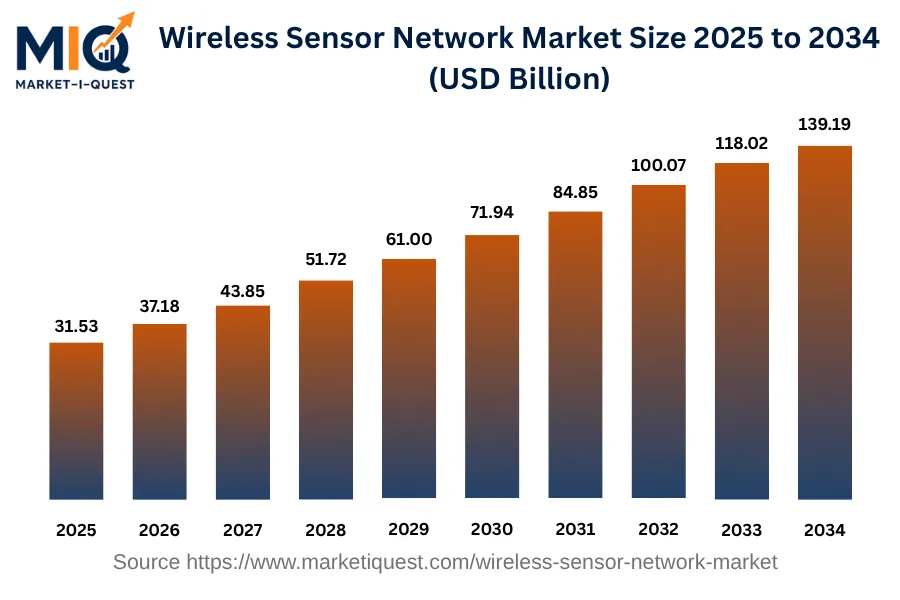
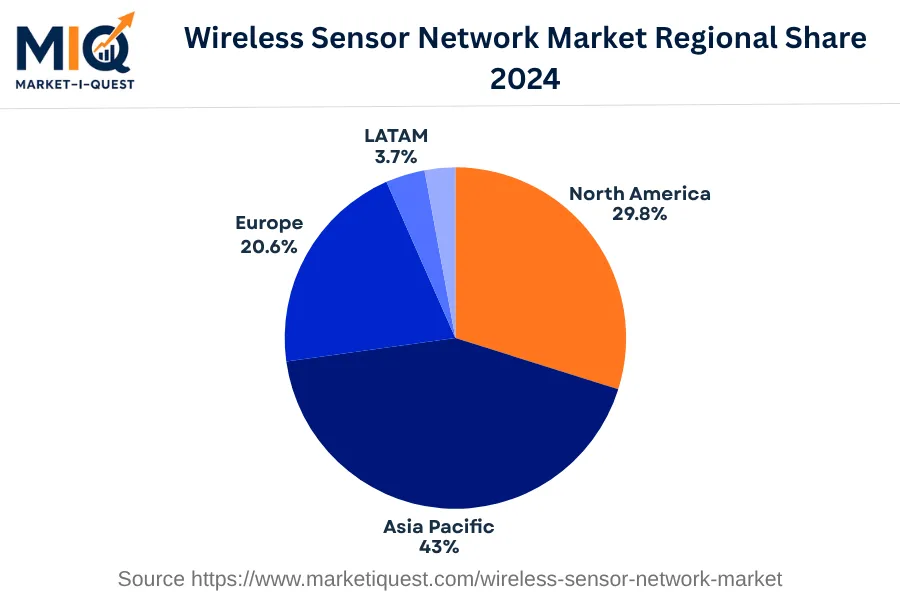
The Wireless Sensor Network Market size is projected to increase from USD 31.53 billion in 2025 to USD 139.19 billion by 2034, at a CAGR of 17.94%. This expansion is characterized by a significant increase from USD 26.73 billion in 2024 to USD 31.53 billion in 2025. The rise in market size can be attributed to advancements in wireless communication technologies and the increasing adoption of wireless sensor networks across various sectors. The growth is also driven by the rising demand for remote monitoring of equipment, systems, and operations, as well as the need for cost-effective and energy-efficient solutions. In terms of regional market share in 2024, Asia Pacific held the largest share at 42.96%, followed by North America with 29.84%, Europe with 20.58%, Latin America with 3.72%, and Middle East and Africa with 2.9%.

Key Takeaways

  • By Component - Software led the market by holding a substantial share in 2024.
  • By Sensor Type - MEMS Sensors dominating as the leading subsegment of this segment in 2024.
  • By Application - Industrial Automation held the largest market share of the segment in 2024.
  • By End-use Industry - Automotive and Transportation segment held the top position of the segment in 2024.
wireless-sensor-network-market market size

Key Driving Factors

Emergence of Industrial IoT (IIoT)

The incorporation of Industrial IoT (IIoT) across multiple industry verticals such as manufacturing, oil and gas, and utility sectors is a key driver for the adoption of wireless sensor networks. This is due to the ability of wireless sensor networks to collect, analyze, and transmit data in real-time, which helps in predictive maintenance, minimizing downtime, improving efficiency, and optimizing operations. These characteristics make wireless sensor networks an integral part of an IIoT infrastructure. As companies increasingly deploy IIoT applications due to their ability to improve operational efficiency and profitability, the demand for wireless sensor networks is simultaneously escalating.
Implementation of Smart Cities & Building Automation

Another factor driving the growth of the wireless sensor network market is the rising trend of smart cities and intelligent building automation. Municipalities and city administrators around the world are focusing on using technology to make the urban environment more connected, sustainable, and livable. Wireless sensor networks play a crucial role in this, offering real-time monitoring and management of various city infrastructure such as traffic, public utilities, and energy consumption. In the case of smart building automation, these networks provide a cost-effective solution for energy management and optimization by providing controls for heating, ventilation, and air conditioning systems, making buildings more energy-efficient. This has led to a surge in the adoption of wireless sensor networks in these sectors.

Market Evolution by Timeline

2019-2023
During this period, the Wireless Sensor Network (WSN) market saw demand primarily in smart cities, healthcare, and environmental monitoring. Specifically, in the European and North American regions, environmental agencies and municipal bodies adopted WSNs for real-time monitoring of air, water, and soil quality. Simultaneously, medical institutions used sensor networks for patient monitoring and drug administration. Technologically, these years saw battery-powered, short-range sensors become dominant. However, interoperability between different sensor brands and models remained a major challenge. Policy-wise, FCC regulations regarding radio spectrum use and data privacy rules impacted the adoption. Common commercial models included one-off purchases and subscription services for integrated systems. One significant risk during this period was the vulnerability of WSNs to cyber attacks.
2024
By this time, industrial automation became a major vertical for WSNs. Companies worldwide, especially in developed Asian regions like Japan and South Korea, integrated WSNs into their production lines for inventory tracking and quality control. On the supply side, energy-efficient sensors with improved range surfaced, but integration issues continued. New data security standards, like ISO/IEC 27001, emerged, dictating data handling practices within WSNs. The prevalent commercial model was the 'Sensors-as-a-Service' with fixed-term contracts and add-on services. But, system reliability was a concern due to issues with sensor battery life and connectivity.
2025-2029
WSNs found increased adoption in precision agriculture and weather forecasting applications in this phase. Predominantly, the demand came from North America, South America, and Australia. The release of new, AI-based sensor models with increased sensitivity unlocked these use-cases. However, lack of standardization remained a bottleneck. Policymakers initiated programs like 'The Green Digital Program' to boost WSN utilization in sustainable ways. Commercially, vendors shifted towards performance-based contracts, where payment hinged on the network's uptime. The major risk in these years included 'monitoring gaps', where sensor coverage is insufficient or non-uniform.
2030-2034
During these years, smart homes became a promising sector for WSNs - especially in the U.S. and Western Europe. Technologies evolved to provide extended battery life and greater interoperability. However, sensor installation and maintenance became major problems. In terms of regulations, GDPR 2.0, which had stricter data privacy laws, affected WSN deployment in Europe. The 'Pay-per-Sensor' pricing model became dominant, where customers paid for individual sensor usage. Risks in this phase included higher failure rates of sensors and high maintenance costs, which vendors tried to mitigate with extended warranty and preventive maintenance packages.

Future Market Outlook

Future Opportunities

As the demand for smart solutions rises, the future opportunities for the wireless sensor network market remain promising due to current technological trends and regulatory developments. The ongoing expansion of smart city initiatives, such as the Barcelona Smart City Project initiated in 2019, is expected to create demand for integrated wireless sensor solutions for traffic management and environmental monitoring. Similarly, as industries increasingly focus on Industry 4.0, the implementation of wireless sensor networks in manufacturing processes is anticipated to improve operational efficiency and predictive maintenance capabilities, driven by partnerships like the one between Siemens and Amazon in 2022. Furthermore, the global push for sustainable development has prompted governments to encourage the deployment of wireless sensor networks for agricultural monitoring and resource optimization, with countries like India piloting IoT-based solutions. Notably, the European Union's Green Deal emphasizes the need for smart agriculture, which could enhance the adoption of wireless sensor technologies in crop monitoring. Moreover, the emergence of edge computing is expected to optimize the functionality of wireless sensor networks by processing data closer to the source, as seen in collaborations between tech companies and academic institutions in 2023. Lastly, advancements in battery technology, particularly initiatives by organizations like the International Energy Agency to improve energy storage solutions, are expected to enhance the longevity and performance of wireless sensor devices, offering further opportunities for market growth.

Segmentation Analysis

By Component

The market is divided into subsegments including Hardware, Software, and Services, with Software accounting for the largest revenue share while Services are expected to grow at the fastest CAGR during the forecast period.

Largest Revenue Share

Software

Market Share Leader

Within the market’s different components, software holds the largest revenue share due to numerous factors. Software being at the core of most contemporary technologies, has driven its high market value. It's versatility allows it to be integrated into various industries, including but not limited to, healthcare, education, and manufacturing. The pervasiveness and applicability of software, combined with its necessity across various business operations, have positioned it as an indispensable tool. At a regional level, North America and Western Europe, with their robust IT infrastructure and digital transformation initiatives across enterprises, contribute significantly to the software market's considerable share. Additionally, regulatory considerations play an increasingly vital role in driving the market towards software compliance solutions. Products are assessed based on their compliance to industry-specific rules and regulations, influencing purchasing decisions. With high switching costs due to the technical nature of software and potential business disruption, clients are more likely to continue their existing partnerships. Hence, the software market continues to lead due to its undeniable utility, versatility, widespread applicability, and regulatory implications.

Fastest CAGR

Services

Forecast Period Growth Leader

Despite the dominant position of software, the Services component is expected to grow at the fastest CAGR during the forecast period. As the market becomes more saturated, services related to installation, maintenance, and integration stand out as key differentiation points for industry players. Moreover, demand for these services is spurred on by the surge in software adoption regardless of industry. Constant evolution of technology dictates a need for continuous update and maintenance services, serving as a strong driver for growth. Adoption barriers for businesses might be the perceived difficulty in incorporating these services into their digital transformation efforts and budget constraints. However, strategic partnerships can provide comprehensive solutions catering to diverse needs of businesses. Regulations, too, play a significant role in driving demand for services as companies strive to stay compliant. The development of technology and the necessity to keep pace with changes present near-term risks, requiring constant innovation. Thus, the growth of the services subsegment is powered by competitive differentiation, technological advancements, and regulatory landscapes.

By Sensor Type

The market is divided into subsegments including MEMS Sensors, CMOS-based Sensors, LED Sensors, and Motion and Position Sensor. Among these, MEMS Sensors accounted for the largest revenue share while LED Sensors are expected to grow at the fastest CAGR during the forecast period.

Largest Revenue Share

MEMS Sensors

Market Share Leader

MEMS sensors hold the biggest market share in 2024 due to a variety of factors. Firstly, the increasingly miniaturized and sophisticated electronic goods require sensors with a small form factor but high sensitivity, and MEMS sensors perfectly fit this bill. Their small size allows seamless integration into various consumer electronic devices such as smartphones, wearables, and medical devices. In addition to this, the ongoing IoT revolution is playing a crucial role in boosting the demand for MEMS sensors, as they are a core component in most IoT devices. Regions with high technological adoption rates such as North America, Europe, and Asia-Pacific continue to be the main geographic drivers of this growth. Regulation, purchase criteria, and supply dynamics further cement MEMS Sensors as the leading subsegment in terms of revenue. High switching costs for manufacturers and a growing preference for MEMS sensors among consumers also ensure that MEMS sensors are likely to maintain their dominant position in the near future.

Fastest CAGR

LED Sensors

Forecast Period Growth Leader

While it is acknowledged that MEMS Sensors are currently leading in revenue generation, LED Sensors are the fastest growing subsegment in this industry. The rate of adoption for LED Sensors is significantly growing thanks to their inherent benefits such as low power consumption and longer lifespan compared to traditional lighting solutions, making them an environmentally friendly choice. Coupled with the global movement towards energy conservation and green technologies, these advantages serve as key growth drivers. Tech advancements and partnerships, in the form of research and development for newer, more efficient LED technologies and collaborations between LED manufacturers and automotive & consumer electronic industry giants respectively, act as catalysts spurring this growth. However, it's worth noting that the prohibitive initial cost of LED Sensors could be deemed an adoption barrier that could drastically affect its growth predictions. As for geographical uptake, the Asia-Pacific region, particularly China & India, with their booming electronics industry and government initiatives promoting LED lighting, is championing the adoption of LED Sensors.

By Application

The market is divided into subsegments including Home and Building Automation, Industrial Automation, Military Surveillance, and Smart Transportation. Industrial Automation accounted for the largest revenue share while Smart Transportation is expected to grow at the fastest CAGR during the forecast period.

Largest Revenue Share

Industrial Automation

Market Share Leader

Industrial Automation in 2024 is assumed to be the reigning subsegment with the most substantial revenue share based on broader market commonalities. Its primary drivers are improved efficiency, quality, and safety in various industries resulting in significant reductions in errors and operational costs. The ongoing technological advancements enable faster and more precise operations. Corporate clients come from a broad array of industries, ranging from manufacturing and oil & gas to healthcare and agriculture. These domains are demonstrating a heightened demand for modernized facilities. Developed regions such as North America and Europe are key geographics, owing to their mature industrial sector and high adoption of advanced technologies. Meanwhile, promising growth in emerging economies, especially in Asia-Pacific, offer considerable opportunities for market expansion. Regulatory frameworks are increasingly encouraging automation to enhance industry competitiveness. Significant capital investment and long-term contracts make it harder for customers to switch providers, in turn asuring a steady revenue stream. Through direct channels and partnerships with local vendors, these solutions reach end-users worldwide.

Fastest CAGR

Smart Transportation

Forecast Period Growth Leader

Smart Transportation is projected to be the fastest-growing subsegment over the forecast period. The subsegment's rapid growth is driven by burgeoning urbanization, increasing demand for efficient transportation systems, and growing awareness about environmental sustainability. The introduction of smart cities across the globe is catalyzing the adoption of smart transportation. Technological advances, such as IoT and AI, have been instrumental in the subsegment's exponential growth, providing real-time traffic management and intelligent routing. However, the high cost of infrastructure development and privacy and security concerns are possible barriers to adoption. Government policies aimed at reducing traffic congestion and pollution are facilitating investment in smart transportation projects, propelling its growth. Collaborations and partnerships with tech companies are proving to be instrumental in accelerating the development of smart transport solutions. While unpredictable events such as pandemic outbreaks pose temporary disruption in growth, the long-term outlook remains promising with an increased drive towards sustainable and efficient transportation solutions.

By End-Use Industry

The market is divided into subsegments including Automotive and Transportation, Aerospace and Defence, Oil and Gas, Healthcare, and Others. Of these, the Automotive and Transportation sector accounted for the largest revenue share while the Healthcare sector is anticipated to exhibit the quickest growth during the forecast period.

Largest Revenue Share

Automotive and Transportation

Market Share Leader

The Automotive and Transportation industry has emerged as the market segment with the greatest revenue in the base year 2024. This can be attributed to the steady growth of economies worldwide, rising disposable income, and increasing vehicle ownership. These trends are driving growth and profitability in the automotive and transportation sector. Furthermore, the continuous evolution of technology in this industry, including advancements in electric and autonomous vehicles, have created lucrative opportunities for market participants. Regulations supporting lower emissions and increased fuel efficiency have also spurred the demand for more sophisticated and high-tech automotive components, contributing to their expanded market share. Geographically, Asia-Pacific is a prominent contributor to the sector's revenue, thanks to the increasing sales of automobiles, specifically in emerging markets like China and India. In addition, the robust infrastructure for supply chains and logistics in this region has fostered the growth of the transportation industry.

Fastest CAGR

Healthcare

Forecast Period Growth Leader

The Healthcare sector is poised to register the fastest compound annual growth rate during the forecast period. This growth is supported by the global aging population and the escalating prevalence of chronic ailments, which demand long-term care and consistent medical intervention. Advances in medical technology, such as the digitization of healthcare information and the rise of telemedicine, are key catalysts propelling the market's growth. Additionally, significant capital expenditure in healthcare infrastructure, particularly in developing economies, is accelerating the sector's expansion. Government policies promoting universal healthcare access and raising health awareness are serving as additional growth triggers. However, barriers such as stringent regulatory frameworks and data security concerns might challenge the pace of growth. Forthcoming trends, including the integration of artificial intelligence and machine learning applications in healthcare, offer significant potential, but also bring near-term risk due to their nascent stage and high costs.

Competitive Analysis: Wireless Sensor Network Market

Key Market Players

Manufacturers / OEMs

ABB Ltd.
Switzerland
Honeywell International Inc.
US
Texas Instruments Incorporated
US

Key Suppliers & Raw Materials

STMicroelectronics
Switzerland
Broadcom Inc.
US
Cypress Semiconductor Corporation
US

Distributors, Integrators & Channel Partners

Avnet, Inc.
US
Arrow Electronics, Inc.
US
Digi-Key Electronics
US

Porter’s Five Forces Analysis

A comprehensive exploration of the competitive dynamics within the Wireless Sensor Network Market

Supplier Bargaining Power

Medium

Well-established suppliers exert moderate power due to their ability to manipulate prices of components.

Buyer Bargaining Power

High

Buyers have high bargaining power owing to broad availability of diverse sensor networks and solutions.

Threat of Substitutes

Low

Unique functionality and adaptability of sensor networks limit threat of viable substitutes.

Threat of New Entrants

Medium

High R&D costs and technical expertise needed deter entry, but IoT growth could attract new entrants.

Competitive Rivalry

High

Market saturation from tech giants and SMEs elevates competitive rivalry in wireless sensor network landscape.

Regional Analysis

Geographic market dynamics and growth opportunities across key regions

Global Market Outlook

wireless-sensor-network-market market regional share

North America

In 2024, the Wireless Sensor Network Market in North America was characterized by a robust demand due to the increased adaptation of digital technologies and the need for efficient data management. Critical demand drivers included the ascendant technological advancement, high investment in R&D, and the surging adoption of IoT devices across various sectors. Regulatory push from governments, like the U.S Federal Communications Commission's policy on the fair allocation of spectrum resources, also steered the market growth. Rapid urbanization and the escalating need for real-time data analysis fueled more adoption, creating a favorable supply dynamic.

Trend-wise, several emerging technologies, such as Big Data and Artificial Intelligence, were incorporated within wireless sensor networks. The growth of smart homes and cities in the U.S and Canada led to a surge in buyer interest in these networks. Partnerships and M&As became a common dynamic to boost market share and reach, prominently between tech companies and the manufacturing and healthcare sectors. Organizations focused on harnessing the network's efficiency, such as the Internet of Things Solutions Alliance (IoTSA), emerged to standardize and encourage the technology's adoption. The primary sectors capitalizing on these dynamics comprised healthcare, manufacturing, retail, utilities, and government agencies, reflecting the critical role of wireless sensor networks in the entire North American economy in 2024. These networks significantly enhanced data-driven decision-making in these sectors.

Asia Pacific

The Wireless Sensor Network (WSN) market in Asia Pacific in 2024 was characterized by a positive growth trajectory, predominantly driven by burgeoning demand, technology adoption, and regulatory landscapes. Rapid urbanization coupled with the increasing need for efficient monitoring systems across sectors such as healthcare, utilities, and manufacturing catalyzed demand in key markets like China, India, and Japan. Tech-savvy South Korea showed a notable trend of adopting advanced sensor technologies, spearheading regional growth. Additionally, favorable government policies, particularly in Australia and ASEAN markets, propelled WSN implementations, thereby facilitating market expansion.

On the trend spectrum, buyer behavior was distinctly marked by a preference for integrated, intelligent sensor systems. For instance, Indian manufacturers showcased a marked shift toward WSNs for predictive maintenance, indicating a maturing market landscape. China, with its strategic focus on Industry 4.0, also witnessed accelerated adoption of WSNs. In Japan, there was a clear trend toward using sensor networks in retail environments for improved inventory and energy management. The year also witnessed landmark public-private partnerships in Australia, aimed at promoting WSN utilization across various sectors. In tandem, strict policy enforcement to ensure data privacy in South Korea and key ASEAN markets helped maintain robust market health in 2024.

Europe

In 2024, the Wireless Sensor Network (WSN) market in Europe demonstrated solid growth driven by increasing demand and enhanced technology adoption. Legislation, such as the European Union's Radio Equipment Directive, regulated interoperability, safety standards, and energy efficiency, thus boosting the market. Deepening investments from countries like Germany and the UK in smart cities, green energy infrastructure, and Industry 4.0 were observed. There was evident uptake of WSN by manufacturers in Italy, healthcare providers in France, and utilities sectors across Benelux due to the rising efficiency and decreased operational costs. In the Nordics, IoT integration into everyday operations evidenced the need for advanced WSN technology.

Consumer behaviour in 2024 evinced an increasing preference for wireless sensors, influenced not only by the convenience but also the growing smart home trend across Europe, particularly in Spain. Substantial shifts in technology favoured low-power wide-area networks (LPWANs) for their broad coverage and low energy usage. Notably, partnerships and M&A activities were widespread, such as the collaboration between Nordic Semiconductor and Dutch telecom KPN, enhancing product accessibility. A drive towards standardisation, under the aegis of organisations like the European Telecommunications Standards Institute, was also evident, ensuring compatibility and utility across different applications. Clearly, technology adoption and improved regulatory framework played crucial roles in driving Europe's WSN market in 2024.

Latin America

In 2024, the Wireless Sensor Network (WSN) market in Latin America (LATAM) experienced steady growth, primarily fuelled by increased adoption in various sectors. Drivers of this expansion were manifold: the surge in smart city initiatives, particularly in Brazil and Mexico, increased demand for WSN; stricter environmental regulations in Argentina and Chile prompted utilities to incorporate sensor technology for improved resource management; Colombia's booming manufacturing sector invested heavily in automation, necessitating the use of WSN for efficient operation; and advancements in technology made wireless sensors cost-effective and more accessible across the region.

Notable market trends included a shift in buyer behavior, with enterprises opting for sensor solutions that offered enhanced data analytics capabilities. Product evolution was also evident, with the introduction of low-power, wide-area network technologies reflecting the growing demand for long-range connectivity. In terms of partnerships, significant mergers and acquisitions took place, especially within Brazil's retail sector. This consolidation aimed at strengthening capabilities and enlarging customer bases. Regulatory standards became stricter to ensure the security of data transmitted via sensors, with Peru leading policy enforcement. Demand was highest in the government, healthcare, utilities, manufacturing, and retail sectors, each of which increasingly recognized the benefits of real-time data monitoring and management.

Middle East & Africa

In 2024, the wireless sensor network market in the Middle East and Africa demonstrated substantial growth in response to end-user demand for efficient, real-time data and monitoring systems. Market drivers included robust investment in IoT technologies from sectors such as healthcare, manufacturing, and oil and gas, particularly in economies such as Saudi Arabia and the UAE, enhancing technology adoption across the region. Increasing governmental regulations, especially in Egypt and South Africa, also forced improvements in environmental monitoring, boosting demand for advanced sensor networks. Plus, favorable pricing dynamics, largely driven by abundant supply in Nigeria and Kenya, promoted greater market penetration.

The noteworthy trends within the market involved a significant shift in buyer behavior towards smart and integrated solutions with a particular focus on security, energy management, and logistical efficiency. There was a marked emphasis on IoT in utilities and the telecommunication sector across Israel and Qatar, underlining the shift towards automation and digital transformation. Furthermore, a surge in strategic partnerships and M&A activities was observed, particularly in financial services and the retail sector as businesses sought to deploy advanced sensor networks for optimized operations. Lastly, stronger enforcement of standards and policies impacted the deployment and integration of these networks, influencing market trends predominantly in countries with stringent regulations such as South Africa and Israel.

Recent Industry Developments

Latest market innovations, product launches, and strategic initiatives

January 2026

Bosch Sensortec launched the BMI5 platform, a new generation of sensors equipped with built-in artificial intelligence. This development allows the sensors to process movement data directly on the device rather than sending it across a network to a central server, which drastically cuts power use and speeds up reaction times for robotics and smart wearable devices.

November 2025

STMicroelectronics released the ISM6HG256X, a three-in-one motion tracking sensor designed specifically for heavy industrial environments. By shrinking the physical size of the sensor and combining multiple tracking tools into one single unit, this launch makes it much cheaper for companies to install widespread, wireless monitoring systems across entire factories without sacrificing physical durability.

June 2025

Rockwell Automation published their annual smart manufacturing report, detailing a massive shift in how the industry uses wireless networks. The report revealed that 95% of manufacturers are now investing in machine learning that connects directly to wireless sensors, allowing factories to predict equipment failures instantly rather than relying on older, slower wired systems.

Frequently Asked Questions