Thin Film Material Market Snapshot

Key Players

  • First Solar (United States)
  • Moser Baer India Ltd (India)
  • Hanergy Thin Film Power Group (China)
  • Strem Chemicals Inc. (United States)
  • Norsk Hydro ASA (Norway)
  • Materion Corporation (United States)
  • 3M (United States)
  • Kaneka Corporation (Japan)
  • Umicore Group (Belgium)
  • Suzhou NanoGrid Technology Co. Ltd. (China)

Market Size

Base Year 2024
$15.83 Bn
CAGR
5.86%
Forecast 2034
$27.98 Bn

Market Segments

By Product Type
Thin Film Transistors, Light-Emitting Diodes (LEDs), Solar Cells, Capacitors, Resistors, Sensors, Fuel Cells, Medical Devices
By Material Type
Metals, Semiconductors, Dielectrics, Polymers, Others
By Deposition Method
Physical Vapor Deposition (PVD), Chemical Vapor Deposition (CVD), Molecular Beam Epitaxy (MBE), Sol-Gel, Others
By Application
Semiconductors, Solar Cells, Displays, Optical Coatings, Sensors, Batteries, Fuel Cells, Others

Market Dynamics

Drivers
  • Rising demand for solar panels
  • Advancements in nanotechnology
Restraints
  • High production costs
  • Technological limitations
Opportunities
  • Emerging renewable energy sector
  • Advancements in nanotechnology

Market Size

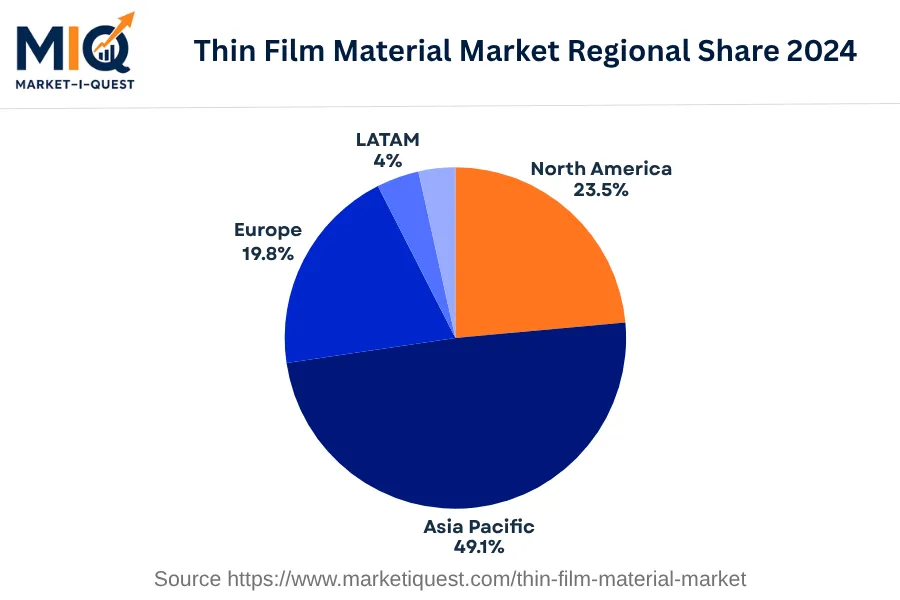
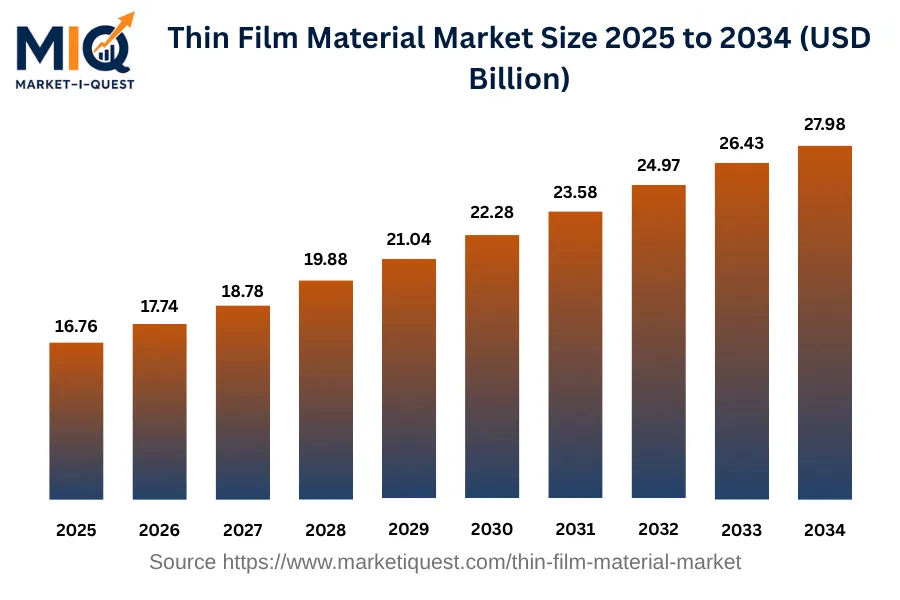
The Thin Film Material Market is slated to grow from a value of 16.76 billion USD in 2025 to 27.98 billion USD by the year 2034, indicating a CAGR of 5.9% along this trajectory. The financial path delineates that the market value measured 15.83 billion USD in the start year, 2024 and is projected to experience a moderate increase in the following year 2025 to value 16.76 billion USD. Thereon, a steady growth pattern is anticipated, eventually culminating in the market scaling up to 27.98 billion USD by the end year, 2034. The growth in the market size is primarily attributable to the escalation in the adoption and application of thin film materials across various industries. Region-wise, the Asia Pacific accounted for the largest market share in 2024, holding 49.1%, followed by North America and Europe with 23.54% and 19.84% respectively, while LATAM and MEA accounted for smaller shares; 4.02% and 3.48% respectively.

Key Takeaways

  • By Product Type - Light-Emitting Diodes (LEDs) dominated having a remarkable position in 2024.
  • By Material Type - Semiconductors led the market with a significant share in the same year.
  • By Deposition Method - Chemical Vapor Deposition (CVD) held the highest rank in 2024.
  • By Application - Semiconductors was the top subsegment marking a noteworthy segment share in 2024.
thin-film-material-market market size

Key Driving Factors

Emergence of Flexible Electronics

The growing field of flexible electronics is significantly impacting the thin film materials market. As industry players strive to develop devices that are lightweight, durable, and malleable, they increasingly turn to thin film materials. Thin film materials meet the challenging design requirements for flexible electronic devices, such as foldable displays, wearable tech, and Internet of Things (IoT) sensors, due to their adaptable properties and capacity for seamless integration into various product architectures. This adoption by mainstream flexible electronics manufacturers is facilitating the expansion of the thin film materials market.

Increasing Solar Energy Applications

The thin film materials market is being propelled by the surge in solar energy applications. Thin film photovoltaic (PV) cells, made of thin film materials, have gained popularity due to their cost effectiveness and improved efficiency. Manufacturers prefer thin film PV cells over traditional silicon-based panels for these benefits, despite lower efficiency ratings, because of lower installation costs and ability to function effectively even in low-light conditions. This affinity for thin film in solar energy applications boosts the market demand. Furthermore, global trends towards green energy and government initiatives to reduce carbon footprints have intensified this growth.

Market Evolution by Timeline

2019-2023
In this period, thin film materials were primarily demanded by the semiconductor and photovoltaic industries with Asia Pacific region, particularly countries like China, Japan, and South Korea, showing the most demand due to the presence of large manufacturing units. The thin film materials produced were mainly sputtering targets and evaporation materials. On supply aspect, the market witnessed integration of thin film coating technology with smart product technologies. However, low efficiency, compared to conventional solar modules was a constraint. Concerning policy, standards like ISO 12944 drove the market with strict regulations on corrosion protection pushing towards thin film materials. Commercially, contract manufacturing was a prevailing model. Lower cost was a typical selling point. Practically, long product life cycles and high inventory levels were a risk to supply chain sustainability.
2024
For the year 2024, display technologies including flatscreen TVs and smartphones were key sectors demanding thin film materials, with demand focused in North America due to advancements in consumer electronics. Silicon and compound semiconductors were largely produced thin film materials. Supply-wise, advancements in roll-to-roll processing allowed streamlined production of thin films. Regulatory-wise, RoHS compliance steered market behavior aiming for hazardous substance restriction in electronic equipment. Partnership-based alliances with technology providers became a common commercial approach aiming for better market penetration. Main practical risk faced was compliance with the increasingly strict environmental regulations in developed regions.
2025-2029
During 2025-2029, demand for thin film materials extended to medical devices and implants, predominantly from Europe and North America, aiming for increased device performance and patient compatibility. Produced thin films were typically bio-functional coating materials with high biocompatibility. Technologically, companies pushed for integrating nanotechnology into thin film manufacturing for miniaturizing medical devices. Policies largely revolved around medical device regulations like the EU Medical Device Regulation (MDR) affecting product development. The common commercial model involved providing customized thin film solutions per client needs. The predominant practical risk was ensuring biocompatibility and safety in bio-medical applications.
2030-2034
In 2030-2034, thin film materials found utility in new applications like quantum computing and energy storage, notably in the U.S. and Canada attributed to the blossom of high-tech industries. High-performance materials like superconducting films became the popular thin film products. On supply side, integration with advanced manufacturing processes such as atomic layer deposition was apparent. Regulatory impact was particularly felt in quantum computing as governments like the U.S. DoE pushed research programs influencing the technological trajectory. Licensing agreements emerged as a typical commercial model enabling technology transfer. Addressing requirement for ultra-clean environments in manufacturing posed as a practical risk.

Future Market Outlook

Future Opportunities

Current developments in the thin film material market present several strategic opportunities for growth. As of 2023, the increasing demand for clean energy technologies is prompting companies like SunPower to explore new thin film applications in solar panels aimed at residential and commercial setups in the United States. The anticipated updates to the ISO 14001 environmental management standards in 2024 further encourage businesses to adopt sustainable practices, potentially boosting the use of eco-friendly thin films in manufacturing. Furthermore, advancements in the aerospace sector, led by Boeing's ongoing research into ultra-lightweight thin film materials, highlight applications that can improve fuel efficiency in aviation. The automotive industry is also pursuing partnerships to leverage thin films for lightweight car designs, with manufacturers like Toyota actively investigating the integration of such materials in future electric vehicle models projected for release by 2025. Advancements in regulatory frameworks, particularly in Europe, are also expected to drive market expansion as the EU pushes for increased renewable energy adoption. The intersection of environmental regulations and technology will likely spur innovation in thin film materials, allowing companies to explore new markets in sectors such as construction, consumer electronics, and renewable energy solutions. Overall, favorable technological trends and proactive regulatory environments will serve as catalysts for expansive applications of thin film materials across various industries.

Segmentation Analysis

By Product Type

The market is divided into subsegments including Thin Film Transistors, Light-Emitting Diodes (LEDs), Solar Cells, Capacitors, Resistors, Sensors, Fuel Cells, and Medical Devices. The Light Emitting Diodes (LEDs) accounted for the largest revenue share, while Solar Cells are expected to grow at the fastest CAGR during the forecast period.

Largest Revenue Share

Light-Emitting Diodes (LEDs)

Market Share Leader

LEDs command the lion's share of the market revenue owing to their widespread usage across several industries, including consumer electronics, automotive, and even residential lighting applications. The increasing consumer preference for energy-efficient and environmentally-friendly lighting solutions has been instrumental in driving LED demand. Moreover, technological advancements have made them more cost-effective, contributing to their dominance in the marketplace in 2024. High switching costs for LED alternatives act as a strong barrier for competitors, and the established distribution channels foster easy accessibility for consumers. Geographic regions with higher per capita income, such as North America and Western Europe, significantly contribute to the revenue since they are early adopters of this technology. Government policies supporting the use of energy-saving solutions also contribute to the reinforcement of LED's market position.

Fastest CAGR

Solar Cells

Forecast Period Growth Leader

Solar Cells are forecasted to experience the fastest growth rate within the given market subsegments. Driving factors for this fast-paced growth include increased environmental awareness and governmental policies promoting the utilization of renewable energy sources. Corporate investment into research and development of more efficient and affordable Solar Cell technology acts as a catalyst for this growth. Additionally, the recent partnerships between solar cell manufacturers and utility companies have broadened the use of this technology in power grids, contributing to its rapid adoption. Despite the high initial Capex, a shift toward green energy solutions and the potential for energy cost savings make Solar Cells an attractive choice for both businesses and consumers. However, aspects like weather dependency and the need for adequate installation space could pose near-term growth risks.

By Material Type

The market is divided into subsegments including Metals, Semiconductors, Dielectrics, Polymers, and Others. In 2024, Semiconductors accounted for the largest revenue share while Dielectrics is expected to grow at the fastest CAGR during the forecast period.

Largest Revenue Share

Semiconductors

Market Share Leader

Semiconductors have taken the lead in the material type market owing to a combination of factors. Key among these is their applicability in a wide range of industries such as electronics, automotive, and aerospace. Semiconductors form the backbone of modern technology; their utility spanning from basic electronic gadgets to complex spacecraft components. An increase in demand and consumption of electronic devices have largely contributed to the high revenue of this subsegment. Geographically, regions like Asia-Pacific, home to many technological industries, have played a pivotal role in driving the sale of semiconductors. Regulatory mandates promoting the use of energy-efficient electronic appliances have also acted as a boost. Customer demand for enhanced speed and performance in electronic devices invariably leads to the continual purchase of better semiconductors, thus creating a sustained revenue source.

Fastest CAGR

Dielectrics

Forecast Period Growth Leader

The Dielectrics subsegment is poised for the fastest expansion due to several catalysts. There is an increasing demand for dielectric materials in industries such as telecommunications, electrical and electronics, power plants, automotive, and more. These materials, owing to their insulating properties, are crucial for the operation of capacitors, transistors, and various other electrical components. Technological advancements and the subsequent inception of high-k dielectrics offering better insulating properties have redefining this sector. Policies promoting renewable energy and increased Capex in power plants are also acting as growth catalysts. However, the high cost of dielectric materials and issues regarding their integration into existing architectures present near-term risks to their rapid adoption.

By Deposition Method

The market is divided into subsegments including Physical Vapor Deposition (PVD), Chemical Vapor Deposition (CVD), Molecular Beam Epitaxy (MBE), Sol-Gel, and others. In 2024, the Chemical Vapor Deposition (CVD) subsegment accounted for the largest revenue share, while the Molecular Beam Epitaxy (MBE) is expected to grow at the fastest CAGR during the forecast period.

Largest Revenue Share

Chemical Vapor Deposition (CVD)

Market Share Leader

The Chemical Vapor Deposition (CVD) subsegment leads in revenue generation due to its versatile application in various industries. It's a preferred deposition method in semiconductor manufacturing due to its ability to produce high purity, high-performance solid materials and superior quality thin films. The burgeoning semiconductor industry worldwide, especially in geographies like Asia-Pacific which is becoming a new hub for semiconductor production, contributes significantly to CVD's high revenue. Rapid digitization and increasing demand for better electronic devices, which rely on semiconductors, also drive the revenue of CVD. In addition, strict regulation in industries such as automotive and aerospace for uniform, high-quality, and durable coatings, makes CVD a preferred choice over other methods, thereby enhancing revenue generation.

Fastest CAGR

Molecular Beam Epitaxy (MBE)

Forecast Period Growth Leader

The Molecular Beam Epitaxy (MBE) subsegment is projected to grow at the fastest CAGR. Emerging technologies like advanced LED lights, power electronics, and satellite communications, which require flawless and top-quality semiconductor devices, are driving the adoption of MBE due to its superior ability to deposit ultra-thin layers of materials. Policy shifts towards cleaner and renewable sources of energy have spurred the demand for high-efficiency solar cells, a sector in which MBE plays a critical role. Rapid advances in nanotechnology and growing partnerships between MBE equipment manufacturers and end-user industries are also catalyzing its growth. However, the high initial investment and technical expertise required for MBE could pose near-term adoption barriers, requiring aggressive capacity building and cost reduction strategies by market players.

By Application

The market is divided into subsegments including Semiconductors, Solar Cells, Displays, Optical Coatings, Sensors, Batteries, Fuel Cells, Others. Semiconductors accounted for the largest revenue share while Displays is expected to grow at the fastest CAGR during the forecast period.

Largest Revenue Share

Semiconductors

Market Share Leader

In the base year of 2024, semiconductors were the leading segment in terms of revenue. This is primarily attributed to their widespread use across industries, including consumer electronics, automotive, healthcare, and more. The ongoing digitization trend seems to fuel the demand for semiconductors because they form the core of any electronic device. Furthermore, advancements in semiconductor technology, such as the development of nanodevices and power semiconductors, are expected to further drive this demand. In addition to this, emerging technologies like AI and IoT heavily rely on semiconductors, suggesting that the trend is unlikely to slow down anytime soon. Regions with strong technology sectors, such as North America and Asia Pacific, contribute significantly to this revenue stream. Stringent environmental regulations worldwide are also supporting this growth by encouraging the development of electric vehicles, which use power semiconductors.

Fastest CAGR

Displays

Forecast Period Growth Leader

The Displays subsegment is likely to grow at the fastest pace due to swift technological advancements, demand for improved visual experience, and the advent of new application areas. The rapid uptake of high-resolution devices by consumers is a significant growth driver. This demand has seen an uptick, especially with the increase in remote work and learning arrangements amidst the global pandemic. The rise of AR and VR technologies also presents new opportunities for the growth of this segment. Adoption barriers most likely include the relatively higher cost of advanced display panels and issues related to power consumption. However, continued investments in technological innovation and partnerships between display manufacturers and OEMs are anticipated to counteract these barriers. On the capex side, new manufacturing units and the upgrade of existing facilities can take place in the near term. Policy changes can act as both catalysts and risk points, particularly those related to international trade and e-waste management.

Thin Film Material Market Competitive Analysis

Key Market Players

Manufacturers / OEMs

Hanergy Thin Film Power Group
China
Kaneka Corporation
Japan
First Solar Inc.
US

Key Suppliers & Raw Materials

Ascent Solar Technologies Inc.
US
Ulbrich Stainless Steels & Special Metals Inc.
US
Corning Incorporated
US

Distributors, Integrators & Channel Partners

SolarWorld AG
Germany
Trony Solar Holdings Co. Ltd.
China
Moser Baer Solar Ltd.
India

Porter’s Five Forces Analysis

Analysis of competition, bargaining power, and threat factors in the thin film material market.

Supplier Bargaining Power

High

High because of scarce raw materials and limited number of suppliers.

Buyer Bargaining Power

Medium

Medium due to the increasing demand but high switching costs.

Threat of Substitutes

Low

Low due to lack of comparable performance and cost-effective alternatives.

Threat of New Entrants

Medium

Medium because of high capital costs and technical know-how requirements.

Competitive Rivalry

High

High due to the presence of various established industry giants.

Regional Analysis

Geographic market dynamics and growth opportunities across key regions

Global Market Outlook

thin-film-material-market market regional share

North America

In 2024, the North American Thin Film Material Market exhibited prolific growth driven by technological advancements, legislative mandates, and increased demand from key sectors. Solar energy industry's continuous expansion played a significant role, stimulated by governmental regulations promoting green energy adoption in Canada, Mexico, and especially in the United States where state-level incentives were prevalent. Notably, the proliferation of consumer electronics also served as a central growth driver, with demand for high-performance thin films in display technology rising sharply. The market was marked by several trends. Consumer preference leaned towards lightweight, cost-effective products, subsequently propelling technological shift towards more efficient thin film materials. Manufacturing partnerships held strong, particularly amongst US-based companies seeking to augment production capacities. Furthermore, stringent policy enforcement by the EPA and Environment and Climate Change Canada on industrial effluents directly influenced R&D for eco-friendly thin film materials.

Key customer sectors that contributed to market expansion in 2024 included enterprise, healthcare, and retail, specifically in terms of high efficiency thin film-based photovoltaics for power generation in commercial spaces. Meanwhile, manufacturing sector harnessed thin films predominantly for coating and surface treatment processes. Government initiatives also remained instrumental, supporting research efforts and adoption in utility-scale solar projects. Surface-level, the North American Thin Film Material Market experienced robust growth in 2024 as technology adoption, demand factors, and regulations coalesced to drive forward momentum.

Asia Pacific

In the base year 2024, presence of key players and various growth drivers moulded the Asia Pacific Thin Film Material market. Predominantly, surging demand for thin film materials in China, South Korea, and Japan, driven by rapid advancement and adoption of technology in sectors such as energy, medical devices, and electronics, fuelled market growth. There was significant investment in research and development by governments and corporations in India and China, further driving the supply and uptake of thin film materials. The introduction of stringent policies in Australia and key ASEAN markets, encouraging renewable energy usage, indirectly elevated thin film materials demand for solar cells production.

Market trends in 2024 revealed more nuanced developments. China's trend of miniaturization in the electronics sector amplified the demand for thin film materials. In South Korea and Japan, advancements in healthcare systems propelled the use of thin film materials in medical devices. There was a shift in buyer behaviour across the region, leaning towards sustainable and efficient energy solutions, expediting the adoption of thin film in photovoltaic cells. The ASEAN market saw a rise in strategic partnerships among regional and international players, expediting technology transfers, and thus propelling market growth. Finally, regulatory bodies in India were visible with stricter enforcement of “Make in India” policy, fuelling local production and consumption of thin film materials.

Europe

In 2024, the Europe-centered Thin Film Material market showcased significant fluctuations across diverse sectors and regions. Drivers of this market included substantial investments in technology adaptation from sectors like utilities and manufacturing, particularly in influential economies like Germany and the UK. Regulatory actions favoring sustainable products, most notably in France and the Nordics, catalyzed increased demand for thin film materials. Furthermore, supply dynamics, pivoting towards localized production to mitigate interruptions and cost adjustments, significantly influenced the market in Spain, Italy, Benelux, and Central & Eastern Europe.

Shifts in buyer behavior toward quality and reliability of products drastically transformed the thin film material landscape in 2024. This shift coupled with strategic partnerships and M&As, targeted at improving product offerings and expanding market reach, underscored the year's trend. For example, the Italian utility sector saw several partnerships between local startups and established players. Strict enforcement of relevant policies, such as the EU's Circular Economy Action Plan, prompted a push toward sustainable manufacturing practices. In response, retail and enterprise businesses in the UK and Germany accelerated their adoption of thin films, aligning operations to these standards, further solidifying the thin film material market in these regions.

Latin America

In 2024, Latin America's thin film material market experienced substantial dynamic shifts. Growth was driven primarily by the accelerated adoption of photovoltaic technologies for solar energy, especially in Argentina and Chile, presenting vast opportunities for thin film materials. Significant investments in Brazil and Mexico's electronic industry also propelled demand. Regulatory frameworks favoring sustainable energy solutions, clear in Colombia's Decree 1073, underscored this upward trajectory. However, volatile raw material prices, particularly of amorphous silicon, created supply uncertainties.

Simultaneously, trends signifying the market's evolution surfaced. The adoption of thin film semiconductors translated into a shift in consumer preference towards energy-efficient electronic devices, primarily in the consumer goods sector. Technological advancements resulting in the production of thin film materials with superior properties, prevalent in the manufacturing sector, further defined the market landscape. Proprietary alliances, such as between Brazil's EMBRAER and Argentina's INVAP, signified a drive towards augmenting technological capabilities. Stricter policy enforcement on environment-conservation, evident in Peru's stricter renewable-energy regulations, drove the demand for green technologies by institutional consumers. These market dynamics have positioned thin film materials as an integral determinant in industries such as solar energy, electronics, and healthcare in Latin America. Therefore, understanding these key drivers and trends is critical for stakeholders desiring to navigate this industry effectively.

Middle East & Africa

In 2024, the Middle East and Africa's thin film material market had a vibrant economy with significant dynamics. Major drivers included rising demand for photovoltaic solar cells, particularly from Saudi Arabia and UAE due to their government's investments to create sustainable and independent energy sources. The market was also fueled by increased uptake in the communication sector- strong wireless network infrastructures in countries like Kenya and Israel increasingly depend on thin film materials. Moreover, the reduced prices of these materials in the global market had positively influenced their accessibility and affordability within these regions.

Notable trends involved changing buyer behaviors, with an unprecedented move towards energy-efficient and miniature devices in sectors like healthcare and retail particularly in Egypt and South Africa. A prominent product shift was seen towards flexible and lightweight thin film materials in the manufacturing sectors, with Nigeria leading in this adoption. Simultaneously, there was an increased enforcement of policies advocating efficient use of energy, especially in Qatar which further spurred the thin film materials market. A substantial number of partnerships and M&A were observed in various sectors, as companies aimed to consolidate their positions in this market, further boosting the overall market dynamics.

Recent Industry Developments

Latest market innovations, product launches, and strategic initiatives

August 2025

Covestro successfully completed the acquisition of Pontacol, a Swiss manufacturer of multilayer adhesive films, expanding its specialty films portfolio with highly specialized flat and blown films.

August 2025

Quzhou Xin'an Development Co., Ltd. signed an agreement to acquire a 95.46% stake in Vital Thin Film Materials Co. Limited for an enterprise value of approximately CNY 12 billion (later cancelled in May 2026).

Frequently Asked Questions