
Power Electronics Market Snapshot

Key Players

  • Infineon Technologies (Germany)
  • Texas Instruments (United States)
  • ON Semiconductor (United States)
  • Mitsubishi Electric Corporation (Japan)
  • Hitachi Power Device (Japan)
  • Toshiba Electronic Devices & Storage Corporation (Japan)
  • NXP Semiconductors (The Netherlands)
  • Panasonic Corporation (Japan)
  • STMicroelectronics (Switzerland)
  • ABB Ltd. (Switzerland)

Market Size

Base Year 2024
$29.73 Bn
CAGR
5.9%
Forecast 2034
$52.74 Bn

Market Segments

By Device Type
Power discrete devices, Power modules, Power ICs
By Component
Thyristors, Gate turn-off transistors, MCTs, Silicon controlled rectifiers, AC/AD converters, Static switches, MOSFETs, Others
By Material
Silicon (Si), Silicon carbide (SiC), Gallium nitride (GaN), Others
By End User Industry
Automotive, IT & Telecom, Energy & Utilities, Aerospace & Defense, Industrial Manufacturing, Others

Market Dynamics

Drivers
  • Rapid industrialization
  • Growing renewable energy sector
Restraints
  • High manufacturing costs
  • Technological complexity
Opportunities
  • Emerging electric vehicle industry
  • Renewable energy sector growth

Market Size

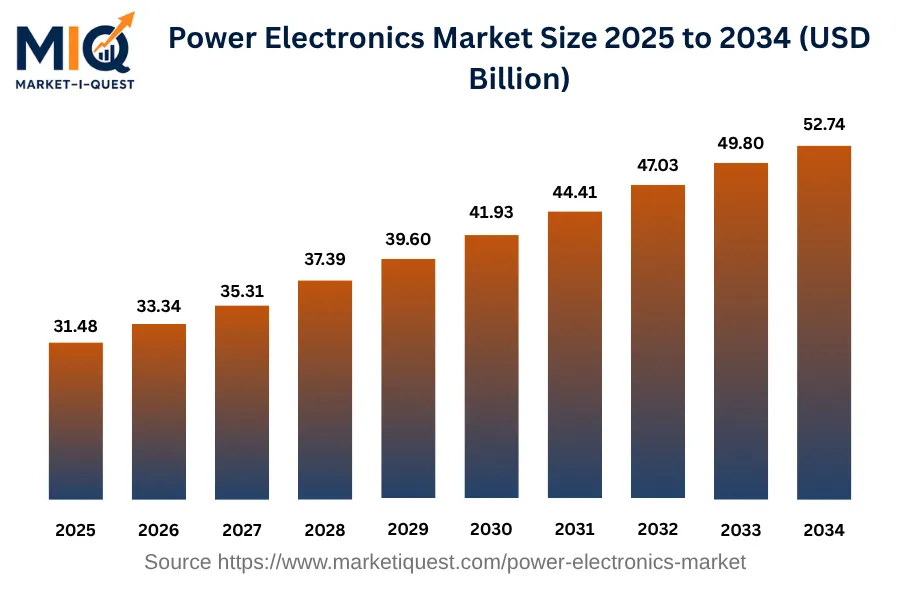
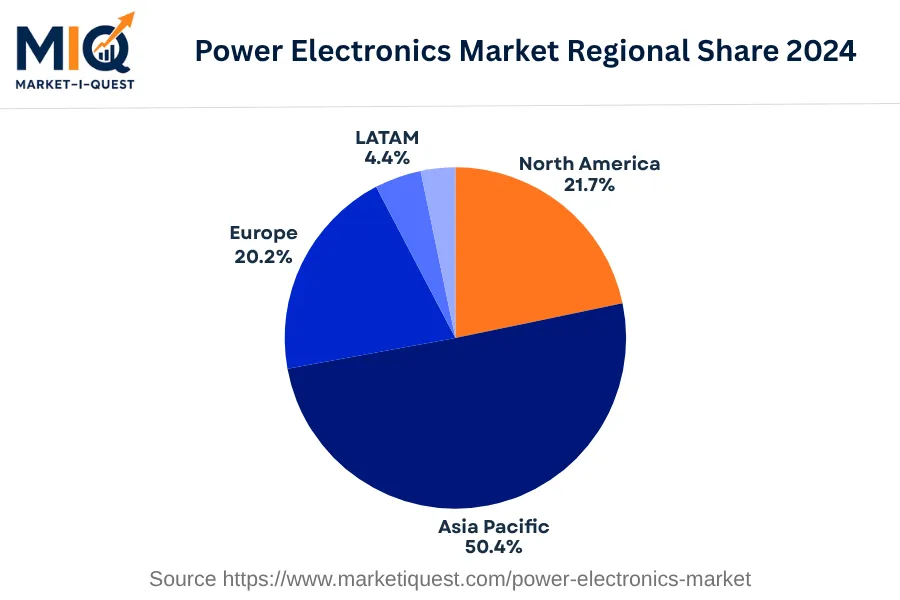
The Power Electronics Market, in terms of revenue, was worth 31.48 billion USD in 2025 and is projected to reach 52.74 billion USD by 2034, growing at a CAGR of 5.9%. Between 2025 and 2034, this marks a significant increase of over 21 billion USD in market value. This trend of growth may be attributed to a multitude of factors. The primary drivers of growth are situated in the advancing technology and the increasing need for efficient power management solutions. As a result, there is a consistent uptick in the market size in the ten-year forecast period. There are however regional variations. For instance, in 2024, Asia Pacific accounted for 50.4% of the market share, the largest proportion. This was followed by North America and Europe with a share of 21.7% and 20.2% respectively. The smallest shares were held by LATAM and MEA, contributing 4.4% and 3.3% of the market respectively.

Key Takeaways

  • By Device Type - Power ICs held the leading position accounting for the major market share in 2024.
  • By Component -Silicon controlled rectifier led the market accounting for a significant share in 2024.
  • By Material - Silicon (Si) accounted for the largest share in 2024 leading the market in this segment.
  • By End User - Industrial Manufacturing expanded the fastest accounting for the prime share in the year 2024.
power-electronics-market market size

Key Driving Factors

Adoption of Electric Vehicles and Renewable Energy Systems

The transition towards green energy sources, coupled with the adoption of electric vehicles, is emerging as a powerful driving force in the power electronics market. Power electronic devices are fundamental to the operation of renewable energy systems and electric vehicles, assisting in the efficient conversion, control, and conditioning of electric power. Governments worldwide are also incentivizing the use of renewable energy and electric vehicles to curb carbon emissions, further propelling the market for power electronics. Herein, the demand for devices such as inverters, converters, and controllers has increased drastically, substantially driving market growth.
Expansion of Data Centres

The surge in data generation, primarily driven by the digitalization of industries and the adoption of cloud computing, has led to an increase in the demand for data centres. Power electronics are integral to the functioning of data centres, ensuring the seamless flow of power and mitigating potential breakdowns by maintaining power quality standards. These devices also play a crucial role in enhancing energy efficiency, a significant concern in large-scale data centres due to high power consumption. Thus, as businesses worldwide continue investing in data centres, there's a growing demand for power electronics, further propelling the market growth.

Market Evolution by Timeline

2019-2023
Buyers during this period, namely automotive and renewable energy companies, lean towards Asia-Pacific region devices due to their integration maturity and operational efficiency. Market attention is mainly on inverters, converters, and power supplies. For technology, silicon carbide and gallium nitride are standard, although supply has constraints due to high manufacturing costs. Policies such as the Paris Agreement are stimulating demand as they encourage green energy. In response, manufacturers are entering strategic partnerships to offset costs. Contracts often see fixed-volume procurement. Biggest risks come from logistics disruption due to ongoing trade disputes affecting the timely supply of raw materials.
2024
In 2024, data centers and electric vehicle suppliers dominate demand. Silicon carbide and gallium nitride are still dominant materials. Manufacturing challenges persist, limiting supply. Most manufacturers are based in Asia, specifically China. As business continuity becomes a key concern, geographical diversification of supply chains gains importance. Prices have a tendency to decrease; volume agreements still in place but with more suppliers. Regulatory influences such as data protections laws in the EU likely to affect the market. Increasing cybersecurity risks, due to the heavy dependence on online infrastructures, have led to rise in risk management programs.
2025-2029
Demand diversifies as Robotics, UAVs, and EV Charging Infrastructure suppliers showed significant interest. Constraints persist on supply side due to manufacturing complexities. US and China dominate power gadget production landscape, but India and Brazil are emerging. Compact, lightweight, and energy-efficient devices are preferred. Pricing shift towards performance-based contracts is seen. EU's Circular Economy Action Plan encourages power electronics recycling, shaping market direction. Concerns over environmental impact of gathering raw materials increasing, prompting investigations into more sustainable extraction processes. Recurring trade disputes between nations create uncertainties over raw material supply and amplify volatility of material costs.
2030-2034
Maritime and space buyers join market for power electronics. Material-wise, diamond started to replace silicon carbide and gallium nitride due to its better thermal conductivity. Manufacturing still concentrated in Asia, but North America and Europe gain ground. Standardisation efforts evolve as IEEE initiates high-frequency power electronics project. More long-term strategic partnerships are developed to ensure reliability of supply. Pricing still performance-oriented, but companies usually implement risk-sharing agreements to minimise uncertainty. Introduction of 6G network revolutionises communication, prompting regulatory changes. Acute shortage of raw materials is a key supply risk, raising necessity for more circular economy dynamics.

Future Market Outlook

Future Opportunities

Future opportunities in the power electronics market are closely tied to the evolving landscape of electric transportation and renewable energy integration. As nations globally push towards carbon neutrality, with countries like Norway targeting all new cars to be zero-emission by 2025, electric vehicles stand at the forefront of this transition. Companies such as Ford and Volkswagen are actively developing high-performance power electronic systems to support their upcoming EV models. Furthermore, as industries adjust to stricter environmental regulations, like the European Union’s Fit for 55 initiative introduced in 2021, industries across Europe are looking to upgrade their power management systems to comply. The growing demand for flexible and efficient energy storage systems presents a significant market opportunity as more residential and commercial entities adopt energy storage solutions to optimize solar energy use, evidenced by platforms such as the Tesla Powerwall. Additionally, continued investment in infrastructure, such as smart grids, is expected as countries, especially in Asia, prioritize digital transformation initiatives to enhance energy distribution. Collaborations and partnerships, such as the one between Siemens and the National Renewable Energy Laboratory, emphasize research into advancing power electronic technologies. This trend suggests that the integration of power electronics within applications across sectors will not only enhance system efficiency but also support the transition to renewable energy, representing substantial future growth avenues in the market.

Segmentation Analysis

By Device Type

The market, divided by device type into subsegments including Power discrete devices, Power modules, and Power ICs, sees Power ICs as leading the revenue share, while Power discrete devices are expected to have the fastest CAGR during the forecast period.

Largest Revenue Share

Power ICs

Market Share Leader

Power ICs have emerged as the dominant force among device type subsegments, mainly due to their tremendous utility in various applications. Its increasing adoption in automobiles, telecommunications, and consumer electronics has contributed significantly to its high revenue. As more devices start incorporating intelligence and functionality, the demand for Power ICs, known for their efficient performance and compact form, has escalated. The upswing in hybrid vehicles and the significant push toward electrification of the transportation sector have also stimulated the growth of the Power ICs market. Geographically, the APAC region contributes substantially because of the strong presence of automotive and consumer electronics companies. The combination of these factors has propelled the Power ICs segment's revenue beyond its peers.

Fastest CAGR

Power discrete devices

Forecast Period Growth Leader

Power discrete devices are anticipated to be the fastest-growing subsegment in the coming years. Their growth can be attributed mainly to their flexibility and capability to operate at high voltages and temperatures, which make them ideal for applications in renewable energy, automotive, and industrial sectors. The transition towards renewable energy sources, along with the surge in electric vehicle infrastructure developments, has amplified the demand for power discrete devices, particularly in emerging markets such as India, China, and Brazil. However, intense competition and price pressure from substitutes may pose challenges to growth. Adopting advanced technological innovations, fostering strategic partnerships for materials and technology exchange, and capitalizing on untapped potential markets could serve as potential accelerators for future growth for this subsegment.

By Component

The market is divided into subsegments including Thyristors, Gate turn-off transistors, MCTs, Silicon controlled rectifiers, AC/AD converters, Static switches, and MOSFETs, among others. In 2024, Silicon controlled rectifiers accounted for the largest revenue share while AC/AD converters are expected to grow at the fastest rate during the forecast period.

Largest Revenue Share

Silicon controlled rectifiers

Market Share Leader

Silicon controlled rectifiers (SCRs) emerged as the component with the largest revenue share in 2024, largely due to their wide range of uses across a multitude of industries. SCRs are often used in power devices extensively in various sectors such as automotive, industrial electrical equipment, and consumer electronics. Their efficiency, reliability, and compact size make them a preferred choice over other alternatives. In the industrial domain, SCRs are an integral part of motor control systems and power supplies. Their rising use in electric vehicle charging stations, renewable energy systems, and power transmission lines further conceivably drove the market demand. Features like high surge current capability and low on-state voltage drop are also instrumental in high adoption rates. The high implementation in regions with robust industrial growth also correlates with the large revenue contribution.

Fastest CAGR

AC/AD converters

Forecast Period Growth Leader

AC/AD converters, while accounting for a smaller revenue share as compared to some other components in 2024, are predicted to show the fastest increase in adoption during the forecast period. AC/AD converters are essential components in modern electronics and renewable energy solutions. This rapid growth can be attributed to the increased use of advanced electronics and IoT devices globally, which typically require signal conversion for microcontrollers to process data. Additionally, the renewable energy sector is growing rapidly, leading to an increased demand for AC/AD converters in energy conversion systems. Advances in technology and a push towards energy efficiency have increased the efficiency and lowered the cost of AC/AD converters, driving their adoption. The growth might face challenges in the form of technical complexities and the cost of advanced AC/AD converters.

By Material

The market is divided into subsegments including Silicon (Si), Silicon carbide (SiC), Gallium nitride (GaN), and others, with the Silicon (Si) accounting for the largest revenue share, while Gallium nitride (GaN) is expected to grow at the fastest CAGR during the forecast period.

Largest Revenue Share

Silicon (Si)

Market Share Leader

Silicon has been a long-standing material of choice in the semiconductor industry due to its high abundant supply and well-established manufacturing processes, which have led to cost efficiencies and reliability that drive its leading position in revenue. Its use spans across a wide range of applications such as microchips, solar cells, and LCD displays among others. Silicon's highly predictable and stable properties enable manufacturers to produce high-performance products reliably, especially in the mature industrial and automotive segments. Despite competition from newer materials such as Silicon carbide and Gallium nitride, Silicon continues to dominate these segments due to the significant initial cost and technical barriers for large-scale shift towards alternative materials. Moreover, policies and regulations have been in favor of Silicon due to its established safety profile and negligible impact on the environment compared to less mature and less tested alternative materials.

Fastest CAGR

Gallium nitride (GaN)

Forecast Period Growth Leader

Gallium nitride (GaN) holds the potential for significant growth going forward. This is because of its superior properties, such as high power density, high breakdown strength, and high thermal conductivity. These characteristics enable the development of smaller, more efficient, and higher performing electronic devices. GaN is witnessing increasing application in next-generation power electronics, RF devices, and LEDs. Major tech companies are investing and partnering to harness the potential of GaN. Government policies promoting energy-efficient devices are also fostering its adoption. While GaN’s high cost and complex manufacturing process compared to Silicon are barriers to adoption, advancements in production techniques and scale are poised to reduce costs and spur growth. Despite these hurdles, the potential benefits make GaN an attractive prospect for numerous tech-driven sectors, making it the subsegment with the highest projected CAGR.

By End User Industry

The market is divided into subsegments including Automotive, IT & Telecom, Energy & Utilities, Aerospace & Defense, Industrial Manufacturing, and others. Industrial Manufacturing accounted for the largest revenue share while IT & Telecom is expected to grow at the fastest CAGR during the forecast period.

Largest Revenue Share

Industrial Manufacturing

Market Share Leader

Industrial Manufacturing claims the biggest chunk of revenue in this sector. Several factors drive this trend. Firstly, industrial manufacturing is a broad sector, encompassing a wide range of products and services, from machinery to electronic devices. The sheer diversity of this subsegment contributes to its large revenue share. Secondly, the ongoing industrial revolution, aptly named Industry 4.0, is causing a surge in demand for high-tech manufacturing solutions, which in turn generates robust revenues. Industrial manufacturing is also geographically widespread, breaking down geographical barriers and enabling revenues not tied to any particular region's economic health. In many countries, industrial manufacturing forms the backbone of the economy, which ensures its sustained demand. Finally, low switching costs and standardization in the industrial manufacturing subsector facilitate transactions and product uptake, increasing sales numbers and hence revenue.

Fastest CAGR

IT & Telecom

Forecast Period Growth Leader

The IT & Telecom sector is expected to grow at the fastest rate during the forecast period. A crucial growth driver is the digital transformation sweeping across industries, demanding cutting-edge telecom services and innovative IT solutions. Companies are increasingly adopting cloud-based services, data analytics, and artificial intelligence technologies to streamline operations and enhance customer experience, sparking demand in the IT & Telecom subsegment. Policy initiatives in many countries favoring the digital economy and aiming to enhance network infrastructures are another impetus for growth. Major investments by leading players to develop 5G and subsequent network generations promise high growth rates in the near future. However, privacy and security concerns, compliance with diverse international regulations, and high initial Capex could pose challenges to rapid growth. Market players that can address these concerns while offering competitive pricing and innovative solutions are poised for success.

Competitive Analysis

Key Market Players

Manufacturers / OEMs

Infineon Technologies AG
Germany
Texas Instruments Incorporated
US
NXP Semiconductors NV
Netherlands

Key Suppliers & Raw Materials

ADVANCED SEMICONDUCTOR ENGINEERING, INC.
Taiwan
Intel Corporation
US
Sumitomo Chemical Co., Ltd.
Japan

Distributors, Integrators & Channel Partners

Avnet, Inc.
US
Arrow Electronics, Inc.
US
Electrocomponents plc
UK

Porter’s Five Forces Analysis

This analysis assesses the power electronics market’s competitive dynamics and attractiveness.

Supplier Bargaining Power

Medium

Suppliers have moderate power due to the limited number of manufacturers of advanced power electronic components.

Buyer Bargaining Power

High

Buyers have high power due to the availability of multiple suppliers and low switching costs.

Threat of Substitutes

Low

Threat of substitutes is low as power electronics have unique features not easily replaced.

Threat of New Entrants

Medium

Entry barriers are moderate due to required technical expertise and initial investment in R&D and manufacturing infrastructure.

Competitive Rivalry

High

Rivalry is high due to the presence of many players competing on technology advancements and price.

Regional Analysis

Geographic market dynamics and growth opportunities across key regions

Global Market Outlook

power-electronics-market market regional share

North America

In 2024, the North American power electronics market underwent a significant shift. The market's dynamic largely derived from advances in technology, increased energy demand, and regulatory changes. A growing emphasis on renewable energy sources and the proliferation of electric vehicles in the U.S., Canada, and Mexico catalyzed the demand for power electronic systems. Investment from enterprise customers and government entities in solid-state transformers and energy-efficient power devices further drove the market.

Several notable trends underscored the market landscape. An evident shift towards silicon carbide (SiC) and gallium nitride (GaN) technologies in the manufacturing sector inspired the development of high-power-density devices. Simultaneously, utilities and retail sectors saw increasing adoption of smart power management solutions. The enforcement of power conservation standards and norms by regulatory bodies encouraged the surge in energy-efficient and compact device usage across various sectors, including healthcare and industrial.

Partnerships and mergers & acquisitions transpired consistently between local and international market players. These aimed at technological enhancements and fulfilling the burgeoning energy demand, especially in industries such as renewable energy and electric vehicle manufacturing. It was evident that the nuances of the North American power electronics market in 2024, reflected a compound response to technological advancements, investment influx, and changing regulatory frameworks.

Asia Pacific

In 2024, Asia Pacific's Power Electronics Market showed significant growth, fueled by various drivers and shaped by key trends. Increased population, rapid urbanization, and growing demand for energy-efficient devices in countries like China, India, and Japan propelled market expansion. Regulatory pressures for energy-efficient systems within manufacturing, utilities, and enterprise sectors also galvanized growth. Enhanced investment in renewable energy projects, especially in China and India, boosted the demand for power electronics. Technological adoption, notably of gallium nitride-based devices, further invigorated the market.

Conversely, buyer behavior depicted an increased preference for compact, energy-efficient devices, prompting a shift towards advanced power electronics technologies. In Japan and South Korea, digitization and implementation of IoT in enterprises incited the requirement for power-efficient devices and systems. Channel dynamics revolved around strengthening local production capacities, as seen in China’s 'Made in China 2025' policy that bolstered domestic power electronics industry. Notable partnerships and M&A took place, such as the merger of semiconductor giants in Taiwan and South Korea, signifying a push for technology advancement. Policy enforcement aimed at reducing carbon emissions also played a key role, with Australia setting robust measures for energy-efficient applications.

Europe

In 2024, Europe's Power Electronics market demonstrated robust dynamism, underpinned by several key drivers and trends. Demand soared as a result of growth in renewable energy installations, especially in Germany and the UK, where aggressive government targets advocated for a cleaner energy future, alongside stringent EU-wide regulations for energy efficiency. Corporations in particular, from sectors such as manufacturing and utilities, spearheaded technology adoption to meet these standards and improve system reliability.

Investments in the market were further invigorated by the digitization of industries and rising preference for electric vehicles, particularly in France and the Nordics, enhancing their respective power electronics ecosystems. A surge in renewable energy production also prompted an increase in the market, driven by technology advancements like power MOFSETs and IGBTs in Spain and Italy.

Meanwhile, buyer behavior exhibited noticeable shifts toward energy-efficient and compact devices, with Central & Eastern Europe and Benelux at the reins. Partnerships and M&A activities swelled as retail sector businesses sought to strengthen their competitive positions. Policy enforcement of EU's 'Green Deal' governed market direction, pushing for the adoption of energy-saving electronics. Lastly, an observable trend was the strengthened demand by healthcare facilities for reliable power electronics to support critical infrastructure, reflecting pandemic-induced priorities. Overall, the Power Electronics market in Europe witnessed substantial growth and transformation in 2024.

Latin America

In 2024, the Power Electronics market in Latin America demonstrated significant growth due to various impactful drivers. Market demand escalated due to the massive adoption of renewable energy sources and the use of power electronics in electric vehicles and energy-efficient industrial drives, particularly in Brazil and Mexico. Regulatory efforts, like Argentina's Renewable Energy Law, motivated an upsurge in investments towards energy-efficient solutions. Early adoption of next-gen technologies like SiC and GaN semiconductors further accelerated the sector.

Technology evolution made a noticeable shift in buyer behavior. Customers prioritized energy-efficient, high-performance power systems over traditional alternatives. Hybrid models saw widespread use in sectors ranging from enterprise to manufacturing, with strong public-sector adoption seen in Colombia and Peru. The market saw a significant rise in partnerships and mergers, with multinational corporations keen on accessing innovative technologies and local knowledge. Strict execution of energy standards and policy enforcement were notable across sectors, including utilities and healthcare, exerting a profound influence on market activity.

Chile stood out due to its robust regulatory environment and competitive retail sector, boosting demand for power electronics even further. Meanwhile, the burgeoning tech sector in Mexico provided a significant boost to the market, marked by a surge in demand for smart and compact power electronic devices.

Middle East & Africa

In 2024, the Power Electronics Market in the Middle East and Africa expanded its influence due to increased demand, infrastructural investments, regulatory compliance, and technological strides. Drivers such as rapid urbanization and industrialization have set the pace in countries like Saudi Arabia and the United Arab Emirates. Additionally, significant investments in modern power infrastructure in countries such as Nigeria and South Africa have lured global players into the regional market. Strict power consumption regulations in Egypt and Israel have also aided the market's growth, driving adoption of energy-efficient power electronics devices.

Trends observed in 2024 include advancements in power electronics technology with increased emphasis on enhancing efficiency. Concurrently, the rise in partnerships and M&A activities points to market consolidation – for instance, between local and global players. Shifts in buyer behavior have also been noteworthy, with a marked preference for green and sustainable solutions, largely shaped by the increased environmental awareness in sectors such as government, utilities, and manufacturing. Policy enforcement supporting these greener solutions has been evident notably in Qatar and Kenya, underpinning the overall growth in the power electronics market in the region.

Recent Industry Developments

Latest market innovations, product launches, and strategic initiatives

June 2026

Wolfspeed officially introduced its fifth-generation (Gen 5) Silicon Carbide (SiC) MOSFET technology and launched new 3.3 kV SiC power modules. This release is heavily targeted at solving the escalating thermal and efficiency bottlenecks in AI data center power supplies and utility-scale renewable energy infrastructure.

June 2026

STMicroelectronics expanded its GaN power device portfolio by launching the MASTERGAN6 and MASTERGAN7 platforms. This development specifically integrates Low Dropout Regulators (LDOs) directly into the package, drastically simplifying the circuitry required for engineers to implement high-efficiency Gallium Nitride power conversion in industrial devices.

April 2025

Polymatech Electronics formally initiated the foundation of India's first dedicated Gallium Nitride (GaN) semiconductor chip manufacturing plant. Backed by state incentives, this ₹1,143 crore facility represents a major geographical shift in the supply chain, moving advanced high-frequency GaN power component manufacturing into South Asia.

Frequently Asked Questions