Medical Adhesives Market Snapshot

Key Players

  • 3M Company (US)
  • C.R. Bard Inc. (US)
  • Johnson & Johnson (US)
  • Medline Industries Inc. (US)
  • Henkel AG & Co. (Germany)
  • B. Braun Melsungen AG (Germany)
  • Cohera Medical Inc. (US)
  • GEM S.r.l. (Italy)
  • Chemence Ltd. (UK)
  • Adhesive Research Inc. (Ireland)

Market Size

Base Year 2024
$12.46 Bn
CAGR
7.18%
Forecast 2034
$24.93 Bn

Market Segments

By Resin Type
Natural, Semi-Synthetic, Synthetic
By Technology Type
Solvent-Based, Solids & Hot Melts, Water-Based
By Enterprise Type
Large Enterprises, Small & Medium Enterprises (SMEs)
By Application
Dental, External Medical Applications, Internal Medical Applications, Medical Devices & Equipment, Others

Market Dynamics

Drivers
  • Increasing healthcare expenditure
  • Advancements in adhesive technology
Restraints
  • Regulatory compliance challenges
  • Emerging bio-based alternatives
Opportunities
  • Increasing chronic diseases incidence
  • Advancements in adhesive technology

Market Size

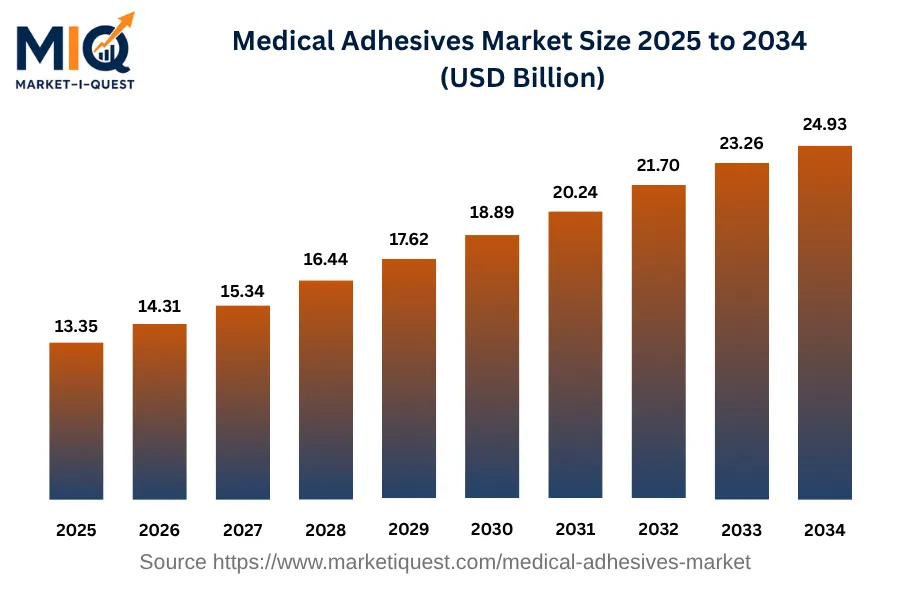
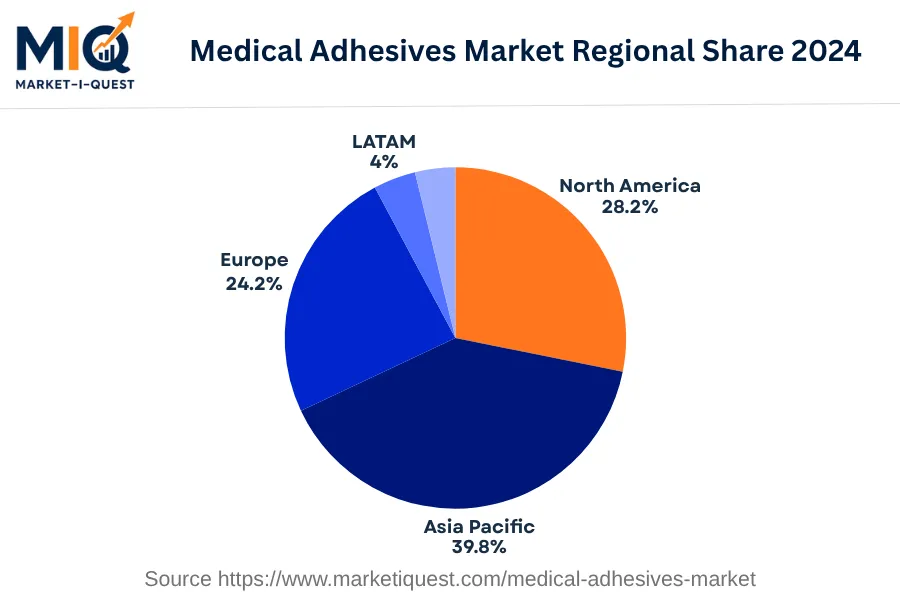
The Medical Adhesives Market was valued at $13.35 billion in 2025 and is projected to grow to $24.93 billion by 2034, with a compound annual growth rate (CAGR) of 7.18%. The steady increase in value over the decade indicates a steadily growing demand for these specialized adhesives within the healthcare industry. Factors such as technological advances and an increase in surgical procedures likely contribute to this rise. The market expansion from $12.46 billion in 2024 to $13.35 billion in 2025, and further to $24.93 billion by 2034 points towards a consistent upward trend. Regional shares in the market during 2024 showed that Asia Pacific held the largest share of 39.84%, followed by North America and Europe with 28.16% and 24.18%, respectively. LATAM and MEA regions held a smaller segment of the market with 4.01% and 3.81% shares respectively.

Key Takeaways

  • By Resin Type - Natural held the largest share in the Medical Adhesives Market in 2024.
  • By Technology Type - Solvent-Based led the segment registering a high CAGR during 2025-2034.
  • By Enterprise Type - Large Enterprises dominated accounting for a significant portion of the market in 2024.
  • By Application - Medical Devices & Equipment held the top position contributing to a large market share in 2024.
medical-adhesives-market market size

Key Driving Factors

Increasing preference for minimally invasive surgeries

Currently, the medical world is witnessing a shift towards minimally invasive surgeries as they come with benefits such as shorter hospital stays and quick recovery times. Medical adhesives play a crucial role in these surgical procedures, replacing traditional sutures and staples, thereby minimizing the patient's trauma. They offer enhanced wound closure capabilities and reduced occurrence of infection, resonating with the need for quicker, safer, and efficient surgical systems. Medical adhesive manufacturers are focusing on innovating and expanding their adhesive product lines to support this shift, in turn driving market acceleration.

Stringent regulatory norms for biocompatibility

The increasing imposition of strict regulatory norms related to biocompatibility and biosafety also significantly drives the medical adhesives market. Various competent bodies like the U.S. Food and Drug Administration (FDA) and the European Union's Medical Devices Regulation (MDR) demand medical products, including adhesives, to meet certain safety standards before their approval and use. These adhesives must not induce any adverse local or systemic effects, nor do they interfere with the healing process or the body's physiologic functions. Meeting these requirements consequently ensures greater adoption of medical adhesives by healthcare providers, thus fostering market growth.

Market Evolution by Timeline

2019-2023
During this period, the medical adhesives market saw a growing adoption of these products in wound care, particularly in North America. The wide use of medical adhesives in surgical procedures was also a key trend. Suppliers were dominated by established manufacturers like 3M and Medline Industries. Price competition was fierce, and contracts typically involved bulk orders. Regulatory constraints centred around the need for these products to be biocompatible. The key risk was the potential for skin irritation caused by some products, leading manufacturers to invest in the development of hypoallergenic adhesives.
2024
In 2024, dental adhesives gained popularity, expanding the buyer segment to include dentists and orthodontists. China and India witnessed a surge in demand driven by the increasing number of dental surgeries. On the supply side, companies such as Johnson & Johnson dominated the market. These adhesives needed to meet stringent regulatory standards related to oral use. Bulk purchase was common in the procurement model. The rising issue of counterfeit products posed significant risk, prompting companies to implement stringent quality checks.
2025-2029
The use of medical adhesives in internal surgeries became more common during this time, alongside orthopaedic applications, especially in European countries. Manufacturers started integrating nanotechnology to improve adhesive properties. Strict regulations on the chemical composition of adhesives used internally were in place, and products had to pass ISO 10993 for biocompatibility. Competitive pricing and long-term contracts with healthcare institutions were typical. The main risk was the accelerating need for specialised adhesives for different uses, pressuring manufacturers to diversify their product portfolios.
2030-2034
This period saw an increased demand in medical adhesives for use in wearable medical devices, particularly in regions like Japan and South Korea. The market was marked by the entry of new suppliers leveraging innovative technologies, challenging the dominance of traditional manufacturers. IoT integration in the supply chain was on the rise to enhance traceability. Regulatory standards were updated to account for the use of adhesives on wearable devices. Partnerships between adhesive manufacturers and wearable device companies became frequent. The risk of potential allergic reactions posed a constant challenge, necessitating ongoing research and development.

Future Market Outlook

Future Opportunities

Future opportunities in the medical adhesives market are expected to align closely with ongoing advancements in healthcare practices and regulatory landscapes. With the increasing focus on personalized medicine, companies such as Johnson & Johnson are exploring customizable adhesive formulations tailored to individual patient needs. This initiative stems from the rising emphasis on patient-centric approaches, highlighted by the World Health Organization’s (WHO) guidelines established in 2021. Additionally, the expansion of telemedicine and remote patient monitoring has opened avenues for developing adhesives that cater to at-home care, initiating trials of wearables in the U.S. in mid-2023. Companies are also investigating multi-functional adhesives that can serve both for wound closure and drug delivery, as exemplified by recent developments from Acelity. Furthermore, partnerships between adhesives manufacturers and healthcare technology firms are becoming increasingly common, like the collaboration between B. Braun and various telehealth platforms launched in 2022. As sustainable practices gain traction, the use of eco-friendly materials in adhesive formulations presents a considerable opportunity for manufacturers. This emphasis aligns with the new environmental standards set forth by the European Union in 2022, urging medical device manufacturers to adopt greener alternatives. As the market continues to evolve, these opportunities provide a pathway for increased innovation and adaptation to future healthcare demands.

Segmentation Analysis

By Resin Type

The market is divided into subsegments including Natural, Semi-Synthetic, and Synthetic. Among these, the Natural segment accounted for the largest revenue share while the Synthetic segment is expected to grow at the fastest CAGR during the forecast period.

Largest Revenue Share

Natural

Market Share Leader

The Natural subsegment reaps the greatest revenue in the sector, a reflection of increasing customer preference for environmentally friendly products. Increased attention towards sustainable sourcing and the lower levels of harmful emissions associated with natural resins contribute to their popularity. Companies operating in sectors that focus on eco-friendly products like agricultural films, car interiors or industrial containers often choose natural resin-based products because of their reduced environmental impact and the positive perspective this brings to their brand image. Furthermore, certain jurisdictions have begun implementing stricter environmental regulations, prompting a shift in preference from synthetic to natural resins. The opportunity to command a price premium, coupled with the increasing feasibility of sourcing these materials, has further stimulated their adoption. High switching costs, particularly in terms of overhauling production processes, deter some companies from transitioning to alternatives. Additionally, established supply chains and distribution channels favor the continued dominance of the natural segment.

Fastest CAGR

Synthetic

Forecast Period Growth Leader

Despite the dominance of the Natural subsegment in terms of revenue, the Synthetic subsegment is projected to grow at the fastest rate. The reasons for the expected high CAGR of Synthetic resins can be traced to various factors. High performance characteristics offered by synthetic resins, such as resistance to heat, chemicals, and wear, are leading to their gradual acceptance in various applications, especially in regions with minimal environmental regulations. Technological advancements and the increasing availability of refined petrochemical derivatives contribute to their demand. However, barriers to adoption exist, like the perception of environmental impact and regulatory pressures in certain regions. To counter these hurdles, companies are investing in research and development to enhance the eco-friendliness and performance of synthetic resins. Furthermore, synthetic resin companies are opting for strategic partnerships to boost their manufacturing capabilities and market reach, mitigating some of the near-term risks related to competition and supply disruptions.

By Technology Type

The market, divided by technology type, includes subsegments such as Solvent-Based, Solids & Hot Melts, and Water-Based. In 2024, the Solvent-Based subsegment had the largest revenue share while Water-Based technology is projected to grow at the fastest rate during the forecast period.

Largest Revenue Share

Solvent-Based

Market Share Leader

The solvent-based technologies sub-segment maintains its lead in revenue generation due to its long-standing presence and acceptance across various industries. Its superior adhesion and fast drying properties make it widely used across automotive, marine, and aerospace industries for coatings and adhesives. It offers a bundle of durability, resistance to wear and tear, providing companies with a competitive advantage in quality. In regions such as North America and Europe, where conditions can be harsh, the resilience of solvent-based technology has led to its extensive use, thereby driving its market revenues. However, given the growing environmental regulations about volatile organic compounds, companies are innovating to create solvent-based solutions that meet regulatory standards. This innovation pressure acts as a switching cost - another reason why this subsegment is still maintaining its revenue leadership.

Fastest CAGR

Water-Based

Forecast Period Growth Leader

Water-Based technologies are expected to witness the fastest growth. This growth is likely to be driven by increased environmental regulation, along with growing customer consciousness towards greener alternatives. Water-Based technologies, while traditionally less effective than solvent-based, have received significant attention and investment for research and development focused on enhancing their performance. These ongoing innovations, coupled with their inherent low toxicity and low flammability, are expected to catalyze their adoption rates. Moreover, emerging partnerships between manufacturing firms and research institutions could speed up this innovation and adoption pace, aiding the growth of this subsegment. A critical near-term risk involved is ensuring these new formulations meet the performance standards set by their solvent-based counterparts and convincing potential customers to make the switch.

By Enterprise Type

The market is divided into subsegments including Large Enterprises and Small & Medium Enterprises (SMEs). In the base year 2024, Large Enterprises accounted for the largest revenue share while Small & Medium Enterprises (SMEs) is expected to grow at the fastest CAGR during the forecast period.

Largest Revenue Share

Large Enterprises

Market Share Leader

Large Enterprises dominate the segment due to their greater financial capabilities to invest in high-end technologies, access to larger markets and established distribution channels. They have a larger customer base, creating an inherent demand for their products or services. Furthermore, regulations tend to favor larger corporations due to established compliance departments and the ability to sustain regulatory shocks more efficiently than smaller entities. The oligopolistic nature of large enterprises prevents newer entrants, thus ensuring a steady revenue stream. While Large enterprises have high purchasing power, they also mitigate risks through diversified portfolios, absorbing losses and ensuring overall growth. Despite potential challenges such as slow decision-making and potential bottlenecks, large enterprises due to their scale and leverage continue to contribute the largest revenue share in the market as of 2024.

Fastest CAGR

Small & Medium Enterprises (SMEs)

Forecast Period Growth Leader

Small & Medium Enterprises (SMEs) stand as the fastest growing subsegment on account of their inherent characteristics - fast decision-making, flexibility and adaptability to market changes. The primary driver of growth for SMEs is technological advancements that are lowering barriers to entry and generating cost effectiveness. As technology becomes more accessible and affordable, SMEs are leveraging these to gain market share. Moreover, policy emphasis on entrepreneurial culture and financing incentives are actively encouraging SMEs. Despite their growth potential, SMEs face obstacles like lack of skilled workforce, financing constraints and regulatory hurdles. However, effective collaborations, well-negotiated partnerships and innovative financing models are opening up growth avenues. Moreover, the risks to SMEs remain, including marketplace volatility and global economic fluctuations. Still, their potential to adapt and evolve make them the subsegment with the most promising growth trajectory.

By Application

In the field of applications, the market is segmented into Dental, External Medical Applications, Internal Medical Applications, Medical Devices & Equipment, and Others. Among these, Medical Devices & Equipment subsegment accounted for the largest revenue share in 2024 while Dental subsegment is projected to grow at the fastest CAGR in the subsequent period.

Largest Revenue Share

Medical Devices & Equipment

Market Share Leader

Medical Devices & Equipment subsegment's position as the revenue leader is reflective of a variety of factors. Medical Devices & Equipment includes an extensive array of tools and devices used across the medical industry, ranging from diagnostic devices to advanced surgical equipment. The primary driver for this segment can be linked to the global increase in population and the subsequent rise in demand for healthcare services, making such devices indispensable in modern medicine. There is also an exponential increase in the usage due to advanced medical procedures conducted globally that necessitate the use of these high-tech devices. Additionally, statutory regulations in many countries also require hospitals and healthcare institutions to keep specific standard equipment on hand, presenting a consistent demand. With the continuous improvement in healthcare infrastructure across the world and the rise in demand for sophisticated medical procedures, it is logical for the Medical Devices & Equipment to generate the most revenue.

Fastest CAGR

Dental

Forecast Period Growth Leader

Despite its smaller sized market, Dental subsegment is projected to register significant growth in the recent period. Dental industry has witnessed a disruption from technological advancements, with the introduction of digital dentistry, CAD/CAM systems, and other innovative devices which has increased the demand for technologically advanced dental hardware. The heightened accessibility and improved efficiency offered by these advanced systems are acting as catalysts for the subsegment's growth. Yet, there are challenges including high cost of the dental devices and related procedures, which might slow down the adoption. However, partnerships between manufacturers and healthcare providers coupled with robust insurance coverage in developed regions are expected to drive accessibility and subsequently, growth in this subsegment. Moreover, growing awareness of oral health and cosmetic dentistry ensures a steady demand for dental services, which fosters the accelerated CAGR in this segment.

Competitive Analysis

Key Market Players

Manufacturers / OEMs

3M Company
US
Adhesive Research Inc.
US
Johnson and Johnson Services
US

Key Suppliers & Raw Materials

Henkel AG & Co. KGaA
Germany
Gluestick Company
UK
Huntsman International LLC
US

Distributors, Integrators & Channel Partners

Medline Industries Inc.
US
Cardinal Health
US
McKesson Medical-Surgical Inc.
US

Porter’s Five Forces Analysis

This analysis investigates the competitive forces underlying the Medical Adhesives Market landscape.

Supplier Bargaining Power

Medium

Variety of suppliers but specialized requirements limit options.

Buyer Bargaining Power

High

Buyers have options between different adhesive types and producers.

Threat of Substitutes

Medium

Other technologies like sutures and staples exist, but have trade-offs.

Threat of New Entrants

Low

High entry barriers due to strict health sector regulations and capex.

Competitive Rivalry

High

Market with several strong participants constantly vying for dominance.

Regional Analysis

Geographic market dynamics and growth opportunities across key regions

Global Market Outlook

medical-adhesives-market market regional share

North America

In 2024, North America's medical adhesives market witnessed dynamic activity, predominantly centered around healthcare and manufacturing sectors in the U.S., Canada, and Mexico. On the Drivers front, rising incidences of chronic diseases ignited the demand for surgical procedures and, concurrently, medical adhesives. In Canada, rigorous healthcare standards propelled a consistent need for quality-driven, compliant adhesion products. Meanwhile, technological advancements such as biodegradable adhesives inspired market growth and increased investment into related R&D sectors, especially within the U.S. The transferring of manufacturing hubs closer to key raw material sources sheds light on shifts in supply chain dynamics.

Trends-wise, emerging adhesion technologies transformed buyer behavior, motivating stakeholders to adapt to bio-based adhesives. Notably, in Mexico, there was a substantial uptick in the usage of polyurethane and cyanoacrylate adhesives. Regulatory requirements concerning sterility and bio-compatibility presented a shift towards green products and the need for product traceability, while rising healthcare costs pushed for economical adhesive solutions. This wave of sustainability and cost-effectiveness was driven home by several significant partnerships and M&A activities among major players. Cumulatively, these factors solidified North America's position as a hub for innovation and growth in the medical adhesives market in 2024.

Asia Pacific

In 2024, the demand for medical adhesives significantly escalated in the Asia Pacific region, spearheaded by countries such as China, India, Japan, South Korea, Australia, and pivotal ASEAN markets. Rising healthcare improvements, increasing expenditure in medical infrastructure, and rigorous government regulations drove the regional market. Progressive technological adoption contributed notably as healthcare providers leveraged the adhesives' versatility in wound dressings, surgery, and device implant cases. Concurrently, shifting supply dynamics boosted production, with manufacturers exploring renewable resources and pricing strategies to enhance market competitiveness. The year witnessed pivotal buyer behaviour changes, primarily influenced by heightened awareness around hygiene and patient comfort, pushing the demand for biocompatible and skin-friendly medical adhesives. A striking trend was the product technology shift towards bio-based adhesives, spurred by rising environmental concerns.

Investments witnessed an uptick in channels focusing on research collaborations, propelling advancements in adhesive technology. Moreover, the surge in strategic partnerships and mergers & acquisitions indicated efforts towards consolidating the market landscape. Enforcement of stringent standards emerged as a trend, steering manufacturers towards high-quality, reliable products that adhere to regulatory compliance. The demand sectors varied from hospitals, private clinics to home healthcare settings, with an intriguing surge in manufacturing and retail sectors investing in safe and efficient adhesive solutions.

Europe

In 2024, the European Medical Adhesives market experienced significant dynamics led by changing health protocols and technological advancements. Market drivers included increased demand from healthcare and manufacturing sectors, primarily stimulated by rising chronic conditions, such as diabetes demanding sophisticated wound care solutions. Regulations also played a vital role in fueling growth, with stringent EU standards for biocompatibility and sterilization increasing the need for certified medical adhesives. Moreover, substantial investments in R&D, particularly in Germany and the UK, accelerated the adoption of innovative adhesive technologies.

Trends influencing the market involved a shift in buyer behavior towards bio-based adhesives, especially in France and Italy, driven by sustainability concerns. Development in hydrogel adhesives emerged as a significant product shift, enhancing the comfort and skin-friendliness of medical appliances. The dynamics of distribution channels saw a notable increase in online sales due to digitalization. There was also a notable rise in partnerships and M&A activities, with companies aiming to diversify their portfolios and expand their European footprint. Lastly, heightened policy enforcement relating to patient safety enhanced traceability requirements for medical adhesives in regions like Benelux, Nordics, and Central & Eastern Europe, thereby influencing the market’s structure.

Latin America

In the base year of 2024, the medical adhesives market in Latin America (LATAM) was characterized by robust growth stimulated by various demand factors, the implementation of stringent regulations, and the adoption of novel technologies. In particular, the escalating incidence of chronic diseases in populous countries such as Brazil and Mexico was a key driver, as patients' needs for surgical interventions instigated demand for medical adhesives. Investment in healthcare infrastructure, particularly in Argentina, Chile, and Peru, also influenced the market positively as it increased the accessibility and availability of adhesives. Additionally, more rigorous standards enforced for biocompatibility and sterilization of medical adhesives within LATAM countries propelled manufacturers to enhance the quality of their products.

Buying behavior reflected trends of seeking high-performance and cost-effective adhesives, largely driven by hospitals and clinics aiming to minimize surgical complications. Manufacturers focused on the technological advancement of adhesives, shifting towards pain-free and quick-curing products. Establishing partnerships and engaging in M&A became the norm amongst key players to broaden their product portfolio and reach in the market. The governments in Brazil, Mexico, and Colombia played a significant role in promoting the use of medical adhesives through their healthcare provisions and policy enforcements, thereby shaping market trends in 2024.

Middle East & Africa

In 2024, the Medical Adhesives market in the Middle East and Africa experienced steady growth due to regulatory advancements, adoption of cutting-edge technologies, and investment infusion. Increased demand for surgical procedures in the healthcare sector, especially in countries like Saudi Arabia, South Africa, and Israel buoyed the market. The implementation of stricter safety standards related to medical adhesives in the United Arab Emirates and Qatar added impetus to the growth. Moreover, technical advancements in adhesive substances for dental and orthopaedic applications have boosted investments in the market.

Trends shaping the market include rising consumer awareness concerning adhesives' usage in non-invasive surgical procedures in key economies, such as Nigeria and Kenya. There was a perceptible shift toward advanced bioadhesives in wound closure and drug delivery systems. There was amplified policy enforcement conducive to the sector, particularly in Egypt, which witnessed increased Channel dynamics. The year also saw new partnerships emerging, with manufacturing companies merging with suppliers to streamline production and supply. Overall, the Medical Adhesives market in the Middle East and Africa saw substantial growth in 2024, primarily driven by robust demand from the healthcare sector accompanied by regulatory enhancements and heightened technology adoption.

Recent Industry Developments

Latest market innovations, product launches, and strategic initiatives

July 2026

Biesterfeld, an international distribution and service company, entered into a distribution agreement with Bostik (the adhesive solutions segment of Arkema) to offer three medical-grade adhesive lines. The agreement covers Cyanoacrylates (CAs) and UV-curing Cyanoacrylates, Epoxies (1K and 2K systems), and Hotmelt Polyurethanes (PUs), targeting demanding medical applications such as surgical instruments, IV sets, and endoscopes.

August 2025

Paris-based TISSIUM secured FDA Investigational Device Exemption (IDE) approval for its vascular sealant polymer, a light-activated pre-polymer that reduces postoperative bleeding and doubles as a resin for 3D-printed implantable devices.

Frequently Asked Questions