Indium Tin Oxide Market Snapshot

Key Players

  • Tokai Cobex GmbH (Germany)
  • Indium Corporation (USA)
  • China Rare Metal Material Co. Ltd (China)
  • Hefei Crystalbridge Optoelectronic Materials Co. Ltd. (China)
  • PlasmaChem GmbH (Germany)
  • Genvac Aerospace Inc. (USA)
  • ULVAC Inc. (Japan)
  • American Elements (USA)

Market Size

Base Year 2024
$2.85 Bn
CAGR
7.46%
Forecast 2034
$5.85 Bn

Market Segments

By Form
Powder, Coating, Thin Film
By Purity Level
99.99%, 99.9%, 99
By Application
Flat Panel Displays, Touchscreens, Solar Cells, LEDs, Transparent Conductors
By End Use Industry
Electronics, Renewable Energy, Automotive, Aerospace, Healthcare

Market Dynamics

Drivers
  • Growing consumer electronics industry
  • Increasing demand for touch-enabled devices
Restraints
  • High Production Costs
  • Alternative Material Availability
Opportunities
  • Rising demand in touch-sensitive devices
  • Growth in smart window tech industry

Market Size

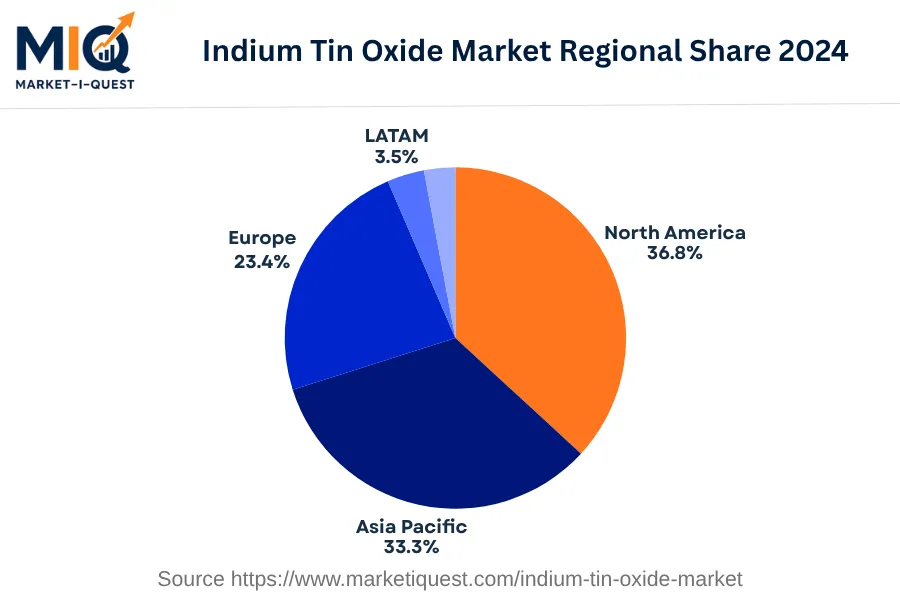
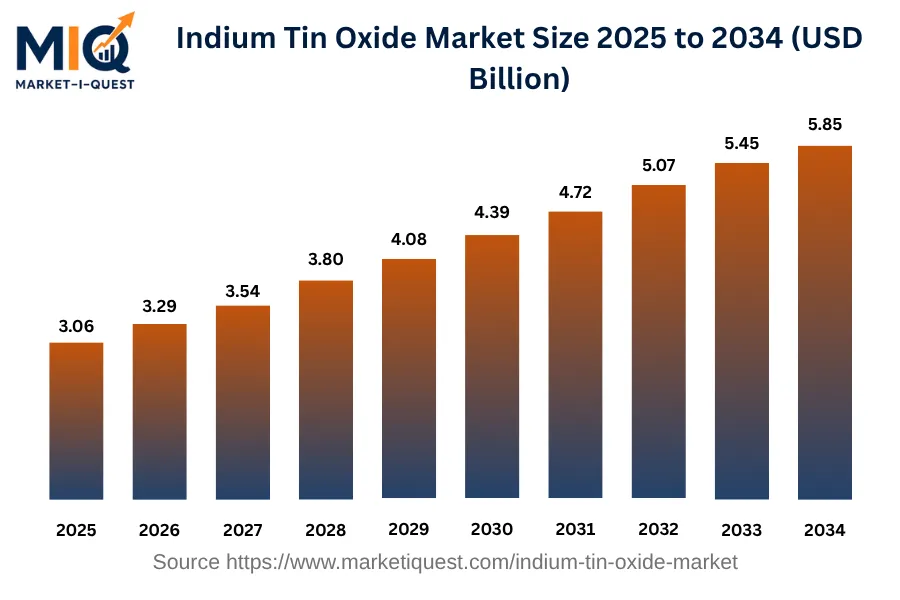
The Indium Tin Oxide market was worth USD 3.06 billion in 2025 and is predicted to grow to USD 5.85 billion by 2034, with a compound annual growth rate (CAGR) of 7.46%. This substantial increase in market value from 2025 to 2034 indicates a consistent increment in the adoption and usage of Indium Tin Oxide across different sectors. This growth is primarily driven by the ever-increasing demands and broadening application spectrum of Indium Tin Oxide in various industries. On a regional basis, in 2024, the Asia Pacific had the highest market share at 55.46%, followed by North America at 20.84%, and Europe at 16.87%. The regional market shares for LATAM and MEA were lower, standing at 3.62% and 3.21%, respectively. This regional market share distribution points to a highly concentrated market in the Asia Pacific and a moderate concentration in North America and Europe, with much lesser market presence in the LATAM and MEA regions.

Key Takeaways

  • By Form - Powder led the Indium Tin Oxide market accounting for a significant share in 2024.
  • By Purity Level
  • - 0.9999 purity level held the highest market share in 2024.
  • By Application - Transparent Conductors registered fastest growth being widely used in the Electronics industry in recent years.
  • By End-Use Industry - Automotive dominated accounting for the largest market share in the Indium Tin Oxide market in 2024.
indium-tin-oxide-market market size

Key Driving Factors

The Proliferation of Consumer Electronics

The increasing global market for consumer electronics is a significant factor driving the demand for indium tin oxide. Indium tin oxide assumes a pivotal role in the production of consumer electronics, particularly as a transparent conductive coating for touchscreens, LCD panels, and flat-panel TVs. Touchscreen devices rely heavily on this material due to its ability to remain conductive even when stretched and flexed, making it an essential component. As these consumer electronic devices continue to grow in popularity and become increasingly embedded in daily life, the consumption of indium tin oxide surges proportionally, thereby propelling the market.

Increasing Application in Solar Industry

The accelerating transition to renewable energy sources, especially solar power, is another robust driver for the indium tin oxide market. Indium tin oxide serves as an excellent conductive material used in the thin-film solar cell industry due to its high transparency and conductivity traits. Many new solar projects worldwide integrate thin-film technologies for their efficiency and flexibility advantages. Simultaneously, national governments have been providing subsidies and implementing policies to support the development of renewable energy, including solar power. This broad acceptance and the progressive trend towards solar energy contribute to a greater demand for indium tin oxide.

Market Evolution by Timeline

2019-2023
During this period, smartphone and wearable tech manufacturing segments in Asia, particularly China, heavily influenced demand for Indium Tin Oxide (ITO) due to its transparency and conductivity qualities. Integration into flat-panel displays and organic light-emitting diodes became increasingly common. However, with finite ITO supply and the lack of efficient recycling processes, higher pricing trends were observable. The United States Geological Survey warned of the impending ITO shortage. No primary regulations appeared to significantly impact ITO market, although increased need for environmental responsibility in mining practices became apparent. Interestingly, contract models based on volume-purchasing agreements became ubiquitous, offering a price consistency. Risk mitigation focused on search for alternative materials like aluminum-doped zinc oxide or graphene.
2024
By 2024, ITO consumption in solar cells segment started taking flight, mainly in Europe's push for renewable energy. Supply issues persisted as mines faced depletion, causing price fluctuations. However, adoption of sputter targets became more mature, offering more efficient usage. Facing a resource crisis, the European Union's Horizon 2020 initiative funded a research project to develop ITO alternatives, trying to lessen dependence on scarce materials. At the same time, more partnerships between manufacturers and academic institutions were formed to collectively address supply constraints. The risk of a more significant shortage loomed over the industry.
2025-2029
The demand plateaued in this period as the manufacturing industry actively shifted towards ITO alternatives. North America, primarily driven by US manufacturers, led this transition. New technologies like carbon nanotubes and copper nano-meshes started replacing ITO in touch screens. ITO's scarcity, high price, and the market's susceptibility to supply shocks prompted this change. On the commercial side, transitioning away from dependency on a single supplier became a common procurement strategy to manage supply risks efficiently. During this phase, regulatory focus heightened on responsible sourcing and sustainable practices in mining.
2030-2034
By 2030–2034, ITO's market settled primarily for niche applications like electromagnetic shielding and infrared reflectors, with Japan being a leading consumer. In contrast, the dominance of ITO alternative technologies broadened, like graphene and silver nanowires. They boasted not just supply abundance but also eco-friendly sourcing and disposal. Few manufacturers continued ITO use, all subject to strict environmental regulations and standards. Most adopted a partnership model with source mines to control costs and manage risks. The maturity reached by alternative materials led to a significant decline in ITO demand towards the end of this period.

Future Market Outlook

Future Opportunities

Looking forward, the indium tin oxide market stands to benefit from several burgeoning trends rooted in present-day developments. The shift towards renewable energy sources, particularly solar power, indicates a growing demand for ITO in photovoltaic applications. In 2022, the International Renewable Energy Agency reported a significant increase in solar energy installations globally, which likely intensifies the need for effective conductive materials. Companies like First Solar are actively investing in research and development related to ITO applications in thin-film solar panels. The automotive sector’s transition towards electric vehicles heightens opportunities for ITO utilization in touch and display interfaces, with major car manufacturers such as Tesla enhancing user experiences. Partnerships between technology firms and automotive players are likely to emerge, as was seen in June 2023 when Apple collaborated with various automotive companies for tailored infotainment systems. Moreover, legislative actions worldwide, such as the European Union's Green Deal, create a framework that may incentivize the development of sustainable ITO solutions. Disruptions in supply chains for rare metals, coupled with increasing scrutiny over ethical sourcing, offer additional pathways for growth in research on sustainable alternatives to indium. Overall, the current trends solidify the potential for both market expansion and innovative application, indicating a promising road ahead for ITO stakeholders.

Segmentation Analysis

By Form

The market is divided into subsegments including Powder, Coating, and Thin Film. Of these, Powder accounted for the largest revenue share while Thin Film is expected to grow at the fastest CAGR during the forecast period.

Largest Revenue Share

Powder

Market Share Leader

Powder form dominates the market for several reasons. First, the ease of usage and storage makes it a favorite among consumers. Comparatively, the powder form allows for longer shelf life and lower storage conditions than other forms. It is also cheaper to manufacture, transport, and package compared to both Coating and Thin Film. Second, the versatility of powder form is unmatched - it can be used in a wide range of applications across several industries. This versatility extends to its adaptability in varied socioeconomic and geographical contexts. It's common use in both developed and emerging markets implies a wider customer base and consequently, larger sales volume. Third, strictly from a supply-side perspective, the regulatory approvals for powder form are easier to obtain compared to other forms. Finally, the purchasing criteria lean toward the powder form due to the aforementioned reasons coupled with lower switching costs for consumers given its ubiquity and widespread channels of distribution.

Fastest CAGR

Thin Film

Forecast Period Growth Leader

Despite Powder holding the largest market share, Thin Film is posited to register the fastest growth. There are multiple drivers of this growth. From a technology perspective, advancements in Thin Film formation and application techniques are increasing its ease of use, efficiency, and efficacy. This, coupled with significant capital investments from both the public and private sectors in research and development, is rapidly enhancing its market potential. Furthermore, the trend of forming strategic partnerships across the value chain is allowing for more streamlined production and delivery, directly influencing its cost-effectiveness and overall adoption rate. From a policy standpoint, while there are regulatory hurdles to be crossed, favorable government policies aimed at encouraging adoption of innovative approaches are serving as a strong catalyst for growth. In the short-run, however, certain risks could hamper the pace of growth. These include the challenge of achieving economies of scale, potential supply chain disruptions, and the time requirement for seamless integration into existing systems.

By Purity Level

The market is divided into subsegments including purity levels of 99.99%, 99.9%, and 99%. The 99.99% purity level accounted for the largest revenue share, while the 99% purity segment is expected to grow at the fastest CAGR during the forecast period.

Largest Revenue Share

0.9999

Market Share Leader

The 99.99% purity level subsegment commands the largest revenue share driven by its demand across critical high end applications. This level of purity is especially essential in semiconductor manufacturing, pharmaceuticals, and other delicate applications that demand near-absolute purity. These industries are well-regulated, with standards often mandating the use of extremely pure materials, thusly underpinning the demand for the 99.99% level of purity. Major markets include developed economies with strong industrial bases. Key purchasing criteria for this subsegment focus around quality and regulatory compliance. Switching costs from this high purity level can be substantial due to the risk of compromising production quality, making for a resilient customer base. Lastly, the distribution of these products remains predominantly B2B - reliant on industrial supply chains.

Fastest CAGR

0.99

Forecast Period Growth Leader

The 99% purity subsegment, whilst currently attracting less revenue than the 99.99% level, shows the fastest growth outlook. This is largely due to its wider applicability and lower cost, making it attractive for industries and processes that do not require absolute purity. Rapidly developing economies are now pushing growth in manufacturing sectors that can work with this purity level, such as general plastic production, non-specialized chemical synthesis and others. However, barriers to adoption exist terrestrially, particularly in developed markets with stringent regulation promoting higher purity standards. Significant growth catalysts include policy shifts in developing markets and the entrance of capital expenditure into low and middle-income countries to establish basic manufacturing. Near-term risks include volatility in these emerging markets and potential regulatory changes.

By Application

The market, by application, is divided into subsegments including Flat Panel Displays, Touchscreens, Solar Cells, LEDs, and Transparent Conductors. In the base year of 2024, Flat Panel Displays accounted for the largest revenue share while Transparent Conductors is expected to grow at the fastest CAGR during the forecast period.

Largest Revenue Share

Flat Panel Displays

Market Share Leader

In the changing landscape of technology, Flat Panel Displays have emerged as the subsegment yielding the most revenue in the base year of 2024. Demand has been driven by growing consumer electronics market, particularly handheld devices like smartphones and tablets that primarily utilize flat panel display technology. Additionally, an increase in economies of scale and a reduction in production costs has facilitated accessibility and affordability of the technology. Adoption is also fueled by an emerging trend of high-resolution displays in televisions and monitors. This subsegment also benefits from geographical factors because these items are essential components of products assembled by the booming tech industry in Asia. However, saturation in developed markets and hyper-competition could pose challenges for sustained growth.

Fastest CAGR

Transparent Conductors

Forecast Period Growth Leader

Although the size of Transparent Conductors as a subsegment lags behind others, its potential growth is promising as it is expected to achieve the fastest CAGR. A fundamental driver of this growth is the increasing emphasis on energy efficiency and conservation globally, which is promoting the use of transparent solar panels. Technological advancements in flexible and printable electronics also rely heavily on the development of transparent conductors. Moreover, regulatory support pushing clean energy solutions, in conjunction with significant capex in related research and development, potentially acts as a catalyst for its expansion. However, technical complexities and high production costs could set up barriers to entry and adoption, calling for strategic partnerships for cost-effective manufacturing and marketing.

By End Use Industry

The market is divided into subsegments including Electronics, Renewable Energy, Automotive, Aerospace and Healthcare, with the Automotive subsegment accounting for the largest revenue share, while Renewable Energy is expected to grow at the fastest CAGR during the forecast period.

Largest Revenue Share

Automotive

Market Share Leader

The Automotive subsegment, in 2024, experiences the highest revenue generation owing to several factors. The principal rationale being the consistent technological advancement in the automotive industry, which demands constant upgrades in components and applications contributing to its major revenue. The upsurge in the population and increasing purchasing power parity has facilitated a higher demand for vehicles, especially in developing economies. Moreover, stringent environmental regulations worldwide have led to an escalating adoption rate of electric vehicles. Consequently, these vehicles demand more complex and innovative components driving the higher revenue generation in this subsegment. Additionally, the global automotive production rebound post-COVID-19 pandemic period has fueled the market growth. The comprehensive network of channel partnerships ranging from component manufacturers to distributors that penetrate the global market also underpins the significant market share.

Fastest CAGR

Renewable Energy

Forecast Period Growth Leader

The Renewable Energy subsegment is projected to have the fastest growth in CAGR during the forecast period. This burgeoning growth rate can be attributed to the escalating global demand for clean and sustainable energy. The increasing awareness of reducing carbon footprints and the harmful impact of conventional energy sources on the environment serve as major catalysts for change. Global initiatives towards reaching net-zero emissions have resulted in widespread adoption and increase in projects geared towards renewable energy sources. Additionally, advancements in technology and declining cost in renewable energy production increased accessibility, thus fueling the growth. Government policies and incentives pushing forth the usage of renewable energy drives further investment and development in this sector. However, technology adoption barriers, costly initial set-up, and fluctuation in raw material costs pose risks for the sector in the near term.

Competitive Analysis: Indium Tin Oxide Market

Key Market Players

Manufacturers / OEMs

Mitsui Mining & Smelting
Japan
Samsung Corning Precision Materials
South Korea
Indium Corporation
US

Key Suppliers & Raw Materials

Teck Resources Limited
Canada
Glencore Plc
Switzerland
Trevali Mining Corporation
Canada

Distributors, Integrators & Channel Partners

Geib Refining Corp
US
William Rowland Limited
UK
Tongling Nonferrous Metals Group Co., Ltd
China

Porter’s Five Forces Analysis

The Indium Tin Oxide Market is characterized by technical barriers, concentration of suppliers, brand loyalty, and cost of substitutes.

Supplier Bargaining Power

High

A few suppliers mainly dictate the pricing due to the rarity and sourcing difficulties of Indium Tin Oxide.

Buyer Bargaining Power

Low

Specialized use in electronics coupled with lack of substitutes limits the power of price negotiations for buyers.

Threat of Substitutes

Low

No cost-effective and efficiency-matching substitutes present in the market that can harm Indium Tin Oxide's demand.

Threat of New Entrants

Medium

High capital expenditure and technical proficiency required barriers to entry, but potential profitability could attract entrants.

Competitive Rivalry

High

Intense competition and high barriers to exit due to sunk costs make rivalry among companies high.

Regional Analysis

Geographic market dynamics and growth opportunities across key regions

Global Market Outlook

indium-tin-oxide-market market regional share

North America

In 2024, the North American market for Indium Tin Oxide (ITO) embodied a crucial component in the electronics and renewable energy sectors. An escalating demand for touch-responsive and large-area electronic devices primarily motivated market expansion in the United States, Canada, and Mexico. Indeed, its versatility in applications ranging from smart sensors to photovoltaics spouted immense growth potential. Regulatory norms promoting the use of energy-efficient products collectively endowed the ITO market’s advance across North America. Furthermore, technological advancements entailing higher conductivity and transparency propelled its adoption. However, limited regional supplies and high procurement costs hampered unrestricted growth.

A conspicuous trend in 2024 was the purchasers’ preference towards high-resolution devices, which employed ITO to extend product lifecycles. Overarching industrial tendencies also witnessed a consequential transition towards green technology like photovoltaics, charging the demand for ITO in the renewable sector. Industry stakeholders sought strategic partnerships to amplify their operational efficacy, with notable policies like the U.S. Federal Trade Commission’s approval for M&A in facilitating business resilience and competitiveness. The enforcement of stringent environmental norms, like the U.S. Clean Air Act and Canada’s Environmental Protection Act, echoed the preference for green products, further influencing purchasing preferences across corporates, utilities, and retail sectors.

Asia Pacific

In 2024, the Indium Tin Oxide (ITO) market in Asia Pacific showcased significant dynamism, largely propelled by demand factors, regulatory measures, and technological advancements. Drivers of this market included escalating demand for touch screen interfaces and liquid crystal displays encompassing consumer electronics and automotive sectors, especially in leading economies such as China, South Korea, and Japan. Regulatory initiatives, particularly in China and Japan, advocating for energy conservation, further amplified the demand for ITO in solar panel manufacturing. Investment in technology adoption, spurred notably by South Korea's advanced electronics industry, sought to optimize the efficacy of ITO-based optoelectronic products.

Trends in the ITO market in Asia Pacific reflected changes in buyer behavior and market dynamics. Firstly, the shift from traditional display systems towards smart touch interfaces in various sectors like healthcare, retail, and manufacturing became more pronounced. Secondly, there were significant product shifts, typified by Australia's burgeoning interest in ITO alternatives due to ITO's surging prices and supply insecurity. Furthermore, new partnerships and M&A activities were identifiable, such as key collaborations between Chinese and ASEAN manufacturers to increase production capacities. Policy enforcement showed steady expansion, with India emphasizing domestic manufacturing of ITO to counter dependence on import. In summary, the 2024 Asia Pacific ITO market saw substantial market activity driven by varied demand dynamics, technological progress, regulatory measures, and changing market trends.
Europe

In 2024, the market for Indium Tin Oxide (ITO) within Europe projected robust activity. Sweeping environmental regulations spurred demand, with industries such as automotive, electronics and renewable energy pivoting towards energy-efficient technologies that employ ITO. Investment in tech sectors further fuelled supply dynamics, notably in Germany and the UK, where commitment to sustainable manufacturing practices gave rise to ITO adoption. The pricing was particularly attractive in central and eastern Europe. Countries like Poland and the Czech Republic showed unprecedented demand as local manufacturing sectors looked towards cost-effective, flexible, and transparent electronics, underpinning expansive ITO market penetration.

Trends in 2024 were predominately shaped by shifting consumer preferences towards high-quality display systems in industries like retail, entertainment, and information technology. Use of touch screens in public facilities and private spaces in Italy and Spain, for example, drove interest in ITO capacities. More businesses integrated ITO-based solutions into their operations, announcing partnerships that combined sphere on expertise and technological strengths. In the Nordic region, policy enforcement concerning renewable energy usage increased the adoption of ITO in photovoltaic cells, a trend mirrored in Benelux nations where government schemes to promote energy-efficient electronics continued to propel the market. Overall, the European ITO market evolved greatly in 2024 with government policies, tech adoption, and supply-demand dynamics influencing growth trajectories.

Latin America

In 2024, the Indium Tin Oxide (ITO) market in Latin America displayed significant growth driven by multiple factors. Increased demand from touch-based interfaces, particularly smartphones and tablets, drove industry growth. Brazil led this momentum, thanks to its robust consumer electronics manufacturing sector. Moreover, energy-efficiency regulations in place across LATAM had led to higher adoption of ITO in energy-saving display devices. Investments in technological advances on behalf of manufacturers in Mexico and Argentina led to improvements in the performance of ITO-based devices; this, in turn, stimulated market demand. A tightening of global indium supply dynamics pushed up ITO prices, making the market more lucrative.

Trends spotted in 2024 included a surge in ITO use in photovoltaics, promoted by solar energy expansion policies across LATAM, particularly in Chile and Peru. E-commerce growth led to an increased need for inventory management systems, thus driving demand for ITO-coated barcode scanners, especially in retail and manufacturing sectors. Partnerships like the one between Colombia's government and local tech companies to enhance the digitization of public services further spurred ITO demand. A notable regulatory trend was tighter enforcement of environmental policies in Brazil and Argentina, encouraging greener production methods among ITO manufacturers. Finally, nanotechnology adoption in healthcare became a trend, thus enhancing ITO applications in bio-sensing devices.

Middle East & Africa

In 2024, the Indium Tin Oxide (ITO) market in Middle East and Africa committee steady expansion driven by escalating demand in display and photovoltaic applications. Boosted by robust investment in sustainable solutions, Saudi Arabia and UAE were leaders in adopting ITO-based technologies to enhance energy efficiency in residential and industrial sectors. South Africa and Nigeria also saw demand surges due to regulatory emphasis on renewable energy. Supply resilience played a crucial role in setting ITO prices, especially in Egypt and Israel—an uptick in domestic production reduced import reliance and moderated price volatility. Technological adaptability, too, positively influenced market dynamics; Kenyan manufacturers ramped up adoption of ITO thin films, given their high optical transparency and electrical conductivity.

ITO-based touchscreens trended across the region's retail sector, with Qatari enterprises leading the charge. Meanwhile, the uptake of electric vehicles across the Middle East popularized the use of ITO in rear-view mirrors due to its anti-fogging properties, aligning the automotive industry with the ITO market trajectory. Increased government intervention, particularly on e-waste management, reshaped procurement practices. Manufacturers inclined more towards partnerships with recyclers in UAE and Saudi Arabia to ensure environmentally conscious disposal of ITO. Similarly, changes in trade policies across Africa intensified intra-regional trade of ITO, further influencing the market landscape in 2024.

Recent Industry Developments

Latest market innovations, product launches, and strategic initiatives

January 2026

Research and Markets published its Indium Tin Oxide Market - Forecasts from 2025 to 2030 report, projecting the ITO market to grow at a 6.02% CAGR from $7.189 billion in 2025 to **$9.629 billion by 2030**. The broader ITO sputtering targets market was valued at $1.925 billion in 2025** and is anticipated to reach **$2.298 billion by 2032 at a 2.6% CAGR.

October 2025

Hony Glass Technology Co., Ltd. announced the acquisition of Gem Tech Optoelectronics Corp.'s ITO production line, expanding its presence in the advanced display and conductive glass markets.

Frequently Asked Questions