
Flat Panel Display Market Snapshot

Key Players

  • Samsung Electronics Co. Ltd. (South Korea)
  • LG Display Co. Ltd. (South Korea)
  • Sony Corporation (Japan)
  • Sharp Corporation (Japan)
  • Panasonic Corporation (Japan)
  • Vizio Inc. (United States)
  • Innolux Corporation (Taiwan)
  • BOE Technology Group Co. Ltd. (China)
  • AU Optronics Corp. (Taiwan)
  • TCL Corporation (China)

Market Size

Base Year 2024
$182.7 Bn
CAGR
6.14%
Forecast 2034
$331.53 Bn

Market Segments

By Technology
  • LCD
  • LED
  • OLED
  • Others
By End User Industry
  • Retail
  • Media and Entertainment
  • Consumer Electronics
  • Automotive
  • Industrial
  • Healthcare
  • Others

Market Dynamics

Drivers
  • Growing consumer electronics demand
  • Advancements in display technology
Restraints
  • High manufacturing cost
  • Emerging alternative technologies
Opportunities
  • Emerging smart home trends
  • Advancements in automotive display technology

Market Size

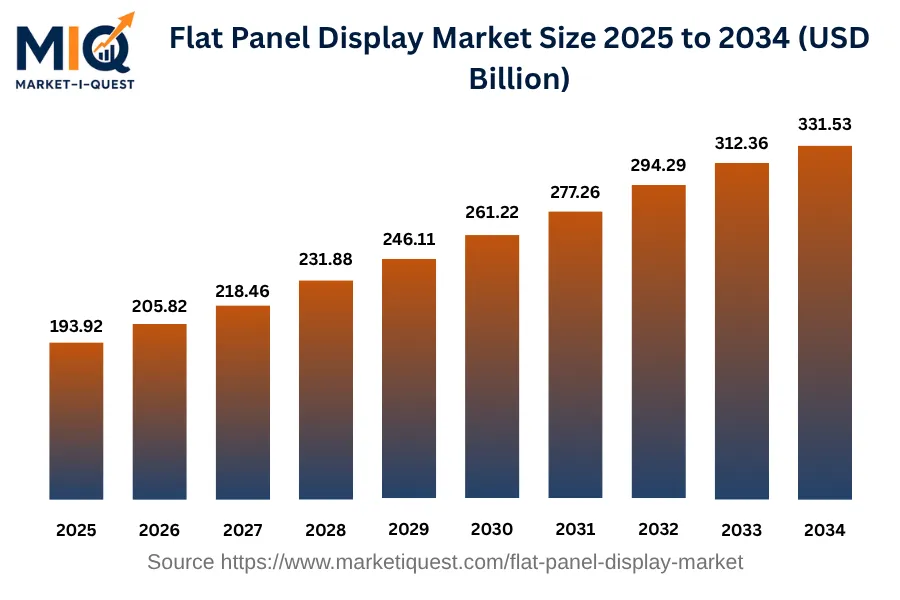
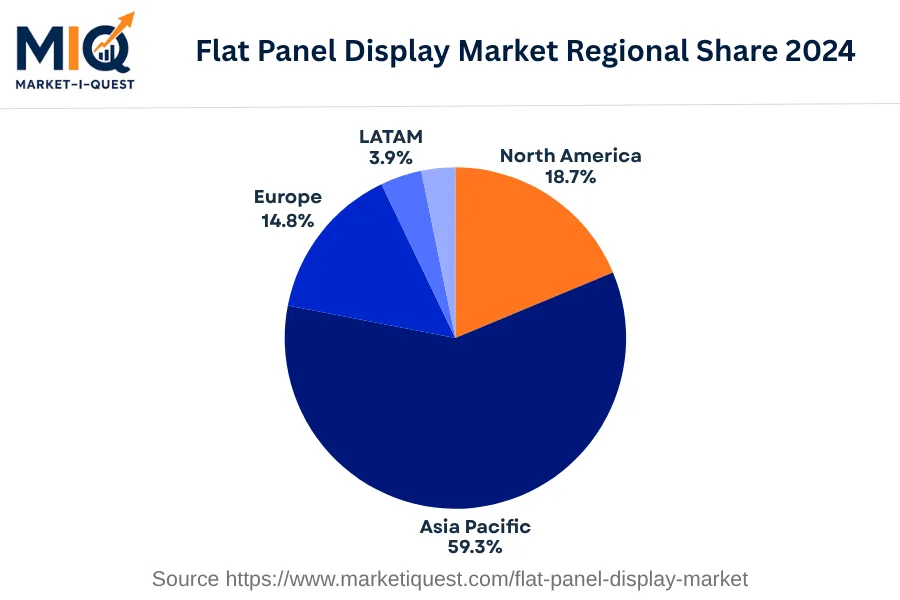
The Flat Panel Display Market was valued at $193.92 billion in 2025, and it is expected to grow to $331.53 billion by 2034, expanding at a compound annual growth rate of 6.14%. The market's continuous growth trajectory started in 2024 with a value of $182.7 billion, further increasing year over year to reach its projected worth in 2034. The main aspects propelling these advancements entail the increasing demand for higher resolution and energy-efficient display panels across several electronic devices. To provide a geographical perspective, in 2024, the regional market share accounted for by Asia Pacific was 59.34%, followed by North America with 18.72%, Europe at 14.81%, LATAM with 3.92%, and the Middle East and Africa held a share of 3.21%.

Key Takeaways

  • By Technology - LED led the market accounting for a significant share in the base year.
  • By End User Industry - Consumer Electronics held the top position in the base year.
flat-panel-display-market market size

Key Driving Factors

Shift towards OLED Technology in Consumer Electronics

Increasing consumer awareness and demand for better quality images in electronics goods is a key driver in the flat panel display market. OLED (Organic Light Emitting Diodes) technology is currently leading the trend with its promise of high-quality visual experiences. OEMs in the consumer electronics sector, like Samsung, Sony, and LG, are ramping up their OLED offerings, especially in their television and smartphone product lines. This transition is primarily fueled by OLED's ability to display deeper black levels, which directly enhances color contrast and sharpness - a key product differentiator to win over discerning customers in the high-end electronics segment. Thus, consumer electronics manufacturers' shift towards OLED technology is driving the flat panel display market forward.
Proliferation of In-Vehicle Display Systems in Auto Sector

Automobile manufacturers are integrating advanced in-vehicle display systems as a key feature of their next-generation vehicles. The trend of larger, multiple displays inside vehicles is primarily driven by consumer preference for feature-rich, interactive systems delivering navigation, entertainment, and real-time vehicle information. TFT-LCD (Thin Film Transistor-Liquid Crystal Display) is the most commonly used technology in this segment for its advantages with respect to variable ambient light conditions. As auto manufacturers, particularly in luxury segment, vie for market share, the inclusion of sophisticated in-vehicle flat panels is becoming a standard offering rather than a premium add-on. This is propelling growth in the flat panel display market as demand increases in the automobile sector.

Market Evolution by Timeline

2019-2023
In this period, there was surge in automotive displays with major car manufacturers integrating flat-panel display tech in dashboards, heads-up displays, and entertainment systems. Asia, particularly China, South Korea, and Japan, led in the supply of these displays, driven primarily by established production capacities. This was also a phase where Flexible OLED technology was tested and adopted widely for mobile devices due to its lightweight and flexibility, despite the high production cost. The global standardisation of 5G during this period, motivated tech companies to integrate flat-panel technology in 5G devices. Commercially, there have been bulk procurement strategies followed in order to effectively manage the high cost of these screens. The risk was mainly centered around the limited availability of raw materials and patented production technology.
2024
By 2024, flat-panel displays have been widely adopted in consumer electronics such as television, laptops, and tablets, with North America and Europe showing strong demand. Advancements in technology saw the introduction of QLED (Quantum Dot LED) displays for better color accuracy and energy efficiency. While the supply concentrated in Asia, there has been a rise in manufacturing units in North America and Europe due to shifting of supply chain for strategic reasons. Policy wise, recycling regulations pushed recycling initiatives among display manufacturers. In terms of distribution and price, tie-ups between manufacturers and consumer electronic brands guaranteed steady demand, and prices were adjusted according to the size of the display screens. The risks were linked to stringent carbon emission norms affecting the manufacturing process.
2025-2029
The increasing demand for high-definition visuals and augmented reality (AR) simulations drove the market in this period. Asia continued to dominate the supply side with innovations in nanocrystal technology. The industry worked towards the development of screens using nanocrystals that could change color on the fly, providing users with a more immersive and vibrant visual experience. This was reflected in the rise in procurement from sectors such as healthcare and military for training and simulation purposes. Industry players have typically partnered to meet the high resource demands that are inherent in this pivot. Notably, the widespread adoption encountered logistical challenges including the safe transportation of fragile nanocrystal displays.
2030-2034
The maturity of MicroLED technology in this period created a paradigm shift in flat panel display manufacturing, with MicroLED screens outperforming older LED and OLED technologies in terms of energy efficiency and lifespan. While the bulk of manufacturing was still centered in East Asia, a number of European countries, notably Germany and Netherlands, explored MicroLED manufacturing due to their thriving tech industries. Environmental policies have pushed for cleaner manufacturing processes, positively affecting the production of MicroLEDs. Commercially, the high cost of MicroLED screens demanded flexible payment models such as EMI and leasing for large-scale procurements. The potential risks in this period were mostly technology related, including the patent disputes and production inefficiencies of MicroLED screens.

Future Market Outlook

Future Opportunities

The evolving flat panel display market offers numerous opportunities grounded in current technological advancements and consumer trends. The rising adoption of remote working post-2020 motivates demand for larger and higher resolution home office monitors, with companies like Dell expected to focus efforts on developing monitors with enhanced ergonomics and connectivity options. Additionally, as augmented and virtual reality applications surge, manufacturers like Meta are investing in displays designed to provide immersive experiences, anticipating a need for high refresh rates and low latency. Partnerships between display manufacturers and software developers are emerging, fostered by a drive for seamless integration in devices such as smart TVs and gaming consoles. Regulatory initiatives promoting sustainability are likely to spur the development of eco-friendly display solutions, as evidenced by initiatives like the EU's Green Deal that target electronic waste reduction by 2025. The automotive sector presents further potential, with companies such as Tesla integrating large-format displays within their vehicles, indicating a shift towards increased digital interfaces. Advances in flexible display technology are leading manufacturers, including BOE Technology Group, to explore markets in wearable devices and foldable electronics. The standardization effort for 8K displays, driven by industry bodies like the International Telecommunication Union, seems poised to redefine home entertainment, emphasizing a clear path for investment and innovation.

Segmentation Analysis

By Technology

The market is divided into subsegments including LCD, LED, OLED, and Others. The LED subsegment accounted for the largest revenue share while the OLED subsegment is expected to grow at the fastest CAGR during the forecast period.

Largest Revenue Share

LED

Market Share Leader

Within the technology-based subsegmentation of the market, LED secures the largest share of revenue. The primary reasons for LED's dominance can be attributed to its widespread adoption, mature technology, and cost-effectiveness. LEDs are extensively used in sectors like automotive, industrial, and consumer electronics. Their low energy consumption, long lifespan, and favorable impact on the environment make them a prime choice for most consumers. Additionally, LED products offer a wider range of practical applications as compared to their counterparts, due to which they have managed to gain significant market share. Furthermore, LED technology has been the mainstay for large-screen TV, laptop, and smartphone backlighting requirements, contributing to the major portion of its revenue. Emerging countries in Asia-Pacific region, such as China & India, play a pivotal role in driving the LED market revenue, as they constitute the major consumer hubs for electronic products. This broad-based demand, along with industry-friendly government regulations, justifies LED's high revenue share.

Fastest CAGR

OLED

Forecast Period Growth Leader

While LED holds a major revenue share, OLED technology presents the most promising growth prospects. OLED subsegment's rapid growth is largely attributable to its feature-rich offerings and evolving market trends fueled by technical advancements. OLEDs deliver superior quality displays compared to other technologies and are gaining preference for high-quality display requirements in top-tier smartphones, televisions, and wearables. Consumer preferences are shifting towards thinner, lighter, and flexible displays which OLED inherently provides. Technological innovations are catalyzing the growth of this segment; for example, advancements in flexible AMOLED display technology have increased their adoption in foldable smartphones. Partnering with major smartphone manufacturers provided an initial thrust to the OLED technology; now, continuous capital investments by manufacturers to expand OLED production capacity are further propelling growth. However, the high cost and limited life span pose adoption barriers and near-term risks, potentially slowing down the uptake of OLED. Despite these challenges, the growing consumer insight and demand for high-quality displays indicate a favorable growth perspective for the OLED subsegment.

By End User Industry

The market is divided into subsegments including Retail, Media and Entertainment, Consumer Electronics, Automotive, Industrial, Healthcare, and Others. The Consumer Electronics subsegment accounted for the largest revenue share while the Healthcare subsegment is expected to grow at the fastest CAGR during the forecast period.

Largest Revenue Share

Consumer Electronics

Market Share Leader

The Consumer Electronics subsegment is currently leading the market on account of a sharp increase in the demand for electronic products. In combination with societal shifts towards digitalization and increasing disposable income, the customer base for consumer electronics has grown significantly in recent years. This is particularly evident in developing economies where the middle class is expanding rapidly. Advances in technology and a constant stream of new product releases keep the customer base engaged and drive up the demand levels. Additionally, sale channels for consumer electronics, such as online retail, are now more efficient and widely used than ever, further driving up sales. Moreover, consumer electronics products are often upgraded, creating purchase cycles that sustain the segment's revenue. Supply chains in this subsegment are generally robust and reliable, contributing to its domination in terms of revenue.

Fastest CAGR

Healthcare

Forecast Period Growth Leader

The Healthcare subsegment is forecasted to have the fastest growth rate in the coming years. This is largely due to the technological advancements that are taking place in the sector, such as the introduction of telemedicine, virtual healthcare, and artificial intelligence-based solutions, which are particularly relevant to improving patient healthcare outcomes. On the policy front, increasing government expenditure on healthcare infrastructures and services is also a significant driver. However, the adoption of these new technologies may face some resistance due to concerns over data security and privacy. Furthermore, the cost of implementation and limited availability of trained personnel might pose potential risks. Investment in partnerships and alliances to deliver better solutions, enhance technical capabilities, and increase geographical reach is set to catalyze the growth of this subsegment.

Competitive Analysis

Key Market Players

Manufacturers / OEMs

Samsung Display Co., Ltd.
South Korea
LG Display Co., Ltd.
South Korea
Sharp Corp.
Japan

Key Suppliers & Raw Materials

Corning Incorporated
US
Nitto Denko Corporation
Japan
Universal Display Corporation
US

Distributors, Integrators & Channel Partners

Arrow Electronics, Inc.
US
Avnet, Inc.
US
Ingram Micro Inc.
US

Porter’s Five Forces Analysis

A thorough analysis of competitive forces impacting the Flat Panel Display Market.

Supplier Bargaining Power

Medium

Power impacted by the dependency on limited raw material providers and varied manufacturing processes.

Buyer Bargaining Power

High

Buyer power driven by numerous choices, low switching costs and standardization of technology.

Threat of Substitutes

Medium

Substitution threats exist from alternate display technologies like projectors and CRT monitors.

Threat of New Entrants

Low

High entry barriers due to the need for significant CapEx and technological expertise.

Competitive Rivalry

High

Intense rivalry with key players in a highly consolidated market, ongoing price wars, and rapid technological advancements.

Regional Analysis

Geographic market dynamics and growth opportunities across key regions

Global Market Outlook

flat-panel-display-market market regional share

North America

In 2024, the North American Flat Panel Display Market found its footing in an era of digital transformation. On the drivers side, increased demand for advanced display technologies in various sectors, from enterprises and healthcare to government and retail, powered market growth. Tech adoption further accelerated with the influx of substantial investment in research and development, leading to groundbreaking innovations in display technology. Regulatory compliance, particularly in the US, around energy-efficient display screens also positively impacted the market.

Trends shaping the market trajectory included a noticeable shift in consumer preference towards high-resolution displays for personal and professional use. Technology advances led to the emergence of flexible and foldable displays, setting a new industry standard. Strong channel dynamics characterized the market, with e-commerce platforms playing a significant role in product dissemination. In terms of partnerships and acquisitions, Apple's acquisition of LuxVue contributed to increased competitiveness. Simultaneously, the enforcement of eco-friendly policies in both Canada and Mexico ramped up the demand for green displays. The flat-panel display market in North America proved resilient in 2024, driven by strong demand, regulatory developments, and industry leader innovations.

Asia Pacific

In the base year 2024, the Flat Panel Display Market in the Asia Pacific shows robust activity, led by China, Japan, South Korea, India, Australia and key ASEAN markets. Market growth is driven by the demand for improved technologies and the adoption of advanced displays in sectors such as healthcare, manufacturing, and retail. Investments in research and development are a cornerstone. Specifically, China's expansive consumer electronics production and Japan's technologically advanced market fuel this growth. Regulatory policies, such as South Korea's encouragement of eco-friendly manufacturing processes in displays, have reinforced supply chain efficiencies.

Market trends are defined by shifts in consumers' preferences towards high-resolution, energy-efficient flat panel displays and the increasing use of organic light-emitting diode (OLED) technology. The evolution of digital platforms is driving partnerships and M&A activity among key players across the region. For instance, China's BOE Technology acquired SES-imagotag, a digital price tag provider, to broaden its retail application spectrum. Lastly, the enforcement of standards relating to display quality and energy conservation further shapes the market environment. This market snapshot reflects strong regional demand, technology transitions, and strategic industry alignments, underpinned by supportive regulation reinforcing sustainable and quality-driven practices.

Europe

In 2024, the European flat panel display market demonstrated significant dynamism. Driving factors included a sharp increase in demand due to a substantial surge in telecommuting and remote education, necessitated by the ongoing pandemic measures. Government policies across Germany, the United Kingdom, France, and Italy enabling technological modernization in public sectors elevated the demand further. Besides, the adoption of advanced technology, like OLED and QLED in consumer electronics and the automotive sector, fueled the market growth. Additionally, investments from major players like LG and Samsung in manufacturing units in Central & Eastern Europe provided an impetus to the supply side.

The market exhibited several disruptive trends. There was a noticeable behavior shift among buyers towards energy-efficient and high-resolution displays predominantly in the enterprise and retail sectors throughout Spain, the Nordics, and Benelux. Moreover, the transition from LED to OLED technology in the television and smartphone industry was highly evident. Channel dynamics evolved with online platforms becoming a preferred mode of procurement owing to their wide product range and competitive pricing. A trend towards eco-sustainability prompted manufacturers to focus on recyclable materials and energy-saving features. Partnership and M&A activities were pronounced particularly in Germany, aimed at portfolio diversification, suggesting an intent for increased market penetration.

Latin America

In 2024, the Flat Panel Display Market in Latin America expanded significantly amidst increased digital dependency. The market's growth was chiefly propelled by rising adoption of advanced display technologies in Brazil and Mexico, driven by accelerated digital transformation in sectors including enterprise, retail, and healthcare. Regulatory shifts in Argentina enforcing the use of energy-efficient solutions further stimulated the market, while high investment in technological infrastructure in Colombia played a pivotal role in bolstering the demand for flat panel displays.

The market witnessed key trends shaping its dynamics. First, a marked preference among enterprise and government sectors in Chile for interactive flat panel displays became apparent. Second, a shift toward flexible and transparent OLED panels burgeoned in Peru's manufacturing sector. Next, an increasing number of partnerships and M&A between local and international display providers was prevalent, strengthening the market's structure. Fourth, a noticeable transition to digital signage in retail and commercial sectors was observed across the region. Moreover, policy enforcement toward e-waste management in countries such as Brazil and Argentina intensified, requiring flat-panel display manufacturers to reassess their production and disposal methods. Lastly, consumers displayed a preference for large, high-resolution screens in their personal devices, echoing the region's evolving aesthetic and functional demand.

Middle East & Africa

In 2024, the Middle East and Africa flat panel display market was primarily driven by burgeoning demand, supportive government regulations, and rapid technology adoption. Increased demand stemmed from sectors such as healthcare, manufacturing, telecom, and retail where flat panel displays found significant use due to their high resolution and space efficiency. Governments in key markets like Saudi Arabia, UAE, and Qatar introduced regulations encouraging the use of energy-efficient technologies, prompting businesses to invest in flat panel displays. Rapid technology adoption was evident in countries such as South Africa, Kenya, and Israel, underpinned by the growing proliferation of smart devices and digital signage.

Market trends showed a shift towards ultra-high-definition displays, driven by consumer push for enhanced viewing experiences. Retailers in Egypt and Nigeria ushered in interactive kiosks and digital signage, popularizing the use of touchscreen flat panel displays. There was an apparent rise in partnerships across the region, as companies sought to share expertise and consolidate their market positions. On the policy front, governments, notably in Saudi Arabia and UAE, enforced energy efficiency standards leading to an increased uptake of LED and OLED displays. Overall, the market in 2024 was largely shaped by a technology-driven demand surge and conducive regulatory environment.

Recent Industry Developments

Latest market innovations, product launches, and strategic initiatives

March 2026

TCL Electronics invested HK$3.8 billion in a newly established joint venture with Sony (TCL 51%, Sony 49%), acquiring 100% equity in Sony's Malaysian TV manufacturing plant.

January 2026

Tianma and Universal Display Corporation signed long-term OLED material supply and license agreements, reinforcing their strategic partnership to advance OLED technology worldwide.

Frequently Asked Questions