Indium Market Snapshot

Key Players

  • Korea Zinc Group (South Korea)
  • Teck Resources Limited (Canada)
  • Dowa Holdings Co. Ltd. (Japan)
  • Nyrstar (Belgium)
  • Avalon Advanced Materials Inc. (Canada)
  • Huachang Antimony Industry (China)
  • Indium Corporation (USA)
  • Nippon Rare Metal Inc. (Japan)
  • Young Poong Corporation (South Korea)

Market Size

Base Year 2024
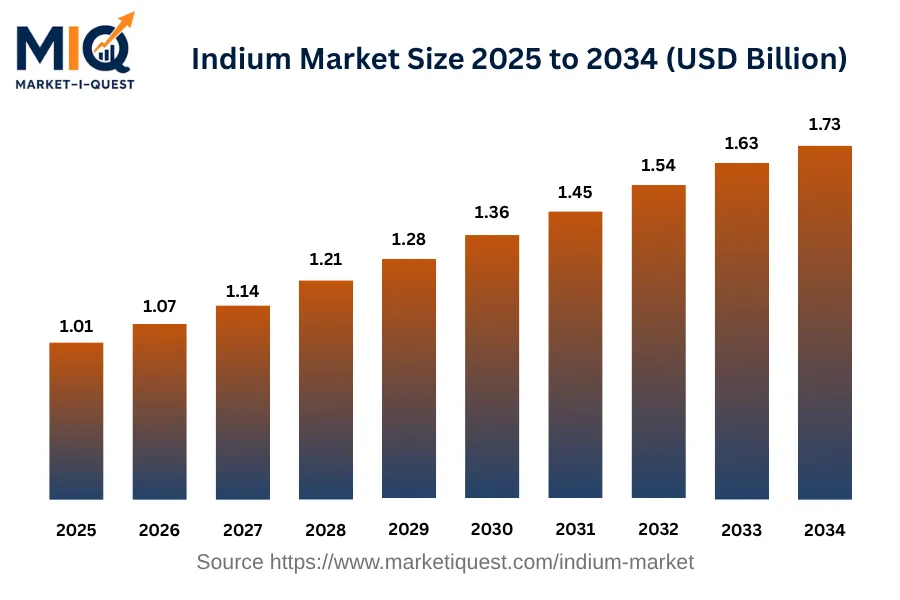
$0.953 Bn
CAGR
6.15%
Forecast 2034
$1.73 Bn

Market Segments

By Grade
High Purity Indium, Standard Grade Indium, Others
By Form
Indium Ingots, Indium Wire, Indium Foil, Indium Powders, Indium Compounds
By Application
Soldering & Brazing, Flat Panel Displays, Solar Cells, Semiconductors, Others
By End Use Industry
Electronics, Automotive, Aerospace, Renewable Energy, Others

Market Dynamics

Drivers
  • Rising demand in LCD production
  • Increased usage in solar panels
Restraints
  • Limited indium reserves
  • Recycling challenges
Opportunities
  • Increasing solar panel production
  • Rising demand for semiconductors

Market Size

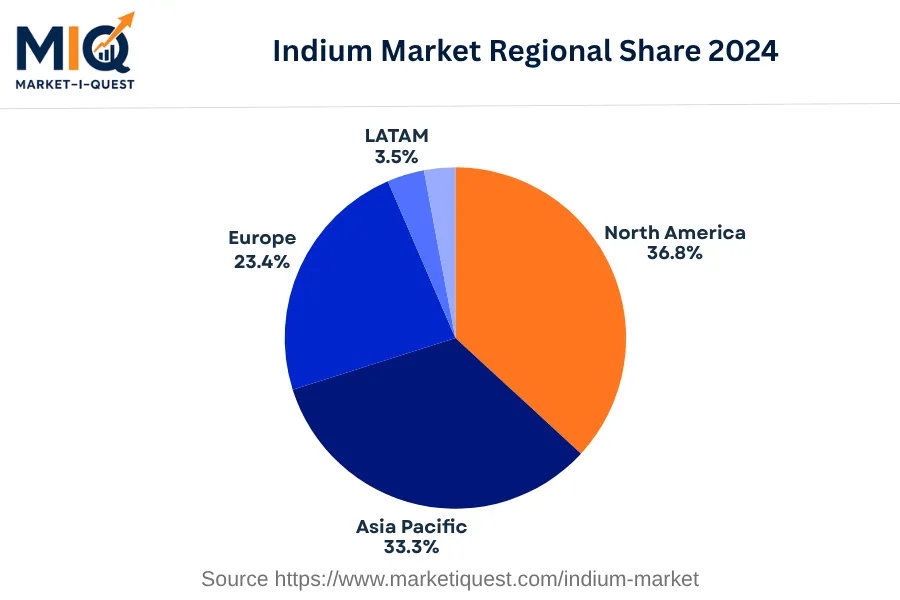
The Indium market size in 2025 is projected to be $1.01 billion and this is an increase from the $0.95 billion of 2024. By 2034, the market size is expected to further increase to $1.73 billion, depicting a Compound Annual Growth Rate (CAGR) of 6.2% for the period 2025 to 2034. This progression in market size from 2024 through 2034 indicates a steady growth pattern, where each consecutive year experiences an increase in market size, proportional to the stated CAGR. The growth in the Indium market is attributed to the interplay of several variables that are characterized by prevalent market dynamics over the forecast period. In terms of regional share as of 2024, the Indium market has the following distribution: North America, 19.2%; Asia Pacific, 57.8%; Europe, 15.8%; Latin America, 3.6%, and Middle East and Africa, 3.5%.

Key Takeaways

  • By Grade - Standard Grade Indium led the market in 2024.
  • By Form - Indium Ingots held a dominant position in 2024.
  • By Application - Semiconductors had the highest growth in 2024.
  • By End Use Industry - Automotive led the Indium Market in 2024.
indium-market market size

Key Driving Factors

Spread of Advanced Electronic Devices

Indium is one of the key components used in the manufacture of a number of advanced electronic devices, and the growing consumer base for these products is contributing to the positive trajectory of the indium market. The demand is specifically strong in the manufacturing of touchscreens for smartphones, tablets and other similar devices where indium tin oxide is used. Greater consumer adoption of these advanced devices worldwide due to increased connectivity and accessibility has significantly boosted demand for indium. As more novel applications of these devices come to the forefront, the accessibility expands, thereby compounding the demand for indium.

Regulations Mandating Lower Carbon Emissions

Indium is crucial in the production of photovoltaic cells used in solar panels, and this application is a key driver for the indium market. Governments worldwide are increasingly putting in place stringent regulations to lower carbon emissions and encouraging cleaner energy sources. Solar energy is one of those resources that's being extensively promoted for its environmental benefits, leading to numerous large-scale photovoltaic installation projects. As a result, manufacturers of photovoltaic cells are under pressure to increase production, requiring them to procure larger quantities of indium. As governments persist in their quest for cleaner energy, the demand for indium is bound to remain high for the foreseeable future.

Market Evolution by Timeline

2019-2023
During this period, the demand for Indium spiked in East Asia, particularly China, due to its usage in LCD and LED manufacturing. Other regions, namely North America and Europe, showed a budding interest in Indium for producing solder and alloys. On the supply side, such major producers as Canada, China, and Bolivia faced challenges with diminishing indium reserves. However, technological advancements in recycling e-waste provided an alternative indium supply stream. In terms of regulation, the Environmentally Preferable Purchasing policy by the U.S. aimed to boost e-waste recycling, indirectly impacting indium supply. Commercially, long-term contracts dominated the market to secure indium supply. One risk during this timeframe was the price volatility, driven by supply constraints.
2024
In 2024, the demand for Indium continued to surge, especially in the emerging markets of India and Latin America. The primary buyers were electronics manufacturers and the solder industry. With limited scope for increasing primary production, recycled indium started gaining significant traction. This year saw advanced recycling technologies becoming more mainstream. On the regulatory side, European Union's Waste Electronic and Electrical Equipment Directive bolstered e-waste recycling efforts. At a commercial level, spot purchases of indium became more frequent due to price volatility. Supply constraints continued to pose risks, leading to increased dependence on secondary indium sources.
2025-2029
This period saw a significant shift in the demand for Indium towards renewable energy sectors, such as photovoltaic cells, given its semiconductor properties. This trend was most pronounced in countries investing heavily in renewables like the U.S., Germany, and China. To meet this demand, indium recovery from e-waste became more widespread. Policy-wise, standards such as ISO 14001 obtained global recognition, promoting e-waste management. Commercially, the rise of producer-buyer partnerships was a noticeable trend to mitigate supply chain constraints. Risk factors included the potential for a technological shift away from Indium as newer alternatives began to surface.
2030-2034
By 2030, the demand for Indium further diversified, ranging from battery manufacturing for electric vehicles to microprocessor production, particularly in countries like Japan, South Korea, and China. On the supply side, increasing efforts to leverage technology for recovering indium from mining by-products were observed. Government policies such as the Critical Minerals Strategy in various countries started recognizing indium's strategic importance in next-generation technologies. The commercial landscape signified a shift towards collaborative supply chain models to stabilize indium pricing. Risks during this period were centered around the sustainability challenges linked to primary indium production and the development of viable alternatives to Indium.

Future Market Outlook

Future Opportunities

The potential for indium in next-generation technologies is substantial, driven by current developments in electronics and materials science. With the advent of electric vehicles, manufacturers such as Tesla are scrutinizing the effectiveness of various materials. Indium's role in enhancing the performance of power electronics in these vehicles marks an important shift toward heavier reliance on this metal. Furthermore, industry experts anticipate increased demand for indium in the semiconductor sector, especially as companies like Intel ramp up efforts to advance chip technologies. The exploration of alternatives to ITO, fueled by global initiatives for lowering material costs, signifies an avenue for further investigation. In 2022, several universities, including Stanford, published studies exploring the use of alternative materials while highlighting indium's position as an essential candidate in various applications. The ongoing geopolitical landscape also presents opportunities for collaboration among countries seeking stable indium supply chains, notably among nations participating in resource-sharing agreements. Additionally, the recent push from regulators worldwide to promote the recycling of rare materials supports the development of closed-loop systems in electronics manufacturing, which could enhance sustainability and create new markets for recycled indium. Overall, these factors position the indium market for diversified growth that aligns contemporary technological demands with emerging global trends in environmental responsibility and resource management.

Segmentation Analysis

By Grade

The market is divided into subsegments including High Purity Indium, Standard Grade Indium, and Others. Standard Grade Indium accounted for the largest revenue share while High Purity Indium is expected to grow at the fastest CAGR during the forecast period.

Largest Revenue Share

Standard Grade Indium

Market Share Leader

The Standard Grade Indium subsegment is currently leading in terms of revenue. The predominant reason behind this is its vast variety of applications across different industries including electronics, coatings, and alloys. Being more affordable than high purity Indium, it has a wider market uptake, especially in emerging economies. Customers from a diversified range of industries count on Standard Grade Indium due to its versatility and cost-effectiveness. Interestingly, its performance across various geographies is strong, driven by the escalating demand for electronic devices and semiconductors. Regulations have not significantly affected the sales, contributing to the steady revenue. The purchasing criteria for Standard Grade Indium typically involve a balance between quality and cost, and due to the established distribution channels and the increasing consumption in electronics underpins the sustained leadership of this subsegment in the market.

Fastest CAGR

High Purity Indium

Forecast Period Growth Leader

High Purity Indium is projected to be the fastest-growing subsegment. Impetus for its growth can be attributed to its distinctive high-quality features that are extensively used for specialized applications in the semiconductor and high-end electronics, driven by advances in technology and the upsurge of next-generation electronic devices. Its higher price point compared to Standard Grade Indium is a barrier to adoption, keeping it from immediate mass market domination. Yet as tech-focused industries are booming and standards for material purity are increasing, adoption is expected to escalate. Furthermore, partnerships with technologically advanced industries and heavy capital investments in research and development are predicted to be catalytic to the growth of this subsegment. However, uncertainties in economic climates and fluctuations in raw material cost pose risks to its short-term growth. Assumption is made that there will be a consistent rise in the demand for high-quality materials in the electronics and semiconductors industries.

By Form

The 'By Form' market is divided into subsegments including Indium Ingots, Indium Wire, Indium Foil, Indium Powders, and Indium Compounds and as of the base year 2024, Indium Ingots accounted for the largest revenue share while Indium Foil is expected to grow at the fastest CAGR during the forecast period.

Largest Revenue Share

Indium Ingots

Market Share Leader

The dominance of Indium Ingots in the revenue share is a consequence of its sweeping applications in electronics & semiconductors and solar power plants. Indium, being a rare metal with high thermal and electrical conductivity, is most efficiently utilized in the in the form of ingots for a variety of industrial processes. The rise in the electronic markets especially in regions with high tech manufacturing facilities such as Asia Pacific has significantly increased the demand for indium ingots. Furthermore, their use in flat-panel devices, solders and alloys further propels their market outreach. Governments and corporations across the globe focusing on renewable energy sources have contributed to an increase in solar power projects and encouraged the usage of indium for photovoltaic cells manufacturing.

Fastest CAGR

Indium Foil

Forecast Period Growth Leader

Whist affecting a smaller portion of the market, Indium Foil is expected to register the fastest growth. The malleability and ductility properties of indium in the form of foil have enabled it to be widely used in high-end technological applications, such as gaskets for cryogenic applications and thermal interfaces in electronics which are expanding fields. Further simplifying its use, indium foil does not oxidize most metals, making it an ideal choice for creating a hermetic seal between two different types of metals. This adaptability and versatility fosters its noticeably faster growth. However, Indium is a limited resource; therefore, industrial strategies to recycle Indium could be a critical factor for sustaining this fast growth in the future.

By Application

The market can be segmented into Soldering & Brazing, Flat Panel Displays, Solar Cells, Semiconductors and Others. Semiconductors accounted for the largest revenue share, while solar cells is expected to grow at the fastest CAGR during the forecast period.

Largest Revenue Share

Semiconductors

Market Share Leader

The semiconductor subsegment is the monetary backbone of the application market in 2024. The key drivers for its large share include the widespread use of semiconductors in virtually every type of electronic device from computers to smartphones to home appliances. With the increasing demand for these devices, especially in developing regions, and the expanding internet of things ecosystem, the opportunities for semiconductor applications are precipitously increasing. In addition to this, government regulations favouring the manufacturing of semiconductors and technological advancements in semiconductor fabrication have contributed prominently to boosting the revenue generation capability of this subsegment. The customers are majorly tech firms that manufacture electronic goods. Geographically, Asia Pacific contributes to the most significant share due to the strong presence of key electronics manufacturers. The specific purchasing criteria focus on cost-effectiveness and innovativeness leading to a lesser switching cost.

Fastest CAGR

Solar Cells

Forecast Period Growth Leader

Solar cells are anticipated to grow at the quickest rate in the forecast period. Technological innovations such as the development of perovskite solar cells and bi-facial solar cells are constantly improving the efficiency and reducing the cost of solar cells, thus driving their adoption. Additionally, governments across the world are actively promoting sustainable energy practices, in form of tax benefits and subsidies, resulting in augmented demand for solar cells. In regions where sunlight is plentiful, the economics of solar power becomes highly compelling. However, adoption barriers such as high initial capital expenditure, and intermittent power generation still exist. Strategic partnerships with construction firms for solar-ready buildings, and research institutions for better technology could be potential growth catalysts. Moreover, increased climate awareness and push for energy independence will serve as potent drivers for this subsegment. While the short term risks could include policy reversals or economic downturn impacting infrastructure projects.

By End Use Industry

The market is divided into subsegments including Electronics, Automotive, Aerospace, Renewable Energy, and Others. In the base year 2024, the Automotive subsegment accounts for the highest revenue, while the Renewable Energy subsegment is projected to grow at the most rapid pace.

Largest Revenue Share

Automotive

Market Share Leader

The automotive sector leads the market in terms of revenue and this can be attributed to numerous factors. Electronics have become an integral part of automobiles, enhancing safety, efficiency, and convenience for drivers, which in turn drives demand for advanced components. As technology continues to evolve, automobiles are increasingly being equipped with electronic devices for various applications including infotainment, navigation, and safety systems. The push towards electric and autonomous vehicles has also increased the reliance on electronics, particularly in battery management and sensor systems, thus bolstering demand within the sector. Notably, the trend towards 'smart' and 'connected' vehicles, further propels demand. Geographies such as North America, Europe, and Asia-Pacific, known for their strong automotive production and consumption, are key markets. Regulations supporting emission reduction and safety features in vehicles, intensify the need for sophisticated electronics.

Fastest CAGR

Renewable Energy

Forecast Period Growth Leader

Renewable Energy is the fastest-growing subsegment, driven by escalating concerns over climate change, increasing government initiatives to reduce dependence on fossil fuels, and improvements in renewable technologies. The move towards clean energy has necessitated a greater need for electronic components, especially for energy storage and power conversion in systems such as photovoltaic inverters, wind turbine generators, and electric vehicle charging stations. However, high capital costs and concerns about reliability and grid stability can be barriers to widespread adoption. These challenges are being addressed through advancements in electronics technology, including the development of more efficient and reliable power electronics. Partnerships between electronics companies and renewable energy companies also play a crucial role in driving growth. Nevertheless, issues related to electronic waste and its environmental impact may pose near-term risks to the market. Government policies promoting sustainable electronics practices could potentially mitigate these risks, and also significantly drive market growth

Competitive Analysis of Indium Market

Key Market Players

Manufacturers / OEMs

Korea Zinc
South Korea
Dowa Metals & Mining
Japan
Teck Resources Limited
Canada

Key Suppliers & Raw Minerals

Asahi Pretec Corp
Japan
Metallo-Chimique NV
Belgium
American Elements
US

Distributors, Integrators & Channel Partners

Belmont Metals
US
William Rowland Limited
UK
Umicore
Belgium

Porter’s Five Forces Analysis

This analysis provides crucial insights into the competitive dynamics of the Indium market.

Supplier Bargaining Power

Medium

Indium suppliers possess moderate power due to its limited global availability and mining challenges.

Buyer Bargaining Power

Low

Buyers have low power due to no viable alternatives and high demand in tech industries.

Threat of Substitutes

Low

Indium’s unique properties limit the threat of direct substitutes.

Threat of New Entrants

Medium

Technological innovation could lower barriers but capital investment and regulation remain significant.

Competitive Rivalry

High

Rivalry is high due to market growth and the fight for limited resources.

Regional Analysis

Geographic market dynamics and growth opportunities across key regions

Global Market Outlook

indium-market market regional share

North America

In 2024, the North American indium market reflected an intensified interaction between demand dynamics, regulations, technology adoption, and pricing drivers. The demand for indium remained robust due to its critical role in modern technology; specifically, its use in manufacturing flat panel devices and thin-film solar cells. Regulatory frameworks, particularly in the U.S and Canada, placed stringent environment control measures on indium extraction that influenced supply capabilities. The adoption of advanced extraction and refining techniques further enhanced efficiency in indium production, contributing to the supply dynamics. Fluctuating global indium price played a decisive role in determining the market status.

Notable trends in this base year pointed towards evolving buyer behavior and technological shifts. The demand for high-quality flat panel displays led to a surge in Indium Tin Oxide (ITO) consumption among tech manufacturers. Furthermore, the transition towards renewable energy sources bolstered the uptake of indium for photovoltaic application. Changes in the partnership landscape, with tech giants seeking alliances with raw material suppliers to ensure indium availability, emerged as a distinctive trend. Implementation of stringent policies for environmental conservation saw many manufacturers resorting to indium recycling, inducing significant policy enforcement impacts on the market. Primarily, the key sectors impacted by these trends included technology, manufacturing, energy and utilities.

Asia Pacific

In the base year 2024, the Indium market within the Asia-Pacific region showcased significant dynamism, majorly influenced by regulatory frameworks, demand-supply correlations and pricing intricacies. Key market drivers included the elevated demand for Indium in manufacturing LCDs, particularly in countries like South Korea and Japan, that host renowned electronic companies. The upsurge for eco-friendly technologies in China promoted the increased use of thin-film solar panels, augmenting the demand for Indium. Regulatory mandates in India targeting the reduction of carbon emissions faciliated investments in Indium-powered industries. Due to its rarity, supply of refined Indium remained consistent, instituting higher price equilibriums.

As far as trends are concerned, a shift towards sustainable green technologies in Australia charted a spurring demand for Indium in photovoltaic cells. China, with its versatile manufacturing sector, witnessed an upturn in Indium usage in LED manufacturing. Consolidations became more frequent, especially amongst ASEAN suppliers, to ensure better supply chain management and price stabilization. Standards enforcing the responsible sourcing of Indium gained prominence in India and China. Overall, sectors such as electronics, manufacturing and green-tech witnessed increased procurement of Indium, leading to a buoyant market scenario in the Asia-Pacific region in 2024.

Europe

In 2024, the European Indium market experienced robust demand with notable influences shaping its landscape. Drivers included a heightened demand in the semiconductor industry owing to technological adoption, particularly in Germany and the United Kingdom, which have a strong tech sector presence. Environmental regulations across Europe, especially the UK and France, spurred demand for indium due to its use in making low-energy electronic devices. Italy, Spain, and Benelux also witnessed significant investment in solar technology, where indium plays a crucial role, boosting the overall supply dynamics.

Key market trends included heightened buyer preference for eco-friendly electronics, invigorating the demand for indium in manufacturing. Additionally, technological shifts toward the more substantial use of touch screens, particularly in consumer electronics and automotive industries, escalated the demand. This shift was pervasive throughout Europe, but particularly in the Nordics. An increase in partnerships and M&A activities, primarily in Central & Eastern Europe, was a major trend, as companies aimed to secure indium sourcing to assure supply stability. Lastly, stricter enforcement of electronics’ waste-recycling policies across Europe increased the product availability from secondary sources, significantly influencing the market dynamics. In summary, 2024's European indium market bore the imprint of technological advancement, environmental policy, and enhanced cooperation.

Latin America

In 2024, the Indium market in Latin America is characterized by increased consumer electronics manufacturing and a shift towards green energy. The primary drivers for the market include the burgeoning technology sector in Brazil and Mexico, propelling demand for Indium in touch screens and LEDs. Additionally, the growing emphasis on renewable energy across the region, especially in Chile and Argentina, triggered the demand for Indium in photovoltaic cells production. Moreover, the favorable governmental policies in countries like Colombia, promoting foreign investment in local industries, opened pathways for market expansion.

Significant trends shaping the market include the surge in online retailing of electronic goods in Peru, changing the dynamics of Indium consumption in the country. The partnership between Mexico's local manufacturers and Chinese electronics companies is another vital trend, enhancing the market's supply chain efficiency. Furthermore, the enforcement of environmental standards across LATAM to curb e-waste is leading manufacturers to adopt Indium recycling methods, thereby influencing the overall market equilibrium. Key consumers include the manufacturing sector, particularly consumer electronics, solar power, and LED lighting industries. Therefore, the Indium market in LATAM is largely prompted by the interplay of demand growth in technology and energy sectors, evolving market trends and supportive government policies.

Middle East & Africa

In 2024, the indium market in the Middle East and Africa presented a dynamic landscape. Key drivers included substantial demand in the electronics sector - with countries such as Saudi Arabia, UAE, and Israel serving as regional hubs for electronics manufacturing - and stringent environmental regulations promoting the move towards indium-based photovoltaic solar cells. Rising investment from government entities, particularly in Saudi Arabia and UAE, into more energy-efficient products also boosted the market. Furthermore, favorable pricing by key suppliers in Nigeria and South Africa acted as a catalyst.

A shift towards green technology was a prominent market trend, especially in Egypt, South Africa, and Israel. Additionally, end-user adoption of touch screens and LCD displays (which utilize indium tin oxide) presented a growing trend across consumer electronics and automotive sectors. Furthermore, partnerships among telecommunications companies - notably from UAE, Kenya, and Qatar - aiming to capitalize on advanced indium-phosphide (InP) semiconductors for faster data transfer were notable. Policy support in countries such as Israel and Saudi Arabia for the electrification of vehicles and increased use of renewable energy, demanding more efficient and durable semiconductor materials, also influenced the market trends significantly, indicating the importance of the indium market in technological advancement and improvement of energy efficiency.

Recent Industry Developments

Latest market innovations, product launches, and strategic initiatives

June 2026

AXT Inc. (Nasdaq: AXTI) confirmed it is ahead of schedule on plans to double indium phosphide substrate capacity in 2026 compared with Q4 2025 levels, and then double capacity again in 2027. The company completed a $632.5 million capital raise** to support the expansion. AXT's backlog exceeded **$100 million with demand fueled by AI data centers, optical transceivers, and co-packaged optics applications. Shares of AXT skyrocketed 578% year-to-date.

Frequently Asked Questions