LED Lighting Market Snapshot

Key Players

  • Philips Lighting (Netherlands)
  • Cree Inc. (United States)
  • Osram Licht AG (Germany)
  • GE Lighting (United States)
  • Zumtobel Group AG (Austria)
  • Samsung Electronics (South Korea)
  • Nichia Corporation (Japan)
  • LG Innotek (South Korea)
  • MLS Co. Ltd. (China)
  • Acuity Brands (United States)

Market Size

Base Year 2024
$96.5 Bn
CAGR
8.6%
Forecast 2034
$220.20 Bn

Market Segments

By Product Type
Lamps, Luminaires
By Installation Type
New Installation, Retrofit
By Sales Channel
Online, Offline
By End Use
Residential, Commercial, Industrial

Market Dynamics

Drivers
  • Increasing energy efficiency demand
  • Policies favoring eco-friendly solutions
Restraints
  • High initial installation costs
  • Lack of awareness about benefits
Opportunities
  • Increasing energy efficiency demand
  • Emerging smart lighting technology

Market Size

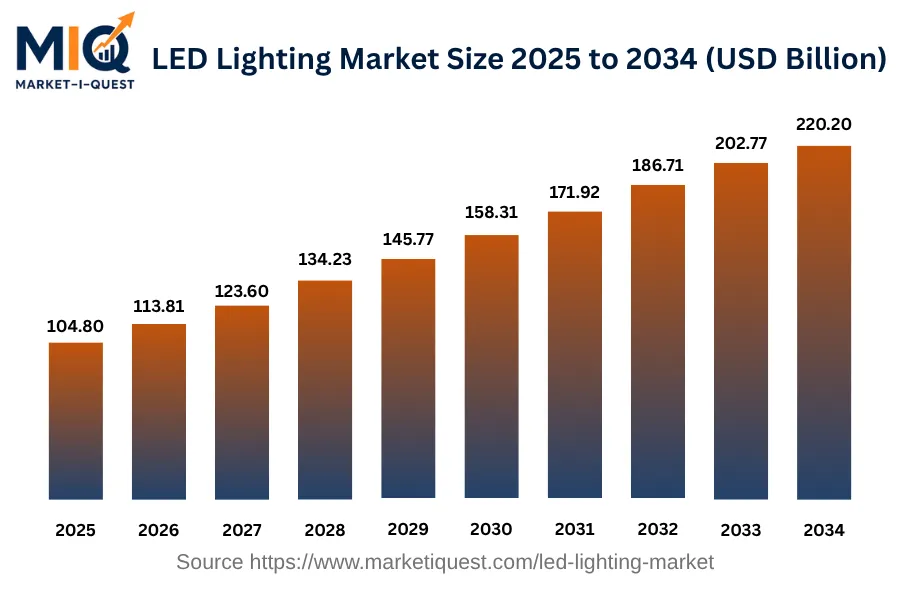
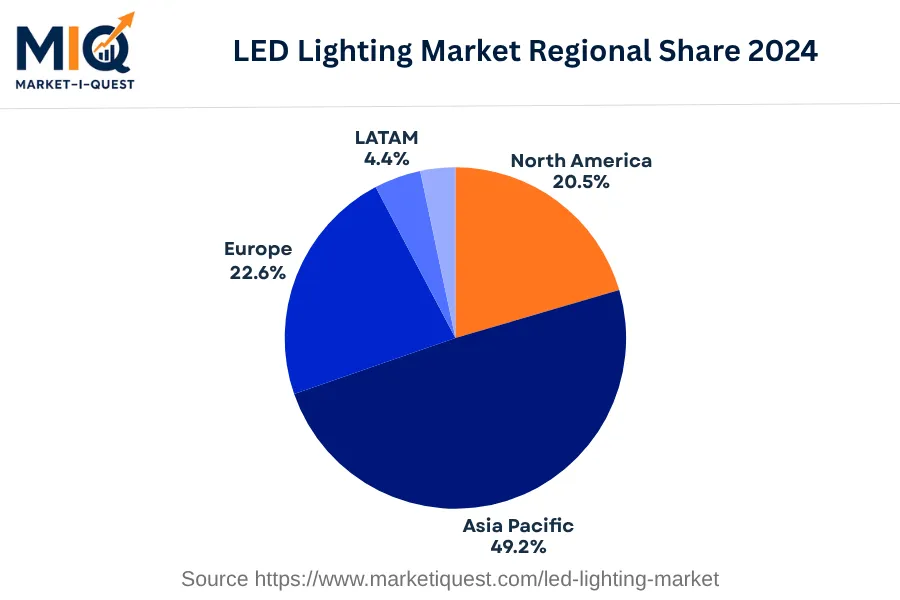
The LED Lighting Market was valued at 104.80 Billion USD in 2025 and is projected to grow to 220.20 Billion USD by 2034 with a CAGR of 8.6%. This sizeable increase in market value over the period is majorly attributed to continuous advancements in LED technology. The performance improvements has stimulated demand in various sectors. Geographical market shares in 2024, highlighted Asia Pacific holding the largest portion at 49.2%, followed by Europe at 22.6% and North America at 20.5%. Whereas Latin America, Middle East & Africa with 4.4% and 3.3% respectively.

Key Takeaways

  • By Product Type - Lamps led the LED Lighting Market accounting for the largest share in 2024.
  • By Installation Type - Retrofit expanded rapidly accounting for a significant proportion of installations in 2024.
  • By Sales Channel - Offline was the dominant route holding the majority of the market share in 2024.
  • By End Use - Commercial segment led the LED Lighting Market with the highest utilization in 2024.
led-lighting-market market size

Key Driving Factors

Adoption of Global Energy Efficiency Standards

With constant implementation of strict energy efficiency standards by various global regulatory bodies including International Energy Agency. These measures specifically preferring lighting solutions for substantial impact on global energy consumption. For instance, the European Union's ERP Directive has set stricter regulations on the energy efficiency of lighting products, which directly influences the LED lighting market. This directive drives businesses for replacing conventional lighting systems with energy-efficient alternatives such LEDs. Similarly, in U.S., the Department of Energy has tightened energy efficiency regulations for commercial and residential buildings. As these standards become more widespread, the LED lighting market will continue to grow because LED lights use significantly less power and last longer than traditional lighting.
Shift towards Smart Homes and Buildings

The growing trend towards smart homes and buildings is a major factor driving adoption in the LED lighting market. Today's consumers are seeking intelligent and adaptable lighting systems. However, integration of IOT technology into lighting systems allows consumers for controlling and managing their environment. LED lighting known for its digital control capability are the major drivers of the demand. Moreover, commercial building operators are also driven towards automated and energy-efficient lighting solutions to reduce their operational costs. Buildings that use IoT-enabled LED lights not only reduce energy consumption but also provide better lighting management. Thus, in a connected environment where all appliances communicate with each other, the adoption of LED lighting systems becomes essential.

Market Evolution by Timeline

2019-2023
The major buyers for LED lights during this period were homes, industries and commercial spaces, driven mainly by energy savings. Regionally, North America was the leading buyer, followed by Asia-Pacific. The availability of LEDs within this time has significantly improved efficiency and longer lifespan with some integration into Smart Homes systems. The Energy Star program in the USA influenced adoption through its stringent certification process. The dominant pricing model was premium pricing due to high production costs. However, long-term contracts and bulk purchases provided discounts. Thus, this period played a major role in heightening the market growth.
2024
Europe saw surge in LED lighting demand, supported by energy conservation measures and policies such as European Green Deal. In terms of technology, manufacturers introduced Circadian-rhythm LED lights that adjust according to sleep schedule of the user. EU restricted the sale of halogen lamps in 2024 which subsequently accelerated shift towards LEDs. Commercially, competitive pricing structures were in place, and strategic partnerships with distributors were frequent. Thus, 2024 acted as a major year for the expansion of LED lighting market.
2025-2029
Government sectors will likely also be a prominent buyers with homes, industries and commercial spaces in adoption of the market. Demand will rise from Asia, Europe, North America and begin expanding towards developing economies. Advances in technology will likely see introduction of autonomous LED lighting systems will likely observe demand towards motion sensor. Major policy rule was the enforcement of strict import standards for LEDs by the World Trade Organization. Commercially, LED light as a service was typical, where customers paid for light instead of bulbs. Efficiency of recognized certification programs significantly reduced such infringements. Thus, this period will likely see major demand and growth of the market.
2030-2034
Residential sectors in developing regions such as Africa will likely see a rise in LED lighting installations. This period will witness a widespread use of solar-powered LEDs due to advancing solar cell technology and declining costs. The World Bank's Lighting Global program will likely facilitate LED adoption in off-grid areas via funding. LED-lighting manufacturers will increasingly start adopting subscription pricing model. Manufacturers will respond by focusing on n segments such LED grow lights for indoor farming or high-efficiency LEDs for hectic industrial locations.

Future Market Outlook

Future Opportunities

The current shift towards smart cities has expected for creating various opportunities for LED lighting market, particularly in regions actively pursuing sustainability. For instance, in 2022, U.S. announced significant infrastructure investments aimed at modernizing urban infrastructures, including LED streetlights. This transformation is likely to boost partnerships among municipalities and tech companies. Whereas cities such as Barcelona and Singapore by now are initially evaluating smart lighting solutions integration with IOT connectivity. Reduction of operational costs related with LED lighting will incentivize modernizing projects in commercial sectors. For instance, Walmart initiated a nationwide energy-efficient lighting transforming in its stores. Additionally, expansion of renewable energy sources highlights opportunities for LED technologies to align with green energy initiatives, as seen in Germany’s Energiewende policy aiming for progressive reductions in carbon emissions. Moreover, government regulations advocating for improved building standards such as the International Energy Conservation Code, will likely lead to increased demand for LED lighting in construction and renovation projects. The increasing awareness of health impacts related to lighting quality should encourage advancements in human-centric lighting systems. As a consequence, companies such Aculux are developing products that shift towards tunable white LED solutions, reflecting a market adaptation to emerging consumer preferences. Overall, aligning product offerings with sustainability initiatives and innovative smart technologies will define the imminent future of the LED lighting sector.

Segmentation Analysis

By Product Type

The market is divided into subsegments including lamps and luminaires. The lamps subsegment accounted for the largest revenue share, while luminaires is expected to grow at the fastest CAGR during the forecast period.

Largest Revenue Share

Lamps

Market Share Leader

In 2024, lamps subsegment held the largest revenue share of this segment significantly contributing in growth of the market. This growth is driven by various major factors including relative cost-effectiveness plays key role in driving the demand. In compared to luminaires, lamps are usually less expensive and meet necessary requirements of providing functional and aesthetic illumination. Combined this factors makes it a popular choice among consumers, especially in developing regions where cost considerations often take precedence. Notably, lamps are easy to install and requires significantly low capital investment. It's important to address wider availability of these products, both in physical stores and online e-commerce platforms, contributing to their prominence in the market. Whereas, regulatory incentives promoting energy-efficient lighting solutions have also boosted the demand for specific types of lamps such as LED and CFL. Moreover, the diversity of lamps available in various shapes, sizes, colors, and designs, satisfying customers with varied preference and demands.

Fastest CAGR

Luminaires

Forecast Period Growth Leader

Luminaires are expected to grow at the fastest CAGR. The major growth drivers for this subsegment include technological advancements, shifts in design trends and policy towards energy efficiency. Emerging technologies such as smart lighting and integration of IOT with lighting solutions making luminaires more engaging to consumers seeking convenience and control. Luminaires are majorly preferred for their aesthetics and ability for contributing within the atmosphere of a room , with new design trends focusing on integration of light installations into the overall design of a space. However, energy efficiency policies and regulations are major drivers driving shift towards luminaires, as many modern luminaires are designed for maximizing light output while minimizing power consumption. With partnerships between lighting companies and tech firms have further led to innovations in luminaires, offering features such as remote control, automated dimming and energy usage monitoring.

By Installation Type

The market is divided into subsegments including New Installation and Retrofit. Within these, Retrofit accounted for the largest revenue share while New Installation is expected to grow at the fastest CAGR during the forecast period.

Largest Revenue Share

Retrofit

Market Share Leader

The Retrofit subsegment leads in revenue generation due to several factors. In an increasingly resource-conscious market, businesses and consumers alike are seeking to upgrade and modernizing their existing systems rather than implementing entirely new installations. These retrofit improvements offers cost-effective way to improve efficiency, resulting in substantial energy and cost savings. Additionally, there is an increased interest in sustainable practices across industries, encouraging firms to retrofit their existing systems for reducing environmental impact and follow stricter regulations. Regionally, with the widespread demand and strong adoption in developed regions with higher concentration of established, and matured infrastructure that requires improvements. However, with a diverse customer base, from industrial establishments looking to streamline operations to homeowners seeking to improve energy efficiency.

Fastest CAGR

New Installation

Forecast Period Growth Leader

The New Installation subsegment is projected to grow at the fastest rate. Major drivers for this growth include technological advancements, rising demand in emerging markets and increasingly highlighting energy-efficient systems. New technologies are constantly evolving, offering more efficient and advanced solutions, leading to increased demand for new installations. Furthermore, rapid economic and infrastructural growth in emerging markets is fueling increasing new installations as they expand and modernize their energy and operational systems. Moreover, ongoing shift towards environmentally friendly and energy-efficient solutions also encourages new installations equipped with latest technology, offering optimal performance and energy usage. Thus, increased capital expenditures in infrastructure and strategic partnerships with technology developers fuel this growth.

By Sales Channel

The sales channel market is subdivided into Online and Offline segments. In the base year of 2024, the Offline subsegment commanded the largest revenue share while the Online subsegment is projected to grow at the fastest rate during the forecast period.

Largest Revenue Share

Offline

Market Share Leader

In 2024, the Offline subsegment had the largest share of the revenue. This is attributed to several factors common in industry dynamics. Due to the demands consumers for tangibility and instant gratifications, which are key purchasing factors provided by offline sales channels. Additionally, regulatory policies in certain regions may also prefer offline transactions, further boosting its revenue generation. Within specific regions, particularly with limited internet connectivity or low digital literacy, significantly contributing to frequency of offline sales. However, established supply chains and distribution channels of offline subsegment ensure steady revenue stream. Thus, notable shift in model towards online retailing, catalyzed by changing consumer behaviors and technological advancements.

Fastest CAGR

Online

Forecast Period Growth Leader

Online subsegment is expected to grow at an accelerated pace. This growth is primarily driven by rise in internet penetration and expansion of smart devices. The convenience and extensive choices offered by online platforms attracting modern consumers, thereby driving the expected expansion. Technological innovations in form of enhanced payment security, seamless user experience and artificial intelligence-based recommendations forms catalysts accelerating adoption of online sales channels. Partnerships between online retailers and logistics firms promote segment expansion by improving delivery efficiency. Thus, given the prevailing trends, the potential of online sales continue to highlights a prominent market.

By End Use

The market is divided into subsegments including Residential, Commercial, and Industrial, with the Commercial segment accounting for the largest revenue share and the Industrial segment forecasted to grow at the fastest CAGR during the predicted time frame.

Largest Revenue Share

Commercial

Market Share Leader

The Commercial segment being highest revenue contributor is driven by many factors. Primarily, the modern commercial structures demand advanced solutions pertaining to the segment under discussion. Businesses have been investing significantly in commercial sector due to its potential for high returns. Commercial use generally corresponds to higher volume and, consequently, higher revenue, compared with Residential and Industrial segments. Regulatory factors support growth in commercial sector, as governments worldwide are introducing favorable policies to boost commercial sector for economic development. Moreover, geographies with higher urbanization rates present more opportunities for the commercial sector. Increased number of commercial complexes, high purchasing power, swift adoption of new technologies, and less switching costs have been driving the growth of this segment. More extensive distribution channels and strong supplier relationships have also helped commercial entities leverage market opportunities. But market dynamics may change based on various factors, including technology advancements and regulatory changes.

Fastest CAGR

Industrial

Forecast Period Growth Leader

Industrial subsegment is expected to grow at the fastest CAGR. This is largely attributed to fast adoption of innovative technologies within industrial sector, fueled by continuous capital investment. Major drivers include advancements in technology and increased partnership between key stakeholders, aiming to drive efficiency and productivity. Concurrently, policies encouraging industrial growth in emerging economies support this rising trend. The sector's complexity might additionally slow adoption rate. There's risk of regulatory changes, as any stringent control from authorities could hamper growth. It's critical for market players to keep these factors in mind while devising strategic plans for capturing the industrial market's rapid growth.

Competitive Analysis

Key Market Players

Manufacturers / OEMs

Cree Inc.
US
Nichia Corporation
Japan
OSRAM GmbH
Germany

Key Suppliers & Raw Materials

Epistar Corporation
Taiwan
LG Innotek
South Korea
Samsung Electronics
South Korea

Distributors, Integrators & Channel Partners

Arrow Electronics
US
WESCO International
US
Rexel Group
France

Porter’s Five Forces Analysis

This analysis defines the level of competition and the attractiveness of the LED Lighting market.

Supplier Bargaining Power

Medium

Power is moderate due to diverse supplier base, though high-tech components can command premiums.

Buyer Bargaining Power

High

High due to multiple vendors, low switching costs and significant information availability.

Threat of Substitutes

Low

Substitution threat is low given the superior energy efficiency and longevity of LED lighting.

Threat of New Entrants

Medium

Moderate entry barriers exist due to technological knowledge requirements and certification standards.

Competitive Rivalry

High

Strong rivalry with numerous established companies and price-based competition.

Regional Analysis

Geographic market dynamics and growth opportunities across key regions

Global Market Outlook

led-lighting-market market regional share

North America

In 2024, the North American LED lighting market highlighted substantial growth due to several key drivers and emerging trends. Capital investments in energy efficiency and cost-saving measures enhanced the adoption of LED lighting in the United States, Canada and Mexico. Technological advancements, particularly in smart lighting systems, drove the market growth. With the implementation of stringent energy efficiency regulations across North America significantly drove the demand. Furthermore, the reduced supply chain costs of LEDs made them an economically feasible lighting solution, driving their broad adoption in various sectors.

Buyer behavior significantly shifted in 2024, with more consumers shifting towards energy-efficient and durable lighting options such as LEDs. The market also witnessed increased adoption of smart LED lighting solutions seen in enterprise and retail sectors. There was a marked trend in North America for integrating LED systems with smart home devices. Stringent policy enforcement around energy efficiency led to growing institutional adoption, particularly in government and healthcare sectors. With witnessing significant strategic partnerships aimed at advancing LED technologies with manufacturers accelerating to meet the increased market demand. The LED lighting market in North America in 2024 was therefore characterized by technological adoption, driven by energy efficiency concerns and strategic alliances to deliver advanced lighting solutions.

Asia Pacific

In 2024, Asia Pacific's LED lighting market experienced a substantial growth driven by several factors. In countries such as China, India and South Korea due to increasing environmental concerns, regulation policies and energy-saving goals significantly rose the demand. The Chinese government's policy regarding the elimination of incandescent light bulbs significantly impacted supply dynamics, leading to massive adoption of LED options. Whereas, India's UJALA initiative drove LED adoption within households and enterprises. However, higher LED technology adoption rates due to both governmental regulations and reduction of price, making LEDs more cost-effective was witnessed in Japan and Australia.

The market trends in 2024 highlighted a shift in both buyer behavior and product technology. Consumers in China and ASEAN markets showed a preference for smart, connected LED products with strict government standards with rising manufacturers for innovating. High-profile partnerships such as LG's deal with South Korean government, accelerated market adoption of LED lighting in public spaces and utilities. Meanwhile, Japan emerged as major leader in enterprise-level LED adoption, primarily in healthcare and manufacturing sectors. In Australia, enforcement of stringent energy efficiency standards drove shift in the retail sector towards the adoption of LED lighting. Across the region, this trajectory was indicative of the Asia Pacific's broader commitment to sustainability and energy efficiency in 2024.

Europe

In 2024, the LED lighting market in Europe highlighted substantive growth due to various key driving factors and emerging trends. Regulatory measures including EU's directive on eliminating incandescent lamps, driving market adoption. Cost efficiency and enhanced lifespan of LED lights drove widespread usage across various sectors such retail, healthcare and government. Investment from major corporations such as Siemens and Philips intensified competition, driving innovation and improved supply dynamics.

Among trends observed, a notable shift towards energy-efficient smart lighting controls was seen in countries such as Germany and UK promoted sustainability. There was growing preference among customers in France and Italy towards customizable and design-oriented LED fixtures. Spain, Central & Eastern European market witnessed expanding e-commerce channels for LED product distribution. Significant partnerships and M&As, for instance, the collaboration between Zumtobel and Bosch in Germany, influenced market. Regulatory enforcement of standards such as EU's Eco-Design directive assured the quality and reliability of LED products across Europe. Though every region had its unique market dynamics, broadly speaking, the drivers and trends in 2024 highlighted the LED lighting market's robust and innovation-driven character across Europe.

Latin America

In 2024, the LED Lighting Market in Latin America continued to evolve due to various drivers and trends. In regions such as Brazil and Mexico leading to increased adoption of energy-efficient LED lights with the rising energy prices and environmental awareness drove consumer demand. These countries improved from substantial government investments in public infrastructure, fueling rising usage of LED in governmental establishments. Moreover, expansion of smart homes in Argentina incentivized incorporation of smart LED lighting solutions.

Whereas, shifting consumer behavior indicated rising preference towards integrated lighting systems, particularly in retail sectors in areas such as Colombia and Chile. The impact of this trend was amplified by key partnerships and M&A activities among local and international lighting companies, seeking to optimize supply chains and capitalize on these emerging trends.

Regulation increasingly influenced the market with enforcement of energy-saving standards in Peru, with a accelerating shift from traditional lighting to LED. The utilities sector, in particular, started complying with these standards, promoting LED adoption. Technologically, LED industry saw an rise of innovative lighting solutions with improved designs and luminosity, adopting usage in various sectors, including healthcare, manufacturing and enterprise market. Thus, LED market in LATAM in 2024 saw significant growth due to many influencing factors.

Middle East & Africa

In 2024, LED Lighting Market in Middle East and Africa experienced significant expansion. This growth was driven due to increased energy conservation efforts, government regulations promoting energy-efficient lighting and significant investments in infrastructure development. In particular, Saudi Arabia's Vision 2030 reform program led to increased adoption of LED lighting in public infrastructure projects. Additionally, techno-economic transition in countries such as UAE and Qatar increased the adoption of energy-efficient lighting in utilities and oil and gas sectors.

Simultaneously, rising consumer awareness in Egypt, South Africa, Nigeria and Kenya about long-term cost benefits of LED lighting majorly influenced buyer behavior, driving market growth. With noticeable shift towards LED technology in these regions with more retail outlets and manufacturing companies looking for LED lighting over conventional lighting. Furthermore, partnerships between LED manufacturers and government bodies in Israel led to its wider adoption in healthcare and telecom sectors.

The market also experienced firm policy enforcement towards usage of energy-efficient lighting, particularly LED lights in South Africa's public sector, further contributing to market growth. However, pricing competition of LED products, due to advancements in technology and large-scale production also played a major role in shaping the LED Lighting Market in the Middle East and Africa in 2024.

Recent Industry Developments

Latest market innovations, product launches, and strategic initiatives

August 2025

Luminous Devices launched its MP-5050 Series of high-power LEDs. This development specifically targets commercial and outdoor lighting sectors, addressing critical market need for enhanced durability and energy efficiency in high-demand environments like public streetlights and sports stadiums.

May 2025

Signify launched Philips MASTER LEDtube T8, marking the introduction of Europe's first LED tube manufactured using approximately 40% post-consumer recycled plastic. This move directly addresses impending circular economy regulations in European market and sets new baseline for sustainability in commercial lighting retrofits.

March 2025

Signify and Dixon Technologies entered into a large-scale joint venture focused on manufacturing high-efficiency lighting within the Indian subcontinent. This development represents a massive structural shift toward localizing supply chains, mitigating tariff risks, and reducing reliance on imported semiconductor components for the rapidly expanding APAC market.

Frequently Asked Questions