Gas Sensor Market Snapshot

Key Players

  • Honeywell International Inc. (United States)
  • ABB Ltd. (Switzerland)
  • General Electric Company (United States)
  • Robert Bosch GmbH (Germany)
  • Emerson Electric Co. (United States)
  • Siemens AG (Germany)
  • Spectris PLC (United Kingdom)
  • DENSO Corporation (Japan)
  • NGK SPARK PLUG CO. LTD. (Japan)

Market Size

Base Year 2024
$3.59 Bn
CAGR
8.27%
Forecast 2034
$7.95 Bn

Market Segments

By Technology
  • Electrochemical
  • Photoionization Detectors (PID)
  • Solid-State/Metal Oxide Semiconductor (MOS)
  • Catalytic
  • Infrared
  • Laser
By Gas Type
  • Oxygen
  • Carbon Monoxide
  • Carbon Dioxide
  • Hydrogen Sulfide
  • Nitrogen Oxide
  • Hydrogen
  • Others
By Application
  • Water & Wastewater Treatment
  • Aerospace & Defense
  • Automotive & Transportation
  • Industrial Safety
  • Oil & Gas
  • Consumer Electronics
  • Others

Market Dynamics

Drivers
  • Rising air pollution levels
  • Industrial safety regulations enforcement
Restraints
  • High manufacturing costs
  • Slow technology advancements
Opportunities
  • Rising environmental concerns
  • Increasing safety regulations

Market Size

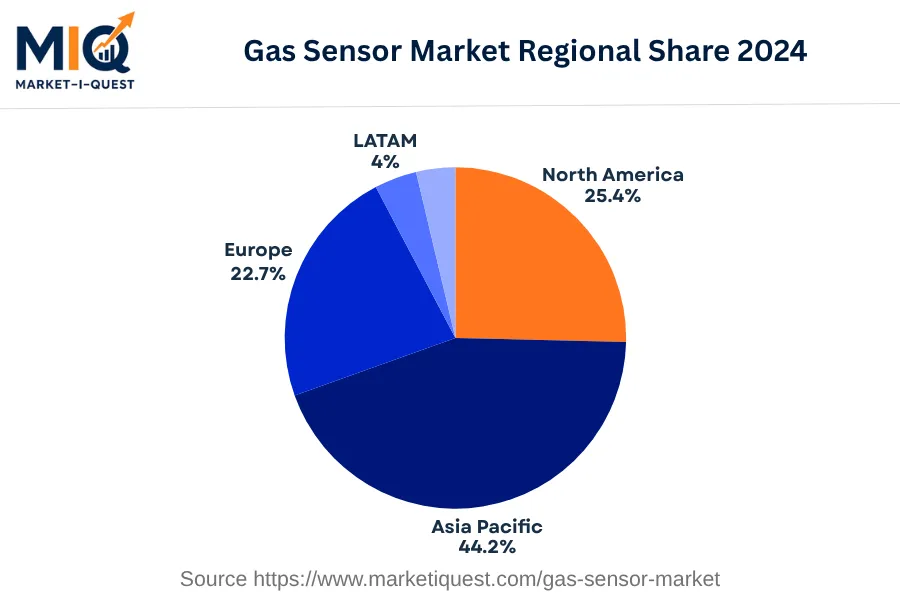
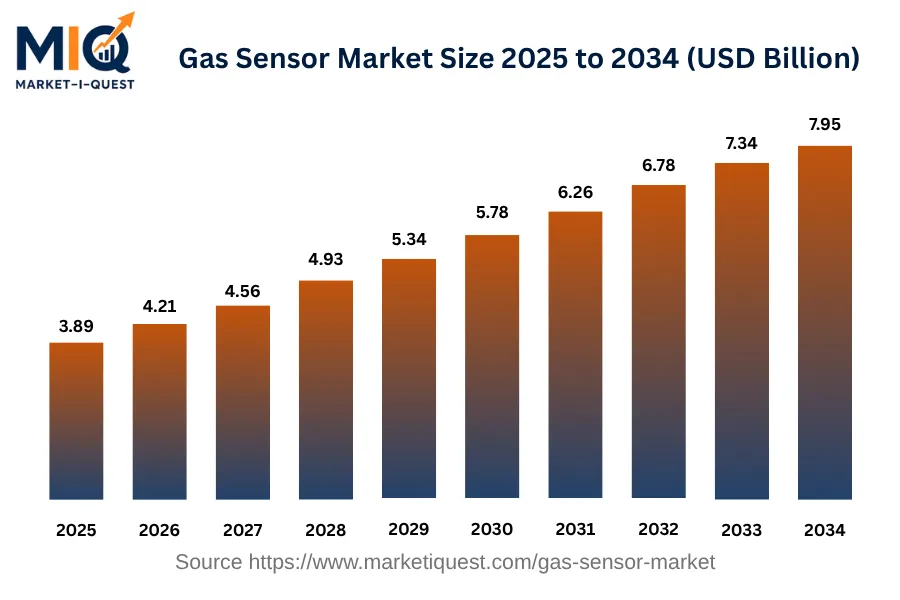
The Gas Sensor Market in 2025 is projected to reach a value of $3.89 billion, a slight increase from the $3.59 billion market size in 2024. There is a substantial growth trajectory extending over the next decade: by 2034, the market size is expected to more than double to $7.95 billion. This growth signifies a Compound Annual Growth Rate (CAGR) of 8.3% between 2025 and 2034. The escalating growth over these years is mainly due to heightened demand for safety systems, the growing need for monitoring pollutants, and continuous advancements in sensor technology. In terms of regional shares in 2024, the Asia Pacific region dominated the market with a 44.2% share, followed by North America holding a 25.4% share and Europe with a 22.7% share. The remaining regions, Latin America and the Middle East and Africa (MEA), cumulatively account for a small fraction of global market shares, at 4.02% and 3.7% respectively.

Key Takeaways

  • By Technology - Electrochemical category led the market with an impressive share in the base year.
  • By Gas Type - Oxygen dominated the market with a significant hold in the given year.
  • By Application - Consumer Electronics recorded as the top category in the observed year.
gas-sensor-market market size

Key Driving Factors

Stricter Government Regulations Regarding Industrial Emission Standards

Industrial sectors globally are now held to greater account in reducing their contributions to air pollution thanks to increasingly stricter government regulations imposed on industrial emission standards. To ensure they meet these heightened standards and avoid heavy penalties, industries are integrating advanced gas sensors into their operations. These sensors accurately monitor and control gas emissions and improve air quality, thereby aiding industries in achieving compliance with regulatory laws. For instance, The Clean Air Act in the United States mandates the reduction of hazardous air pollutants, catalyzing the adoption of gas sensors by American industries. This governmental steer on emission control is significantly driving the boom in the gas sensor market.

Expansion of Smart Home Technology

As the smart home sector proliferates, gas sensors are becoming crucial components of home automation systems. With homeowners prioritising safety and convenience, integrating gas sensors in household devices helps in real-time monitoring of potential gas leakages, thus preemptively safeguarding the health and safety of the residence. These sensors' ability to connect to the internet provides further convenience by sending alerts to homeowners or activating ventilation systems in response to detected gas leaks. For example, smart thermostats and HVAC systems often include gas sensors as a standard feature. As the trend towards smarter, safer homes continues, the demand for gas sensors in the consumer electronics sector is expected to fuel the market further.

Market Evolution by Timeline

2019-2023
During this period, the gas sensor market saw increased demand from industries such as oil and gas, petrochemical, and healthcare mostly in regions like North America, Europe, and Asia-Pacific. Manufacturers began implementing IoT in their gas sensor systems, leading to improved monitoring and detection capabilities. However, integration complexities with existing infrastructure posed challenges. Regulatory mandates like those established by the Occupational Safety and Health Administration (OSHA) compelled companies to adopt gas sensors for safety purposes. Fixed price contracts were typical, and collaborations between sensor producers and software firms evolved for stronger Internet of Things (IoT) integration. A significant risk involved technology malfunction, leading to inaccurate readings, thus yielding ineffective response systems.
2024
By 2024, gas sensors were highly demanded by the food and beverage industry to monitor gas composition in processing plants and storage facilities, specifically in developed regions like the United States, Japan, and Germany. With advanced microelectromechanical systems technology, gas sensor efficiency saw noticeable enhancements but faced challenges in interoperability with disparate systems. The introduction of EU's RoHS 3 Regulations limited the type of materials manufacturers could use. Pricing models began to diverge, and partnerships with cloud service providers increased. Sensor inaccuracies remained a significant risk, leading to incidents of gas leaks or exposure.
2025-2029
In these years, environmental monitoring applications in developing economies like India, Brazil, and South Africa spiked demand for gas sensors. Nanotechnology in sensors led to miniaturization and cost-efficiency but faced issues in mass production. Regulatory agencies, including India's Central Pollution Control Board, necessitated the use of environmental gas sensors. A subscription pricing model, based on real-time data provision, emerged predominantly. The trend of partnerships shifted towards telecom providers for IoT-enabling. The risk of cyber-attacks on IoT-enabled sensors loomed, making cybersecurity measures an important focus.
2030-2034
The demand for gas sensors increased in the transportation sector, particularly in regions with high traffic pollution such as China, the United States, and the European Union. The incorporation of AI into gas sensor systems led to real-time and predictive analytics, albeit with implementation difficulties. EU's General Safety Regulation 2022 mandating emission sensors in vehicles impacted adoption. An outcome-based pricing model for gas sensors became increasingly common. Strategic partnerships with AI analytics firms rose to tap potential predictive capabilities. High technology-dependence posed a risk, with contingencies focusing on strengthening AI's reliability and robustness.

Future Market Outlook

Future Opportunities

Future opportunities in the gas sensor market are closely tied to increasing regulatory pressures and technological advancements. Following the adoption of stricter emission standards outlined by the International Organization for Standardization (ISO 14001:2015), industries are seeking compliance solutions that include advanced gas monitoring. Governments in regions like California have initiated programs aimed at reducing greenhouse gas emissions, creating a favorable market for enhanced sensor technologies. The adoption of smart home technologies presents further opportunities, as consumers demand improved indoor air quality solutions. For instance, in 2023, major appliance manufacturers such as Samsung announced plans to integrate gas sensors into home automation systems. Additionally, the rise of vertical farming in urban areas, supported by initiatives from the Food and Agriculture Organization (FAO), has increased interest in precise air quality management. Companies are exploring new materials, such as graphene and carbon nanotubes, which are expected to play pivotal roles in developing new sensor technologies. Startups like Airthings are leveraging this trend by introducing sensors that monitor indoor air quality and provide user-friendly interfaces. The global push towards achieving carbon neutrality by 2050, as seen in commitments from various countries, is likely to foster collaboration between regulatory bodies and sensor manufacturers. As end-users seek reliable data, the focus on customizable and portable sensor solutions is expected to intensify, indicating a vibrant future for the gas sensor market.

Segmentation Analysis

By Technology

The market is divided into subsegments including Electrochemical, Photoionization Detectors (PID), Solid-State/Metal Oxide Semiconductor (MOS), Catalytic, Infrared, and Laser technologies. Electrochemical technology accounted for the largest revenue share while Photoionization Detectors (PID) is expected to grow at the fastest CAGR during the forecast period.

Largest Revenue Share

Electrochemical

Market Share Leader

Electrochemical technology has taken a significant lead in the technology market sector due to several factors. Its prominence stems largely from its relatively low operational cost, simplicity, and reliability in detecting a range of gases. Its broad detection spectrum has allowed its adoption in various applications including industrial safety, environmental monitoring, and healthcare diagnostics, thereby driving its revenue growth. Moreover, customer preference for this technology significantly attributes to the low maintenance and high accuracy it offers in gas identification and concentration measurement. Its versatility in vast geographical diversities also plays an important role in its revenue dominance. Regulatory and supply dynamics further boost its market position, as certifications and standards are generally easier to attain for this technology compared to others. In terms of purchasing criteria, the low initial investment coupled with the reduced switching costs adds to its acceptance across different channels.

Fastest CAGR

Photoionization Detectors (PID)

Forecast Period Growth Leader

Photoionization Detectors (PID) is forecasted to grow at the fastest rate among these technology subsegments. This is primarily driven by the ability of PIDs to measure low levels of volatile organic compounds (VOCs), a capability much needed in the growing environmental monitoring market. The advent of advanced PID versions capable of measuring even lower VOC levels is catalyzing the growth. Regulatory bodies are also making stringent policies for VOC detection, thereby providing an opportunity for growth of PIDs. However, the higher initial cost could be a potential barrier to the adoption of PIDs. To overcome this, manufacturers and vendors are entering partnerships to offer cost-effective solutions. Overcoming this barrier could unlock a widened market segment. Near-term risks include technological complexities and the relatively higher maintenance required as compared to other technologies, but these factors are mitigated well by the huge capability they offer for VOC detection.

By Gas Type

The market is divided into subsegments including Oxygen, Carbon Monoxide, Carbon Dioxide, Hydrogen Sulfide, Nitrogen Oxide, Hydrogen, and Others. Oxygen accounted for the largest revenue share while Hydrogen is expected to grow at the fastest CAGR during the forecast period.

Largest Revenue Share

Oxygen

Market Share Leader

Oxygen holds the highest market share among its peers for numerous reasons. It is primarily due to its wide range of applications in various sectors such as healthcare, metal fabrication, water treatment, and environmental technology which ensure steady demand. Oxygen therapy in healthcare is particularly important and widely used because of the rising incidence of respiratory diseases due to environmental pollution. Additionally, the use of oxygen in metal fabrication processes, primarily in welding and cutting, maintains industrial demand, while it's significant role in environmental technology such as waste water treatment maintains further growth potential. Furthermore, oxygen is largely available, making it cost-effective compared to other gas types, increasing its attractiveness to all sorts of industries. Moreover, the well-established supply chain and regulations surrounding oxygen gas further reinforce its market position.

Fastest CAGR

Hydrogen

Forecast Period Growth Leader

Despite Oxygen's significant market position, Hydrogen is projected to witness the fastest growth rate. This is primarily driven by the increasing adoption of clean and sustainable energy sources. Hydrogen, when used as a fuel, produces water as a byproduct, making it environmentally friendly. It's potential within the creation of fuel cells for electricity generation and automobiles is currently being extensively explored. In addition, its use in various sectors such as chemicals, oil refining, and steel manufacturing, will contribute to its increasing demand. Key challenges include its production cost and storage requirements, but technological advancements and supportive governmental policies are expected to foster its market adoption. However, volatility of raw material prices and safety issues related to hydrogen may pose risks to the growth trajectory.

By Application

The market is divided into subsegments including Water & Wastewater Treatment, Aerospace & Defense, Automotive & Transportation, Industrial Safety, Oil & Gas, Consumer Electronics, and Others. Among these subsegments, Consumer Electronics registered the highest revenue while Aerospace & Defense is expected to grow at the fastest CAGR during the forecast period.

Largest Revenue Share

Consumer Electronics

Market Share Leader

Consumer Electronics has been the leading subsegment in terms of revenue in 2024. This can be attributed to the exponential growth in the usage of electronic devices such as smartphones, laptops, and smart home devices among consumers worldwide. Following the global digitization wave, the demand for these devices has skyrocketed, inflating the revenue figures for this subsegment. Additionally, substantial developments in IoT and Artificial Intelligence have spurred the creation of more innovative, multi-functional electronic products that cater to diverse consumer needs, which in turn fueled market growth. The popularity of ecommerce platforms led to a wider, more convenient market reach. However, the subsegment may face potential risks such as ever-changing technological trends and consumer preferences, and pressure to constantly innovate and stay competitive.

Fastest CAGR

Aerospace & Defense

Forecast Period Growth Leader

The Aerospace & Defense subsegment is projected to grow at the most rapid pace in the market. This anticipated growth surge is largely due to increased global tensions and heightened focus on national security, leading governments around the world to allocate larger portions of their budget for defense and intelligence technology upgrades. The rapid technological advancements in aerospace development, combined with the entry of commercial companies into the space exploration field, are also fueling growth. Additionally, partnerships between governments and private companies are acting as catalysts, paving the way for innovation. While there are bright prospects, this subsegment also carries risks associated with stringent government regulations and the massive capital requirements for research and development in the sector.

Competitive Analysis

Key Market Players

Manufacturers / OEMs

ABB Ltd
Switzerland
Robert Bosch GmbH
Germany
Honeywell International Inc
US

Key Suppliers & Raw Materials

Alphasense
UK
Dynament Ltd
UK
Sensirion AG
Switzerland

Distributors, Integrators & Channel Partners

Siemens AG
Germany
Schneider Electric SE
France
Emerson Electric Co
US

Porter’s Five Forces Analysis

This analysis scrutinizes the competitive forces impacting the Gas Sensor Market.

Supplier Bargaining Power

Medium

Moderate power due to the presence of numerous suppliers providing different types of gas sensors.

Buyer Bargaining Power

High

High consumer knowledge of products and many competing companies give buyers significiant power.

Threat of Substitutes

Low

The specificity and needs assurance of gas sensors limit threat from substitutes.

Threat of New Entrants

Medium

High initial capital expenditure and technology expertise pose barriers to entry, but potential high returns attract new entrants.

Competitive Rivalry

High

This space is highly competitive with numerous established firms investing heavily in R&D.

Regional Analysis

Geographic market dynamics and growth opportunities across key regions

Global Market Outlook

gas-sensor-market market regional share

North America

In 2024, the North American gas sensor market was largely driven by critical applications in industrial safety, indoor air quality, and environmental monitoring. Factors such as stringent government regulations on occupational health and safety, particularly in the US and Canada, created a favorable demand scenario. Investment in advanced sensor technologies continued to grow, with companies and governments recognizing their potential for early detection and prevention of gas leaks. A noteworthy trend was the rising implementation of smart and miniaturized wireless gas sensors, demonstrating a significant technological shift. Customer focus intensified towards sensors exhibiting high sensitivity, long-term stability, and quick response times, a shift motivated by the need for real-time monitoring and improved safety standards. In terms of sectors, major demand was seen from industries such as oil and gas, chemicals, power generation, and mining where the risk of toxic or combustible gas exposure is higher.

The thriving partnerships and acquisitions in the market indicated a competitive landscape with a focus on innovation. For example, multiple collaborations emerged between sensor manufacturers and field communication standard organizations to develop the next generation of gas sensors. Regulatory bodies in North America rigorously enforced policies to ensure gas detection and monitoring equipment meets requisite safety and performance standards.

Asia Pacific

In 2024, the gas sensor market in Asia Pacific saw heightened activity due to diverse dynamics primarily driven by technological advancements, regulatory measures, market pricing, and increased demand across industrial sectors. Rapid urban development and industrialization led China and India to invest heavily in environment-monitoring infrastructure, with gas sensor implementation being paramount, promoting market growth. Japan's stringent safety regulations prompted increased adoption of gas sensing technologies across hospitality, healthcare, and manufacturing sectors, thereby strengthening demand. Meanwhile, price sensitivity remained a factor in key ASEAN markets, influencing the adoption rate of gas sensors. Shifting trends were also noted. Buyer environment-focus, catalyzed by heightened awareness, paralleled a technological shift being led by IoT integration and AI-assisted gas sensing technologies. In South Korea, the government’s rigorous emission standards fostered partnerships and increased M&A activity amongst local manufacturers and international tech giants.

Similarly, utility sectors in Australia and other mature markets saw increased use of wireless gas sensors for remote monitoring of gas pipelines, encouraged by supportive policy enforcement. Customer priorities ranged widely; manufacturing sectors prioritized cost-effectiveness, utility sectors emphasized accuracy and responsiveness, while healthcare sectors chiefly valued portability. The gas sensor market of 2024 was hence characterized by increased demand and a push towards smarter, integrated technologies.

Europe

In 2024, the European gas sensor market was influenced by a number of key factors and trends. Stringent safety regulations in the region required industries such as oil & gas, chemicals, and manufacturing to increase their use of gas sensors for employee safety and environmental protection. There was also growing demand from the healthcare sector for compact, reliable sensors for use in respiratory devices and anesthesia equipment. Technology adoption played a crucial role with the increasing integration of IoT, advancing nanotechnology, and enhancing sensor sensitivity and lifespan. Noteworthy trends shaping the market included a shift towards wireless gas sensors, due to their operational advantages and cost-effective installation, particularly in the UK and Germany. The automotive industry, with its increasing focus on reducing vehicle emissions, became a significant buyer, especially in France and Italy.

The trend of industry consolidations and partnerships was prominent in Central & Eastern Europe as companies aimed to expand their foothold. Furthermore, the implementation of environmental policies like the EU’s Air Quality Standards acted as a catalyst for market growth. The market demonstrated a clear orientation towards digitalization, automation, and environmental protection in 2024, with businesses across different sectors adopting gas sensors for safety, compliance, and operational efficiency.

Latin America

In the base year of 2024, the Gas Sensor market in Latin America (LATAM) was distinctly defined by technological advances and government regulations. Drivers included heightened observational abilities due to advancements in sensory technology. This, coupled with increased investment in the oil and gas sector, particularly in Brazil and Mexico, ramped up demand for gas sensors. Additionally, the implementation of strict environmental regulations across countries such as Argentina and Chile mandated the use of gas sensors in various sectors, thus stimulating growth. Significant trends involved shifts in user preference for compact, durable, and efficient gas sensors. Consequently, manufacturers in LATAM, often in collaboration or through M&A activities, began producing more advanced, smaller, and longer-lasting sensors. Emphasizing environmental sustainability, governments in Colombia and Peru enforced laws and standards for gas emissions, further guiding market dynamics.

The gas sensor market in LATAM predominantly catered to the petrochemical industry, utilities, and environmental sectors, all driven by increasing awareness about occupational health and safety norms. The demand also saw a surge from the manufacturing sector, notably in Brazil and Mexico, requiring effective gas detection and monitoring systems. Healthcare and retail firms were other key beneficiaries of the growing gas sensor market, implementing these devices for safety and operational efficiency.

Middle East & Africa

In 2024, the gas sensor market in the Middle East and Africa showed considerable dynamics. Increasing concerns over workplace safety, stringent environmental regulations, and rising investment in the technology sectors in nations like Saudi Arabia, United Arab Emirates, and Israel drove the market upward. In Nigeria and Kenya, the demand for gas sensors was pushed by the expanding oil and gas sector that required safety measures to prevent and detect gas leaks. Similarly, in Egypt and South Africa, the growth was spurred by adoption in utilities and manufacturing sectors.

Market trends in 2024 showed a shift towards NDIR (Non-Dispersive Infrared) sensors for accurate detection of gases like CO2, with considerable adoption in industrial settings. Buyers also favored sensors embedded with Internet of Things (IoT) capabilities for real-time data tracking. There was a noticeable emergence of partnerships and M&A activities, as telecom giants in the UAE and Israel sought to integrate gas sensor technology in their infrastructure for safety measurements. In regard to policy enforcement, the Saudi and Qatari government's strict adherence to environmental norms also governed market direction. Consequently, the gas sensor market landscape in the Middle East and Africa in 2024 was marked by strong demand drivers and significant technology shifts.

Recent Industry Developments

Latest market innovations, product launches, and strategic initiatives

July 2026

MSA Safety completed the acquisition of Autronica Fire and Security in a transaction valued at approximately $555 million. Based in Trondheim, Norway, Autronica is a designer, manufacturer, and supplier of fire detection, gas detection, and alarm systems, reporting approximately $160 million in sales in 2025. The acquisition enhances MSA's fixed detection growth strategy and positions the company to expand into a $3 billion-plus addressable market.

May 2025

MSA Safety Incorporated acquired M&C TechGroup, a German manufacturer of gas analysis systems, in a transaction valued at approximately $200 million. M&C TechGroup provides gas sampling, conditioning, and advanced process control systems for energy, chemicals, utilities, and food & beverage industries. The acquisition expands MSA's detection solutions and adds new capabilities in the gas analysis and process safety markets.

Frequently Asked Questions