Vertical Farming Market Snapshot

Key Players

  • AeroFarms (United States)
  • Bowery Farming Inc (United States)
  • Sky Greens (Singapore)
  • InFarm (Germany)
  • Plenty (United States)
  • MIRAI Co. (Japan)
  • Agricool (France)
  • Freight Farms (United States)
  • Green Spirit Farms (United States)
  • Vertical Harvest (United States)

Market Size

Base Year 2024
$8.94 Bn
CAGR
21.53%
Forecast 2034
$62.83 Bn

Market Segments

By Structure
  • Building-Based
  • Shipping Container-Based
By Component
  • Lighting System
  • Irrigation and Fertigation System
  • Climate Control
  • Sensors
  • Others
By Growth
  • Aeroponics
  • Hydroponics

Market Dynamics

Drivers
  • Growing population demand
  • Technological advancements in agriculture
Restraints
  • High initial investment costs
  • Limited crop variety availability
Opportunities
  • Rapid urbanization
  • Technological advancements in farming

Market Size

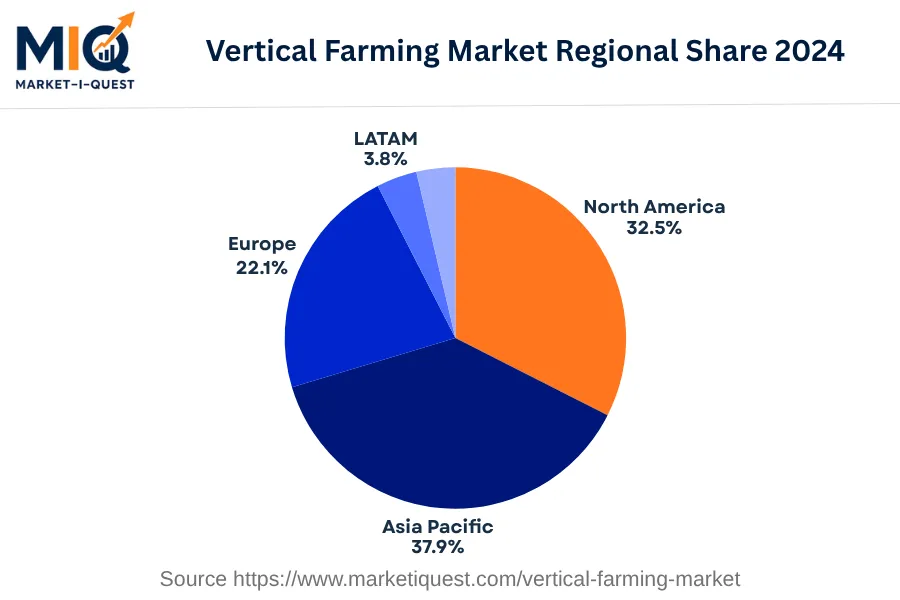
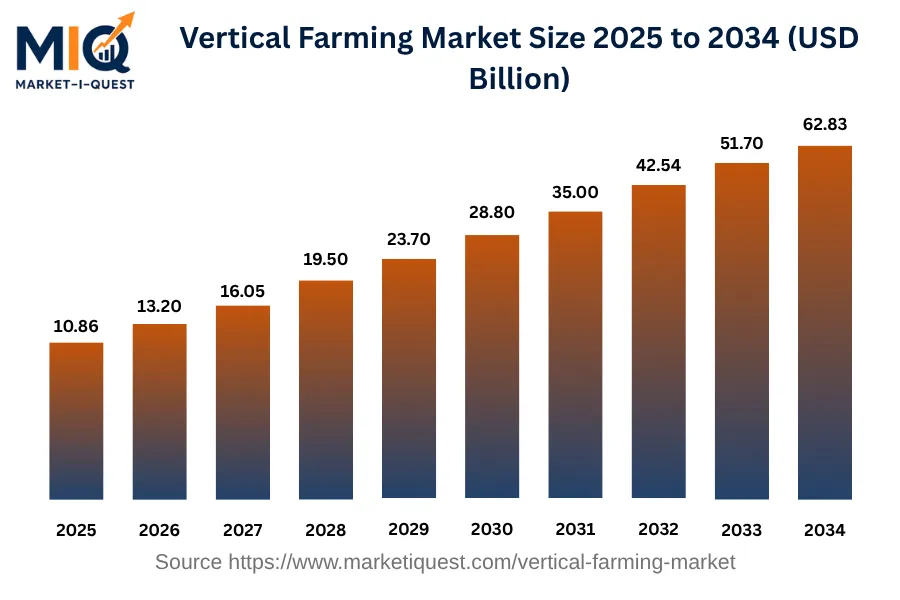
The Vertical Farming Market size is projected to increase from USD 10.86 billion in 2025 to USD 62.83 billion in 2034, with a CAGR of 21.53%. This market experienced steady growth from USD 8.94 billion in 2024. The acceleration in market growth from 2025 to 2034 is primarily attributed to rapid technological innovations and the increasing adoption of sustainable farming practices globally. By region in 2024, the market's largest share was in the Asia Pacific, representing 37.86% of the global market. North America followed with 32.48%, and Europe with 22.14%. The regions with the smallest shares were Latin America with 3.84% and the Middle East and Africa with 3.68%.

Key Takeaways

  • By Structure - Building-Based dominated the Vertical Farming Market holding a key market position in recent years.
  • By Component - Lighting System led the market accounting for a significant share during the base year.
  • By Growth - Hydroponics expanded at the Largest rate showing promising growth potential for the forecast per.
vertical-farming-market market size

Key Driving Factors

Urbanization and Land Scarcity

Space constraint in urban areas poses a significant challenge to traditional farming; thereby making vertical farming a viable solution. Vertical farming, which involves crop production in stacked layers, optimizes space usage, making it an appealing option in metropolitan cities where land is expensive and limited. Furthermore, studies on land management underscore the reality of agricultural land scarcity even in non-urban locations which is prompting both private companies and governmental bodies to explore alternatives like vertical farming. Consequently, the pressure from this land crisis has directly incentivized the expansion of the vertical farming market.

Shift towards Sustainable and Resilient Food Systems

As climate change disrupts traditional food production systems, there's a pivot towards more sustainable and resilient alternatives. Vertical farming is emerging as a key solution due its potential to produce food year-round in a controlled environment, thus being resilient to external climate conditions or disasters. Additionally, vertical farming employs hydroponics and aeroponics, which drastically cut water usage compared to conventional farming methods. These technology-driven farming practices align with a wider international shift, championed by organizations like the Food and Agriculture Organization and the UK's National Farmers' Union, towards constructing robust, climate-smart food systems. This drive for sustainability and resilience in agriculture acts as potent stimuli directing the growth of the global vertical farming market.

Market Evolution by Timeline

2019-2023
From 2019 to 2023, the urban farming initiative 'AgLanta' in Atlanta led to an increased adoption of vertical farming methods in the city. The use of hydroponics and LED light-based farming techniques were predominant, aimed at reducing reliance on traditional agriculture. The USDA's Farm Bill support, opening financial and technical assistance, also played a role in stimulating the sector. Large-scale farmers and restaurants were the primary customers due to the promise of consistent produces. In terms of supply, firms like AeroFarms were leaders with their patented aeroponic vertical farm systems. While these years saw steady adoption, high installation costs remained a barrier to entry.
2024
In 2024, the climate goals of the Paris Agreement came into effect, stimulating interest in sustainable farming systems, like vertical farming. Several cities in Europe, most notably London and Barcelona, saw the establishment of community-led vertical farming initiatives. On the supply side, the key development was the introduction of solar-powered vertical farming systems, reducing the running cost and operational carbon footprint. However, the lack of standardized regulations around vertical farming remained a commitment obstacle for potential buyers. Commercially, companies started offering manageable lease-based contracts to ease initial cost burdens.
2025-2029
From 2025 to 2029, vertical farming witnessed wider recognition as an effective urban farming method. The demand was mainly driven by metropolitan zones in Asia, especially in Tokyo and Singapore, aiming to maximize food production on minimal land space. New vertical farming standards were proposed by the International Organization for Standardization, offering clarity and reducing early-stage risks. Technological developments such as AI-controlled growth systems began to emerge, optimizing growing conditions. Amidst this, power usage and related costs still posed significant constraints to smaller players in the market.
2030-2034
From 2030 to 2034, the buyers trend shifted towards home consumers due to the growing popularity of personal kitchen-garden vertical farms. The demand for organic and freshly harvested vegetables led to an increase in household-level buyers. The prices of initial setup dropped owing to technology advancement and market maturity. The regulatory framework was more robust with the establishment of vertical farm certification programs encouraging more participants. On the down side, the challenge of re-purposing or recycling the specialized equipment started to surface as a significant concern in this period.

Future Market Outlook

Future Opportunities

The vertical farming market presents significant opportunities for growth and innovation shaped by prevailing trends and pressures. The increasing public awareness around food security and sustainability is driving demand for more reliable food sources, particularly in densely populated regions. For example, the World Economic Forum has highlighted urban agriculture as a key strategy in enhancing food resilience in cities, urging governments to support local initiatives. As regulations tighten on traditional farming practices, organizations are exploring vertical farming as an alternative means of overcoming supply chain disruptions. Collaboration between established agricultural firms and technology startups is exemplified by partnerships such as that between IKEA and vertical farming company Infarm to integrate agriculture into retail spaces across Europe. Additionally, trends in health and wellness are prompting consumers to seek fresh, locally grown produce; thus, vertical farms could potentially cater to this emerging market segment by providing clean and pesticide-free options. Investments in research and development from academic institutions and corporations aim to optimize vertical farming techniques, particularly in climates unsuitable for traditional agriculture. As the circular economy gains traction, innovations utilizing organic waste in nutrient solutions are becoming crucial, demonstrating a move toward more sustainable operational practices. Furthermore, growth of smart city initiatives globally illustrates a demand for urban agriculture solutions that align with sustainable urban development goals, such as those set by the United Nations’ Sustainable Development Goals. These factors collectively create a landscape ripe for advancement and diversification within the vertical farming sector.

Segmentation Analysis

By Structure

The market is divided into subsegments including Building-Based and Shipping Container-Based structures. Building-Based has accounted for the largest revenue share while Shipping Container-Based is expected to grow at the fastest CAGR during the forecast period.

Largest Revenue Share

Building-Based

Market Share Leader

Building-Based structures' prominence in generating the highest revenue is attributable to several factors. One of the significant drivers is its widespread use across varied sectors, including commercial, industrial, and residential sectors, originating from its versatility and adaptability. Consumers generally prefer these structures due to their durability and the broad array of customization options available. Geographically, high-income regions where the construction sector has matured, such as North America and Europe, contribute significantly to the revenue of this subsegment. New construction regulation policies favoring sustainable and energy-efficient building techniques also positively impact this segment. Further increasing its growth are the purchasing criteria wherein major decision factors are quality, safety standards, and energy efficiency. Another contributing factor is the established distribution channels that comprise both direct sales and third party distributors, making building-based structures accessible.

Fastest CAGR

Shipping Container-Based

Forecast Period Growth Leader

Shipping Container-Based structures, despite their relatively smaller revenue share, are expected to show the fastest growth in terms of CAGR. Niche adoption along with the appeal of affordability and recycling has projected it as a trendy alternative to traditional construction. Young generations and sustainability-oriented consumers are displaying increased interest, serving as a sign of market expansion. However, certain barriers such as stringent regulations and challenges in building code adaptation are impeding their rapid acceptance. Potential growth drivers, like developing regions and emerging markets where cost-effective construction solutions are in demand, can act as catalysts. Technological advancements, such as prefabricated and modular constructions, along with supportive policies are also poised to provide a significant boost to this subsegment's growth. As far as risks are concerned, fluctuation in shipping container prices, contingent on global trade, may pose challenges to the segment's growth outlook.

By Component

The market is divided into subsegments including Lighting System, Irrigation and Fertigation System, Climate Control, Sensors, and Others. In 2024, the Lighting System accounted for the largest revenue share while the Sensors segment is expected to grow at the fastest CAGR during the forecast period.

Largest Revenue Share

Lighting System

Market Share Leader

The Lighting System subsegment has remained at the forefront in terms of revenue generation in this market. This dominance can be primarily attributed to the essential role of lighting in indoor and vertical farming practices. Lighting is a critical component of every agricultural setup, enabling year-round yield irrespective of external weather constraints. The lighting system in indoor farming directly influences plant growth, harvest quality, and farming cycle length. Therefore, growers are ready to invest significantly in innovative and efficient lighting technologies to optimize their production output. Additionally, the advent of LED grow lights, which are energy-saving and customizable according to plant needs, has opened a new revenue avenue in this market. These offerings have been witnessing a high adoption rate due to their prolonged lifespan and reduced electricity usage, making them a sustainable and cost-effective option for farmers around the globe. However, the segment's growth is subject to the regulatory environment promoting energy-efficient lights and the availability of electricity in certain regions.

Fastest CAGR

Sensors

Forecast Period Growth Leader

Among all subsegments, Sensors are set to witness the fastest growth. The need for precision farming and the increasing adoption of modern farming techniques have created a surge in demand for various sensors. These devices serve as the primary data collection units, enabling farmers to monitor and control the farming environment accurately. Variables such as temperature, light intensity, humidity, soil moisture, and nutrient level are crucial for crop growth, thus necessitating the use of sensors. Moreover, the growing IoT and AI revolution in agriculture are timely catalysts. They have enabled farmers to process sensor data in real-time, making automated decision-making possible. Emerging collaborations and partnerships within the tech and agriculture industry to develop and promote these technologies have further fuelled this subsegment's growth. However, challenges such as high capital expenditure, lack of technical know-how, and data security issues may hamper the immediate growth prospects of this segment.

By Growth

The market segment 'By Growth' divides into the subsegments Aeroponics and Hydroponics. In the base year 2024, Hydroponics contributes significantly to revenue, while Aeroponics has the most promising growth potential.

Largest Revenue Share

Hydroponics

Market Share Leader

Hydroponics has emerged to be the subsegment that holds the most significant revenue in the 'By Growth' market segment. This pattern is due to the numerous advantages of Hydroponics. Firstly, the technique offers a highly manageable and controlled growing environment that reduces the risk of disease and pests, thus improving yield potential and quality. Secondly, it uses a water-based solution, allowing it to be less water-intensive and more environmentally friendly compared to traditional soil-based farming. Lastly, its space efficiency, capacity for vertical growth, and adaptable indoor setup enable large scale production in urban and densely populated areas. As urban agriculture gains momentum, the demand for Hydroponics systems continues to grow. However, we must take into consideration that this subsegment's growth is also shaped by the increasing consumer demand for organic farm-to-table produce and local fresh food production, regulatory support for sustainable farming, and technological advancements in farming infrastructure.

Fastest CAGR

Aeroponics

Forecast Period Growth Leader

While Hydroponics leads in terms of revenue generation, Aeroponics forecasts the fastest growth. It is particularly intriguing due to lower water and nutrient requirements compared to Hydroponics, in addition to facilitating faster plant growth. A significant factor is technological improvements and investments that allow for better system efficiency and ease of management. Furthermore, there is an increasing trend towards indoor farm facilities which can make the most of Aeroponics due to its adaptability and space efficiency, attributing to its fast growth. The main obstacles obstructing its adoption include higher initial setup costs, technical knowledge requirements, and sensitivity to power outages or system failures. Nonetheless, these bottlenecks are expected to lessen as the market matures and awareness grows. However, the accelerated market growth is also contingent on an enabling policy environment, committed investment, and advances in complementary technology such as LED lighting, climate control, and monitoring systems.

Competitive Analysis

Key Market Players

Manufacturers / OEMs

AeroFarms
US
Illumitex Inc.
US
Sky Greens
Singapore

Key Suppliers & Raw Materials

Philips Lighting
Netherlands
Osram Licht AG
Germany
Everlight Electronics
Taiwan

Distributors, Integrators & Channel Partners

Urban Crops Solutions
Belgium
Signify Holdings
Netherlands
Argus Control Systems Ltd.
Canada

Porter’s Five Forces Analysis

This analysis comprehensively evaluates the competitive intensity and attractiveness of the Vertical Farming Market.

Supplier Bargaining Power

Low

Suppliers do not have a strong position due to the availability of numerous suppliers of seeds, nutrients, and equipment.

Buyer Bargaining Power

High

Buyers have high power due to the variability in quality, pricing, and the large number of sellers in the market.

Threat of Substitutes

Low

Lower threat due to the distinct benefits of vertical farming, such as high yield and low water usage.

Threat of New Entrants

Medium

Barriers such as high initial capital and operational proficiency limit market entry, but potential profitability attracts newcomers.

Competitive Rivalry

High

High rivalry due to the presence of numerous established companies and innovative startups worldwide.

Regional Analysis

Geographic market dynamics and growth opportunities across key regions

Global Market Outlook

vertical-farming-market market regional share

North America

In 2024, North America's vertical farming market emerged as a pivotal segment of the larger agricultural industry. The market's growth was driven by several factors, including increased demand for organic food in the U.S. Canada's new regulations promoting sustainable farming methods also played a part in expanding the market. Additionally, technology adoption, spurred by investments in advanced lighting and water management systems, transformed supply dynamics and pricing, making vertical farming a more viable option for many agricultural firms.

Shifts in buyer behavior towards eco-friendly and locally sourced foods helped strengthened vertical farming trends. This was also reflected in evolving technology use — AI and data analytics for crop health monitoring became more prevalent, especially in the U.S and Canadian markets. Several partnerships and mergers were observed in the sector – for instance, large retail chains partnering with vertical farm operators to ensure a fresher supply of produce. Changes in policy, such as the "Farm to School" initiative in the U.S, promoted the adoption of vertical farming among institutions like schools and hospitals. Primarily, the market served the retail sector with fresh produce. However, other notable customer sectors included healthcare, with vertical farms supplying medicinal plants, and utilities, exploiting the potential of vertical farms for wastewater treatment and urban heat island mitigation.

Asia Pacific

The Asia Pacific Vertical Farming sector was vibrant in 2024, characterized by technological advancements, regulatory support, and growing demand for fresh produce. Increasing urbanization and falling agriculture land availability heightened the demand, leading to a surge in innovative farming methods. Specifically, governments in China, India, and Australia prioritized vertical farming, incentivizing investment and technology adoption, in their efforts to improve food security. In terms of emerging trends, IoT proliferation and advancements in hydroponic technologies reshaped the market dynamics within the region. Channel dynamics, particularly in retail, were redefined as a significant shift towards procurement from vertical farms yielded fresher supply chains. Japan and South Korea notably led in terms of technological integration, seeing a substantial rise in ag-tech partnerships and M&A activities.

Greater enforcement of environmental standards added momentum. Key markets such as China and India ensured strict adherence to pollution norms, pushing enterprises to explore vertical farming as a sustainable alternative. Moreover, there was substantial consumer preference shift towards organically grown produce in the region resulting in a growth spurt in the vertical farming sector across the retail and food service sectors in major markets like Japan, Australia and ASEAN countries. This shift helped in mitigating conventional farming drawbacks and bolstered the overall Produce as a Service (PaaS) customer base.

Europe

In 2024, the vertical farming market in Europe demonstrated a significant demand uptick driven by various factors. Urbanization led to increased investments towards land-saving farming techniques, particularly across burgeoning cities in the UK, Germany, and France. Regulations for sustainable agriculture in Italy and Spain promoted the adoption of vertical farming technology. Moreover, the pricing dynamics of vertical farming favored its adoption across the enterprise sector, particularly within the manufacturing and retail industries.

The vertical farming market witnessed buyer behavior shift towards efficient, space-saving farming practices, as observed in the Nordics and Benelux. There was a noticeable uptrend in partnerships and mergers & acquisitions, especially in Central & Eastern Europe, to streamline supply chains. Product and technology shifts were prominent in France and Italy, where farm-to-table dining trends drove high-end restaurants to invest in onsite vertical farms. Finally, increased policy enforcement in the UK and Germany for sustainable agricultural strategies further boosted the market. From the healthcare sector's interest in pharmaceutical-grade crops to utilities looking for biofuel sources, vertical farming has demonstrated diverse application potential. Overall, the vertical farming market's robust growth in 2024 was paralleled with the broader move towards resource efficiency and sustainability in Europe.

Latin America

In 2024, the Latin American vertical farming market witnessed steady growth, propelled by various forces and trends. The rapidly urbanizing landscape accompanied by limited arable land across Brazil, Mexico, Argentina, Colombia, Chile, and Peru, has heightened the adoption of this innovative farming practice. The increasing private sector investment in AgriTech, like the systemic rollout of IoT in agriculture by major Brazilian firms, played a key role in modernizing farming infrastructure. Additionally, stringent environmental policies enacted by countries such as Chile stimulated sustainable practices like vertical farming.

Customer trends in 2024 showed an accelerating demand for locally sourced, pesticide-free produce in urban centers of Mexico and Argentina, driving grocery retailers to source from local vertical farms. The increasing role of e-commerce platforms in direct sales of fresh produce influenced the sector's distribution dynamics, with many vertical farming firms in Colombia and Peru exploring online channels. There was also a significant traction seen in partnership between local vertical farming startups and international technology providers. The enforcement of food safety standards across LATAM markets, heightened by the COVID-19 pandemic, indirectly advocated for controlled environment agriculture like vertical farming. Key customer sectors included supermarkets, restaurants, and catering firms, benefitting particularly from the promise of steady supply and reduced transport costs. Most vertical farms focused on leafy greens, herbs, and vine crops, reflecting a broader trend of customer preference for diverse, fresh produce.

Middle East & Africa

In 2024, the Vertical Farming Market in the Middle East and Africa saw remarkable adoption, driven by demand for localized, sustainable food production and ambitious government initiatives across Saudi Arabia, United Arab Emirates, Qatar, Egypt, South Africa, Nigeria, Kenya, and Israel. Technology adoption was platformed on energy-efficient LED lighting and advanced hydroponics, causing high growth in sectors such as retail, manufacturing, and utilities. Innovative financing and investment models also supplemented the shift, supporting enterprises in overcoming initial cost barriers.

Market dynamics showcased a distinct preference for edible crops, steering towards mainstream retail distribution. As a response, product shifts to include more diverse crops like herbs and exotic vegetables were observed. Egypt, Nigeria, and South Africa fostered crucial partnerships between vertical farming enterprises and traditional agribusinesses, resulting in efficient shared-resource models. Israel, a known agritech hub, was at the forefront of the technology shifts, setting benchmarks for resource-efficient vertical farming systems. Market trends revealed a focus on sustainability, as seen in the UAE and Qatar, where local governments actively enforced policies encouraging sustainable vertical farming practices. The region also witnessed a rise in strategic M&As, primarily in Saudi Arabia and Kenya, aiming to strengthen supply chains and lower operational costs, further propelling the vertical farming market in this region.

Recent Industry Developments

Latest market innovations, product launches, and strategic initiatives

May 2026

Strawberry vertical farm operator Oishii, following its $150 million Series C funding round, announced plans to expand year-round production capacity, increase investment in robotics, develop new product formats, and boost R&D investment.

January 2026

UK vertical farm Fischer Farms launched a new consumer-facing bagged salad brand, New Eden, featuring three products: Burger Lettuce, Zesty Mixed Salad, and Pea Shoots (all at an RRP of £1.60/80g), now available at Ocado.

Frequently Asked Questions