Energy Storage Market Snapshot

Key Players

  • Tesla Inc. (United States)
  • BYD Company (China)
  • LG Chem (South Korea)
  • Samsung SDI (South Korea)
  • Panasonic Corporation (Japan)
  • EnerSys (United States)
  • Siemens AG (Germany)
  • GE Renewable Energy (United States)
  • ABB Group (Switzerland)
  • SCHMID Group (Germany)

Market Size

Base Year 2024
$58.26 Bn
CAGR
15.84%
Forecast 2034
$253.49 Bn

Market Segments

By Technology
  • Batteries
  • Pumped-Storage Hydroelectricity
  • Thermal Energy Storage
  • Hydrogen-Based Storage
  • Compressed Air Energy Storage
  • Liquid Air / Cryogenic Storage
  • Flywheel Energy Storage
By Connectivity
  • On-Grid
  • Off-Grid
By Application
  • Grid-Scale Utility
  • Residential Behind-the-Meter
  • Commercial & Industrial Behind-the-Meter
  • EV-Charging Infrastructure
  • Others

Market Dynamics

Drivers
  • Rising renewable energy demand
  • Government energy storage initiatives
Restraints
  • High initial investment cost
  • Regulatory hurdles
Opportunities
  • Renewable energy trend growth
  • Electric vehicle adoption

Market Size

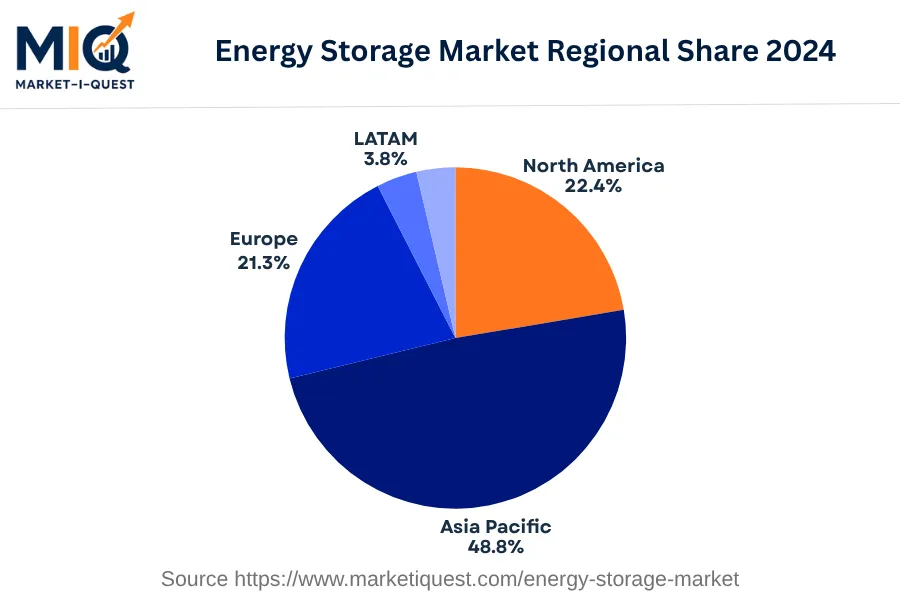
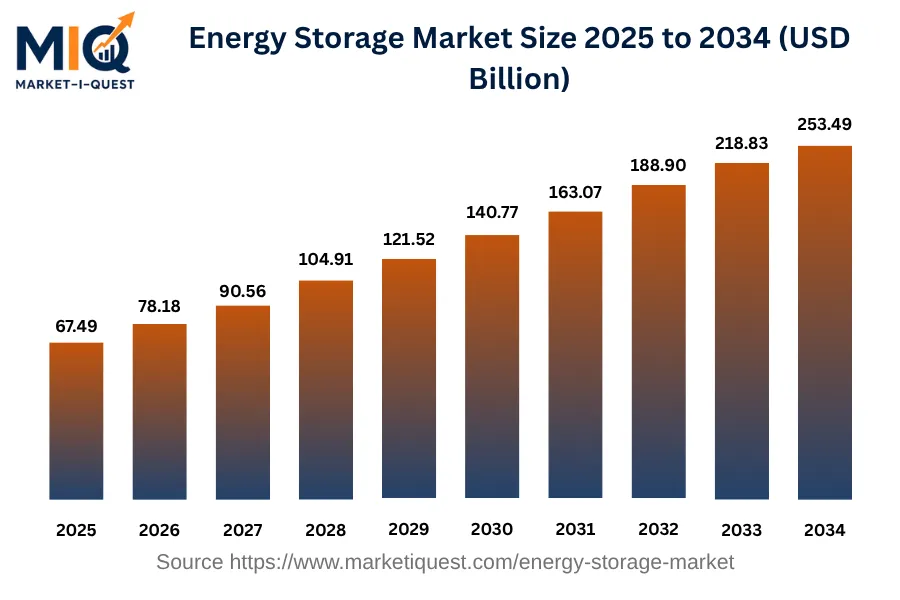
The Energy Storage Market size, valued at 67.49 billion USD in 2025, is projected to grow to 253.49 billion USD by 2034, with a CAGR of 15.84%. This sizeable growth is indicated by the fact that in 2024 the market stood at 58.26 billion USD, and within a span of just one year it saw an increment of over 9 billion USD. By extrapolating these growth rates, the market value is expected to nearly quadruple over the next decade. Growth in the energy storage market is likely attributed to the increasing demand for renewable energy sources and the advancement of technologies allowing for more efficient energy storage. On a regional level in 2024, the Asia Pacific held the largest share of the market with 48.8%, followed by North America and Europe with shares of 22.36% and 21.28% respectively. LATAM and MEA held smaller shares in the market with 3.84% and 3.68% respectively.

Key Takeaways

  • By Technology - Batteries held the largest fraction accounting for a significant share in the Energy Storage Market.
  • By Connectivity - The On-Grid connectivity subsegment has experienced significant growth.
  • By Application - Grid-Scale Utility sector led accounting for the dominant market position over the base year.
energy-storage-market market size

Key Driving Factors

Decentralization of Power Generation

The ongoing trend towards the decentralization of power generation is an integral driving factor for the energy storage market. With more homes and commercial establishments moving towards generating their own power using renewable energy sources such as solar panels and wind turbines, there is a pressing need for effective energy storage solutions. The unpredictability of these energy outputs due to varying conditions (e.g., cloudy or windless days) makes it even more crucial. Energy storage technologies, especially batteries, facilitate the capture and storage of excess energy generated during peak periods for use when generation is low or demand is high. Thus, the increased adoption of decentralized power systems is directly fuelling the growth of the energy storage market.

Stricter Carbon Emission Regulations

Another specific driver for the energy storage market is the enforcement of stricter regulations to reduce carbon emissions, such as the Paris Agreement. This international treaty aims to limit global warming well below 2 degrees Celsius compared to pre-industrial levels. The commitment to this goal necessitates the accelerated adoption of renewable energy, which in turn underscores the importance of energy storage to compensate for the intermittent nature of many renewable resources. In this context, energy storage technologies like lithium-ion batteries, flow batteries, and thermal storage become a vital element of the clean energy infrastructure, helping nations meet their carbon emission reduction targets.

Market Evolution by Timeline

2019-2023
Primarily, utility and residential consumers of energy storage technologies in North America and Asia encouraged market growth. Favorable government initiatives, like the United States' Investment Tax Credit and South Korea's subsidies for residential energy storage supported demand. Technologically, lithium-ion batteries were the leading energy storage solution, despite concerns around sourcing of key materials and end of life disposal. Regulatory developments, such as Australia's minimum VPP standards, improved integration of storage into grid infrastructure. Typically, flat-rate pricing was common, with energy companies establishing partnerships for power purchase agreements. Containerized solutions were on the rise as a flexible option with shorter lead times. Recycling constraints posed challenges, driving explorations into second life applications for worn out batteries.
2024
In 2024, Europe's rapid increase in renewable energy production caused a surge in energy storage demand to stabilize the grid. EU-funded programs such as Clean Sky incentivized local energy storage technology advancements, contributing to a growth in varied technology use cases, including thermal, mechanical, and chemical storage beyond traditional batteries. Energy storage providers partnered with utility companies through Power Purchase Agreements to secure future revenue flows. Standardized contract types emerged, which eased the integration and regulatory compliance effort. However, the rollout of these new technologies and developments faced challenges such as material sourcing difficulties and connection bottlenecks in the grid infrastructure.
2025-2029
Corporate businesses in countries with unreliable power supply increased the energy storage demand for backup applications during 2025-2029. Technological advancement led to the rise of advanced solid-state and flow batteries with improved safety and longer lifespan. The integration of energy storage into grid planning caused many grid regulators, like FERC in the USA, to recognize storage as a core grid element. Pricing moved toward performance-based contracts as batteries proved their resilience and reliability. The growth of electric vehicle market resulted in an oversupply of lithium-ion batteries and increased battery recycling activity, but concerns about the environmental impact of materials extraction remained.
2030-2034
Emerging economies instituted energy security regulations that fueled the demand for locally grid-attached and off-grid energy storage solutions in the period of 2030-2034. Energy storage tech witnessed maturity with an increase in the use of organic flow batteries and supercapacitors. The adoption rate in Africa showed a rising trend, facilitated by the United Nations Sustainable Energy for All initiative. Partnerships flourished between energy storage providers and microgrid developers with shared savings contracts gaining acceptance. The biggest struggle was the constrained availability of resources such as lithium and cobalt for battery production, compelling research into alternative materials.

Future Market Outlook

Future Opportunities

The evolution of energy storage technologies presents various future opportunities defined by current market dynamics and regulatory frameworks. As decarbonization accelerates, the focus on energy transition in regions like California is fostering partnership opportunities between private entities and local governments to enhance grid resilience, particularly through demand response programs. In 2023, the U.S. Department of Energy announced initiatives to incentivize the establishment of large-scale battery manufacturing facilities, further strengthening the domestic supply chain. Companies like Fluence Energy are positioning themselves to capitalize on the increasing reliance on grid-scale batteries to meet peak demands, facilitated by data analytics and AI technologies. Moreover, the climb in renewable energy installations is creating a stringent need for effective energy storage solutions, particularly in offshore wind projects along the coasts of the United Kingdom and Germany, highlighting regional partnerships between developers and technology providers. The growing emphasis on energy storage systems for electric vehicles is also evident, as manufacturers such as Volkswagen advance battery development and production capabilities. Additionally, collaborations like that between LG Chem and global automakers signal a commitment to enhancing battery performance while addressing recycling challenges. Overall, the convergence of regulatory support, industry innovation, and the pursuit of sustainability will likely pave the way for robust growth in diverse energy storage applications in this evolving market landscape.

Segmentation Analysis

By Technology

The market is divided into subsegments including Batteries, Pumped-Storage Hydroelectricity, Thermal Energy Storage, Hydrogen-Based Storage, Compressed Air Energy Storage, Liquid Air / Cryogenic Storage, Flywheel Energy Storage, with Batteries accounting for the largest revenue share, whilst Liquid Air / Cryogenic Storage is projected to grow fastest in the forecast period.

Largest Revenue Share

Batteries

Market Share Leader

The Battery segment currently leads the market in revenue, primarily due to the robust demand for energy storage across several applications, particularly in electric vehicles and renewable power generation. Global markets are witnessing a swift shift towards renewable sources, such as wind and solar, driving the demand for advanced energy storage solutions, for the continuous supply of power during outages and cloudy or windy conditions. Batteries, with their declining cost and improving energy density, offer an efficient solution, leading to their consistent market dominance. Customer preferences are also biased towards batteries, given their high-energy efficiency, longevity, and easy installability. The advent of stringent regulatory policies for reducing carbon footprint and conserving energy is another significant driver, as batteries facilitate efficient energy use and contribute to environmental sustainment. Switching costs are relatively high for consumers, further sealing the market position of batteries.

Fastest CAGR

Liquid Air / Cryogenic Storage

Forecast Period Growth Leader

The Liquid Air / Cryogenic Storage segment, although currently smaller, is projected to grow at a fast pace in the forecast period. This rapid growth can be attributed to the increasing focus on long-duration energy storage solutions, necessitated by intensified renewable energy harvesting efforts, which generates excess power during peak production hours. Liquid air storage, unlike its contemporaries, enables storing energy for extended periods without significant loss, providing it an edge in sustained renewable power generation habitats. Furthermore, the capacity for large-scale storage in liquid form makes it an attractive option for grid applications. However, high operational complexity and associated cost pose as adoption hurdles, currently restricting market penetration. Increased capital expenditure in technological advancements and strategic partnerships to simplify operations can act as potential catalysts, driving accelerated growth in the near future. Nonetheless, costs associated with handling extreme cold temperatures pose near-term risks. Given these factors, heedful adoption is expected, which informs the growth prediction.

By Connectivity

The market is divided into subsegments including On-Grid and Off-Grid connectivity, with On-Grid accounting for the largest revenue share, while, Off-Grid is expected to grow at the fastest CAGR during the forecast period.

Largest Revenue Share

On-Grid

Market Share Leader

The On-Grid connectivity subsegment has experienced significant growth and remains the largest revenue contributor in 2024. This can be attributed to a number of robust market drivers. Predominantly urbanized regions and developed countries, where the grid infrastructure is stable and reliable, are the key contributors to the strong growth rate of the On-Grid subsegment. Moreover, the advent of various grid-tied renewable energy sources such as solar and wind farms has also amplified this growth. On-Grid systems generally can sell excess power back to the grid, which increases the return on investment for these systems, fueling adoption by both residential and commercial consumers. Additionally, national and regional energy policies and incentives have favored On-Grid renewable energy generation. For instance, some utilities are mandated to purchase surplus renewable energy fed back into the grid, which increases the financial feasibility of these systems. However, the dominance of On-Grid systems is challenged by high switching costs for potential off-grid adopters and consumers residing in locations with unreliable grid connectivity.

Fastest CAGR

Off-Grid

Forecast Period Growth Leader

Although Off-Grid connectivity as a market subsegment accounted for a smaller revenue share in 2024, it is expected to grow at the fastest pace in the coming years. The primary growth drivers for the Off-Grid subsegment include advancements in technologies such as solar panels and batteries, and escalating energy demand from rural and remote regions that lack access to conventional grid infrastructure. New capital investments and partnerships in the sector, particularly in developing countries, are also aiding the rapid growth. These regions exhibit tremendous untapped market potential which can be realized through Off-Grid energy solutions. However, high setup costs and regulatory barriers could pose as near-term risks and hamper the growth rate. Nevertheless, recent policy incentives to drive sustainable energy generation and technology advancements that improve affordable energy storage solutions are set to serve as major catalysts for the fast-paced expansion of the Off-Grid connectivity.

By Application

The market is divided into subsegments including Grid-Scale Utility, Residential Behind-the-Meter, Commercial & Industrial Behind-the-Meter, EV-Charging Infrastructure, and Others. Among these, the Grid-Scale Utility subsegment accounted for the largest revenue share while the EV-Charging Infrastructure is expected to grow at the fastest CAGR during the forecast period.

Largest Revenue Share

Grid-Scale Utility

Market Share Leader

The Grid-Scale Utility subsegment leads in revenue generation, a trend largely driven by the growing global demand for renewable energy solutions and the large-scale industrial application of these systems. The market is seeing an increasing number of utility-scale projects as countries aim to ensure energy stability and reduce carbon emissions. These projects require substantial storage resources which provide ample revenue opportunities. Furthermore, advancements in smart grid technology and reduced costs for energy storage systems are encouraging adoption, thereby augmenting revenues. Demand is also fuelled by regulatory support from governments that recognize the role of these systems in achieving renewable energy targets. High switching costs and prolonged life spans of grid-scale systems add boost to its dominant position. Key markets for grid-scale utility include developed regions with a high renewable energy implementation such as Europe and North America.

Fastest CAGR

EV-Charging Infrastructure

Forecast Period Growth Leader

The EV-Charging Infrastructure subsegment is projected to experience the fastest growth, riding on the wave of escalating adoption of electric vehicles worldwide. This upward trajectory is propelled by significant technological advancements, focused investment, and enhancing policy support. Many countries, especially in Europe and Asia, are aggressively promoting electric mobility to combat air pollution and reduce dependence on fossil fuels, leading to increased demand for charging infrastructure. Moreover, partnerships between vehicle manufacturers and charging station providers are helping to expand the infrastructure network, catalyzing growth further. Another driver includes the significant capital expenditures from major automotive players and government bodies on developing sophisticated and widespread charging infrastructures. However, potential risks include the current challenges related to the grid infrastructure's capacity to support the expanding EV charging demand and the required investment to upgrade these systems.

Competitive Analysis

Key Market Players

Manufacturers / OEMs

Tesla, Inc.
US
Panasonic Corporation
Japan
LG Chem, Ltd.
South Korea

Key Suppliers & Raw Materials

Albemarle Corporation
US
Ganfeng Lithium Co., Ltd.
China
Umicore
Belgium

Distributors, Integrators & Channel Partners

Sungrow Power Supply Co., Ltd.
China
AVEVA Group plc
UK
Siemens AG
Germany

Porter’s Five Forces Analysis

The Energy Storage Market is experiencing rapid innovation and industrial transformation.

Supplier Bargaining Power

Medium

Control over vital components and raw materials gives suppliers some influence.

Buyer Bargaining Power

High

Growing demand and availability of alternatives increases buyer power.

Threat of Substitutes

High

Emerging technologies pose a strong substitute threat to traditional energy storage systems.

Threat of New Entrants

Medium

High capital expenses and regulatory hurdles moderate the threat of new entrants.

Competitive Rivalry

High

Intense rivalry with frequent innovation and competitive pricing strategies.

Regional Analysis

Geographic market dynamics and growth opportunities across key regions

Global Market Outlook

energy-storage-market market regional share

North America

In 2024, the North American Energy Storage Market is characterized by increased adoption of renewable energy sources and technological development in energy storage systems. The market driver includes strong support from the U.S. and Canadian government institutions through subsidies and policies encouraging the use of renewable energy sources and energy storage solutions. Similarly, a rise in private sector investment is fueling technological innovation and capacity building within the energy storage industry, significantly impacting supply dynamics and pricing strategies.

Notable trends include shifts in buyers' preference. Enterprises, utilities and governments show growing interest towards green energy initiatives, adopting energy storage systems to meet sustainability aims. Additionally, technological advancements such as lithium-ion batteries and flow batteries are gaining traction in the market. A surge in strategic partnerships and M&A activities is also noticeable, largely driven by efforts to enhance product offerings and to achieve competitive advantage in the energy storage market.

In terms of regulatory standards and policy enforcement, the U.S., Canada, and Mexico continue to tighten CO2 emission norms, indirectly propelling the demand for efficient energy storage systems. For instance, the Clean Power Plan in the U.S. encourages energy companies to shift from coal-derived energy to renewable and cleaner sources. The impact of these factors on the market indicates a robust growth trajectory for the energy storage market in the North American region in 2024.

Asia Pacific

In 2024, the Asia Pacific energy storage market, driven by growing clean energy requirements and advancements in battery technologies, showed palpable growth. Increasing investments, particularly in China and India, bolstered the market, both favoring policies for renewable power generation and grid stability. Key drivers include the escalating demand for electrification, rising investments in smart grid infrastructure, and regulatory support for clean energy in Japan, South Korea, and Australia. Rapid technology adoption and declining costs of lithium-ion batteries contributed to a formidable supply side push. Emerging trends were evident in broader adoption of energy storage solutions across utilities, manufacturing, and government sectors. As buyer preference shifted towards sustainable energy sources, the uptake of solar plus storage solutions sky-rocketed in residential areas.

Meanwhile, notable market trends in key ASEAN economies involved increased collaboration - M&A activities spiked to improve technology efficiency and bring more cost-effective solutions to the market. Furthermore, there was a stricter enforcement of renewable portfolio standards, promoting a higher share of renewables in total energy consumption. Especially in China and South Korea, government-owned utilities were the primary customers, incentivizing energy storage for grid ancillary services. In contrast, in Australia and India, commercial and industrial sectors led market demand, incorporating energy storage as a tool for energy management and cost optimization.

Europe

In 2024, Europe's Energy Storage Market was largely influenced by regulations, sustainability goals, technology advancements, and strategic investments. Drivers such as the EU's stringent carbon-neutral objectives and increasing investments in renewable energy sources amplified the demand for energy storage solutions across the region. Additionally, improvements in battery technology and energy-storage systems, propelled by countries like Germany and the United Kingdom, boosted the market's growth. Supply dynamics were another critical factor, with more cost-effective energy storage options becoming available due to advancements in manufacturing processes. Consumer preference trends leaned toward cleaner, more reliable energy supply, prompting utilities and manufacturing companies primarily in France, Italy, Spain, the Nordics, and Benelux to adopt advanced energy storage technologies.

Product shifts were noticeable, with an enhanced focus on lithium-ion batteries and emerging hydrogen storage solutions. Distribution channel dynamics also morphed alongside market growth, resulting in a spike in partnerships and M&A activities, particularly in Central & Eastern Europe. Policy enforcement was rigorous, reflecting Europe's commitment to a sustainable future. Strict implementation of recognized policies like the Renewable Energy Directive and the Energy Efficiency Directive worked in favor of the energy storage market by promoting deployment in sectors like enterprise, government, utilities, and retail.

Latin America

In 2024, the LATAM Energy Storage Market is defined by technological advancements, policy reforms, and burgeoning investments. Increasing demand for renewable energy, specifically from Brazil and Mexico, is progressively driving the growth of the market. Regulatory support, such as Argentina's RenovAr program and Colombia's Resolution 405 adopted in 2020, is fostering expansion, encouraging the adoption of advanced storage technologies. This is further buoyed by considerable market investment from global and regional players, particularly in Peru and Chile. Green tech adoption is a dominant trend, marked by a surge in lithium-ion batteries use as energy storage solutions, particularly in utilities and manufacturing sectors in Brazil and Mexico. Partnering with international tech companies, local firms are focusing on enhancing storage capacity and efficiency.

Furthermore, amalgamation activities between regional and global players, represented by Enel's acquisition of a majority stake in Empresa Electrica de los Andes in Chile, are reshaping the business landscape. On the consumer side, an escalating prominence of grid-interactive storage systems in utilities, manufacturing, and retail sectors is noticeable, driven by the need for reliable power and cost-effectiveness. Finally, rigorous implementation of governmental policies encouraging renewable energy, especially in Argentina and Colombia, is influencing buyer behavior, compelling enterprises to adopt green energy storage solutions.
Middle East & Africa

In the base year 2024, the Energy Storage Market across the Middle East and Africa witnessed significant developments propelled by various drivers and trends. Widespread adoption of renewable energy, primarily in countries such as Saudi Arabia, UAE, and South Africa, drove the demand for advanced energy storage systems. Regulatory frameworks favoring the deployment of energy storage projects, notably in Israel and Egypt, contributed to the market dynamics. Increased investments in modernizing grid infrastructure, particularly in Saudi Arabia and Qatar, boosted the supply dynamics of energy storage technologies.

Simultaneously, transitions in buyer behavior were evident, with players across sector lines - government, oil and gas, utilities, and telecom - expressing a heightened interest in renewable and efficient energy storage options. Tech shifts were prominent in South Africa and Nigeria, with the gradual shift towards more environmentally friendly and efficient energy storage technologies. For instance, lithium-ion batteries gained traction in these countries due to their efficiency and eco-friendliness. Strategic partnerships and mergers were observed, notably in UAE and Saudi Arabia, further consolidating the market. New standards and policy enforcement, particularly in Israel, dictated the overall industry conduct, pushing towards a more sustainable and efficient energy storage landscape.

Recent Industry Developments

Latest market innovations, product launches, and strategic initiatives

June 2026

Texas-based solar manufacturer T1 Energy entered into a definitive agreement to acquire KORE Power, a BESS provider, for approximately $32 million. The acquisition is expected to expand T1 Energy's reach into battery storage and AI data center infrastructure markets.

February 2026

The Government of India outlined a multi-pronged strategy to scale up the country's energy storage capacity, aiming to meet the requirements projected in the Central Electricity Authority's "Optimal Generation Mix 2030" report.

Frequently Asked Questions