
Xylene Market Snapshot

Key Players

  • Reliance Industries Limited (India)
  • Exxon Mobil Corporation (United States)
  • Royal Dutch Shell (Netherlands)
  • BASF SE (Germany)
  • Dow Chemical Company (United States)
  • LG Chem (South Korea)
  • Formosa Chemicals & Fibre Corporation (Taiwan)
  • LOTTE Chemical CORPORATION (South Korea)
  • Braskem (Brazil)
  • Sinopec Corp (China)

Market Size

Base Year 2024
$52.84 Bn
CAGR
5.28%
Forecast 2034
$88.39 Bn

Market Segments

By Product
  • P-Xylene
  • O-Xylene
  • M-Xylene
  • Mixed Xylene
By End Use
  • Automotive
  • Textile
  • Chemical
  • Oil and Gas
  • Leather
  • Paints and Coatings
  • Others

Market Dynamics

Drivers
  • Increasing industrial applications
  • Rising demand in plastic industry
Restraints
  • Environmental regulations
  • Health hazards of xylene exposure
Opportunities
  • Emerging economies growth
  • Increasing demand in petrochemical industries

Market Size

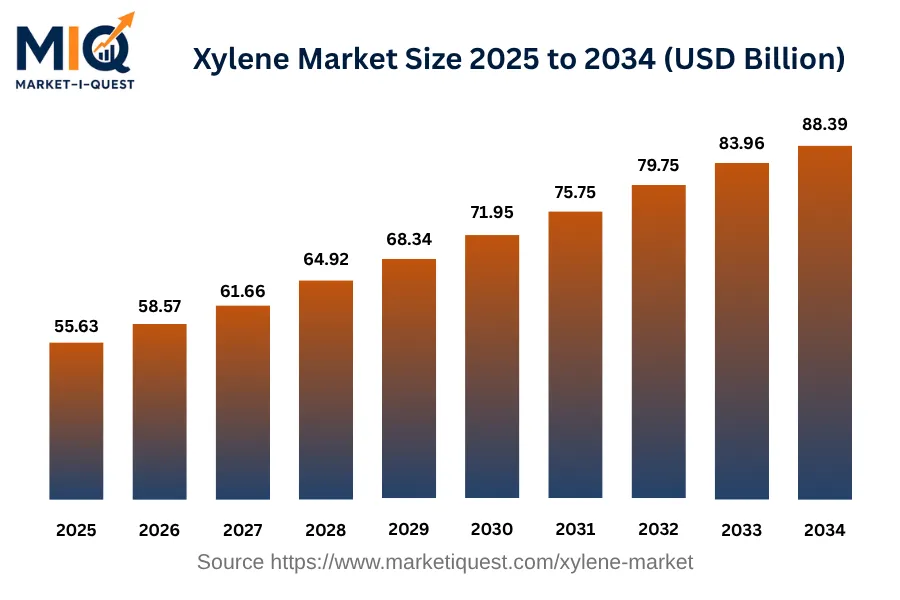
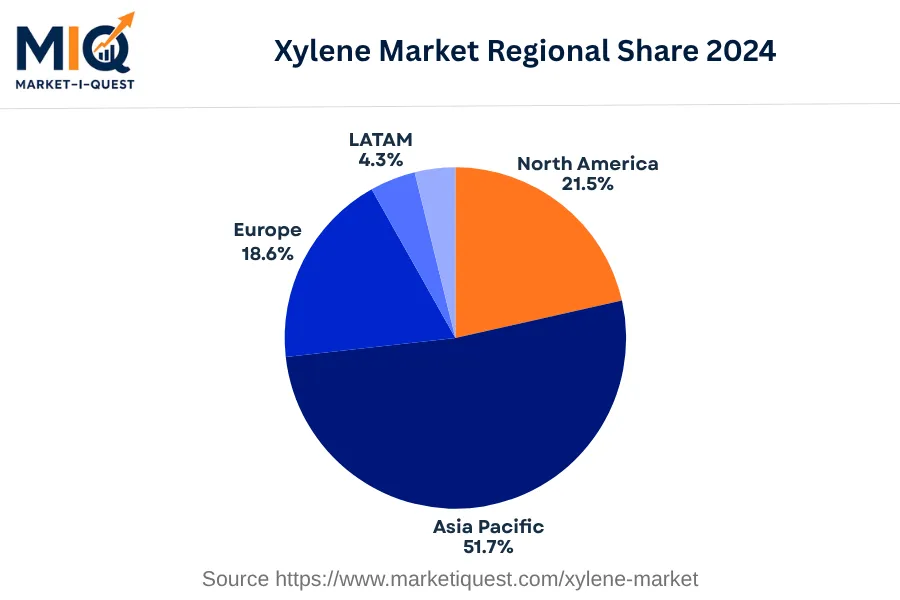
The Xylene Market, valued at 55.63 billion USD in 2025, is projected to grow to 88.39 billion USD by 2034, with a CAGR of 5.28%. This considerable enlargement in market size from 52.84 billion USD in 2024 to the projected value in 2034 demonstrates a steady growth path over ten years. Reasons attributable for this growth include increasing demands, industrial applications and advancements in processing technologies. Regionally in 2024, the market shares were distributed as follows: The Asia Pacific region was the leader, holding 51.74% of the market share, followed by North America with a 21.48% share. Europe held 18.62% of the market, whereas Latin America with 4.32% and the Middle East and Africa with 3.84% held smaller percentages of the market. This distribution gives us insights into the regional preferences and consumptions patterns of the Xylene market.

Key Takeaways

  • By Product - P-Xylene held the leading position in terms of sales and usage in 2024.
  • By Product - M-Xylene grew at the fastest pace from 2025 to 2034.
  • By End Use - Oil & Gas subsegment led the market accounting for the highest share in 2024.
xylene-market market size

Key Driving Factors

Increasing Usage in PET Industry

Xylene is a key raw material used in the manufacturing of Polyethylene Terephthalate (PET), a plastic resin immensely used in packaging applications for beverages, food, non-food products, and pharmaceuticals. Growing consumer preference for convenience and hygiene, driven by rapid urbanization and increasing disposable incomes, has significantly increased the demand for packaged products, which in turn influences the demand for PET, thus driving the xylene market. With many countries introducing stringent regulations for food packaging materials to improve product safety, PET's popularity has skyrocketed due to its inherent advantages such as resistance to microorganisms, chemical inertness, and recyclability.
Expansion of Marine Coating Applications

Xylene also finds substantial utilization in the production of marine coatings as a solvent. Marine coatings serve as a protective layer for vessels and offshore structures from harsh environmental conditions such as saltwater, moisture, UV rays, and biological fouling. With the global maritime industry witnessing steady growth facilitated by the expansion of international trade, there's a corresponding surge in the demand for marine coatings. This directly translates into a growing drive for the xylene market because effective marine coatings demand use of high-grade solvents, here being xylene. Furthermore, the adoption of stricter environmental regulations concerning marine pollution also thrusts the growth, as manufacturers are compelled to opt for high-performance, eco-friendly coating solutions.

Market Evolution by Timeline

2019-2023
In this period, the Xylene market saw increased demand primarily from paints and adhesives industry, specifically in developing regions of Asia like China and India. This hike was due to expansion in construction activity, which needed these products. However, there were supply chain constraints due to the growing environmental concerns and tighter regulations around hazardous substances. The US EPA implemented a standard named TSCA that indirectly affected Xylene production. Commercially, there was a move towards cost plus pricing models initiated by suppliers to deal with volatile raw material prices. The key risk in this time frame was the growing push against hazardous chemicals leading to possible alternatives being sought, to which manufacturers responded by investing in R&D for less harmful products.
2024
In the year 2024, the xylene market went through a slowdown. The developed markets saw a decrease in demand from the automotive sector given the shift towards electric vehicles but found an unexpected increase in demand from the textiles industry, specifically in regions such as South Korea and Turkey. However, continued raw material volatility created supply uncertainty. The market also had to adapt to new EU regulations (REACH) that were implemented during the year, causing further supply disruptions. In response, suppliers initiated long term contracts to ensure steady revenue streams. The risk of complete bans on Xylene continued, sparking both product and supply chain innovation.
2025-2029
During this period, the Xylene market continued to evolve with a steady demand from the textiles and leather industry. This demand was seen predominantly in Latin America, including countries like Mexico, Brazil, and Argentina, emphasizing on product usage in high-quality goods manufacturing. Advancements in production technology allowed companies to produce Xylene with less environmental impact, easing regulatory pressures. Additionally, the chemical industry faced an international standard (ISO 14001) encouraging environmentally friendly practices. Commercially, the possibility of more sustainable production processes changed procurement models towards long-term contracts, spreading costs over time. The risk of substitutes loomed large, despite the slower than expected development of effective alternatives.
2030-2034
In this latest period of Xylene market evolution, indications are that there has been a significant turn towards finding non-hazardous alternatives by major buyer segments, spurred by continued environmental concerns. Regions like the European Union had geopolitical factors at play affecting supply, due to trade restrictions. A notable technology trend during this period was the increasing use of biotechnology to produce Xylene, reducing reliance on traditional petrochemical processes that are less environment-friendly. In terms of regulation, more stringent global standards for hazardous substances' disposal, like BASEL Convention, led to stricter adherence to disposal norms. The commercial model shifted more towards value-based pricing, factoring in environmental impact. The major risk in this period was managing the accelerated transition to alternatives within regulatory and supply constraints.

Future Market Outlook

Future Opportunities

As the xylene market evolves, various future opportunities arise from current industry dynamics. Regulatory frameworks, such as the REACH legislation in Europe, impose stringent requirements on chemical manufacturers, propelling investments in safer and more sustainable xylene derivatives. In 2023, the demand for xylene in the production of lightweight automotive parts, especially in electric vehicles, has increased, presenting a niche for specialized manufacturers. In countries like China, which is investing heavily in its electric vehicle sector, xylene derivatives used in adhesives and coatings are poised for growth. The rising focus on circular economy principles is prompting partnerships between xylene producers and recycling companies to explore recovered xylene from post-consumer plastics. Additionally, the pharmaceutical industry is increasingly utilizing xylene as a solvent for drug formulations, leading to greater demand in regulated markets. In 2022, major pharmaceutical firms began discussions on supply chain collaborations to ensure a steady supply of high-purity xylene. As bioplastics gain popularity, xylene's application in developing greener alternatives presents another avenue for expansion, particularly in regions prioritizing environmental sustainability. Overall, these trends indicate a landscape where the demand for xylene remains pivotal, offering numerous opportunities for adaptation and engagement across diverse sectors.

Segmentation Analysis

By Product

The market is divided into subsegments including P-Xylene, O-Xylene, M-Xylene, and Mixed Xylene. Of these, P-Xylene accounted for the largest revenue share while Mixed Xylene is expected to grow at the fastest CAGR during the forecast period.

Largest Revenue Share

P-Xylene

Market Share Leader

P-Xylene, the standout performer in terms of revenue within this segment, owes its market leadership to a few key dynamics. Its superior chemical properties lend a distinct advantage in the manufacture of terephthalic acid – a compound essential to the production of polyesters. Amid the increasing demand for polyester in various industries such as textiles and packaging, P-Xylene becomes indispensable, contributing to its share dominance. Additionally, the consistent supply, as a byproduct of gasoline production, ensures stable pricing and availability. The purchasing criteria skew in favor of P-Xylene due to its performance characteristics and cost-effectiveness. Distribution channels are typically robust for this subsegment, thanks to its widespread use and popularity among manufacturers. Though it might occur for a manufacturer to consider switching to alternatives, it would be hindered by high switching costs – the tight integration of P-Xylene into various production processes makes decoupling arduous, time-consuming and financially burdensome.

Fastest CAGR

Mixed Xylene

Forecast Period Growth Leader

Despite not being the revenue leader, Mixed Xylene has been identified as the subsegment with the fastest growth projections. While it faces hurdles in terms of a still emerging market and regulatory challenges, its diverse usage promises potential growth. As an effective solvent for a wide range of materials and constituting a crucial component in certain paints, adhesives, and cleaning agents, its adoption is growing despite the barriers. Technological advancements aiding safer and more effective use of Mixed Xylene are important catalysts driving this trend. In addition, there has been an increase in efforts to promote partnerships between manufacturers and end users to streamline the supply and encourage sustained usage. There is a distinct risk of volatile raw material prices impacting the subsegment's growth. However, with proper planning and strategy, Mixed Xylene is projected to outpace its peers in terms of its growth rate.

By End Use

The market is divided into subsegments including Automotive, Textile, Chemical, Oil and Gas, Leather, Paints and Coatings, and Others, where the Oil and Gas subsegment accounted for the largest revenue share while the Automotive sector is expected to grow at the fastest CAGR during the forecast period.

Largest Revenue Share

Oil and Gas

Market Share Leader

Oil and Gas as a subsegment is leading the market in revenue generation owing mainly to its pervasive utilization across diverse industries. Demand drivers include global industrialization, growing energy needs, and technological advancements in extraction, refining, and processing of oil and gas products. Geographically, Middle-East and North America remain as major contributors due to their significant oil and gas reserves and established production capacities. Moreover, strict environmental regulations have driven the adoption of cleaner and more energy-efficient solutions, resulting in increased investments in the oil & gas sector. Customer purchasing decisions typically involve a careful consideration of technology capabilities, product quality, and service portfolio. High switching costs associated with infrastructural investments, supplier contracts, and strategic partnerships are commonly observed in this segment, further solidifying long-term customer relationships. Distribution of oil and gas products generally follows established supply chain routes, encompassing transport through pipelines, shipping, road or rail.

Fastest CAGR

Automotive

Forecast Period Growth Leader

The Automotive subsegment is deemed for the fastest growth, based on its robust CAGR outlook in the coming years. The major growth drivers include the increasing global demand for mobility, advancements in automotive technology, and the breakthrough development in electric and autonomous vehicles. There are adoption barriers too, such as the high costs associated with advanced technologies and rigorous safety standards, but these are being mitigated by government policies encouraging clean and sustainable transport. Massive capital expenditures are expected in the development of infrastructure like charging stations for electric vehicles. Partnerships are increasingly seen between tech companies and traditional auto manufacturers to leverage synergies and quicken transformation. Near-term risks include potential disruptions in supply chains brought by regulatory changes or geopolitical issues. Nonetheless, broad consumer adoption and regulatory backing ensure this subsegment's substantial growth momentum.

Competitive Analysis: Xylene Market

Key Market Players

Manufacturers / OEMs

Exxon Mobil Corporation
US
Royal Dutch Shell Plc
Netherlands
Total SA
France

Key Suppliers & Raw Materials

Puritan Products, Inc.
US
Honeywell International Inc.
US
Eastman Chemical Company
US

Distributors, Integrators & Channel Partners

Braskem
Brazil
Linde AG
Germany
Praxair, Inc.
US

Porter’s Five Forces Analysis

This analysis evaluates the competitive environment and attractiveness of the Xylene Market.

Supplier Bargaining Power

Medium

Limited suppliers and high switching costs slightly enhance supplier power.

Buyer Bargaining Power

High

Buyer power is high due to availability of similar products and low switching costs.

Threat of Substitutes

High

High threat due to readily available and cheaper alternatives.

Threat of New Entrants

Low

Entry barriers like high set-up cost and regulatory compliance hinder new entrants.

Competitive Rivalry

High

Rivalry is high with many players providing similar products.

Regional Analysis

Geographic market dynamics and growth opportunities across key regions

Global Market Outlook

xylene-market market regional share

North America

In 2024, the North American Xylene market was defined by a notable influence of high-demand sectors, policy shifts, and changing industry dynamics. The market was increasingly driven by substantial demand from key industries including automotive, leather, and rubber, or particularly enterprises leveraging Xylene for manufacturing processes in these sectors. Sharp investments in technology bolstered growth, specifically in the U.S. where advanced technological adoption optimized usage and effectiveness of Xylene across primary sectors. Overall, pricing remained a crucial throttle, with adjustments in the U.S., Canada, and Mexico affecting the consumer purchase decisions and commercial use.

Significant trends around partnerships and merger and acquisition activities were prevalent, especially among major American and Canadian chemical companies. A considerable shift was observed in buyers' behavior, gravitating towards products integrated with advanced technology as a response to a rapidly-changing manufacturing landscape. Regulatory policies saw significant enforcement in Canada and Mexico, essentially altering market directions. Environmentally conscious policies from the Canadian government aimed at reducing hazardous air pollutants impacted Xylene usage within the country's manufacturing and utilities sectors. Meanwhile, in Mexico, national enforcement focused on minimizing chemical exposure risk in the healthcare sector, spurring a reconsideration of Xylene-based products and leading to strategic changes within the market. These policy enforcements were instrumental in directing the market's course in 2024.

Asia Pacific

In 2024, the Xylene market in Asia Pacific experienced significant dynamism largely propelled by industrial growth and evolving trade practices. Major drivers included China's increasing consumption due to the expansion of its end-use industries like automobile and textile, and India's surge in petrochemicals production. Xylene production in Japan was driven by technological advancements in its chemical industry, whereas South Korea saw a boost in Xylene exports due to a favorable regulatory environment. Australia, along with key ASEAN markets, witnessed a rise in Xylene demand in the paint and coating industry, attributable to the burgeoning construction sector.

Market trends encapsulated shifts in consumer preference toward recyclable and sustainable products, influencing the Xylene industry to augment their production process. In China and Japan, technological initiatives to decrease Xylene's environmental impact resulted in the adoption of cleaner manufacturing processes. Cross-border joint ventures, like that between India's Reliance Industries and a Saudi based firm, showcased the trend of strategic collaborations to enhance supply-chain efficiency. Policy enforcement around environmental safety in Australia and key ASEAN markets became stricter, nudging the industry toward improved standards. Demand from healthcare and utilities sectors, particularly in South Korea and Japan, demonstrated a visible uptick, necessitating more custom solutions in the Xylene offering.

Europe

In 2024, the Xylene market in Europe displayed a dynamic performance driven by several factors. Increased demand from industries such as paints, adhesives, and rubber facilitated growth, particularly in manufacturing powerhouses such as Germany and Italy. Regulatory intervention, especially EU’s adoption of VOC emission standards, cajoled companies into innovating and adopting cleaner technologies in Xylene production. Remarkable investment in research and development from companies like Total S.A. in France and Ineos in the United Kingdom underscored market vitality, while occasional supply hiccups of raw materials raised pricing issues in certain regional pockets.

Consumer behavior significantly influenced market trends where the greener building and construction industry in the Nordics ignited a shift towards bio-based Xylene. The United Kingdom's retail market worked towards procuring Xylene from circular economy models, influencing overall sourcing dynamics. In Central & Eastern Europe, partnerships and mergers among petrochemical giants consolidated xylene production capabilities, reinforcing market defenses against policy strictures. Enforcement of EU's Circular Economy Action Plan set stringent recycling targets, triggering extensive use of Xylene in recycling PET bottles in Benelux. Such diverse trends in buyer behavior, technology adoption, and industry partnerships sculpted the Xylene market landscape across Europe in 2024.

Latin America

In 2024, the Latin American (LATAM) Xylene Market was primarily driven by robust demand in industries like paint, automotive, and textile. Increasing demand for xylene-based products in Brazil's booming construction industry influenced regional market growth. In Mexico, regulatory tightening in petrochemical residues disposal bolstered the adoption of xylene as an effective solvent. Additionally, Colombia invested heavily in petrochemical infrastructure, ramping up regional xylene production.

Significant trends included a shift in consumer preference in Argentina towards eco-friendly adhesives, which influenced the xylene market positively since it is a key constituent. In the Chilean retail sector, accelerating use of xylene in packaging materials was noted. The Mexican government's policy enforcement on carbon emissions also stimulated the usage of xylene-based lightweight auto parts.

Partnerships and mergers emerged in Peru's manufacturing sector to jointly invest in xylene-specific production facilities. Industries in Brazil followed global standards for xylene usage due to growing environmental concerns. Lastly, advancements in xylene manufacturing technology were adopted across the region for efficient production, as seen in Argentina's technologically sophisticated refineries. The principal customers in 2024 included various sectors such as manufacturing, automotive, retail, and government-linked infrastructural projects.

Middle East & Africa

The Xylene market in the Middle East and Africa, in 2024, presented a dynamic landscape fueled by various demand factors and supply dynamics. Strongest drivers included expanding industrial sectors in Saudi Arabia and UAE adopting advanced petrochemical processes which increased xylene demand. In South Africa and Israel, stricter environmental regulations prompted industries to opt for xylene as a safer solvent. Qatar saw major investment in its oil and gas sector that led to burgeoning xylene production.

The market's trends were marked by shifting buyer behavior and policy enforcements. In Nigeria and Kenya, a growing awareness among manufacturers about xylene's applicability as a solvent steered its adoption in paints and coatings sector. In Egypt, channel dynamics evolved as retail enterprises started stocking xylene-based products amid increasing consumer appeal. Israel saw a rise in M&A activities in its chemicals sector, indirectly stimulating xylene market. Meanwhile, Saudi Arabia enforced rigorous safety standards in its industrial sector, enhancing the preference for xylene in operations.

The key sectors encompassed government institutions, oil and gas industries, utilities, and retail, with the oil and gas sector in UAE and Qatar contributing majorly to the xylene demand. Thus, in 2024, the xylene market in the Middle East and Africa was largely driven by sectoral growth, regulatory landscape and evolving buyer behaviors.

Recent Industry Developments

Latest market innovations, product launches, and strategic initiatives

March 2026

Indian Oil Corporation (IOCL) advanced toward the commercial commissioning of its massive 1,200 KTA Purified Terephthalic Acid (PTA) plant at Paradip, India. This large-scale facility directly utilizes regional para-xylene feedstock, securing captive offtake for local xylene production and strengthening backward integration across the domestic polyester supply chain.

Frequently Asked Questions