
Paints and Coatings Market Snapshot

Key Players

  • Sherwin-Williams (United States)
  • Axalta Coating Systems (United States)
  • AkzoNobel (Netherlands)
  • BASF (Germany)
  • PPG Industries (United States)
  • Hempel (Denmark)
  • Jotun (Norway)
  • Kansai Paint Co. Ltd (Japan)
  • RPM International (United States)
  • Nippon Paint Holdings Co. Ltd (Japan)

Market Size

Base Year 2024
$198.46 Bn
CAGR
5.47%
Forecast 2034
$338.04 Bn

Market Segments

By Resin
  • Acrylic
  • Alkyd
  • Polyurethane
  • Epoxy
  • Others
By Technology
  • Water-Borne
  • Solvent-Borne
  • Powder Coating
  • UV-Cured Coating
By End User Industry
  • Architectural
  • Automotive
  • Wood
  • Protective Coating
  • Others

Market Dynamics

Drivers
  • Rising construction activities
  • Increasing automotive production
Restraints
  • Volatile raw material prices
  • Strict environmental regulations
Opportunities
  • Eco-friendly product demand
  • Emerging economies' industrialization

Market Size

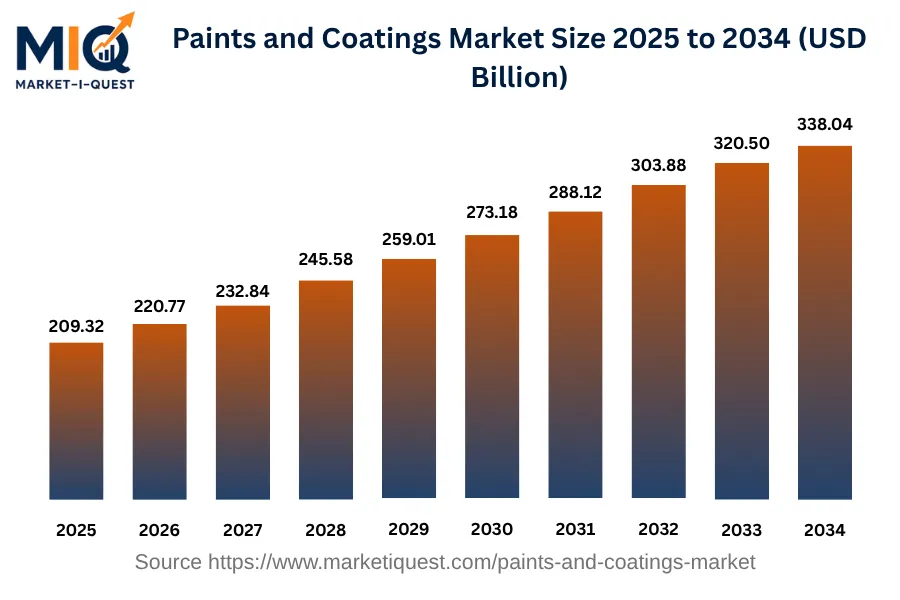
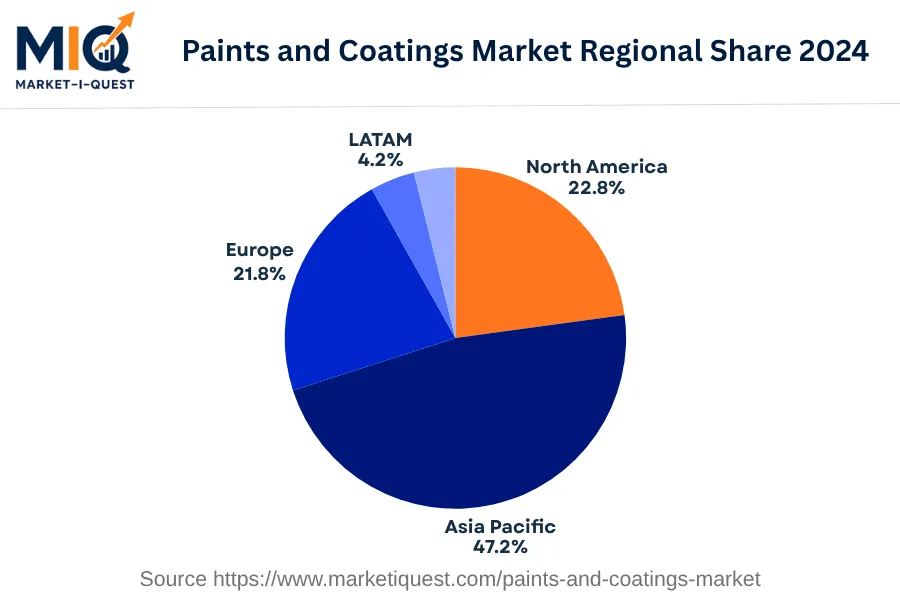
The Paints and Coatings Market size was USD 209.32 billion in 2025 and is expected to reach USD 338.04 billion by 2034, with a CAGR of 5.5%. The market size in 2024 was USD 198.46 billion. Therefore, there is a steady increase in value over ten years, resulting from various factors. The increase in the value between 2024 and 2025 is 5.5%, reflecting the start of a growing trend that continues until 2034. This growth may be attributed to advancements in industry requirements and consumer demands during this period. The regional share mix in 2024 was as follows: North America accounted for 22.8%, Asia Pacific held 47.2%, Europe claimed 21.8%, LATAM took 4.2%, and MEA was responsible for 3.9%.

Key Takeaways

  • By Resin - Epoxy led the market accounting for the highest market share in the base year.
  • By Technology - Solvent-Borne held a dominant position contributing to a significant portion of the total market share.
  • By End User Industry - Powder Coating featured as the top consumer driven by various construction activities globally.
paints-and-coatings-market market size

Key Driving Factors

Shift towards Eco-friendly Products

Consumers across the globe, particularly in developed regions such as North America and Western Europe, have been noticeably shifting towards Eco-friendly products. This trend is drastically shaping the paints and coatings market as manufacturers are increasingly focusing on developing paints and coatings with minimal environmental impact. It involves the production of products that release fewer volatile organic compounds (VOCs) and other harmful substances compared to traditional paints and coatings. Furthermore, government regulations aimed at reducing the impact on the environment, such as the Clean Air Act in the United States, have made it necessary for paints and coatings manufacturers to comply with their rules and guidelines. This trend is compelling producers to innovate and develop environmentally-friendly solutions for their offerings.
Rapid Urbanization and Growing Construction Activities

The paints and coatings market is witnessing a surge due to rapid urbanization and increasing construction activities globally, especially in emerging economies such as India, China, and Brazil. The expanding construction industry requires significant volumes of paints and coatings for various purposes, such as enhancing aesthetic appeal and providing durability to constructed structures. Residences, office buildings, and infrastructure projects have necessitated the application of paints and coatings for protection against weather, insects, and damage. This increase in construction activities, backed by the government's focus on infrastructure development plans, provides immense growth opportunities for the paints and coatings market.

Market Evolution by Timeline

2019-2023
During this period, the residential and construction sectors represented the major share of demand for paints and coatings. The Asia-Pacific region, particularly China and India, dominated in terms of market share due to urbanization and rapid construction activities. Suppliers focused on environmentally friendly products, like water-based paints, due to stringent environmental regulation like the U.S. National Volatile Organic Compound Emission Standards. Price volatility of raw materials like titanium dioxide, resin, and oil derivatives, influenced the pricing dynamics, typically leading to increased prices. Key contractual partnerships during this period included mergers and acquisitions, as seen in PPG's acquisition of Hemmelrath.
2024
In 2024, automotive industry emerged as a prominent consumer due to increasing vehicle production, particularly in Germany, Japan, and the US. From the supply side, nanotechnology-based coatings were introduced and growing in popularity due to their superior properties like scratch resistance and UV protection. The E.U.'s REACH (Registration, Evaluation, Authorization, and Restriction of Chemicals) regulations continued to push manufacturers towards environmentally friendly options, influencing the market trends. A rise in long-term agreements with vendors was observed to hedge against price volatility risks associated with raw materials.
2025-2029
The demand from 2025 to 2029 was highly influenced by the protective and marine coating sector. Regions with strong maritime industries, like the Middle East and Southeast Asia, saw increased consumption. Technological advances led to the development of bio-based paints and coatings, which minimized carbon emissions and reduced dependence on petrochemical derivatives. Regulations such as the European Union's Biocidal Products Regulation pushed for more sustainable alternatives. The trend towards e-commerce boosted online sales channels, changing the dynamics of purchase and distribution. Increased pressure on resource efficiency highlighted the need for waste management and recycling practices.
2030-2034
Between 2030-2034, rising refurbishment and maintenance activities in developed regions like North America and Europe largely drove the demand for paints and coatings. Also, increased interest in Advanced Driver-Assistance Systems (ADAS) in vehicles led to higher demand from the automotive sector. Technology-wise, smart coatings equipped with self-healing and self-cleaning properties garnered attention. Even as environmental regulations became more stringent, such as the Paints Directive 2004/42/EC in Europe targeting VOC emissions, eco-innovations like plant-based coatings gained prevalence. Operational and supply chain risks related to climate change, however, began to be a concern for manufacturers, pushing them to adopt more resilient business and supply models.

Future Market Outlook

Future Opportunities

As sustainability continues to dominate consumer preferences, the paints and coatings market is poised for growth in eco-friendly product lines. With regulations tightening across the globe, opportunities for investments in bio-based coatings are expanding, as seen in companies such as BASF, which announced its plans in early 2023 to develop paint formulations derived from renewable raw materials. The rise of the building and construction sector fuels demand for specialized coatings, particularly in regions like North America, where infrastructure projects are surging following government funding initiatives. Additionally, the automotive coatings market is evolving, with players like Axalta exploring innovative solutions for electric vehicles that require unique finishes to enhance functionality and appearance. The trend of aesthetic personalization is prevalent, especially in Europe, driving the development of custom colors and textures, leading companies to invest in advanced online platforms to streamline orders. The integration of smart technologies in coatings for buildings and vehicles is another area ripe for growth, as consumers increasingly seek features like self-cleaning and temperature regulation. Furthermore, as consumers focus on health and safety, manufacturers are likely to explore solutions that minimize exposure to harmful chemicals, guided by initiatives from regulatory bodies like OSHA. This evolving landscape creates numerous avenues for development and investment, allowing industry players to align with contemporary demands and integrate sustainability into their core strategies.

Segmentation Analysis

By Resin

The market is divided into subsegments including Acrylic, Alkyd, Polyurethane, Epoxy, and Others with Epoxy accounting for the largest revenue share while Acrylic is expected to grow at the fastest CAGR during the forecast period.

Largest Revenue Share

Epoxy

Market Share Leader

Epoxy resins are driving the revenue growth in this segment due to their superior properties and versatile application base across diversified industries like automotive, aerospace and marine. Epoxy's high strength, thermal stability and resistance to chemicals and corrosion have made it favorable for several heavy-duty applications. Geographically, Asia-Pacific region, popular for its flourishing automotive and construction industry, is a significant player in contributing to the sales revenue. Rapid urbanization within this region, specifically in emerging economies like China and India, has given a boost to infrastructural development, consequently, increasing the demand for epoxy resin. Government regulations, particularly in the developed regions, promoting sustainability, encourages the use of epoxy as it is environmentally friendly and has less volatile organic compounds. The purchasing criteria revolves around product durability and quality, where epoxy comes with high-performance promise, again a driver for its substantial market share.

Fastest CAGR

Acrylic

Forecast Period Growth Leader

Explanation for the rapid growth of acrylic resin within the forecasting period can be attributed to its increasing use in the booming paint and coatings industry where it is preferred due to its color retention capacity, glossiness and resistance towards external environmental factors. Acrylic's adhesion to different substrates coupled with its faster drying times makes it suitable for various DIY projects and home decoration, therefore, catalyzing its demand in the residential sector, which is on rise owing to the shifting trend towards nuclear families and urban living. However, the fluctuating prices of raw materials used for manufacturing acrylic resins act as an adoption barrier, causing uncertainty among the producers. There is a constant push by key players for research and innovative technologies to reduce production costs and dependence on specific raw materials, indicating positive future growth prospects of acrylic in the years ahead.

By Technology

The technology-based market is divided into subsegments including Water-Borne, Solvent-Borne, Powder Coating, and UV-Cured Coating. Among these, Solvent-Borne accounted for the largest revenue share while Powder Coating is expected to grow at the fastest CAGR during the forecast period.

Largest Revenue Share

Solvent-Borne

Market Share Leader

The Solvent-Borne subsegment leads the market in revenue, mainly due to its broader application range and high performance characteristics. It is widely used in various end-use industries, such as automotive, construction, and industrial goods, due to its superior properties, including durability, corrosion resistance, and high gloss. Furthermore, the growing industrialization and urbanization rates, especially in developing economies, boost the construction and automotive sectors, ultimately driving the demand for Solvent-Borne coatings. These coatings provide effective solutions to withstand harsh operation conditions, and thus, meet the stringent quality standards of these sectors. However, increasing environmental concerns and related regulations enforcing the reduction of volatile organic compounds (VOCs) would challenge this subsegment's growth.

Fastest CAGR

Powder Coating

Forecast Period Growth Leader

The Powder Coating subsegment is set to grow at the fastest rate. Key growth drivers include its environmental friendliness, cost-effectiveness, and superior performance properties. Unlike solvent-based coatings, Powder Coating does not emit VOCs, aligning with the global shift towards greener and sustainable solutions. Cost-effectiveness is also an important factor contributing to its rapid adoption, as it requires less equipment and it is reusable, reducing wasted material. Its durability and the ability to provide a high-quality finish also contribute to the increasing preference for Powder Coating. However, implementation barriers such as the requirement for large upfront capital expenses and the difficulty in achieving thin coatings could pose challenges to its adoption. While advancements in technology and potential collaborations among key market players could address these challenges, near-term risk includes any regulatory changes concerning manufacturing and application processes.

By End User Industry

The End User Industry segment is divided into subsegments including Architectural, Automotive, Wood, Protective Coating, and Others. In the base year 2024, the Automotive subsegment accounted for the largest revenue share while the Architectural subsegment is expected to grow at the fastest CAGR during the forecast period.

Largest Revenue Share

Automotive

Market Share Leader

The Automotive subsegment within the End User Industry has emerged as the leading revenue generator in 2024. There are a few key reasons for this dominance. One of the primary drivers of this trend is the continuous growth and expansion of the automotive industry worldwide. The increase in production and sales of vehicles, combined with the growing emphasis on maintaining their aesthetic appeal and longevity, has boosted the demand for quality coatings. Moreover, regulatory bodies across the globe have been implementing stringent regulations concerning the emission of volatile organic compounds (VOCs), thereby increasing the need for high-performing coatings in the automotive industry. Additionally, factors such as the increasing purchasing power of consumers and a rising preference for vehicles with superior finishes and textures have also significantly contributed to this subsegment's high revenue generation. These factors combined indicate that the Automotive subsegment will remain a critical component in the revenue structure of the coating industry.

Fastest CAGR

Architectural

Forecast Period Growth Leader

The Architectural subsegment is expected to grow at the fastest CAGR within the End User Industry segment. The demand for protective and decorative coatings in construction and renovation projects is a significant catalyst for growth. As urbanization rapidly progresses, especially in emerging economies, the need for architectural coatings is witnessing a surge. Technological innovations and improvements in coating formulations for durability and improved aesthetics have encouraged adoption. However, volatility in raw material prices could pose a near-term risk to this upward trajectory. Besides, stringent environmental regulations regarding VOC emissions from coatings can also slow down growth. There's an ongoing shift towards ‘green buildings’ and sustainability. The industry is responding with the development and launch of eco-friendly coatings, which should further stimulate this subsegment's growth, ultimately contributing to the overall expansion of the End User Industry segment.

Competitive Analysis - Paints and Coatings Market

Key Market Players

Manufacturers / OEMs

Akzo Nobel N.V.
Netherlands
RPM International Inc.
US
BASF SE
Germany

Key Suppliers & Raw Materials

ExxonMobil
US
DowDuPont Inc.
US
Lanxess
Germany

Distributors, Integrators & Channel Partners

Sherwin-Williams
US
Axalta Coating Systems
US
Beckers Group
Germany

Porter’s Five Forces Analysis

This analysis evaluates the competitive intensity and attractiveness of the Paints and Coatings Market.

Supplier Bargaining Power

Medium

Suppliers have moderate power due to the availability of raw materials and price volatility.

Buyer Bargaining Power

High

Buyers have high power due to wide range of products and switching possibility among brands.

Threat of Substitutes

Low

Low threats from substitutes as there are few alternative products with similar performance.

Threat of New Entrants

Low

Entry barriers like high capital investment and strict regulations limit new entrants.

Competitive Rivalry

High

High rivalry due to wide presence of major industry players and minimal product differentiation.

Regional Analysis

Geographic market dynamics and growth opportunities across key regions

Global Market Outlook

paints-and-coatings-market market regional share

North America

In the base year of 2024, the North American paints and coatings market experienced widespread dynamism due to multiple factors. Environmental regulations propelled an augmented demand for waterborne and high-solids coatings, predominantly in the United States and Canada, leading to changes in manufacturers' production processes. Moreover, significant investment was observed in research and development for eco-friendly painting solutions by key players such as PPG Industries and Sherwin-Williams. Technological advancements, particularly in the realms of nanocoatings and smart coatings, got prominent attention, mainly due to their enhanced durability and cost-effectiveness.

Consumer trends indicated preference shifting towards environmentally friendly and premium products. Meanwhile, online retail emerged as a significant distribution channel during this period, particularly in the U.S, spurred by high Internet penetration rates and pandemic-induced digitalization. The market witnessed increased partnerships and M&As, exemplified by the acquisition of Consorcio Comex by PPG Industries to expand its business in Mexico. Stricter policy enforcement on Volatile Organic Compounds (VOC) led to the prominence of low-VOC paint products across sectors including construction, automotive, and industrial manufacturing. The noticeable focus on home improvements amongst North American homeowners, driven by government incentives, additionally buoyed the residential paints and coatings market during this year.

Asia Pacific

In 2024, the Asia Pacific market for paints and coatings experienced substantial growth, primarily driven by increasing demand from the construction, automotive, and industrial sectors in China, India, and ASEAN countries. Infrastructure expansion and urbanization in these regions necessitated substantial consumption of paints and coatings. Moreover, government regulations in Japan and Australia favoring environmentally friendly, low-VOC paints stimulated market growth. Technological advancements in waterborne and high solids coatings also played a significant role in market expansion.

Market trends have been shaped by changing consumer preferences toward sustainable and eco-friendly products. This led to greater adoption of waterborne and powder coatings, backed by policy enforcement in countries like South Korea. In China and India, rapid digitization influenced the distribution channels, shifting sales towards e-commerce platforms. The ASEAN region saw an uptick in collaboration and M&A activities among key players to optimize production capabilities and introduce innovative product lines. Across all markets, standards demanding high-performing, energy-efficient buildings have elevated demand for thermally efficient and durable coatings in the construction sector. Hence, the paints and coatings industry in the Asia Pacific in 2024 was shaped by regulatory drivers, sustainable upgrade in technology, and changing purchase behaviors.

Europe

In 2024, Europe's Paints and Coatings Market was driven by variety of factors and trends. Key drivers included stringent environmental regulations, favouring the demand for environmentally-friendly and low VOC paints and coatings. The European Union's push for decarbonization, forced manufacturers to minimize the use of toxic constituents, especially in countries such as Germany and the U.K. Economic recovery post-pandemic resulted in rapid urbanization and infrastructural advancement across Italy and Spain, stimulating the market.

In terms of trends, technological innovations steered the market - nanoparticles and smart coatings caught attention across major manufacturing sectors. Central and Eastern Europe exhibited the prevalence of digital color matching techniques, which impacted retail trends significantly. M&A activities also accelerated in the region, with key manufacturers such as AkzoNobel and BASF targeting to expand their operations in the Nordics and Benelux region.

Consumers increasingly opted for eco-friendly products, creating exponential demand across various sectors, including automotive, architecture, and healthcare. Governments across Europe encouraged the use of green building materials - a policy that directly translated into high demand in the paint and coatings market. With significant investment in the market, and a strong focus on technological progression, 2024 was a pivotal year characterized by substantial growth and development in Europe's Paints and Coatings Market.

Latin America

In 2024, the paint and coatings market in Latin America (LATAM) exhibited dynamic growth, strongly influenced by Brazil, Mexico, Argentina, Colombia, Chile, and Peru. Notable drivers included rising construction activities, increased investment into infrastructure projects, and superior technological adoption across these nations, promoting the demand for high-quality paints and coatings. Regulations governing VOC emissions also pushed the market towards eco-friendly coatings, while raw material availability and pricing affected supply dynamics substantially.

In terms of market trends, consumer preference leaned heavily towards environmentally sustainable paints and coatings, reflecting an increased consciousness about environmental health. There was a visible shift towards the adoption of nanotechnology and green products in the coatings segment. Significant growth was also observed in online sales channels for these products, as traditional distribution networks were challenged by the rise of e-commerce businesses. Notably, strategic partnerships and mergers & acquisitions were prevalent, aiming for expansion of product portfolio and enhancement of market reach. Additionally, strict enforcement of environment safety standards by government bodies affected the formulation and choice of coatings.

The key sectors driving uptake included the construction industry, automotive manufacturing, and the retail sector. Government investment in infrastructure development also played an instrumental role, particularly in Brazil and Mexico.

Middle East & Africa

In 2024, the Paints and Coatings Market in the Middle East and Africa represented a significant industrial segment driven by varied factors. Demand sensibly increased due to booming construction industry, especially in Qatar, UAE, and Saudi Arabia with governments investing heavily in infrastructure and residential projects. Regulatory enforcements such as adoption of low volatile organic compound (VOC) policies in Egypt and South Africa also catalyzed the market expansion. Technological adoption, specifically nanotechnology in coatings pioneered by Israel, improved product quality and resilience, thereby boosting demand.

Ostensible market trends included a notable consumer shift towards eco-friendly products due to heightened environmental concerns. Nano-ceramic coatings technology adoption was prevalent due to its corrosion resistance and durability, primarily in the UAE's automotive and marine sectors. Channel dynamics slightly pivoted towards online retailing, reflecting changes in buyer behavior accelerated by technological integration. Moreover, strategic partnerships and M&A, particularly in Nigeria's and Kenya's manufacturing sectors, encouraged market consolidation. Strict enforcement of standardization policies across countries, particularly related to fire safety in coatings used in utilities and oil and gas sectors, played a significant role in structuring market landscape.

Recent Industry Developments

Latest market innovations, product launches, and strategic initiatives

March 2026

Global manufacturers accelerated capital investments into waterborne and high-solids production facilities to comply with revised volatile organic compound (VOC) caps under the EU Industrial Emissions Directive and China's GB 18582 national standard.

Frequently Asked Questions