Marine Coatings Market Snapshot

Key Players

  • AkzoNobel (Netherlands)
  • Sherwin-Williams (US)
  • Chugoku Marine Paints (Japan)
  • Hempel Group (Denmark)
  • Jotun (Norway)
  • Kansai Paints Co. Ltd. (Japan)
  • BASF SE (Germany)
  • PPG Industries (US)

Market Size

Base Year 2024
$5.92 Bn
CAGR
4.98%
Forecast 2034
$9.62 Bn

Market Segments

By Resin Type
  • Epoxy
  • Alkyd
  • Polyurethane
  • Others
By Product Type
  • Anti-Corrosion Marine Coatings
  • Antifouling Coatings
  • Others
By Application
  • Cargo Ships
  • Passenger Ships
  • Boats
  • Others

Market Dynamics

Drivers
  • Increasing shipbuilding activities
  • Rising maintenance and repair demands
Restraints
  • Regulatory compliance issues
  • Volatility in raw material prices
Opportunities
  • Increasing shipbuilding activities
  • Advancements in coating technology

Market Size

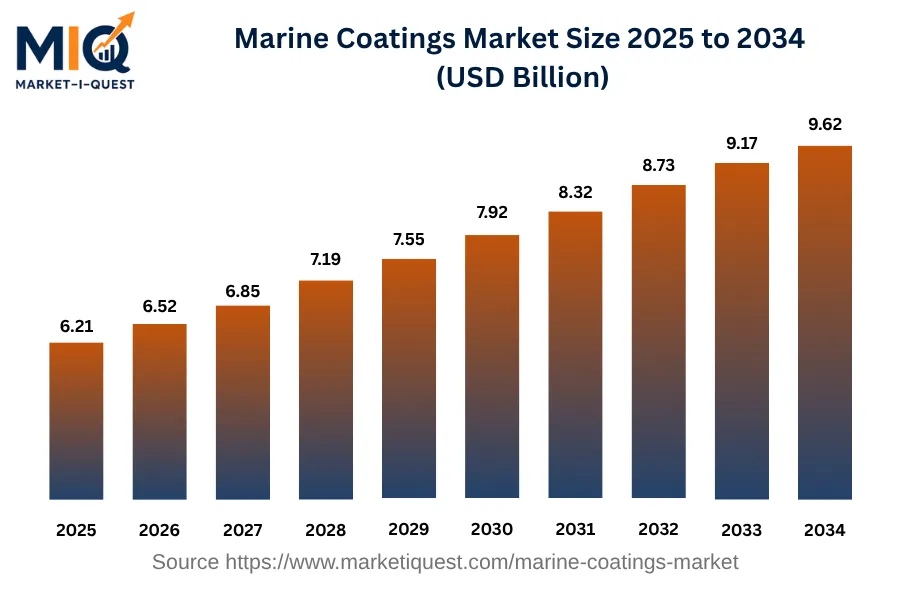
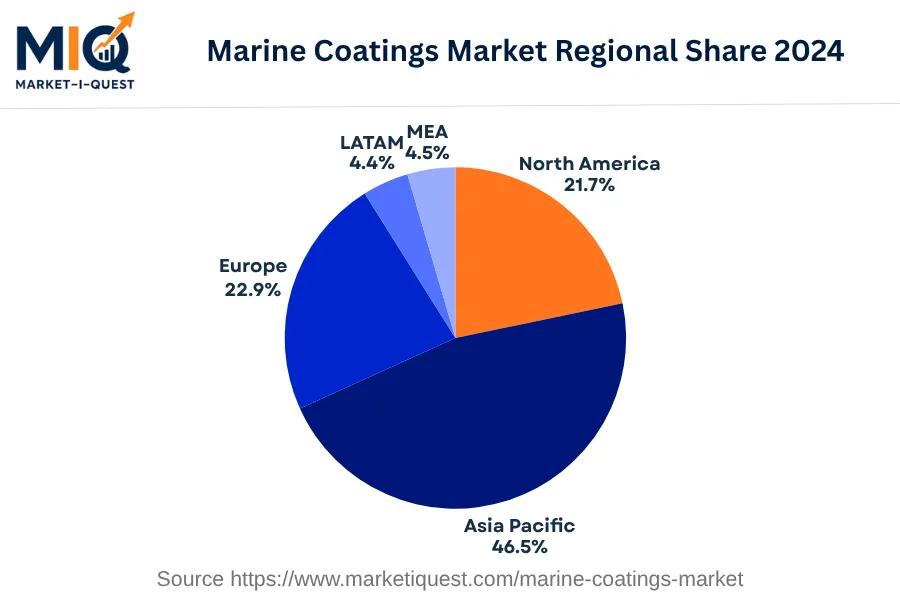
The Marine Coatings Market was sized at USD 6.21 billion in 2025 and is expected to expand to USD 9.62 billion by 2034, compounded annually at a growth rate of 4.98%. This substantial increase over nearly a decade highlights the steady upsurge in demand for marine coatings. The escalating approval for these coatings is attributed to their exceptional properties such as corrosion resistance, fouling resistance, and durability. They also play a crucial role in improving the speed and fuel efficiency of the ship due to the smoothness they provide. As of 2024, the market share of marine coatings varied significantly across regions. Specifically, North America held 21.7% of the market share, while the Asia Pacific led with a 46.5% share. Europe followed with a 22.9% share, and the remaining portions were held by LATAM and MEA, with 4.4% and 4.5% respectively.

Key Takeaways

  • By Resin Type - Epoxy led the Marine Coatings Market contributing the most to market share in 2024.
  • By Product Type - Antifouling Coatings were dominant seizing the largest section of the market in 2024.
  • By Application - Cargo Ships held the leading position accounting for a large portion of the Marine Coatings Market in 2024.
marine-coatings-market market size

Key Driving Factors

Implementation of Stringent Environmental Regulations

Stricter environmental norms enforced globally, such as the International Convention for the Prevention of Pollution from Ships (MARPOL), are a key driver for the marine coatings market. These regulations require ship owners to use eco-friendly antifouling coatings and paints that don't release harmful toxins into the ocean thereby preserving marine life. Shipowners are adapting to these mandates by purchasing and applying new, compliant marine coatings. This necessity for environmentally friendly solutions helps marine coating manufacturers thrive despite the associated cost increases because they can offer products that meet these new legal requirements.
Increasing Maintenance and Repair Activities in Shipbuilding

An uptick in the maintenance and repair activities in the shipping industry propels the marine coatings market forward. As ships age, they require more frequent repairs, maintenance, and recoating to prevent corrosion and improve vessel longevity. Subsequently, shipbuilders and repair companies heavily invest in high-quality marine coatings to provide better defense against salt water, temperature changes, and marine organisms that can damage the ship's hull. This emphasis on preventative care results in consistent demand for marine coatings, specifically within ship repair and maintenance markets.

Market Evolution by Timeline

2019-2023
Buyers in this period are global shipping companies, dockyards, and naval forces. Demand increases in Asia-Pacific due to expansion in the shipping industry. Meanwhile, anti-fouling coatings dominate, attracting large-scale adoption for hull protection. Constraints appear due to volatile raw material costs and environmental impacts. Regulations intensify under the International Maritime Organization (IMO) guidelines for limiting harmful substances in marine paints. Fixed-term contracts become prevalent due to the steady demand. The risk lies in the demand and supply imbalance caused by the unstable procurement of raw materials, with most companies integrating in-house production as a response.
2024
The US navy and private ship-building companies are the primary consumer segments, attributed to the increasing defence budget and commercial vessel production. High demand arises for eco-friendly coatings, leading suppliers to develop low-VOC and biodegradable options. These green solutions gain popularity as they adhere to EPA's newly enacted Marine Coating National Emission Standards. Inevitable price increase follows due to cost-intensive production. Spread of long-term contracts is seen because of the growing preferences for environment-friendly products. The challenge posed by this stage is the breakthrough in innovation, with firms resorting to research and development for solutions.
2025-2029
Buyers comprise major ship builders from China, South Korea, and Japan. A noticeable shift is seen towards smart coatings with self-healing and anti-corrosive properties. Suppliers focus on nanotechnology to enhance coating performance. Standards enforcing lower VOC-emissions encourage this shift. Price escalates as smart coatings require more sophisticated manufacturing processes. The trend towards long-term contracts continues, encouraged by stability in supply chains. Risks associated are mainly related to the adaptation of new technologies with expedited patents filing and industrial-scale trials being the frequent responses.
2030-2034
Demand gains momentum, particularly from the offshore wind energy sector due to the surge in wind farm constructions. Suppliers actively engage in the production of specialized offshore wind turbine coatings. Compliance with Renewable Energy Directive (RED II) becomes a salient feature. Prices stabilize due to a matured market and improved supply chain mechanism. Large-scale suppliers establish strategic partnerships with offshore wind project developers to ensure a steady demand; growth contracts become a common procurement model. The prime risk factor would likely be the high Wind Energy Penetration, addressed often by advanced weather resistance features in the coatings.

Future Market Outlook

Future Opportunities

Looking forward, the marine coatings market presents ample opportunities linked directly to current regulations and innovations. The 2023 EU regulations on marine pollution are likely to accelerate demand for products that minimize environmental impact, such as eco-friendly coatings that utilize renewable resources. As shipbuilding countries like South Korea and China commit to improving the sustainability of their fleets, companies that align with these initiatives could see growth in adoption rates. Furthermore, with rising environmental consciousness, stakeholders are increasingly seeking coatings that offer longer-lasting protection and reduced maintenance costs. Collaborations between companies and research institutions, such as the partnership formed in 2022 between PPG and the University of Southampton to develop next-generation antifouling coatings, highlight a strategic pivot towards research-driven solutions. Additionally, relying on digital technologies like AI-driven analytics for better performance tracking presents an opportunity for the sector to innovate around maintenance practices. With regulatory bodies, such as the IMO, emphasizing sustainable practices, companies that invest in smart, efficient coatings could achieve a competitive advantage. Moreover, the continued expansion of the offshore wind energy sector, which often requires specialized coatings for durability, presents new markets for marine coatings. The synergies between regulatory impetus and technological progress will shape future developments, supporting a transition towards cleaner and more efficient marine operations.

Segmentation Analysis

By Resin Type

The market is divided into subsegments including Epoxy, Alkyd, Polyurethane, and Others. Epoxy accounted for the largest revenue share while Polyurethane is expected to grow at the fastest CAGR during the forecast period.

Largest Revenue Share

Epoxy

Market Share Leader

Epoxy resin has emerged as a leading subsegment in terms of revenue generation. This comes down to several key factors. Firstly, epoxy resin offers desirable attributes such as high performance, durability, and strong resistance to corrosive substances, which make it highly useful in a wide range of industries including automotive, marine, industrial and protective coatings. Besides that, the growing demand for lightweight materials in the automotive and aerospace industries, which helps optimize fuel efficiency, has further driven the application of epoxy resin. Additionally, the increasing usage in wind energy applications is another reason for its predominant position. However, it is crucial to note the potential regulatory challenges due to the potential environmental impact of epoxy production and waste management. Some markets may see increased regulation or consumer preference shifting towards more environmentally friendly alternatives.

Fastest CAGR

Polyurethane

Forecast Period Growth Leader

Polyurethane dominates as the subsegment with the fastest growth projection. Its extensive usage in industries such as automotive, construction, and furniture, due to its versatile properties like flexibility, toughness, and resistance to weather, oil, and chemicals, act as key growth catalysts. Additionally, its growing use in insulation applications due to energy efficiency benefits cannot be overemphasized. Expansion in the construction industry, particularly in developing economies, is expected to fuel the demand further. Among the possible barriers to adoption are the high manufacturing cost and potential environmental concerns associated with the production and disposal of polyurethane. It's also important to watch for potential regulatory developments that may impact the polyurethane market, as well as the continuing volatility in the price of raw materials. Technological advancements aimed at reducing production costs and emissions could provide significant growth impetus.

By Product Type

The market is divided into sub-segments including Anti-Corrosion Marine Coatings, Antifouling Coatings, and Others. Among these, Antifouling Coatings accounted for the largest revenue share while Anti-Corrosion Marine Coatings is expected to grow at the fastest CAGR during the forecast period.

Largest Revenue Share

Antifouling Coatings

Market Share Leader

Antifouling coatings account for the largest revenue share due to their vital role in protecting marine vessels from biofouling, which forms when marine organisms attach to the submerged portions of ships and boats. This biofouling can cause serious damage to the vessel and decrease its operational efficiency. As such, antifouling coatings, which are specifically designed to resist this biological growth, are in high demand. These coatings also help in improving fuel efficiency by reducing drag, a benefit that significantly appeals to ship operators striving to reduce operational costs. The maritime industry's growth, particularly in regions such as the Asia-Pacific, which boasts a robust shipbuilding sector, further fuels demand for antifouling coatings. However, the regulation of toxic substances used in these coatings represent a challenge, thus it's crucial for providers to offer environmentally friendlier solutions without compromising effectiveness.

Fastest CAGR

Anti-Corrosion Marine Coatings

Forecast Period Growth Leader

Although Antifouling coatings command the largest revenue share, Anti-Corrosion Marine Coatings are projected to grow at the fastest pace. These coatings play an instrumental role in maintaining the integrity of marine structures and vessels, which are continuously exposed to harsh, corrosive saltwater environments. Increasing demand for longer vessel life and reducing maintenance costs are the key drivers for the adoption of these coatings. Technological advancements, such as development of more durable and effective coatings, are expected to boost the segment's growth further. Also, increased partnerships between coating manufacturers and shipbuilders indicate positive prospects. However, the growth may face barriers due to stringent environmental regulations that restrict the use of certain substances in coatings. Manufacturers who can balance effectiveness with regulatory compliance are likely to take the lead in this rapidly growing segment.

By Application

The market is divided into subsegments including Cargo Ships, Passenger Ships, Boats, and Others. In the base year of 2024, Cargo Ships accounted for the largest revenue share while Boats is expected to grow at the fastest CAGR during the forecast period.

Largest Revenue Share

Cargo Ships

Market Share Leader

In the base year of 2024, the cargo ships subsegment secured its position as the market leader. A multitude of factors underpin this dominance. The global economy heavily relies on the ocean freight industry with cargo ships accounting for the bulk of cargo volume traffic. They remain key to international trade and logistics due to factors such as high capacity, cost-efficiency, and geographical versatility. Cargo ships are preferred because they offer safe transportation for every kind of goods including hazardous, large-scale, and temperature-sensitive items, thus commanding substantial market revenue. Favorable economic environments, increasing international trade agreements and regulations supporting maritime transportation are factors contributing to the outsized revenue share of this segment. In addition, significant infrastructure investments across developing nations to boost port capabilities for mega cargo ships have spurred demand for larger and technologically advanced ships, enhancing revenue.

Fastest CAGR

Boats

Forecast Period Growth Leader

Despite currently occupying a smaller share of the market, the boats subsegment shows signs of faster growth ahead, outpacing other subsegments in terms of CAGR. The primary drivers being increasing consumer interest in recreational activities involving water sports, fishing and cruising which triggers the demand for a variety of boats. Furthermore, technological advancements including the integration of IoT devices for enhanced navigation, safety, and fuel efficiency add substantial appeal. Adoption barriers include relatively high ownership, operation, and maintenance costs. Moving forward, partnerships with leasing and boat-sharing companies are anticipated to reduce barriers to ownership and drive market growth. Equally, policy initiatives focusing on promoting tourism and maritime activities contribute to the favorable market scenario for this segment. While near-term risks involve economic volatility and fluctuating fuel prices, the growth trajectory remains positive.

Marine Coatings Market Analysis

Key Market Players

Manufacturers / OEMs

PPG Industries, Inc.
US
Akzo Nobel N.V.
Netherlands
Sherwin-Williams Company
US

Key Suppliers & Raw Materials

BASF SE
Germany
DuPont
US
DOW Inc.
US

Distributors, Integrators & Channel Partners

Graco Inc.
US
Hempel A/S
Denmark
RPM International Inc.
US

Porter’s Five Forces Analysis

A comprehensive assessment of the competitive dynamics within the global marine coatings market.

Supplier Bargaining Power

Medium

Dependent on raw material suppliers, price volatility influences bargaining power.

Buyer Bargaining Power

High

Multiple suppliers available, stringent regulations, and cost-effectiveness influence buyer's choice.

Threat of Substitutes

Low

Performance benefits and regulatory constraints limit substitutable products.

Threat of New Entrants

Medium

Capital intensive industry with regulatory barriers, but potential for tech-driven disruption.

Competitive Rivalry

High

Numerous established firms, high competition, and ongoing technological improvements heighten rivalry.

Regional Analysis

Geographic market dynamics and growth opportunities across key regions

Global Market Outlook

marine-coatings-market market regional share

North America

In 2024, the North American marine coatings market was influenced by dynamic factors in demand, regulatory compliance issues, and technology adoption. Greater investment in recreational marine activity and offshore wind farms in both the U.S and Canada drove significant demand for anti-corrosive and anti-fouling coatings. A tightening regulatory environment, with policies such as the U.S. Vessel General Permit and Canada's Clean Fuel Standard, underscored the significance of environmentally friendly marine coatings. Technological advancements, primarily in protective coatings like epoxy and silicone, further stimulated the market.

Consumer preference in North America shifted towards sustainable products, given the heightened environmental awareness and stricter regulations. Additive manufacturing and nanotechnology emerged as transformative trends in the marine coatings sector, showing potential for growth especially in areas of enterprise and manufacturing. Additionally, mergers and acquisitions, such as the acquisition of AkzoNobel by PPG Industries, were prevalent, indicating a move towards consolidation in this space. The distribution channels saw a pivot towards e-commerce, with companies like Sherwin Williams launching online platforms to facilitate sales. Lastly, active enforcement of policies by agencies, such as the Environmental Protection Agency (EPA) in the U.S. and Environment and Climate Change Canada, influenced consumer and investor behavior in the marine coatings industry.

Asia Pacific

The Asia Pacific Marine Coatings market, in 2024, was a dynamic sector shaped by multiple factors. Notable growth drivers included the increasing maritime trade in China and India, heightened ship-building activities in South Korea, Japan and key ASEAN markets, and escalating demand for leisure boats in Australia. Furthermore, stringent regulations aiming to prevent biofouling and corrosion in marine vessels, such as China's Anti-Fouling Systems in Maritime Transportation, incentivized investments in advanced marine coatings. Technological adoption, particularly nanotechnology in coatings, provided a competitive edge in supply dynamics.

Changing market trends seen throughout 2024 highlighted a shift towards eco-friendly, low-VOC (Volatile Organic Compound) coatings, as buyers leaned more towards sustainable practices. Innovative marine coatings with self-cleaning and anti-fouling properties peaked in popularity in the shipping industry. The rise of e-commerce in India and China led to an increase in the use of online platforms for purchasing marine coatings, altering channel dynamics. High-profile partnerships and M&A activities, such as Nippon Paint's acquisition of Betek Boya, exemplified the consolidation trend in the sector. Lastly, the enforcement of the IMO's policy limiting sulphur emissions in shipping fuels indirectly influenced the marine coatings market, favoring products that improved fuel efficiency.

Europe

In 2024, Europe's Marine Coatings Market demonstrated robust performance mainly driven by stringent environmental regulations, technological advancements and cost efficiency measures employed by key players. Increased demand from the shipping industry responding to regulations aimed at reducing harmful aquatic emissions propelled market growth. Moreover, governmental investments in naval defense systems in Germany, the United Kingdom, France, Italy and Spain bolstered the market. There was significant adoption of advanced coating technologies, including nanotechnology, offering improved durability and corrosion resistance characteristics. The year was marked by certain key trends. There was a noticeable shift in buyer preference towards environmentally friendly, anti-fouling coatings, driven by strict enforcement of maritime environmental policies. Increased M&A activity was observed, as companies primarily from Benelux and the Nordics sought to expand their technological capabilities and market reach. For instance, the introduction of transparent coatings for aesthetic purposes marked an important product innovation.

There is now increasing focus on ensuring lower dry-dock expenses and vessel fuel consumption by ship-owning corporations and marine service providers, pointing towards the enhanced demand for high-performance and energy-saving marine coatings. Lastly, the year witnessed the increased use of e-commerce channels by manufacturers for sales, as the traditional distributor-led sales model faced challenges.

Latin America

In the base year 2024, Latin America's Marine Coatings Market was driven by multiple factors including infrastructure development projects, environmental regulations, and technological innovation. Brazil and Mexico's extensive investment in their shipping infrastructure led to high demands for anti-corrosion and anti-fouling coatings. Simultaneously, Argentina, Colombia, Chile, and Peru saw increased eagerness for marine coatings due to stricter environmental regulations necessitating eco-friendly coatings to minimize pollutant release. Lastly, the rapid adoption of nanotechnology-based coatings, particularly in Brazil and Mexico, played a vital role in the market's progression.

In terms of trends, the market noted a transition towards water-borne coatings due to their low VOC emissions, catalyzed by environmental policy enforcement across LATAM. There was also a shift in buyer preference towards coatings with added functionality, such as anti-microbial properties, predominantly among the utilities and manufacturing sectors. Additionally, partnerships and M&A activities were observed, particularly between national industries and foreign market leaders, intending to enhance marine coating technologies and product quality. The market witnessed a significant shift in distribution channels too, with an increasing number of purchases made online, most noticeably within the retail sector. Furthermore, bio-based marine coatings gained prominence due to their eco-friendly nature and suitability with regulatory standards.

Middle East & Africa

In the base year 2024, the Middle East and Africa's marine coatings market exhibited significant growth. Factors driving this escalation included massive investments in offshore oil and gas explorations, especially in nations like Nigeria and Saudi Arabia, precipitating demand for high-performance marine coatings. Regulatory mandates in Israel and Egypt, compelling use of environmentally-friendly coatings, also fueled the market growth. Enhanced adoption of silicon-based technologies in marine coatings presented numerous benefits, including reduced fuel consumption, particularly in South Africa and Kenya's shipping sector, effectually stimulating the market.

Consumer behavior inclined toward nano-technology-based coatings due to their superior protection capabilities, offering a notable market trend. A significant shift was observed in the use of anti-fouling coatings toward foul-release coatings, predominantly in the UAE and Qatar's shipping industries, due to enhanced efficiency and low maintenance. Strategic partnerships and M&A were noted in the sector, with key players seeking to expand their footprint across the regions. An example includes the UAE’s National Paints Factories Co. Ltd’s collaboration aiming at product differentiation and expansion. Strict enforcement of maritime safety standards across these regions, especially in offshore oil and gas sector, reflected a greater awareness and demand for marine coatings. As such, the marine coatings market emerged as a critical component in the maritime sector across the Middle East and Africa in 2024.

Recent Industry Developments

Latest market innovations, product launches, and strategic initiatives

July 2026

Nippon Paint Marine was selected by Wan Hai Lines to supply FASTAR XI antifouling coating and EVER COOL heat-reflective coating for two methanol dual-fuel container newbuilds (8,700 TEU and 16,000 TEU) — the first newbuild project between the two companies.

December 2025

AkzoNobel completed the sale of its Indian decorative paints business (AkzoNobel India Ltd) to JSW Group for €1.4 billion enterprise value, while retaining and expanding its aerospace and marine coatings operations in India.

Frequently Asked Questions