
Additive Manufacturing Market Snapshot

Key Players

  • 3D Systems Corporation (United States)
  • Stratasys Ltd. (Israel)
  • GE Additive (United States)
  • EOS GmbH (Germany)
  • Materialise NV (Belgium)
  • SLM Solutions Group AG (Germany)
  • ExOne Co. (United States)
  • Carbon Inc. (United States)
  • HP Inc. (United States)
  • Dassault Systèmes (France)

Market Size

Base Year 2024
$34.86 Bn
CAGR
21.9%
Forecast 2034
$251.53 Bn

Market Segments

By Component
Hardware, Software, Services
By Printer Type
Desktop 3D Printer, Industrial 3D Printer
By Technology
Stereolithography, Fuse Deposition Modeling, Polyjet Printing, Selective Laser Sintering, Inkjet Printing, Direct Metal Laser Sintering, Electron Beam Melting, Digital Light Processing, Laser Metal Deposition, Laminated Object Manufacturing, Others
By Material
Polymer, Metal, Ceramic
By Application
Prototyping, Tooling, Functional Parts
By End Use
Industrial Additive Manufacturing, Desktop Additive Manufacturing

Market Dynamics

Drivers
  • Technological advancements in 3D printing
  • Increasing industrialization in emerging economies
Restraints
  • High equipment costs
  • Slow production speed
Opportunities
  • Advanced material development
  • Emerging economies' industrial growth

Market Size

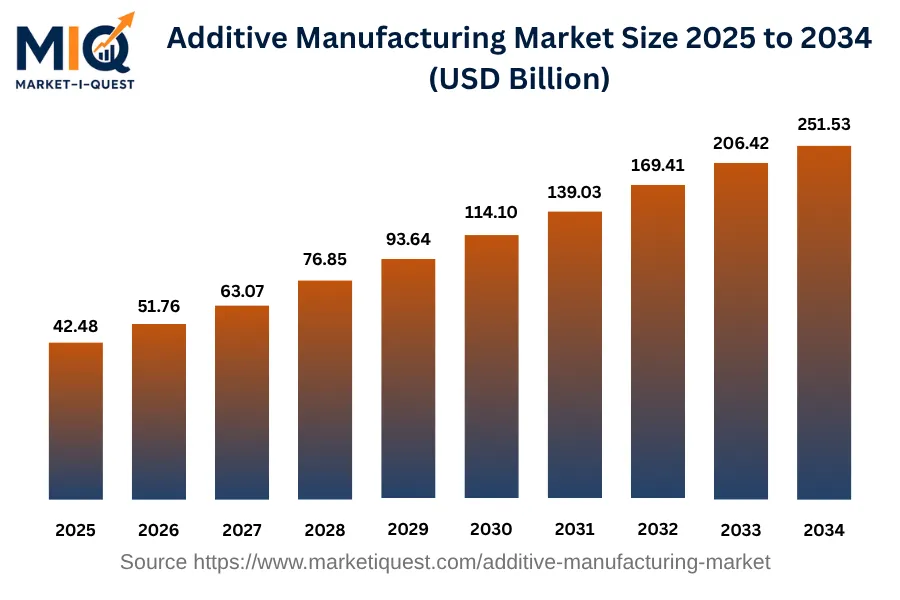
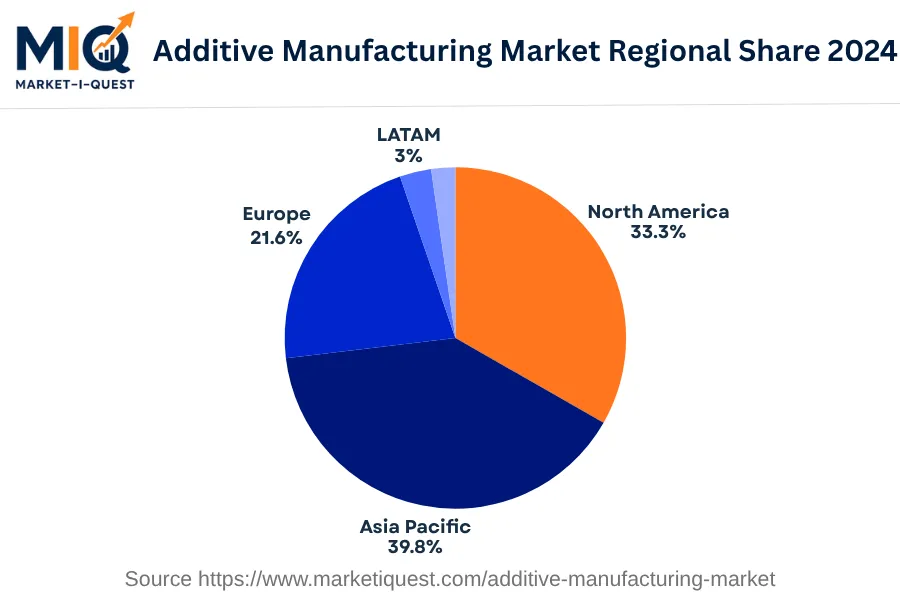
The Additive Manufacturing Market size, valued at 42.48 billion USD in 2025, surges to 251.53 billion USD by 2034, reflecting a CAGR of 21.9%. The market demonstrates a steep upward trajectory from its size of 34.86 billion USD in 2024, underpinned by continuous technological advancements and growing manufacturing sector interest. The nearly eightfold rise in market size by 2034 uniquely positions the Additive Manufacturing Market for substantial industry influence. Among regional markets in 2024, the Asia Pacific lead with a 39.8% share, closely followed by North America with a 33.3% share. Simultaneously, Europe held a share of 21.6%, while the Remaining regions, including LATAM and MEA, collectively accounted for a total of 5.3% of the global market, with 2.98 and 2.28% respectively. The relative share standings underline the role of regional markets in the industry's overall growth.

Key Takeaways

  • By Component - Hardware held the dominant position in the base year.
  • By Printer Type - Industrial 3D Printer led the market in terms of share.
  • By Technology - Direct Metal Laser Sintering assumed the leading role base on market share.
  • By Material - Metal was the most prominently used material in the base year.
  • By Application - Tooling held a commanding position based on market share.
  • By End Use - Industrial Additive Manufacturing held the largest share of the segment.
additive-manufacturing-market market size

Key Driving Factors

Adoption of additive manufacturing in medical and dental industries

Adoption by the medical and dental industries has been a significant driver of the additive manufacturing market. Traditional manufacturing processes are often unable to produce the intricate designs required in these fields. For instance, in the dental industry, additive manufacturing allows for the easy creation of crowns, bridges and aligners, providing a more precise, comfortable fit for patients. By contrast, in the medical industry, this technology is crucial in the production of personalized prosthetics, implants, and surgical instruments which offer improved patient outcomes. The capability of additive manufacturing to build customized and complex shapes without compromising speed and efficiency has made it an attractive solution in these sectors.
Environmental regulations promoting sustainable manufacturing practices

Another driving factor for the additive manufacturing market has been the increased scrutiny on environmental impact and waste reduction by global regulatory bodies. Traditional subtractive manufacturing processes typically generate a significant amount of waste, as material is removed from a larger piece until the final product is achieved. Conversely, additive manufacturing only uses the amount of material needed to form the end product, drastically reducing waste production. Thus, companies that shift towards additive manufacturing practices are better positioned to meet environmental regulations and demonstrate sustainability. Furthermore, they can potentially avoid hefty regulatory fines and reputational damage associated with non-compliance, making the adoption of additive manufacturing a strategic business decision.

Market Evolution by Timeline

2019-2023
During this period, the main buyers of additive manufacturing were typically in the automotive, aerospace, and healthcare industries. These industries utilized 3D printing for creating prototypes and parts in North America and Europe. Metal 3D printing saw notable adoption due to the robustness of the product. Additive manufacturing was largely integrated on a pilot basis. Constraints included the slower speed of production compared to traditional manufacturing and the high costs. Policies influencing adoption included ISO/ ASTM 52900, which defined terms in the field. The commercial model primarily featured direct purchases with stiff pricing due to the novelty of the technology. A significant risk during this period was the steep learning curve and the need for skilled operators.
2024
Expected buyers in the defense sector started embracing the technology in large scale. The Asia Pacific region witnessed a surge in demand due to growing industrial infrastructure. High speed sintering technology debuted making supply faster and less costly. Policy developments saw the introduction of ASTM F3303, promoting safe usage of equipment across industries. Commercial models in 2024 demonstrated a shift towards customization and affordability. Partnerships surged between manufacturers and software companies to offer integrated solutions. The major risk was maintaining the quality of products produced faster and more cheaply.
2025-2029
Demand expanded to home products and food industry across all regions, driven by the increased familiarity and acceptance of the technology. Hybrid machines offering both additive and subtractive manufacturing capabilities were introduced. Regulatory landscape saw active involvement of international bodies like ISO and ASTM in setting global standards. Pricing model evolved, demonstrating a general downward trend as more manufacturers entered the market, increasing competition. Major risk remained in maintaining standardized quality while trying to lower the print costs and time.
2030-2034
The Additive Manufacturing market by 2030 is anticipated to be mature and more competitive. The construction industry showed increased interest in this technology for large-scale projects. Companies started investing in multi-material printing capabilities, offering supply advancements. Policy-makers focused heavily on sustainable manufacturing practices in the wake of growing environmental concerns. The commercial model was highly cost-competitive with an emphasis on streamlining the supply chain. The key risk emerged from new entrants disrupting the market dynamics and patent disputes.

Future Market Outlook

Future Opportunities

Given the current advancements in additive manufacturing, various sectors are positioned to capitalize on emerging opportunities. The aerospace industry, with its stringent requirements for lightweight and high-performance materials, stands to benefit significantly from tailored solutions, particularly as companies like Boeing explore the use of 3D-printed components in their new aircraft models. In the automotive sector, OEMs such as Ford are investing in additive manufacturing capabilities to streamline prototyping and production processes, allowing for rapid design iterations and reduced lead times. The medical field presents additional prospects, particularly for custom implants and surgical tools, as highlighted by the ongoing collaborations between 3D printing firms and hospitals to create patient-specific products. Regulatory support from bodies like the Food and Drug Administration is crucial for establishing standards around these applications, contributing to the market’s future trajectory. Emerging markets, particularly in Asia-Pacific, present further growth potential, as countries like China and India rapidly adopt additive technologies for industrial applications. Increase in research and development funding towards sustainable materials for additive manufacturing is also expected to shape future product offerings, reflective of global sustainability trends. These opportunities suggest a robust outlook for additive manufacturing as industries adapt to advanced technologies and evolving market demands, further evidenced by ongoing strategic investments by prominent players.

Segmentation Analysis

By Component

The market's division into subsegments includes Hardware, Software, and Services, with Hardware accounting for the largest revenue share, while Services offer the highest future growth potential.

Largest Revenue Share

Hardware

Market Share Leader

The Hardware subsegment currently leads the market in terms of revenue. This dominance can be attributed to several factors particular to the Hardware market sector. The tangible nature of Hardware commands a higher price point, leading to increased revenue. The demand for Hardware is robust across industries and regions, which broadens the customer base driving revenues. Higher switching costs associated with Hardware, compared to Software or Services, mean customers are less likely to change suppliers, ensuring a steady revenue stream for Hardware suppliers. Regulation and supply constraints, particularly for certain types of hardware components such as semiconductors, further drive up prices, contributing to higher revenues. Purchasing criteria often prioritize reliable and durable Hardware, which commands higher prices and drives up revenue. The sales channel structure, which often includes multiple resellers, adds mark-up costs and further increases revenue figures. Therefore, based on these factors, the Hardware subsegment is currently the main revenue driver of the market.

Fastest CAGR

Services

Forecast Period Growth Leader

The Services subsegment is set for the fastest growth, driven by several emerging trends and catalysts. The move towards digital transformation is accelerating across industries, with companies increasingly seeking solutions that combine both hardware, software and relevant services, driving demand and growth for the Services sector. Although initial adoption barriers exist, particularly for smaller firms due to high costs, partnerships and policy support are helping overcome these. The increasing investment in technology combined with implementation support services represent significant growth opportunities for the Services subsegment. However, certain near-term risks must also be factored in. These include the dependence on continuous capex and the need for partner ecosystems to deliver holistic solutions. High switching costs and long contract terms could also cause hurdles for rapid growth. Still, the overall future growth potential of the Services subsegment appears promising, mainly due to increasing digitalization and tech advancements.

By Printer Type

The market is divided into subsegments including Desktop 3D Printer and Industrial 3D Printer. In the base year 2024, Industrial 3D Printer accounted for the largest revenue share, while the Desktop 3D Printer is expected to grow at the fastest CAGR during the forecast period.

Largest Revenue Share

Industrial 3D Printer

Market Share Leader

The Industrial 3D Printer segment leads the revenue chart due to several factors. First, the adoption of advanced manufacturing processes by industries globally has acted as a primary driver. This segment is vastly used in industries such as automotive, construction, aerospace and healthcare, for prototypes, parts, and even functional products due to their high precision and durability. Second, the geographical extent of industrial activities is a major contributor. Regions such as North America, Europe, and Asia-Pacific, with concentrated industrial activities, provide significant demand for these printers. Regulatory support for advanced manufacturing technology also contributes to the segment's leadership. The purchasing criteria for these printers revolve around accuracy, speed, and materials compatibility, with leading printer manufacturers ensuring these parameters are met. The supply chain of industrial 3D printers involves robust channels including original equipment manufacturers (OEMs), resellers, and online retailers, helping facilitate smooth transactions.

Fastest CAGR

Desktop 3D Printer

Forecast Period Growth Leader

Even though the Desktop 3D Printer may lag in revenue, it is growing at the fastest CAGR. One primary driver for this momentum is the increased adoption of these printers in education, where they play a vital role in practical learning and innovation. The affordability and convenience of these printers have further expanded their user base to include hobbyists, small businesses, and even home users. Although initial setup costs might pose a hurdle, the declining prices and increasing benefits outweigh the negatives over the long run. Policies advocating STEM learning and collaborative partnerships between educational institutions and printer manufacturers also contribute to the growth in this segment. Advancements in technology, including improvements in printer hardware and software, are expected to add to the growth momentum. However, near-term risks such as the impact of economic slowdowns on discretionary spending could potentially slow the rate of adoption.

By Technology

The market by technology is divided into various subsegments including Stereolithography, Fuse Deposition Modeling, Polyjet Printing, Selective Laser Sintering, Inkjet Printing, Direct Metal Laser Sintering, Electron Beam Melting, Digital Light Processing, Laser Metal Deposition, Laminated Object Manufacturing, and others. Direct Metal Laser Sintering accounted for the largest revenue share while Polyjet Printing is expected to grow at the fastest rate.

Largest Revenue Share

Direct Metal Laser Sintering

Market Share Leader

Direct Metal Laser Sintering (DMLS) holds the highest revenue share of the 3D printing market in 2024. DMLS is a powerful and highly versatile manufacturing technology, widely used in industries that require complex geometries and designs. These include aerospace, automotive, and healthcare industries, driving the high demand for this technology. DMLS can produce parts from a wide range of metal powders, providing a significant advantage over traditional manufacturing methods that impose restrictions based on the material type. Its ability to manufacture high-quality, durable parts with intricate geometries and fine details gives it an edge. Its use in multiple geographic regions also contributes to its high revenue generation, thanks to its broad application scope and versatility. DMLS technology, due to its accuracy and precision, also attracts stringent industries like aerospace and defense, where product quality cannot be compromised. However, it's the versatility in material selection and application sectors that makes DMLS the revenue leader.

Fastest CAGR

Polyjet Printing

Forecast Period Growth Leader

Polyjet Printing technology is projected to witness the fastest Compound Annual Growth Rate (CAGR). Numerous factors catalyze this growth - technological advancements, partnerships, and policies in favor of environment-friendly manufacturing practices. PolyJet technology opens up a whole new gamut of possibilities for industries, thanks to its ability to create intricate designs, high-resolution models with smooth surfaces, and a mix of rigid and flexible materials. It enables many industry players to create prototypes quickly, leading to faster time-to-market. This competitive advantage encourages many companies to adopt this technology, consequently driving the growth. However, the high set-up cost of PolyJet printing remains a significant barrier to its adoption, especially for small and medium-sized business. But industry leaders are continuously investing in research to minimize these costs, providing a promising future outlook for PolyJet printing.

By Material

The market is divided into sub-segments including Polymer, Metal, and Ceramic. Metal accounted for the largest revenue share, while Polymer is expected to grow at the highest CAGR during the forecast period.

Largest Revenue Share

Metal

Market Share Leader

Metal has been the dominating segment in terms of overall market revenue in the base year 2024, largely due to their extensive applications across various industries. The durability, strength, and resistance to wear and tear make metals a preferred choice in many manufacturing processes including construction, marine and automotive industries. In comparison with polymer and ceramic, metals are generally easier to source and process which boosts their economic feasibility for larger scale projects. Geographically, heavy industrial regions are recognized as the key revenue-contributing areas. Moreover, environmental regulations encouraging recycling and usage of sustainable materials have also played a critical role in driving the metal subsegment. Furthermore, these materials fulfill several purchasing criteria as industries prefer materials with easy availability and reliable performance. Despite competition from other materials such as polymers and ceramics, the metals segment continues to uphold strong positions in many markets due to these reasons.

Fastest CAGR

Polymer

Forecast Period Growth Leader

Polymer is projected to expand at the fastest CAGR during the forecast period. The rise of polymers can be attributed to advancements in material science technology. These materials are favored for their less weight, high strength-to-weight ratio and resistance to corrosion, making them suitable for various applications especially in aerospace and automobile industries where weight is a critical factor. Adoption of Polymer as replacement for traditional materials is the main growth driver. However, a major barrier for its adoption is its relatively high cost. On the bright side, increased adoption and production scale, partnerships for shared technology development, and the introduction of more cost-effective manufacturing techniques are likely to lower the unit price, thus catalyzing further growth. Near term risks including oil price fluctuations which could impact Polymer costs, and resistance from traditional industries could inhibit growth but the overall outlook remains strongly positive for this subsegment.

By Application

The market is divided into subsegments including Prototyping, Tooling, and Functional Parts. In 2024, Tooling accounted for the largest revenue share, while Prototyping is expected to grow at the fastest CAGR during the forecast period.

Largest Revenue Share

Tooling

Market Share Leader

Tooling dominates the market due to its extensive use across diverse industries such as aerospace, automotive, and manufacturing. This subsegment offers cost and time efficiency as it reduces the number of steps in the manufacturing process and decreases material waste. Demand for highly specific and precise tools is further augmenting this segment's revenue, as industries progressively shift to advanced manufacturing techniques to increase productivity and accuracy. Geographically, developed economies like the United States, Germany, and Japan are contributing notably to Tooling's dominant market position due to their high manufacturing outputs and adoption of advanced processes. Additionally, government regulations and policies promoting environmentally friendly and efficient manufacturing methods are catalyzing the tooling subsegment's market growth. Factors such as low supplier bargaining power and high switching costs further solidify tooling's position as the subsegment with the largest revenue share.

Fastest CAGR

Prototyping

Forecast Period Growth Leader

Despite not being the largest revenue contributor, Prototyping is projected to show the fastest growth. This is primarily driven by the increasing adoption of rapid prototyping in varied industry verticals like technology, health care, and consumer goods for product design and development activities. The growing demand for custom and complex designs is fueling the adoption of Prototyping as it allows for fast and cost-effective error detection and rectification, thereby hastening the product launch process. Emerging technologies, particularly in additive manufacturing and 3D printing, act as catalysts supporting adoption and reducing barriers such as high costs and complex operations. Additionally, strategic partnerships between prototyping solution providers and companies can be spotted, fostering the subsegment's growth. However, concerns related to intellectual property rights and copyright infringement pose potential risks for the prototyping subsegment's growth.

By End Use

The market is divided into subsegments including Industrial Additive Manufacturing and Desktop Additive Manufacturing. Industrial Additive Manufacturing accounted for the largest revenue share, while Desktop Additive Manufacturing is expected to grow at the fastest CAGR during the forecast period.

Largest Revenue Share

Industrial Additive Manufacturing

Market Share Leader

Industrial additive manufacturing holds a significant position in terms of revenue. This can be attributed to the broad application of this manufacturing form across different industrial sectors. Industrial additive manufacturing is used to produce sophisticated parts for applications in industries ranging from aerospace to healthcare. The technology's ability to fabricate complex geometries and patterns that are otherwise unachievable using traditional manufacturing methods is a primary growth driver for this segment. Furthermore, governments and regulatory bodies worldwide are taking steps to promote the growth of the manufacturing sector, which directly benefits this subsegment. For instance, increased investments in research and development activities and favorable policies aimed at promoting industry 4.0 are among the primary drivers. As for purchasing criteria, clients frequently prioritize customization capabilities, productivity, and precision, all areas where additive manufacturing excels. Additionally, the continual efforts by key players in the industry to improve the technology and reduce costs further support the segment's revenue leadership.

Fastest CAGR

Desktop Additive Manufacturing

Forecast Period Growth Leader

The desktop additive manufacturing segment is poised for the highest growth rate during the forecast period. As the technology becomes more accessible and less costly, the relative ease of use is accelerating the adoption rate among small to medium-sized businesses and hobbyists. Educational institutions are also incorporating additive manufacturing into their curriculum, expanding its use at a grassroots level. While new users might initially face technical and operational barriers, the proliferation of user-friendly software and online tutorials mitigate these challenges. Adoption is further bolstered by corporate partnerships in the tech sphere, incentivizing additive manufacturing technology uptake among startups and manufacturers. However, minor implementation risks persist, such as intellectual property issues and the need for a more mature recycling infrastructure to handle the waste generated. Despite these challenges, the continued technology advancements and market responsiveness signify a robust growth trajectory for this segment.

Competitive Analysis

Key Market Players

Manufacturers / OEMs

Stratasys Ltd.
US
3D Systems Corporation
US
Arcam AB
Sweden

Key Suppliers & Raw Materials

Höganäs AB
Sweden
Voxeljet AG
Germany
Sandvik AB
Sweden

Distributors, Integrators & Channel Partners

Avnet, Inc.
US
Arrow Electronics, Inc.
US
Tech Data Corporation
US

Porter’s Five Forces Analysis

Analyzing factors shaping competition in the Additive Manufacturing Market.

Supplier Bargaining Power

Medium

Diverse range of suppliers limits individual bargaining power, but specialized services can command high price.

Buyer Bargaining Power

High

Abundance of additive manufacturing providers drives competition and empowers buyers to negotiate prices.

Threat of Substitutes

Low

Unique advantages of additive manufacturing limit the availability and relevance of substitutes.

Threat of New Entrants

Medium

High capital investment and intellectual property protection act as barriers, but innovation rate encourages new entrants.

Competitive Rivalry

High

Numerous competitors with similar products and services intensify rivalry in the additive manufacturing industry.

Regional Analysis

Geographic market dynamics and growth opportunities across key regions

Global Market Outlook

additive-manufacturing-market market regional share

North America

In 2024, the North American Additive Manufacturing Market was marked by innovation, advancements, and broad adoption across varied sectors. The market was driven by increased investment in research and development in technology sectors within the U.S., Canada, and Mexico. Sustainability regulations endorsed by governments to reduce carbon emissions influenced the turn towards energy-efficient manufacturing processes. Further, growing demand in healthcare, automotive, and aerospace applications fueled the industry's proliferation.

Among the trends, buyer behavior showcased a growing preference for custom-made products leading to an increased demand for additive manufacturing. The emergence of sophisticated software solutions and advanced materials compelled manufacturers to frequently upgrade their product offerings. Channel dynamics noted a growing network of partnerships, acquisitions, and collaborations among manufacturers, material providers, and end user sectors, such as GE and Boeing.

In the government sector, policy enforcement lead to the formation of safety standards for additive manufacturing, creating a favorable market environment for compliance-driven adoption. Moreover, the implementation of additive manufacturing improved production efficiency in various sectors, such as automobile manufacturing and healthcare, offering custom solutions and increasing the market's reach. The year was remarkable for integration, development, and adaptation in the North American additive manufacturing industry.

Asia Pacific

In 2024, the Asia Pacific Additive Manufacturing Market continued to see a steady rise, primarily propelled by key economic players in the region namely China, India, Japan, South Korea, Australia, and ASEAN countries.

Increased investments in research and development by these nations, coupled with supportive government policies, proved instrumental in this growth. For instance, China's Made in China 2025 strategy heavily promoted the adoption of advanced manufacturing technologies, influencing supply dynamics. India, too, capitalized on its burgeoning IT sector to facilitate technology adoption in additive manufacturing.

Cost efficiency and customizability of products led to higher demand, especially from sectors such as healthcare and manufacturing. Particularly, additive manufacturing gained traction in Japan's automobile industry, while South Korea’s tech market leveraged it for electronics.

As for Trends, there was a noticeable shift towards sustainable and bio-degradable materials following environmental regulations. Australia emerged as a frontrunner in enforcing these policies. Also prevalent was the trend of partnerships and M&As to consolidate market presence and diversify product portfolio, with notable alliances in ASEAN markets.

In the retail sector, a trend towards using additive manufacturing for personalized products was observed. Moreover, governments across the region implemented quality and standardization policies to ensure reliability and consistency in the output of additive manufactured products.

Europe

In 2024, additive manufacturing in Europe has experienced considerable growth and adoption. Key demand drivers include technological advancement, expanding use cases, and strategic investments. Industries such as automotive, aerospace, healthcare, and consumer goods show extensive uptake, largely triggered by the technology's potential to enable tailor-made products, improve efficiency, and reduce waste. Governmental regulations, as seen in Germany and France, are compelling manufacturers to integrate additive manufacturing into their production processes to foster a circular economy.

Simultaneously, three strong trends shape the market: first, buyer behavior is gravitating towards personalization and customization, where additive manufacturing is a key enabler. In Spain and Italy, for example, the fashion and design sectors embrace additive manufacturing to cater to individual customer preferences. Second, technological shifts such as the integration of AI and IoT with additive manufacturing systems rise in popularity across the UK and Nordics, enhancing process efficiency and product quality. Third, the additive manufacturing market witnesses an increase in strategic alliances and M&A among printer manufacturers, material providers, and software firms to build comprehensive solutions and gain competitive advantage. Taking the Central and Eastern Europe region into account, the leading manufacturing sectors are increasingly exploring these collaborative models.

Latin America

In 2024, the Additive Manufacturing Market in Latin America exhibited substantial growth and dynamism, shaped by various drivers and trends. Government initiatives in countries like Brazil and Argentina encouraged technological adoption leading to increased investment in additive manufacturing. Mexico saw a surge in demand owing to the robust manufacturing and automotive sectors, while Colombia, Chile, and Peru registered growth on the back of thriving industrial markets.

High-quality and cost-efficient outputs amplified demand, dominated by industries such as healthcare, enterprise, and manufacturing sectors. Furthermore, favorable pricing stimulated advanced technology incorporation across different segments.

On the trends front, consumer behavior reflected an increase in preference for tailor-made products, driving the market forward. Technological shifts led to a greater reliance on additive manufacturing techniques for intricate designs and rapid prototyping, with the retail and utilities sectors standing out. The emergence of significant partnerships and mergers represented an essential channel dynamic, altering competitive landscapes and establishing new market standards. Greater policy enforcement, particularly in standardization and intellectual property rights, also had a central role in shaping market dynamics.

In the prevailing market scenario, key sectors such as manufacturing, healthcare, and government institutions, stood as pivotal customers of additive manufacturing in the region, steering market growth and defining its trajectory in 2024.

Middle East & Africa

In 2024, the additive manufacturing market in the Middle East and Africa exhibited steady growth, predominantly in Saudi Arabia, UAE, Qatar, Egypt, South Africa, Nigeria, Kenya, and Israel.

Market drivers were extensive. Regulatory support such as Saudi Arabia's Vision 2030 initiative promoted advanced industrial techniques like additive manufacturing. Technology adoption was augmented by increasing investment in Israel, recognised for its tech-centric economy. Conversely, the depletion of traditional oil reserves set in motion the demand for novel manufacturing methods in Nigeria and Qatar. Lower supply costs in South Africa also facilitated market expansion.

The market trends skewed technological and infrastructural. The surge in e-commerce led to shift in buyer behaviour, prompting retail and manufacturing sectors to invest in additive manufacturing. Simultaneously, adoption of eco-friendly production methods was trending across sectors, particularly utilities and oil and gas. Furthermore, a surge in partnerships between African telecom companies and additive manufacturing providers reflected the move towards digital manufacturing.

Meanwhile, South African healthcare sector exhibited a growing tendency to apply additive manufacturing in prosthetics production, in response to policy enforcement advocating for affordable healthcare solutions. Lastly, a unique trend observed was the integration of additive manufacturing into the fintech sector as Kenya, a leading fintech hub, explored its potential in enhancing financial services.

Overall, the additive manufacturing market in the Middle East and Africa has been propelled by a combination of market drivers and trends, contributing to its growth in 2024.

Recent Industry Developments

Latest market innovations, product launches, and strategic initiatives

March 2026

GE Aerospace committed a $1 billion investment to expand its manufacturing network. A significant portion of this capital is directly funding the integration of 3D printing technologies to produce aircraft engines and parts faster and with less material waste.

March 2026

Phillips Machine Tools formed a joint partnership with 2OneLab. This move is designed to make metal 3D printing technology more accessible to local manufacturers looking to upgrade their traditional production lines.

November 2025

3D Systems introduced a new commercial 3D printer meant for factory floors. This machine allows companies to bypass traditional manufacturing steps and directly print final, durable parts for immediate use rather than just making initial prototypes.

Frequently Asked Questions