
Paint Packaging Market Snapshot

Key Players

  • Sherwin-Williams Company (United States)
  • AkzoNobel NV (Netherlands)
  • Asian Paints Limited (India)
  • PPG Industries Inc. (United States)
  • DuluxGroup Ltd (Australia)
  • Kansai Paint Co. Ltd. (Japan)
  • Nippon Paint Holdings Co. (Japan)
  • Axalta Coating Systems (United States)
  • Jotun A/S (Norway)
  • Tikkurila Oyj (Finland)

Market Size

Base Year 2024
$27.84 Bn
CAGR
5.91%
Forecast 2034
$49.44 Bn

Market Segments

By Packaging Type
Metal Cans, Plastic Containers, Drums & Pails, Flexible Packaging
By Substrate Type
Metal, Plastic, Glass, Paper & Cardboard
By Distribution Channel
Direct Sales, Distribution Networks, Online Retailers, Specialty Stores
By End Use Industry
Construction, Automotive, Industrial Manufacturing, Marine, Others

Market Dynamics

Drivers
  • Increasing construction activities
  • Changing consumer preferences
Restraints
  • Material volatility risks
  • Environmental regulations
Opportunities
  • Eco-friendly packaging demand
  • Increasing home-improvement initiatives

Market Size

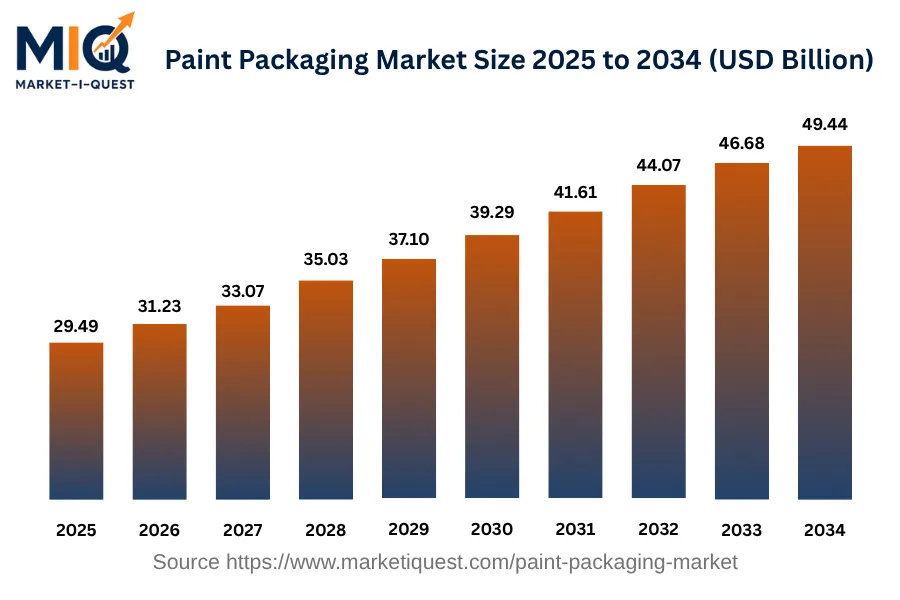
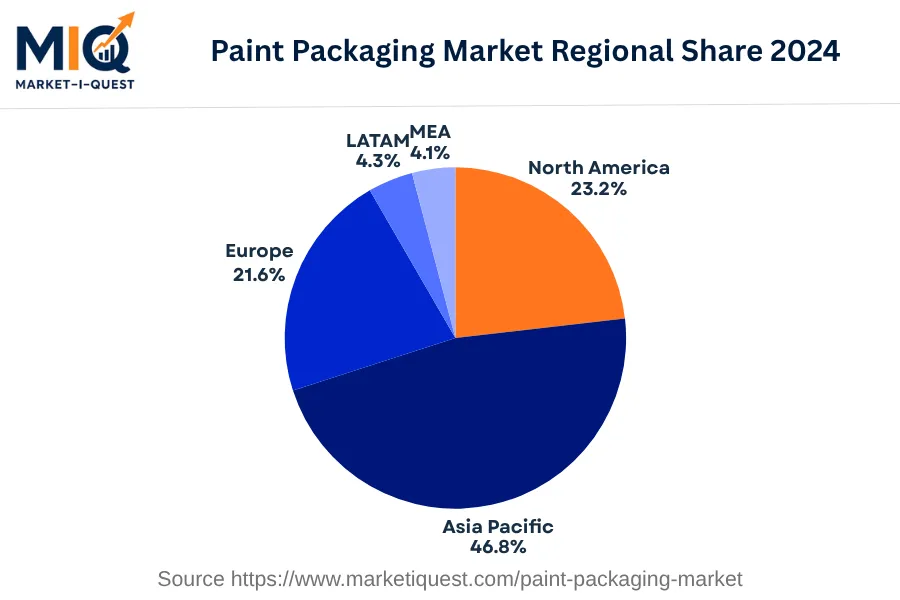
The Paint Packaging Market is anticipated to grow from USD 29.49 billion in 2025 to USD 49.44 billion in 2034, a CAGR of 5.91%. Starting from USD 27.84 billion in 2024, the market value ascends by roughly USD 1.65 billion in the following year, and this uptrend initiates the projected period of sustainable growth leading to almost doubling of the market volume by the year 2034. This remarkable growth trajectory over the course of a decade is marked by steady annual increments in market value. The regional market shares in 2024 are distributed with Asia Pacific claiming the lion's share at 46.8%, followed by North America at 23.2%, Europe at 21.6%, while LATAM and MEA hold smaller shares at 4.3% and 4.1% respectively.

Key Takeaways

  • By Packaging Type - Plastic Containers held the major share in the Paint Packaging Market in the base year.
  • By Substrate Type - Plastic led the market accounting for a significant market share in the recent past.
  • By Distribution Channel - Distribution Networks was the leading segment in the base year.
  • By End Use Industry - Industrial Manufacturing emerged as the top sector in the Paint Packaging Market.
paint-packaging-market market size

Key Driving Factors

Sustainability and Environmental Regulations

In the paint packaging market, a significant driving factor is the increasing emphasis on sustainability and the regulations related to environmental protection. Governments worldwide have been implementing stricter measures to reduce environmental pollution, pushing companies to shift towards eco-friendly packaging solutions. For instance, European Union directives emphasize minimizing the impact of packaging on the environment. Thus, there is a rising demand for recyclable, reusable, and biodegradable paint packaging solutions. Adoption of environmentally friendly materials like bio-plastics and paper in packaging facilitates manufacturers in adhering to these regulations, simultaneously improving their brand image. This is driving innovation in the paint packaging industry, with companies investing in R&D to develop green packaging materials that meet both regulatory requirements and consumer preferences.
E-commerce boom and Consumer Convenience

The rising e-commerce boom, especially since the onset of the Covid-19 pandemic, is another key driving factor for the paint packaging market. With more people shopping for home improvement and DIY projects online, paint manufacturers are innovating their packaging to ensure product safety, ease of transport, and consumer convenience. Packaging now needs to withstand various handling stages, maintaining its integrity during shipping and ensuring no damage or leakage. This is resulting in a greater need for secure, durable, and effective packaging solutions for paints. Furthermore, user-friendly packaging with easy-to-open caps, grip-friendly design, or clear instructions for use is becoming increasingly important to enhance customer experience. These needs are directly influencing the paint packaging trends and driving the market growth.

Market Evolution by Timeline

2019-2023
During this period, predominantly construction companies and decorators drove demand in North America and Europe. The introduction of exciting eco-friendly packaging options transitioned the market from traditional metal cans to plastic cans and pouches. This shift faced constraints due to a lack of public recognition, delays in production lines and the initial costs of converting machinery. Notably, green certification, such as Cradle to Cradle (C2C) and Green Seal standards, influenced adoption. The pricing was competitive, with long-term contracts preferred by suppliers. Consumers were hesitant about the durability and sturdiness of these new packages, causing hesitation in acceptance.
2024
A surge was observed in Asia due to the rapid urbanization in countries such as India and China. On the supply side, manufacturers were able to improve plastic packaging quality, resulting in heightened acceptance. The European Union also enacted the Packaging and Packaging Waste Directive to push for recyclability in this year, affecting market behavior. A partnership approach between paint and packaging producers became more common. However, high raw material prices increased packaging costs, negatively affecting affordability.
2025-2029
Within this timeframe, key buyers include individual consumers and automotive companies, primarily in Africa and South America. Water-based paint packaging took precedence over solvent-based variants in an effort towards sustainability. The final hurdles for integration of eco-packaging were overcome, with regular end-users finding no difficulty in handling these packages. Prices were likely to be stable, with take-or-pay contracts most prevalent. A risk observed was the constant volatility of crude oil price - a key component for plastic packaging.
2030-2034
Demand from shipbuilding and repair companies grew significantly, concentrated in the Asia-Pacific region. The market saw increased recycling rates and a shift away from single-use plastics owing to technology advancements. Legislation notably embraced packaging neutrality, with the Packaging Neutrality Initiative (PNI) leading the charge. The commercial model involved bulk purchasing discounts to encourage larger orders. The key risk in this period was backlash from industries dependent on traditional packaging and their resistance to change.

Future Market Outlook

Future Opportunities

The current trajectory of the paint packaging market presents numerous future opportunities, primarily driven by sustainability initiatives and technological advancements. As consumer awareness regarding environmental issues grows, packaging solutions that comply with regulations such as the UK Plastic Packaging Tax are expected to gain traction, presenting an opportunity for companies like Sherwin-Williams to pivot towards sustainable options. The rise of e-commerce has led to an increased demand for efficient, durable packaging that minimizes product damage during transit. Companies like Behr Paints are likely to invest in innovative packaging designs to cater to the e-commerce segment. The trend toward DIY home improvement projects, which surged during the COVID-19 pandemic in 2020, continues to influence consumer behavior, providing opportunities for manufacturers to target novice DIY enthusiasts. Collaborations between paint manufacturers and tech firms, such as those seen in partnerships between RPM International and software developers, could further enhance the efficacy of paint applications. Moreover, the evolution of smart packaging technologies may provide fresh avenues for monitoring paint conditions, which would be appealing to both consumers and retailers. Market players could also explore opportunities in emerging markets, where urbanization trends are increasing the demand for quality paint products. These dynamics suggest a multifaceted growth landscape, driven by evolving consumer preferences and ongoing advancements in packaging technologies.

Segmentation Analysis

By Packaging Type

The market is divided into subsegments including Metal Cans, Plastic Containers, Drums & Pails, and Flexible Packaging; with Plastic Containers accounting for the largest revenue share and Flexible Packaging expected to grow at the fastest CAGR during the forecast period.

Largest Revenue Share

Plastic Containers

Market Share Leader

In base year 2024, Plastic Containers stood as the dominating sub-segment in terms of revenue owing primarily to its ubiquitous application across various industries. While Metal Cans, Drums & Pails and Flexible Packaging do have their use cases, Plastic Containers appear to be the go-to solution for packaging due to their lightweight nature, affordable manufacturing cost, and resistance to impacts or breakage. A vast majority of industries such as food & beverages, chemicals, pharmaceuticals, among others consistently prefer plastic containers due to these virtues. Additionally, these containers can be manufactured in a wide array of shapes, sizes, and colors, which allows for customization suiting different industry needs. Furthermore, plastic containers are more favorable to retailers and customers in terms of storage and transport as they do not pose the risk of breakage during shipment and handling. Although environmental regulations are increasingly strict about plastic waste, improvements and advances in recyclable plastic materials help retain the dominance of this sub-segment.

Fastest CAGR

Flexible Packaging

Forecast Period Growth Leader

Flexible Packaging is projected to grow at an accelerated CAGR during the forecast period post 2024. This predicted growth is spurred by increasing popularity and usability in sectors requiring flexible and lightweight packaging solutions, including personal care, food & beverages, household products and much more. Alongside, consumers' changing lifestyles and growing demand for portable and convenient packaging drive the proliferation of flexible packaging. This subsegment also offers significant advantages such as improved shelf visibility, easy use and storage, and customization options which further boost its demand. Their manufacturing process is also more environmentally friendly, using less plastic and producing less waste than traditional rigid packaging. Moreover, investments in technological advancements can lead to innovative functions such as resealability, different shapes, and microwave compatibility, making these more attractive. However, potential concerns about the recyclability and disposal of flexible packaging may pose a potential risk to growth.

By Substrate Type

The market is divided into subsegments including Metal, Plastic, Glass, and Paper & Cardboard. In 2024, the Plastic segment accounted for the largest revenue share while the Metal subsegment is projected to grow at the fastest CAGR during the forecast period.

Largest Revenue Share

Plastic

Market Share Leader

The Plastic subsegment stands as the revenue heavyweight in 2024 due to several influencing factors. Firstly, Plastic Substrates are widely used in industries such as automotive, electronics, and construction because of their lightweight, cost-effectiveness, and durability. Plastic as a substrate material also delivers high performance, flexibility, and adaptability character, allowing manufacturers to meet complex product specifications, thus boosting its demand. Furthermore, consumer trends in packaging solutions also drive a huge demand for plastic, as it is versatile and can be easily formed into various shapes and sizes. In the automotive industry, the use of plastic substrates also helps in weight reduction of vehicles and enhances fuel efficiency as well. Last but not least, advancing technology has boosted the recycling of plastic, thus encouraging its use as a substrate due to its reduced environmental impact.

Fastest CAGR

Metal

Forecast Period Growth Leader

The Metal subsegment, while not leading in revenue generation in 2024, is expected to grow at the fastest rate. The growth of this sector is primarily driven by its essential role in the rapidly evolving electronics and aerospace industries. Metals are exceptional conductors of electricity, making them integral to electronics manufacturing - from mobile devices to large household appliances. Meanwhile, heat resistance and durability properties of metals are favorable in aerospace for improving the overall performance and longevity of aircraft. Additionally, continuous advancements in processing technologies and additive manufacturing, or 3D printing, have made metal a preferred choice for substrate. The opportunities for customization offered by these technologies have led to increased adoption of metal substrates in small-batch, high-precision applications. However, these opportunities carry near-term risks too, as regulatory standards and shifting market dynamics can affect the market progress severely.

By Distribution Channel

The market is divided into subsegments including Direct Sales, Distribution Networks, Online Retailers, and Specialty Stores, with Distribution Networks accounting for the largest revenue share while Online Retailers is expected to grow at the fastest CAGR during the forecast period.

Largest Revenue Share

Distribution Networks

Market Share Leader

Distribution networks are at the forefront in terms of revenue generation for this market. In 2024, this is largely due to the widespread distribution capabilities, economies of scale, and the established relationships that these networks hold within the industry. Distribution networks typically have the prowess of reaching diverse geographies, which includes both urban and hard-to-reach rural areas, thereby ensuring a broader market reach. Moreover, the partnerships these networks have with a vast number of suppliers allow access to a wide product range to cater to a diverse set of customer needs. An additional factor contributing to their large revenue share is the reduction in supply chain complexities, providing a smooth procurement process and abating shortage issues. The customer base prefers these networks for the trust built over the years in providing quality products, reliability, and better customer service. So, largely the revenue generation capability of distribution networks is a function of their strategic positioning, geographical penetration, and established customer base.

Fastest CAGR

Online Retailers

Forecast Period Growth Leader

Online retailers are projected to grow at the fastest CAGR as the emerging market trends are favoring the growth of this segment tremendously. The driving factors behind this incline include an increase in internet penetration, technological advancements, and a shift in consumer behavior towards convenient shopping, especially in light of recent global events promoting social distancing. The rapid adoption of smartphones and increased convenience of shopping from home is a critical catalyst propelling growth. Moreover, online retailers can leverage advanced analytics to offer personalized customer experiences, which would provide an essential competitive edge. Partnerships with logistics companies can also mitigate delivery challenges and optimize shipping times, further fueling growth. However, near-term risks include cybersecurity threats and data privacy concerns, which need to be effectively managed to maintain the trust and patronage of customers. Nonetheless, with suitable strategies in place, online retailers are expected to significantly outperform other channels in terms of growth.

By End Use Industry

The market is divided into subsegments including Construction, Automotive, Industrial Manufacturing, Marine, and Others. In 2024, the Industrial Manufacturing sector accounted for the largest revenue share, while the Automotive sector is expected to grow at the fastest CAGR during the forecast period.

Largest Revenue Share

Industrial Manufacturing

Market Share Leader

Industrial manufacturing stood out as the largest revenue provider in 2024. Major factors contributing to its dominance include its vast range of applications and the rise in global manufacturing activities. With constant advance in technology, industrial manufacturing has moved far beyond traditional machines, promoting automation and efficiency. Industrial machines are now increasingly connected and automated, driving significant incremental value for businesses. Additional growth is primarily driven by globalization and an upswing in the demand for mass production. From consumer good to heavy machinery, the exponential demand in all sectors has meant this segment's success. The growth of the industrial industry and its manufacturing segments in developing countries like China and India has also helped push further revenue. The rise in ambitious government policies aimed at developing their manufacturing sectors is fueling growth. Therefore, the strengthening of the global economy, coupled with technological innovations, is expected to continue to drive the industrial manufacturing sector forward, guaranteeing considerable revenue.

Fastest CAGR

Automotive

Forecast Period Growth Leader

The Automotive sector in 2024 is poised to grow at the highest CAGR during the forecasted period. The sector's growth is attributable to factors such as the swift advancements in automotive technology to increase efficiency and meet consumers' increasing safety requirements. The emergence of electric vehicles and autonomous driving technology has opened up new opportunities for the automotive sector. Rising environmental concerns and regulatory pressure to cut carbon emissions have sped up the shift toward cleaner, electric mobility. Government incentives for electric vehicles and investments by global automakers are driving this shift. However, this transition also presents challenges such as infrastructure development for EV charging and cost reduction for electric vehicle manufacturing. Partnership of automakers with tech companies to drive innovations in assisted driving and connectivity, along with investments in battery technology, is vital for growth. Therefore, with the right actions and preparedness for the identified risks, the automotive sector stands to showcase accelerated growth.

Competitive Analysis

Key Market Players

Manufacturers / OEMs

PPG Industries Inc.
US
AkzoNobel N.V.
Netherlands
Sherwin-Williams Company
US

Key Suppliers & Raw Materials

Dow Chemical Company
US
BASF SE
Germany
Dupont
US

Distributors, Integrators & Channel Partners

Valspar
US
Kansai Paint Co., Ltd.
Japan
RPM International Inc.
US

Porter’s Five Forces Analysis

This analysis examines the competitive dynamics within the paint packaging market.

Supplier Bargaining Power

Medium

Suppliers have power due to material variation, but standardization offsets this somewhat.

Buyer Bargaining Power

High

Commoditized products and lack of differentiation boost buyers' power.

Threat of Substitutes

Low

Substitutes are few due to specific requirements of paint packaging.

Threat of New Entrants

Medium

Potential new entrants may be deterred by established brands and supply contracts.

Competitive Rivalry

High

Fierce rivalry exists due to low cost differentiation and availability of substitutes.

Regional Analysis

Geographic market dynamics and growth opportunities across key regions

Global Market Outlook

paint-packaging-market market regional share

North America

In 2024, the North American paint packaging market experienced strong dynamics influenced by various drivers and trends across the United States, Canada, and Mexico. Key demand factors were the growing construction sector, particularly residential, and an uptick in home improvement projects. Environmental regulations also shaped the market, pushing for more sustainable packaging solutions. Investment in R&D for innovative, eco-friendly materials intensified, accompanied by swift adoption of automation technologies for higher manufacturing efficiency.

There was a discernible shift towards online sales channels underpinned by the digitalization wave across retail sectors, altering buyer behavior markedly. Partnerships between paint and packaging companies became more frequent, aiming towards integrated packaging solutions. The upsurge in the e-commerce sector necessitated compliance with stringent transport regulations, fostering enhanced packaging standards for improved product protection during transit.

A noticeable trend was the increased demand from the government sector for refurbishment work on public infrastructure. Meanwhile, utilities and manufacturing sectors showed heightened interest in anti-corrosive paints, resulting in a need for specialized packaging. Additionally, increased consumer awareness on waste management invoked a trend toward recyclable packaging in the household paints sector. The interplay of these drivers and trends determined the trajectory of the North American paint packaging market in 2024.

Asia Pacific

In 2024, the Asia Pacific Paint Packaging Market experienced pronounced dynamics, largely driven by surges in construction and renovation activities, particularly in India, China, and key ASEAN markets. Governments' push for urbanization and robust foreign investments spurred the demand for sustainable paint packaging, aligning with environmental standards and restrictions on plastic use. Inflationary pressure and evolving material prices influenced supply dynamics, further strengthening the adoption of biodegradable paint packaging.

Significant shifts in consumption patterns were noted in Japan and South Korea, with a preference for eco-friendly and convenient packaging solutions. Technology played an instrumental role in market trends, with companies adopting advanced packaging systems to reduce carbon footprints and ensure product longevity. In Australia, regulations enforcement was evident, encouraging industry stakeholders to conform to green packaging norms. The manufacturing sector emerged as a substantial consumer of paint packaging, necessitating large scale procurement in countries like China and India.

Furthermore, the retail channels saw expanded footprints, with business consolidations and partnerships becoming commonplace to maximize market reach. Certain norms, such as China's Green Packaging Standards, became increasingly influential, prompting market players to rethink and redesign paint packaging strategies. Consequently, the Asia Pacific Paint Packaging Market in 2024 operated in a complex, continually evolving landscape, significantly shaped by environmental considerations, technology integration, and regulatory stipulations.

Europe

In 2024, the European paint packaging market experienced significant changes, shaped by a variety of factors. Regulatory commitments towards environment-friendly solutions drove demand for recyclable and eco-friendly paint packaging, primarily in Germany, the UK, and France. This shift was catalyzed by successful research in technological innovation within the packaging industry. Investment from major companies also played a significant role in creating competitive pricing dynamics, especially in Italy and Spain where local manufacturers increased their budget allocation towards sustainable packaging solutions.

Buyer behavior across the region also reflected an increasing preference for ecological considerations, pushing for a shift towards bio-sourced and biodegradable packaging. Furthermore, in the Nordics and Benelux, a trend towards using small-portion packaging prevailed, driven by consumer demand for convenient, less wasteful options. The dynamics of distribution channels underwent transformations as online platforms gained popularity in Central and Eastern Europe due to their ability to offer a wider variety. In terms of policy, strict enforcement of EC No.1272/2008 - CLP regulation within the European Union led to alterations in packaging standards, affecting labels and safety datasheets in particular.

In summary, the European paint packaging market in 2024 was underpinned by environmentally sensitive regulation, technology innovation, investment, pricing dynamics, evolving buyer preferences, and policy enforcement, impacting various sectors from manufacturing and retail to government and enterprise.

Latin America

In 2024, the Latin American paint packaging market experienced dynamic shifts driven by various factors. Increased construction activities, particularly in Brazil and Mexico, boosted demand for paint packaging. Regulatory changes in Argentina concerning environmentally-friendly packaging also instigated a notable shift toward sustainable packaging solutions. Furthermore, investment in advanced packaging technology was a major driver, primarily from Colombia's manufacturing sector seeking efficient, cost-effective packaging solutions.

Trends shaping the market included a distinct move toward recyclable and biodegradable materials in response to stringent environmental policies, particularly in Chile and Peru. Consumer behavior also showed increased preference for high-quality, innovative packaging designs, significantly influencing purchasing habits in retail sectors across LATAM. Notably, Mexico's retail sector saw the largest adoption of such trends. Additionally, voluntary standards implementation became more pronounced, driven by government and enterprise sectors attempting to achieve harmonization in packaging norms. In Brazil, this led to several partnerships and mergers among key players aiming to capture larger market shares.

Furthermore, the enforcement of strict waste management policies in Argentina underpinned the increased adoption of eco-friendly paint packaging, influencing both the supply and demand dynamics in the country. Importantly, a significant update in technology fostered efficiency in the LATAM paint packaging market, with Colombia's manufacturing sector being a key adopter of process automation and technology integration.

Middle East & Africa

In 2024, the Paint Packaging Market in the Middle East and Africa witnessed significant growth due to various demand and supply dynamics. The market saw an increase in demand thanks to infrastructure investment in Saudi Arabia, UAE, and Qatar linked to their transformation programs. In South Africa, Nigeria, and Kenya, growth was propelled by accelerating urbanization and retail expansion. Rising levels of disposable income across Egypt and Israel also played a prominent role, contributing to the upsurge in demand for paint and thus its packaging.

Increased environmental regulations, particularly in the UAE and Israel, encouraged the adoption of more sustainable paint packaging methods. Manufacturing companies responded by investing in technology to produce recyclable and reusable packaging. Emerging trends included a shift towards online distribution channels, driven by the widespread use of digital technology. Consumer behavior in countries like Saudi Arabia and South Africa also showed a preference for purchasing paint online. Major acquisitions, especially those involving established manufacturing companies, reshaped the existing competitive landscape. In Egypt, stricter policy enforcement was seen in the paint industry aiming at safeguarding consumers from substandard products. The key sectors involved in the paint packaging market included construction, oil and gas in countries like Nigeria and UAE, manufacturing in Egypt, and government-led infrastructure projects across Saudi Arabia and Qatar.

Recent Industry Developments

Latest market innovations, product launches, and strategic initiatives

February 2026

Mauser Packaging Solutions expanded its intermediate bulk container (IBC) and industrial steel/plastic drum reconditioning facilities across North America and Western Europe to meet growing circular-economy demands from industrial coatings manufacturers.

September 2025

Packaging material developers introduced next-generation monomaterial flexible pouches with spout closures for consumer DIY paint touch-ups and sample testing. The flexible pouch formats reduce plastic resin consumption by up to 70% compared to traditional 1-liter rigid cans and allow near-100% product evacuation to minimize paint waste.

Frequently Asked Questions