
Industrial Coatings Market Snapshot

Key Players

  • PPG Industries (United States)
  • Akzo Nobel N.V. (Netherlands)
  • The Sherwin-Williams Company (United States)
  • Axalta Coating Systems (United States)
  • Nippon Paint Holdings Co. Ltd. (Japan)
  • BASF SE (Germany)
  • RPM International Inc. (United States)
  • Kansai Paint Co. Ltd. (Japan)
  • Jotun Group (Norway)
  • Hempel Group (Denmark)

Market Size

Base Year 2024
$165.93 Bn
CAGR
3.75%
Forecast 2034
$239.78 Bn

Market Segments

By Resin
  • Acrylic
  • Epoxy
  • Polyester
  • Polyurethane
  • Fluoropolymers
By Technology
  • Water-Based
  • Solvent-Based
  • Powder
By End Use
  • General Industrial
  • Automotive & Transportation
  • Industrial Wood
  • Marine Protective
  • Packaging
  • Others

Market Dynamics

Drivers
  • Rapid industrialization growth
  • Increasing demand for eco-friendly coatings
Restraints
  • High production costs
  • Stringent environmental regulations
Opportunities
  • Rising infrastructure development
  • Increasing automotive production

Market Size

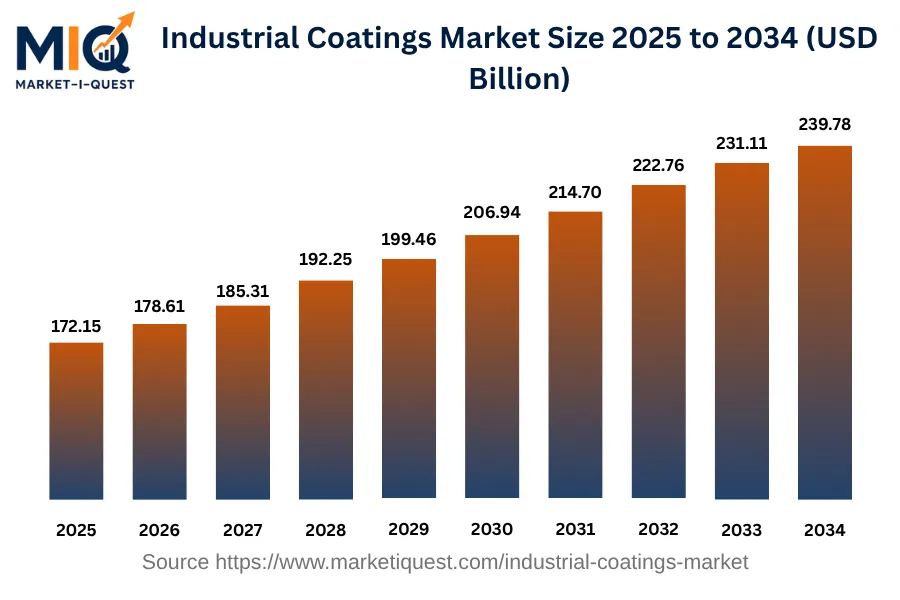
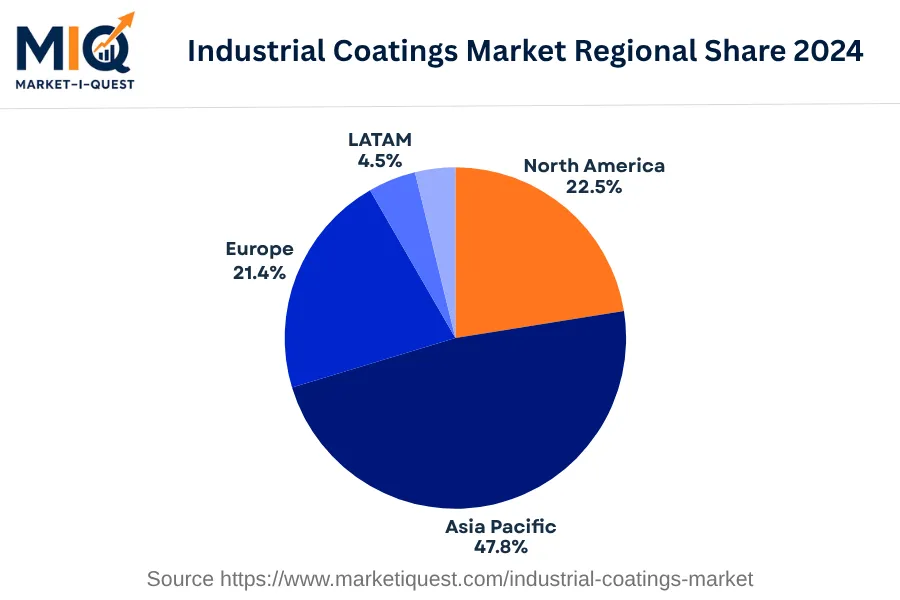
The Industrial Coatings Market was valued at USD 172.15 Billion in 2025 and is considerably projected to reach USD 239.78 Billion by 2034, expanding at a Compound Annual Growth Rate (CAGR) of 3.75%. Considering the progress from the initial value in 2024, which was recorded as USD 165.93 Billion, the market has seen a steady climb, set to continue moving on the same trajectory through the mentioned period up towards 2034. This growth is likely due to consistent advancements in industrial applications and technology in sectors such as vehicular production, construction, and others that indirectly demand increased output from the Industrial Coatings Market. In terms of regional market share in the target year of 2024, the highest share was held by Asia Pacific making 47.8% of the total market, with North America contributing 22.5%, followed by Europe which held 21.4% of the market. The remaining share was split between Latinoamerica and the Middle East and Africa region contributing 4.5% and 3.8% respectively to the global market.

Key Takeaways

  • By Resin - Epoxy subsegment held the top share prominently driving the market in 2024.
  • By Technology - Solvent-Based coatings emerged as the leading segment in 2024 in terms of market share.
  • By End Use -Automotive & Transportation subsegment played a dominant role in the market's growth in 2024.
industrial-coatings-market market size

Key Driving Factors

Stringent Environmental Regulations

In many industrialized countries, the implementation of stringent environmental regulations is significantly affecting the industrial coatings market. Regulations such as the National Emission Standards for Hazardous Air Pollutants (NESHAP) in the United States, and European VOC (volatile organic compounds) directives, are limiting the emission of VOCs and hazardous air pollutants (HAP). These substances are often present in traditional solvent-based industrial coatings. As a reaction, manufacturers are gravitating towards development and adoption of water-borne and high solid coatings, which have lower VOC content. Not only does this meet regulatory requirements, but it also enhances their CSR (Corporate Social Responsibility) image, while assuring the same level of protection and durability for their products.
Accelerating Infrastructure Development

The industrial coatings market is also being driven by accelerating infrastructure development globally. Particularly in regions like Asia-Pacific, there's a pronounced focus on infrastructure development for transportation, energy, and heavy industries. This movement is led by countries such as India and China and is part of their respective national growth strategies. Such infrastructure projects demand high volumes of industrial coatings to protect structural steel, concrete, and other materials from corrosion, extreme temperatures, and harsh weather conditions. Furthermore, the trend towards urbanization and the renovation of existing infrastructure in developed regions also provides impetus to the market.

Market Evolution by Timeline

2019-2023
Between 2019 and 2023, the global industrial coatings market saw a rising demand in the Asia-Pacific sector, particularly in China and Japan, as the automotive and construction industries thrived. Waterborne and powder coatings started getting traction due to environmental concerns and regulations such as REACH, replacing traditional solvent-borne coatings. Challenges faced included raw material cost fluctuation and consequently, unstable pricing patterns. Longer-term contracts became more common to manage aforementioned risk. Partnerships between suppliers and end-users formed for closer collaboration and alignment of roadmaps.
2024
In 2024, demand from emerging economies like India and Mexico rose, driven by infrastructure development programs such as 'National Infrastructure Pipeline' and 'Plan Nacional de Infraestructura'. However, supply chain disruptions due to COVID-19 pandemic remained, causing delays in coating deliveries and an increase in prices. Compliance to lower VOC emission regulations increased demand for eco-friendly coatings. Contract types evolved towards cost-sharing to manage supply and price risks. New partnerships formed as coating producers expanded into emerging markets.
2025-2029
Between 2025 and 2029, Europe witnessed increased demand for industrial coatings driven by the green energy initiatives, particularly wind turbine needs. Technological advancements in nanocoatings enhanced the properties of coatings, however, high production costs and equipment needs posed challenges. Stricter environmental regulations drove the industry towards more eco-friendly options. Subscription-pricing models began to appear to tackle cost uncertainty and induce customer loyalty. Coating manufacturers, due to supply-chain disruptions, expanded local production capabilities as a strategy to reduce dependence on imports.
2030-2034
In the period of 2030 to 2034, digitalisation was evident in the industrial coatings market. Buyers in US and Canada asked for touch-up coatings for the booming digital device industry. Advances in robotics and automation technology enhanced precision in coating application, pushing down manufacturing costs. Local regulation changes in the United States led to more rigorous product testing. A trend in production-sharing agreements emerged due to economic uncertainties. More direct-to-consumer channels were observed due to shifts in buying habits, but this exposed manufacturers to higher product liability risks.

Future Market Outlook

Future Opportunities

The industrial coatings market is expected to derive significant future opportunities from emerging technologies and evolving regulatory landscapes. As of late 2022, the emphasis on sustainable construction practices in regions like North America has prompted manufacturers to explore biodegradable and recyclable coating formulations, expanding their portfolios. With legislation such as the EU’s Green Deal paving the way for stricter environmental requirements by 2025, firms are likely to increase investments in R&D related to eco-friendly solutions. Integrated smart coatings, which provide self-repair and real-time monitoring capabilities, are being piloted by companies such as BASF in various industrial applications, suggesting a shift towards technological integration. The ongoing demand for protective coatings in renewable energy sectors, notably solar and wind, is evident as companies like Sherwin-Williams seek to develop specialized coatings tailored for these applications. Additionally, automation in production processes, exemplified by projects in Germany utilizing AI-driven technologies for precise coating applications, illustrates efficiency gains and cost-saving possibilities. Partnerships between coating manufacturers and academic institutions, initiated to explore advanced materials and processing techniques, are likely to streamline innovation pathways. The increasing focus on maintenance and lifecycle management within industrial operations could foster growth in specialty coatings, as businesses recognize the value of durability and performance over time.

Segmentation Analysis

By Resin

The market is divided into subsegments including Acrylic, Epoxy, Polyester, Polyurethane, and Fluoropolymers. Epoxy resin accounted for the largest revenue share while Fluoropolymers are expected to grow at the fastest CAGR during the forecast period.

Largest Revenue Share

Epoxy

Market Share Leader

The epoxy resin scores highly in bulk revenue generation owing to its multifaceted application in various areas such as coatings, adhesives, composites and other industrial applications. Its qualities, such as high strength, durability, and excellent adhesion, contribute heavily to its primary role in protective coatings that maintain infrastructure and machinery. As industries, both in developed and emerging economies, expand their operations and increase capital expenditure, the demand for epoxy soars. Consequently, geographic spread and diversified customer base account for its large revenue share. Its dominant position is further bolstered by the lack of viable substitutes, contributing to a high customer switching cost in this segment. While the competition is intense and regulation stringent, the key to capturing the market is excellence in supply chain operations, where leading brands are investing to make a difference.

Fastest CAGR

Fluoropolymers

Forecast Period Growth Leader

Although Fluoropolymers subsegment does not currently hold the largest market share, it is expected to grow at an unprecedented rate. The notable growth of Fluoropolymers can be attributed to its superior performance characteristics such as heat resistance and low friction, extending its use across a spectrum of applications in the automotive, aerospace, and electronics industries. Policy shifts towards renewable energy and electric vehicles are pushing automative companies to improve efficiencies where Fluoropolymers serve an essential role. Further developments in the Fluoropolymers market are catalyzed by technological advancements and strategic partnerships. Though initial capital investment in its production can pose as a barrier to rapid adoption, the solution lies within innovative financing models and partnerships. However, near-term risks such as fluctuations in raw material prices and regulatory impositions need to be diligently navigated.

By Technology

The technology segment comprises subsegments like Water-Based, Solvent-Based, and Powder technology. Solvent-Based technology is the leading revenue generator whereas Powder technology is anticipated to register the highest CAGR in the future.

Largest Revenue Share

Solvent-Based

Market Share Leader

The Solvent-Based technology is the largest revenue earner in 2024 and this could be attributed to its widespread application across various sectors. It is highly favoured for its quick drying times and durability. The Solvent-Based technology delivers high-quality finishes and offers excellent performance in extreme weather conditions, making it suitable for outdoor applications. Additionally, products from this subsegment often require fewer layers of application, which spells considerable cost savings and convenience. The main consumers of Solvent-based technology are industries that require their end products to have excellent finishing and resilience. Geographically, regions with burgeoning construction sectors like Asia-Pacific probably contribute largely to the demand. At the same time, regulations that favor low-VOC products might pose a challenge to this subsegment. However, it's clear that both manufacturers and consumers alike recognize the unique advantages of solvent-based technology and its value proposition, contributing to its significant revenue generation.

Fastest CAGR

Powder

Forecast Period Growth Leader

The Powder technology is expected to post the highest CAGR during the forecast period. This is due to the growing preference for eco-friendly solutions as the subsegment operates without solvents thus limiting harmful emissions. The Powder technology also boasts a high transfer efficiency and offers the ability to reclaim and recycle overspray. Technological advancements such as the increasing use of automation in the powder coating process will further propel its adoption rate. The introduction of new formulas that improve the performance of powder coatings could unlock new applications and opportunities. However, initial setup and operating costs can be relatively high, potentially hindering some businesses from readily adopting Powder technology. Successful partnerships with equipment manufacturers to make entry-level powder coating systems more affordable could accelerate the adoption. Despite these potential challenges, the drive for sustainability combined with the technology's inherent efficiency makes it the fastest-growing subsegment in this context.

By End Use

The market's end-use segment comprises diverse subsegments including General Industrial, Automotive & Transportation, Industrial Wood, Marine Protective, Packaging, and Others. Of these, Automotive & Transportation accounted for the largest revenue share in 2024, while the Industrial Wood subsegment is anticipated to see the fastest CAGR during the forecast period.

Largest Revenue Share

Automotive & Transportation

Market Share Leader

The robustness of Automotive & Transportation subsegment's revenue generation can be attributed to a myriad of factors. The ever-growing global automotive industry, coupled with the pressing demand for safer and more efficient vehicles, has stimulated demand for high-performance and durable coatings and finishes, driving revenue growth for this subsegment. Geographically, booming automotive sectors in emerging markets such as India and China further amplify this trend, and stringent regulations regarding CO2 emissions have stimulated the production of lightweight vehicles, necessitating innovative coating solutions. The automotive & transportation industry’s purchasing decisions are highly influenced by the cost-effectiveness, durability, and performance of products. Besides, the high switching costs associated with changing suppliers in this industry also help to sustain revenue generation for this subsegment.

Fastest CAGR

Industrial Wood

Forecast Period Growth Leader

The Industrial Wood subsegment is projected to register the quickest growth rate moving forward. This growth will be fueled by mounting global demand for furniture and other wood products, thanks to ever-increasing urbanization as well as rising disposable incomes. The deployment of innovative technologies has enabled the production of durable, water-resistant, and aesthetically appealing finishes on wood products, driving demand especially in residential and commercial settings. However, the high capital expenditure associated with adopting these technologies may pose a barrier to rapid adoption. Environmental regulations promoting sustainable practices can also act as a catalyst for growth in this subsegment, encouraging adoption of eco-friendly coatings. However, near-term economic uncertainties related to the ongoing COVID-19 pandemic could potentially disrupt growth.

Competitive Analysis

Key Market Players

Manufacturers / OEMs

AkzoNobel N.V.
Netherlands
PPG Industries, Inc.
US
Sherwin-Williams Company
US

Key Suppliers & Raw Materials

Evonik Industries AG
Germany
Eastman Chemical Company
US
BASF SE
Germany

Distributors, Integrators & Channel Partners

Sigma-Aldrich Corporation
US
Univar Solutions Inc.
US
Azelis SA
Europe

Porter’s Five Forces Analysis

This analysis evaluates the competitive dynamics in the industrial coatings market.

Supplier Bargaining Power

Medium

Deals with the level of competition among raw material suppliers and their ability to dictate prices.

Buyer Bargaining Power

High

Major industrial clients can adjust their demand and negotiate better prices.

Threat of Substitutes

Low

Limited substitutes due to the specific functionality of industrial coatings, such as corrosion resistance.

Threat of New Entrants

Medium

Entry barriers include heavy regulations, but innovations can lower startup costs.

Competitive Rivalry

High

Market flourishes with numerous competitors providing a wide spectrum of coating technologies.

Regional Analysis

Geographic market dynamics and growth opportunities across key regions

Global Market Outlook

industrial-coatings-market market regional share

North America

In 2024, the North American industrial coatings market demonstrated steady growth, driven predominantly by robust demand, technological advancements and increased investments in the region. The escalation in demand was primarily attributed to a flourishing construction sector and expanding automotive manufacturing hubs in the U.S., Canada, and Mexico. A rise in green building certifications and stricter government regulations on emissions and pollutants also played a part, enforcing the use of environment-friendly coatings. Moreover, increasing investments in research and development to improve coating technology gave a significant boost to the market.

Notably, buyer behaviors pointed towards a strong preference for coatings with antibacterial and antiviral properties, due to heightened hygiene awareness in healthcare and food processing industries. Technological strides led to an elevated popularity of nano-coatings due to their superior protective and durability features. Additionally, the market saw a surge in partnerships to expand product portfolios and streamline distribution channels. For instance, numerous coating manufacturers formed alliances with residential building constructors to ensure steady supply. In enforcement terms, industrial policies tightened the production quality standards and regulatory norms, bolstering the market for premium, regulation-compliant coatings. The significant impact sectors included transportation, construction, and utilities, among others. Hence, in 2024, the North American industrial coatings market was fueled by evolving technologies, strict health and environmental regulations, and changing consumer preferences.

Asia Pacific

In 2024, the industrial coatings market in Asia Pacific experienced an evolution instigated by several drivers and reshaped by emerging trends. Decentralized manufacturing growth, stringent environmental regulations and infrastructural development across China, India, and key ASEAN markets were primary demand-side drivers. Appreciable investments in advanced technological adaptation, along with escalating raw material costs added layers of complexity to the supply dynamics. Seismic shifts concerning buyer behavior were noticeable, leaning towards sustainable and eco-friendly solutions in response to constructive policy enforcement in countries like Japan and South Korea. Governments, large-scale manufacturers, and utilities were vital market participants adapting this change. The inclusion of nanotechnology in coating formulations was another notable technological shift, pioneered by prominent M&A activities among market leaders, particularly in Australia.

The online retail space emerged as a popular distribution channel, propelled by the pandemic-induced push for digital optimization, even for traditional industries like industrial coatings. Furthermore, the concerted focus on standardizing coatings applications underlined a critical market trend, especially visible in India's automotive and construction sectors. Regulatory emphasis on fire-resistant and anti-corrosion coatings solidified this paradigm shift. Hence, in 2024, the Asia Pacific industrial coatings market existed within a dynamic ecosystem gravitated towards technological adoption, sustainable practices, and standardized regulations.

Europe

In 2024, the industrial coatings market in Europe experienced significant growth, driven by several key factors. High demand from automotive and construction sectors, particularly in Germany and the UK, boosted consumption. This surge was specifically pronounced due to increased investment in infrastructure and growing needs for corrosion resistance and high-temperature stability. Regulatory pressures also spurred growth, with the European Union's stringent environmental regulations prompting an industry shift towards eco-friendly, water-based coatings. Additionally, rapid technology adoption, chiefly in France and Italy, facilitated the development and application of innovative coating types, enhancing product performance while controlling production costs.

Dominant market trends reflected shifts in buyer behavior and evolving industry standards. An increased emphasis on sustainability, notable in sectors such as manufacturing and utilities, facilitated the increased adoption of environmentally-conscious coatings. This preference was prevalent in Scandinavian countries, known for their advanced sustainability practices. Additionally, there was a distinct move towards digital channels for sales and distribution, amplified by the industry response to the pandemic's lingering effects. A rise in partnerships and M&A activity was evident, especially within Central & Eastern Europe, as companies sought to broaden their capacities and enter niche market segments. Lastly, strict enforcement of EU policies on VOC emissions compelled firms to fine-tune their product portfolios, prioritizing coatings with reduced environmental impact.

Latin America

In 2024, the Industrial Coatings Market experienced vigorous activity in Latin America, largely driven by escalating infrastructural development, robust automotive production, and stringent regulatory requirements across countries including Brazil, Mexico, Argentina, Colombia, Chile, and Peru. Underpinning this industry were three core drivers: soaring demand for waterborne and high-performance coatings, elevated investments in infrastructure and automotive sectors, and increased adoption of resource-efficient coating technologies due to stringent environmental regulations. Increased implementation of the latter was seen especially in Mexico and Brazil. Regulatory compliance also influenced price dynamics, with premium products gaining impetus due to their eco-friendly properties.

Key trends observed in the market included a shift from solvent-based to waterborne and powder-based coatings, owing to rising awareness about VOC emissions and their impact on the environment. Additionally, there was a noticeable surge in e-commerce sales, reflecting changes in channel dynamics. Furthermore, partnerships and acquisitions became a common strategy among global players for market expansion. This was particularly visible in Brazil, where key players sought to strengthen their market grip. Enforced policy changes, such as the Volatile Organic Compound (VOC) Emission Standards, led to a rise in demand for compliant products in regulated sectors like manufacturing, utilities, and automotive.

Middle East & Africa

In 2024, the Middle East and Africa's Industrial Coatings Market witnessed significant growth driven predominantly by investment and pervasive demand from diversified sectors. The heightened investment levels in Saudi Arabia, United Arab Emirates, Qatar, and Egypt instigated this surge, propelled by infrastructural advancements and broadening manufacturing arenas. Technology adoption was discernibly high in sectors like oil and gas, utilities, and telecommunication, with a notable emphasis on corrosion resistant coatings. Regulatory mandates for environmental sustainability in Israel and South Africa also played a pivotal role, augmenting the demand for water-based and powder coatings. The stark increase in automotive production in Nigeria and Egypt additionally fueled the market.

Operational efficiency remained a paramount trend, with customers prioritizing low VOC emissions and increased lifespan of coatings. Technological innovation also played a significant role, the embracement of nanotechnology coatings to mitigate operational costs was particularly observable. Indeed, manufacturers and users increasingly gravitated towards environmentally friendly products for compliance and cost-effectiveness, shifting from solvent-based to waterborne coatings. Partnerships and M&A activities accentuated in severity, driven by an urgency to capture new growth opportunities, particularly in South Africa, Saudi Arabia, and Qatar. Finally, the enforcement of more stringent safety and environmental standards across sectors and economies contributed to the enduring market dynamism.

Recent Industry Developments

Latest market innovations, product launches, and strategic initiatives

July 2026

BASF Coatings finalized its transition to the brand name "Surventis" following the completion of a major transaction with the private equity firm Carlyle. This rebranding marks a new chapter for the business unit as it focuses on autonomous operations in the specialty coatings sector.

June 2026

Allnex completed a significant expansion of its manufacturing capacity at its Mahad site in India. This investment is designed to accelerate the regional supply of sustainable, high-performance coating resins, directly supporting the growing demand for eco-friendly industrial formulations in the Asia-Pacific region.

Frequently Asked Questions