Waterborne Coatings Market Snapshot

Key Players

  • Axalta Coating Systems (United States)
  • PPG Industries Inc. (United States)
  • Sherwin-Williams (United States)
  • Akzo Nobel NV (Netherlands)
  • RPM International Inc. (United States)
  • Asian Paints Ltd. (India)
  • Kansai Paint Co. Ltd. (Japan)
  • Nippon Paint Holdings Co. Ltd. (Japan)
  • Jotun A/S (Norway)
  • DSM (Netherlands)

Market Size

Base Year 2024
$91.48 Bn
CAGR
6.42%
Forecast 2034
$170.43 Bn

Market Segments

By Type
  • Acrylic
  • Polyester
  • Alkyd
  • Epoxy
  • Polyurethane
  • PTFE
  • PVDC
  • Others
By Application
  • Architectural
  • Industrial
  • Others

Market Dynamics

Drivers
  • Increasing environmental awareness
  • Rapid industrialization growth
Restraints
  • Stringent environmental regulations
  • Volatile raw material cost
Opportunities
  • Eco-friendly product demand
  • Emerging markets expansion

Market Size

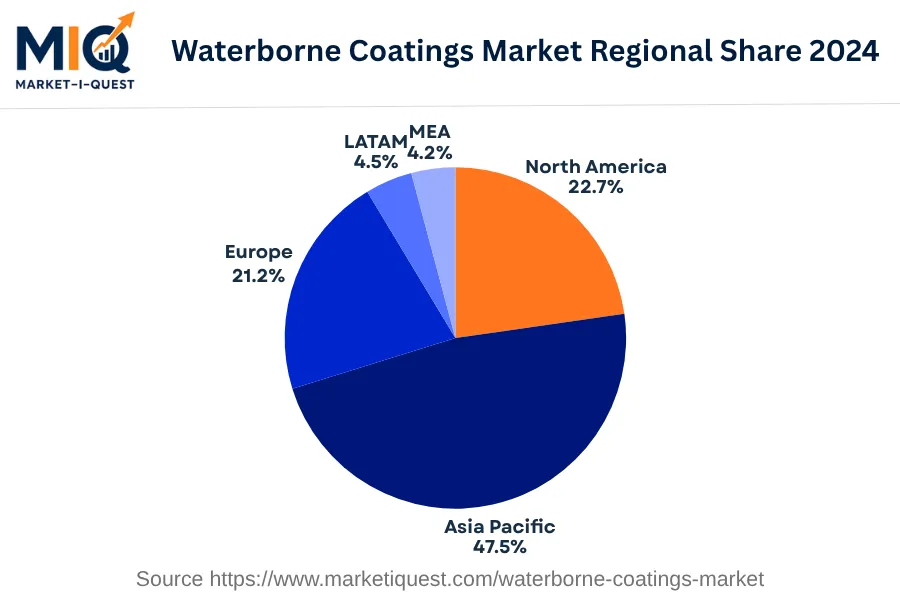
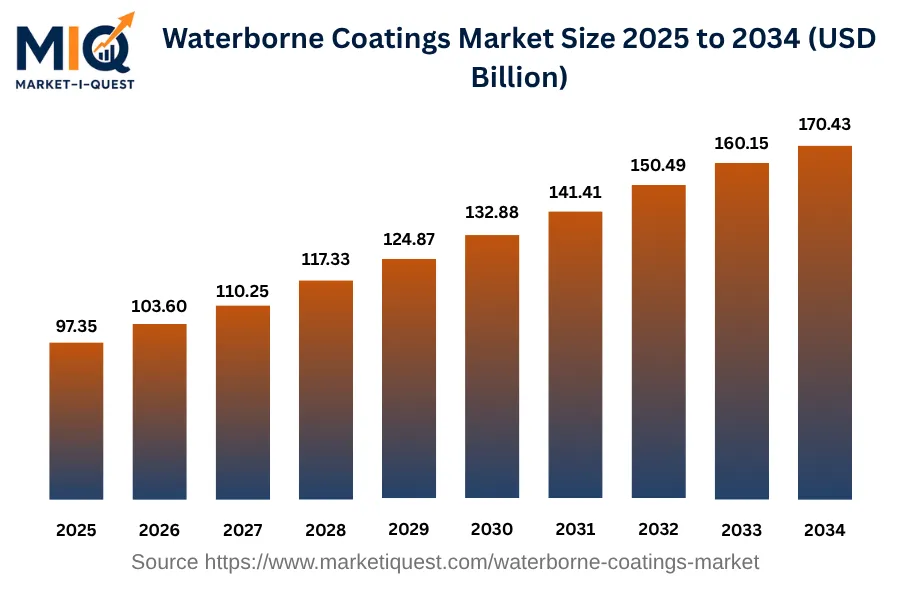
The Waterborne Coatings Market was valued at USD 91.48 billion in 2024, growing to USD 97.35 billion in 2025. Over the subsequent nine years, the industry expanded at a CAGR of 6.42% to reach a market value of USD 170.43 billion by 2034. This yield trajectory leverages the market's potential across the anticipated period, culminating in substantial industry growth. The growth was driven by the market's predominant regions, which were consistent contributors to the global market share. In 2024, the Asia Pacific held the largest regional share at 47.48%, followed by North America at 22.73%, and Europe at 21.16%. Meanwhile, LATAM and MEA contributed lesser extents to the global market with shares of 4.47% and 4.16%, respectively. These proportions reflect the geographical distribution of the market within the specified year, providing insights into the market's diverse global presence.

Key Takeaways

  • By Type - Acrylic was the leading subsegment in the Waterborne Coatings Market as of the base year.
  • By Application - Architectural held a significant position in the market share showcasing high demand.
waterborne-coatings-market market size

Key Driving Factors

Stringent Environmental Regulations

The waterborne coatings market is being heavily influenced by the strict environmental regulations imposed by governments worldwide, especially in North America and Europe. These jurisdictions continually tighten the rules on volatile organic compound (VOC) emissions in an effort to mitigate climate change. Waterborne coatings possess low VOC content, making them an eco-friendly alternative to solvent-based coatings. Manufacturers are compelled to reformulate their products to comply with these regulations, which directly leads to increased production and use of waterborne coatings. Simultaneously, downstream users in industries such as automotive and construction are pivoting to these greener coatings to meet their corporate sustainability targets.

Surge in Construction Activities in Developing Regions

A massive upswing in construction activities noted across developing regions like Asia-Pacific and Middle East & Africa is driving growth in the waterborne coatings market. Rapid urbanization combined with government initiatives for infrastructural development in countries such as China, India, and the UAE is leading to an increased demand for coatings in construction projects. Waterborne coatings, known for their durability and resistance to heat and humidity, are being widely used in this sector. Despite initial cost concerns, the long-term protection these coatings offer makes them more cost-effective in the long run, making them a preferred choice for builders and contractors in these regions.

Market Evolution by Timeline

2019-2023
In this period, Waterborne Coatings Market produced eco-friendly options, soared in construction, automotive, and furniture industries owing to regulations advocating for environment-friendly products. Products like epoxy resins, and acrylics gained popularity. However, supply struggled with issues like longer drying period and lesser spread. The United States, China, and Germany were major consumers, triggered by stringent regulatory standards - like the VOC emission standards by the US Environmental Protection Agency - encouraging use of environment-friendly substances. Typical contracts involved bulk purchases with price determined by market's volatility. Shrinking raw materials supplied posed risks, answered by recycling waste products and continual exploration for alternative raw materials.
2024
The Waterborne Coatings Market saw the introduction of nanotechnology during 2024. Improvements in technology enabled the production of nano waterborne coatings with superior properties including high corrosion resistance and superior hardness. Mainly, buyers were automotive and infrastructure industries. This was driven by gradual displacement of solvent-based coatings due to the Volatile Organic Compounds (VOCs) related regulation enforcement globally. Commercial engagements centered on long-term partnerships for scaling production capacity. A notable challenge was the high cost of raw materials and technology integration.
2025-2029
In this phase, development of the Waterborne Coatings Market was consolidated with market segments like polyurethane dispersions and inorganic waterborne coatings displaying demand growth. Industries like packaging, electronics, and aerospace were key demand drivers. Nano-coatings saw further refinement and wider acceptance because of their superior qualities. Supply constraints revolved around sourcing nano materials and complex product formulations. The European Union's ban on lead in paints played a role in regional market preferences and drove innovations in safer constituents. Commercial models further evolved as technology sharing and strategic alliances became common. Potential risks lay in fluctuations of raw material prices and resistance to technology adoption from traditional players.
2030-2034
During this period, the Waterborne Coatings Market's focus was on developing coatings with intelligent and functional properties, such as self-healing or stimuli-responsive coatings. Growing demand stemmed from industries like healthcare and consumer electronics that valued these high-tech coatings. Production faced challenges in ensuring consistent quality and scale. Regulatory measures, especially in Europe and North America, favored waterborne coatings with lower VOCs and Hazardous Air Pollutants (HAPs). Market trends visibly shifted towards performance-based contracts which were pegged to measurable parameters of the coatings applied. A futuristic risk was large-scale bio-based and mineral-based solutions potentially usurping synthetic waterborne coatings.

Future Market Outlook

Future Opportunities

The waterborne coatings market presents several avenues for future growth, particularly as environmental regulations become increasingly stringent in various regions. For example, the European Union's REACH regulations mandate a shift towards safer chemical alternatives, which could lead to greater demand for waterborne products. Manufacturers are well-positioned to capitalize on these changes, as shown by companies like Sherwin-Williams announcing their commitment to expanding green product lines. Additionally, in 2022, the U.S. adopted the Clean Air Act amendments, which focus on reducing air pollution from industrial sources, stimulating investments in low-emission coating solutions. The automotive industry is another promising sector, where OEMs like Ford are seeking sustainable coating options for their electric vehicles, highlighting an urgent need for waterborne alternatives. Collaborations, such as the partnership between PPG and Tesla in 2023, demonstrate how companies are aligning to meet these sustainability goals while enhancing their product offerings. Furthermore, the rise in DIY home improvement projects, accelerated by the COVID-19 pandemic, suggests an expanding consumer market for user-friendly, waterborne coatings. As consumers increasingly prioritize eco-friendly choices, brands that proactively market their sustainable attributes will likely gain competitive leverage. The convergence of regulatory support, industry alliances, and evolving consumer preferences positions the waterborne coatings market for promising opportunities as it adapts to meet future demands and expectations.

Segmentation Analysis

By Type

The market is divided into subsegments including Acrylic, Polyester, Alkyd, Epoxy, Polyurethane, PTFE, PVDC, and others. Acrylic accounted for the largest revenue share while Epoxy is expected to grow at the fastest CAGR during the forecast period.

Largest Revenue Share

Acrylic

Market Share Leader

Acrylic leads the market in terms of revenue share due to its vast range of applications. It is a versatile material that is highly resistant to weather, UV rays, and chemicals, making it the preferred choice for various industries such as automotive, construction, and electronics. Additionally, the recent surge in infrastructure development across developing economies like China and India has significantly amplified the demand for acrylic coatings for their durability and protective qualities. Furthermore, regulatory reforms favoring environmentally friendly products are driving the shift towards water-based acrylic coatings that have low VOC emissions, thereby contributing to their substantial revenue share. However, it's important to note that fluctuations in raw material prices may pose challenges to the acrylic segment's growth.

Fastest CAGR

Epoxy

Forecast Period Growth Leader

On the other side of the spectrum, Epoxy is expected to witness the fastest growth during the forecast period. Epoxy's robust growth can be attributed to its excellent adhesion, high resistance to chemicals and corrosion, and suitability to various substrates. The growing aerospace and automotive industries, as well as an increasing demand for corrosion-resistant coatings in marine applications, are likely to be significant growth drivers. It is noteworthy that technology advances improving epoxies' adaptability to extreme temperatures and harsh environments could further boost their adoption. However, higher costs and longer curing times when compared with other options, such as polyurethane coatings, may serve as barriers to growth in cost-sensitive markets.

By Application

The market is divided into subsegments including Architectural, Industrial, and Others. Of these, Architectural accounted for the largest revenue share whilst Others is expected to grow at the fastest CAGR during the forecast period.

Largest Revenue Share

Architectural

Market Share Leader

The Architectural subsegment pervasively leads in revenue, attributable to a surge in urbanization and the emerging trend of smart cities. With ever-growing urban landscapes, the demand for innovative and sustainable architectural solutions is at an all-time high. Furthermore, regulatory policies advocating for energy-efficient and environmentally friendly practices have stimulated the sector, rendering it as the largest revenue contributor. Geographically, regions with high rates of urban planning and construction, such as Asia and North America, significantly bolster this segment's dominance. Equally important is the consumer’s preference for aesthetics and durability, which, coupled with rising disposable income, escalates the purchasing pattern towards high-quality architectural solutions. Established supply chains and strong partnerships with construction firms fuel supply efficiency, thereby reinforcing the architectural sector's hold on the market. However, the segment faces risks in the form of volatility in raw material prices and stringent environmental regulations.

Fastest CAGR

Others

Forecast Period Growth Leader

The Others category, while diverse, is expected to experience the most considerable growth in coming years. This is primarily driven by the growing adoption of advanced materials and processes in various industries that do not fall under the traditional architectural or industrial categories. Potential catalysts for this growth include technological advancements, supportive policy measures, and strategic partnerships – all of which enhance the viability of niche applications. Industries such as electronics, aerospace, and automotive are progressively exploring novel applications due to factors such as capex reduction and performance enhancement, acting as significant contributors to this growth. However, hurdles to adoption, such as the absence of well-established channels and potentially high implementation costs, may pose near-term risks. Thence, a balanced view must be maintained when considering investments in the Others segment.

Competitive Analysis

Key Market Players

Manufacturers / OEMs

Akzo Nobel N.V.
Netherlands
PPG Industries, Inc.
US
The Sherwin-Williams Company
US

Key Suppliers & Raw Materials

BASF SE
Germany
Arkema Group
France
Nippon Paint Holdings Co. Ltd.
Japan

Distributors, Integrators & Channel Partners

PPG Industries, Inc.
US
RPM International Inc.
US
Kansai Paint Co., Ltd.
Japan

Porter’s Five Forces Analysis

This analysis delves into the competitive dynamics in the global waterborne coatings market.

Supplier Bargaining Power

Medium

Suppliers have some influence due to the specialized nature of coating material production.

Buyer Bargaining Power

High

Buyers from big industries command high bargaining power due to the presence of multiple suppliers.

Threat of Substitutes

Low

Due to superior performance and environmental friendliness, waterborne coatings face low substitution threats.

Threat of New Entrants

Medium

Facility setup and R&D funding pose barriers, but increasing demand can attract new players.

Competitive Rivalry

High

Competition is strong with many established players providing a wide array of product choices.

Regional Analysis

Geographic market dynamics and growth opportunities across key regions

Global Market Outlook

waterborne-coatings-market market regional share

North America

In 2024, the North American waterborne coatings market presented a dynamic landscape, primarily driven by environmental regulations, demand from key industries, and technological advancements. Strict governmental policies in the U.S., Canada, and Mexico, such as the Clean Air Act, steered manufacturers toward low-VOC waterborne coatings in an effort to reduce environmental impact. Large-scale investments in infrastructure and automotive sectors bolstered demand, with a high uptake of waterborne coatings seen in industries spanning from automobile manufacturing to housing construction due to their eco-friendly and low-toxicity properties. Technology adoption played a significant role in market dynamics. Advanced production methods enabled cost-efficient development of high-performing waterborne coatings, stimulating supply. On the pricing front, competitive prices for waterborne coatings as compared to traditional solvent-based options spurred their wider adoption.

In terms of trends, buyer preferences leaned toward sustainable and higher performance products. This shift was reflected in increased demand for acrylic and polyurethane-based waterborne coatings in sectors including automotive, architectural, and industrial. Distribution channels also evolved, with online platforms playing a key role in product availability and purchase. As for industry collaboration, notable partnerships and M&As between leading coating producers and raw material suppliers were observed, aimed at strengthening supply chain efficiency and ensuring consistent product quality. Regulatory bodies continued to maintain rigorous standards, impacting product formulation and delivery.

Asia Pacific

In 2024, the Waterborne Coatings Market in Asia Pacific experienced noticeable growth, influenced by various drivers and trends. With governments in countries like China and India emphasizing environmental sustainability, regulations promoting low-VOC coatings accelerated market demand. Additionally, extensive investments in infrastructure projects across these regions fueled the need for waterborne coatings. Technology adoption in Japan and South Korea enabled efficient production, leading to consistent supply dynamics.

Interest in eco-friendly products significantly shifted buyer behavior, leading to increased market acceptance. Also, demand from key sectors such as construction, automobile, and manufacturing propelled market expansion. Channel dynamics evolved as digital platforms offered products directly to end-users, promoting customer reach and profit margins. Furthermore, collaborative partnerships and M&A activity strengthened among multinationals to consolidate their market positions. In Australia and ASEAN markets, the enforcement of strict environmental policies led to an increased market preference away from solvent-borne coatings. With these driving factors and trends, Waterborne Coatings Market manifested a robust position in the Asia Pacific region in 2024. Affected by localized demand factors, regulations, technology adoption, and policy enforcement, the focus on environmental sustainability remained central to its expansion. The evolving buyer behavior, growing digital space, and strong demand from key industry sectors further solidified the market’s stance.

Europe

In 2024, the European Waterborne Coatings Market saw substantial development due to various demand factors and regulatory requirements. Environment-focused regulations across Europe, including Germany's Chemikalien-Verbotsverordnung, significantly encouraged the adoption of eco-friendly waterborne coatings. The commitment to green manufacturing was paramount in enhancing demand, particularly within the automotive and construction sectors. Notably, investments in research and development increased, promoting technological advancements in waterborne coatings, essential for high-performance demands across industries including maritime and utilities.

The market observed a shift in buyer behavior as sustainable purchasing became a regained focus across the European Union, particularly in France and Benelux, where Green Seal standards played a pivotal role. Product shifts to nanosilica waterborne coating materials, renowned for their durability and environmental friendliness, were increasingly prevalent in Italy and Spain due to the resurgence in construction. Partnerships between coatings manufacturers and automotive giants proliferated in the UK market, with aims to reduce the environmental impact of car manufacturing. Strict policy enforcement, especially in the Nordics and Central & Eastern Europe, contributed to a significant reduction and eventual eradication of solvent-borne coatings.

Latin America

In 2024, the Waterborne Coatings Market in Latin America remained a vibrant segment within the chemicals industry, heavily influenced by factors such as regulatory changes, growing demand, and advances in technology. Stringent environmental regulations were particularly influential, driving demand for eco-friendly waterborne coatings in countries like Brazil and Mexico. Further, growing industrialization and urbanization across Brazil, Argentina, and Peru kindled investment in construction and automotive sectors, significantly boosting demand for protective waterborne coatings. Waterborne technology itself underwent substantial advancements during this period, with Argentina leading in the adoption of high-solid binders in waterborne formulations, enhancing both performance and sustainability. While regulations and demand proved compelling drivers, supply dynamics were shaped by raw material availability and price volatility.

Shifting trends similarly characterized the market in 2024, with significant changes detected in buyer behavior and tech adaptations. The pandemic induced a significant shift towards online procurement across Latin American countries, particularly in retail and enterprise sectors, fostering direct manufacturer-end user connections, and hence, redefining channel dynamics. The motor vehicle sector, for instance, recorded an increase in demand for improved corrosion resistance, prompting a rise in waterborne coatings usage. Additionally, notable enforcement of green building standards in Colombia and Chile created a substantial shift towards sustainable products, driving the regional adoption of waterborne coatings. Further, major consolidations and M&A activities were observed in regions prioritizing economies of scale and technology advancements.

Middle East & Africa

In 2024, the Waterborne Coatings Market saw impressive traction in the Middle East and Africa. The market growth was propelled by increased demand in the construction and automotive sectors, need for eco-friendly solutions in Saudi Arabia, UAE, Egypt, and South Africa, and significant technological advancements in coating solutions. Factors such as stringent environmental regulations, particularly in Israel and South Africa, and heavy investment in the infrastructure sector, notably in the UAE and Qatar, too played a vital role in defining market dynamics. Simultaneously, the trend of transitioning from conventional solvent-based coatings to waterborne coatings became pronounced across sectors, inclusive of manufacturing and retail. Green building standards and policies, strongly enforced in nations such as Saudi Arabia and Israel, boosted the adoption of waterborne coatings. There was a noticeable shift in buyer behavior, favoring products with lower environmental impact, seen predominantly in Jordan and Kenya.

In the realm of strategic cooperation, partnership ventures and M&A activities gained momentum, contributing significantly to market expansion. Key industry sectors such as oil and gas, utilities, and telecom became prime customers for these coatings, pushing demand higher. The incorporation of nanotechnology in coating solutions was a crucial technological shift observed in the base year. The market growth was marked by the interplay of these drivers and trends.

Recent Industry Developments

Latest market innovations, product launches, and strategic initiatives

May 2025

China's State Administration for Market Regulation and Standardization Administration jointly issued two mandatory national standards — GB 30981.1-2025 (Architectural Coatings) and GB 30981.2-2025 (Industrial Coatings) — setting stricter limits on VOCs, SVOCs, formaldehyde, benzene series, and heavy metals in waterborne coatings. The standards took effect on June 1, 2026.

Frequently Asked Questions