
Oxo Alcohol Market Snapshot

Key Players

  • Dow Chemical Company (United States)
  • BASF SE (Germany)
  • Eastman Chemical Company (United States)
  • Evonik Industries AG (Germany)
  • Ineos Oxide (Switzerland)
  • LG Chem Ltd. (South Korea)
  • Exxon Mobil Corporation (United States)
  • Andhra Petrochemicals Ltd (India)
  • Sasol Limited (South Africa)
  • Elekeiroz SA (Brazil)

Market Size

Base Year 2024
$15.39 Bn
CAGR
5.52%
Forecast 2034
$26.34 Bn

Market Segments

By Type
  • n-Butanol
  • Iso-Butanol
  • 2-Ethylhexanol
  • Others
By Application
  • Plasticizers
  • Acrylates
  • Acetates
  • Resins
  • Solvents
  • Glycol Ethers
  • Lube Oil Additives
  • Others

Market Dynamics

Drivers
  • Increased demand in plasticizer industry
  • Rise in cosmetic & personal care sector
Restraints
  • Regulatory Constraints
  • Volatile Raw Material Prices
Opportunities
  • Growing demand in plasticizers industry
  • Rising use in detergents manufacturing

Market Size

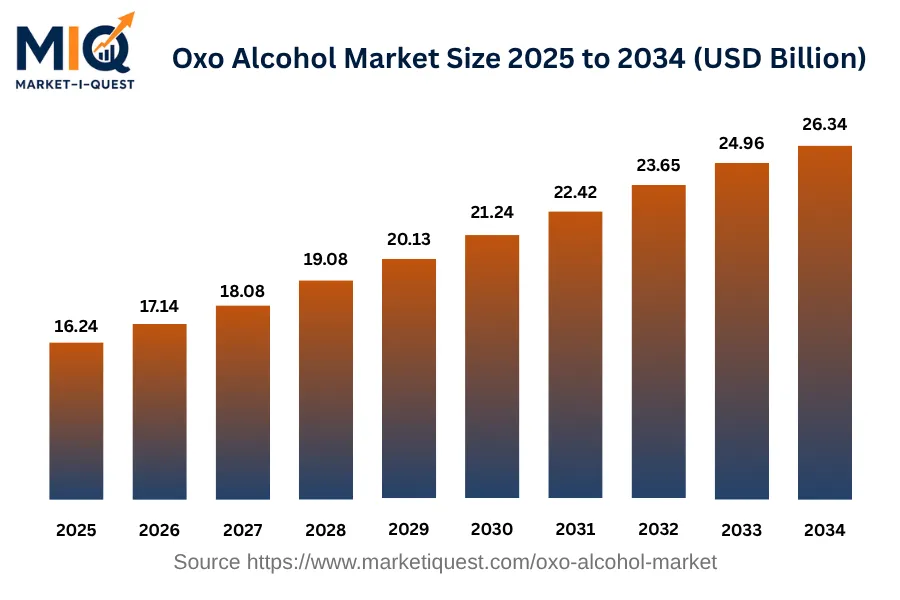
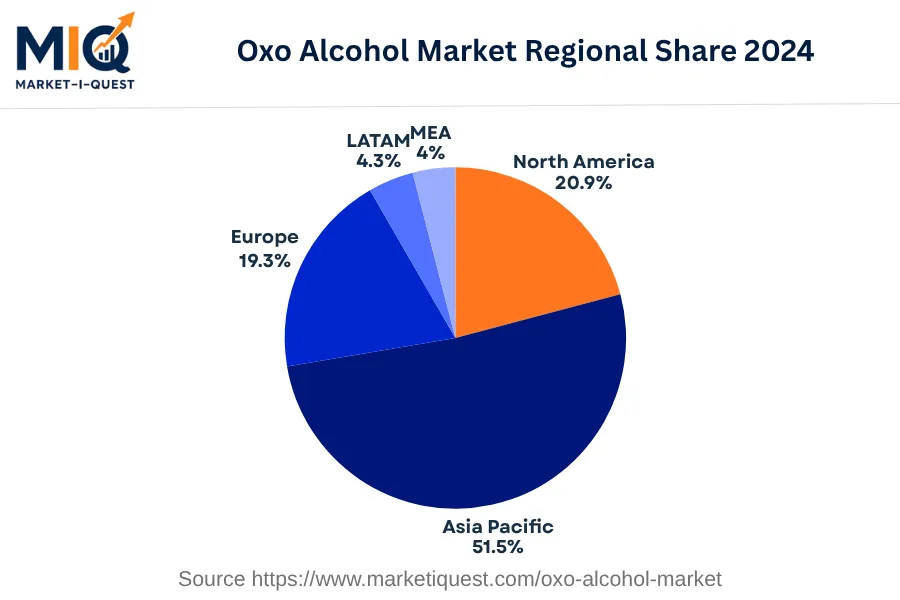
The Oxo Alcohol Market, valued at 16.24 billion USD in 2025, is expected to grow significantly to reach a value of 26.34 billion USD by 2034, representing a CAGR of 5.52% throughout this period. The market begins its growth path from a size of 15.39 billion USD in 2024, experiencing steady growth and expansion over the subsequent decade. While the increase is consistent, the impact of market variations across the timeline should be duly acknowledged. Analyzing the regional market share as of 2024, Asia Pacific leads the pack with a dominating 51.48%, followed by North America at 20.86%, and Europe at 19.32%. The least shares of the Oxo Alcohol Market are held by LATAM and MEA with 4.31% and 4.03% respectively. This distribution provides insight into the geographical expansion and potential of the market, imparting a crucial understanding of areas with development potential for stakeholders.

Key Takeaways

  • By Type - n-Butanol is witnessing swift growth representing the fastest-growing subsegment.
  • By Application - Plasticizers led the market registering substantial dominance over other applications.
oxo-alcohol-market market size

Key Driving Factors

Shift towards Bio-based Oxo Alcohols

The market for oxo alcohols is increasingly influenced by the global and regional shift towards environmentally sustainable raw materials. As the potential impact of petrochemical products on the environment has gained global recognition, industries are transitioning towards bio-based alternatives, a trend also observed in the oxo alcohol market. This is particularly the case in regions like Europe and North America where stringent governmental regulations encourage the use of eco-friendly materials. As bio-based oxo alcohols are derived from renewable sources such as vegetable oils, their manufacture and use result in lesser environmental damage, driving industries to adopt them over traditional petrochemical-based oxo alcohols.
Favorable Industrial Applications of Plasticizers

A significant portion of the global oxo alcohol market demand comes from its primary downstream application, plasticizers. These substances are crucial in the manufacturing of polyvinyl chloride (PVC), one of the most widely used polymers worldwide in industries such as constructions, automotive, and packaging. Oxo alcohols, especially 2-ethylhexanol and n-butanol, are extensively used in the production of plasticizers due to their effective properties. The thriving industrial demand for PVC-based products, therefore, directly influences the growth of the oxo alcohol market. Specifically, the construction industry, which makes extensive use of PVC for pipes, cables, and flooring, plays a pivotal role in driving the demand for oxo alcohols.

Market Evolution by Timeline

2019-2023
In this period, Asian market, led by China and India, exhibited increased consumption for Oxo alcohols, particularly in the plastics and coatings industries. On the supply front, the production slightly decreased due to environmental regulations that aimed to minimize the negative environmental impact of Oxo alcohol production. Pricing tendencies leaned towards a slight increase, considering the production costs affected by these regulations. The most common commercial model was long-term contracts between manufacturers and large-scale consumers. During this period, the primary risk was the inability to meet environmental standards, which companies addressed by adopting energy-efficient production processes.
2024
Seeing the market trends the previous year, 2024 witnessed an increased demand for Oxo alcohols in the European market, particularly in the cosmetics and personal care sector. Technological advancements led to improved production processes which complied with stringent environmental regulations. Policy enforcement under the EU Chemicals Strategy for Sustainability tightened. This, in turn, pushed the prices higher due to the increased cost of compliance. Companies were more inclined towards strategic partnerships to share the costs of regulatory compliance. The risk of non-compliance with EU policies was high and required strategic planning for mitigation.
2025-2029
This period was marked by strong North American demand driven by the expanding construction sector. Major producers like Dow Chemicals launched efficient production technologies to meet demand within environmental standards. Despite the increased compliance cost, the pricing remained competitive due to economies of scale achieved through technological advancements. More flexible, performance-based contracts began to emerge in this period, addressing both buyer and producer needs. The main risk was the availability of raw materials due to geopolitical tensions, met by diversifying supply sources.
2030-2034
The global focus now shifted to the growing bio-based Oxo alcohol market, with Europe leading the way. New technologies made bio-based Oxo alcohols a viable alternative. This followed a trend seen under the European Green Deal committing to develop sustainable chemicals. Pricing remained high due to research and development costs, yet were offset by renewable energy subsidies. Green partnerships became prominent, making it easier for companies to exchange technology and expertise. The risk of not being able to scale production to meet global demand was a common concern.

Future Market Outlook

Future Opportunities

The oxo alcohol market is set to explore several potential opportunities fueled by current industry dynamics and evolving consumer preferences. With regulatory frameworks tightening around product sustainability, manufacturers are increasingly focusing on biobased oxo alcohols, as evidenced by Clariant's commitment to developing renewable products from bio-sourced feedstocks announced in 2023. These strategies align with global trends towards sustainability, creating avenues for new product development and market expansion in regions such as Asia-Pacific, where demand for biodegradable materials is burgeoning. Moreover, collaborations among major corporations, like the partnership between LyondellBasell and TotalEnergies aimed at expanding low-carbon technologies, will likely open up new channels for growth. As consumer awareness around environmental issues grows, innovations in product formulations that meet ecotoxicological standards, such as those from the American National Standards Institute, will gain importance, paving the way for new offerings. In the automotive industry, the rising trend of electric vehicles is creating a fresh demand for specialty chemicals, including oxo alcohols, for applications in lightweight materials. Companies, including Dow, are also testing new applications for oxo alcohols in alternative energy systems. Thus, a strategic focus on sustainability initiatives and new application developments will position industry players to capitalize on shifting market landscapes effectively and responsively.

Segmentation Analysis

By Type

The market is divided into sub-segments including n-Butanol, Iso-Butanol, 2-Ethylhexanol, and Others. Of these, 2-Ethylhexanol accounted for the largest revenue share, while n-Butanol is expected to grow at the fastest CAGR during the forecast period.

Largest Revenue Share

2-Ethylhexanol

Market Share Leader

2-Ethylhexanol dominates the type segment in 2024 based on revenue largely due to its versatile functionality and wide-ranging application, particularly in the chemical industry. It is significantly used as a solvent in painting and coating industries, and as a plasticizer in PVC manufacturing. Its demand is also driven by the construction industry due to its use in PVC products such as pipes, cables, and insulation. In terms of geographical advantage, regions with robust construction and chemical industries tend to generate high demand for 2-Ethylhexanol. Ongoing industrialization and construction projects in regions like Asia-Pacific are further contributing to its revenue leadership. Stringency in environmental regulation has also been encouraging the use of 2-Ethylhexanol in formulations over other traditional solvents. Lastly, its longstanding presence in the market has solidified established distribution networks, easing accessibility for consumers and adding to its revenue superiority.

Fastest CAGR

n-Butanol

Forecast Period Growth Leader

n-Butanol is anticipated to be the fastest-growing subsegment in the type category, having seen rising interest and demand in the recent years. Significant driving factors for this growth include its increasing utilization in the production of butyl acrylate, butyl acetate, and glycol ethers, which are extensively used in industries like surface coating, textiles, and automotive. Furthermore, it has viable use as a solvent, an additive for fuels, and a raw material in synthetic resins, thereby broadening its application spectrum. The ongoing research and development projects, partnerships in the public and private sectors, and regulatory incentives to replace harmful raw materials in various industries promise further adoption. However, volatility in raw material prices and stringent environmental regulations could pose near-term risks to this growth. Our forecast assumes the continued innovation and partnerships driving n-Butanol's growth will continue to overcome these barriers seamlessly.

By Application

The market of Application is categorized into subsegments such as Plasticizers, Acrylates, Acetates, Resins, Solvents, Glycol Ethers, Lube Oil Additives, and Others. Of these, Plasticizers account for the largest revenue share, while Solvents are projected to grow at the fastest CAGR during the forecast period.

Largest Revenue Share

Plasticizers

Market Share Leader

In the base year 2024, Plasticizers emerged as the highest revenue-generating subsegment in the Application market. This dominance can be attributed to the pervasive use of plasticizers in a variety of sectors, particularly the construction and automotive industries. Plasticizers are crucial additives that increase the plasticity and flexibility of materials, making them essential to numerous manufacturing processes. Moreover, the booming construction industry worldwide, particularly in developing regions such as Asia-Pacific and Africa, has surged the demand for plasticizers. Additionally, the increasing demand for lightweight and fuel-efficient vehicles has further stimulated plasticizers' use in the automotive sector, consequently driving their market growth. However, there are certain regulatory challenges concerning the environmental impact of some conventional plasticizers, which might slightly constrain their market growth.

Fastest CAGR

Solvents

Forecast Period Growth Leader

The Solvents subsegment is projected to be the fastest-growing in the Application market. A key catalyst for this growth is the expanding demand for solvents across a wide swath of industries, including paints and coatings, pharmaceuticals, and adhesives. In the paints and coatings industry, solvents are used extensively to dissolve or disperse various components, such as pigments and resins. The rapid urbanization and industrialization, especially in emerging economies, have substantially increased the demand for paints and coatings, thereby driving the solvents market growth. In the pharmaceutical industry, solvents are critical for drug formulation. Given the constant growth in the global pharmaceutical industry, the demand for solvents is expected to rise rapidly. However, regulatory restrictions over the use of certain solvents due to environmental and health concerns could pose potential risks to this growth trend.

Competitive Analysis Oxo Alcohol Market

Key Market Players

Manufacturers / OEMs

ExxonMobil Corporation
US
BASF SE
Germany
The Dow Chemical Company
US

Key Suppliers & Raw Materials

Saudi Basic Industries Corporation (SABIC)
Saudi Arabia
INEOS AG
Switzerland
Eastman Chemical Company
US

Distributors, Integrators & Channel Partners

Helm AG
Germany
Univar Solutions Inc.
US
Brenntag AG
Germany

Porter’s Five Forces Analysis

This analysis investigates the competitiveness and strategic options available in the Oxo Alcohol Market.

Supplier Bargaining Power

High

Few suppliers and high switching costs increase supplier bargaining power.

Buyer Bargaining Power

Medium

Product differentiation is low but bulk purchase capability increases buyer bargaining power.

Threat of Substitutes

Low

Limited alternatives exist, making the threat of substitutes low.

Threat of New Entrants

High

Low capex requirements and minimal regulatory barriers make market entry relatively easy.

Competitive Rivalry

Medium

A moderate number of competitors with capacity for product innovation enhances competitive rivalry.

Regional Analysis

Geographic market dynamics and growth opportunities across key regions

Global Market Outlook

oxo-alcohol-market market regional share

North America

In 2024, the North American Oxo Alcohol market experienced a surge, driven by various factors and trends. Key drivers included the escalating demand for plasticizers in construction and automotive sectors across the U.S., Canada, and Mexico, increased adoption of environment-friendly alcohols in manufacturing and chemical industries, and enhanced capital investment in sustainable technology adoption.

Policies reinforcing greener production and increased demand for Polyvinyl chloride (PVC), a product of Oxo Alcohols, also stimulated the market growth. Pricing dynamics added an extra dimension, with Oxo alcohols becoming comparatively attractive due to the high cost of alternate options, further enhancing demand.

Trends witnessed in 2024 incorporated shifts in buyer behavior, favoring Oxo alcohols due to their broad application base in solvents, paints, and adhesives. Channel dynamics saw a rise in partnerships and M&As, primarily in the U.S market, with a focus on expanding supply and distribution networks. The emphasis on environmental compliance and sustainability standards also shaped the market trends, with enterprises and manufacturers increasingly adopting Oxo alcohols in their operational processes.

Simultaneously, the government's strong enforcement of policies promoting greener options drove firms in varied sectors - from healthcare to utilities and retail - to switch to Oxo Alcohols. As such, demand remained robust in North America's Oxo Alcohol market throughout 2024.

Asia Pacific

In 2024, the Oxo Alcohol market in Asia Pacific displayed robust dynamics linked predominantly to industrial development and population growth. A surge in demand for plasticizers resulting from infrastructure projects across China, India, and ASEAN countries significantly propelled the market. Moreover, revitalized domestic manufacturing sectors in Japan, South Korea, and Australia stimulated the demand for solvents, a derivative of Oxo alcohols—an underlying driver for market growth. Compliance with environmental policies favored the adoption of water-based paints and coatings, abetting demand for Oxo Alcohols that served in the production of these eco-friendly products.

Emergent trends observed in the market included a swerve towards sustainable production methods. Key players in China and Japan increasingly incorporated energy-efficient technologies in Oxo alcohol production. Regulatory stringency, primarily through China's “Air Pollution Prevention and Control Law”, reinforced this trend. There was a distinct shift in customer preference toward online purchases, marking a change in the market's channel dynamics. Traditional partnerships faced disruption as firms opted for strategic M&A; the Hitachi- Mitsubishi merger was a notable example. Government enforcement of VOC emission standards compelled industries towards water-borne coatings, thereby indirectly increasing the demand for Oxo alcohols. Overall, buoyed by industrial growth and guided by regulatory norms, the Oxo Alcohol market in Asia Pacific saw growth and transformation in 2024.

Europe

In 2024, the European Oxo Alcohol market witnessed robust conditions driven by several factors. Declining crude oil prices led to profitable production costs for manufacturers and influenced the demand positively. Regulatory supports particularly from the European Union Green Deal favored the adoption of Oxo-Alcohol in manufacturing sustainable chemicals and the paints & coatings sector. The market also benefitted from increased investments by key players in Eastern Europe to harness an untapped market potential.

Among the rising trends, sustainability emerged as a fundamental drive in buyer behaviour as manufacturers shifted towards natural feedstocks and renewable energy sources. The escalated demand for low Volatile Organic Compounds (VOC) products significantly shifted product technology towards advanced Oxo-Alcohols such as 2-Ethylhexanol and n-Butanol. Channel dynamics evolved towards e-commerce due to pandemic-induced constraints and digital transformation, enabling direct-to-consumer approaches. Strategic alliances and M&A activities were widespread across the region with emphasis in the Benelux and Nordic countries, primarily driven by a goal for sectoral expansion and dominance.

Industries such as automotive, pharmaceuticals, and consumer goods became prominent users of the Oxo Alcohol in the region, predominantly led by Germany, France, and the United Kingdom. These nations capitalized on the benefits of Oxo-Alcohols’ versatile properties to achieve performance improvements and eco-friendliness in their products.

Latin America

In the base year 2024, the Latin American Oxo Alcohol market was principally driven by demand from the emerging industrial sector especially from countries like Brazil, Mexico, Argentina, Colombia, Chile, and Peru. The increase in industrial applications of Oxo Alcohols, particularly in plasticizers, acrylates and solvents, underlined the rising demand. Furthermore, regulations favoring the use of environmentally friendly solvents spurred market growth while robust investment in the chemical sector led to improved supply dynamics.

Technological adoption in oxo-alcohol production, most notably in catalysts, resulted in cost-competitiveness and higher yields, optimizing both production and pricing. However, fluctuations in raw material prices introduced an element of unpredictability in the market.

Trends witnessed included a shift in consumer preference towards bio-based Oxo Alcohols, anchoring the importance of sustainability. Meanwhile, manufacturers focused on production of high-grade Oxo Alcohols for specialized industries such as manufacturing, retail, and healthcare.

Channel dynamics showcased a preference for direct sales to enterprise customers and government agencies, with a rising number of manufacturers entering into strategic partnerships to consolidate their market positions. Moreover, policy directives from LATAM governments enforcing stricter compliance with norms for chemical production and disposal were aggressively implemented, creating a higher standard for operation within the sector.

Middle East & Africa

In the base year of 2024, the Oxo Alcohol market in the Middle East and Africa demonstrated firm resilience and adaptability in midst of changing market dynamics.

Significant drivers include escalating demand in Saudi Arabia, United Arab Emirates, Kenya, and South Africa due to rapid industrialization. Improving regulatory environment, particularly in Israel and Egypt, encouraged investment, while advanced technological adoption in countries like Qatar allowed for effective supply chain management, affecting availability and pricing of Oxo Alcohol. Government-led initiatives, particularly in utilities and manufacturing sectors, fueled demand, with Nigeria's National Industrial Revolution Plan (NIRP) playing a major role.

Simultarily, evident trends included shifts in buyer behavior, as retail and healthcare sectors prioritized sustainable supply options in response to increasing environmental awareness. Technological advancements facilitated digital channel dynamics, transforming distribution processes, particularly in financial sectors in the United Arab Emirates and Nigeria. Partnerships and M&A activities saw a rise, most notably with Saudi Arabia's SABIC. Strict policy enforcements, particularly in the oil and gas sector, predictably impacted the market posture.

Thus, comprehending the drivers and trends in the Oxo Alcohol market is vital to understanding its future trajectories in the Middle East and Africa.

Recent Industry Developments

Latest market innovations, product launches, and strategic initiatives

April 2025

INEOS Oxide successfully restarted its Oxo alcohols production facility following a planned maintenance downtime. The operational restoration stabilized regional supply chains across key downstream sectors, including plasticizers, industrial coatings, and specialty chemical intermediates.

Frequently Asked Questions