
Pigment Dispersion Market Snapshot

Key Players

  • Chromaflo Technologies (United States)
  • Clariant AG (Switzerland)
  • BASF (Germany)
  • Pidilite Industries Ltd. (India)
  • DIC Corporation (Japan)
  • Eckart GmbH (Germany)
  • RPM International Inc. (United States)
  • Tikkurila Oyj (Finland)
  • Archroma (Switzerland)
  • Shanghai Caison Color Material Chem. Co. Ltd. (China)

Market Size

Base Year 2024
$28.53 Bn
CAGR
5.86%
Forecast 2034
$50.42 Bn

Market Segments

By Type
  • Organic Pigments
  • Inorganic Pigments
  • Specialty Pigments
By Application
  • Paints and Coatings
  • Plastics
  • Inks
  • Cosmetics
  • Textiles
By End Use Industry
  • Automotive
  • Construction
  • Consumer Goods
  • Packaging
  • Furniture
  • Others

Market Dynamics

Drivers
  • Rising demand in Paints Industry
  • Increased popularity of water-borne coatings
Restraints
  • High production costs
  • Stringent environmental regulations
Opportunities
  • Rising demand in paint industry
  • Increasing personal care product usage

Market Size

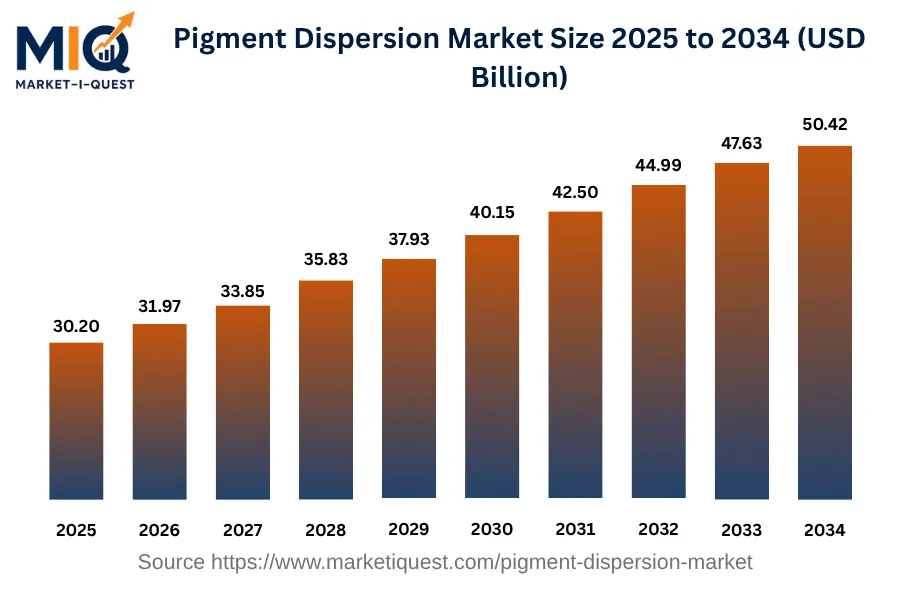
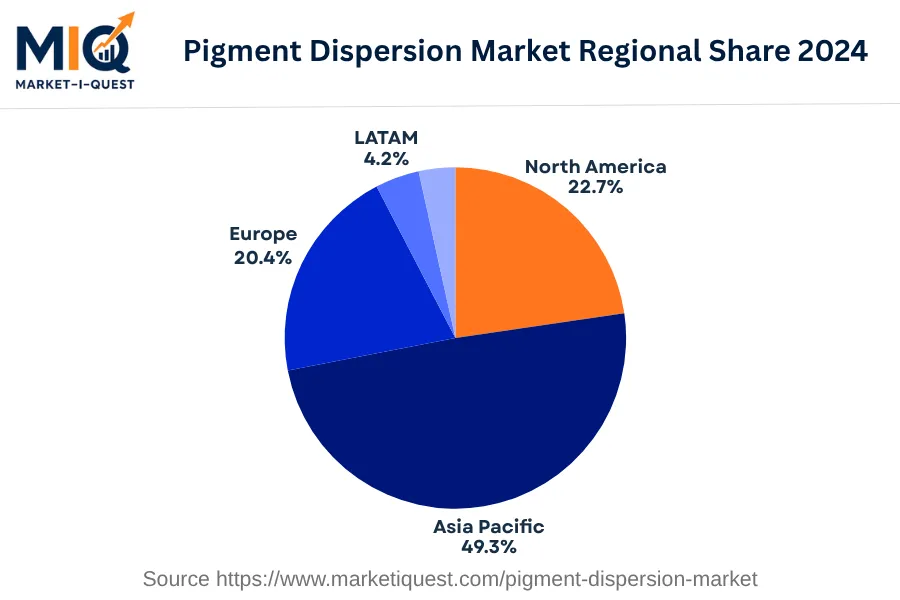
The Pigment Dispersion Market size in 2025 is estimated at USD 30.20 billion, up from USD 28.53 billion in 2024. By 2034, the market reaches USD 50.42 billion, reflecting a compounded annual growth rate (CAGR) of 5.9% from 2025 to 2034. Over the decade, the pigment dispersion market gradually expands, tracking a consistent and steady growth path. In terms of regional market share in 2024, the Asia Pacific region leads with a significant 49.3% share. North America and Europe follow, accounting for 22.7% and 20.4% of the market respectively. The rest of the market share is distributed between Latin America and the Middle East and Africa, with these regions holding 4.2% and 3.5% of the market respectively.

Key Takeaways

  • By Type - Inorganic Pigments held a leading position in 2024.
  • By Application - Cosmetics emerged as the fastest-growing segment since 2024.
  • By End Use Industry - Automotive held a significant share in 2024.
pigment-dispersion-market market size

Key Driving Factors

Shift in Packaging Color Preferences

Over the past few years, there has been a notable shift in consumer preferences for packaging colors, particularly in the food and beverage industry. This shift is causing companies to alter their packaging design strategy to appeal to consumer aesthetics and elicit emotional responses. This is significantly driving the pigment dispersion market. For instance, the increasing popularity of earthy tones over traditional metal and plastic hues is pushing companies to invest more in natural and organic pigments. These pigments are often dispersed to achieve the desired shade and uniformity. Therefore, the evolution of packaging color trends and subsequent changes in companies' design strategies are acting as a significant driver for the pigment dispersion market.
Increasing Legal Standards for Emission Controls

Toughening emissions standards around the globe are another notable driver for the pigment dispersion market. In industries such as construction and automobile manufacturing, traditional solvent-based coatings are being widely replaced by waterborne and high-solids coatings to adhere to environmental regulations. These coatings require pigments for color and are often formulated as dispersions to improve the sustainability profile and ensure efficient mixing. These regulations, implemented by authorities like the Environmental Protection Agency in the United States and the European Environment Agency in Europe, are influencing industry operators to switch to environment-friendly coating solutions. Ineffect, these regulations are accelerating demand in the pigment dispersion market, spurring growth in multiple end-use industries.

Market Evolution by Timeline

2019-2023
During the 2019-2023 period, the coatings sector emerged as a major buyer, sourcing pigment dispersions for applications in both residential and commercial settings, particularly in Asia-Pacific region attributing to the booming construction industry. Manufacturers were primarily offering water-based pigment dispersions, largely due to tightening VOC regulations in Europe and North America. Stricter regulations around chemical safety steered the market towards safer, eco-friendly options. On the commercial front, competition-driven pricing and long-term supply contracts were observed. There were some supply constraints resulting from the increased demand for environmentally compliant products. The market faced risks from inconsistent quality of raw materials and fluctuating prices of key feedstocks.
2024
In 2024, plastics sector became a significant purchaser of pigment dispersions for packaging applications, especially in China due to its expansive manufacturing industry. Advancements in the development of organic pigments were seen, helping to circumvent supply shortages of certain inorganic pigments. Newly adopted REACH regulations in the European Union was driving further reduction of hazardous chemicals. In response to aggressive pricing by Chinese manufacturers, western suppliers leaned towards value-addition as a differentiator. The sporadic disruption in the supply of raw materials posed a challenge, prompting suppliers to maintain buffer stocks.
2025-2029
Between 2025 and 2029, the buyer profile diversified with the emergence of the automotive sector. Manufacturers increasingly supplied high-performance pigment dispersions with enhanced weathering and lightfastness properties. Regions such as India and ASEAN countries drove demand owing to thriving automotive industries. Integration with digital printing technology became more mature. Commercially, value-based pricing gained acceptance and strategic partnerships between suppliers and end users were commonly found. The advent of circular economy policies promoted recycle-ready pigments, leading to a rise in the use of biodegradable raw materials. The major risk factor pertained to the escalating trade tensions causing market uncertainty.
2030-2034
During the 2030-2034 window, digital printing was a major use case, specifically in North American and European countries. Companies were frequently shipping smart pigment dispersions, with physical characteristics modifiable post-processing. A key constraint during this period was the escalating cost of innovative technologies. Jurisdictions worldwide implemented stricter regulations on chemical usage, further propelling the shift towards safer pigments. On the commercial side, dynamic pricing models based on demand and raw material cost fluctuations became commonplace, with most contracts carrying price fluctuation clauses. Widespread use of digital platforms for procurement and order management was observed. The key risk involved potential infringements of intellectual property amidst rapid technological evolution.

Future Market Outlook

Future Opportunities

The pigment dispersion market is poised for opportunities driven by regulatory trends and industry demand for sustainable solutions. The introduction of stricter environmental regulations by bodies like the U.S. Environmental Protection Agency in late 2022 has prompted manufacturers to explore eco-friendly dispersants. In response, companies such as Clariant are investing in sustainable pigment dispersions formulated using renewable resources. Additionally, the automotive sector's commitment to electric vehicles, as seen in Ford's 2021 transition plan, has created a rising demand for specialized coatings that require advanced pigment dispersion. The annual global paint and coatings conference, held in November 2023, presented insights into how these newer formulations can meet automotive manufacturers' stringent quality demands. Moreover, the increasing use of pigment dispersions in 3D printing technologies is creating unique trends. Research conducted at Stanford University indicated that custom pigment formulations for 3D printed materials could redefine aesthetic design possibilities. Moreover, there is a notable trend within the packaging industry, where brands are seeking safe and vibrant color applications compliant with global safety standards like ISO 8124. As the awareness of sustainability grows, opportunities for market players lie in developing biodegradable pigment dispersions that align with consumer expectations for eco-conscious products. These dynamics illustrate a market landscape ripe for innovation and collaboration across various sectors.

Segmentation Analysis

By Type

The market is divided into subsegments including Organic Pigments, Inorganic Pigments and Specialty Pigments. Among these, Inorganic Pigments accounted for the largest revenue share while Organic Pigments is expected to grow at the fastest CAGR during the forecast period.

Largest Revenue Share

Inorganic Pigments

Market Share Leader

Inorganic Pigments dominate the market in terms of revenue, accounting for the largest share. This subsegment's dominance can be attributed to several factors. First, inorganic pigments, being derived from minerals, are more abundant and easier to source, making them a cost-effective choice for manufacturers. They also possess excellent lightfastness and weather resistance, a feature that has boosted their demand in industries like construction and automotive, which value durability. Furthermore, inorganic pigments offer a broad color range and high covering power, a crucial factor in their application in coatings and plastics. Popular among consumers for their non-toxic profiles, Inorganic Pigments have been favoured by global regulations that have increasingly discouraged the use of harmful materials in production. However, while the Inorganic Pigments subsegment retains a significant share, market trends suggest a shift toward more sustainable options, which could influence future market dynamics.

Fastest CAGR

Organic Pigments

Forecast Period Growth Leader

Organic Pigments, despite currently holding a smaller market share, is expected to grow at the fastest pace in the coming years. This fast growth can be attributed to increasing environmental consciousness among consumers and a broader shift towards sustainable and eco-friendly solutions. Organic Pigments are characterized by their superior brightness and high tinting strength, which make them appealing for industries such as printing inks and packaging. They are also known for being non-toxic and safe, properties increasingly being demanded by consumers. Despite these benefits, the high manufacturing costs of Organic Pigments compared to Inorganic Pigments remain a barrier to their widespread adoption. As technologies advance and production processes improve, it is likely that this barrier will be diminished, further driving growth in this subsegment. However, potential regulatory changes and market volatility are factors to watch in this rapidly evolving segment.

By Application

The market is divided into subsegments including Paints and Coatings, Plastics, Inks, Cosmetics, and Textiles. Among them, the Plastics accounted for the largest revenue share in 2024, while the Cosmetics category is projected to grow at the fastest CAGR during the forecast period.

Largest Revenue Share

Plastics

Market Share Leader

The Plastics subsegment held the most revenue share in 2024. This can be attributed to the broad range of applications plastics have across many sectors such as automotive, construction, packaging, and consumer goods, among others. The versatility of plastics is unmatched, contributing to their widespread adoption. Moreover, the advancement in plastic manufacturing technology has driven the cost down, making it an appealing choice for a variety of uses. The stable supply chain, backed by large-scale manufacturers worldwide, ensures consistent availability. Regulatory frameworks, too, have exerted an influence. While regulations aiming at reducing plastic usage emphasizes its environmental cost, they have also indirectly expanded its industrial applications where plastic recycling and reuse have become revenue-gaining ventures. The availability, affordability, and functionality of plastics are the key customer purchasing criteria, leading to high revenues from this subsegment.

Fastest CAGR

Cosmetics

Forecast Period Growth Leader

Despite not being the subsegment with the highest revenue, the Cosmetics category is expected to have the fastest growth in the foreseeable future. Socio-economic factors such as rising disposable income and changing lifestyle trends, particularly in developing countries, play a significant role in the increased adoption of cosmetics. The industry's incorporation of advanced technology, coupled with innovative marketing strategies, allows a wider demographic to experience superior products, spurring the growth further. However, restrictions in certain geographies, stringent regulations on product safety and animal testing potentially pose near-term risks. Partnerships with local brands and focus on sustainable, organic products can act as catalysts in overcoming these barriers and propelling growth. This infers that the cosmetics subsegment is on an upward trajectory, attributing to its forecast of high CAGR.

By End Use Industry

The market is divided into subsegments including Automotive, Construction, Consumer Goods, Packaging, Furniture, and Others. In 2024, the Automotive sector accounted for the largest revenue share while the Furniture subsegment is expected to grow at the fastest CAGR during the forecast period.

Largest Revenue Share

Automotive

Market Share Leader

The Automotive segment has seen the highest revenue generation in 2024. This is due to a multitude of factors. Cars have become a necessity rather than a luxury in most parts of the world, leading to significant growth in demand. The increased production of automobiles, combined with advances in technology such as electric and self-driving cars, are factors contributing to the growth of the automotive industry. In addition, the demand for high-performance, fuel-efficient cars has stimulated this growth. Additionally, emerging markets have seen a rise in automotive sales which has further driven growth. Regulation and policies in many countries have favored the automotive industry, leading to its major share in the market. Customer preferences are seen to shift towards cars with sophisticated technology and green solutions, thus contributing to the current automotive market expansion.

Fastest CAGR

Furniture

Forecast Period Growth Leader

The Furniture segment is showing the fastest growth in terms of CAGR in the market. Given the rise of urbanization and the growing real estate sector, there is an increasing demand for home furnishings. Being a direct proxy for economic development, the popularity of luxury and versatile furniture is growing in both developed and developing markets. Additional drivers include increasing disposable income of customers, the rise of E-commerce platforms facilitating easy purchase, and the growing trend of interior decoration. Governments too are encouraging industry participants by offering them subsidies and easier access to finance. However, the sector also needs to overcome potential challenges, such as low entry barriers leading to overpopulation and fluctuations in raw material prices, to maintain its rapid growth trajectory.

Competitive Analysis

Key Market Players

Manufacturers / OEMs

Venator Materials PLC
UK
Chromaflo Technologies Corp
US
BASF SE
Germany

Key Suppliers & Raw Materials

Lansco Colors
US
Epsilon Dispersions LLC
US
Heubach GmbH
Germany

Distributors, Integrators & Channel Partners

RPM International Inc
US
Pidilite Industries Ltd
India
Berger Paints India Ltd
India

Porter’s Five Forces Analysis

This analysis assesses the competitive environment and industry attractiveness of the Pigment Dispersion market.

Supplier Bargaining Power

Medium

Dependence on specialized suppliers for raw materials impacts pricing power.

Buyer Bargaining Power

High

Numerous suppliers and low product differentiation gives high negotiation power to buyers.

Threat of Substitutes

Low

Substitution possibilities are limited due to unique color and performance characteristics of pigment dispersions.

Threat of New Entrants

Medium

Medium entry barriers exist due to required technical expertise and regulatory compliances.

Competitive Rivalry

High

Market is highly fragmented with intense competition among established players.

Regional Analysis

Geographic market dynamics and growth opportunities across key regions

Global Market Outlook

pigment-dispersion-market market regional share

North America

In 2024, the North American pigment dispersion market was primarily driven by expanding industries like plastics, construction, printing inks, and coatings. Technological advancements such as nano-pigments and High-Performance Pigments (HPP) adoption accelerated market growth, offering superior properties like high heat stability and light fastness. Regulatory changes including stricter enforcement of environmental protection laws stimulated the switch towards water-borne pigment dispersions to reduce Volatile Organic Compound (VOC) emissions. The trend of repackaging pigment dispersions for household use, into easily manageable sizes for DIY projects, was upsurging in the U.S. Another key trend observed was the shift towards organic pigments due to rising health awareness among customers. Additionally, the market saw a surge in partnerships and M&A, with companies like PPG Industries, BASF, and Sherwin-Williams expanding their product footprints in Canada and Mexico.

Significant demand from the automotive sector, specifically in Mexico, played a substantial role in market dynamics. This sector was specifically attracted to pigment dispersions for their use in automotive coatings. Meanwhile, the construction sector drove the market in the U.S. and Canada, with growing residential and commercial construction activities requiring architectural coatings. Furthermore, the printing inks and packaging sectors also acted as key customers, adopting pigment dispersions for color-rich packaging trends, enriching the North American pigment dispersion market in 2024.

Asia Pacific

In 2024, the pigment dispersion market in Asia Pacific is characterized by a combination of high demand factors, regulatory changes, and technological adoption. Economies such as China, South Korea, and India have invested heavily in constructions and automobiles, bolstering the demand for pigment dispersions. In particular, China’s Belt and Road initiative has significantly accelerated the demand for architectural coatings, amplifying the market. Government regulations aimed at reducing volatile organic compounds in coatings have driven the shift towards waterborne pigment dispersions across sectors, such as automotive, construction, and furniture. With the rise of Industry 4.0, countries like Japan and South Korea have adopted automated pigment dispersion processes, resulting in cost-effective and high-quality products.

Trends reflect a shift in buyer behavior towards eco-friendly options, influencing manufacturers to develop green pigment dispersions. M&A activities, notably in India and ASEAN markets, have allowed companies to increase their production capabilities and market reach. The enforcement of stricter environmental standards across Asia Pacific has also catalyzed the adoption of organic and inorganic pigment dispersions in various sectors such as textile, printing inks, and plastics, indicating a policy-driven market trend. Overall, the pigment dispersion market in 2024 is evolving, influenced by a blend of policy, technology, and market forces as manufactures strive to meet environmental and quality demands.

Europe

The Pigment Dispersion Market in Europe saw robust growth in 2024, driven by varied factors and impacted by several trends. An upsurge in demand for high-performance pigments in industries like automotive, construction, and textiles was a key driver. Regulatory standards favoring eco-friendly pigments, such as the EU’s REACH regulation, induced companies to invest heavily in green pigment manufacturing methods. The adoption of nanotechnology in pigment dispersion boosted market growth, as it led to superior product properties.

On the trends front, a shift in buyer behavior was observed, favoring products emphasizing sustainability. This aligned with the adoption of stricter environmental policies by European governments, leading suppliers to invest in R&D to develop greener products. Channel dynamics also shifted, with a heightened focus on online retail platforms to cater to increasing consumer demand. Significant M&A activities marked the industry landscape as companies aimed to acquire innovative pigment technologies and reinforce market positions. Additionally, the enforcement of stringent safety standards across industries like manufacturing and retail played a notable role in shaping the pigment dispersion market's trajectory. Verticals like enterprise and government showed significant uptake in eco-friendly pigments, accentuating market dynamics. Influenced by factors such as these, the Pigment Dispersion Market in Europe emerged as a sector of dynamic growth and developmental change in 2024.

Latin America

In 2024, the Latin American (LATAM) pigment dispersion market shaped up under the influence of various demand factors and changes in market dynamics. Increased infrastructure investment, particularly in Brazil and Mexico, drove the demand for pigment dispersions used in construction. Simultaneously, tightened environmental regulations across LATAM countries spurred the adoption of water-based pigment dispersions, altering market supply mechanics. Moreover, the introduction of advanced dispersion technology in Argentina resulted in novel products and fostered competition. Inflated import costs led to substantial price hikes in Chile and Peru, impacting buyer behavior. A shift towards local production occurred in these countries, marking a significant channel dynamic change. Furthermore, the escalating domination of e-commerce in Colombia aided the expansion of pigment dispersion suppliers, enhancing their market reach.

Partnerships and mergers were prominent in the manufacturing sector with a notable alliance between Brazilian and Mexican pigment producers. Strict policy enforcement in waste management sparked notable demand in the utilities and governmental sectors. The healthcare sector demonstrated increased reliance on pigment dispersions for aesthetic applications, fueled by an upsurge in public health expenditure in most LATAM countries. As such, the LATAM pigment dispersion market in 2024 saw a blend of factors driving growth and shifting market trends.

Middle East & Africa

In the base year of 2024, the pigment dispersion market in the Middle East and Africa demonstrated substantial dynamics. Driving factors included escalating demand from industries such as paints and coatings, particularly in the United Arab Emirates and Saudi Arabia. Additionally, the adoption of state-of-the-art technology in pigment synthesis in countries like Israel enhanced supply capacity. Still, the inconsistent pricing of raw materials across the region, resulting from regulatory intervention, notably in South Africa and Nigeria, posed challenges. In terms of trends, there was an evident shift in buyer behavior towards eco-friendly pigment dispersion products in response to stringent environmental policies across several nations, notably Kenya and Egypt. The rise in mergers and acquisitions, as demonstrated by key players in the United Arab Emirates and Saudi Arabia, intensified market competition. Furthermore, advancements in digitalization significantly streamlined sales channels across various sectors, particularly in the retail and manufacturing industries.

The pigment dispersion market catered primarily to sectors like the construction industry, which exhibited robust growth in countries like Qatar and Saudi Arabia due to increased government spendings. Simultaneously, the rising popularity of pigment dispersion products in the oil and gas sector, especially in Nigeria, was a notable market aspect. Conclusively, the base year of 2024 was characterized by heightened demand, technological integration, and regulatory influence on the pigment dispersion market in the Middle East and Africa region.

Recent Industry Developments

Latest market innovations, product launches, and strategic initiatives

April 2026

Lubrizol launched Solsperse™ 82510 Hyperdispersant, a high-efficiency dispersant engineered for solvent-borne coatings, printing inks, and pigment concentrates. The product offers grind efficiency and reliable stability across diverse resin systems with wide solvent compatibility.

January 2026

Sioen Industries, through its subsidiary European Master Batch N.V., completed the acquisition of ISL-Chemie from the Berlac Group. ISL-Chemie specializes in pigment pastes for polyurethane applications and in-mould coatings (IMC). The acquisition strengthens Sioen's position in the pigment pastes market.

Frequently Asked Questions