Matting Agents Market Snapshot

Key Players

  • Evonik Industries AG (Germany)
  • Akzo Nobel N.V. (Netherlands)
  • Imerys Minerals Ltd (France)
  • J.M. Huber Corporation (United States)
  • PQ Corporation (United States)
  • BYK Additives & Instruments (Germany)
  • Shamrock Technologies (United States)
  • Munzing Chemie GmbH (Germany)

Market Size

Base Year 2024
$0.962 Bn
CAGR
5.58%
Forecast 2034
$1.66 Bn

Market Segments

By Product Type
  • Natural
  • Synthetic
By Source
  • Vegetable
  • Animal
  • Mineral
By End Use Industry
  • Pharmaceuticals
  • Paints & Coatings
  • Cosmetics & Personal Care
  • Food & Beverages
  • Agriculture
  • Textiles
  • Construction
  • Others

Market Dynamics

Drivers
  • Increasing demand in paint industry
  • Advancements in technologies
Restraints
  • High production costs
  • Environmental regulations
Opportunities
  • Growing demand in paints industry
  • Need for higher grade matting agents

Market Size

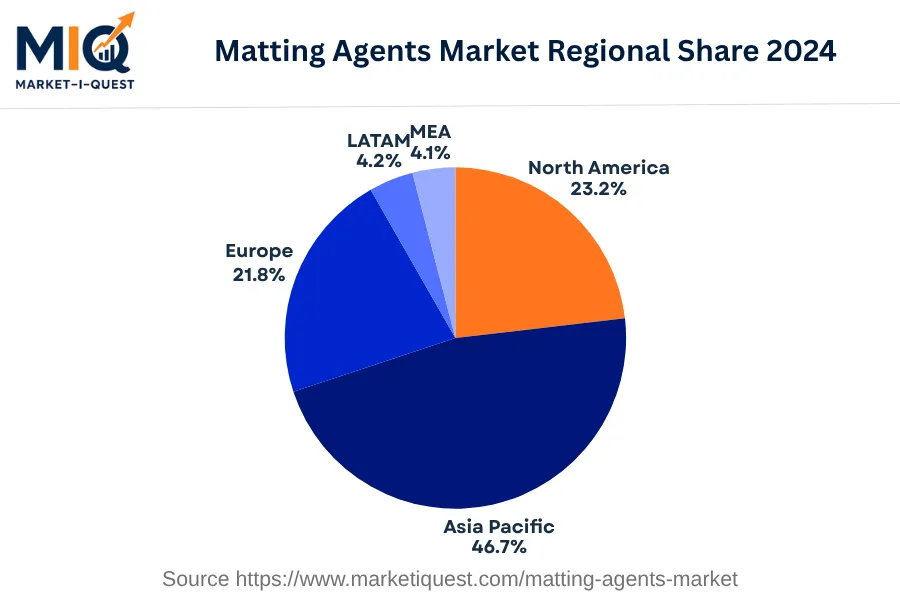
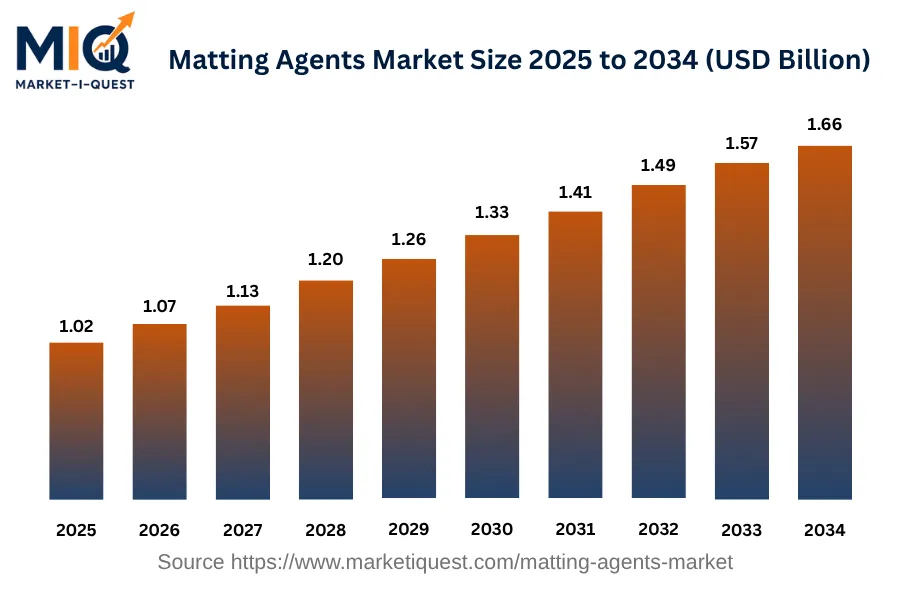
The Matting Agents Market size was valued at USD 1.02 Billion in 2025 and is expected to increase to USD 1.66 Billion by 2034, exhibiting a CAGR of 5.6%. The market is witnessing this expansion due to several contributory factors. The increase between 2025 and 2034 represents a substantial hike which is likely to follow the trajectory shaped by developments in market dynamics. The year-wise progression will record critical milestones forming this growth path in the Matting Agents market. On a regional scale in 2024, the Asia Pacific held the lion's share at 46.7%, followed by North America at 23.2%, and Europe at 21.8%. The regions with lesser shares were LATAM and MEA, amounting to 4.2% and 4.1% respectively.

Key Takeaways

  • By Product Type - Synthetic matting agents led the market accounting for a significant share in the base year.
  • By Source - Mineral held the top position in terms of demand in the specified year.
  • By End Use Industry - Pharmaceuticals was the leading consumer of matting agents accounting for the largest market share.
matting-agents-market market size

Key Driving Factors

Strict Regulatory Guidelines regarding High Gloss Finishes

Manufacturers of end-use products, especially in the automotive and consumer electronics industries, are seeing a continuous shift towards low gloss finishes, propelled by strict regulatory guidelines. High gloss finishes are increasingly scrutinised due to their reflective properties that can cause visual discomfort and disturb the functionality of electronic devices or road safety in vehicles. Consequently, these industries are now leveraging matting agents to achieve required finishing standards, specifically targeting a balance between aesthetic appeal and product usability. This growing preference for low gloss finishes due to strict regulatory measures is adding momentum to the robust progression of the matting agents market.

Expansion and Innovation in the Paint and Coatings Industry

The expansion and innovation in the paint and coatings industry is fuelling the matting agents market. This industry is consistently seeking advancement in material characteristics like improved scratch resistance, greater durability, and enhanced protection against weather elements. Matting agents are integral to achieving these enhancements, making matte-finishes a popular choice in the protective coatings range for industrial, commercial, and residential applications. As a result, matting agents are becoming a pivotal component in paint formula developments, driving the growth of the matting agents market.

Market Evolution by Timeline

2019-2023
In this period, the matting agents market witnessed a steady uptake, mostly driven by industrial and commercial applications. Buyers mainly came from the coatings, painting, and plastics industries, with Asia-Pacific region leading the demand due to rapid industrialization. There was a preference for silica-based matting agents due to their compatibility with different polymer systems. The supply side saw an increased focus on formulating eco-friendly matting agents. In terms of policies, countries in the European Union accelerated regulations against VOC emissions, affecting the choice of matting agents. Commercially, long-term supply contracts were prevalent with emphasis on stable pricing. A key risk during this period was the volatility in raw material prices, for which buyers typically responded with strategic sourcing and supplier diversification strategies.
2024
The matting agents market in 2024 was influenced by a flux of regulatory norms. Demand remained high, particularly from the paints and coatings industry, amidst an increased awareness of product aesthetics. On the supply side, technology integration led to the manufacturing of nanoscale matting agents, but this was a relatively immature market. The EU's laws for chemical ingredients became strict under the REACH regulation, pressuring manufacturers to review their formulations. Contractually, manufacturers formed alliances with raw material suppliers to mitigate price uncertainties. Supply chain disruptions due to unpredictable geopolitical factors was a prominent risk encountered in 2024.
2025-2029
This period saw an evolving demand in the matting agents market. Textile and leather industries emerged as important buyer segments due to rising fashion and lifestyle trends. North America showed significant market growth due to a resurgence in manufacturing activities. Suppliers adopted nanotechnology and organic additives to produce high-performance matting agents. However, integration issues with polymeric design were prevalent. The adoption of green building standards like LEED increased the use of non-toxic matting agents. The commercial model witnessed a rise in joint ventures and strategic partnerships that ensured reliable raw material supply. The possible health impacts of long-term exposure to matting agents was a significant risk during this period.
2030-2034
During 2030-2034, a trend switch was observed in the matting agents market. Demand surged in the automotive and construction industries in emerging economies like India and South-East Asian countries. Innovation in formulation technologies saw the creation of spherical-shaped matting agents with superior scattering properties. Financial constraints, however, restricted the widespread adoption of these high-cost technologies. The implementation of stringent environmental and safety standards, like ISO 14001 and OHSAS 18001, drove the market towards less hazardous substances. Notably, pricing dynamics followed a spot-buy pattern due to fluctuating raw material prices. The risk of falling behind technological advancements was among the main challenges identified in this period.

Future Market Outlook

Future Opportunities

Future opportunities in the matting agents market are closely tied to current regulatory frameworks and technological advancements. The ongoing shift toward sustainable and high-performance coatings is creating avenues for growth. In June 2023, the U.S. Environmental Protection Agency rolled out new guidelines to phase out harmful solvents in consumer products, prompting manufacturers to seek alternative matting agents that comply with stricter environmental standards. This regulatory push is already in motion, as firms like BASF explore partnerships to develop innovative bio-based solutions that meet these criteria. Moreover, the automotive sector is increasingly focusing on matte finishes for vehicle coatings, driven by consumer demand for aesthetics and reduced glare. This presents a significant avenue for growth, particularly in regions like Germany, which is known for its automotive industry. Investment in research for multifunctional matting agents that offer not just visual appeal but also scratch resistance and durability is gaining momentum. Collaborations between chemical companies and academic institutions are fostering advancements that can lead to enhanced product formulations. Additionally, the trend toward customization in consumer products opens new markets for specialized matting agents tailored to niche applications. As regulatory frameworks evolve globally and market demands shift, companies that are proactive in innovation and compliance will find a wealth of opportunities in the matting agents market.

Segmentation Analysis

By Product Type

The market is divided into subsegments including Natural and Synthetic product types. The Synthetic subsegment accounted for the largest revenue share, while the Natural subsegment is expected to grow at the fastest CAGR during the forecast period.

Largest Revenue Share

Synthetic

Market Share Leader

The Synthetic subsegment dominates the market in terms of revenue, primarily driven by its high-volume usage across various industries. Synthetic products are commonly used due to their cost-effectiveness and considerable performance characteristics. They're often preferred by manufacturers and consumers due to their consistent quality, high purity, and reliable supply chain. With comparisons to the Natural segment, the Synthetic products have a predictable pricing structure, which attracts bulk purchasers. This predictability in quality and price helps businesses to manage their operations more efficiently, reducing the risks associated with fluctuating raw material prices. Additionally, regulations support the Synthetic segment, where the use of natural resources is restricted to maintain environmental balance, further boosting the Synthetic product market. Lastly, well-established distribution channels for synthetic products, supported by robust infrastructure, contribute in ensuring its higher share in the revenue compared to its counterpart.

Fastest CAGR

Natural

Forecast Period Growth Leader

Despite the Synthetic segment's dominance, the Natural product segment shows strong growth prospects, emerging as the fastest-growing subsegment. This growth is strongly tied to increasing consumer awareness about product safety, thereby driving demand for natural products. The adoption barriers initially faced by the Natural product segment, such as supply chain complexities and higher costs, are steadily being overcome. Investment in resource sourcing, partnerships for supply assurance, and advances in processing technologies are contributing to the competitive pricing of Natural products. Regulatory support toward sustainable and eco-friendly products further bolsters the Natural product market. However, uncertainties in raw material supply due to natural calamities pose a near-term risk. In conclusion, the Natural segment, though trailing in terms of current share, is expected to show strong growth due to market factors driving consumer preference towards more sustainable options.

By Source

The market is divided into subsegments including Vegetable, Animal, and Mineral. Mineral accounted for the largest revenue share while Vegetable is expected to grow at the fastest CAGR during the forecast period.

Largest Revenue Share

Mineral

Market Share Leader

The Mineral subsegment contributes the most revenue in 2024, largely driven by its broad application across different industries such as construction, electronics, energy, and healthcare. Minerals are a fundamental component in the production of goods, from building materials and electric components to pharmaceuticals. The availability and abundance of minerals, particularly in geographically diverse regions, have made it a reliable source of revenue. Regulatory supports for responsible and sustainable mining practices also fuel the robust revenue generation in most advanced and emerging economies. Additionally, the purchasing criteria revolving around quality, purity, and sustainable extraction methodologies further bolster the Minerals subsegment. The presence of established supply chains and minimal switching costs, along with the varying consumer needs, all serve to strengthen the Mineral subsegment's revenue-leading stance in the market.

Fastest CAGR

Vegetable

Forecast Period Growth Leader

Projected as the fastest growing with a high CAGR in the future, the Vegetable subsegment's growth is largely attributed to the rising trend of health consciousness, environmental awareness, and sustainable living. Adoption of plant-based diets and the increasing demand for organic produce significantly drive the sector's growth. Governments' implementation of policies favoring sustainable agricultural practices, as well as investments in agri-tech and bio-tech, serve as catalysts that boost market expansion. Partnerships between farmers and tech companies to increase crop yield and quality are common to meet the rising demand. However, the Vegetable subsegment must overcome substantial barriers such as climate change, unpredictable weather conditions, and limited arable land to sustain high growth. Mitigating these risks through the use of technological innovations like vertical farming and genetically modified crops will be a crucial factor fuelling the future expansion of the Vegetable subsegment.

By End Use Industry

The market is divided into subsegments including Pharmaceuticals, Paints & Coatings, Cosmetics & Personal Care, Food & Beverages, Agriculture, Textiles, Construction, and Others. In 2024, the Pharmaceuticals sector accounted for the largest revenue share while the Cosmetics & Personal Care industry is predicted to grow at the fastest pace during the forecast period.

Largest Revenue Share

Pharmaceuticals

Market Share Leader

In our base year of 2024, the Pharmaceuticals subsegment derived the most revenue. This bullish trend can be attributed to a gamut of factors. Predominantly, rising global health concerns leading to increased demand for medications and healthcare products have significantly bolstered the industry's growth. Furthermore, the ever-constricting regulatory policies around health and safety, while challenging, offer the Pharmaceuticals sector a certain degree of insulation against new entrants, thus ensuring incumbents can maintain their revenue shares. Technological advancements in drug discovery and delivery systems, along with extensive research and development activities, have further created a conducive environment for growth. The steady rise of personalized medicine catered to the genetic makeup of the individual is another strong driver for the Pharmaceuticals industry. Geographically, the dominant share of revenue comes from developed markets, like North America and Europe, due to their robust healthcare systems and high per-capita healthcare spending.

Fastest CAGR

Cosmetics & Personal Care

Forecast Period Growth Leader

Despite not being the most significant revenue contributor in 2024, the Cosmetics & Personal Care subsegment is expected to showcase the quickest Compound Annual Growth Rate (CAGR). A variety of social, economic, and technological factors are driving growth in this sector. First and foremost, altering societal norms and increasing disposable incomes have led to enhanced emphasis on beauty and personal care across both genders. This, coupled with the rising influence of beauty bloggers, vloggers, and influencers on social media, has led to increased adoption of cosmetic and personal care products among consumers. Technological advancements in product formulation and personalization, as well as increased demand for organic and natural products, constitute additional growth catalysts. However, the subsegment also faces potential near-term risks, including stringent regulations, particularly in relation to ingredient safety. Technological disruption in the form of AI and AR-enhanced beauty applications, while promising, pose a potential risk of adoption barriers, requiring significant capex and partnerships.

Competitive Analysis

Key Market Players

Manufacturers / OEMs

Evonik Industries
Germany
Akzo Nobel N.V.
Netherlands
BASF SE
Germany

Key Suppliers & Raw Materials

Arkema Group
France
W.R. Grace & Co.
US
Honeywell International Inc.
US

Distributors, Integrators & Channel Partners

PENPET Petrochemical Trading GMBH
Germany
CheMarCo, Inc.
US
Krahn Chemie GmbH
Germany

Porter’s Five Forces Analysis

Analysis of the Matting Agents Market using Porter's Five Forces.

Supplier Bargaining Power

Medium

Upswings in raw material prices can impact the overall matting agents pricing.

Buyer Bargaining Power

High

The diverse product range allows buyers to choose between multiple manufacturers.

Threat of Substitutes

Low

Unique functional benefits of matting agents curb the threat of alternatives.

Threat of New Entrants

Medium

Capital-intensive setup and specific production know-how constitute barriers to entry.

Competitive Rivalry

High

Several global players drive a competitive matting agents market.

Regional Analysis

Geographic market dynamics and growth opportunities across key regions

Global Market Outlook

matting-agents-market market regional share

North America

In 2024, the North American matting agents market experienced a surge, driven by a combination of industry dynamics and consumer preferences. U.S manufacturers increased investment in advanced technologies for producing high-quality, environment-friendly matting agents, in response to stricter EPA regulations. This, coupled with a steady rising demand from the paint and coatings sector equally distributed across the U.S, Canada, and Mexico, largely fueled the market growth. A noticeable trend in 2024 was the shift towards organic and natural matting agents due to enhanced awareness of environmental sustainability among consumers. Moreover, rapid digitalization led to a change in the channel dynamics, where reliance on e-commerce platforms for purchase significantly increased. Additionally, partnership efforts between matting agent manufacturers and paint and coating enterprises gained momentum. These collaborations aimed to develop innovative products, taking advantage of economies of scale in the production process.

Sectors driving this market included manufacturing, particularly the automotive, marine, and industrial coatings, alongside retail and construction sectors. Consumer preference for aesthetic appeal and durability in these areas increased the demand for premium quality matting agents. Therefore, despite higher pricing, the market sustained growth through quality-driven and environmentally conscious consumers. In conclusion, 2024 marked a significant year for the matting agents market in North America with rising technological adoption, stringent regulations, and consumer-driven demand shaping its trajectory.
Asia Pacific

In 2024, the matting agents market in Asia Pacific was characterized by robust activity centered on improving coatings' aesthetic and functional properties. The market drivers included rising consumer and industrial demand for product improvements for dye, paint, and coating applications in sectors like manufacturing and retail. Regulatory enforcement in countries like China and Japan further prompted firms to innovate for environmentally safe and efficient matting agents. Moreover, in India and key ASEAN markets, increased investment in infrastructure and manufacturing stimulated the supply-demand dynamics, leading to competitive pricing. Buyer behavior displayed a trend toward environment-friendly, high-performing matting agents, especially in countries like China and Australia abiding by stringent environmental norms.

A technologically driven product shift was evident in the market, with nanoparticles and wax-based matting agents becoming increasingly popular in South Korea and Japan. There was a noticeable tilt in channel dynamics towards ecommerce platforms due to increased digitization, especially in China and India. Company partnerships and M&A activities were also witnessed, such as arrangements between Chinese and Australian companies aimed at sharing advanced matting agent technologies while adhering to environmental standards. Lastly, rigorous policy enforcement by governments, particularly in China and India, shaped the operational and strategic decisions of companies participating in the market.

Europe

In 2024, the Matting Agents market in Europe was characterized by strategic alliances and growing demand from a diverse range of sectors. In terms of drivers, increased consumer demand for satin and matte finishes, particularly in the automotive and personal care sectors, fueled the market. The introduction of eco-friendly, water-based matting agents led to favorable regulations in Germany and the UK, significantly boosting investment and market growth. In France and Italy, advancements in silica-based matting agents led to wider adoption, accompanied by an attractive price-performance ratio.

Trends during the year saw a shift in buyer behavior, with a visible preference for products incorporating matting agents, especially in the retail sector in Spain, the Nordics, and Benelux. Responding to this shift, manufacturers entered strategic partnerships and undertook mergers and acquisitions to expand their product offerings. Furthermore, the wave of sustainability policies enforced across Central and Eastern Europe acted as an additional driver, pushing companies to innovate and deliver eco-friendly matting solutions. The building and construction sector figures particularly prominently, with a high adoption rate of environmentally-friendly, quality matting agents. Technological strides in delivering durable, scratch-resistant matte finishes significantly shaped this trend.

Latin America

In 2024, the matting agents market in Latin America flourished based on a combination of demand factors, governmental regulations, and technological adaptation. Key drivers included increased demand from automotive and industrial sectors in Mexico, Brazil, and Argentina due to a rise in the manufacturing and sales of matte-finished products. In addition, new environmental regulations in Chile, Colombia, and Peru propelled companies to invest in eco-friendly matting agents, stimulating market growth. With the adoption of advanced technology in manufacturing processes, a surge in supply dynamics further expanded the market.

Notably, several trends shaped the market scope. As consumer preferences in Brazil and Mexico shifted towards matte-finished paints and coatings for their aesthetics and durability, manufacturers tailored their offerings. The increasing preference for online buying in these countries brought about changes in channel dynamics, leading to strategic partnerships and mergers and acquisitions among e-commerce giants and matting agent providers. Regulatory bodies in Argentina, Colombia, and Chile tightened policy enforcement concerning emission standards, prompting players to innovate in this niche space. The rise of retail and manufacturing sectors as the primary customer base had a significant impact on the market dynamics as well. Overall, these drivers and trends collectively contributed to the matting agents market vitality in LATAM in 2024.

Middle East & Africa

In 2024, the Matting Agents market in the Middle East and Africa experienced significant growth, driven by demand from industries like paint and coatings, plastics, and textiles, especially in countries such as Saudi Arabia, UAE, and South Africa. Increasing urbanization and industrialization led to heightened construction activities, bolstering the need for matting agents in paint and coatings. Moreover, stringent regulations encouraging the use of environment-friendly matting agents amplified market traction in Egypt and Kenya. The growing investments in infrastructure and real estate sectors in countries like Nigeria and Qatar also spiked the demand.

A major trend observed in the year was the rising use of organic and water-based matting agents due to their eco-friendly characteristics, across sectors including healthcare and manufacturing. This shift can be attributed to the enforcement of strict environmental policies in regions like Israel. Furthermore, technological advancements leading to the production of high-performance matting agents have driven the market growth. In 2024, strategic partnerships were common among players to expand their footprint, particularly in the lucrative markets of UAE and Saudi Arabia. Additionally, increased market penetration was observed in online sales channels, exemplifying altered buyer behaviors induced by the digitalization wave in the region.

Recent Industry Developments

Latest market innovations, product launches, and strategic initiatives

May 2026

W.R. Grace developed three new matting agent products (A, B, and C) that match the performance of its classic SYLOID® RAD 2105 silica matting agent across most performance dimensions, each offering unique advantages. All three products have been commercialized and are available for sample testing.

October 2025

BASF Coatings introduced its 2025-2026 Automotive Color Trends collection, featuring 45 innovative colors incorporating advanced matting technologies. The collection emphasizes "refined faux solids" with smooth, low-gloss finishes, including effects such as the Phygital Magnetar liquid-metal appearance.

Frequently Asked Questions