Liquid Crystal Polymers Market Snapshot

Key Players

  • Polyplastics Co. Ltd. (Japan)
  • Solvay SA (Belgium)
  • Celanese Corporation (United States)
  • Sumitomo Chemical Co. Ltd. (Japan)
  • TORAY INDUSTRIES INC. (Japan)
  • Kuraray Co. Ltd. (Japan)
  • RTP Company (United States)
  • Ensinger GmbH (Germany)

Market Size

Base Year 2024
$1.79 Bn
CAGR
8.31%
Forecast 2034
$3.98 Bn

Market Segments

By Type
  • Thermotropic
  • Lyotropic
By Application
  • Electronic & Electrical
  • Automotive
  • Consumer Goods
  • Surgical Devices
  • Others

Market Dynamics

Drivers
  • Increasing demand in electronics industry
  • Advanced thermal properties
Restraints
  • High production cost
  • Availability of alternatives
Opportunities
  • Rising demand in electronics industry
  • Advanced automotive applications growth

Market Size

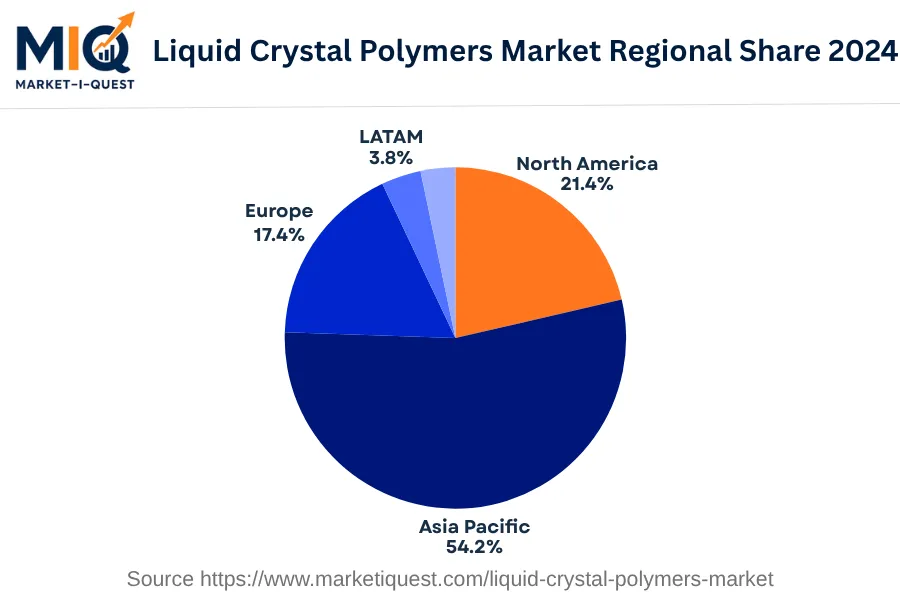
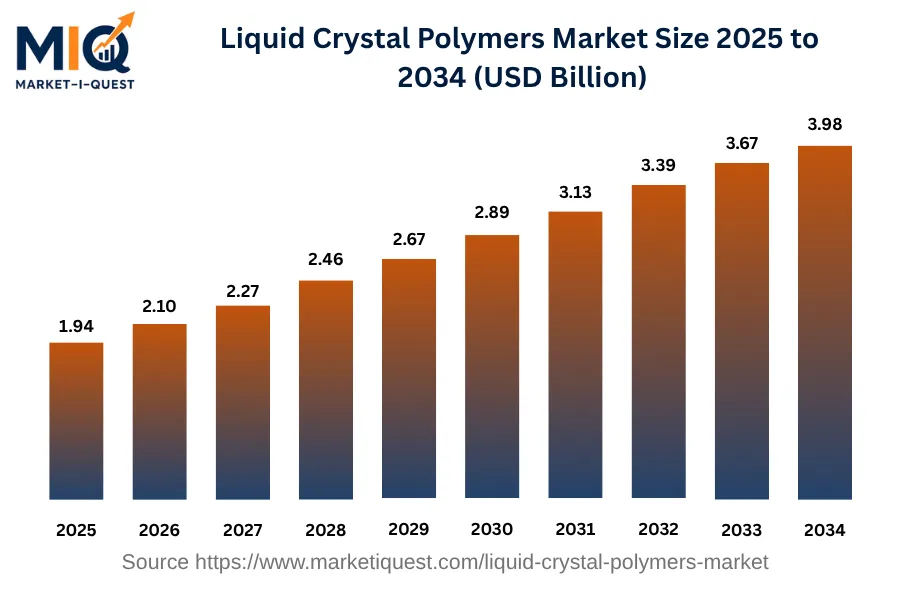
The Liquid Crystal Polymers Market stood at USD 1.94 billion in 2025 and is projected to surge to reach approximately USD 3.98 billion by the year 2034, posting a Compound Annual Growth Rate (CAGR) of 8.31%. This steady ascension from almost USD 1.79 billion in 2024 reflects a consistent expansion in demand over the 10-year forecast period. The growth momentum of this market is principally attributed to advancements in the industry and rising applications across varied sectors. On the geographical distribution front, as of 2024, the majority share (54.16%) was commanded by the Asia Pacific region. This was followed by North America, which accounted for 21.38% of the total market. Europe, meanwhile, held 17.42% of the market share. The remaining regions, Latin America, and the Middle East & Africa (MEA), comparatively held smaller shares of 3.76% and 3.28% respectively.

Key Takeaways

  • By Type - Thermotropic was leading with significant share in the Liquid Crystal Polymers Market in 2024.
  • By Application - Electronic & Electrical led the market holding the major share in 2024.
liquid-crystal-polymers-market market size

Key Driving Factors

Adoption in Electronic Miniaturization Process

One major driving force in the liquid crystal polymers market comes from the electronics industry's trend to continuously iterate and produce smaller, more compact devices. Liquid crystal polymers possess properties such as high temperature resistance, ease of processability, and dimensional stability, which make them the preferred material in the miniaturization of electronic components. They fill a key role in developing impressively small and efficient parts like connectors, sockets, and mounts, which are essential in producing slim and lightweight devices. This means manufacturers in the electronics industry are turning to the use of liquid crystal polymers more frequently, propelling the growth of the market.

Advancements in Medical Implants

Another substantial influence on the liquid crystal polymers market is their growing application in the healthcare sector, specifically in the manufacturing of medical devices and implants. The biocompatibility of liquid crystal polymers combined with their high mechanical strength and chemical resistance makes them an ideal choice for medical implants such as orthopedic devices or cardiovascular stents. The increased adoption of these advanced materials in the construction of medical components reflects the healthcare industry's commitment to improving patient outcomes and safety - actions which naturally extend the reach and value of the liquid crystal polymers market.

Market Evolution by Timeline

2019-2023
During this time, there was a significant demand for liquid crystal polymers in electronic industries to manufacture complex shaped parts, particularly in Asia-Pacific regions. Governments like India and South Korea started incentivizing local electronics industries, which drove the demand for LCPs. Simultaneously, manufacturing methods improved, and larger batches of reliable, high-quality LCPs were made. However, there were challenges, including increased competition from cheaper alternative polymers and the high costs of the LCP manufacturing process which were reflected in pricing. Commercially, LCPs were often sold in a bundled package with other polymers.
2024
In 2024, the adoption of new environmental regulations in the US and Europe restrict the use of certain alternative polymers, favoring LCPs. LCP demand rose among automobile manufacturers looking for lightweight, high-strength materials to meet stringent emission standards. Technological advancements saw improvements in LCPs lowering defect rates and enhancing material properties. Commercial models evolved, with long-term supply contracts becoming more prevalent. The main risk was keen competition from emerging polymer technologies.
2025-2029
Demand in this period was primarily driven by healthcare industries due to the ability of LCPs to withstand sterilization methods. Asia continued to dominate the market, propelled by growing healthcare industries in India and China. LCP manufacturers had not yet found ways to implement recycling, leaving concerns about environmental impact. In commercial terms, manufacturers typically developed strategic partnerships with buyers to ensure consistent supply and pricing stability.
2030-2034
By 2030, the demand for LCPs had flattened, largely because of advancements in cheaper, more easily recyclable polymers. Most LCP use was from legacy applications in electronics and healthcare. Policy initiatives to improve plastic recycling, such as the Plastic Waste Management Rules 2021 in India, made it more difficult to justify the use of LCPs. Nevertheless, select high-performance applications in the aerospace industry kept the LCP market afloat.

Future Market Outlook

Future Opportunities

The liquid crystal polymers market is poised for growth as industries seek materials that meet evolving regulatory and performance demands. In 2021, the IPC, a global electronics association, emphasized the need for higher reliability in printed circuit boards, which presents opportunities for LCPs in electronic packaging solutions. Automotive manufacturers, including Mercedes-Benz, are exploring LCPs for lightweight components in electric vehicles, enhancing energy efficiency and performance. As environmental concerns rise, regulatory bodies like the Environmental Protection Agency in the United States are pushing for toxins reduction, paving the way for greener LCP alternatives. Companies such as Celanese are focusing on bio-based LCP formulations, which may gain traction due to incoming mandates for sustainable materials in packaging by 2025. Moreover, advancements in additive manufacturing techniques present opportunities for customized LCP applications across industries. The increasing demand for high-temperature resistant materials in aerospace applications positions LCPs favorably, especially for companies like Boeing and Airbus, exploring advanced composites for aerospace parts. As LCP technology improves through research collaboration between manufacturers and universities, emerging applications in medical devices are also anticipated, highlighting the growing versatility of LCPs in sectors requiring high-performance materials. These opportunities suggest an expanding landscape for LCP applications in response to current industry needs and future regulations.

Segmentation Analysis

By Type

The market is divided into subsegments including Thermotropic and Lyotropic, with Thermotropic accounting for the largest revenue share while Lyotropic is expected to grow at the fastest CAGR during the forecast period.

Largest Revenue Share

Thermotropic

Market Share Leader

The Thermotropic subsegment holds the largest market share due to its wide range of applications across various industries. The material's ease of manufacture and versatility make it a preferred choice for the production of plastics, resins, and other related products. It flourishes in markets where regulation supports the use of materials with high-temperature resistance and low flammability. Geographically, this subsegment strongly performs in industries situated in regions with a dense manufacturing sector, such as Asia-Pacific. From an end-user perspective, the thermotropic type's high-performance characteristics greatly influence purchasing decisions. Key attributes such as its exceptional thermal stability and mechanical properties trigger a high demand, consequently, significant revenue. Traditional channels, as well as online markets, serve as major platforms for product distribution, thereby enhancing its reach to potential customers. As switching costs are relatively high due to the specificity of application, customers tend to stick to Thermotropic solutions, thereby contributing to its larger share in the market revenue.

Fastest CAGR

Lyotropic

Forecast Period Growth Leader

Conversely, while the Lyotropic subsegment may currently hold less market share, it is projected to experience the fastest growth. Advancements in technology and increasing applications in specialized fields such as biomedical, pharmaceuticals, and electronics, are key growth drivers. The unique properties of Lyotropic materials, such as their fluid responsiveness under external stimuli, are unlocking new applications in advanced industries. Additionally, the shift towards capital expenditure in research and development activities to create innovative products has catalyzed its growth. However, it must be noted that the higher production cost and complexities associated with the manufacturing process serve as adoption barriers. Furthermore, immediate risks include the fluctuating raw material prices and stringent environmental regulations governing its production and disposal. Nevertheless, increased collaborations and partnerships among major market players are expected to support the market growth, positioning Lyotropic as the fastest growing subsegment.

By Application

The market is divided into sub-segments including Electronic & Electrical, Automotive, Consumer Goods, Surgical Devices, and others. Among these, the Electronic & Electrical segment accounted for the largest revenue share, while the Automotive sector is expected to grow at the fastest CAGR during the forecast period.

Largest Revenue Share

Electronic & Electrical

Market Share Leader

The Electronic & Electrical segment commands a significant share of the revenue in this market due to a variety of factors. One of the major drivers is the ongoing digital transformation in almost every industry which has augmented the demand for electronic devices and components. Geographically, developed markets like North America and Western Europe contribute significantly to the revenue buoyed by their technologically advanced infrastructures and high consumer purchasing power. Regulations encouraging energy efficiency have also triggered growth in this segment, enhancing production of electrically efficient appliances, thus fuelling revenue growth. Another aspect to consider is the steady supply chain, which ensures that materials and components can be easily procured, maintaining a steady flow of production and supply to meet the increasing demand. Thus, with a combination of technology adoption, geography, regulation, supply, purchasing power, and supply chain efficiency, the Electronic & Electrical segment leads in revenue for the base year 2024.

Fastest CAGR

Automotive

Forecast Period Growth Leader

The Automotive sub-segment is forecasted to experience the fastest growth over the forecast period. This growth is driven by rapid advancements in automotive technology, increased customer demand for advanced vehicles, and robust capital investments within this industry sector. Technological catalysts such as the rise in electric vehicles (EVs) and autonomous driving technologies have significantly contributed to the demand within this sub-segment. Policy supports in the form of government subsidies and initiatives encouraging the adoption of EVs and other advanced automotive technologies are also fueling growth. However, high switching costs for manufacturers and customer concerns around autonomous technologies are barriers to adoption. Despite these, partnerships and collaborations among different industry players are paving the way for widespread adoption and are likely to mitigate these challenges. Near-term risks include technological glitches and supply chain disruptions, but the overall CAGR outlook for this sector remains strong.

Competitive Analysis

Key Market Players

Manufacturers / OEMs

Polyplastics Co. Ltd.
Japan
Solvay
Belgium
Toray Industries Inc.
Japan

Key Suppliers & Raw Materials

Sumitomo Chemical Co., Ltd.
Japan
Ueno Fine Chemicals Industry, Ltd.
Japan
Eastman Chemical Company
US

Distributors, Integrators & Channel Partners

Pantech Corporation
Korea
Ayana Plast
India
IntechOpen Limited
UK

Porter’s Five Forces Analysis

A study of competitive forces in the Liquid Crystal Polymers market.

Supplier Bargaining Power

Medium

Limited suppliers and specialized production process enhance supplier power.

Buyer Bargaining Power

High

Large electronic component manufacturers and multiple sourcing options increase buyer power.

Threat of Substitutes

Low

Unique thermal and chemical properties of Liquid Crystal Polymers limit threat of substitutes.

Threat of New Entrants

Low

High barrier to entry due to complex production process and capital investment.

Competitive Rivalry

Medium

Industry characterized by a mix of large established firms and niche players.

Regional Analysis

Geographic market dynamics and growth opportunities across key regions

Global Market Outlook

liquid-crystal-polymers-market market regional share

North America

In 2024, the North American market for Liquid Crystal Polymers (LCPs) experienced heightened activity across multiple sectors due to various economic and technological drivers. High demand from the electronics industry, driven by LCPs' unique physical properties like high-temperature resistance and mechanical strength, stimulated the market. Further, increased investment in research and development within the manufacturing sector continues to expand the use-cases for LCPs, particularly in products requiring miniaturization and precision, such as micro connectors. Pricing has been affected by these market dynamics, causing the value of LCPs to rise.

Trends in the North American LCP market in 2024 show a notable shift in buyer behavior, with a growing preference for LCPs in sectors like healthcare, aerospace, and automotive, for their dimensional stability and resistance to a variety of environmental conditions. Product shifts were evident in the increased adoption of LCPs in 5G technology due to their excellent dielectric properties. Mergers and acquisitions have also been prevalent, with companies aiming to consolidate their market position by capitalizing on synergies. Regulatory standards have progressively shifted towards enforcing the use of materials like LCPs, as they exhibit lower carbon footprints compared to conventional polymers, reflecting an inherent drive towards sustainability.

Asia Pacific

In 2024, Asia Pacific witnessed a dynamic growth in the Liquid Crystal Polymers (LCP) market. Such expansion was driven by high-demand electronics manufacturing sectors in China and South Korea, hastened by the miniaturization trend in electronic devices that require stable, high-performance materials like LCP. India's aggressive infrastructure development also fueled LCP demand, particularly in telecommunications. Regulatory initiatives also played a role, as Japan enforced policies promoting lightweight, high-strength materials for auto-parts manufacturing amid strict emission guidelines, contributing to increased LCP usage.

In terms of trends, environmental-consciousness became pronounced among the consumer base. This was evidenced in Australia, where sustainable sourcing and reduced waste redirection into electronics dominated purchasing preferences. Cross-region collaborations in research and development was another observable trend, as seen in partnership engagements between Indian and Japanese firms innovating for high-temperature resistant LCP's. Channel dynamics shifted towards e-commerce platforms for LCP distribution, a trend primarily dictated by Chinese consumers for efficient B2B transactions. Lastly, stricter policy reinforcement was evident within ASEAN markets, with more stringent quality control on imported LCPs, conspicuously from manufacturers in China and South Korea, to ensure adherence to market standards. The LCP market in 2024, therefore, rode the wave of booming electronics manufacturing, regulatory initiatives, and changing consumer preferences, with each driver and trend bringing its unique influence.

Europe

In 2024, Europe's Liquid Crystal Polymers (LCP) market demonstrated significant activity primarily driven by key industry sectors in Germany, the United Kingdom, France, Italy, Spain, the Nordics, Benelux, and Central & Eastern Europe. Increased demand for miniaturization in electronics and automotive sectors, primarily in Germany and the UK, significantly accelerated the LCP market. The stringent emission rules imposed by the European Union led to greater implementation of LCPs in automotive lightweighting applications. Italy and France saw robust investment in R&D for innovative LCP applications, also influencing growth. The market witnessed a shift towards higher adoption of LCPs in medical industries, especially within Spain and the Nordics, due to their high temperature resistance and inertness. Mergers and acquisitions between major manufacturing groups, most notably in Benelux and Central & Eastern Europe, introduced dynamic changes to the LCP supply-chain.

Notable trends included a customer preference for environmentally friendly products, causing manufacturers to opt for LCPs as they are recyclable and comply with the Restriction of Hazardous Substances (RoHS) directive. An emerging trend was the increased use of LCPs in 5G technology across manufacturing and retail sectors, given their excellent electrical properties and flame resistance. Lastly, enforcement of stricter waste-management regulations prompted the utility sector to explore LCP-based solutions for waste reduction.

Latin America

In 2024, Latin America's Liquid Crystal Polymers (LCP) market experienced significant growth, driven by rising demand in industries like telecommunications, automotive, and electronics. Increased consumption of consumer electronics in Brazil and Mexico, combined with a growing trend towards miniaturization of electronic components, fueled LCP market proliferation. Technological advancements in Argentina’s automotive industry boosted the use of LCPs due to their superior thermal stability and mechanical strength. In Colombia, government policies favoring domestic manufacturers led to increased production of LCPs. Trends in 2024 revealed an uptick in strategic partnerships among manufacturers in Chile and ancillary suppliers to ensure sustained supply of LCPs. The rise in e-commerce in Peru influenced channel dynamics, leading to online sales gaining traction. Additionally, a regulatory shift in Brazil mandated more robust fire safety standards in the electronics sector, augmenting LCP use given their flame-retardant properties.

Changing consumer preferences in the region also highlighted an elevated consumer inclination toward high-quality, durable goods, further stimulating the market. The telecommunications industry in Mexico, for example, adopted LCPs extensively due to their desirable properties such as low water absorption and excellent dielectric constant values, crucial for wireless communication systems. Thus, the LATAM LCP market in 2024 showed notable expansion driven by industry-specific demands, regulatory changes, and evolving distribution channels.

Middle East & Africa

In 2024, the Liquid Crystal Polymers (LCP) market in the Middle East and Africa largely thrived due to robust demands in sectors like telecommunications, aerospace, and healthcare. Rising demands were primarily driven by accelerated technology adoption, especially in Saudi Arabia and the United Arab Emirates, enhancing LCP use in high-frequency applications for telecom infrastructure. Increased investment, specifically in Qatar's and Nigeria's oil and gas industry, necessitated the superior thermal stability of LCPs, driving regional consumption. Distinct trends in the LCP market included a shift towards miniaturization in electronics manufacturing. Israel and South Africa led fronts in the adoption of compact designs, favoring LCP for its thin-wall design capability. In Egypt, strict reinforcement of safety standards in the healthcare sector propelled LCPs application in medical devices.

Mergers and acquisitions, such as the one between UAE's retail giants, significantly expanded LCP capacity across Africa. The LCP market saw prominent demands from the government sector, particularly for defense, in Saudi Arabia. Meanwhile, Kenya's rapidly growing telecom sector actively implemented LCPs for base station antennas due to its low dielectric constant properties. Overall, technology adoption, investments, policy enforcement, and sector-specific demands constituted major drivers, while technological shifts, policy reinforcement, and strategic alliances facilitated prominent trends in the Middle East and Africa's LCP market.

Recent Industry Developments

Latest market innovations, product launches, and strategic initiatives

April 2026

Z-Polymers announced a strategic investment and partnership with Kureha Corporation to accelerate commercialization of its next-generation high-performance LCP fiber platform, based on a novel molecular architecture enabling mechanical and thermal capabilities beyond conventional melt-processable LCPs.

June 2025

Sumitomo Chemical successfully established mass production technology for LCP using a biomass-derived monomer. The company aimed to complete customer certification by the end of fiscal 2026 and begin supplying bio-based LCP products from fiscal 2027.

Frequently Asked Questions