Orthopedic Devices Market Snapshot

Key Players

  • Zimmer Biomet (United States)
  • Stryker (United States)
  • Johnson & Johnson DePuy Synthes (United States)
  • Smith & Nephew (United Kingdom)
  • Medtronic (Ireland)
  • Arthrex (United States)
  • ConforMIS (United States)
  • Orthofix Medical Inc. (United States)
  • Globus Medical (United States)
  • B. Braun Melsungen (Germany)

Market Size

Base Year 2024
$63.84 Bn
CAGR
5.98%
Forecast 2034
$114.11 Bn

Market Segments

By Product Type
  • Joint Reconstruction Devices
  • Spinal Devices
  • Orthobiologics
  • Support Devices
By Material
  • Metal
  • Plastic
  • Ceramics
  • Composite
By End User
  • Hospitals
  • Orthopedic Clinics
  • Rehabilitation Centers
  • Ambulatory Surgical Centers (ASCs)

Market Dynamics

Drivers
  • Increasing global geriatric population
  • Advancements in orthopedic surgeries technology
Restraints
  • High cost of devices
  • Stringent regulatory processes
Opportunities
  • Aging global population
  • Advancements in orthopedic technology

Market Size

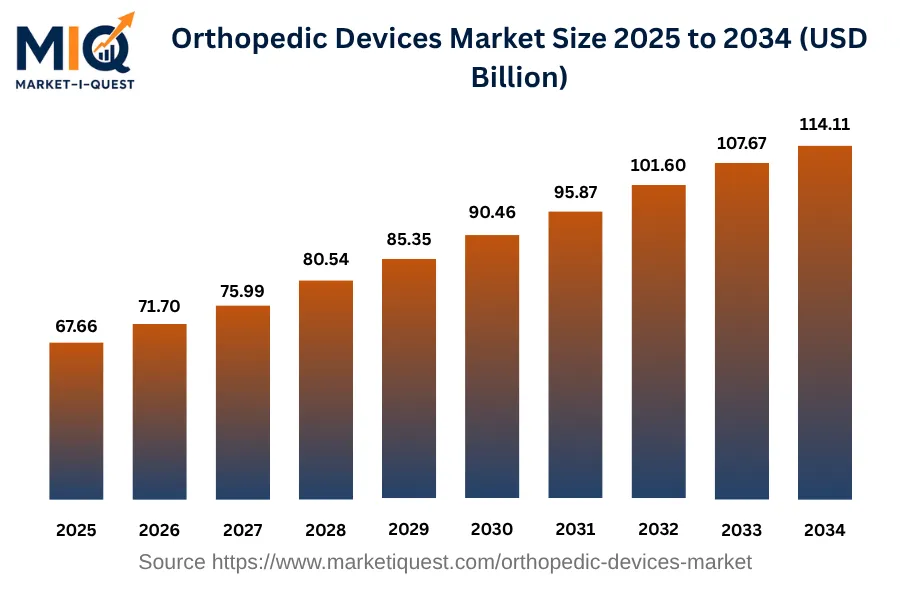
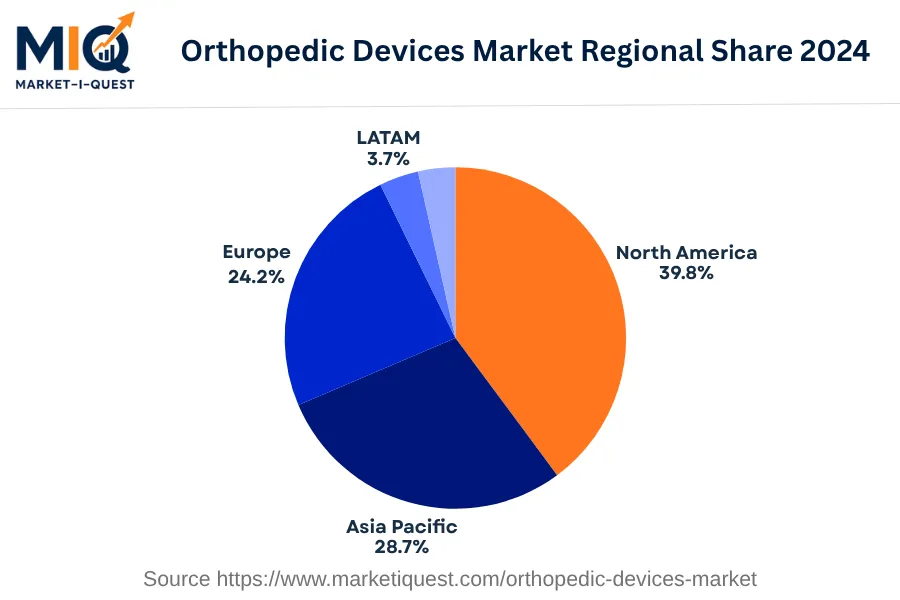
The Orthopedic Devices Market had a size of $67.66 Billion in 2025, and this value is expected to increase to $114.11 Billion by 2034, with a CAGR of 5.98%. The growth path from 2025 to 2034 is marked by an increase from $67.66 Billion in 2025 to a significant market size of $114.11 Billion in 2034. This growth represents an escalation of 68.68% over the decade span. The rise in market size is indicative of significant expansion and consumer demand for orthopedic devices during this period. The regional share in 2024 was scattered, with North America holding 39.84%, the largest slice of the market. The Asia Pacific held 28.74%, and Europe held 24.18%. The remaining shares were held by the LATAM region (3.72%) and MEA (3.52%), showing the global appeal and use of orthopedic devices.

Key Takeaways

  • By Product Type - Joint Reconstruction Devices led the Orthopedic Devices segment holding a significant market share in 2024.
  • By Material - Metal dominated accounting for a significant portion of the segment share in the Orthopedic Devices Market in 2024.
  • By End Use - Hospitals held a leading position in 2024 in the Orthopedic Devices Market.
orthopedic-devices-market market size

Key Driving Factors

Increasing Prevalence of Osteoarthritis

An upward trend in osteoarthritis cases globally provides a significant push to the orthopedic devices market. Osteoarthritis, the most common form of arthritis, causes pain and stiffness in joints, and these symptoms often get worse with age. Orthopedic devices like joint replacements are among the most effective solutions available. Medical professionals recommend these devices, primarily for elderly patients, to potentially alleviate pain and restore mobility. This close link between osteoarthritis prevalence and the orthopedic devices industry adds a considerable momentum to the latter's expansion. Though entirely reliant on fluctuations in osteoarthritis cases, this factor represents a concrete driver in today's orthopedic devices market.
Introduction of Minimally Invasive Surgeries

The introduction of minimally invasive techniques in orthopedic surgeries significantly propels the orthopedic devices market. These novel techniques include smaller incisions, decreased blood loss, and shorter recovery time, making them desirable for patients and surgeons alike. As a result, the demand for orthopedic devices designed for these procedures has sharply risen. Medical device manufacturers are responding to this demand, creating instruments tailored for minimally invasive orthopedic surgeries such as joint replacements and spinal fusion. This development aligns with a broader trend towards patient-friendly surgical methods and can have far-reaching consequences for the orthopedic devices market.

Market Evolution by Timeline

2019-2023
During 2019-2023, a marked surge in orthopedic conditions such as osteoporosis and arthritis, especially among the aging population in regions like North America and Europe, drove demand for orthopedic devices. Additionally, an increase in sports injuries and accidents also contributed to higher sales. Manufacturers predominantly based in U.S., Germany and Japan, produced implants and prosthetics using medical-grade stainless steel, titanium alloys, and biocompatible plastics. Regulations like the FDA's 2019 update on ISO 10993-1 emphasized the importance of biological evaluation for orthopedic devices. Commercially, companies offered these devices via direct supply contracts with hospitals and clinics. Risks included stringent FDA norms and high cost of devices, which manufacturers tried offsetting through value-based pricing models and product innovation.
2024
In 2024, the orthopedic devices market witnessed technology integration with a spike in top-tier manufacturers using 3D-printing for personalized implants. Regions like the Middle East and Latin America saw a surge in demand due to the improvement in healthcare facilities. FDA introduced stricter guidelines for 3D printed devices to ensure safety and efficiency. Manufacturers opted for direct-to-consumer model reducing dependence on hospitals and clinics. Major procurement involved long-term contracts due to the complex nature of production. The main risks involved potential lack of trust from customers in the new technologies, which manufacturers encountered by providing detailed educational material and consultations.
2025-2029
The period between 2025 and 2029 saw emerging markets like China, India, and Brazil demanding more orthopedic devices due to a growth in their healthcare sector and an increase in discretionary income. Smart implants and minimally invasive surgery devices gained popularity. Manufacturers aligned with the EU's Medical Device Regulation (MDR) policy, ensuring clinical evaluation and risk management for medical devices. Most companies moved to a pay-per-use pricing model to reduce the financial burden on patients. The heightened risk came from escalating raw material prices, forcing manufacturers to consider alternatives less reliant on volatile international markets.
2030-2034
Between 2030 and 2034, Africa's rapidly developing healthcare sector increased demand, despite North America still accounting for the lion's share of the orthopedic devices market. Automation in production became common, increasing efficiency and reducing errors. The World Health Organisation's 2030 standards influenced orthopedic device production, emphasizing on reducing device-related infections. Commercially, manufacturers moved towards subscription-based services, effectively handling periodic upgrades and after-sales services. Market risks emerged from increased competition leading to price wars, although innovations maintained profitability for most manufacturers.

Future Market Outlook

Future Opportunities

There are substantial opportunities for growth in the orthopedic devices market, particularly in underserved regions like Southeast Asia, where demand for advanced medical equipment is rapidly increasing. In 2022, the World Health Organization reported that over a billion people globally live with musculoskeletal conditions, highlighting a significant unmet need for effective interventions. Companies like Smith & Nephew are focusing their product development strategies on expanding into emerging markets, establishing partnerships with local healthcare providers to improve access to orthopedic solutions. Regulatory support is evident as nations encourage local manufacturing through favorable policies; for instance, India has been promoting its "Make in India" initiative since 2014, positioning local firms to produce a broader range of orthopedic devices at accessible price points. Technological education and training for healthcare professionals also represent a growth area, as global institutions collaborate to enhance skills related to modern surgical techniques and device usage. The increasing prevalence of lifestyle-related orthopedic conditions, driven by changes in demographics and activities, further accentuates the need for such devices. Moreover, cross-sector collaborations between tech companies and orthopedic firms are expected to flourish, particularly in data analytics and telemedicine solutions to enhance post-operative care. Collectively, these factors indicate a fertile landscape for innovation and development within the orthopedic devices domain, prioritizing patient outcomes while addressing the evolving demands of global healthcare systems.

Segmentation Analysis

By Product Type

The market is divided into subsegments including Joint Reconstruction Devices, Spinal Devices, Orthobiologics, and Support Devices. Joint Reconstruction Devices accounted for the largest revenue share while Orthobiologics is expected to grow at the fastest CAGR during the forecast period.

Largest Revenue Share

Joint Reconstruction Devices

Market Share Leader

Joint Reconstruction Devices are the major revenue contributor in the base year 2024, due to several key factors. An ageing global population with a longer lifespan increases the prevalence of orthopedic diseases. As a consequence, there is an escalating demand for joint replacement surgeries, which require these devices. Furthermore, technological advancements that have improved the efficacy and durability of implants, are also appealing to younger and more active patients seeking long-term solutions. Pain mitigation and enhanced mobility are key purchasing criteria that appeal to end-users, further flaring up the demand. These products are usually sold through multiple channels, including hospitals, orthopedic clinics, and ambulatory surgical centers, increasing their reach. Geographically, developed regions, with a higher percentage of elderly citizens, leading healthcare facilities and adequate reimbursement policies, are likely to continue driving the demand for these devices.

Fastest CAGR

Orthobiologics

Forecast Period Growth Leader

Orthobiologics is projected to be the fastest-growing subsegment. The demand for these biological substances is driven by their potential in accelerating healing in orthopedic injuries, a unique proposition which separates them from other segments. Orthobiologics find substantial use in surgeries to hasten recovery, primarily in sports injuries or maxillofacial surgeries which observe high patient volume globally. Democratization of sports and the rise of lifestyle-oriented hobbies are acting as key catalysts for this trend. Nevertheless, there are adoption barriers due to their relatively higher cost and nascent state of clinical provenness in comparison to traditional solutions. Near-term risks might include potential policy changes in healthcare reimbursement or new clinical evidence questioning their efficacy. As technology progresses in improving these products' effectiveness and potentially reducing their cost, partnered with positive policy regulations, a significant upward trajectory in their adoption is expected.

By Material

The market is divided into subsegments including Metal, Plastic, Ceramics, and Composite. Metal accounted for the largest revenue share while Composite is expected to grow at the fastest CAGR during the forecast period.

Largest Revenue Share

Metal

Market Share Leader

Metal, as a market subsegment, dominates the revenue share because of various factors that contribute to its extensive use. First and foremost is the durability and strength offered by metals. From heavy industries to daily utility products, metals are universally utilized due to their longevity. Furthermore, metal's high amenability to recycling processes contributes to its widespread use, a trend particularly significant considering the growing attention to environmental sustainability and circular economy principles. Production convenience also plays an essential role here. Several metals can be easily molded and adapted into multiple forms, allowing businesses across diverse sectors to use it for different products. Thirdly, certain regulatory changes emphasize materials that provide strong resistance to environmental conditions, this too solidifies the position of metals in the market. The extensive global supply chains for metals also encourage market players to choose metals for their cost-effectiveness and the relative simplicity of procurement.

Fastest CAGR

Composite

Forecast Period Growth Leader

The Composite subsegment is projected to grow at the fastest CAGR for several reasons. Composites are materials made from two or more constituent materials that retain their distinctive properties while collectively providing superior characteristics. This introduces a range of possibilities for industries in terms of product innovation and differentiation, thereby driving composite adoption. Moreover, the versatility and adaptability of composites cater to personalized demands from different industrial sectors. Furthermore, technological advancements are continually improving composite manufacturing processes, reducing costs and making them more attractive. Partnerships between businesses and research institutions are also fostering innovation in the field. Despite many inherent advantages, composites face barriers relating to recycling and environmental footprint, but initiatives are underway to mitigate these issues. Thus, while composites may not currently dominate the market, their growth prospects make them an area to watch in the future.

By End User

The market is divided into distinct subsegments including Hospitals, Orthopedic Clinics, Rehabilitation Centers, and Ambulatory Surgical Centers (ASCs). Out of these, Hospitals accounted for the largest revenue share, while Orthopedic Clinics pose the most robust growth outlook based on the forecast period.

Largest Revenue Share

Hospitals

Market Share Leader

Hospitals are the most integral and conventional part of the healthcare delivery system, hence generating the largest share of revenue in 2024. Multiple factors contribute to hospitals driving sales in the end-user segment. Firstly, hospitals usually possess extensive facilities and well-established infrastructures that allow for a broad suite of services ranging from diagnosis to complex surgeries and postoperative care, amplifying their revenue stream. Secondly, hospitals benefit from a larger patient volume compared to other subsegments due to their higher capacity and their comprehensive care capacity. They are also often the first point of contact for patients with severe and complex conditions, which typically involve high-value treatments. Geographically, urban centers with a higher density of hospitals contribute significantly to the revenue, owing to the population concentration and the trend of referral to tertiary care centers in cities.

Fastest CAGR

Orthopedic Clinics

Forecast Period Growth Leader

Orthopedic Clinics is expected to grow at the fastest rate in the forecast period. This growth can be attributed to multiple factors. First, there is an increasing incidence of musculoskeletal conditions, both chronic, like osteoporosis, and acute, like sport injuries, which directly feed into the demand for orthopedic care. Furthermore, the evolution of technology and newer treatment modalities in orthopedic procedures are making treatments more effective and patients are recognizing this. In addition, societies are witnessing an aging population, the segment most prone to orthopedic ailments, which is another demand driver. However, one key barrier is the relatively high cost of orthopedic treatment which could impede the rate of adoption by patients. Public-private partnerships and governmental policies to provide affordable healthcare could be potential catalysts in speeding up capex allocation and overcoming the cost barrier, ensuring an accelerated growth for this segment.

Competitive Analysis - Orthopedic Devices Market

Key Market Players

Manufacturers / OEMs

Stryker Corporation
US
Zimmer Biomet Holdings
US
DePuy Synthes
US

Key Suppliers & Raw Materials

Carpenter Technology Corporation
US
ATI Specialty Alloys & Components
US
Sandvik AB
Sweden

Distributors, Integrators & Channel Partners

OrthoPediatrics Corp.
US
Smith & Nephew plc
UK
SKY Surgical
UK

Porter’s Five Forces Analysis

Analysis of orthopedic devices market's dynamics in terms of five critical forces.

Supplier Bargaining Power

High

Limited suppliers and high production costs strengthen supplier's bargaining power.

Buyer Bargaining Power

Medium

The numerous range of products empowers buyers, but differentiated devices limit their influence.

Threat of Substitutes

Low

Low threat due to lack of viable substitutes for orthopedic devices.

Threat of New Entrants

Low

High entry barriers such as regulatory norms, and significant R&D investment deter new entrants.

Competitive Rivalry

High

The global market's profitability attracts high competition among established players.

Regional Analysis

Geographic market dynamics and growth opportunities across key regions

Global Market Outlook

orthopedic-devices-market market regional share

North America

The North America Orthopedic Devices Market witnessed considerable growth in 2024, shaped by various drivers and trends in the healthcare sector. Strong demand resulted from an aging population, particularly in the U.S., with greater incidence of bone and joint conditions requiring orthopedic intervention. Technological advancements and high healthcare spending further drove market growth, especially the adoption of minimally invasive surgeries and personalized orthopedic devices. Regulatory policies like the Health Canada's medical device regulations focused on improved patient safety, ignited innovations in the industry.

Consumer preference towards customized implants due to enhanced effectiveness in treatment was a major market trend. Furthermore, technological shifts emerged in the form of robotic surgery or 3D printing technologies used in the production of orthopedic devices. Distribution channels also evolved, with significant growth in online platforms for purchasing orthopedic devices. In terms of M&A trends, strategic partnerships became prevalent as companies sought to expand their product range and footprint in the U.S., Canada, and Mexico. For example, Stryker's acquisition of Wright Medical deepened its presence in the upper extremities, lower extremities, and biologics markets.

The primary sector driving orthopedic device demand was healthcare, with hospitals being the largest customer base due to high patient influx requiring orthopedic surgeries. A sizeable demand also originated from orthopedic clinics, rehabilitation centers, and homecare settings.

Asia Pacific

In 2024, the Asia Pacific orthopedic devices market experienced a significant demand surge. Essential drivers included rapid urbanization in key markets such as China and India, leading to more sedentary lifestyles and increasing incidents of orthopedic ailments. Ageing populations in Japan and Australia significantly widened the customer base. Enhanced healthcare budgets in these nations streamlined patient access to orthopedic treatments, stimulating the market. Additionally, widespread adoption of advanced orthopedic technologies across Asia Pacific medical institutions contributed to industry growth.

Trends witnessed in 2024 included a shift in patient preference to minimally invasive surgeries and personalized orthopedic solutions. Rising internet penetration bolstered online consultations, virtual rehabilitation services, and e-commerce sales of orthopedic devices, especially in China, South Korea, and key ASEAN markets. An uptick in strategic partnerships and mergers within the sector improved distribution networks and facilitated product diversification. Stringent regulatory enforcement, particularly in Australia and Japan, dictated product quality and safety standards, adding another layer to market dynamics. Demand primarily came from the healthcare sector, including private hospitals, government healthcare institutions, and orthopedic clinics, followed by the growing at-home care segment, particularly in Australia and Japan. Access to orthopedic devices became more democratic, broadening market reach.

Europe

In 2024, the European Orthopedic Devices market depicted a strong growth trajectory with Germany holding the largest market share.

On the drivers side, the increasing prevalence of orthopedic diseases like osteoarthritis and osteoporosis significantly propelled the market. Additionally, regulatory authorizations like the EU MDR, which mandated stringent checks for medical devices, boosted confidence in these products. Investment in R&D, particularly in countries like the UK and France, fueled market growth as advanced technologies such as 3D-printing and robotics found wider acceptance. Furthermore, supply dynamics were positively affected as manufactures in Italy and Spain ramped up production capacities and adopted aggressive pricing strategies.

Trends prevalent in the market included user preference for minimally invasive surgeries, leading to a demand surge for related orthopedic devices. In the technosphere, the adoption of AI and IoT in orthopedic devices to enhance diagnostic accuracy became mainstream. There were also noticeable channel dynamics across Europe, with retailers preferring direct-to-patient models. An upsurge in strategic partnerships and M&A activities was evident, particularly in Germany and the Benelux region. Enforcement of stricter post-market surveillance policies by the European Commission ensured the safety and efficiency of these devices.

Primary customers of orthopedic devices included healthcare establishments and government bodies, with significant usage observed in the enterprise sector.

Latin America

In 2024, the Orthopedic Devices Market in Latin America saw a significant growth, primarily attributed to the rising prevalence of musculoskeletal conditions in Brazil, Mexico, Argentina, Colombia, Chile, and Peru. As the region's population aged, the increased need for these devices greatly influenced the market's expansion. New technologies in the field, such as minimally invasive orthopedic devices, further fueled market growth as more healthcare practitioners adopted the technology.

In terms of trends, the market saw a shift towards customized patient-specific implants, particularly in nations like Brazil and Argentina due to their more sophisticated healthcare systems. Online channels for orthopedic device acquisition emerged strong, partly driven by increased internet penetration across LATAM countries. Significant consolidation also occurred within the market, marked by various partnerships and M&A activity, particularly in economies like Mexico and Chile, with a focus on expanding product offerings and reaching to broader patient demographics. Regulatory bodies enforced stricter product approval standards, pushing manufacturers to invest more in R&D and quality assurance to meet these stringent regulations.

Key sectors driving demand in 2024 included government healthcare institutions and private hospitals, both handling a significant bulk of orthopedic surgeries. Retail pharmacies also played a crucial role in catering to over-the-counter orthopedic aid devices such as braces and splints.

Middle East & Africa

In 2024, the Orthopedic Devices Market in the Middle East and Africa remained robust, driven by demand factors, regulations, and technological adoption. Strong demand from countries like Saudi Arabia, United Arab Emirates, Egypt, South Africa, Nigeria, Kenya, and Israel came from a rising number of orthopedic surgeries, within an aging population and a surge in lifestyle-related disorders. Strict regulatory frameworks, such as the Saudi Food and Drug Authority (SFDA)'s guidelines for the import of medical devices, raised the bar for market entrants, creating a competitive landscape dominated by suppliers who prioritize quality. The acceptance and implementation of new technologies like robotic surgeries and 3D printing in countries like UAE and Qatar propelled market growth.

The market trends included a shift towards customized orthopedic implants, stimulating a shift in manufacturing and supply channels. In Egypt and South Africa, there was a notable increase in hospital and clinic partnerships to ensure adequate supply of devices. The trend of medical tourism in countries like UAE and Israel continued to influence the market, further boosted by policies promoting healthcare infrastructure. However, disparity in access to healthcare, especially in rural areas of Nigeria and Kenya, remained a persistent challenge for the uniform adoption of orthopedic devices across the region.

Recent Industry Developments

Latest market innovations, product launches, and strategic initiatives

January 2026

Global medical equipment metrics confirmed that the top five consolidated market leaders—DePuy Synthes (Johnson & Johnson), Stryker, Zimmer Biomet, Smith & Nephew, and Medtronic—controlled over 55% of global orthopedic devices market share.

May 2025

Align Technology received regulatory clearance from China's National Medical Products Administration (NMPA) for its 3D-printed Invisalign Palatal Expander System, accelerating custom pediatric orthopedic and dental reconstruction workflows.

Frequently Asked Questions