Orthopedic Implants Market Snapshot

Key Players

  • Zimmer Biomet (United States)
  • Smith & Nephew (United Kingdom)
  • Stryker Corporation (United States)
  • Johnson & Johnson (United States)
  • Medtronic (Ireland)
  • Orthofix Medical (United States)
  • Globus Medical (United States)
  • Wright Medical Group (Netherlands)
  • ConforMIS (United States)
  • Arthrex (Germany)

Market Size

Base Year 2024
$28.96 Bn
CAGR
5.86%
Forecast 2034
$51.18 Bn

Market Segments

By Product
Lower Extremity Implants, Spinal Implants, Dental Implants, Upper Extremity Implants
By Material
Metallic Materials, Ceramic Biomaterials, Polymeric Biomaterials, Others
By Distribution Channel
Offline, Online
By End Use
Hospitals, Outpatient Facilities

Market Dynamics

Drivers
  • Aging global population
  • Technological advancements in implants
Restraints
  • High product cost
  • Stringent regulatory processes
Opportunities
  • Aging global population
  • Improving healthcare infrastructure

Market Size

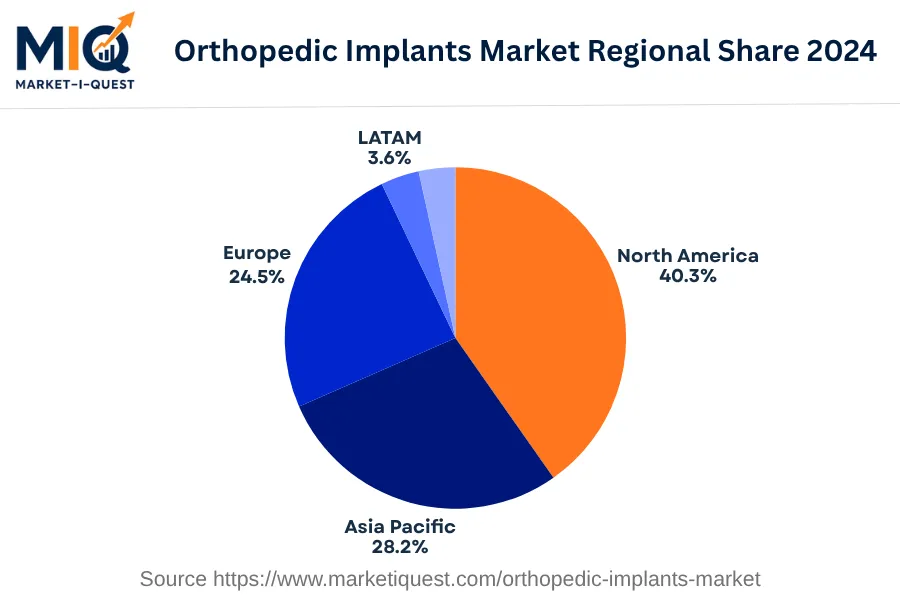
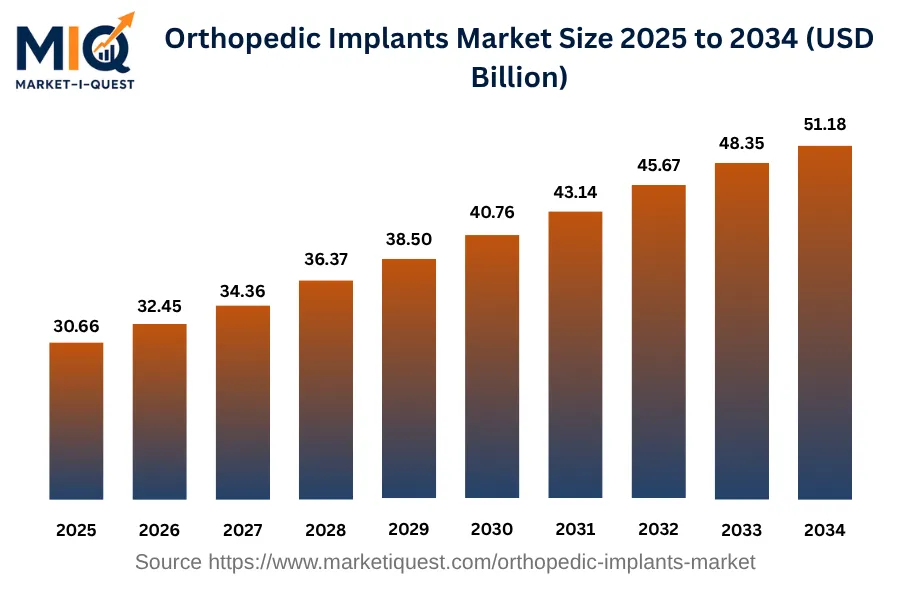
The Orthopedic Implants Market is projected to grow from USD 30.66 billion in 2025 to USD 51.18 billion in 2034, with a CAGR of 5.9%. The steady increase in the Orthopedic Implants Market can be traced from USD 28.96 billion in 2024 to the approximated figure of USD 51.18 billion by 2034. This growth in the market is primarily driven by the increasing prevalence of orthopedic conditions requiring implant procedures and the continuous advances in the orthopedic implants manufacturing processes and materials. The Orthopedic Implants Market has an extensive reach, with North America holding the largest share at 40.3% in 2024. This is followed by Asia Pacific at 28.2%, Europe at 24.5%, LATAM at 3.6%, and MEA at 3.46%. This regional distribution informs the global range and impact of the Orthopedic Implants Market.

Key Takeaways

  • By Product - Dental Implants led the market sharing high percent overall in the year 2024.
  • By Material - Polymeric Biomaterials held the leading position contributing to the majority share in 2024.
  • By Distribution Channel - Offline segment maintained robust dominance in the market with the majority share in 2024.
  • By End Use - Hospitals represented the largest segment delivering a significant contribution to the market's growth in 2024.
orthopedic-implants-market market size

Key Driving Factors

Increasing Prevalence of Orthopedic Conditions

One of the critical drivers for the orthopedic implants market in the near term is the rising incidence of orthopedic conditions such as osteoporosis, fractures and arthritis. As the population ages, these conditions become more common, leading to a higher demand for orthopedic implants. Hospitals and clinics are being pushed to procure more implants to cater to the increasing number of procedures. Moreover, people with a sedentary lifestyle, obesity, or other conditions that put strain on the musculoskeletal system are experiencing orthopedic issues at a younger age. This shift is also contributing to the expanding demand for orthopedic implants.

Enforcement of Patient-Protection Regulations

Another specific driving factor for the orthopedic implants market is the enforcement of regulations that mandate higher standards of patient safety and product quality. Regulatory authorities such as the Food and Drug Administration (FDA) and the European Medicines Agency (EMA) have rigorous quality requirements for orthopedic implants. They require manufacturers to comply with stringent standards in product design, manufacturing processes, and post-market surveillance. To meet these requirements, orthopedic implant producers are investing in research and development and upgrading manufacturing facilities. This enforcement of regulations results in an increased demand for high-quality orthopedic implants, thereby stimulating growth in the market.

Market Evolution by Timeline

2019-2023
During this period, the North American market, fueled by an aging population and increasing cases of osteoporosis, dominated the demand for orthopedic implants. European markets followed, driven by similar demographic trends. Manufacturers improved production efficiency by introducing automation and improved material quality. Regulatory bodies, like the US FDA, introduced more stringent rules to ensure safety and effectiveness of these implants, affecting the speed of product launches and adoption. Price competition was intense due to the presence of many vendors. However, partnerships between vendors and healthcare providers were common, often under contract manufacturing agreements. The market faced supply chain disruption risks due to geo-political tensions and trade restrictions.
2024
In 2024, Asia-Pacific markets emerged as significant buyers due to the growing awareness about the benefits of early intervention in orthopedic conditions. The increased adoption of advanced manufacturing technologies allowed suppliers to meet this growing demand. In terms of regulatory landscape, the European Union Medical Device Regulation came into full effect, requiring vendors to comply with stricter product traceability requirements. The market saw a number of strategic alliances being formed to ensure compliance with this regulation and to strengthen supply chains. However, regulatory compliance costs inflated the product prices.
2025-2029
Between 2025 to 2029, Latin America and Middle East & Africa markets showed increased demand due to healthcare sector improvements. Suppliers were beginning to use biocompatible material and 3D printing technology for personalized orthopedic implants. Policies like Affordable Care Act in the US made orthopedic implants more accessible to patients. There was a shift towards value-based pricing model where pricing was linked to patient outcomes. This period saw a greater concern towards cybersecurity risk as orthopedic implants started to incorporate 'smart' features.
2030-2034
From 2030 to 2034, the buyer segment comprised largely of elderly people as life expectancy increased worldwide. The technology for orthopedic implants reached maturity with the wide usage of nanotechnology and biomaterials. Due to the implementation of Universal Health Coverage (UHC) under Sustainable Development Goals (SDGs) by the UN, policy landscape became conducive for market expansion in developing countries. The commercial model was focused more on collaborative agreements between suppliers and public health agencies to meet UHC targets. Quality control and standardization risk started becoming more prominent with diversity in product ranges.

Future Market Outlook

Future Opportunities

Future opportunities in the orthopedic implants market are closely linked to current trends and challenges faced by the industry. The shift towards an aging global population is creating an increased demand for joint replacement surgeries, particularly in countries with higher life expectancies like Japan and Germany. As healthcare systems adapt, opportunities for implementing digital health solutions such as telemedicine have emerged, thereby improving patient consultations and follow-ups post-surgery. In 2023, the World Health Organization conducted research highlighting the need for improved access to orthopedic care in rural areas, prompting collaborations between technology companies and healthcare providers. Opportunities also exist in the realm of regulatory compliance, as companies that efficiently navigate the complex landscape established by the FDA or the European Medicines Agency can leverage this to position themselves favorably against competitors. Furthermore, sustainable practices are becoming vital with an emphasis on reducing environmental impacts. Companies are now exploring biodegradable materials for implants, evidenced by recent research partnerships involving universities and implant manufacturers. Additionally, innovations in robotics and AI-driven analytics can enhance operational efficiency in surgical environments. As regulatory landscapes evolve, companies that successfully implement these advanced technologies while adhering to stringent guidelines are likely to capture a larger share of the market in the coming years.

Segmentation Analysis

By Product

The market is divided into subsegments including Lower Extremity Implants, Spinal Implants, Dental Implants, and Upper Extremity Implants. Dental Implants accounted for the largest revenue share while Spinal Implants is expected to grow at the fastest CAGR during the forecast period.

Largest Revenue Share

Dental Implants

Market Share Leader

Dental implants have been garnering the highest revenues within the product segment, with key driving factors being the prevalent trends in cosmetic dentistry and the increase in the geriatric population prone to oral health issues. Factors like dental caries, periodontal diseases, and tooth loss are prevalent among the vast age group, thereby fueling the demand for dental implants. The market penetration of dental implants is high in developed countries due to the availability of advanced dental surgical facilities and high purchasing power. However, emerging economies are anticipated to significantly contribute to the revenue share due to growing awareness campaigns about oral health. On the supply side, manufacturers are continuously investing in R&D to develop innovative and effective implants, further providing a boost to the segment. The dental implant segment's growth is also bolstered by the regulation and policies encouraging dental care, strategic marketing through dentists, and favorable insurance coverage in some markets.

Fastest CAGR

Spinal Implants

Forecast Period Growth Leader

Spinal implants are projected to witness the fastest growth rate during the forecast period. The driving force behind this rapid growth is the prevalence of degenerative disc diseases and the increase in the geriatric population suffering from lower back pain. As the ageing population grows, so does the number of individuals with spinal problems, resulting in higher demand for spinal implants. Technological advancements, such as minimally invasive spinal surgeries and the launch of bone morphogenic proteins, are other key catalysts propelling the segment growth. Policies promoting innovative medical devices and favorable reimbursement terms regarding spinal surgery are also playing key roles in accelerating growth. However, the high cost of spinal implants and surgeries may act as a barrier and therefore presents a near-term risk to this rapid growth. Nonetheless, partnerships between hospitals and implant manufacturers, along with government initiatives to subsidize expensive procedures, are expected to mitigate this risk and foster the segment's growth in the forecasted period.

By Material

The market is divided into subsegments including metallic materials, ceramic biomaterials, polymeric biomaterials, and others. Polymeric biomaterials accounted for the largest revenue share while ceramic biomaterials are expected to grow at the fastest CAGR during the forecast period.

Largest Revenue Share

Polymeric Biomaterials

Market Share Leader

Polymeric biomaterials are perceived in the market as a key contributor to revenue growth primarily due to their versatile nature, making them ideal for a variety of applications. These materials offer high levels of biocompatibility and can be engineered to suit a wide variety of needs and demands. Their primary use in orthopedics and cardiology, which are two large and growing medical sectors, fuels the sales further. In addition, they are extensively utilized in drug delivery systems due to their ability to encapsulate drugs and release them at a controlled rate, increasing their demand in pharmaceutical industry. The low cost and easy processability of polymeric biomaterials when compared to their metallic and ceramic counterparts also play a significant role in sustaining their leading position in terms of revenue.

Fastest CAGR

Ceramic Biomaterials

Forecast Period Growth Leader

Ceramic biomaterials are expected to grow at an impressive rate over the forecast period. Often used in orthopaedics, dentistry and in the development of artificial organs, these materials have a significant edge over others due to their excellent biocompatibility and ability to undergo osseointegration. Medical professionals increasingly prefer ceramic biomaterials as they do not trigger allergic reactions, and their esthetic qualities enhance patient acceptance. As technology continues to develop, we expect the processing and customization capabilities of ceramic materials to improve, leading to a wider range of applications, and subsequently, stronger market growth. However, one must consider the relatively higher costs and potential brittleness as barriers to market expansion.

By Distribution Channel

The market is divided into subsegments including Offline and Online. Offline mode accounted for the largest revenue share while the Online subsegment is expected to grow at the fastest CAGR during the forecast period.

Largest Revenue Share

Offline

Market Share Leader

Offline distribution in the year 2024 accounts for the largest revenue share within the industry. This is can largely be attributed to widespread consumer preference and the guarantee of immediate availability of goods and services. Offline channels provide a tactile experience that allows customers to inspect the quality of a product before they purchase, leading to increased customer satisfaction and repeat business. Moreover, offline distribution provides advantages like allowing one-on-one customer interaction which plays a significant role in enhancing the sales of a company. The geographies that benefit the most from offline distribution are rural and developing regions, where internet access might still be a challenge. Regulations and supply chains also favor offline distribution as it is a well-established and traditional channel, providing smooth logistics and operations. High switching costs from offline to online due to operational changes and customer adaptations act as another reason that the offline segment has held onto its dominance.

Fastest CAGR

Online

Forecast Period Growth Leader

While the Offline distribution channel dominates in terms of revenue, the Online distribution segment is witnessing the fastest growth in the market. The accelerated growth of this segment can be attributed to the widespread adoption of internet and smartphone usage. Advances in e-commerce technology, increasing consumer trust in online purchasing, and the advent of easy, safe payment systems are key drivers for the growth of online sales. Moreover, growing digitization and the convenience of home-delivery have made online channels an attractive platform for consumers. However, there are potential barriers such as cybersecurity and data privacy concerns that hinder market growth, but policies and regulatory measures are being put in place to address these issues. Continuous investment in improving the digital infrastructure and partnerships between e-commerce giants and local players are also boosting the online segment growth. While operational challenges and resistance to change in traditional markets pose near-term risks, the overall growth outlook remains positive for the Online distribution channel.

By End Use

The market is divided into subsegments including Hospitals and Outpatient Facilities. With the largest portion of overall revenue base, Hospitals have the most share of the market while Outpatient Facilities are positioned to see the fastest growth rate.

Largest Revenue Share

Hospitals

Market Share Leader

Hospitals account for the most considerable income due to the wide range of services and treatments they provide, the high patient influx, and the constant demand. As the main hub for most critical and complicated health cases, they not only offer treatment but also state-of-the-art facilities for various surgeries, diagnostics, and rehabilitation services. Their broad customer base ranging from emergency patients to those needing constant and specialized care contributes immensely to the revenue. Geographically, hospitals in urban areas where the population is dense are more likely to generate higher revenues. The market presence of hospitals is further bolstered by regulatory support, such as government initiatives in many regions to provide accessible public healthcare. These factors cumulatively make hospitals the subsegment with the highest revenue in the market.

Fastest CAGR

Outpatient Facilities

Forecast Period Growth Leader

Although hospitals dominate the market in terms of revenue, Outpatient Facilities are set to grow at the fastest rate. Drivers of growth in this segment include the increasing shift toward cost-effective treatment options and the advancement in healthcare technology that allows many procedures to be performed without the need for hospitalization. Furthermore, the growth in home healthcare services and the rising preference for minimally invasive treatments are pushing more patients towards outpatient facilities. This change in patient behavior can be attributed to the desire for faster recovery times and the convenience associated with skipping hospital stays. Despite this, there are adoption barriers, notably the perception that more severe health conditions should be treated in full-service hospitals. Risks, including the need for sudden hospitalization due to complications, also exist. Nonetheless, the growing healthcare spending and patients' awareness are expected to catalyze this subsegment's growth.

Competitive Analysis

Key Market Players

Manufacturers / OEMs

Johnson & Johnson
US
Zimmer Biomet
US
Stryker Corporation
US

Key Suppliers & Raw Materials

Carpenter Technology Corporation
US
ATI Specialty Alloys & Components
US
Fort Wayne Metals
US

Distributors, Integrators & Channel Partners

Avnet, Inc.
US
Future Electronics
Canada
Cardinal Health, Inc.
US

Porter’s Five Forces Analysis

The analysis examines dynamics shaping the orthopedic implants market.

Supplier Bargaining Power

Medium

Suppliers control raw materials, but are subject to large volume contracts and long-term agreements.

Buyer Bargaining Power

Low

Buyers, mainly hospitals and clinics, face high switching costs and limited alternatives.

Threat of Substitutes

Low

Substitute treatments are limited and often less effective than orthopedic implants.

Threat of New Entrants

Low

High capital costs, strong IP protection, and regulatory barriers limit new entries.

Competitive Rivalry

High

Fierce competition among established firms on innovation, pricing and quality.

Regional Analysis

Geographic market dynamics and growth opportunities across key regions

Global Market Outlook

orthopedic-implants-market market regional share

North America

In 2024, North America's orthopedic implants market advanced significantly, driven primarily by the buoyant demand in the United States, Canada, and Mexico. The rising incidences of osteoarthritis and osteoporosis fueled the market growth alongside the region's substantial investment in healthcare infrastructure. Regulatory support, particularly from the U.S. Food and Drug Administration (FDA), encouraged manufacturers and research entities to enhance technological innovation in implant devices. Concurrently, supply dynamics witnessed a favorable transformation due to the implementation of advanced manufacturing techniques, significantly reducing the cost of these implants.

Market trends in 2024 favored minimal invasive surgery, an emerging preference among patients, propelling the use of orthopedic implants like spinal devices and joint reconstruction hardware. Technological advancements, such as 3D printing and robotics, began impacting product development, leading to improved patient outcomes. Major orthopedic companies, including Stryker and Zimmer Biomet, saw several strategic partnerships and mergers to expand their product portfolios and strengthen their positions in North America. These efforts were further echoed by the enforcement of stringent standards by medical bodies like the American Academy of Orthopaedic Surgeons (AAOS) to ensure product safety and efficacy. Lastly, the healthcare sector itself acted as an ardent customer, with government and private hospitals contributing significantly to the demand for orthopedic implants.

Asia Pacific

In 2024, the orthopedic implants market in the Asia Pacific demonstrated a robust growth trajectory. Ageing populations in Japan and Australia, alongside the increase in orthopedic disorders, were amongst the primary drivers promoting this advance. Enhanced government spendings on healthcare, particularly in China and India, enabled hospitals to invest in high-quality orthopedic implants. Knowledge dispersion about cutting-edge procedures, such as navigated and robot-assisted surgeries in countries like South Korea, created an unprecedented demand for advanced implant materials and designs.

On the trends side, the emergence of novel orthopedic implants like 3-D printed implants raised the competition, primarily in technologically advanced healthcare markets like Japan. The digital boom in major regions of China and ASEAN nations prompted e-commerce platforms to stock implant devices, which inadvertently increased their reach and visibility among end-users. Regulatory tightening around product quality and patient safety in India resulted in an uptick of mergers and partnerships, for instance, between local manufacturers and global brands to achieve necessary certifications and seize market share. In contrast, Australia observed strict enforcement of recently-implemented UDI (Unique Device Identification) policies, increasing traceability and post-market surveillance of implants, thereby fostering transparency and confidence in the device's performance and safety. This was specifically noted within healthcare and retail sectors, promoting a steady growth.

Europe

In 2024, the European Orthopedic Implants Market experienced significant shifts due to a combination of demographic changes, regulatory affairs, and technological advancements. Aging populations particularly in Germany and Italy drove the demand for orthopedic implants, due to higher incidence of osteoporosis and osteoarthritis. The European Union’s Medical Device Regulation (MDR) enhanced product quality and safety standards, prompting increased investment in Research & Development among manufacturers. The adoption of Additive Manufacturing (AM) technologies, especially in the UK and Benelux countries, drastically changed supply dynamics, reducing production costs and lead times for custom implants.

Purchase behavior was primarily marked by a rising preference for bio-absorbable implants in Nordic countries, driven by concerns over long-term biocompatibility. There was also a widespread shift towards minimally invasive surgical techniques, due to the associated benefits of reduced recovery times and complications. Leading manufacturers like Zimmer Biomet and Stryker took strategic steps to consolidate the market through partnerships and acquisitions, including acquisition of small-scale AM facilities. The European Commission’s reinforcement of CE marking standards also reshaped channel dynamics, creating opportunities for authorized representatives to support regulatory compliance. The healthcare sector, particularly hospitals and orthopedic clinics, remained the leading consumer of orthopedic implants, with high demand for joint reconstruction and spinal implants.

Latin America

The Latin American Orthopedic Implants Market in 2024 witnessed substantial transformation due to various drivers and trends. Primarily, rising cases of osteoporosis, arthritis, and obesity largely drove the demand for orthopedic implants. Implementation of stringent regulations to ensure product quality and reliability further steered the market, with countries like Brazil and Mexico being at the forefront. In addition, increased investment in healthcare infrastructure in Argentina, Colombia, and Chile amplified market activity.

Trends influencing market dynamics included a discernible shift towards minimally invasive surgeries mainly performed in Brazil and Mexico, fueling the need for specialized implants. Technological advancements, specifically in 3D-printed orthopedic implants experienced increased adoption across these nations. Moreover, collaborations and merger activities, most notably between local manufacturers and international companies, were common trends shaping the market.

Healthcare establishments, including hospitals and clinics, were core customer segments, with a heightened demand for these implants in orthopedic, geriatric care, and obesity clinics. As for sectors, the enterprise sector seemed predominantly focused on providing advanced solutions as per specific customer requirements. Notably, policy enforcement regarding the health and safety of orthopedic implants was implemented rigorously, shaping the market dynamics across Latin America in 2024. Undeniably, the axis of change revolved around the pursuit of product innovation, established regulations, and accessibility of advanced orthopedic solutions.
Middle East & Africa

In 2024, the Middle East and Africa (MEA) orthopedic implants market witnessed considerable activity influenced by demand, innovation, and regulatory patterns. A robust segment of healthcare, it is driven by an aging population in countries like Saudi Arabia and South Africa, leading to increased incidences of osteoporosis and osteoarthritis, which necessitate implant intervention. Technological adoptions in digital health, such as IoT-based tracking and AI-powered predictive analysis, have also impacted the market, enhancing the longevity and functional compatibility of implants. Additionally, the move towards standardization such as the Saudi Food and Drug Authority’s regulatory framework for Medical Devices, motivated manufacturers to adhere to quality, safety, and efficacy of orthopedic implants, shaping the market dynamics.

Trends within the MEA orthopedic implants market indicate significant shifts in both consumption and supply chains. Greater awareness and affordability have boosted consumer demand, particularly in pockets of well-developed healthcare infrastructure like the United Arab Emirates. Notable product advancements, such as 3D-printed bespoke implants, garnered attention, while strategic partnerships strengthened market reach - Medtronic’s expansion in Egypt being a case in point. There have also been shifts in procurement channels, with e-commerce platforms increasingly used, reflecting changes in buyer behavior. The regulatory push for improved remote patient monitoring, as shown by the Kenyan government, marks another trend, influencing healthcare providers' choice of implants.

Recent Industry Developments

Latest market innovations, product launches, and strategic initiatives

May 2025

Align Technology secured regulatory approval from China's National Medical Products Administration (NMPA) for its custom 3D-printed Invisalign Palatal Expander System, marking a major expansion for patient-specific 3D-printed orthopedic and dental appliances in Asia.

Frequently Asked Questions