Industrial Wireless Sensor Network Market Snapshot

Key Players

  • Endress+Hauser (Switzerland)
  • Emerson Electric (United States)
  • Honeywell International (United States)
  • ABB (Switzerland)
  • Texas Instruments (United States)
  • STMicroelectronics (Switzerland)
  • Yokogawa Electric (Japan)
  • Siemens AG (Germany)
  • General Electric (United States)
  • Schneider Electric (France)

Market Size

Base Year 2024
$9.67 Bn
CAGR
14.83%
Forecast 2034
$38.55 Bn

Market Segments

By Component
Hardware, Software, Services
By Sensor Network Type
Temperature, Pressure, Level, Flow, Humidity, Motion & Position, Gas, Light, Chemical, Others
By Network Technology
Bluetooth, ZigBee, Wi-Fi, Near Field Communication (NFC), Cellular Network, ISA 100.11a, Others
By End Use Industry
Automotive, Oil & Gas, Utilities, Mining, Food & Beverage, Manufacturing, Others

Market Dynamics

Drivers
  • Increasing industrial automation
  • Rise in IoT adoption
Restraints
  • High implementation cost
  • Security concerns
Opportunities
  • Emerging IoT trends
  • Growing Industrial automation demand

Market Size

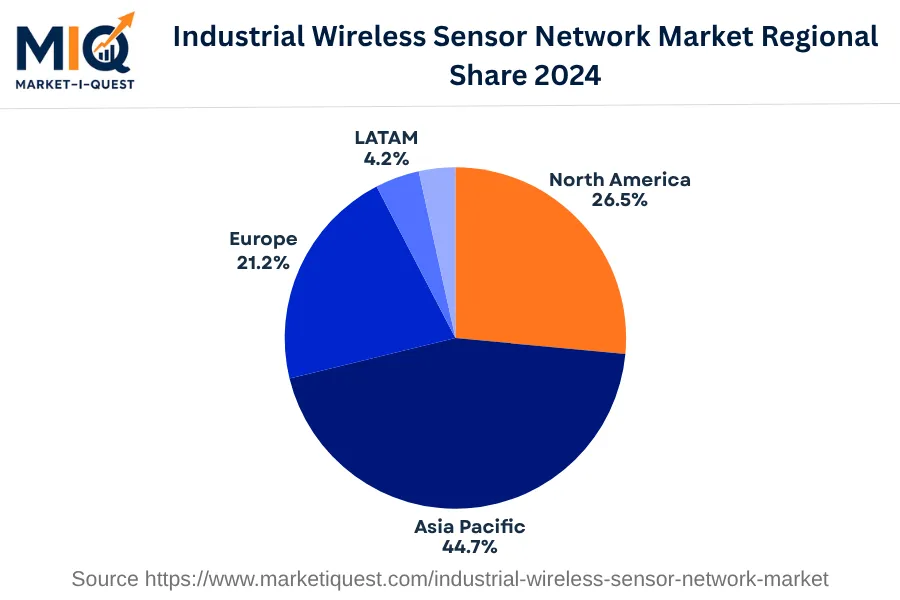
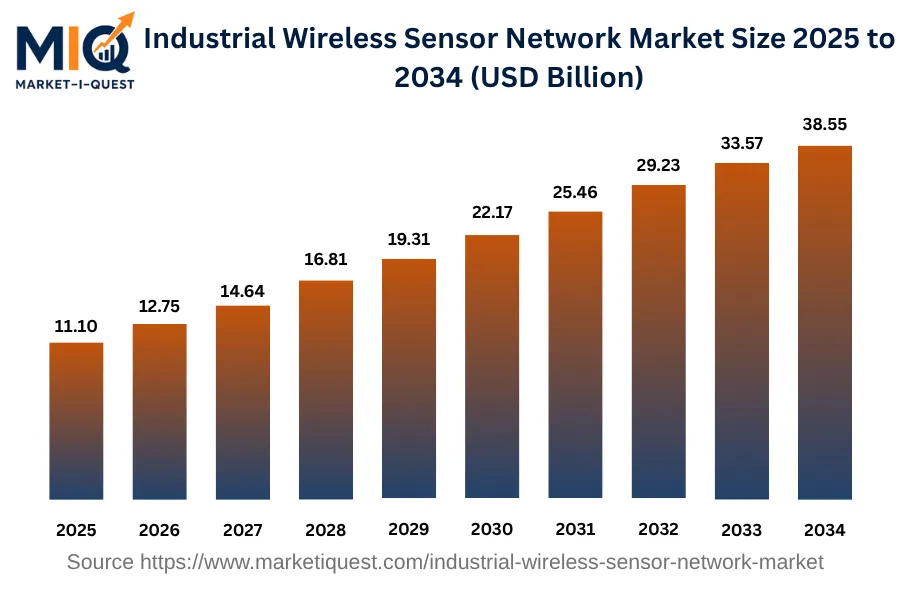
The Industrial Wireless Sensor Network Market size is projected to increase from USD 11.10 Billion in 2025 to USD 38.55 Billion by 2034 with a CAGR of 14.83%. The market's substantial growth over this period reflects a nearly fourfold increase in its valuation, set in motion by rapid advancements in wireless sensor technology and increased industrial automation needs. A continually expanding utilization of sensor technology in diverse industrial sectors such as manufacturing, oil and gas, and power generation has also played a key role in propelling the market growth trajectory. The regional share for the Industrial Wireless Sensor Network Market in 2024 was distributed with Asia Pacific holding the largest share at 44.72%, followed by North America at 26.48% and Europe at 21.16%. The regions of LATAM and MEA held smaller shares at 4.19% and 3.45% respectively.

Key Takeaways

  • By Component - Hardware held the predominant share in the Industrial Wireless Sensor Network Market in the recent past.
  • By Sensor Network Type - Temperature sensors led accounting for a significant share in the base year.
  • By Network Technology - Cellular Network was the leading technology accounting for a substantial market share.
  • By End Use Industry - Automotive sector was the top player holding a major position in the previous year.
industrial-wireless-sensor-network-market market size

Key Driving Factors

Need for Real-time Data Monitoring in Industries

The demand for real-time monitoring of complex industrial operations is becoming increasingly significant. Industrial Wireless Sensor Networks (IWSN) provide a seamless method for retrieving precise and timely data, thereby aiding in decision-making processes. Industries, such as manufacturing, oil and gas, and utilities, use IWSN for real-time quality control, predictive maintenance, and supply chain optimization, which significantly enhance their productivity and operational efficiency. The immediacy of the data collected and the ability to wirelessly connect to difficult-to-reach industrial environments positions IWSN as a critical factor in ensuring the smooth running of operations, reducing downtime, and mitigating risks associated with unforeseen issues.

Adherence to Regulatory Standards for Worker Safety

In the industrial sector, safety regulations stipulated by occupational safety organizations, like the Occupational Safety and Health Administration (OSHA) in the United States, mandate companies to maintain a safe working environment. IWSN make it possible to monitor harmful environmental and occupational health conditions such as high noise levels, harmful gases, extreme temperatures, and other potential hazards in real-time. This enables industries to maintain compliance with regulatory standards and protect workers' safety. In addition, these networks assist in failure prediction and accident prevention, which further enhance worker safety and reduce a company's liability. The use of IWSN in ensuring compliance with strict safety regulations is, therefore, a significant driver of its market growth.

Market Evolution by Timeline

2019-2023
Industrial sectors namely oil and gas, utilities, and manufacturing showed demand for wireless sensor networks during this period primarily for remote monitoring applications. High temperature tolerant sensors piloted by U.S firms attracted attention. Supply chain constraints related to semiconductor production caused price fluctuations. The Open Wireless Architecture Platform (OWA), which promotes an open-source approach, gained acceptance. Performance-based procurement model dominated contracts with initial payment benchmarked on set milestones. Security vulnerability due to unattended operation was a risk though mitigation measures like encryption, identity authentication were applied.
2024
Adoption of wireless sensor networks in the automotive industry spiked up in the United States, Germany, and Japan for real-time monitoring in production sites. Advancements in miniaturization and battery longevity were recorded. The emergence of multiple wireless standards posed compatibility issues, making it harder to integrate devices interoperably. Pricing dynamics were driven by supply and demand trends with prices trending higher due to increased demand. Cybersecurity concerns persist as increased industrial use escalated the risk of hacking.
2025-2029
Innovative applications emerged in the agriculture sector across developed countries like Australia for monitoring soil moisture levels. The supply was marked by the introduction of energy harvesting techniques. Standards such as IEEE 802.15.4 saw worldwide acceptance reducing cross-vendor interoperability issues. Companies looked out for long-term leasing contracts rather than the outright purchase of devices. Cyber threats remained a constant concern although robust network security measures were commonly implemented.
2030-2034
Developing nations like India and Indonesia saw increased adoption of wireless sensor networks in urban development projects for smart city applications. Energy harvesting techniques became mainstream providing steady supply. ISO/IEC 29182 established as a universal standard making interoperability seamless. Manufacturers started offering sensor-as-a-service models. Though the risk of signal loss due to interference from similar radio frequency-based devices was a consideration, technological advancements helped to overcome it.

Future Market Outlook

Future Opportunities

As industries continue to embrace wireless sensor networks, several future opportunities emerge, particularly in sectors like manufacturing, energy management, and smart cities. With the increasing number of regulations focused on energy efficiency and emissions reductions, there is a significant drive towards integrating wireless sensors into energy management systems. For instance, the European Union has set ambitious climate targets that require enhanced monitoring of emissions and energy consumption by 2030, creating a demand for robust sensor networks. Moreover, companies like Schneider Electric are exploring partnerships that facilitate the implementation of IoT solutions in urban infrastructures, positioning themselves to capture emerging smart city projects that leverage wireless sensor technology. The ongoing development of artificial intelligence and machine learning presents additional opportunities for predictive maintenance and operational optimization for industries adopting sensor networks. In 2024, the Industrial Internet Consortium plans to release guidelines that will enable the interoperability of devices and increase collaboration between industries through shared data analytics. Furthermore, as the agricultural sector increasingly adopts precision farming techniques, there is substantial room for growth in environmental monitoring solutions that utilize wireless sensors. The convergence of health and industry, exemplified by public health concerns, presents additional opportunities for deploying sensor networks in real-time monitoring of environmental conditions affecting worker safety and public health.

Segmentation Analysis

By Component

The market is divided into subsegments including Hardware, Software, and Services with Hardware accounting for the largest revenue share, while Services is expected to grow at the fastest CAGR during the forecast period.

Largest Revenue Share

Hardware

Market Share Leader

Hardware, as a component, typically leads in revenue generation due to its fundamental role in any digital system or process. In this existing market structure, hardware elements, from microprocessors to storage devices, form the operational foundation of many digital solutions. Cost factors also contribute to the prominence of hardware in revenue share. Given that hardware has a tangible, physical nature, its production involves material, manufacturing, and logistical costs which are often transferred to the pricing. Geographically, developed regions with higher purchasing power like North America and Europe are primary contributors to hardware's high revenue share. Regulation and supply dynamics play a part too - the limited number of global hardware manufacturers, regulatory systems favoring international trade, and long-standing supply chains have solidified hardware's leading position. Buyers consider factors like technical specifications, price, and brand reputation when purchasing, and for bulk corporate buyers, supply stability and service agreements are vital as well. Switching costs can be high if entire systems need overhauling, making customers consider their hardware investments cautiously, further contributing to hardware's large revenue share in the market.

Fastest CAGR

Services

Forecast Period Growth Leader

The Service sector is expected to exhibit the fastest growth in terms of CAGR. The primary drivers behind this growth are digital transformations across industries and the ever-increasing technical complexity of solutions. As technologies become more intricate, organizations often fail to fully comprehend and efficiently deploy them. This gap in understanding creates an increasing demand for professional, managed, and consulting services, ultimately driving growth in this segment. Regulatory changes, such as compliance requirements for data security and privacy, also stimulate the demand for specialized services. Similarly, technological advancements such as the rise in artificial intelligence, machine learning, and cloud computing act as catalysts for rapid growth. Partnerships between service providers and organizations for innovative solution deliveries are also gaining momentum. However, the initial capital expenditure for digital restructuring and the difficulty in choosing the right service provider might pose as adoption barriers. The near-term risks include potential security concerns and loss of operational control in outsourcing services.

By Sensor Network Type

The Sensor Network type segment is partitioned into Temperature, Pressure, Level, Flow, Humidity, Motion & Position, Gas, Light, Chemical and other subsegments. In 2024, the Temperature subsegment had the largest revenue share, whereas the Motion & Position subsegment is projected to have the fastest compound annual growth rate (CAGR) in the following years.

Largest Revenue Share

Temperature

Market Share Leader

The Temperature subsegment leads the sensor network market in revenue predominantly due to its universal application across multiple industries. This diverse range of uses includes weather monitoring, industrial process control, home automation, healthcare and many more. The rise of IoT in homes and industries has exponentially increased the demand for temperature sensors for system efficiency and safety reasons. Especially in the healthcare sector, temperature monitoring is key to patient care and drug storage, driving up the demand. Geographically, the Asia-Pacific region contributes significantly due to rapid industrialization and increased use in consumer electronics. Regulatory norms globally have also made temperature monitoring obligatory in certain cases for safety reasons. Finally, high switching costs for users and established supply chains maintain the leading position of this subsegment.

Fastest CAGR

Motion & Position

Forecast Period Growth Leader

The Motion & Position subsegment is expected to register the highest growth among sensor network types. This can be attributed to the increasing demand for position sensors in advanced technology sectors such as autonomous vehicles, robotics, and drones. The global push for automating industries is acting as a catalyst for the growth of this subsegment. Furthermore, advancement in wireless technologies enhances efficiency and reduces the cost of these sensors making them more accessible. Some possible adoption barriers could include concerns about data security and technical complexities in integrating these sensors with existing systems. In the short term, fluctuating raw material costs could pose a risk to growth. However, partnerships with technology companies and substantial investments in research and development are likely to drive the growth of this subsegment.

By Network Technology

The market is divided into subsegments including Bluetooth, ZigBee, Wi-Fi, Near Field Communication (NFC), Cellular Network, ISA 100.11a, and Others. Among these, the Cellular Network accounted for the largest revenue share while Wi-Fi is expected to grow at the fastest CAGR during the forecast period.

Largest Revenue Share

Cellular Network

Market Share Leader

In base year 2024, the Cellular Network stood out as the subsegment generating the most revenue, and for good reasons. It is a prevailing norm across all regions, serving as the backbone of connectivity in our digital world. With billions of people depending on mobile phones for communication and a profound shift towards internet-based services, the demand for cellular networks remains unyielding. Moreover, enterprises are extensively utilizing it for their operations, fuelling the subsegment's growth. Add to this the broadband demand for high-speed internet and video streaming services in HD and 4K, which further accelerates cellular network usage. Hence, the underlying customer necessity, combined with industry and consumer-driven demand, propels the cellular network to achieve the largest revenue share.

Fastest CAGR

Wi-Fi

Forecast Period Growth Leader

Despite the dominance of the Cellular Network in the revenue perspective, the subsegment expected to grow the fastest is Wi-Fi. Driven by the advancements in technology, it offers improved convenience and connectivity to devices without the need for cables. While its penetration is strong in developed countries, developing countries are swiftly catching up, making it a catalyst for growth. Moreover, the rise of smart homes and offices demanding high-speed connectivity opens up new possibilities for Wi-Fi adoption, further enhancing its growth prospects. However, there are still barriers such as potential security risks and inconsistency in connection that could slow down its growth. Nevertheless, with increasing partnerships for technology development and government policies favoring digitization, the Wi-Fi subsegment is set up for a high growth trail.

By End Use Industry

The market is divided into subsegments including Automotive, Oil & Gas, Utilities, Mining, Food & Beverage, Manufacturing and Others, among which Automotive accounted for the largest revenue share while Utilities is expected to grow at the fastest CAGR during the forecast period.

Largest Revenue Share

Automotive

Market Share Leader

The automotive sector holds the highest revenue share within these end-use industries, due to a multitude of factors. Major driving forces include continuous technological advancements, increasing demand for vehicles worldwide, and the growth in the electric vehicle market. Additionally, new regulations related to emissions and fuel economy have led to increased emphasis on more efficient and durable automotive parts. This has driven demand for high-quality materials and innovative manufacturing processes, significantly boosting the industry's revenue. The global spread of automotive manufacturers ensures a stable customer base and revenue stream with diverse geographies contributing to revenue in balance. Consumer preference for newer models and continued requirement for vehicle maintenance also fuel periodic demand spikes. Also, the automotive supply chain, from component manufacturers to assembly plants, ensures regular commerce and propels the sector's revenue growth.

Fastest CAGR

Utilities

Forecast Period Growth Leader

The Utilities subsegment is projected to experience the fastest growth due to a combination of essential structural shifts and policy initiatives. For instance, aging infrastructure across developed economies necessitates its significant overhaul. At the same time, growth in developing countries is powered by expanding access to utilities like electricity and water. Furthermore, global goals for increasing the share of renewable energy are bringing about substantial investments in the utilities sector. Technological advancements in smart grid and metering solutions also act as robust market catalysts. While the growth potential is massive, adoption challenges such as costs and regulatory policies could pose barriers. Nevertheless, private and public partnerships are being forged to fund capital-intensive projects, thereby catalyzing the growth of the utilities sector.

Competitive Analysis

Key Market Players

Manufacturers/OEMs

Honeywell International Inc.
US
Texas Instruments Inc.
US
ABB Ltd.
Switzerland

Key Suppliers & Raw Materials

NXP Semiconductors
Netherlands
Silicon Laboratories
US
STMicroelectronics
Switzerland

Distributors, Integrators & Channel Partners

Anixter International
US
Avnet Inc.
US
Buerkert Werke GmbH
Germany

Porter’s Five Forces Analysis

A comprehensive analysis of the competitive landscape of the Industrial Wireless Sensor Network market.

Supplier Bargaining Power

Medium

Supplier power is moderated by availability of multiple chip manufacturers but specialized sensors may pose challenges.

Buyer Bargaining Power

High

High buyer power due to the presence of several suppliers and low switching costs.

Threat of Substitutes

Low

Minimal threat as viable alternatives to industrial wireless sensor networks are limited and less efficient.

Threat of New Entrants

Medium

Entry largely influenced by rapid technological advances and moderate capital expenditure.

Competitive Rivalry

High

Intense rivalry spurred by rapid tech development, presence of established players, and substantial market potential.

Regional Analysis

Geographic market dynamics and growth opportunities across key regions

Global Market Outlook

industrial-wireless-sensor-network-market market regional share

North America

The Industrial Wireless Sensor Network (IWSN) Market in North America experienced multifaceted growth in 2024, shaped by several key drivers and trends. Increasing demand from sectors such as manufacturing, utilities, and healthcare propelled market advancement. Notably, the push for digitization and automation in enterprise and government sectors fueled widespread adoption of IWSN technology, thereby driving the market. Regulatory policies aimed at promoting IoT applications further enhanced this momentum. Concurrently, advancements in artificial intelligence (AI) and big data analytics turned the spotlight on predictive maintenance applications, boosting IWSN demand. Growing investment in technology integration, notably in Canada, enhanced IWSN supply dynamics and set a competitive pricing landscape.

In terms of market trends, the year 2024 witnessed escalating awareness about the efficiency of IWSN in energy management. This led to augmented adoption rates amongst enterprises, particularly in the U.S. Rapid technology shifts were noted, emphasizing advanced sensor connectivity and interoperability. Channel dynamics witnessed a shift towards direct-to-consumer sales, following consumer behavior patterns. Furthermore, the increase in partnerships and Mergers & Acquisitions (M&A) targeted towards product enhancement stressed the importance of innovation in the highly competitive IWSN market. Lastly, stringent policy enforcement in relation to data privacy and network security, noticeably in Mexico, underlined an integral aspect of IWSN trends.

Asia Pacific

In 2024, the Industrial Wireless Sensor Network (IWSN) Market in Asia-Pacific experienced significant dynamism. Drivers included rising demand for process automation in manufacturing sectors across China, India, and ASEAN markets, propelled by technology adoption and government investment in smart factories. Rapid urbanization in these regions, coupled with initiatives such as China's new infrastructure policy that emphasized digital and intelligent development, fostered favorable conditions for IWSN growth. Additionally, India's "Digital India" campaign boosted the market, advocating for premier wireless infrastructure with transparent governance.

Trending, it was evident that enterprises preferred remote monitoring solutions which, fostered a shift towards advanced IWSN technology, particularly in populated countries like Japan and South Korea. China witnessed an uptick in strategic partnerships, strengthening domestic players' positions. This was reflected in the partnerships between Huawei and prominent industrial automation companies. Simultaneously, Australia prioritized IWSN applications in the healthcare industry for real-time patient monitoring. Standards for IWSN were strictly upheld, with ASEAN's government bodies policing adherence, particularly in the utilities sector. Regulatory enforcement measures heightened in response to cyber-security concerns, particularly following high-profile breaches in South Korea's intelligent utility networks. These drivers and trends shaped a highly competitive, rapidly evolving market landscape.

Europe

In 2024, Europe's Industrial Wireless Sensor Network (IWSN) market witnesses a significant uptake due to various drivers. The expansion in manufacturing, enterprises, and utilities is driven by increased investment in automation technologies, as seen in Germany and the United Kingdom. Demand is further amplified by stringent environmental and industrial safety regulations throughout Europe, specifically in France and Italy, prompting greater market adoption. Additionally, rising realization of the IoT's efficiencies in countries like Spain fosters the technology's uptake.

The market observes noteworthy trends including noticeable shifts towards smart factories in Germany, emphasizing the use of IWSN in managing distributed control systems. Meanwhile in the United Kingdom, buyer behavior indicates a preference for real-time data acquisition capabilities, hence influencing product developments. Partnerships and M&A activities are increasingly observed, particularly in Benelux, fostering sector growth. For instance, France points towards the increasing enforcement of standards such as the Industrial Internet Consortium. Consequently, sectors like healthcare in the Nordics, government in Central & Eastern Europe, and utilities across Europe show increased interest in the IWSN market. Overall, 2024 marks a year of robust growth, technological innovation, and stringent regulatory enforcement in the Industrial Wireless Sensor Network market in Europe.

Latin America

In 2024, the Industrial Wireless Sensor Network (IWSN) Market in Latin America (LATAM) showed significant growth fueled by various factors. Key drivers included increased demand for efficient and real-time data processing in industrial settings due to rapid industrialization in countries like Brazil and Mexico. Advances in technology like machine-to-machine communication, were also widely adopted within Argentina's manufacturing sector to increase productivity, propelling the IWSN market. Additionally, investment in smart factory infrastructures with integrated IWSN systems in Colombia supported this growth trajectory.

The year also revealed various trends impacting the market's landscape. For instance, a significant shift in buyer behavior in Chile reflected a preference for cloud-based IWSN, leading to product enhancements in these sectors. Furthermore, industrial sectors in Peru embraced the Internet of Things (IoT) technology to utilize IWSN in supply chain management, thus influencing channel dynamics. Notably, strategic partnerships and mergers in Brazil and Mexico were seen as pivotal steps to expand product reach and enhance service delivery. Moreover, the application of IWSN systems became more prevalent in various sectors, including utilities, manufacturing, and retail. The adoption of IWSN in the healthcare sector was particularly noticeable in Argentina, paving the way for advancements in remote patient monitoring. All these factors underscored the pivotal role of IWSN technology in LATAM's industrial growth in 2024.

Middle East & Africa

In 2024, the Industrial Wireless Sensor Network (IWSN) market in the Middle East and Africa experienced substantial expansion due to an amalgamation of driving factors. Investments in smart industrial processes increased, especially in the oil, gas, and manufacturing sectors in countries like Saudi Arabia, UAE, and South Africa. These nations' governments implemented regulations encouraging the adoption of advanced technologies, including IWSNs, to improve efficiency and safety in key industries. Demand surged as end-users recognized the benefits of real-time data provided by IWSNs, particularly in utilities, healthcare facilities, and telecom providers.

Trends influencing the growth of the IWSN market were observed across countries. Expanding cellular capabilities across the region, led by telecom giants like Etisalat in the UAE and MTN in Nigeria, enabled the efficient function of IWSNs. There were significant partnerships and mergers, notably the collaborative efforts in Israel's tech sector to strengthen IWSN standards. An observable shift in buyer behavior indicated a growing preference for IWSN systems in financial services and retail sectors in booming economies such as Qatar and Kenya. The reinforcement of data privacy policies by government bodies, especially in Egypt, further galvanized the IWSN market expansion.

Recent Industry Developments

Latest market innovations, product launches, and strategic initiatives

June 2026

Sony announced the mass production of a new X-ray image sensor designed specifically for industrial inspection and measurement. This allows automated factory systems to capture highly accurate internal measurements of products on a single chip, rather than relying on bulkier, slower equipment.

March 2026

At the annual Image Sensors Europe summit, developers outlined the industry's shift toward building artificial intelligence directly onto the camera chips. This allows the sensor to process the visual data itself and only transmit the final decision, which prevents heavy image files from crashing a factory's wireless network.

Frequently Asked Questions