Network Security Market Snapshot

Key Players

  • Cisco Systems (US)
  • Palo Alto Networks (US)
  • Check Point Software Technologies (Israel)
  • Fortinet (US)
  • Juniper Networks (US)
  • Symantec Corporation (US)
  • FireEye (US)
  • Trend Micro Incorporated (Japan)
  • Sophos (UK)
  • Kaspersky Lab (Russia)

Market Size

Base Year 2024
$27.64 Bn
CAGR
13.87%
Forecast 2034
$101.31 Bn

Market Segments

By Type
Firewalls, Antivirus and Antimalware Software, VPN, Wireless Security, Others
By Deployment
Cloud, On-Premise
By Enterprise Type
Small & Medium Enterprises (SMEs), Large Enterprises
By End Use Industry
BFSI, IT and Telecommunications, Retail, Healthcare, Government, Manufacturing, Travel and Transportation, Energy and Utilities, Others

Market Dynamics

Drivers
  • Rising cybercrime activities
  • Increasing demand for cloud solutions
Restraints
  • High implementation cost
  • Complexity in network configurations
Opportunities
  • Increased cyber threat incidents
  • Rise in remote workforces

Market Size

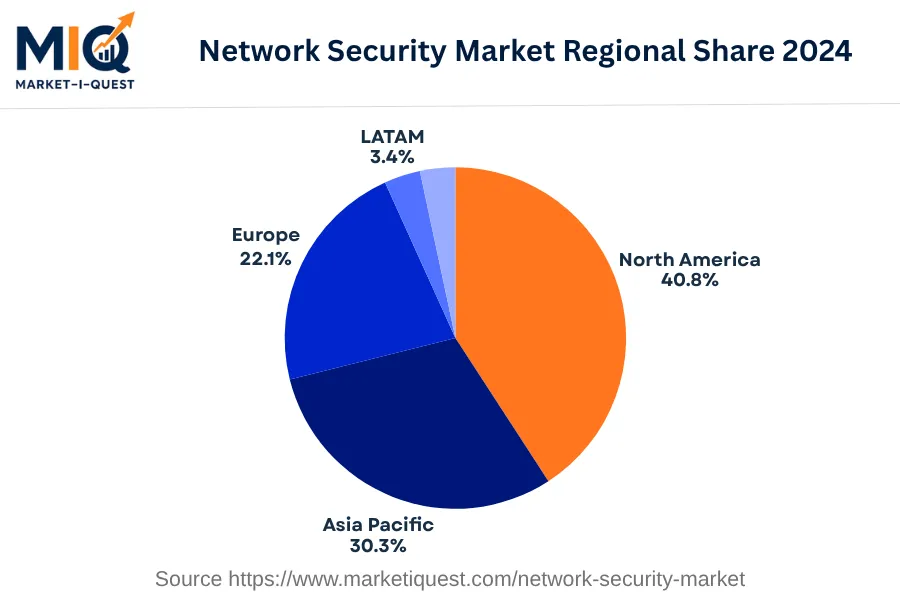
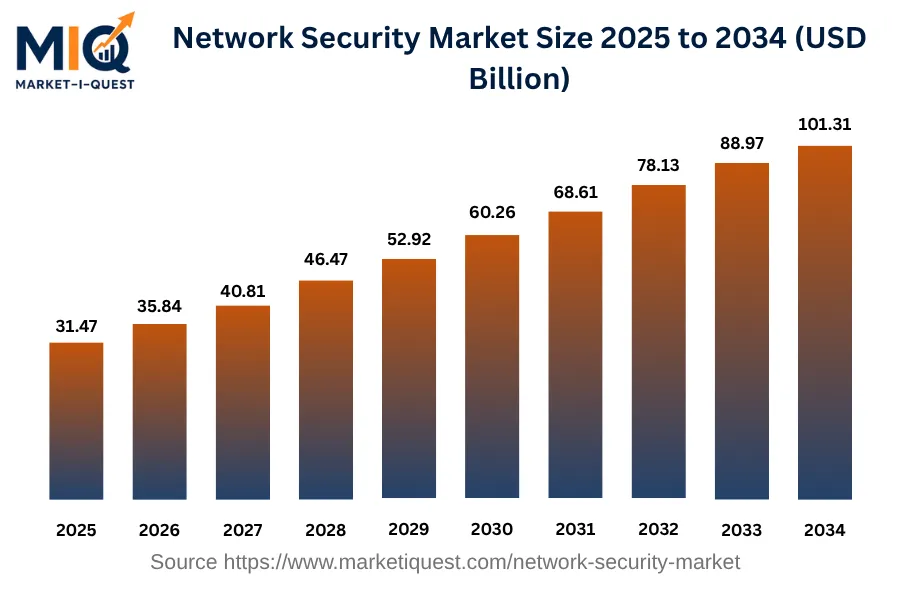
The Network Security Market size is projected to grow from USD 31.47 billion in 2025 to USD 101.31 billion by 2034, with a compounded annual growth rate (CAGR) of 13.87%. The consistent growth over nine years is attributed to the increasing need for securing networks from potential cybersecurity threats. Rising instances of cybercrime and growing complications in network infrastructures have necessitated secure networking, leading to expansion in the market. Moreover, the advancement and integration of AI and cloud services within network security systems are anticipated to propel the market growth further. As per regional shares in 2024, North America held the largest share in the market with 40.83%, followed by Asia Pacific at 30.27% and Europe at 22.14%. The shares of Latin America and Middle East & Africa were comparatively low, with 3.42% and 3.34% respectively.

Key Takeaways

  • By Type - Antivirus and Antimalware Software held a dominant presence accounting for the largest market share in 2024.
  • By Deployment - Cloud emerged as the leading segment holding the major share in 2024.
  • By Enterprise Type - Large Enterprises led the market accounting for the majority share in 2024.
  • By End Use Industry - IT and Telecommunications was the leading contributor holding the highest market share in 2024.
network-security-market market size

Key Driving Factors

Emergence of Internet of Things (IoT)

The adoption and proliferation of Internet of Things (IoT) is a key driving factor for the Network Security Market. An increasing number of devices are now connected to the internet, from home appliances to vehicles, forming a network of interconnected devices. Each of these devices is a potential entry point for cyber threats, increasing the need for robust network security systems to safeguard data. Additionally, businesses use IoT devices for operations and data collection, which contain sensitive information that if compromised, could lead to significant losses. Therefore, the deployment of strong network security measures to safeguard IoT networks is increasingly vital, contributing to the growth of the Network Security Market.

Compliance to Data Protection Regulations

The enactment of stringent data protection regulations globally is another significant driver for the Network Security Market. These regulations, such as the General Data Protection Regulation (GDPR) in the European Union and the California Consumer Privacy Act (CCPA) in the United States, require businesses to protect consumer data, necessitating robust network security measures. Non-compliance with such regulations can result in substantial fines, reputational damage, and loss of customer trust. As a result, organizations are proactively investing in advanced network security solutions to protect data and adhere to these data protection laws, further propelling the Network Security Market.

Market Evolution by Timeline

2019-2023
During this period, end-users in Europe and the APAC region increased interest in network security technology, largely driven by protection against cyber threats, data breaches, and network disruption risks. Major contributors were software vendors specializing in integrated security solutions such as firewalls, antivirus, and intrusion detection systems. However, seamless integration across different technologies remained challenging. GDPR compliance has been stringent, encouraging organizations to adopt network security. Flat-rate pricing models were common. Supply risks included inadequate skilled manpower and technological constraints.
2024
In 2024, Network Security Market had a significant advancement with North America contributing considerably due to the implementation of digitization in sectors like healthcare, finance, and government. Cloud-based security services became more mainstream, but the integration maturity remained typical. Biometric security systems began to appear as a standard for data access. Businesses and government agencies showed a preference for subscription-based pricing models. However, data migration and privacy concerns were major challenges.
2025-2029
In the late 2020s, the trend shifted towards Artificial Intelligence (AI) and Machine Learning (ML) for predictive threat analytics. This was largely due to the growing cyber-attacks complexity. Asia-Pacific was the fastest-growing region during this period. Integration became sophisticated through API-centric solutions. Initiative like the European Cybersecurity Act influenced adoption. A hybrid pricing model emerged where businesses paid a basic fee plus a variable fee based on usage. Identification and handling of false positives by AI-based systems posed challenges.
2030-2034
The Network Security Market in the early 2030s showed demand growth particularly from the service sector. Quantum computing-enhanced cryptography protocol came into the limelight, providing better integration and security. Australia's Online Safety Act influenced the increase in organizations' network security. The tendency for pricing shifted to a dynamic model based on real-time threat landscape. Complexity and cost of implementing Quantum-enabled security were considered practical blockers. However, partnerships between network security firms and quantum computing companies increased.

Future Market Outlook

Future Opportunities

Current regulations and technological advancements generate numerous opportunities in the network security market. For instance, the General Data Protection Regulation (GDPR), enacted in 2018 in the European Union, has led organizations to invest heavily in compliance-driven security solutions. The expansion of cloud services necessitates advancing security measures, as major providers like Amazon Web Services have reported a continuous increase in cloud adoption by enterprises. Furthermore, the European Union’s Cybersecurity Act, effective from 2021, mandates enhanced security protocols among member states, presenting opportunities for cybersecurity firms to offer tailored solutions. Companies that specialize in managed security services are likely to thrive as organizations seek expert partners for their cybersecurity needs. Additionally, the emergence of new Internet of Things devices creates vulnerabilities that require innovative security measures. The International Organization for Standardization has launched initiatives to develop guidelines for IoT security, which could open new markets for service providers. The cybersecurity landscape is also evolving due to an increasing focus on supply chain security, especially after high-profile breaches like the SolarWinds attack in 2020. This shift prompts businesses to look for solutions that address vulnerabilities across their networks. Overall, these factors create a conducive environment for growth and new partnerships, enabling proactive approaches to managing the complexities of modern cybersecurity threats.

Segmentation Analysis

By Type

The market is divided into subsegments including Firewalls, Antivirus and Antimalware Software, VPN, Wireless Security, and Others with Antivirus and Antimalware Software accounting for the largest revenue share, while Wireless Security is expected to grow at the fastest CAGR during the forecast period.

Largest Revenue Share

Antivirus and Antimalware Software

Market Share Leader

The Antivirus and Antimalware Software subsegment dominates the market due to several factors. The proliferation of internet usage and the rise of digital threats have significantly increased the demand for reliable antivirus and antimalware software. These tools are essential for all users, from individuals to large corporations, to protect their systems and data from malicious software. As digital threats become more sophisticated, so does the need for advanced and comprehensive Antivirus and Antimalware solutions, driving the revenue for this subsegment. Further, regulatory compliance concerning data protection and privacy also compels organizations to invest in trusted software, further fueling the market. Market leaders with their robust distribution channels have strategically positioned solutions to cater to different customer segments nationally and internationally.

Fastest CAGR

Wireless Security

Forecast Period Growth Leader

While all subsegments of the market are important, Wireless Security displays the fastest growth potential. This can be attributed to the rapid adoption of wireless technologies, including Wi-Fi and the imminent global rollout of 5G networks. As connectivity becomes more wireless, the vulnerability to security threats also increases, giving a boost to the need for robust Wireless Security solutions. However, while the prospects are bright, certain adoption barriers persist. Many small and medium-sized enterprises may still be hesitant due to the perceived high cost of these solutions and a lack of awareness about the potential threats to wireless networks. Initiatives aimed at alleviating these barriers, combined with tech advancements and policy changes, could act as significant growth catalyzers in the near term, notwithstanding the ever-present risk of technological obsolescence.

By Deployment

The market is divided into subsegments including Cloud and On-Premise, of which the Cloud accounted for the largest revenue share while On-Premise is expected to grow at the fastest CAGR during the forecast period.

Largest Revenue Share

Cloud

Market Share Leader

In 2024, the Cloud subsegment represents the largest revenue source within the market. This can be attributed to a combination of factors. Businesses increasingly realize the flexibility and scalability benefits of cloud deployment, allowing them to easily upscale or downscale based on their needs. The Pay-As-You-Go model associated with cloud services decreases upfront costs of deployment, increasing affordability especially for small and medium enterprises. Furthermore, advances in cloud technology have improved the security measures in place, diminishing previous concerns about data security, a key purchasing criteria for many potential customers. In addition, the rise of remote work has highlighted the need for easy, universal access to business applications from various geographies and devices, an advantage distinctly provided by the cloud. However, the concentration of cloud services among a few major global providers may impact competition and pricing in the future.

Fastest CAGR

On-Premise

Forecast Period Growth Leader

Despite its smaller revenue share in 2024, On-Premise deployment is predicted to have the fastest CAGR during the forecast period. Several catalysts fuel this rapid growth. In contrast to Cloud deployment, On-Premise solutions provide businesses complete control over their data and applications, alleviating any data security or privacy concerns. This is particularly important for sectors with strict regulatory compliance requirements. Larger corporations with the capabilities to maintain and secure on-premises equipment are increasingly choosing on-premise solutions to avoid the recurring costs of cloud services. Technological advancements improving the ease and efficiency of on-premise deployments along with strategic partnerships among providers aiming to enhance their offerings are expected to boost adoption further. However, the high initial CapEx and need for skilled staff to manage the infrastructure pose potential adoption barriers.

By Enterprise Type

The market is divided into subsegments including Small & Medium Enterprises (SMEs) and Large Enterprises. Large Enterprises accounted for the largest revenue share while Small & Medium Enterprises (SMEs) are expected to grow at the fastest CAGR during the forecast period.

Largest Revenue Share

Large Enterprises

Market Share Leader

Large Enterprises have been distinguished as the segment accounting for the highest revenue in 2024. This could be attributed to their financial wherewithal to invest in advanced solutions and infrastructure, which contributes to their substantial market share. In terms of geographical spheres, prominent regions with large enterprises may have a regulatory framework that favors them, further expanding their reach. Large enterprises typically have strong acquisition power and the capability to work with premium-priced offerings, driving robust purchasing behavior. A larger organization's switching costs are often high due to their complex systems and operations. However, their well-established channels for both supply and demand continue to enable substantial revenue generation, keeping them at the forefront of the market.

Fastest CAGR

Small & Medium Enterprises (SMEs)

Forecast Period Growth Leader

Small & Medium Enterprises (SMEs) are projected to show the fastest CAGR outlook. This rapid growth can be attributed to the growing adoption of innovative solutions by these firms to improve efficiency. Technological advancements and policy support for SMEs have dramatically reduced the barriers for small businesses to adopt new solutions, accelerating their progress. However, initial high capex might pose struggles for some SMEs. Nonetheless, strategic partnerships with technology providers are viewed as a promising catalyst to alleviate this hurdle. Near-term risks for this segment may encompass liquidity issues and economic uncertainties, affecting their capacity to invest in new solutions. Despite this, SMEs are anticipated to continue their seek for technologies delivering operational efficiency, hence driving their fast growth.

By End Use Industry

The market is divided into subsegments including BFSI, IT and Telecommunications, Retail, Healthcare, Government, Manufacturing, Travel and Transportation, Energy and Utilities, and Others. The IT and Telecommunications subsegment accounted for the largest revenue share while the Healthcare subsegment is expected to grow at the fastest CAGR during the forecast period.

Largest Revenue Share

IT and Telecommunications

Market Share Leader

The IT and Telecommunications subsegment dominates the market due to a combination of factors. The sector continues to witness significant growth, driven by the continuous evolution and development of technology, increasing demand for data services, and the ongoing shift to digital. As consumer demands rise for digital and video content, mobile technologies, and cloud services, this forces businesses to invest heavily in IT and telecommunication infrastructures and technologies. Geographically, the Asia Pacific region is a major contributor to this segment's revenue, thanks to its large population, quick adoption of technology, and rapidly developing telecom sector. Additionally, government regulations in many countries, aimed at fostering competition, improving quality of service, and reducing prices, have also encouraged growth in this segment. Various factors like company size, buying power, and the urgent need for an effective communication system also considerably influence purchasing decisions in this segment.

Fastest CAGR

Healthcare

Forecast Period Growth Leader

The Healthcare subsegment presents the fastest growth potential. Digital transformation in healthcare, driven by policies favoring digitization and uptake of advanced technologies like artificial intelligence and cloud-based solutions, is the main catalyst. Tech-enabled health practices, like telemedicine, are seeing increased adoption, especially in the wake of COVID-19 pandemic, accelerating the growth of this subsegment. Collaborations between tech firms and healthcare providers are another growth driver, leading to the advancement and broad implementation of tech solutions aiming to improve patient outcomes and streamline operations. However, barriers to adoption do exist. Data security concerns, high capital expenditure, and reluctance among traditional healthcare providers can influence the adoption rate. Due to these influences, the near term outlook for this subsegment features potential risks, primarily revolving around resolving these adoption concerns and adapting to rapidly changing technological landscape.

Competitive Analysis

Key Market Players

Manufacturers / OEMs

Cisco Systems, Inc.
US
Check Point Software Technologies Ltd.
Israel
Juniper Networks, Inc.
US

Key Suppliers & Raw Materials

Intel Corporation
US
Broadcom Inc.
US
International Business Machines Corporation (IBM)
US

Distributors, Integrators & Channel Partners

Tech Data Corporation
US
Arrow Electronics, Inc.
US
Ingram Micro Inc.
US

Porter’s Five Forces Analysis

This analysis evaluates the competitive intensity and attractiveness of the Network Security Market using the Porter's five forces framework.

Supplier Bargaining Power

Medium

Network equipment manufacturers and software providers can command a decent pricing power in the market.

Buyer Bargaining Power

High

Many competitive solutions and services grant buyers significant negotiation leverage.

Threat of Substitutes

Low

Few viable substitutes for robust, comprehensive network security systems exist.

Threat of New Entrants

Medium

Barriers, such as technical knowledge and capital requirements, are substantial but not insurmountable.

Competitive Rivalry

High

The network security market comprises many competent players striving for market share.

Regional Analysis

Geographic market dynamics and growth opportunities across key regions

Global Market Outlook

network-security-market market regional share

North America

In 2024, the network security market in North America saw significant growth driven by various factors including high demand from sectors such as enterprise, government, healthcare, utilities, manufacturing, and retail. High-profile cyber attacks created a sense of urgency among businesses and government agencies to enhance security measures, boosting demand for network security solutions. Technological advances, including the widespread adoption of cloud computing and IoT devices, also increased the complexity of network security, driving further demand for advanced solutions. Increased investment in digital infrastructure as well as the introduction of strict data privacy regulations in the U.S., Canada and Mexico, also fueled further market growth.

On the trends side, a notable shift towards integrating artificial intelligence (AI) and machine learning (ML) into network security protocol became evident, offering improved threat detection and response capabilities. As a result of the growing cyber threat landscape, businesses showed a marked preference for multi-layered security solutions. Moreover, there was an increasing trend of public-private partnerships aimed at bolstering network security, along with a series of mergers and acquisitions to consolidate market presence and expertise. Lastly, the strict enforcement of standards and regulations throughout North America, such as the California Consumer Privacy Act in the U.S., shaped product development and buying behavior.

Asia Pacific

In 2024, the Asia Pacific's Network Security Market witnessed substantial growth brought about by escalating cyber-attack concerns, stringent regulatory frameworks, intensifying investment in IT infrastructure, and swift adoption of digital transformation strategies. Driving forces bore links to increasing demand for advanced threat protection due to a surge in cyber-attacks on enterprises, governments, healthcare, and manufacturing sectors, particularly in China, India, and Japan. Strengthened regulations like China's Cybersecurity Law and India's IT Act compelled firms to invest in advanced network security, creating a demand surge. Investments in cloud-based services, particularly in South Korea and Australia, were amplified, empowering businesses with scalable, flexible, and real-time network security solutions. In ASEAN countries, fast-paced digitalization resulted in greater reliance on network security to avoid potential breaches.

In terms of trends, buyer preference shifted towards integrated solutions covering multiple network layers to ensure comprehensive protection, prevalent among healthcare and retail sectors. Severally, Chinese and Japanese tech giants initiated partnerships and M&A activities, aiming to develop advanced security solutions and consolidate their market positions. Finally, enforcement of data protection standards like the Australian Privacy Principles led to an increase in demand for network security products ensuring compliance. As businesses prioritized cyber hygiene, advanced network security solutions emerged as a key requirement, shaping trends in the Asia Pacific market for 2024.
Europe

In 2024, an uptick in cyber threats defined the European network security market. Demand drivers included regulatory obligations due to the EU Cybersecurity Act that instructs businesses to strengthen network security. Enterprise and public sectors across Germany, France and the UK were leading investment in network security solutions. However, a shortage of highly skilled cybersecurity professionals in these countries influenced market dynamics by causing competitive pricing. Crucial trends encompassed a move towards cloud-based security solutions, evident in Italy and Spain that bore risks of high-profile data breaches. Further, corporations in the Nordics and Benelux prioritised investment in Artificial Intelligence and Machine Learning to prevent cybersecurity threats. The rise of strategic mergers and acquisitions, for instance, France’s Atos acquiring Paladion, reflected consolidation in the market to ensure comprehensive security solutions.

Central & Eastern Europe presented an active use of standards like ISO 27001 for policy enforcement that empowered a data-centric network security approach. Companies in sectors like healthcare, utilities and manufacturing increasingly relied on network security measures to safeguard sensitive information. Notably, retail sectors across Europe adopted multi-layered security measures post the widespread GDPR enforcement to protect customer data, exhibiting the pervasive concern around network security.

Latin America

In 2024, the network security market in Latin America (LATAM) demonstrated a noticeable expansion, marked by Brazil, Mexico, Argentina, Colombia, Chile, and Peru. Key market drivers included rising data breaches, stringent regulatory compliance for data protection, and significant technological investment from enterprises in cloud security solutions. For instance, the implementation of LGPD regulations in Brazil boosted security investments. In Mexico, increased adoption of digitization in various industry sectors like retail, manufacturing, finance, created an escalated demand for robust network security solutions.

A prevalent trend was the growing awareness of cybersecurity risks among government and healthcare sectors, leading to them becoming the largest consumers of network security products. Widespread adoption of mobile devices and IoT further led to a shift towards advanced security solutions in LATAM, incorporating machine-learning and AI for threat detection. Channel dynamics revealed an increased preference for managed security services, although traditional security hardware persisted. Increased collaborations between regional and international companies were observed, highlighting the market’s strategic significance. LATAM also saw stricter policy enforcement pertaining to data privacy and security, exerting a macro-impact on the network security market during the specified period.

Middle East & Africa

In 2024, the Network Security Market in the Middle East and Africa was defined by trends shaping digital growth and strategizing against cyber threats. Drivers for the market encompassed an increased demand due to high internet penetration rates in the region, especially in Saudi Arabia, UAE, and Qatar; robust investments in network infrastructure, particularly visible in South Africa and Israel; and government regulations promoting network security, exemplified by Saudi Arabia's National Cybersecurity Authority initiatives. Additionally, the adoption of advanced security solutions in sectors such as oil and gas, manufacturing, and telecom in countries like Nigeria and Kenya contributed to the market dynamics.

Trends distinguishing the year 2024 included a shift in buyer behavior with a heightened preference for integrated security solutions offering multi-layered protection. Increased M&A activity within the region was observed, especially noticeable with Israeli cybersecurity firms. Moreover, there was apparent movement towards the standardization of network security policies across different sectors, enforced particularly in Egypt's healthcare and financial services sectors. Detailed channel dynamics showcased rising partnerships between network security vendors and local entities, central to market performance in the UAE. Thus, 2024 stood as a pivotal year spotlighting the integrated dynamics of the Network Security Market in the Middle East and Africa.

Recent Industry Developments

Latest market innovations, product launches, and strategic initiatives

July 2026

Qualcomm acquired Israeli cybersecurity company SAM Seamless Network for over $100 million, adding client-side network protection technology that secures over 15 million networks and half a billion devices worldwide, with customers including AT&T, Verizon, and Virgin Media.

June 2026

Accenture agreed to acquire a majority stake in Dragos along with full ownership of runZero and NetRise for approximately $4.2 billion, creating an integrated OT cybersecurity platform for critical infrastructure including power grids, pipelines, and manufacturing facilities. The acquisitions are expected to close in August or September 2026.

Frequently Asked Questions