Managed Security Services Market Snapshot

Key Players

  • IBM Corporation (United States)
  • Symantec Corporation (United States)
  • Verizon Communications Inc. (United States)
  • Cisco Systems Inc. (United States)
  • Fortinet Inc. (United States)
  • Check Point Software Technologies Ltd. (Israel)
  • AT&T Inc. (United States)
  • BT Group plc (United Kingdom)
  • Infosys Limited (India)
  • NTT Security (Japan)

Market Size

Base Year 2024
$36.92 Bn
CAGR
12.86%
Forecast 2034
$123.78 Bn

Market Segments

By Service Type
Managed Detection & Response (MDR), Firewall & Unified Threat Management (UTM), Intrusion Detection & Prevention, Endpoint Security Management, Vulnerability Management, Security Information & Event Management (SIEM), Identity & Access Management (IAM), O
By Deployment Model
On-Premises, Cloud
By Provider Type
IT Service Integrators, Security-Specialist MSSPs, Telecommunications Service Providers, Cloud Service Providers, Other Providers
By End-User Industry
BFSI, Government & Defense, Healthcare, IT & Telecom, Retail, Manufacturing, Energy & Utilities, Others

Market Dynamics

Drivers
  • Increasing cybersecurity threats
  • Rapid digitalization trend
Restraints
  • High implementation costs
  • Lack of skilled professionals
Opportunities
  • Increasing cybersecurity threats
  • Rise of remote workforces

Market Size

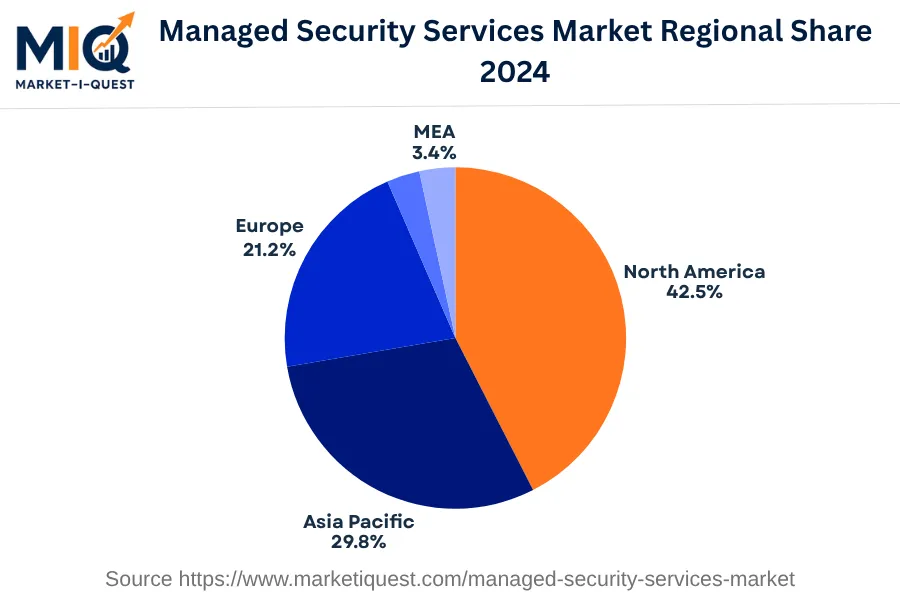
The managed security services market was valued at $41.67 billion in 2025, and it is projected to reach $123.78 billion by 2034, growing at a compound annual growth rate (CAGR) of 12.9%. The substantial increase in value over this period underlines significant growth within this market. From the base year of 2024, a value of $36.92 billion, the market saw an appreciable rise to its 2025 value, initiating this period of expansion. This surge in market size from 2025 indicates heightened demand and adaptation of such services, which will continue till 2034, as mentioned earlier. Regional market shares for the base year 2024 were distributed with North America accounting for 42.5%, followed by Asia Pacific with a 29.8% share. Europe held 21.2% of the market. The markets in Latin America and the Middle East and Africa were smaller, with 3.1% and 3.4% shares respectively in 2024.

Key Takeaways

  • By Service Type - Endpoint Security Management subsegment led the market accounting for a substantial share in 2024.
  • By Deployment Model - Cloud-based services grew fastest demonstrating an upward trend in market preference.
  • By Provider Type - IT Service Integrators held the leading position marking their expertise and trusted status in 2024.
  • By End User Industry -BFSI sector accounted for a significant chunk signaling its high demand for managed security services.
managed-security-services-market market size

Key Driving Factors

Regulatory Compliance Requirements in Banking Industry

The Managed Security Services Market is being driven by increasing demands in the banking industry to meet stringent regulatory compliance requirements. Financial institutions worldwide are under ever-increasing pressure from regulatory bodies such as the Federal Financial Institutions Examination Council (FFIEC) in the United States or the European Banking Authority (EBA) in the European Union to secure their data. Non-compliance is met with hefty fines and punitive penalties, making it essential for these institutions to minimize risks associated with data breaches. Thus, they find it beneficial to outsource their cybersecurity needs to managed security services providers, who can offer specialized expertise, ongoing monitoring, and the most updated security measures, thereby ensuring regulatory compliance.

Increasing Complexity of Cyber Threat Landscape

The continual evolution and increased complexity of the cyber threat landscape has become a significant driver for the managed security services market. Cybercriminals are constantly developing more advanced and insidious methods of attack that internal IT teams may be ill-equipped to combat. This is particularly prevalent in industries that rely heavily on information technology but are not traditionally tech-focused, such as healthcare or manufacturing. These industries are looking towards managed security service providers, who offer dedicated expertise and the ability to rapidly respond to new forms of cyberattacks, to handle their cybersecurity needs. Thus, the ever-evolving complexity of cyber threats is pushing various industry segments towards adoption of managed security services.

Market Evolution by Timeline

2019-2023
In this time period, there was increasing demand from SMEs across North America and Europe seeking to protect their digital assets from rising cybersecurity attacks. The shift to cloud-based managed security services became more noticed with companies like NortonLifeLock, Check Point and Sophos shipping cloud-integrated solutions for threat intelligence, intrusion detection, and threat management. GDPR in EU and California's CCPA shaped market practices to prioritize personal data protection. As for commercial models, the trend towards subscription pricing dominated the market due to budgetary constraints of SMEs. However, lack of skilled professionals and technical complexities in integrating security measures posed significant challenges.
2024
The 2024 market saw strong demand from emerging economies in Asia Pacific due to their growing digital infrastructure. Advanced Persistent Threats forced suppliers to deliver more sophisticated, machine learning powered solutions led by prominent players like IBM and Cisco. Data sovereignty laws in countries like India and China influenced organizations to adopt localized security services. Commercial models continued with subscription-based contracts with increasing strategic partnerships between MSSPs and regional service providers. The main risks included dealing with increasingly sophisticated threats and maintaining compliance with varying regional data laws.
2025-2029
The next five years saw increased demand from government and BFSI sectors due to the initiation of digital government initiatives and fintech advancements globally. The integration of AI and automation into security services became more mature through products from progressive vendors like Accenture and Fortinet. There was a continued drive towards adhering to regional data regulatory standards with GDPR and CCPA influencing broader global data laws. Success favoured MSSPs who offered customized subscription packages and excelled in seamless service integration. It was critical for service providers to stay vigilant as cyber threats evolved and increased in frequency.
2030-2034
Demand came from IoT device manufacturers and healthcare providers due to the surge of connected devices and increased adoption of digital health solutions. Quantum computing in cybersecurity was piloted, challenging the traditional encryption models. Policy changes included the introduction of IoT Cybersecurity Improvement Act in the U.S, framings MSSPs' role in device safety. A trend to watch in the commercial model was the rise of performance-based contracts, shifting the risk from buyers to providers. The main risk was the uncertainty surrounding the security implications of quantum computing and the continued evolution of cyber threats.

Future Market Outlook

Future Opportunities

Future opportunities within the Managed Security Services Market are ripe, particularly regarding compliance and regulatory frameworks that continue to evolve. For instance, the anticipated updates to the Payment Card Industry Data Security Standard (PCI DSS) expected in 2024 create a compelling need for businesses to seek managed services to achieve compliance. Additionally, the enactment of the Cybersecurity Regulation by the European Commission in early 2022 heralds a new era where organizations must implement stringent security practices, driving demand for expert services. The increasing complexity of cyber threats is dictating that smaller businesses, which often lack in-house expertise, are turning to managed service providers for assistance. Noteworthy partnerships, such as CyberArk's collaboration with Microsoft, which was announced in early 2023, will focus on comprehensive identity security solutions that leverage cloud capabilities. Moreover, as work-from-home policies continue, the security landscape must adapt to protect remote infrastructures, presenting significant opportunities for managed services to expand their portfolios. Finally, the continued focus on cybersecurity awareness and training programs, including those mandated by the National Cyber Security Centre (NCSC) in the UK as of 2021, is paving the way for managed services to embed educational elements in their offerings, thereby ensuring a more robust defense mechanism for their clients.

Segmentation Analysis

By Service Type

The market is divided into subsegments including Managed Detection & Response (MDR), Firewall & Unified Threat Management (UTM), Intrusion Detection & Prevention, Endpoint Security Management, Vulnerability Management, Security Information & Event Management (SIEM), Identity & Access Management (IAM), and Other Services. In terms of revenue, Endpoint Security Management brings in the highest income, while Managed Detection & Response (MDR) is projected to grow the fastest during the analyzed period.

Largest Revenue Share

Endpoint Security Management

Market Share Leader

Endpoint Security Management commands the largest market share due to a confluence of factors. One driving factor is the massive increase in remote work situations, which has necessitated robust security systems at the employee's endpoint. Companies, irrespective of their size or industry, are investing heavily in securing their networks, further fueling the demand for the Endpoint Security Management subsegment. Furthermore, the consistent threat of cyber-attacks has enhanced the demand for sophisticated security technologies to protect valuable digital assets. An increased emphasis on regulatory compliances worldwide puts pressure on businesses to employ effective endpoint security measures. Customers' purchasing criteria are heavily tilted towards comprehensive security solutions, making Endpoint Security Management services highly sought after. Switching costs for security systems can be high, meaning that once a business invests in robust Endpoint Security Management, they tend to stay with it. The endpoint security management services are typically delivered over cloud or on-premise, providing flexibility for different types of businesses.

Fastest CAGR

Managed Detection & Response (MDR)

Forecast Period Growth Leader

Despite not being the current leader in terms of revenue, Managed Detection & Response (MDR) is expected to be the fastest growing subsegment. Its growth is predicated on its capabilities to tackle advanced threats and diminish dwell time of such threats. Factors like rising number of cyber-attacks and technological advancements in IT infrastructure across various industries are driving the adoption of MDR. The rise in adoption of cloud-based MDR solutions due to their cost-effectiveness and ability to offer around-the-clock services bolsters its potential for rapid growth. However, the high cost of deployment and lack of skilled practitioners for MDR services can hinder short-term growth. Strategic partnerships with IT providers and policy implementation favoring cybersecurity can act as catalysts for this sub-segment. There is significant capex involved in incorporating MDR services, which acts as a hurdle, especially for small and medium enterprises. In spite of this, the long-term outlook for the MDR subsegment remains positive due to the increasing emphasis of businesses on proactive threat detection and management.

By Deployment Model

The market is dissected into On-Premises and Cloud deployment models. In 2024, On-Premises model accounted for the lion's share of revenue, whereas Cloud is perceived to expand at the most robust CAGR in the upcoming years.

Largest Revenue Share

On-Premises

Market Share Leader

The On-Premises model continues to dominate the revenue generation segment majorly due to the control it offers over systems and data. It allows businesses to have full authority and direct oversight on system configuration, data management, security measures, and modifications as needed. This level of control is crucial for several industries that handle sensitive customer data, such as healthcare and finance where stringent regulations are in place concerning data privacy and protection. This model tends to be the preference in geographies with rigid regulations and mandates. Also, industries with ample IT personnel and infrastructure resource capabilities often lean towards On-Premises model to dodge recurring cloud service expenditures, manage performance levels directly, and evade potential data breaches over the cloud. However, this narrative is slowly changing with the maturing cloud technologies.

Fastest CAGR

Cloud

Forecast Period Growth Leader

The Cloud model is forecasted to outpace the On-Premises model in terms of growth. Main drivers of this growth include demand for cost efficiency, increased flexibility, and scalability that cloud services provide. On the barrier side, data security and privacy concerns have traditionally been a hurdle for the adoption of cloud services, however, with advancements in encryption technologies and security practices, concerns are gradually receding. Moreover, the rise in partnerships among cloud service providers and auditors willing to certify the reliability of cloud services is speeding up the adoption process. Shift towards digital transformation and remote work culture, catalyzed by the COVID-19 pandemic, is further propelling the shift from On-Premises to Cloud. While economic uncertainty and fluctuating internet connectivity in some regions might pose short-term obstacles, the long-term outlook remains bullish on cloud adoption growth.

By Provider Type

The market is divided into subsegments including IT Service Integrators, Security-Specialist MSSPs, Telecommunications Service Providers, Cloud Service Providers, and Other Providers, with IT Service Integrators accounting for the largest revenue share while Cloud Service Providers is expected to grow at the fastest CAGR during the forecast period.

Largest Revenue Share

IT Service Integrators

Market Share Leader

The IT Service Integrators subsegment leads in revenue generation due to its broad scope of operations. Businesses of variegated types and scales leverage IT Service Integrators to implement technology solutions by augmenting their internal IT staff. Customers in mature markets emphasize the need for transforming their IT landscape to reduce cost, improve efficiency, and gain a competitive edge. IT Service Integrators offer an array of services encompassing robust system infrastructure, application services, business process services, and other IT-enabled services. Their ability to provide customized solutions based on each client's unique needs and budget adds to their revenue-generating potential. In addition, IT Service Integrators' reach isn't limited to a specific geographic area given the universal nature of technology services, thereby contributing to an extensive customer base and larger revenue.

Fastest CAGR

Cloud Service Providers

Forecast Period Growth Leader

The Cloud Service Providers subsegment is projected to experience the fastest growth due to multiple factors. Businesses today are increasingly seeking ways to reduce operational costs, enhance scalability, and increase efficiency, all of which can be achieved through cloud services. The global shift towards remote work culture amidst COVID-19 disruptions has hastened the demand for cloud-based solutions given their ease of accessibility and reliability across multiple locations. Furthermore, large-scale digital transformations driven by emergent technologies like AI, ML, and IoT are inviting greater investment in cloud services for data storage and management. However, risks associated with data privacy and security stand as potential hindrances to rapid growth. Accelerated growth can be expected with the mitigation of these concerns, facilitated by advancements in security protocols, enhanced data encryption techniques, and stringent policy regulations.

By End-User Industry

The market is divided into subsegments including BFSI, Government & Defense, Healthcare, IT & Telecom, Retail, Manufacturing, Energy & Utilities and others. Of these subsegments, BFSI accounted for the largest revenue share for the base year 2024 while the IT & Telecom sector is forecasted to grow at the fastest CAGR in the subsequent years.

Largest Revenue Share

BFSI

Market Share Leader

The Banking, Financial Services and Insurance (BFSI) sector lead in revenue generation in 2024 due to several factors. The sector has been at the forefront of the digital revolution, making use of technology to enhance its services, leading to increased revenue. The move towards cashless transactions, online banking and utilization of data analytics for informed decision making have greatly spurred the growth of this sector. Moreover, the BFSI sector has seen an increase in the number of customers using services due to digitization. This is largely due to geographical barriers being eradicated and services being accessible to demographics which were under-served earlier. Further, regulation has played a key role in driving revenues in the sector. Mandatory requirements like insurance coverage and the need for banking services in various aspects of life have ensured growth. Lastly, the sector’s monopolistic nature creates high switching costs, making customers loyal and ensuring a steady revenue stream.

Fastest CAGR

IT & Telecom

Forecast Period Growth Leader

Despite not being the largest revenue generator in 2024, the IT & Telecom sector is expected to experience the fastest Compound Annual Growth Rate (CAGR) in following years. This growth is largely fueled by rapid technological advances and a constant push towards digital transformation in various industries. With the advent of advanced technologies such as AI, machine learning and cloud computing, the role of IT in business operations has drastically escalated. On the other hand, the telecom industry is experiencing exponential growth with increasing global connectivity and mobile device usage. The pandemic has only quickened this shift, with businesses across industries heavily relying on IT & Telecom solutions for remote operations and communications. Nonetheless, adoption barriers such as cybersecurity threats, and the need for significant capex for technology upgrades could pose potential risks. Nonetheless, strategic partnerships and government policies promoting digital infrastructure are stronger catalysts for the segment's growth.

Competitive Analysis

Key Market Players

Manufacturers / OEMs

IBM Corporation
US
SecureWorks Inc.
US
Symantec Corporation
US

Key Suppliers & Raw Materials

Cisco Systems, Inc.
US
Fortinet, Inc.
US
Juniper Networks, Inc.
US

Distributors, Integrators & Channel Partners

AT&T Cybersecurity
US
Trustwave Holdings, Inc.
US
Check Point Software Technologies Ltd.
Israel

Porter’s Five Forces Analysis

Analysis of the competitive intensity of the Managed Security Services Market using Porter's Five Forces framework.

Supplier Bargaining Power

Medium

Limited by power of security tech providers, yet driven by the scarcity of cybersecurity skills.

Buyer Bargaining Power

High

Driven by the availability of multiple vendors and the increasing influence of price competition.

Threat of Substitutes

Low

Low due to the specific nature of cybersecurity needs, increasing data threats and low switching preference from major customers.

Threat of New Entrants

Medium

Balanced by high entry barriers like technological expertise, yet eased by the rising demand of cybersecurity.

Competitive Rivalry

High

Intense due to the presence of diverse players, rapid technologic advancements, and service customization.

Regional Analysis

Geographic market dynamics and growth opportunities across key regions

Global Market Outlook

managed-security-services-market market regional share

North America

In 2024, the North American Managed Security Services Market experienced significant growth due to rising cyber threats, necessity of regulatory compliance, and adoption of technology. Increased investment in cybersecurity by businesses and governments drove demand for Managed Security Services (MSS). A growing necessity for regulatory compliance contributed to market expansion, particularly in sectors like healthcare and finance where personal data security is paramount. Meanwhile, the adoption of advanced technologies like AI and machine learning accelerated detection and response services within the market. Oversupply dynamics, including a swelling number of providers, intensified competition and led to downward pricing pressures, increasing the market’s accessibility.

In terms of trends, there was a clear inclination towards outsourcing security operations to MSS providers. This shift was motivated by an increasing strain on in-house IT teams and an escalating level of threat sophistication. Mergers and acquisitions were prevalent, as companies aimed to expand their capabilities and reach. A significant policy enforcement during this period was the California Consumer Privacy Act (CCPA) that necessitated businesses to bolster their cybersecurity measures. Lastly, sectors such as enterprise, government, manufacturing, and retail showed a considerable uptake of MSS, seeing it as a cost-effective way to maintain robust cybersecurity measures.

Asia Pacific

In 2024, the Managed Security Services Market accelerated across Asia Pacific, driven by rising cyber threats, regulatory pressures, and digital transformation initiatives. Increasing demand for advanced security services from various sectors such as enterprise, government, healthcare, utilities, manufacturing, and retail propelled the market growth. Intensified investments in cloud-based security solutions, particularly in China, India, Japan, South Korea, Australia, and key ASEAN markets, further enhanced the market dynamics. The implementation of stringent cybersecurity regulations such as China's Cybersecurity Law and India's Personal Data Protection Bill encouraged businesses to invest in managed security services.

Transformational trends marked the year as well. Increasing buyer preference for integrated solutions led to a shift in product offerings, with service providers aiming for comprehensive cybersecurity packages. Partnership and M&A activities witnessed a surge, with companies like Sony Network Communications in Japan collaborating with global cybersecurity providers to strengthen their security stance. Meanwhile, adherence to global cybersecurity standards like ISO/IEC 27001 gained prominence. The rise in digital commerce spurred the retail segment’s demand for managed security services, necessitating multi-layered security measures. Therefore, the surge in cyber threats, regulatory constraints, technology proliferation, supply dynamics, and diversified pricing models dominated the Asia Pacific Managed Security Services Market in 2024.

Europe

In 2024, Managed Security Services (MSS) market in Europe saw significant growth owing to the rising prevalence of cyber threats and stringent data protection regulations. Increased demand from sectors like enterprise and government propelled market expansion, as they sought comprehensive network security solutions in accordance with regulations such as GDPR. Enhanced technology adoption also contributed to this growth, with companies in Germany, the UK, and France embracing advanced analytics and artificial intelligence for threat detection. In terms of trends, businesses leaned heavily on integrating MSS into their business models, triggered by the continuous shift towards digital platforms. Notable moves were seen in Central & Eastern Europe and Italy, with multiple partnerships and M&A activities taking place to enhance cybersecurity capabilities.

Emphasis on security standardization was another key trend, especially observed in the Nordics and Benelux regions, where mandatory standards for cybersecurity signified a proactive approach towards combating cyber threats. In the retail sector, Spain showed an increasing appetite for MSS, especially in managing Point-of-Sale systems and protecting customer data. Meanwhile, the healthcare sector in the UK invested heavily in MSS to safeguard sensitive patient data and comply with the stringent data protection laws. In an effort to protect their critical data, utilities and manufacturing sectors in France and Germany upped their investment in MSS. This scenario establishes a robust presence and elevated relevance of Managed Security Services across Europe in 2024.

Latin America

In 2024, the Managed Security Services Market (MSSM) in Latin America embodied the region's proactive response to escalating cyber threats. High demand resulted primarily from the increasing prevalence of cybercrime in sectors like enterprise and government operations. Regulations demanding stricter security protocols in sectors such as healthcare and retail amplified the need for managed security services. Climbing investment, notably in countries like Brazil and Mexico, coupled with aggressive technology adoption in Peru, Argentina, and Chile, magnified market growth. Unpredictable supply dynamics also played into MSSM stimulation, as inconsistencies in security solution sources compelled organizations to embrace dependable, external security management.

From a trends standpoint, the year witnessed a shift in buyer behavior, with customers leaning towards comprehensive, customizable solutions rather than standalone services. This trend was quite marked in the utilities and manufacturing sectors of Argentina and Colombia. Technology shifts were notable, with cloud-based security services gaining traction rapidly across the region. In efforts to expand their reach, several providers engaged in strategic partnerships or M&A activities, especially prevalent in the robust markets of Brazil and Mexico. Stricter policy enforcement around data privacy and protection in all countries, after multiple high-profile breaches, further shaped the market trends, emphasizing the importance of robust, managed security services.

Middle East & Africa

In 2024, the Managed Security Services Market in the Middle East and Africa saw sustained demand driven by the growing digital infrastructure and enhanced cybersecurity regulations. The rapid digitalization of industries like oil and gas, telecom, and financial services increased the necessity for robust cybersecurity measures. For instance, governments such as Saudi Arabia and United Arab Emirates invested heavily in advanced security services to protect their burgeoning digital economy. Moreover, restrictive regulations, including increased standards for data privacy and protection across Egypt, South Africa, and Kenya, promoted the adoption of managed security services.

A significant trend observed in 2024 was the shift towards outsourcing security services with a surge in partnerships and acquisitions among major players in Israel, UAE, and Qatar. Moreover, the introductions of stringent cybersecurity policies influenced buyer behaviour, further ado incentivizing organizations like utilities and healthcare providers to leverage managed security services. Example of this is the implementing of National Cybersecurity Strategy by the Nigerian government, creating a reliable space for managed security services. Despite the observed growth, the market faced headwinds with fluctuating pricing dynamics due to supply chain disruptions. Nevertheless, the year 2024 was productive for the Managed Security Services Market in the Middle East and Africa.

Recent Industry Developments

Latest market innovations, product launches, and strategic initiatives

June 2026

Wipro expanded its partnership with Palo Alto Networks to launch AI-powered managed detection and response (MDR) services, combining Palo Alto Networks' Cortex XSIAM platform with Wipro's CyberShield managed security services.

November 2025

The managed security services market stood at a critical inflection point, with regulatory frameworks such as GDPR, HIPAA, NIS2, CCPA, and DORA catalyzing demand for managed compliance services while creating operational complexity for MSSPs who must navigate data localization and audit readiness across jurisdictions.

Frequently Asked Questions