Image Sensor Market Snapshot

Key Players

  • Sony Corporation (Japan)
  • Samsung Electronics (South Korea)
  • OmniVision Technologies (US)
  • Canon Inc. (Japan)
  • Panasonic Corporation (Japan)
  • STMicroelectronics (Switzerland)
  • Teledyne Technologies (US)
  • Aptina Imaging Corporation (US)

Market Size

Base Year 2024
$28.64 Bn
CAGR
8.65%
Forecast 2034
$65.66 Bn

Market Segments

By Technology
CMOS, CCD, sCMOS
By Linearity
Linear, Non-Linear
By Spectrum
Visible Spectrum, Invisible Spectrum
By Application
Consumer Electronics, Automobile, Surveillance, Medical, Others

Market Dynamics

Drivers
  • Increasing smartphone adoption
  • Advancements in imaging technology
Restraints
  • High manufacturing cost
  • Technological complexity
Opportunities
  • Rising demand for security cameras
  • Increasing smartphone penetration

Market Size

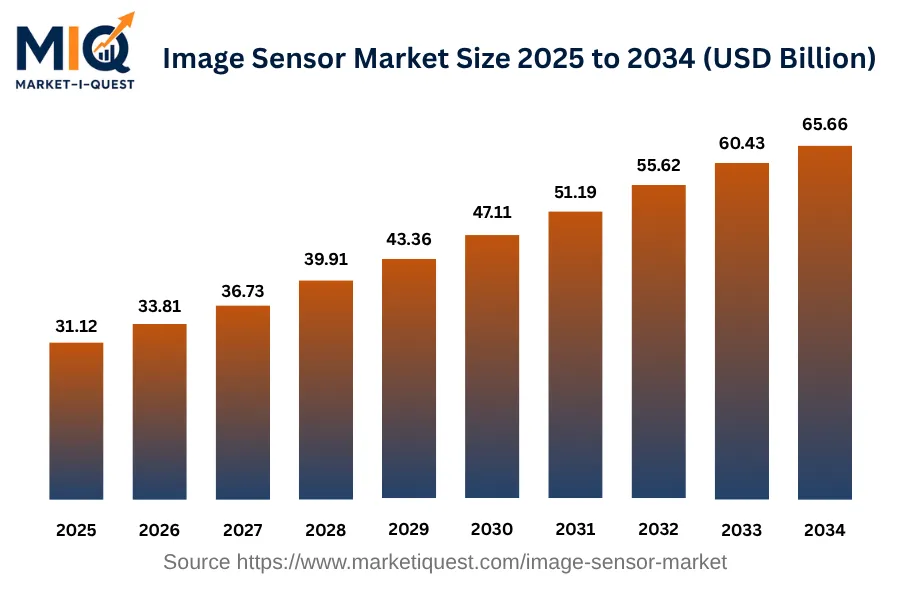
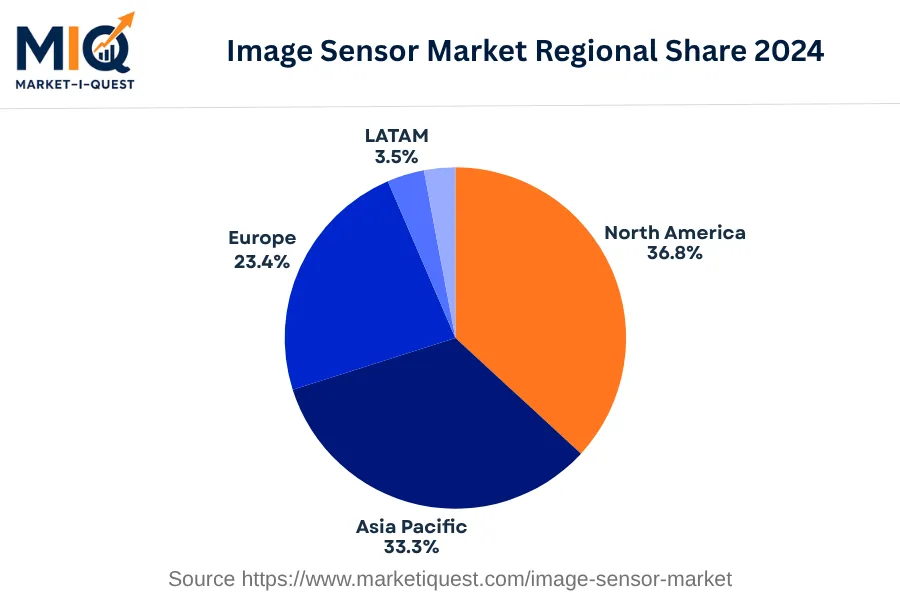
The Image Sensor Market was sized at USD 31.12 billion in 2025, increased from USD 28.64 billion in 2024. Following a growth trajectory over the subsequent years, the market is projected to reach a size of USD 65.66 billion by 2034, exhibiting a Compound Annual Growth Rate (CAGR) of 8.65%. This nearly doubling of the market size over less than a decade is due to several factors. A primary factor behind this growth is a surge in the uptake of image sensors in numerous sectors, such as healthcare, consumer electronics, and automotive. Developments in technology and growing demand for high-resolution imaging are also driving this upward trend. The market share for 2024 shows a significant skew towards the Asia Pacific region, which held 54.6% of the total, followed by North America with 21.8%. Europe constituted 16.7% of the market share. The remaining portions were held by Latin America and the Middle East and Africa region, at 3.6% and 3.2%, respectively.

Key Takeaways

  • By Technology - CMOS held a significant portion in the Image Sensor Market.
  • By Linearity - Non-Linear segment dominated the market in the base year.
  • By Spectrum - Invisible Spectrum led the market with a substantial share.
  • By Application - Consumer Electronics was the leading subsegment in the Image Sensor Market.
image-sensor-market market size

Key Driving Factors

Adoption of Image Sensors in Automotive Safety Systems

The emergence of autonomous and semi-autonomous vehicles requires the integration of advanced technologies for navigation and safety. Image sensors are an essential part of these integrated systems, providing visual data for object detection, lane identification, and collision avoidance. Automakers are therefore significantly increasing their procurement of high-resolution, reliable image sensors. For instance, Tesla's Autopilot system uses a combination of radar, ultrasonic sensors, and image sensors to interpret the environment. This increase in demand from the automotive sector is a potent driving factor for the image sensor market.

Increased Application in Healthcare Diagnostics

Another pivotal driver for the image sensor market is the increasing adoption of these devices in healthcare diagnostics. Image sensors play a crucial role in a variety of diagnostic machines, including MRI, Ultrasound, and CT systems. The shift towards digitalization in healthcare systems has necessitated the use of advanced image analytics, which hinge on high-resolution, precise imaging provided by modern image sensors. For example, the high-resolution imaging capabilities of image sensors are vital for the correct interpretation of scans in radiology. As hospitals and clinics globally continue this digital transition, demand for image sensors is correspondingly increasing.

Market Evolution by Timeline

2019-2023
Throughout this period, most demand originated from smartphone manufacturers and automotive industry, specifically from Asia Pacific countries. Advancements in shopper and driver assistance applications and the increase in production of mid-range & high-end smartphones further drove the demand. Nonetheless, a limited supply provoked slightly higher unit prices. New policies, such as China's Made in China 2025 initiative boosted local industry growth. Despite this, supply-side was fraught with limited foundry capacities. Indicative price models were contract-based, with few partnerships primarily targeted at vertical integration and expansion of capacities. There were some utility risks associated with the use of image sensor technologies in critical applications like autonomous vehicles.
2024
In 2024, Japan implemented regulatory requirements on computational photography capabilities, re-emphasizing the importance of image sensors in the industry. This drove higher demand from smartphone manufacturers, leading to innovations in multispectral and hyperspectral technologies. The bottleneck in foundry capacities marginally eased due to the technological maturity achieved by the industry. On the commercial front, bulk procurement emerged as a significant pricing strategy for major manufacturers. The primary risk remained the dependency on foundry capacities for manufacturing image sensors.
2025-2029
The forecast for this period typically exhibits an increased adoption of image sensors in healthcare and surveillance sectors globally. This resulted from the development of high-resolution image sensors. However, manufacturing constraints persisted partly due to the unavailability of next-generation lithography machines. The adoption of International Business Machines' (IBM) 2 nm chipmaking technique made a significant change in supply. Health monitoring-focused regulations incentivised the use of image sensors in healthcare. Prices were flexible, largely driven by the integration complexity and the resolution of image sensors. Comprehensive improvement of image sensor delivery was the best response to typically solved utility risks.
2030-2034
Image sensor demand continued to expand to other sectors such as weather tracking, environment monitoring, and defense during this period. Moreover, advancements in technology permitted the manufacture of microscopic image sensors. Constraints were qualitatively reduced with the entrance of more players into the market. New US government regulations made it mandatory for industries to incorporate advanced surveillance technologies. Subscription-based pricing models became predominant due to the IoT integration across various sectors. Adoption risks were minimal due to maturation and reception of technology, however, privacy concerns due to image data misuse emerged as new risk factors.

Future Market Outlook

Future Opportunities

In the context of evolving applications and market demands, opportunities for growth in the image sensor market are becoming apparent. The automotive sector is actively exploring the implementation of advanced driver-assistance systems (ADAS), which rely heavily on image sensors for features like lane-keeping assist and automated parking. Companies, including Mobileye and NVIDIA, are collaborating with automakers to develop AI algorithms that improve image processing capabilities in real-time scenarios. The rise of electric vehicles, particularly in countries such as Norway and the United States, is expected to drive the need for advanced imaging technologies to enhance navigation and safety systems. Additionally, the proliferation of smart home devices necessitates high-resolution image sensors for applications like security cameras and doorbell cameras, presenting a lucrative opportunity for companies like Ring and Arlo. The healthcare sector continues to expand its reliance on imaging technologies, particularly in telehealth applications, where real-time consultations are demanding superior imaging quality. Furthermore, the rapid advancement of consumer electronics, fueled by brands such as Apple and Samsung, is likely to create demand for next-generation image sensors capable of supporting augmented reality and virtual reality applications. With increasing regulatory focus on safety and efficiency in various sectors, such as the automotive industry, companies that innovate and adapt to comply with these regulations will find significant opportunities for market expansion and product development.

Segmentation Analysis

By Technology

The technology segment in the market is divided into subsegments including CMOS, CCD, and sCMOS, with the CMOS subsegment accounting for the largest revenue share, while sCMOS is expected to grow at the fastest CAGR during the forecast period.

Largest Revenue Share

CMOS

Market Share Leader

The CMOS subsegment holds the largest share in the market revenue due to its widespread use in various applications, ranging from consumer electronics to medical imaging devices. The primary driver for the dominance of CMOS technology is its cost-effectiveness and lower power consumption compared to other technologies, making it a preferred choice for manufacturers and, ultimately, end-users. Additionally, the increasing demand for handheld devices with camera capabilities has also boosted the growth of the CMOS sub-segment. CMOS sensors are typically used in smartphones, digital cameras, and other portable devices due to their small size and high efficiency. The subsegment's substantial market share can also be attributed to its presence in influential regions noted for their robust consumer electronics industry such as Asia Pacific and North America. However, it is important to note that any regulatory changes or supply chain disruptions can have significant implications on its market position.

Fastest CAGR

sCMOS

Forecast Period Growth Leader

Despite not being the largest revenue-generating subsegment, sCMOS is projected to register the highest growth rate during the forecast period. The key growth drivers for sCMOS technology are its high sensitivity and speed, making it ideal for high-end applications such as scientific research and medical imaging. The ongoing technological advancements broadening the performance capabilities of sCMOS sensors are also playing a crucial role in overcoming adoption barriers. Capital investment in R&D and strategic partnerships focused on the development and promotion of sCMOS technology are serving as significant catalysts for its growth. However, the cost associated with these sensors remains a substantial barrier to adoption. The economic climate and potential regulatory changes also present potential near-term risks that could impact the growth trajectory of this subsegment.

By Linearity

The Linearity market is divided into subsegments including Linear and Non-Linear. In the base year 2024, Non-Linear leads in terms of revenue while Linear showcases the fastest growth.

Largest Revenue Share

Non-Linear

Market Share Leader

The non-linear subsegment held the most significant market share in 2024 due to several factors. This dominance is due to its robust adaptability to complex market dynamics and the flexibility it offers for forecasting, making it more appealing for a variety of industries with varying complexity levels. It also offers the advantage of more sophisticated and responsive modeling, which is critical in fields such as finance and healthcare where changing variables can radically affect outcomes. Geographically, regions with advanced economies have contributed significantly to the large revenue share given their greater adoption of complex financial structures and advanced technological analytics capabilities. Other drivers include governmental policies favoring digital transformation and the prevalence of big data analytics. Limitations to switching include high initial set-up costs, technical expertise and training requirements and systems integrations

Fastest CAGR

Linear

Forecast Period Growth Leader

The Linear subsegment, while not the largest in revenue share, is projected to display the fastest CAGR in the upcoming years. This growth is propelled by its relative simplicity and interpretability compared to non-linear models, making it an excellent entry point for industries and companies just beginning to leverage data analytics. Adoption barriers such as lack of sophisticated technical expertise are far less for this segment, spurring faster adoption rates. Partnerships with tech companies offering artificial intelligence and machine learning technologies act as major growth catalysts due to the ease of integration of linear models with these advanced technologies. However, risks in near-term growth can stem from rapidly changing market dynamics, where linear models might fall short, and increased competition leading to lower profitability.

By Spectrum

The Spectrum market is divided into subsegments including Visible Spectrum and Invisible Spectrum. In 2024, the Invisible Spectrum accounted for the largest revenue share while the Visible Spectrum is anticipated to grow at the fastest CAGR during the forecast period.

Largest Revenue Share

Invisible Spectrum

Market Share Leader

The Invisible Spectrum subsegment leads the market in revenue generation because of a few reasons. The high value of the Invisible Spectrum output is due largely to its diverse applications across sectors like telecommunications, medical diagnostics, and national security. These sectors, which are fundamental to society, have a high demand for invisible spectrum technologies like infrared devices, X-rays, and radio waves. Their utilization for wireless communication like wifi, satellite, and mobile communication enhances their importance even further. Moreover, advanced defence systems, like night vision devices and radar systems, depend heavily on the invisible spectrum, which contributes to its sizable market share. Furthermore, the inability to substitute these technologies without a significant loss in efficiency leads to a high switching cost, maintaining the substantial revenue share of the Invisible Spectrum.

Fastest CAGR

Visible Spectrum

Forecast Period Growth Leader

The Visible Spectrum is projected to grow at the fastest rate due to several key growth drivers. Technological advancements such as the expansion and evolution of holography, 3D visual displays, and high-performance visual communication systems rely heavily upon the visible spectrum. Moreover, increased advancements in optical technology and favourable policy support to advance photodynamic therapy or solar energy adoption are potential growth catalysts. However, the requirement of massive capex and the need for strategic partnerships to ensure efficient distribution can form barriers to adoption. Near-term risks include regulatory changes that could impact the usage of certain light wavelengths and the possibility of market saturation in heavily populated urban regions where these technologies are most adopted. The future of the Visible Spectrum subsegment hinges on how these factors play out, and stakeholders must consider them carefully.

By Application

The market is divided into subsegments including Consumer Electronics, Automobile, Surveillance, Medical, and Others. The Consumer Electronics subsegment accounted for the largest revenue share while the Medical subsegment is expected to grow at the fastest CAGR during the forecast period.

Largest Revenue Share

Consumer Electronics

Market Share Leader

In 2024, Consumer Electronics held the most significant revenue share in the market. This dominance is primarily due to the extensive use of modern appliances in everyday life and the continuously increasing demand for upgraded devices with improved features and functionalities. Consumer Electronics covers a broad range of devices including smartphones, laptops, gaming consoles, smart TVs, among others, which have been witnessing a steady growth in their demands. Moreover, the purchasing power of the population, especially in developing regions, has increased considerably, which has further expanded the consumer electronics market. Furthermore, with advanced technologies like AI and IoT being widely incorporated into these devices, this sector has seen a significant increase in revenue. The availability of multiple distribution channels aiding in their easy availability can also be attributed to the outstanding performance of this segment.

Fastest CAGR

Medical

Forecast Period Growth Leader

The Medical subsegment is anticipated to register the highest CAGR in this market for the coming years. The factors contributing to this rapid growth include the continuous technological advancements in the medical industry that have modernized treatment procedures, as more and more devices are being integrated with technologies like machine learning and IoT helping in better patient care. Additionally, the overarching trend in the medical field has been leaning towards digitization, which has escalated the incorporation of software solutions in providing health care services. This increased utilization of electronic health records, telemedicine, and mobile technologies has paved the way for faster growth in the segment. However, the medical device industry faces potential risks and barriers that revolve around cybersecurity threats due to sensitive patient data being handled, and compliance with certain regulatory standards that have been imposed on this sector nationally and globally.

Competitive Analysis

Key Market Players

Manufacturers / OEMs

Sony Corporation
Japan
Samsung Electronics
South Korea
Omnivision Technologies
US

Key Suppliers & Raw Materials

Micron Technology
US
ON Semiconductor
US
Canon Inc.
Japan

Distributors, Integrators & Channel Partners

Avnet, Inc.
US
Arrow Electronics
US
Future Electronics
Canada

Porter’s Five Forces Analysis

A comprehensive view of competitive dynamics in the image sensor market.

Supplier Bargaining Power

Medium

Moderate due to dependence on raw materials and specialized technological components.

Buyer Bargaining Power

High

High because of the presence of many suppliers and lower switching costs.

Threat of Substitutes

Low

Low, due to lack of viable alternatives for image sensor technology.

Threat of New Entrants

Medium

Medium, driven by high capital investment needs and significant technical expertise.

Competitive Rivalry

High

High due to the presence of multiple global competitors with similar product offerings.

Regional Analysis

Geographic market dynamics and growth opportunities across key regions

Global Market Outlook

image-sensor-market market regional share

North America

In 2024, the North American image sensor market was largely shaped by demand from several key sectors and an array of technological advancements. The rising integration of high-quality image sensors in smartphones, fueled by consumer demand for superior camera functionality, significantly drove the market. Stricter regulations around safety in the automotive industry propelled the adoption of image sensors in vehicles for Advanced Driver-Assistance Systems (ADAS). Investment in security infrastructure across enterprise and government sectors also triggered demand, as sophisticated surveillance systems increasingly adopted advanced image sensors.

Simultaneously, shifts in technology redefined the market landscape. The transition towards Back-Side Illuminated (BSI) sensors, offering superior light capture and improved image quality, dominated advancements. Major players like Sony and Samsung were trailblazers in this transition. The demand for high-resolution image sensors increased in medical imaging and professional photography sectors, in light of developments in CMOS technology. Meanwhile, the sprawling home automation market saw partnerships between tech companies and image sensor manufacturers to integrate image sensors in smart home devices. Policy enforcement in the drone industry, mandating collision avoidance systems, further widened the application of image sensors. In 2024, the convergence of these drivers and trends underpinned the robust growth of the image sensor market in North America.

Asia Pacific

In 2024, the Asia Pacific Image Sensor Market has been influenced by various drivers and undergoing significant trends. Increasing demand in sectors such as automotive, healthcare, and manufacturing is stimulating the market's growth. Additionally, stringent regulations in countries like China and Japan demand better safety and surveillance systems, indirectly driving the adoption of advanced image sensors. Enhanced investments in automotive and security sectors, especially in India and South Korea, have also boosted the market. The region is also witnessing a shift towards CMOS image sensors, owing to their lower power consumption and superior image quality. Manufacturers preferring online channels to distribute their products is another prominent trend in the region, primarily driven by the rise of e-commerce in countries like China and Australia. Key mergers and acquisitions, such as Sony's acquisition of Toshiba's image sensor business, are reshaping the landscape and eliciting newer market dynamics.

Consumer preferences have radically evolved. Enterprises and government entities persist as chief customers, prioritizing customized solutions that cater to their specific needs. In the ASEAN markets, there is a marked surge in demand from the retail sector, resulting from an upsurge in online shopping and need for accurate stock control. Lastly, the push from governments in the region for policy enforcement in areas of public security and safety is influencing the customer behavior in the aforementioned sectors.

Europe

In 2024, the European Image Sensor market continued to be a significant contributor to the global technology dynamics. Numerous drivers fostered this market development. Increasing surveillance applications in Italy and the United Kingdom, propelled by rising security concerns, heightened the demand. The enforcement of stringent vehicle safety regulations across countries such as Germany significantly spurred the adoption of image sensors in automotive applications. In Spain, massive investments into smart city projects catalyzed the growth. Notably, technology advancement and adoption, especially in France and the Nordics, underpinned market expansion.

Market trends in 2024 were majorly customer-focused. A surge in the adoption of high-resolution cameras in the mobile industry, especially in the United Kingdom and Benelux, pointed to a trend of increased buyer preference for enhanced imaging features. The shift towards developing AI-integrated image sensors, as seen in Germany and Central & Eastern Europe, also defined the market trend. Moreover, spare parts manufacturing firms increasingly partnered with image sensor manufacturers to integrate advanced imaging capabilities into automobiles. The focus on enforcing Euro NCAP policy strengthened usage in the automotive safety application. Demand from varied sectors, such as healthcare, utilities, and retail, further shaped the customer behavior and market trends in Europe.

Latin America

In 2024, the Latin American Image Sensor Market was characterized by increased demand, technology adoption, and supply chain improvements. Drivers for market growth included a surge in demand for high-quality images in sectors such as healthcare, manufacturing, and retail. This has been buoyed by policy changes in countries like Brazil and Mexico, encouraging digital transformation and the use of advanced technologies. Increased investments by major players in LATAM, especially in Argentina and Colombia, also spurred market growth, along with the reduction in prices of image sensors.

Market trends conveyed a shift towards CMOS image sensors due to their lower power consumption and higher image quality. A rise in smartphone users in countries like Chile and Peru escalated this demand. Additionally, the enforcement of new vehicle safety standards in LATAM instigated the use of image sensors in the automotive industry. There was a visible shift in channel dynamics with an increased online presence of manufacturers seeking a wider customer base. Strategic partnerships and mergers became prevalent. For example, mainstream image sensor firms collaborated with local enterprises for market domination and product localization. These harmonized drivers and trends molded the Image Sensor Market in Latin America in 2024.

Middle East & Africa

In 2024, the Image Sensor Market in Middle East and Africa witnessed significant growth, driven by several factors and exhibiting key trends. The proliferation of smartphone usage, advancement in sensor technologies, and increased investment in surveillance systems in countries like Saudi Arabia, United Arab Emirates, and Qatar largely drove demand. Additionally, government regulations favoring digital transformation in South Africa and the integration of image sensors in Nigeria's agricultural sector for crop monitoring contributed to widening the market scope.

The year also saw emerging trends like the adoption of image sensors in healthcare for advanced diagnostics in Egypt, and in Israel's automotive sector for enhanced safety systems. South Africa saw an increased application in retail, utilizing image sensors for efficient inventory management. Another notable trend was the use of these sensors in oil and gas industries in Saudi Arabia and UAE for leak detection and pipeline monitoring. Mergers and acquisitions aimed at consolidating market positions and expanding product offerings became apparent, as seen with key telecom firms in Kenya. Furthermore, governments across the region enforced policies supporting technological advancements, which stimulated market growth. These drivers and trends shaped the image sensor market in the Middle East and Africa in 2024.

Recent Industry Developments

Latest market innovations, product launches, and strategic initiatives

May 2026

Sony Semiconductor Solutions and TSMC signed a non‑binding Memorandum of Understanding to establish a strategic partnership for the joint development and manufacturing of next‑generation image sensors. Under the proposed partnership, Sony and TSMC intend to establish a joint venture in Kumamoto Prefecture, Japan, with Sony as the majority and controlling shareholder.

October 2025

FRAMOS and Restar Corporation established a joint venture, RESTAR FRAMOS Technologies, to strengthen distribution of Sony image sensors and displays across Europe, the Middle East, and North America, effective October 1, 2025.

Frequently Asked Questions