Gaming Console Market Snapshot

Key Players

  • Sony Interactive Entertainment (Japan)
  • Microsoft Corporation (USA)
  • Nintendo Co. Ltd. (Japan)
  • Atari SA (France)
  • Sega Games Co. Ltd. (Japan)
  • Konami Holdings Corporation (Japan)
  • Capcom Co. Ltd. (Japan)
  • Square Enix Holdings Co. Ltd. (Japan)
  • Activision Blizzard Inc. (USA)

Market Size

Base Year 2024
$31.95 Bn
CAGR
7.58%
Forecast 2034
$66.34 Bn

Market Segments

By Console Type
Home Console, Handheld Console, Hybrid Console
By Technology
HD Console, 4K-Capable Console, 8K-Ready Console
By Processor Architecture
x86-Based Console, ARM-Based Console, Custom SoC
By End User
Individual, Institutional

Market Dynamics

Drivers
  • Increasing consumer spending
  • Technological advancements
Restraints
  • High manufacturing costs
  • Intense competition
Opportunities
  • Rising eSports popularity
  • Increased demand for VR gaming

Market Size

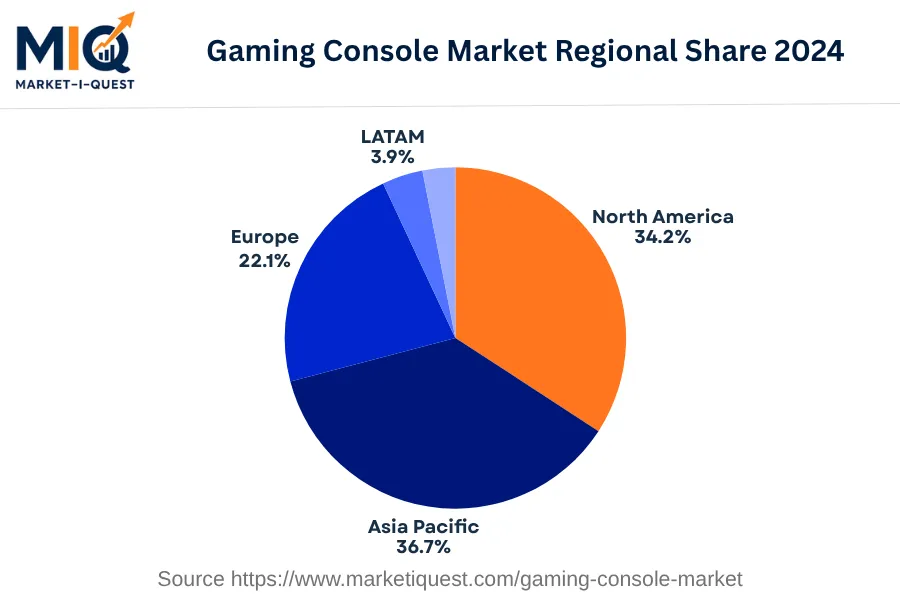
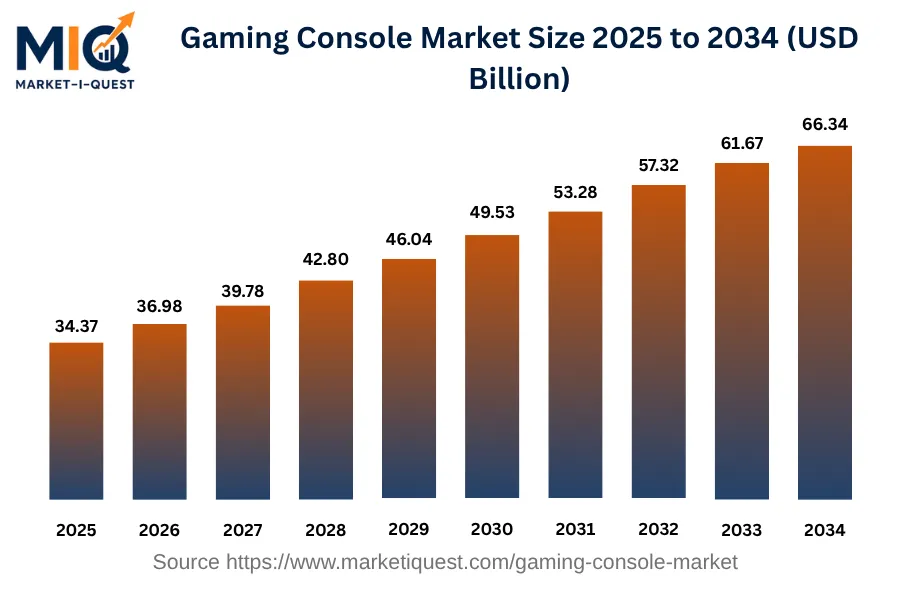
The Gaming Console Market in 2025 stood at USD 34.37 billion, up from USD 31.95 billion in 2024. By 2034, this value is projected to reach USD 66.34 billion, indicating a compound annual growth rate (CAGR) of 7.6% from 2025. The nine-year stretch from 2025 to 2034 was marked by steady growth, catalyzed predominantly by technological advancements and shifting consumer preferences towards more interactive and immersive gaming experiences. In 2024, the regional share of the market was distributed as follows: North America held 34.2%, Asia Pacific held the majority with 36.7%, followed by Europe at 22.1%. Latin America and Middle East & Africa constituted minor shares at 3.9% and 3.1% respectively.

Key Takeaways

  • By Console Type - Home Console led the market accounting for the highest share in the base year.
  • By Technology - 4K-Capable Console emerged as the top sub-segment holding a substantial market share in the review year.
  • By Processor Architecture - x86-Based Console held a notable position leading the market in the base year.
  • By End User - Individual segment was the fastest-growing expanding its market presence significantly in the review period.
gaming-console-market market size

Key Driving Factors

Integration of Advanced Features and Service

One of the main drivers for the gaming console market is the increasing integration of advanced features by major console manufacturers. Companies like Sony and Microsoft are pushing adoption by introducing new features like Virtual Reality capabilities, real-time multi-player gaming, game streaming, and voice controls in their gaming consoles. These features aim to enhance user experience and increase immersion, keeping their offerings competitive. Furthermore, they are bolstering their consoles with subscription services like PlayStation Plus and Xbox Game Pass, which provide users access to a vast library of games, further increasing the value proposition of their consoles and leading to an increase in customer acquisition and retention.

Shift Towards Home Entertainment

Another significant driver in the gaming console market is the shift in consumer behavior towards home-based entertainment, particularly prompted by the COVID-19 pandemic. With restrictions on outdoor activities and the need for social distancing, consumers worldwide have increased their demand for means of home entertainment, with gaming consoles being a popular choice. This behavior is not just limited to traditional demographics of younger male gamers, but also extends to families and older consumers looking for interactive home-based leisure. This expanding consumer base has prompted gaming console manufacturers to diversify their game libraries and product offerings, catering to a wider audience and thus, driving an upturn in the gaming console market.

Market Evolution by Timeline

2019-2023
During this period, North American consumers remained the primary buyers, with demand driven by consumer's increasing willingness to invest in high-quality leisure activities. New models like the PS5, Xbox Series X, and Nintendo Switch increased competition. Noted constraints included the semiconductor supply chain shortage which affected production lead times. The Federal Trade Commission's rulings on warranties impacted the industry, reinforcing the validity of a consumer's warranty even when using third-party components. Typical contracts involved standard retail agreements with varied pricing based on region and retailer. Notably, the dependence on online servers for multiplayer games introduced the risk of data breaches and connection reliability.
2024
In 2024, aspirational buyers in Latin America and Asia surged. Technology advances saw the inclusion of AI-based adaptive gameplay systems for more personalized player experiences. Stamina, a responsive feedback controller, was a common feature. Supply-side challenges included the rare-earth materials demand for more advanced components. The COPPA policy applied to online game purchases impacted age verification protocols. Pricing patterns pointed towards more bundling options, often in cooperation with game developers. The looming risk was the general unpredictability of hardware failures, which manufacturers typically addressed through extended warranties.
2025-2029
The major buyer segment from 2025-2029 was emerging economies, driven by an increase in disposable income. Virtual Reality (VR) technologies significantly matured, leading to more integrated gaming experiences. Compliance with the Circular Economy Action Plan impacted disposal protocols. Partnerships between console manufacturers and telecom companies fueled bundle pricing trends, while rental or lease-to-own procurement models rose. The constraint was the heavy energy consumption of consoles, leading to carbon neutrality concerns. Manufacturers responded by focusing on energy-efficient console designs.
2030-2034
Post-2030, consumers from Africa showed increased interest in gaming. Hybrid consoles, usable both at home and on-the-go, became commonplace thanks to wireless advancements. High-fidelity virtual reality was viable but constrained by the need for powerful, cost-effective processors. The Environmental Impact Assessment regulation impacted manufacturing practices. Instead of flat-fee purchases, subscription services ruled - thanks to collaborations with content delivery platforms. The major risk remained breakdowns with more complex hardware, leading to more companies investing in robust customer support services.

Future Market Outlook

Future Opportunities

The evolving gaming landscape presents numerous opportunities for console manufacturers and developers. As of 2023, significant advancements in AI and machine learning are prompting noteworthy improvements in game design and player experience. Companies like OpenAI released tools that enhance non-player character behavior, setting a higher bar for immersive storytelling. The growing success of online multiplayer platforms encourages console manufacturers to prioritize seamless online integration, as seen with Sony's acquisition of Bungie in January 2022, a move geared to enhance its live service game offerings. Furthermore, the expanding adoption of virtual reality is encouraging console makers to explore VR compatibility; Meta's Quest 2, introduced in 2020, provides insights into consumer preferences for immersive experiences that may prompt adaptations in console functionality. Social features are becoming increasingly essential, with platforms integrating community aspects, as evidenced by Xbox Live’s consistent updates to its services. Regional variations also present untapped markets, particularly in Africa, where mobile gaming popularity is on the rise, pointing toward potential new gaming ecosystems. This need for adaptation aligns with recent regulatory trends concerning online gaming in various countries, necessitating console manufacturers to adapt to different compliance environments. Therefore, as companies align their strategies with these trends, there are ample opportunities to not only retain existing user bases but also expand into new demographics and markets effectively.

Segmentation Analysis

By Console Type

The market is divided into subsegments including Home Console, Handheld Console, and Hybrid Console. Among these, Home Console accounted for the largest revenue share while Hybrid Console is expected to grow at the fastest CAGR during the forecast period.

Largest Revenue Share

Home Console

Market Share Leader

The dominance of the Home Console segment in revenue generation can be attributed to several factors. Firstly, home consoles have traditionally enjoyed a larger user base due to their early entry into the market. This early entry has allowed them to establish strong brand recognition, high-end game availability, and loyalty among gamers. Secondly, home consoles often offer high-quality, immersive gaming experiences with high-definition graphics and sophisticated gameplay mechanics, which attract a large segment of gamers who prioritize these features. The ability to use home consoles for other entertainment purposes, like streaming movies and music, adds to their appeal. Additionally, the increasing trend of multiplayer and online gaming has heightened the demand for home consoles as they tend to facilitate these styles of gameplay more effectively. Lastly, the market for home consoles is geographically diverse, with healthy demand across all key regions globally. However, it is important to note that this segment's growth may be slower compared to others due to market maturity and intense competition.

Fastest CAGR

Hybrid Console

Forecast Period Growth Leader

The Hybrid Console segment, while not the main revenue generator presently, is projected to grow at the fastest pace in the entire console market. These consoles offer a blend of home and handheld gaming experiences, catering to a wider demographic and facilitating gameplay in diverse environments. This dual capability addresses a significant market gap and offers consumers increased convenience. Technological advancements and innovation in console design are driving forces behind this expected rapid growth, as they enable smoother and more engaging hybrid gaming experiences. Additionally, partnerships between console manufacturers and game developers can stimulate growth by providing diverse game libraries for these platforms. However, roadblocks such as higher initial capital expenditure and potential technical issues may hinder immediate, mass-market adoption. Educating consumers about the unique benefits of hybrid consoles and addressing the aforementioned barriers crucial for tapping into the potential this segment holds for growth.

By Technology

The market is divided into subsegments including HD Console, 4K-Capable Console, and 8K-Ready Console with 4K-Capable Console accounting for the largest revenue share while 8K-Ready Console is expected to grow at the fastest CAGR during the forecast period.

Largest Revenue Share

4K-Capable Console

Market Share Leader

The 4K-Capable Console subsegment generates the biggest chunk of revenue due to its broad consumer acceptance and superior balance of cost and quality. 4K consoles hit the sweet spot for many gamers, combining better-than-HD resolution with a price point that is affordable for a good chunk of the consuming populace. Furthermore, 4K consoles benefit from extensive game libraries, well-established ecosystems, and solid support from all major video game publishers. Also, 4K technology is already deeply embedded into other consumer electronics like televisions and monitors, making it a logical and convenient choice for gamers. Geographically, strong adoption rates in regions with higher disposable income (like North America and parts of Europe and Asia) play a crucial role in this subsegment's profitability. The regulations or supply components do not inhibit this subsegment due to well-established manufacturing and distribution channels. The defined customer purchasing criteria such as cost, game availability and resolution, favor the adoption of 4K-Capable Consoles over its HD counterparts or the highly priced 8K-Ready Consoles.

Fastest CAGR

8K-Ready Console

Forecast Period Growth Leader

Although the 8K-Ready Console does not currently command the largest market share, it shows promising signs for the fastest compound annual growth rate in upcoming years. This can primarily be attributed to the continuous advancements in display technology and increased consumer demand for high-definition immersive gaming experiences. As the cost of 8K displays decreases and becomes more accessible, the adoption rate of 8K-Ready Consoles is projected to accelerate. Simultaneously, game developers are beginning to adapt to 8K technology, thus creating a more extensive catalog of games designed to exploit the ultra-high-definition capacity of 8K-console. Near term risks include potential delays in the adoption of 8K-resolution in households due to the existing cost barriers, and a slow shift of game developers towards creating 8K gaming content. However, if companies keep driving investments in research and development, form strategic partnerships to boost game development, and streamline 8K console production to lower consumer prices, the growth of this subsegment could surpass expectations in the forecast period.

By Processor Architecture

The market is divided into subsegments including x86-Based Console, ARM-Based Console, and Custom SoC, where x86-Based Console accounted for the largest revenue share while Custom SoC is expected to grow at the fastest CAGR during the forecast period.

Largest Revenue Share

x86-Based Console

Market Share Leader

The x86-Based Console subsegment leads today due to several factors. First, it taps into the large existing ecosystem of x86 software, reducing development time and costs for game developers. This is a compelling incentive for game developers to prioritize this platform, leading to a larger, more diverse gaming library that attracts more consumers. Second, x86 architecture, which is typically used in PCs, enables the console to provide a performance level that rivals that of a gaming PC. This high performance attracts a segment of demanding customers who seek high-quality gaming experiences. Lastly, although ARM-based architecture is known for its energy efficiency, it does not measure up to x86 in terms of raw performance. This explains the higher demand for x86-based consoles, especially from hardcore gamers and in regions with dependable electricity supplies, like North America and Europe, driving up their revenue contribution.

Fastest CAGR

Custom SoC

Forecast Period Growth Leader

The fastest growing subsegment is predicted to be the Custom SoC subsegment. A System-on-Chip (SoC) with custom design enables console manufacturers to tailor-make their hardware for optimal performance and power efficiency, potentially leading to unique selling propositions in terms of gaming experience, power usage or even form factor. As the gaming console market continues to intensify, manufacturers are pressuring themselves to differentiate their products, leading to increased adoption of Custom SoC. The adoption, however, is not without its barriers. Custom SoCs are more expensive to develop, and therefore to purchase, than generic ones. In response, some companies are partnering with tech corporations to manage costs while ensuring quality and efficiency of their consoles. One potential risk in the near term is the global shortage of semiconductors, which could affect production and drive prices up, but the long-term growth prospects remain promising.

By End User

The market is divided into subsegments including individuals and institutions, with institutions accounting for the largest revenue share while the individual segment is expected to grow at the fastest CAGR during the forecast period.

Largest Revenue Share

Institutional

Market Share Leader

Being the backbone of the segment, institutions, have dominated revenue generation on a substantive basis for year 2024. The driving factors for this dominance are multi-faceted. First, institutions' purchasing power far outweighs that of individuals, enabling them to buy in bulk and negotiate better prices, further stimulating revenue growth. Second, geographic spread of large scale institutions across multiple regions promotes market penetration of diverse offerings, thus increasing sales. Lastly, regulatory factors such as procurement policies and adherence to standards, often favor purchases from the institutional segment. Better logistics and delivery channels for institutions due to large orders also contributes to the revenue. Given these reasons, it's apparent that institutions generate more revenue due to their capability to procure at scale, the geographic diversity they offer for product reach, regulatory conveniences and better logistics and supply considerations.

Fastest CAGR

Individual

Forecast Period Growth Leader

While institutions lead in revenue generation, the individual segment is the one expected to see rapid growth. A number of factors contribute to this projection. The advent and increasing adoption of technology is enabling easier access to products and services for individuals, thus increasing their consumption. Additionally, government policies aimed at promoting individual consumption are acting as catalysts for growth in this segment. Increased disposable income amongst individuals is also driving growth. However, there are challenges. Barriers to full-scale adoption include a lack of awareness, capital, and in some regions, poor supply chains for individual orders. Furthermore, partnership with relevant stakeholders is crucial for overcoming these barriers and accelerating growth in this segment. Despite the challenges, the overall outlook for growth in the individual segment is particularly positive.

Competitive Analysis

Key Market Players

Manufacturers / OEMs

Sony Interactive Entertainment
Japan
Microsoft Corporation
US
Nintendo
Japan

Key Suppliers & Raw Materials

AMD
US
Renesas Electronics Corporation
Japan
Marvell Technology Group
Bermuda

Distributors, Integrators & Channel Partners

GameStop
US
Amazon.com, Inc.
US
Best Buy
US

Porter’s Five Forces Analysis

The following is a Porter’s five forces analysis for the gaming console market.

Supplier Bargaining Power

Medium

Console manufacturers require unique, high-quality components, generating medium supplier power.

Buyer Bargaining Power

High

Buyers have high bargaining power due to the availability of various console options.

Threat of Substitutes

High

PC gaming, mobile gaming, and cloud gaming pose a high substitution threat.

Threat of New Entrants

Low

High development costs and brand loyalty make entry barriers significant.

Competitive Rivalry

High

The market is dominated by a few established players, leading to high competitive rivalry.

Regional Analysis

Geographic market dynamics and growth opportunities across key regions

Global Market Outlook

gaming-console-market market regional share

North America

In 2024, the North American gaming console market witnessed robust growth due to an array of driving factors and industry trends. Significant advancements in technology catalyzed the upsurge in demand for high-definition gaming experiences. Capital investments in virtual reality and artificial intelligence further intensified competition among market players, encouraging the development of advanced consoles. On the consumer side, the increasing popularity of eSports tournaments in the U.S., Canada, and Mexico played a significant role in the demand increase, fostering a growing market for professional-grade consoles. Regulatory mandates, particularly in the U.S., concerning energy usage of electronic devices also influenced console design and manufacturing, promoting energy efficiency.

In terms of trends, an observable shift was consumer preference for hybrid consoles, combining handheld and home console features. The integration of consoles with other platforms, including streaming and social media services, further diversified the gaming experience. Simultaneously, significant mergers and acquisitions took place in 2024, aiming to consolidate market share and encompassing a broader portfolio of games. The enforcement of stricter online safety standards also influenced the market, prompting console manufacturers to incorporate enhanced user safety features. The market dynamics primarily engaged sectors such as entertainment and media. Retailers, both online and brick-and-mortar, played pivotal roles in console distribution, while companies in manufacturing and technology underpinned the development and supply of gaming consoles.

Asia Pacific

In 2024, the gaming console market in the Asia Pacific region saw significant dynamism due to various factors. Market movements were primarily driven by increased consumer spending in gaming as a leisure activity within key markets such as China, Japan, Australia, and India. Technological advancements in home entertainment systems stimulated demand, with the growth of 4K and VR technologies making console gaming more immersive. Moreover, governments across the region, led by South Korea and China, invested heavily in digital infrastructure enhancing online gaming performance.

Several trends marked the landscape of this sector in the Asia Pacific region. User preference shifted towards multi-functional consoles capable of streaming content in addition to gaming. Japan, with its strong history in gaming, saw a disproportionate uptake of retro and arcade-style games. This nostalgia-driven market segment also impacted console design and marketing strategies. Also, there was increased consolidation with established tech giants such as Sony and Nintendo entering partnerships for exclusive game titles. Notably, the gaming console market saw interest outside the traditional consumer circle, with sectors like education exploring the use of gamified teaching tools. New business models, such as game subscription services in Australia or India's reliance on game distribution through retail partnerships, characterized the supply dynamic in the region.

Europe

In the base year of 2024, Europe's gaming console market was defined by enthusiastic consumer demand and technological breakthroughs. Key drivers included heightened consumer spending due to increased interest in home entertainment, driven by the residual impacts of the pandemic. Regulatory ease in places like Germany and the United Kingdom further boosted the availability of gaming consoles as it promoted international trade. Investment in gaming infrastructure, especially in Central & Eastern Europe, grew exponentially, expanding the reach of gaming consoles across these regions. Moreover, advancements in cloud gaming technology fueled heightened console adoption due to increased gaming efficiency and flexibility. However, increased competition from mobile gaming posed challenges and led to changes in pricing dynamics with manufacturers attempting to maintain their market share.

Consumer trends indicative of the market were shifts towards digital downloads and online gaming, prompting strategic partnerships between console manufacturers and game developers. This also led to shifts towards subscription models for better customer retention. In France, Italy, Spain, and the Nordics, the enforcement of stricter regulations around in-game purchases influenced buyer behavior and game design. Sectors such as retail and e-commerce were significantly involved, given the high volumes of gaming console sales in these platforms. Governments across Europe took an active role in policy and standard-setting, further shaping the gaming console market dynamics for the base year of 2024.

Latin America

In 2024, the gaming console market in Latin America began to mature while continuing to harbor potential for growth. Limited disposable income, combined with high import tariffs, particularly in Argentina and Brazil, impacted the availability and affordability of consoles, constraining market expansion. However, increased investment in broadband infrastructure across the region, led by Colombia and Chile, enabled improved Internet connectivity, critical for the adoption of cloud gaming, a key driver for gaming console demand. Additionally, the evolution of payment methods in e-commerce, notably in Mexico and Brazil, facilitated consumer access to online gaming stores. Simultaneously, a rising middle class and growing youth demographic, particularly in Peru, augmented the demand base for gaming consoles.

Several key trends shaped the industry. The digitalization of gaming products accelerated, as console manufacturers leaned into online distribution channels. This transformation was also driven by the enforcement of consumption taxes on digital services in Mexico, Argentina, and Chile. Partnerships between console manufacturers and local telecom providers also emerged, aiming to optimize data consumption for online gaming. M&A activity was observed in the retail sector, with larger chains acquiring smaller specialized gaming stores, to fortify their market position in a sector increasingly moving toward digital consumption. These dynamics reflect a maturing market that continues to adapt to the socio-economic characteristics of the Latin American region.

Middle East & Africa

In 2024, the Gaming Console Market in the Middle East and Africa witnessed dynamic growth. Drivers of this growth included a spike in demand due to increasing internet penetration, particularly in Saudi Arabia, UAE, and Israel. Regulatory flexibility also attracted global console manufacturers to these markets. Moreover, Nigeria and Kenya's significant investments in digital infrastructure facilitated greater technology adoption. Heightened supply dynamics was another driver appreciating the expanding retail sector across Egypt and South Africa, which enabled consumers to access a wider variety of gaming consoles.

Several prominent trends emerged within the market in 2024. A notable behavioral shift saw players in Qatar and UAE demonstrating a increased inclination towards cloud gaming consoles. As a technological shift, the majority of users across the region started embracing VR-compatible gaming consoles. This was especially prevalent in Israel and South Africa, known for their strong tech sectors. E-commerce became a vital sales channel, largely driven by the integration of online retail by many telecom companies within the region. Meanwhile, partnerships between regional firms and international console manufacturers emerged, most notably in Saudi Arabia and Egypt. Lastly, regional governments' strict enforcement of warranties and consumer protection laws added another layer of confidence and security to the market, further amplifying the general growth of console gaming within the Middle East and Africa.

Recent Industry Developments

Latest market innovations, product launches, and strategic initiatives

June 2026

Gaming peripherals giant Razer acquired Controller Gear, a California-based accessories brand that creates licensed merchandise and peripherals for Xbox, PlayStation, Nintendo, and other gaming consoles.

November 2025

Nintendo announced its acquisition of an 80% stake in Bandai Namco Studios Singapore (BNSS), effective April 1, 2026. BNSS, which has worked on Nintendo titles including the Splatoon series, will be renamed Nintendo Studios Singapore Pte. Ltd. and become a Nintendo subsidiary.

Frequently Asked Questions