Untitled Report Snapshot

Key Players

  • Canon Inc. (Japan)
  • Nikon Corporation (Japan)
  • Sony Corporation (Japan)
  • Panasonic Corporation (Japan)
  • Fujifilm Holdings Corporation (Japan)
  • Olympus Corporation (Japan)
  • Leica Camera AG (Germany)
  • GoPro Inc. (United States)

Market Size

Base Year 2024
$7.48 Bn
CAGR
4.7%
Forecast 2034
$11.31 Bn

Market Segments

By Lens
  • Built-in
  • Interchangeable
By Product
  • Compact Digital Camera
  • DSLR
  • Mirrorless
By End User
  • Professional Photographers
  • Content Creators
  • Prosumers

Market Dynamics

Drivers
  • Rising popularity of professional photography
  • Increasing technological advancements
Restraints
  • Smartphone photography rise
  • Economic downturn impact
Opportunities
  • Rising demand for mirrorless cameras
  • Increasing technological advancements

Market Size

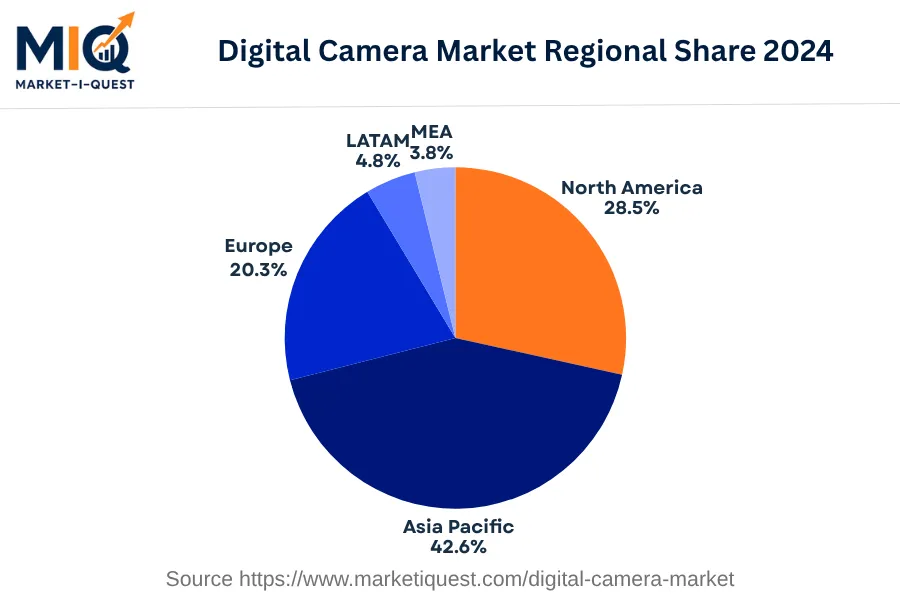
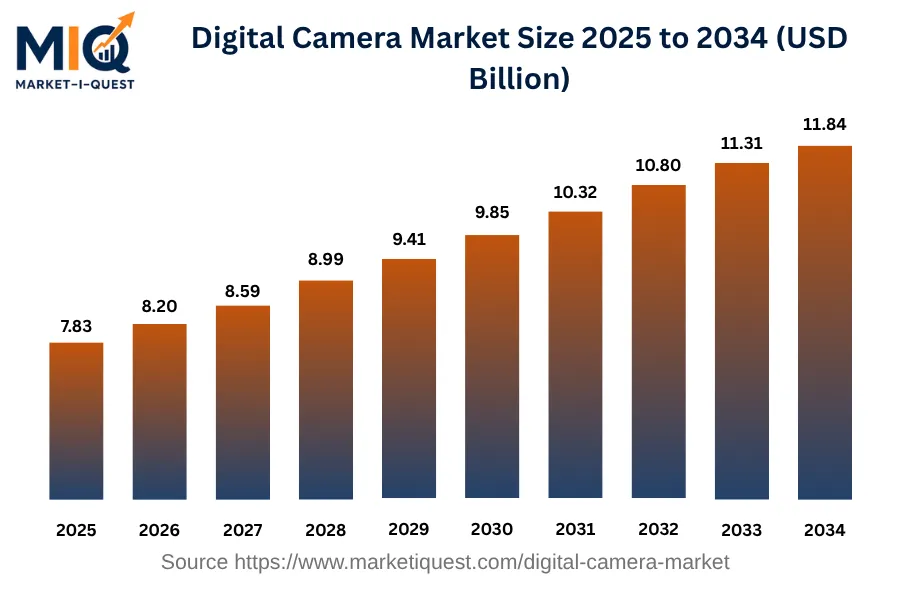
The Digital Camera Market, valued at $7.83 billion in 2025, is projected to grow to approximately $11.84 billion by 2034, showing a CAGR of 4.7%. This increase is significant with the market value for digital cameras rising steadily over the years. Starting from $7.48 billion in 2024, the growth trajectories showcase an upward trend towards their 2034 estimates. The climb from 2024 to 2025 marks an increase of roughly $0.35 billion, setting the pace for the expansion seen in the subsequent years. This trend is influenced by several factors, including advancements in technology and increased customer demand for digital cameras. Regionally in 2024, the market share distribution demonstrated Asia Pacific leading at 42.6%, followed by North America at 28.5%, and Europe at 20.3%. The regions with lesser shares were Latin America at 4.8% and Middle East and Africa at 3.8%, accounting for the remaining portion of the market.

Key Takeaways

  • By Lens - Built-in is the leading subsegment having the largest market share in recent years.
  • By Product - DSLR category held a significant market position in 2024 due to increasing demand.
  • By End User - Professional Photographers led accounting for a substantial market percentage.
digital-camera-market market size

Key Driving Factors

High-Resolution Imaging in Diverse Fields

Professional sectors such as media, film, advertising, real estate, and wildlife are resorting to high-resolution imaging to enhance their work. As a result, the demand for digital cameras capable of high-resolution output, wide dynamic range, and rapid image processing has increased significantly. Specifically, the real estate industry is using such cameras for virtual home tours, and advertising agencies apply them to create stunning visuals. Similarly, professional photographers and filmmakers need cameras with high dynamic range to meet content demands on platforms like Netflix and Amazon Prime. This shift in professional demand towards high-resolution imaging devices is driving the Digital Camera Market.

The Rise of Social Media and Influencer Culture

The Digital Camera Market is experiencing considerable growth due to the rise of social media platforms and influencer culture. Influencers, bloggers, and vloggers, who form a massive user segment in today's market, require high-quality digital cameras for content creation. While smartphones provide convenience, digital cameras give superior image quality and versatility that influencers need to differentiate their content. Consequently, the continuously evolving needs and preferences of this consumer segment are pushing the Digital Camera Market growth. It's notable that photography gear companies are adjusting their promotional strategies to cater to this trend, further boosting market tendencies.

Market Evolution by Timeline

2019-2023
In the 2019-2023 period, the demand for digital cameras saw a resurgence in the market particularly in Asia, driven by emerging affluent photography enthusiasts. The professional photographer segment in the US and Europe region also remained solid, adopting latest camera models. Canon, Nikon and Sony, adopted artificial intelligence in their products and offered cloud platforms for photo storage, reflecting higher integration maturity. However, scarcity in CCD sensors due to factory shutdowns posed a supply chain challenge. Parallelly, the GDPR regulations impacted data handling policies for cloud storage services, influencing digital camera adoption. Commercially, with pricing largely holding steady, subscription-based models for cloud storage were popular. Risk lay in smartphone camera advancements, which continued to threaten the amateur photographer segment.
2024
In 2024, demand for digital cameras became more specialized, with particular uptake in the professional and prosumer segments across all regions. Rise in macro photography and videography have particularly driven the uptake. Fujifilm's GFX series showed advancements in tri-axial tiltable display and stepped up on mirrorless technology. Supply, however, was affected by global chip shortage. On the regulatory front, introduction of 'Anti-Digital Dumping Guidelines' in Europe led to formalised recycling programs. Dynamic pricing models were introduced, where price was based on user stats. Risk came in the form of increasing cell phone quality and supply chain constraints due to chip shortages.
2025-2029
Between 2025-2029, adoption of digital cameras in scientific research grew consistently. Geographically, major demand areas remained in United States, Europe and developed parts of Asia (Japan, South Korea). Several new research-oriented models were introduced by major manufacturers. Adoption of smart image processing technology became more mature during this time. However, continuous supply-chain disruptions due to geopolitical tensions impacted the market. The strict 'Right to Repair' legislation brought more transparency to the digital camera market. Gradual shift towards 'Pay-per-use' models was observed by several companies, trying to combat decreasing demand in the casual-user segment. Major risks included increased smartphone adoption and constant supply chain disruptions.
2030-2034
From 2030-2034, the emphasis shifted to digital cameras with advanced technologies catering to specialized fields like deep-sea exploration, archeology, and astrophotography. The demand was strong particularly in countries heavily investing in related scientific research, like the United States, China, and European countries. Major companies like Nikon, Olympus, and Fuji introduced several camera models catering to these niche markets. Significant advancements were made in materials used to build hardware which could withstand extreme environmental conditions, although it came with higher pricing. New ISO standards for camera functionality under harsh conditions were established. In contrast, the regular consumer market continued to shrink further, making it riskier for manufacturers focusing on the consumer segment.

Future Market Outlook

Future Opportunities

The global digital camera market presents various opportunities poised to shape its evolution. With continuous improvements in AI technology, brands like Canon and Nikon are expected to further innovate in autofocus systems and scene recognition, following developments in their flagship models, like the EOS R5 and Z9. The demand for specialized cameras for niche markets, such as wildlife photography, is likely to grow, as evidenced by the increasing popularity of rugged and high-performance cameras like the Olympus Tough TG-6 released in 2019. These cameras appeal to outdoor enthusiasts seeking durability and advanced features in extreme conditions. Additionally, the rise of social media influencers presents a viable opportunity for brands to tap into marketing strategies around content creation. Partnerships with platforms like Instagram are already forming, highlighting potential collaborations with emerging photographers. Another opportunity lies within the virtual reality sector, as companies like GoPro and Insta360 expand their offerings, indicating a merging of photography with immersive experiences. Improved social sharing capabilities in cloud services and direct integration with mobile applications can cater to younger consumers, bolstering camera sales. As manufacturers work to address evolving consumer needs through diversified product lines, environmental consciousness will guide product development, prompting innovative solutions that cater to sustainability in the market, further shaping future business strategies across the industry.

Segmentation Analysis

By Lens

The market is divided into subsegments including Built-in and Interchangeable lenses. The Built-in lens accounted for the largest revenue share while Interchangeable is expected to grow at the fastest CAGR during the forecast period.

Largest Revenue Share

Built-in

Market Share Leader

The Built-in lens holds the highest revenue segment due to several driving factors. It's comparatively low price relative to interchangeable lenses makes them more accessible to a wider demographic, boosting the overall consumer base. Furthermore, built-in lenses are typically integrated in consumer electronics like smartphones, digital cameras, and camcorders which have a significant global market penetration. This directly adds to their revenue generation as upgrades or replacements of these devices automatically mean a purchase of a new built-in lens. Unique advertising and positioning strategies also contributes to high revenue generation. Popular marketing narratives focus on convenience for non-professionals who want point and shoot devices without having to worry about selection and storage of multiple lenses. Geographically, the large market size of North America and Europe contribute significantly to its revenue. However, emerging economy and rising disposable income in Asia-Pacific region also show robust sales figures for these lenses.

Fastest CAGR

Interchangeable

Forecast Period Growth Leader

The Interchangeable lens segment possesses the fastest growth in terms of CAGR. These types of lenses offer flexibility and adaptability that is highly sought after by professional photographers and videographers. Technological advancements such as silent wave motors for silent autofocusing, image stabilization features, and constant maximum aperture are influencing the growth of these lenses. These specific use-case scenarios and pursuit of quality, which is achievable with various specialized lenses, drives this segment in its competitive edge. Partnerships among camera manufacturers and reputable lens providers, as well as increased capital expenditure in the development of lens technologies, can lead to a surge in the growth of interchangeable lenses. A potential risk might be the high cost of these lenses along with required knowledge to utilize them fully can limit their market to professionals, enthusiasts, or wealthier hobbyists, potentially slowing down the growth speed. However, with the consumer demand for high-quality visual content continues to increase, the market for interchangeable lenses also appears optimistic.

By Product

The market is divided into subsegments including Compact Digital Camera, DSLR, and Mirrorless, with DSLR accounting for the largest revenue share while Mirrorless is expected to grow at the fastest CAGR during the forecast period.

Largest Revenue Share

DSLR

Market Share Leader

The DSLR segment holds the largest share of the camera market revenue in 2024, attributable to its widespread use among professional photographers and increasingly among amateurs. Reason for this high demand is because of the high image quality offered by DSLR cameras, allowing a high-degree of control over aspects such as focus, depth of field, and exposure length. As DSLRs come with detachable lenses, consumers are also attracted by the ability to customize their camera according to their photography style. Increasing interest in DSLR cameras among youth and established photographers in developing regions, adoption of smart devices and e-commerce for purchases, have also contributed significantly to enhancing their market presence. It's assumed that some geographical hotspots for DSLR consumption include North America and Europe, driven by high purchasing power and a vibrant culture of memory preservation through photographs.

Fastest CAGR

Mirrorless

Forecast Period Growth Leader

The Mirrorless camera segment is projected to grow at the fastest compound annual growth rate during the forecast period. The primary growth driver is the evolution in technology that makes these cameras lighter, more compact, and easier to handle over DSLR cameras while not compromising on image quality. Interestingly, mirrorless cameras provide capabilities for video capture, making them a favorite among vloggers and content creators. Also, the progressive decline in DSLR technology and rising need for more portable and convenient devices is expected to contribute to the rapid adoption of these cameras. Another catalyst is the increasing partnerships from major companies with artists and influencers to promote their mirrorless products. Nonetheless, there are near-term risks, such as perceived lack of brand heritage, and limited lens and accessory ranges. However, with the rising preference for lightweight yet sophisticated cameras, the Mirrorless segment is expected to overcome these barriers.

By End User

The market is divided into subsegments including professional photographers, content creators, and prosumers. In 2024, Professional Photographers accounted for the largest revenue share, while Content Creators are expected to grow at the fastest CAGR during the forecast period.

Largest Revenue Share

Professional Photographers

Market Share Leader

The professional photographers' subsegment is leading in revenue generation due to various reasons. Firstly, the demand for high-quality images has been consistently growing. This is driven by industries such as advertising, real estate, and fashion where high-quality photos are essential. Additionally, professional photographers typically invest in higher priced equipment, which drives up the revenue for this segment. Some geographies also contribute to this trend: regions with robust media and entertainment sectors, like North America and Europe, have a higher number of professional photographers. There is also an established photographer culture and appreciation for the art in these regions, further motivating professional-grade purchases. Lastly, there's a slow but steady barrier to entry for becoming a professional photographer, as it does not just require the equipment, but also the skill to use it – which encourages more purchases but fewer potential switchers.

Fastest CAGR

Content Creators

Forecast Period Growth Leader

In the case of growth, the content creators subsegment is expected to exhibit the fastest CAGR. This is due to the proliferation of social media and online platforms where content creation is key. More and more people are turning towards becoming content creators, which is driving the demand for higher quality equipment. Additionally, technological advancements and innovation in digital equipment are increasing accessibility and affordability for these users, enabling them to upgrade their equipment more frequently. However, the growth could face barriers such as certain regulations related to content creation and copyright issues. These potential risks could impact the adoption rate among this subsegment. In the near-term though, partnerships between digital platforms and equipment manufacturers could incentivize more users to invest in professional-grade equipment, thereby propelling the growth of this subsegment.

Competitive Analysis of Digital Camera Market

Key Market Players

Manufacturers / OEMs

Canon Inc.
Japan
Nikon Corporation
Japan
Sony Corporation
Japan

Key Suppliers & Raw Materials

Corning Incorporated
US
Flex Ltd.
Singapore
Sharp Corporation
Japan

Distributors, Integrators & Channel Partners

Amazon.com, Inc.
US
Best Buy Co., Inc.
US
B&H Photo Video
US

Porter’s Five Forces Analysis

This analysis evaluates the forces influencing the competitive intensity and attractiveness of the Digital Camera Market.

Supplier Bargaining Power

Medium

Fewer sensor manufacturers and limited raw materials suppliers increase bargaining power.

Buyer Bargaining Power

High

Consumers enjoy high power due to a wide variety of choices and low switching costs.

Threat of Substitutes

High

Rapidly advancing smartphone cameras stand as imminent substitutes.

Threat of New Entrants

Low

High capital needed for R&D and patents limit the ease of entering this market.

Competitive Rivalry

Medium

Quality differences among brands increase competition amid an overall decrease in market size.

Regional Analysis

Geographic market dynamics and growth opportunities across key regions

Global Market Outlook

digital-camera-market market regional share

North America

In 2024, the North American digital camera market was driven by technology innovation and robust demand for advanced photography tools. Enhanced camera features such as high-resolution image sensors, machine learning capabilities, and improved battery life stimulated consumer interest, with notable uptake in the U.S., Canada, and Mexico. Rapid 5G deployment was another significant influence, boosting real-time content sharing through digital camera integration. Additionally, favorable regulations encouraged investments in the manufacturing sector, resulting in efficient scale production and competitive pricing.

Three prominent trends shaped the 2024 digital camera landscape. Firstly, AI-powered imaging technologies gained traction with buyers, reflecting a shift from traditional cameras to smart devices with integrated software. Secondly, an increased focus on personal content creation catalyzed the popularity of user-friendly digital cameras in consumer markets, notably among young adults. Thirdly, the market witnessed heightened dynamism in multi-channel strategies, with direct-to-consumer and e-commerce sales gaining substantial traction. In relation to sectors, government use of digital cameras in law enforcement surged, driving demand further. From a corporate standpoint, enterprise-level adoption of high-end digital cameras for product photography and marketing content creation was apparent, especially in the retail sector. In summary, the 2024 North American digital camera market was characterized by technological advancements and their adoption among consumers, complemented by positive regulatory and business environment.

Asia Pacific

In 2024, the Asia Pacific digital camera market was predominantly shaped by consumer behavior, progressive technology, and competitive pricing. High demand from photography enthusiasts and professional photographers was a key driver, amplified by rising disposable income in China, India, and key ASEAN markets. In South Korea and Japan, governmental incentive schemes prompted businesses and schools to adopt digital cameras, triggering increased investment in the market. Technological advancements, particularly in lens quality and built-in features, along with aggressive pricing strategies, further fueled market growth.

The trend of high-resolution photography heavily influenced consumer preferences, with Australia witnessing an upsurge in demand for DSLR cameras. E-commerce platforms became preferred sales channels in markets like India, enhancing product accessibility. Concurrently, partnerships were forged between tech giants and camera manufacturers for AI integration, noticeably in Japan and South Korea. Governments across the region started stringently implementing standards on digital photography quality for official usage, changing enterprise purchase patterns. In retail, digital camera applications were being innovatively utilized for inventory management, particularly in China. These dynamics redefined the digital camera landscape in the Asia Pacific region in 2024.

Europe

In 2024, the digital camera market in Europe witnessed considerable dynamics and shifts. A surge in demand for high-resolution imaging, driven by sectors such as surveillance, entertainment, and tourism, bolstered market growth. Germany and the UK observed high adoption rates of advanced technology digital cameras, spurred by significant investment in R&D across both public and private entities. Regulations advocating for quality and performance standards also influenced supply dynamics, with France and Italy witnessing an uptick in premium digital camera offerings. Furthermore, pricing strategies, where Spain and the Nordics stood out, impacted overall sales and market competition.

Trends shaping the market included an evident inclination towards mirrorless cameras for their compactness and superior imaging capabilities. This was prevalent in markets like Central & Eastern Europe and Benelux. Advanced features like Wi-Fi and Bluetooth connectivity became norms, driven by the increasing consumer preference for easy sharing and storage options. The omnichannel retail approach also gained prominence, boosting sales in the UK and Germany. Mergers and acquisitions marked the market landscape, with enterprises striving to expand product portfolios and consolidate market presence. Meanwhile, policy enforcement around data privacy had an impact on how digital cameras were being utilized across sectors, particularly healthcare and manufacturing. In sum, the digital camera market in Europe closed 2024 on a dynamic note.

Latin America

In 2024, the Digital Camera Market across Latin America, particularly in Brazil, Mexico, Argentina, Colombia, Chile, and Peru, saw a distinct progression moderated by various drivers and trends. The market's buoyancy was largely fueled by increasing consumer demand, particularly in the tourism sector, the rise of digital technology adoption in the region, and favourable regulations encouraging tech-based investments. High-demand for superior image quality, coupled with competitive pricing dynamics, further stimulated supply from leading manufacturers and distributors, enhancing market growth.

Predominant trends shaping the market included a shift towards mirrorless cameras by both professional photographers and hobbyists, due to their compact size, and superior image capture technology. E-commerce platforms dominated the retail channel in 2024, supported by aggressive digital marketing strategies adopted by key players. Strategic partnerships between digital camera manufacturers and software companies delivering enhanced camera functionality were increasingly observed. Compulsory quality standard enforcement, particularly in Brazil and Argentina, played a pivotal role in shaping product offerings. The market was significantly influenced by sectors such as media and entertainment, portraying an acute need for high-quality digital cameras. The increasing trend of drone photography in the real estate and tourism sectors was also evident. Government initiatives to promote local manufacturing of digital cameras were prominently visible in Mexico and Colombia.

Middle East & Africa

In 2024, the digital camera market in the Middle East and Africa experienced a period of stability. Drivers behind this development included increased tourism fostering demand for high-quality photography equipment, heightened security measures in countries like Saudi Arabia and Israel necessitating advanced surveillance cameras, and increased investment in film and entertainment industries across the region, particularly in Nigeria, boosting demand for professional-grade cameras. Technological advancements in image and video quality, coupled with favorable import prices, also catalyzed market growth.

In terms of trends, consumer preference leaned towards compact and mirrorless cameras driven by their lightweight property and improved features. Additionally, there was a notable surge in online sales in countries like the United Arab Emirates and South Africa due to increased internet penetration, with retail channels also maintaining a strong presence. Strategic partnerships came into play within the region, for example, Canon with Egypt's National Telecommunications Regulatory Authority for product standardization. Mobile photography also gained noticeable traction, mostly in Kenya and Nigeria, courtesy of smartphone proliferation in these countries. From a sector viewpoint, the market witnessed strong uptake from the entertainment industry, corporates, sporting events, and security-conscious entities such as government and the oil and gas sector, further stimulating the overall digital camera demand.

Recent Industry Developments

Latest market innovations, product launches, and strategic initiatives

May 2026

Sony expanded the high-end photography market by introducing a new professional camera. This release significantly increased the standard image detail available to photographers, while also improving the device's ability to record very high-quality video for long periods without overheating.

February 2026

Canon announced a new limited-edition compact camera to celebrate three decades of their primary point-and-shoot line. This signals that major brands are still investing in small, dedicated cameras designed for everyday content creators, rather than abandoning that entire audience to smartphones.

Frequently Asked Questions