In-Vitro Toxicology Testing Market Snapshot

Key Players

  • BioIVT (United States)
  • Covance (United States)
  • BioReliance Corporation (United States)
  • Charles River Laboratories (United States)
  • Eurofins Scientific SE (Luxembourg)
  • Cyprotex (United Kingdom)
  • GE Healthcare (United States)
  • SGS S.A. (Switzerland)
  • Evotec (Germany)

Market Size

Base Year 2024
$12.85 Bn
CAGR
10.68%
Forecast 2034
$35.45 Bn

Market Segments

By Technology
Cell Culture Technology, High Throughput Technology, Molecular Imaging, OMICS Technology
By Product
Consumables, Assays, Instruments, Software, Services
By Method
Cellular Assay, Biochemical Assay, In Silico, Ex-vivo
By End Use
Pharmaceuticals, Cosmetics & Household Products, Diagnostics, Chemicals, Food, Others

Market Dynamics

Drivers
  • Increasing ethical concerns over animal testing
  • Growing pharmaceutical industry
Restraints
  • High operational costs
  • Strict regulatory policies
Opportunities
  • Rising ethical concerns over animal testing
  • Growth in pharmaceutical and biopharmaceutical industries

Market Size

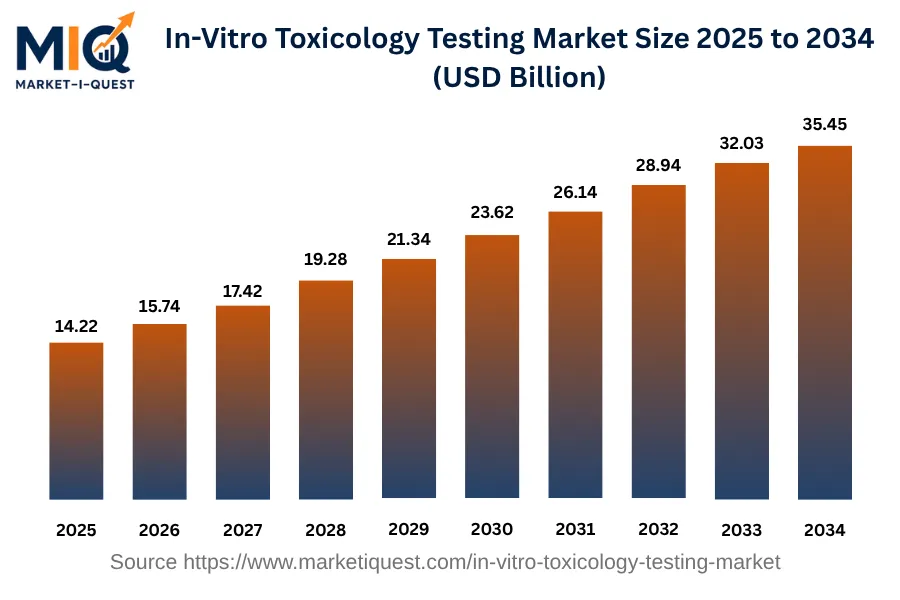
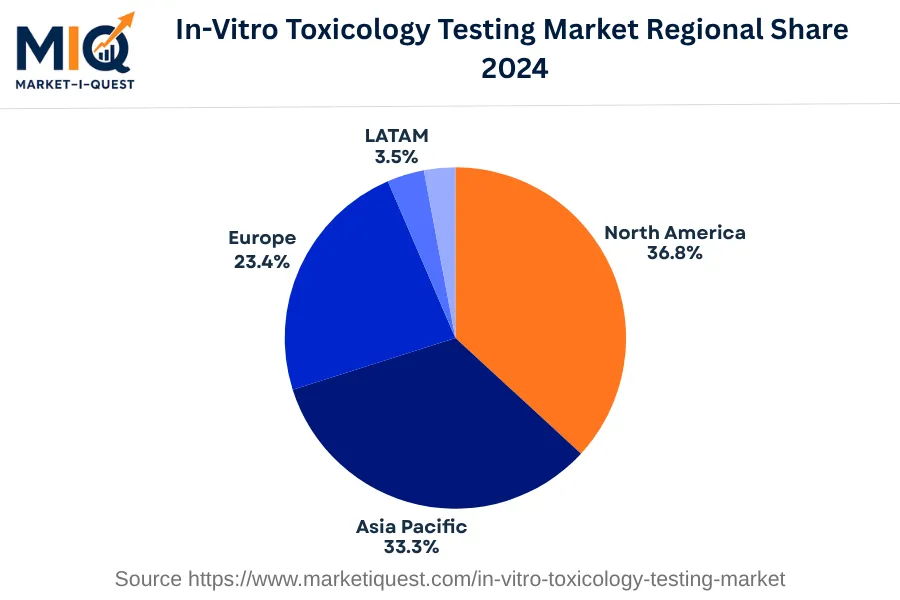
The In-Vitro Toxicology Testing Market size in 2025 is expected to be USD 14.22 billion, from a value of USD 12.85 billion in 2024. By the year 2034, the market size is anticipated to increase to USD 35.45 billion, representing a compound annual growth rate (CAGR) of 10.68% from 2025 to 2034. This substantial growth over these years signifies a steady and consistent increase in the value of the market. Closing the analysis with the regional data hence highlighting the geographic distribution of this market's revenue in the year 2024: North America held the largest share, constituting 39.8% of the market, followed by Asia Pacific with a share of 28.8%, and Europe made up 24.2% of the market mix. Smaller portions were covered with LATAM contributing to 3.7% and MEA with a share of 3.5%.

Key Takeaways

  • By Technology - Cell Culture Technology held the leading position with the highest market share in 2024.
  • By Product - Instruments accounted for the highest share in the market in 2024.
  • By Method - Cellular Assay led the market in 2024 with highest share.
  • By End Use- Cosmetics & Household Products held the fastest growth rate during the forecast period.
in-vitro-toxicology-testing-market market size

Key Driving Factors

Enforcement of Strict Regulatory Frameworks

Regulations such as the European Union's REACH (Registration, Evaluation, Authorisation and Restriction of Chemicals) require that chemical substances be evaluated for their potential to cause harm to human health. This creates a need for reliable and efficient testing methodologies. In-vitro toxicology testing fulfills this need, as it offers a high-throughput, cost-effective, and human-relevant approach to assess the toxicity of these chemical substances. Moreover, it adheres to the overarching ethical movement towards reduction, refinement, and replacement (3Rs) of animal testing in scientific research – a stipulation of many regulations worldwide including Europe's Directive 2010/63/EU. As companies seek to maintain compliance with these rules, they lean further into in-vitro toxicology testing methods.
Integration of In Silico Modelling Techniques

The increasing use of in silico modelling methods in toxicology is another specific driver of the in-vitro toxicology testing market. In silico models, including Quantitative Structure-Activity Relationships (QSARs), use computational power to predict the toxicological effects of chemical substances without laboratory-based experiments. The integration of in vitro toxicology testing with these computational models allows for comprehensive, predictive toxicity evaluations that more accurately reflect complex biological systems. This enhances the appeal and hence, the adoption of in-vitro procedures among pharmaceutical, cosmetic, and chemical manufacturers. As such, the pairing of in vitro testing with in silico methods both optimizes the testing process and expands the market for these tests.

Market Evolution by Timeline

2019-2023
Buyers in the biopharma sector, especially in North America, are using in-vitro toxicology testing to shorten drug development cycles. Laboratory capacity for the testing is being amplified, with Advanced In-Vitro Cell Technologies helping drug developers in the U.S. and Canada decrease the time for product to market. A significant regulatory push is the Guidelines for the Testing of Chemicals, No. 129 from The Organisation for Economic Co-operation and Development, which promotes in-vitro testing. Contracts are usually fixed price, with long-term partnerships. Operational risks frequent due to strict timelines, typically mitigated by investment in larger capacity labs.
2024
Asian markets, primarily China and India, have propelled demand for in-vitro toxicology testing due to surge in generic drug production. In response, companies like Absorption Systems have established testing facilities in these countries. Technology development has seen the introduction of 3D cell-culture systems. The Nagoya Protocol influences the sourcing of genetic resources for testing. Fee-for-service is the dominant commercial model, with supply-demand dynamics influencing pricing. The risk of a shortage of skilled personnel is being managed by increased reliance on artificial intelligence applications.
2025-2029
Demand is growing from bio-medical research institutions and hospitals in Europe for personalized medicine research. Progress is marked by Pion Inc's integration of its bio-chip technology into toxicology workflows for improved accuracy and efficiency. Regulatory pressure stems from the European Union's Registration, Evaluation, Authorization, and Restriction of Chemicals and its guidelines on chemical testing. Tools are typically leased under a subscription model. Supplier risks around industry consolidation and increasing competition are addressed through the pursuit of technical differentiation and specialization.
2030-2034
Multinational pharmaceutical companies are heavily investing in in-vitro toxicology testing. The trend is moving towards AI-driven systems for rapid and accurate analysis. Companies like SRI International have been developing AI-driven applications with higher capacity. Integrated approaches to testing and assessment are encouraged by regulatory bodies like the US Food and Drug Administration under its Safety and Innovation Act. Flexible pricing models are emerging, with tiered pricing based on usage and customer size. Risk of machine failure mitigated with service level agreements and regular maintenance.

Future Market Outlook

Future Opportunities

The growing emphasis on regulatory compliance presents a landscape ripe for opportunity in the in-vitro toxicology testing market. In 2022, the European Parliament introduced stricter regulations targeting chemicals, highlighting the need for validated alternative testing methods. This trend is coupled with increasing consumer awareness regarding safety, driving demand for more reliable toxicology solutions. For instance, the adoption of the Animal Welfare Act in the United States has further motivated companies to seek alternatives to animal testing, which may encourage firms to invest in innovative in-vitro technologies. Additionally, partnerships between academia and industry are forming to advance the development of in-vitro methodologies. A notable example is the collaboration established in 2021 between the University of California, Berkeley and multiple biotech firms to enhance testing frameworks specifically for pharmaceutical applications. Furthermore, advancements in organ-on-chip technologies represent a significant growth frontier; these systems can mimic human organ functions to assess toxicity more accurately. Investments in digital health and biosensors are also projected to play a crucial role as companies aim to create smarter in-vitro testing solutions. As regulatory bodies increasingly prioritize human-relevant testing over traditional methods, the market is likely to experience a shift toward innovative products and services designed to meet evolving compliance standards, positioning stakeholders favorably for future growth.

Segmentation Analysis

By Technology

The market is divided into subsegments including Cell Culture Technology, High Throughput Technology, Molecular Imaging and OMICS Technology. Of these, Cell Culture Technology accounted for the largest revenue share, while High Throughput Technology is expected to grow at the fastest CAGR during the forecast period.

Largest Revenue Share

Cell Culture Technology

Market Share Leader

Cell Culture Technology claims the largest market share primarily due to its broad adoption in the industry and essential role in biological research. As a pillar of biopharma production, this technology is used extensively in drug discovery and development, production of vaccines and therapeutics, stem cell research, and in studying normal cell physiology and biochemistry. A key driver of growth in this subsegment is the high demand for biopharmaceuticals—especially in developing countries where increasing healthcare expenditure, presence of chronic diseases, and improving healthcare infrastructure contribute to the demand. Additionally, this technology is being increasingly relied upon for studying the complex interactions in tumor microenvironments to develop more effective cancer therapeutics, another factor driving growth. Regulatory support in various countries for cell culture-based vaccine production also adds to the overall growth.

Fastest CAGR

High Throughput Technology

Forecast Period Growth Leader

High Throughput Technology, although not the largest, is forecasted to grow at the fastest pace. This technology enables researchers to swiftly conduct millions of chemical, genetic or pharmacological tests. Its potential to exponentially speed up the drug discovery process is a prime catalyst for growth. Additionally, it empowers scientists to effectively use limited samples to analyze thousands of parameters simultaneously. There are some potential challenges such as high initial costs and the need for large data storage and management infrastructure. However, strategic collaboration and partnerships between technology providers, pharmaceutical companies, and academic institutions are expected to mitigate these issues. Furthermore, the push towards personalised medicine and biomarker discovery could further amplify the demand for High Throughput Screening, providing a significant boost to this subsegment's growth in the near future. It must be noted that these are cautious, strategic observations, not hard-and-fast predictions.

By Product

The market is divided into subsegments including Consumables, Assays, Instruments, Software, and Services. The Instruments accounted for the largest revenue share while Services is expected to grow at the fastest CAGR during the forecast period.

Largest Revenue Share

Instruments

Market Share Leader

Instruments currently hold the largest share of the market revenue. This might be attributed to the fact that these are fundamental to any operations within this market. Moreover, the nature of many types of instruments used within this sector, ranging from simple handheld devices to complex analytical equipment, which requires large up-front costs, contributes to this high revenue contribution. Additionally, the operational life of these instruments tends to be long with recurring income generated through maintenance, support, and upgrade. Furthermore, stringent industry regulations often necessitate the adoption of certain types of instruments for standardization and quality purposes. The procurement of these instruments is usually made through direct channels, limiting the negotiation power of customers. Geographically, developed regions with advanced manufacturing and research capabilities are significant markets for these instruments, adding to the overall revenue share.

Fastest CAGR

Services

Forecast Period Growth Leader

The Services subsegment is expected to grow at the fastest CAGR throughout the forecast period. This growth is primarily due to the increasing complexity and sophistication of instruments and assays used in this industry, necessitating the increased use of support services to ensure correct operation. Additionally, the demand for specialized services such as maintenance, calibration, and custom optimization is also growing along with regulatory requirements for regular testing and compliance. A significant driver for its fast adoption is the trend of reducing capex by outsourcing non-core activities; services help align with this strategic direction. However, the high cost and availability of skilled professionals could act as barriers for adoption in some regions. To address these, companies are forming partnerships and investing in skill development. Yet, near-term risks such as regulatory changes and economic uncertainties could potentially affect the growth.

By Method

The market is divided into subsegments including Cellular Assay, Biochemical Assay, In Silico, and Ex-vivo. Cellular Assay accounted for the largest revenue share while In Silico is expected to grow at the fastest CAGR during the forecast period.

Largest Revenue Share

Cellular Assay

Market Share Leader

The Cellular Assay subsegment holds the leading position in terms of revenue owing to a number of factors. Cellular assays are integral to drug discovery and research activities, in turn fueling their demand. These assays are utilized in the identification and validation of drug targets, playing a crucial role in the early stages of drug development. Furthermore, the advent of technologically advanced systems for conducting cellular assays has allowed more efficient and accurate results, fostering the growth of this subsegment. Regulatory bodies across different regions encourage the adoption of cellular assays in biomedical research, driving the robust revenue growth in this area. High switching costs associated with shifting towards alternative methods contribute to the maintenance of this subsegment's market position. Cellular assays represent a well-established methodology, with strong market channels including academic research institutions, pharmaceutical companies, and other research-based organizations.

Fastest CAGR

In Silico

Forecast Period Growth Leader

In contrast, the In Silico subsegment is projected to experience the fastest CAGR. This can be attributed to the rapid developments in computational biology, which make it an efficient and cost-effective method for drug discovery and disease modeling. By leveraging advanced algorithms and machine learning, In Silico methods can dramatically accelerate the research process. However, adoption barriers still exist given the technological sophistication required, and its effectiveness heavily relies on data quality and the complexity of biological systems. Policies promoting the digitization of research and development activities, coupled with strategic partnerships and significant investments for innovation, are anticipated to further catalyze its growth. Alternatively, potential risks associated with this sector relate primarily to data security and privacy concerns, as well as the need for rigorous validation procedures to ensure the accuracy and reliability of results.

By End Use

The market is divided into subsegments including Pharmaceuticals, Cosmetics & Household Products, Diagnostics, Chemicals, Food, and Others. The Pharmaceuticals subsegment accounts for the largest revenue share, while Cosmetics & Household Products is expected to grow at the fastest CAGR during the forecast period.

Largest Revenue Share

Pharmaceuticals

Market Share Leader

In 2024, Pharmaceuticals takes the lead in revenue generation amidst all subsegments. This dominance is primarily driven by an increasing global population and a higher demand for medications and medical interventions. Aging population demographics, particularly in developed economies, contribute to more significant pharmaceutical consumption rates. Burgeoning disease prevalence further fuels the need for innovative medicinal solutions, leading to increased revenues in this subsegment. Regulatory frameworks have also played a significant role in the healthy expansion of pharmaceutical markets across the globe. These regulations set standards to ensure the quality, safety, and effectiveness of these products, thereby enhancing consumer trust and driving market growth. A pivotal purchasing criterion is the established efficacy of medications, as prescribed by healthcare professionals, encouraging patient adherence to pharmaceutical products. High switching costs are also identified since finding alternative solutions is costly, time-consuming, and coupled with considerable health risks. Direct and indirect healthcare channels have further streamlined the procurement and supply chain processes, ensuring steady revenue inflow in the pharmaceuticals market.

Fastest CAGR

Cosmetics & Household Products

Forecast Period Growth Leader

Despite not leading in terms of revenue generation, the Cosmetics & Household Products subsegment dominates in terms of growth rate. Key growth drivers include a steady rise in consumer spending power and changing lifestyle trends, particularly in emerging economies. At the same time, potential barriers like stringent regulations and packaging challenges limit adoption speed. However, advancements in technology, particularly in product formulation and customized solutions, have served as catalysts in surmounting these barriers and have thereby accelerated market growth. Partnerships among cosmetics and household products companies for sharing technology and marketing strategies have further boosted the sector's rapid expansion. Meanwhile, risks in the near-term could stem from fluctuating raw material costs, potentially impacting manufacturing and overall operational expenses. Concurrently, sustainability narratives and eco-conscious consumer behavior are increasingly influencing purchasing decisions, prompting companies to invest in environmentally friendly solutions, fostering accelerated growth in the subsegment.

Competitive Analysis

Key Market Players

Manufacturers / OEMs

Agilent Technologies Inc.
US
Thermo Fisher Scientific Inc.
US
Bio-Rad Laboratories Inc.
US

Key Suppliers & Raw Materials

Covance Inc.
US
SGS S.A.
Switzerland
Merck KGaA
Germany

Distributors, Integrators & Channel Partners

Charles River Laboratories International Inc.
US
Eurofins Scientific
Luxembourg
AMP Biosimilars AG
Germany

Porter’s Five Forces Analysis

This analysis explores the competitive intensity and attractiveness of the In-Vitro Toxicology Testing Market.

Supplier Bargaining Power

Medium

Suppliers have moderate influence due to the specialized nature of products and limited number of suppliers.

Buyer Bargaining Power

High

Buyers, mainly pharmaceutical and biotechnology companies, have high power due to the availability of many service providers.

Threat of Substitutes

Low

The accuracy of alternative methods is still under evaluation, making threat of substitutes low.

Threat of New Entrants

Medium

This market faces medium entry barriers due to high product development and regulatory compliance costs.

Competitive Rivalry

High

Numerous established players and high stake for market share create intense competitive rivalry.

Regional Analysis

Geographic market dynamics and growth opportunities across key regions

Global Market Outlook

in-vitro-toxicology-testing-market market regional share

North America

In 2024, the North American In-Vitro Toxicology Testing Market displayed solid growth trends, shaped by demand and regulatory factors. Pharmaceutical companies' rising investment in drug discovery research and adoption of in-vitro testing methods to minimize animal-based testing propelled the growth. Government regulations, such as the U.S's Federal Food, Drug, and Cosmetic Act, also boosted the market as it compelled manufacturers to prove product safety. Technological advancements, especially in bioinformatics, created a favorable supply dynamic, allowing quick, precise testing. Consumer health/wellness awareness and changing buyer behaviors also influenced market expansion by demanding greater product safety assurances, directing companies toward in-vitro toxicology testing. Changes shifted towards predictive toxicology, using stem cell testing and in-vitro organ chip technology, reflecting an integral technological shift in the sector.

Partnerships flourished, as demonstrated through U.S.-based Thermo Fisher Scientific's collaboration with Canada's StemCell Technologies to develop new in-vitro assays. Pharmacoepidemiological studies became the standard for extrapolating in-vitro results to in-vivo realities, underpinning industry standards and policy enforcement. In sum, in 2024, the North American In-Vitro Toxicology Testing Market was driven by a mix of regulatory demands, technological innovations, healthcare sector investments, and changing consumer behaviors, directing industry practices towards in-vitro testing standards.

Asia Pacific

In 2024, the Asian Pacific region's In-Vitro Toxicology Testing market saw significant activity amid increased regulatory scrutiny and market demand. Market drivers included escalating concerns over animal welfare in research practices, particularly in China and Australia, where governments heightened regulations on animal testing. This fortified the demand for In-Vitro toxicology tests across pharmaceuticals, cosmetics, and food industries. Reduced costs and time-efficient outcomes compared to traditional in-vivo tests drew large-scale investments in key ASEAN markets and India. Rapid technology adoption, notably in South Korea and Japan, led to advancement in 3D cell culture techniques, boosting the industry's growth.

Trends were articulated through an increase in buyer preference for In-vitro tests due to ethical considerations, particularly in the cosmetics industry, resulting in product shift from in-vivo to in-vitro testing. The healthcare sector saw consistent adoption of In-Vitro testing in drug development processes due to its precision. Governmental bodies in India and China enforced stricter policies on animal testing, driving up product standardization in In-Vitro tests. Lastly, strategic partnerships and M&As were observed among local and global market players to enhance their footprint and capabilities in the In-Vitro toxicology testing space.

Europe

In 2024, the In-Vitro Toxicology Testing market in Europe was defined by rigorous regulations, technological advancements, and increased public interest. Regulations like the European Union’s Registration, Evaluation, Authorisation, and Restriction of Chemicals (REACH) legislation drove higher demand for testing, as companies had to prove their products' safety. Technological advancements, particularly the development of 3D cell culture models, also spurred market growth by allowing more accurate, efficient testing. Increasing public concern about ethical implications of live-animal testing, combined with high investment in biotechnology sector, further fueled the demand for in-vitro alternatives.

Trends in 2024 were shaped by a shift in buyer behaviour towards cruelty-free products, leading to increased demand from cosmetics, pharmaceutical, and food & beverage manufacturers. Technological development further affected market trends, with novel testing methods like microfluidic devices and organ-on-chip models becoming more common. Furthermore, increased cooperation between regulatory bodies, companies, and research institutions facilitated pooling resources and knowledge, fostering innovation and effective policy enforcement. Meanwhile stricter enforcement of current regulations prompted higher demand from key customer sectors including pharmaceuticals, cosmetics and personal care, food & beverage, and chemicals. In major economies like Germany, the United Kingdom, France, Italy, Spain, the Nordics, Benelux, and Central & Eastern Europe, the in-vitro toxicology testing market gained significant ground in 2024.

Latin America

In 2024, the In-Vitro Toxicology Testing Market in Latin America (LATAM) saw substantial growth due to various driving factors and trends across countries like Brazil, Mexico, Argentina, Colombia, Chile, and Peru. The primary drivers included increased regulatory mandates for efficient toxicology testing, heightened investment in healthcare research, and technological advancements leading to more sophisticated testing procedures. In countries like Brazil and Mexico, stringent regulations enforced by governmental bodies compelled industries such as pharmaceuticals, biotechnology, and cosmetics to adopt in-vitro toxicology testing, driving market growth. Additionally, Argentina and Colombia witnessed substantial investment in biomedical research infrastructure, promoting the procurement of in-vitro toxicology testing solutions. Moreover, the adoption of high throughput screening technology for toxicology testing notably increased in Chile and Peru. This technological upgrade in testing procedures was another crucial driver that lifted the market's growth trajectory in 2024.

Trends in the LATAM in-vitro toxicology testing market majorly consisted of a noticeable shift in buyer preference towards non-animal based testing methods due to growing ethical concerns. LATAM enterprises were seen increasingly engaging in partnerships and acquisitions to expand their testing capacities. Furthermore, Colombia and Argentina stepped up policy enforcement to meet globally recognized toxicology testing standards, influencing a region-wide shift towards in-vitro procedures. The increased emphasis on policy compliance and standardization culminated in a robust growth trajectory for the in-vitro toxicology testing market in LATAM in 2024.

Middle East & Africa

In 2024, In-Vitro Toxicology Testing Market in the Middle East and Africa had shown substantial growth due to the increased demand for predictive tox screening and regulatory pressures. Factors driving this market include the increasing investment in healthcare research, wider acceptance of in-vitro methods to reduce animal testing, and the need for consistent, reliable data for safety and efficacy assessments in pharmaceuticals and cosmetics industry. For instance, Saudi Arabia and United Arab Emirates had shown significant contributions to health sectors through hefty investments and increased regulatory scrutiny in the pharmaceutical and cosmetic sectors.

Trends in the market include the adoption of high throughput screening, and the use of 3D cell cultures and organ-on-a-chip technologies. This leverage technology shift, particularly apparent in the pharmaceutical industries of Egypt, South Africa, and Israel, resulted in more accurate, nuanced results. A growing preference for in-vitro tests over in-vivo methods in Nigeria and Kenya is also noticeable, largely driven by ethical considerations and the desire for minimally invasive testing. Furthermore, in an effort to standardize practices, increase reliability, and facilitate cross-border trade, partnerships and M&A activities remained prevalently visible, particularly within the governmental and healthcare sectors across these regions. Notably, the policy enforcement surge in Israel and Qatar for in-vitro toxicological assessment standards highlighted the prioritization of these testing methods.

Recent Industry Developments

Latest market innovations, product launches, and strategic initiatives

June 2026

MarketsandMarkets projected the global In Vitro Toxicology Testing Market to grow from USD 12.69 billion in 2026 to USD 20.97 billion by 2031, at a CAGR of 10.6%.

September 2025

The OECD approved ToxTracker® for incorporation into its Test Guideline Programme, positioning the animal-free in vitro reporter assay platform for regulatory use in genotoxicity assessment. ToxTracker, developed by Toxys, is widely used in the pharmaceutical, chemical, and cosmetics industries to reduce reliance on animal testing.

Frequently Asked Questions