
Computational Biology Market Snapshot

Key Players

  • Dassault Systemes (France)
  • Compugen (Israel)
  • Certara (United States)
  • Rosa & Co. (United States)
  • Insilico Medicine (United States)
  • Schrodinger (United States)
  • Genedata AG (Switzerland)
  • Domainex (United Kingdom)
  • Chemical Computing Group (Canada)
  • Evotec (Germany)

Market Size

Base Year 2024
$7.25 Bn
CAGR
12.8%
Forecast 2034
$24.18 Bn

Market Segments

By Service
  • Databases
  • Infrastructure & Hardware
  • Software Platforms
By Application
  • Drug Discovery & Disease Modelling
  • Preclinical Drug Development
  • Clinical Trials
  • Computational Genomics
  • Computational Proteomics
  • Others
By End Use
  • Academic & Research
  • Industrial

Market Dynamics

Drivers
  • Technological advancements in bioinformatics
  • Increasing demand for predictive modeling
Restraints
  • Lack of skilled professionals
  • High computational cost
Opportunities
  • Emerging biotechnology advancements
  • Increased demand for bioinformatics

Market Size

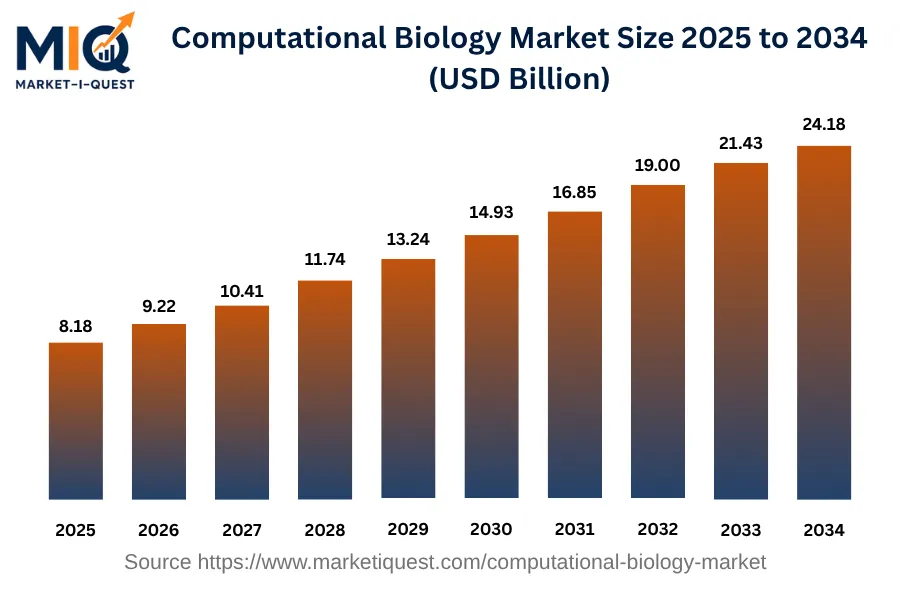
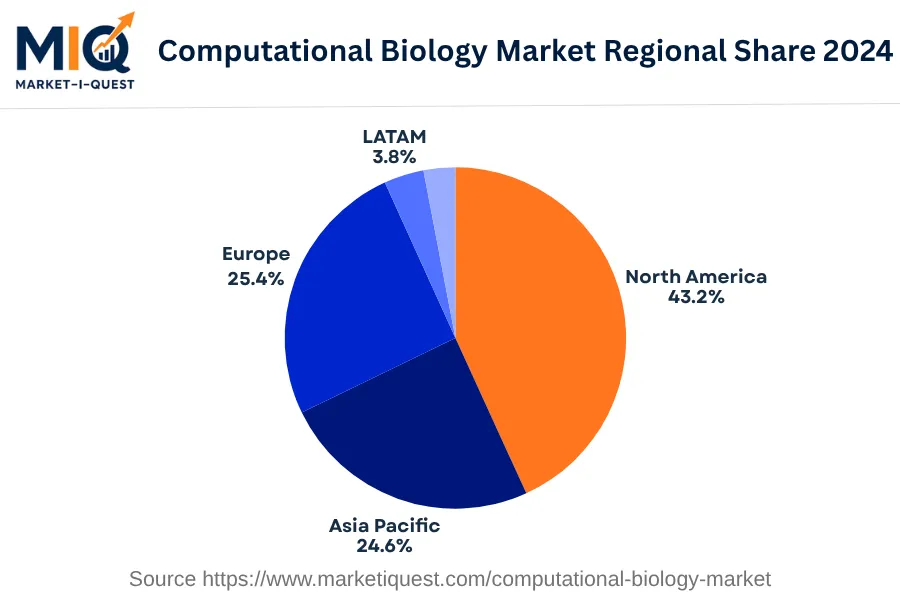
The Computational Biology Market size is projected to grow from 8.18 billion USD in 2025 to 24.18 billion USD by 2034, reflecting a CAGR of 12.8%. The market size in 2024 was 7.25 billion USD, witnessing an initial growth trajectory after that point. The healthy growth rate from 2025 to 2034 is accounted for by an increase in demand across various regions. On a regional basis in 2024, North America held the largest market share at 43.2%. Europe followed closely with a share of 25.4%, and the Asia Pacific comprised 24.6% of the Computational Biology market. Meanwhile, the regions of Latin America, the Middle East and Africa had smaller portions of the market, contributing merely 3.8% and 3.0% respectively. The marked regional differences demonstrated the varied acceptance and utilization of computational biology around the globe.

Key Takeaways

  • By Service - Infrastructure & Hardware Platforms led the market accounting for a dominant share in 2024.
  • By Application - Clinical Trials held a significant position in 2024.
  • By End Use - Industrial subsegment led market with an increasing share in 2024.
computational-biology-market market size

Key Driving Factors

Increased Implementation of Precision Medicine

One significant driver of the Computational Biology Market is the growing implementation of precision medicine across the healthcare industry. Precision medicine involves tailoring treatments to individual patients based on their genetic, environmental, and lifestyle factors. To accurately model and predict patient-specific treatments, vast amounts of multilayered data need to be processed and analyzed, a task that requires application of computational biology. By assembling detailed biological characteristics through computational biology, physicians and researchers can develop more targeted and effective treatment plans. This patient-specific approach is rapidly replacing traditional one-size-fits-all method in healthcare, creating a substantial demand for computational biology tools.
Intensified Drug Discovery and Development Process

Another crucial driving factor for the Computational Biology Market is the intensified drug discovery and development process across pharma industry. This expedited process is necessitated by urgent need to confront emergent diseases and health crises, like COVID-19 pandemic. Computational biology enables researchers to simulate and analyze complex biological systems, leading to accelerated discovery of potential therapeutic targets and drug candidates. By implementing computational biology, pharmaceutical companies can increase efficiency on multiple fronts, including reducing experimental costs and speeding time to market new drugs. This application of computational biology has become an essential strategic leverage in the ever-competitive pharmaceutical industry.

Market Evolution by Timeline

2019-2023
During 2019-2023, academic institutions and pharmaceutical companies, primarily in the U.S., Western Europe, and East Asia, drove demand for computational biology, seeking to expedite drug discovery and optimize genomics research. Meanwhile, vendors primarily shipped gene sequencing software and predictive modeling tools, with integration still maturing. The General Data Protection Regulation (GDPR) in Europe provided a compliance framework, impacting data usage. Flat-rate pricing models dominated over pay-per-use due to consistent need for computation. Risks stemmed from capacity constraints due to rising data volumes and significant resources needed for data storage and computation.
2024
In 2024, demand expanded to include healthcare providers in the U.S. and Western Europe, interested in precision medicine applications. Cloud-based software solutions gained popularity, reducing reliance on on-premises servers. In response to expanding use-cases, vendors began piloting AI and Machine Learning tools. No significant changes in regulations occurred in this year. Pricing increasingly incorporated value-based models reflecting expanded use-cases. Risks in this period revolved around the need to manage vast amounts of data securely and efficiently.
2025-2029
From 2025 to 2029, increasing interest from agritech, primarily in North America and Brazil, introduced new demand. Technology development focused on cloud-based, AI and ML-powered predictive modeling and simulation tools. FDA's endorsement of certain tools for more accurate clinical trials influenced adoption rates. Hybrid pricing models, combining flat-rates and use-based components became common. The main risk addressed was lack of sufficiently trained professionals, creating partnerships with academic institutions for better knowledge transfer.
2030-2034
Between 2030-2034, rising demand among biotech startups, especially in China and India, accelerated market dynamics. Mature cloud-based AI and ML tools for predictive modeling, with drug discovery platforms, offered state-of-the-art technology. Revisions to GDPR and introduction of China's Personal Information Protection Law potentially influenced data processing practices. A combination of subscription and transaction-based pricing models emerged. Risks presented centered around maintaining global data security standards and compliance with evolving regulations in various regions.

Future Market Outlook

Future Opportunities

As computational biology continues to evolve, several future opportunities are emerging that could shape its trajectory. The growing footprint of digital health ecosystem, marked by the 2023 collaboration between Google Health and the American Medical Association, lays the groundwork for improved computational approaches in patient care. Positioning firms to leverage artificial intelligence in diagnostics could yield significant breakthroughs, especially as regulatory acceptance of AI-based solutions increases, illustrated by the FDA's approval of several AI algorithms for medical imaging in 2022. Moreover, the rising prevalence of chronic diseases emphasizes need for innovative computational methods in drug discovery, as evidenced by Pfizer’s investment in AI-driven platforms for drug development announced in 2023. The integration of wearable health devices, like Apple Watch, into preventative healthcare models opens avenues for real-time data analysis, further driving computational biology applications. Furthermore, the focus on equitable health outcomes, underscored by the World Health Organization’s initiatives since 2021, promotes research into bioinformatics tools addressing health disparities. Emerging partnerships between tech firms and academic institutions are encouraging multidisciplinary collaborations that utilize computational biology to tackle complex health issues. In summary, the alignment of regulatory frameworks, technological advancements, and strategic collaborations presents substantial opportunities within the computational biology market, paving way for significant innovations in healthcare delivery and disease management.

Segmentation Analysis

By Service

The market is divided into subsegments including Databases, Infrastructure & Hardware, and Software Platforms. Infrastructure & Hardware accounted for the largest revenue share, while Databases is expected to grow at the fastest CAGR during the forecast period.

Largest Revenue Share

Infrastructure & Hardware

Market Share Leader

Infrastructure & Hardware indisputably secure the highest revenue in the market based on our industry's understanding. Central to the technology and digital revolution, this subsegment's growth can be attributed to the perpetual need for modern and efficient hardware within organizations to handle the massive data influx. As businesses globally transition towards digital practices, the demand for reliable infrastructure and state-of-the-art hardware rises analogously. Geographic regions with strong tech landscape and high digital competitiveness, like North America and Asia-Pacific, are major contributors to this subsegment's revenue. Regulatory compliances on data handling further necessitate robust hardware infrastructures, adding a layer of demand. The customer purchasing criteria often pivot around factors like data capacity, security, speed, and scalability where hardware plays a vital role. High switching costs as well as established procurement channels further stabilize the revenue of this subsegment. All factors considered, it's safe to assume Infrastructure & Hardware to continue reigning in terms of revenue generation.

Fastest CAGR

Databases

Forecast Period Growth Leader

However, for the fastest growing subsegment, Databases assume the position. As businesses are becoming data-driven, databases' significance as the backbone of modern business operations continues to rise. Growth drivers for the Databases subsegment are largely technological advancements that can handle vast data volumes and deliver real-time, actionable insights. The shift towards cloud databases also spurs growth, thanks to cost-effectiveness, scalability, and improved performance. Furthermore, partnerships between database service providers and tech giants are a catalyst, fostering more intuitive, efficient solutions. Near-term risks to the growth trajectory include adoption barriers like data security concerns and scaling issues that could stutter growth. However, given the sheer potential data harnessing brings and firms investing in next-gen database capabilities, the growth rate of the Databases subsegment approximates a substantial acceleration.

By Application

The market is divided into subsegments including Drug Discovery & Disease Modelling, Preclinical Drug Development, Clinical Trials, Computational Genomics, Computational Proteomics, and Others. In 2024, the Clinical Trials subsegment accounted for the largest revenue share, while Computational Genomics is expected to grow at the fastest CAGR during the forecast period.

Largest Revenue Share

Clinical Trials

Market Share Leader

The Clinical Trials subsegment plays a crucial role in bringing a new drug to the market, thus, generating significant revenue within the sector. The process involves extensive testing and validation stages which contribute to its dominant share in the market revenue. Given the sheer number of candidate-drugs in the trial stage and the cost associated with these trials, the revenue generated is substantial. Additionally, regulatory mandates oblige companies to undertake clinical trials, further driving the subsegment's revenue. These exhaustive trials are conducted across diverse geographies due to the need for varied genetic makeup for these experiments. This global outreach lends further scope for high revenue generation. Lastly, outsourcing clinical trials to contract research organizations (CROs) is a growing trend, boosting the subsegment's financial foothold even further.

Fastest CAGR

Computational Genomics

Forecast Period Growth Leader

Computational Genomics is expected to record the fastest growth in the coming years. The leap in technology has served as a considerable catalyst for this progress. Greater computing power and more advanced algorithms now allow large genomic datasets to be analyzed more quickly and accurately. This breakthrough has huge implications in both, diagnosis and drug development, thereby encouraging broader adoption of computational genomics. Moreover, pharmaceutical companies and research institutions are increasingly forging partnerships to leverage this technology, further propelling its growth. However, near-term risks for this quick-paced growth include the high capital expenditure on advanced technology and potential concerns about patient data privacy. Despite these hurdles, Compact Genomics holds much promise and is poised to revolutionize the field with its potential applications.

By End Use

The market is divided into sub-segments including Academic & Research and Industrial. In 2024, the Industrial sub-segment commands the largest revenue share, while the Academic & Research sub-segment is expected to grow at the fastest CAGR during the forecast period.

Largest Revenue Share

Industrial

Market Share Leader

The Industrial sub-segment dominates by revenue in the market, underpinned by a robust global industrial sector which necessitates advanced, reliable, and high-capacity data solutions. An expanding base of industrial customers including manufacturing, construction, and energy industries, strongly drive the demand. These sectors have seen a surge in large-scale implementation of connected technologies and digitalization, lending support to the sector's growth. Further fuelling this sub-segment's growth is the demand from developing economies where industrial sectors are rapidly expanding as they move towards modernization and digital transformation. Regulatory factors also place a crucial role, as stricter regulations regarding data storage and management in critical industries create a stable revenue stream for the segment. A low switching cost due to the availability of multiple vendors and standardized solutions enhances the sector's growth potential. Robust distribution channels, often involving partnerships with local companies in different regions, help to reach a wider customer base, further establishing this sub-segment's dominance.

Fastest CAGR

Academic & Research

Forecast Period Growth Leader

The Academic & Research sub-segment is on a fast-paced growth trajectory, buoyed by the increasing need for innovative data solutions in research and academic institutions worldwide. A significant catalyst for this growth is the rise of research-oriented digital transformation in academia, driven by the need for efficient research data management. These institutions often face challenges in the form of adoption barriers such as budgetary constraints, lack of skill, and infrastructural inadequacies. However, technological advancements, investment in IT infrastructure, and strategic partnerships with data solution providers serve to alleviate these challenges and accelerate adoption. The emergence of new technologies and increasing research activities in fields like genomics, advanced computing, and quantum research present near-term opportunities for growth. However, risks such as cybersecurity threats and regulatory compliance related to data privacy and ethical use can prove to be hurdles.

Competitive Analysis: Computational Biology Market

Key Market Players

Manufacturers / OEMs

Certara, Inc.
US
Terrain Biomedical
US
Dassault Systèmes
France

Key Suppliers & Raw Materials

MathWorks, Inc.
US
Intel Corporation
US
Hewlett Packard Enterprise (HPE)
US

Distributors, Integrators & Channel Partners

IBM Corporation
US
Oracle Corporation
US
Cisco Systems, Inc.
US

Porter’s Five Forces Analysis

Analysis of the key factors affecting competition in the Computational Biology Market.

Supplier Bargaining Power

Medium

Dominance of a few suppliers providing specialized software and hardware inflates their bargaining power.

Buyer Bargaining Power

High

High number of software providers gives buyers more choice and greater bargaining power.

Threat of Substitutes

Low

Advanced functionalities of computational biology tools limit the threat of substitutes.

Threat of New Entrants

High

Low entry barriers and high demand for computational solutions attracts new entrants.

Competitive Rivalry

High

Strong competition among present players due to constant technological advancements.

Regional Analysis

Geographic market dynamics and growth opportunities across key regions

Global Market Outlook

computational-biology-market market regional share

North America

In 2024, North America's Computational Biology Market was dynamic and rapidly evolving, shaped by technological advancements and demand across various sectors. Fueling the market was robust investment in life sciences R&D, especially in the United States, alongside healthcare providers' increasing use of computational biology to enhance precision in diagnosis and treatment. The availability of high-performance computing resources, particularly in Canada, accelerated the adoption of complex computational biology solutions in genomics research.

Concurrently, expanding bioinformatics education, notably in Mexico, enabled a strong talent pipeline that further boosted the market. Pricing dynamics saw an emphasis on value-based costing, with computational modeling solutions being assessed for their potential impact on patient outcomes and research efficacy.

Digital transformation trends played a key role in shaping the market. Enterprises embraced cloud-based computational biology services to facilitate elasticity in IT infrastructure and drive cost efficiencies, while partnerships and M&A activity flourished, such as the acquisition of bioinformatics companies by leading pharmaceutical corporations. Regulatory enforcement around data privacy in patient-related computational biology solutions also emerged as a crucial trend. The use of artificial intelligence and machine learning in computational biology significantly grew across sectors like healthcare, pharmaceutical, and academic research, leading to a surge in demand for AI-integrated computational biology solutions. Thus, the North American Computational Biology market in 2024 was positioned at the intersection of digital innovation and pressing healthcare demands.

Asia Pacific

In 2024, the Computational Biology Market in Asia Pacific was determined by a confluence of demand factors, technological advancements, and regulatory developments. Market drivers included increased investment in biotechnology R&D, particularly in China and India. Rapid advancements in parallel computing and bioinformatics tools facilitated research and drug discovery, further driving demand. Regulatory support, particularly in Japan and South Korea, incentivized increased adoption of computational biology in healthcare and pharmaceutical sectors.

Trends observed in 2024 included the increasing adoption of cloud-based solutions by computational biology service providers which offered scalability and cost-effectiveness. There was a shift in customer preference towards solutions incorporating Machine Learning and Artificial Intelligence. This was particularly evident in the pharmaceutical sector where computational models expedited drug discovery processes. Strategic partnerships, such as between biopharmaceutical companies and bioinformatics service providers, were observed in Australia and key ASEAN markets. Lastly, policy enforcement related to patient data privacy and standardization was noted, particularly in more mature markets such as Australia and Japan. These rules influenced the design and implementation of computational biology solutions, shaping customer-provider relationships and market dynamics within this field.

Europe

In 2024, Europe's Computational Biology Market experienced notable activity due to demand factors, regulations, and investment. A growing demand for personalized medicine, particularly in countries like the UK and Germany, fueled the adoption of computational biology in healthcare, driving the market. Strict regulations, especially in the Nordic countries and Benelux, propelled enterprises to incorporate computational biology for compliance. Moreover, significant capital investment from government bodies in France, Italy, and Central & Eastern Europe provided a sturdy foundation for technology adoption.

Distinct trends shaped the market landscape: rapid digitalization within healthcare and government sectors sparked partnerships and M&A activity amongst computational biology companies. Present was a marked tech shift towards data-driven decision making, especially prevalent within manufacturing and retail sectors in Germany and the UK. Online channels gained momentum for the buying and selling of computational biology services in France and Central & Eastern Europe. The policy enforcement for standardization of technologies also started gaining traction, with the aim to facilitate interoperability between different systems, as seen in Spain and Italy. Demand for computational biology offerings thus increased across sectors in Europe, driven by the need for precise medical solutions, regulatory compliance, significant capital investments, and the rise of digital channels for transaction.

Latin America

In 2024, the Computational Biology Market in Latin America demonstrated significant growth, particularly in Brazil, Mexico, Argentina, Colombia, Chile, and Peru. This expansion was principally driven by an increasing demand for predictive modeling and complex bioinformatics analysis across sectors - explicitly pharmaceutical industries and academic research institutions. A notable upsurge in investments in bio-tech startups and companies influenced the market dynamics significantly. Heightened interest and adoption of advanced tech platforms for genomic and proteomic function analyses were also observed, bolstering market growth. Simultaneously, the addition of computational biology into national research policies, particularly in countries like Brazil and Chile, instilled an environment promoting the discipline's growth. The trend of government-backed initiatives fostering bioinformatics collaborations increased, evident in partnerships such as Mexico's 'Unidad de Genómica Avanzada' and Argentina's 'INDEAR.'

On the other hand, buyer behavior shifted towards outsourcing computational biology solutions, responsible for an increased demand for data analysis services in the healthcare segment. The ongoing adoption of cloud-based solutions accelerated, particularly within the pharmaceutical sector, owing to the need for secure large-scale data storage. There was also a considerable rise in M&A activity to leverage these innovative solutions and assure market expansion, conspicuously seen in Chile and Peru. The set standards of data privacy regulations enforced across the region further shaped the market's operational modus.

Middle East & Africa

In 2024, the Computational Biology Market exhibited significant growth across the Middle East and Africa, driven by mounting healthcare demands and technological advancements. Increased investment in healthcare technology, particularly in Saudi Arabia, South Africa, and Israel, fueled substantial market development. Adoption of computational biology in Nigeria and Kenya, due to regulatory encouragement promoting local pharma and biotech sectors, also positively influenced the market.

A shift towards digitization and integration of AI in healthcare was a compelling trend within the market. Several partnerships and M&As, predominantly within the UAE and Qatar, boosted computational biology product offerings and consumer reach. Additionally, increased usage in oil and gas sectors in Saudi Arabia and the United Arab Emirates reshaped the market dynamics. Implementation in these sectors was primarily for predicting reservoir performance and optimizing oil extraction processes.

Increased usage by the government, particularly in South Africa and Israel, amplified market demand, determined predominantly for disease modeling and drug discovery. In Egypt, the trend towards precision medicine led to the adoption of computational biology in the healthcare sector. Additionally, telecom companies in the region incorporated computational biology to enhance their network performance, impacting the overall market landscape. In conclusion, both demand forces and technological innovation shaped the computational biology market in the Middle East and Africa in 2024.

Recent Industry Developments

Latest market innovations, product launches, and strategic initiatives

April 2026

Benchling launched a new software feature called AI Connectors. This update links a laboratory's scientific data directly with enterprise artificial intelligence systems, allowing AI programs to instantly read and analyze a company's complete history of experiments.

April 2026

Illumina released the DRAGEN v4.5 software system. This is a major update designed to significantly improve how fast and accurately computers can map and analyze large sets of human genetic data, which researchers use to study diseases.

December 2025

The institute released a software tool called RFdiffusion3. This open-source program allows scientists to design new, custom proteins on a computer roughly ten times faster than previous versions, simplifying a process that used to require multiple different programs.

Frequently Asked Questions