Genomics Market Snapshot

Key Players

  • Illumina Inc. (US)
  • 10X Genomics (US)
  • Thermo Fisher Scientific (US)
  • Oxford Nanopore Technologies (UK)
  • BGI Genomics (China)
  • QIAGEN (Germany)
  • Agilent Technologies (US)
  • Biocartis NV. (Belgium)
  • F. Hoffmann-La Roche Ltd. (Switzerland)

Market Size

Base Year 2024
$42.95 Bn
CAGR
14.95%
Forecast 2034
$173.00 Bn

Market Segments

By Technology
  • Sequencing
  • Microarray
  • PCR
  • CRISPR
By Application
  • Drug Discovery
  • Clinical Diagnostics
  • Personalized Medicine
  • Genetic Testing
By End Use
  • Hospitals
  • Diagnostic Laboratories
  • Research Institutes
  • Pharmaceutical Companies

Market Dynamics

Drivers
  • Increasing genomic research
  • Advancements in biotechnological methods
Restraints
  • High cost of genomics equipment
  • Regulatory and ethical challenges
Opportunities
  • Emerging economies
  • Advancements in technology

Market Size

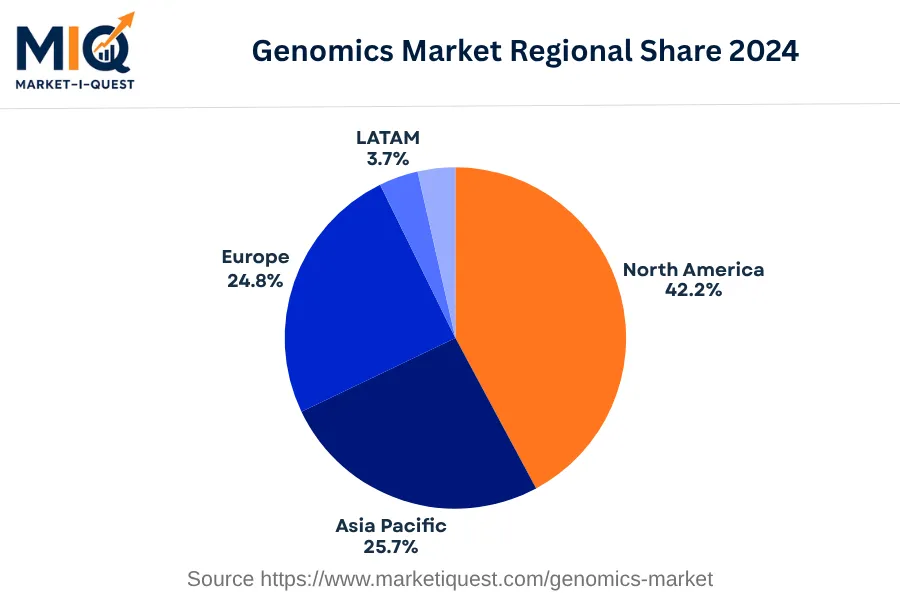
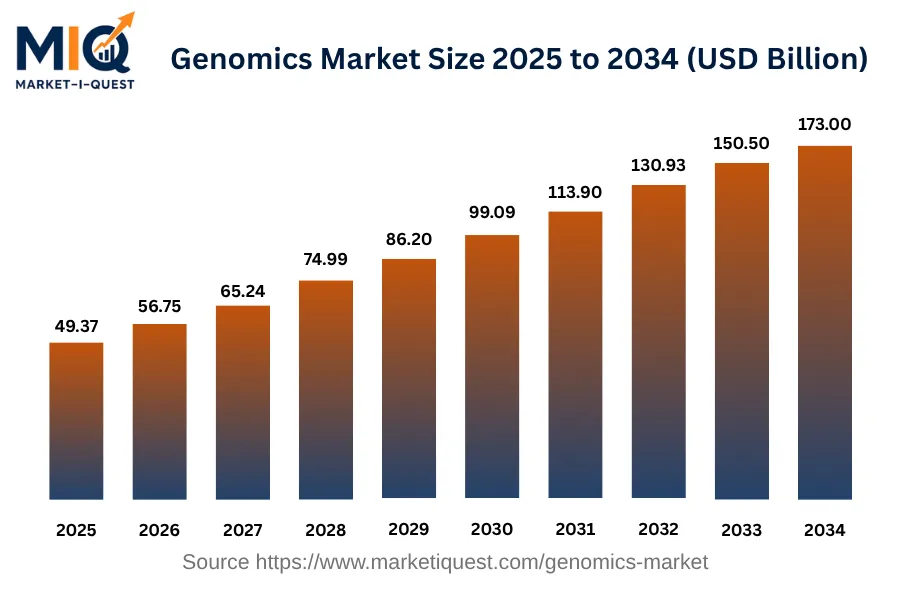
The genomics market is projected to grow noticeably from a size of $49.37 billion in 2025 to an impressive $173.00 billion by 2034, recording a steady compound annual growth rate (CAGR) of 14.95%. This market traces a consistent upward trajectory from its $42.95 billion valuation in 2024, demonstrating a solid expansion within a single decade. Underpinning this growth are advances in genomics technologies, a greater understanding of genetic variations, and an increased emphasis on personalized medicine and diagnostics. The regional market share in 2024 is segmented with North America leading at a substantial 42.2%, trailed by Asia Pacific at 25.7% and Europe at 24.8% of the market size. The remaining regions of Latin America and the Middle East and Africa hold a smaller proportion of the genomics market, contributing 3.7% and 3.6%, respectively. This data indicates a clear dominance of the established markets of North America and Europe, with Asia Pacific showing competitive promise.

Key Takeaways

  • By Technology - Sequencing held the largest market share in the Genomics Market.
  • By Application - Personalized Medicine was the leading segment in the Genomics Market.
  • By End Use - Hospitals outpaced other segments in terms of growth in the Genomics Market.
genomics-market market size

Key Driving Factors

Precision Medicine Initiatives

Precision medicine, whereby individual genetic profiles are used to diagnose and tailor treatments to patients, is becoming a dominant approach in modern healthcare systems. Governments and health organizations globally are endorsing initiatives to implement precision medicine, which is fundamentally hinged on genomics. For example, the U.S. NIH's 'All of Us' research program aims to gather genetic data from one million individuals to enable more tailored healthcare solutions. This broad-scale application of genomics is leading to increased demand for genomics products and services, pushing growth in the genomics market.

Integration of AI and Machine Learning in Genomics

The complexity and volume of genomic data present a significant challenge for analysis and interpretation. To overcome this, there is a growing trend of incorporating artificial intelligence (AI) and machine learning technologies into genomics. These technologies can analyze enormous genomic datasets more efficiently and accurately, revealing valuable insights for research and patient care. As a result, academic institutions, pharmaceutical companies, and biotechnology firms are increasingly employing these technologies, escalating the adoption and spending in the genomics market.

Market Evolution by Timeline

2019-2023
During this phase, increased demand was observed among healthcare institutions and research centers, dominating North America due to heightened activities in gene therapy and cancer research. Major players supplying genomics products were Illumina, GenScript, and Thermo Fisher Scientific, who released new sequencing technologies, ramping up the accuracy and speed of diagnosis. Regulatory environments saw developments such as FDA's launch of programs like the New Era of Smarter Food Safety focusing on traceability. Project-based pricing was prevalent, with partnerships stressing IP rights. Yet, interoperability between different technology platforms remained a constraint, causing providers to bolster their informatics capabilities.
2024
In 2024, genomics reached a wider audience, with more adoption among government bodies for public health monitoring and disease prevention due to the pandemic fight experience. Suppliers began integrating artificial intelligence, improving interpretation capabilities of complex genomic data. The genetic information generated triggered data privacy concerns with EU countries starting to enforce stricter General Data Protection Regulation (GDPR) requirements on genomic data. Manufacturers adopted bundle pricing for complete genomics solutions. Despite advancements, the high-cost of sequencing machinery remains a deterrent, pushing suppliers towards cheaper sequencing alternatives.
2025-2029
Demand surged from private sector companies, predominantly in biopharma, agriculture, and personalized nutrition, who see genomics as key to product innovation. The Asia-Pacific region proved lucrative, fuelled by investments in forensic science and plant genomics. Liquid biopsy's emergence sketched a significant chapter, bringing cancer diagnosis closer to patients. GDPR compliance became mandatory for genomics firms, reflecting increased importance of data privacy. Annual subscription models gained popularity catering to companies using genomics services repetitively. The risk of inaccurate sequencing led to stronger quality assurance practices within supplier firms.
2030-2034
This period reflected an uptick in consumer engagement in genomics, driven by genomic-based fitness and wellness platforms. Africa showed noticeable market expansion, underpinned by strategies aimed at combating genetic diseases. The launch of handheld sequencing machines like Oxford Nanopore's MinION made sequencing more accessible. A standard for data exchange emerged - GA4GH Genomic Data Toolkit, easing data-sharing between institutions. Pay-per-use commercial models began to make headway. Sustainable procurement started featuring in contracts. The major risk remained data security, leading firms to invest more in cybersecurity protocols and frameworks.

Future Market Outlook

Future Opportunities

The genomics market presents myriad opportunities driven by ongoing technological advancements and regulatory changes. With the establishment of the U.S. National Institutes of Health's All of Us program, launched in 2018, there is potential for developing more inclusive genetic databases that can cater to diverse populations. This initiative enhances personalized medicine by ensuring that genomic data reflects various ethnic and demographic groups, thus reducing health disparities. Collaborations between pharmaceutical companies and genomic research organizations are on the rise, evidenced by the partnership between Moderna and the National Institute of Allergy and Infectious Diseases in 2023, aimed at enhancing RNA therapeutics informed by genomic data. The continued push for direct-to-consumer genetic testing services is expanding, as companies like MyHeritage began offering advanced DNA analysis tools in 2020, appealing to broader audiences. The implementation of GDPR in Europe has established stringent data protection regulations, creating opportunities for companies specializing in genomic data security and privacy solutions. As industries adopt AI technologies to analyze genomic data, companies are exploring applications in drug discovery, with firms like BenevolentAI leveraging artificial intelligence to identify novel therapeutics. Internationally, countries such as Japan are investing heavily in genomics research within their healthcare systems, further solidifying the pathway for growth in personalized medicine and public health strategies. These factors highlight a dynamic and evolving landscape ripe for exploration and investment in the genomics space.

Segmentation Analysis

By Technology

The market is divided into subsegments including Sequencing, Microarray, PCR, and CRISPR, of which Sequencing accounted for the largest revenue share while CRISPR is expected to grow at the fastest CAGR during the forecast period.

Largest Revenue Share

Sequencing

Market Share Leader

Sequencing has emerged as a dominant technology in the market, underpinned by its wide usage in various applications such as genomic research, cancer studies, and clinical diagnostic testing. This technology holds a substantial market share, partly due to its adaptability and scalability, allowing labs to sequence a wide array of samples with high precision and speed. Leveraging its customer base, comprised mainly of biopharmaceutical companies and research institutions, Sequencing has been able to generate significant revenue. Geographic locations with a high concentration of these entities, like North America and Europe, contribute heavily to its largest revenue share. Favorable regulatory environment promoting genomic research and advancements in sequencing technologies have also played a role. Purchasing decisions are largely driven by factors like accuracy, cost-effectiveness, and operational efficiency, areas in which Sequencing technology excels. Its robust distribution channels further solidify Sequencing’s market foothold.

Fastest CAGR

CRISPR

Forecast Period Growth Leader

CRISPR, however, is projected to register the fastest CAGR in the coming years. This technology's ascent revolves around its potential to revolutionize industries from agriculture to pharmaceuticals through gene editing capabilities. It offers precise and cost-effective genomic manipulation, which has been a catalyst for growing acceptance and subsequent demand. However, despite its potential, CRISPR faces adoption barriers such as ethical concerns and regulatory hurdles surrounding gene editing technologies. Yet, key growth drivers include advancements in technology, increased investment, and strategic partnerships between gene-editing companies and pharmaceutical firms. Additionally, policy reforms, particularly in areas of unmet medical need, could further accelerate adoption. However, the potential risk that CRISPR faces in the foreseeable future includes the emergence of alternative gene editing technologies and potential regulatory tightening, both of which could impede its otherwise frantic growth trajectory.

By Application

The market is divided into subsegments including Drug Discovery, Clinical Diagnostics, Personalized Medicine, and Genetic Testing. Of these, Personalized Medicine accounted for the largest revenue share while Genetic Testing is expected to grow at the fastest CAGR during the forecast period.

Largest Revenue Share

Personalized Medicine

Market Share Leader

The Personalized Medicine segment commands the highest revenue in the application market primarily due to the growing demand for precision medical care. The modern-day healthcare scenario mandates an increasing requirement for bespoke treatments and therapies which factor in individual patient health history, genetics, and lifestyle. This level of personalization necessitates not only a high degree of technological sophistication, often involving genomics and specialized diagnostic techniques, but also significant investments in R&D. Geographically, North America and Europe, boasting advanced healthcare infrastructure, account for a significant share of the revenue given the higher purchasing power and greater awareness among patients. Furthermore, stringent regulatory requirements in those regions encourage medical practices to adopt personalized medicine. Switching costs are high as personalized therapy requires a significant paradigm shift from conventional broad-spectrum treatment methods. Channels include direct sales to healthcare institutions, via healthcare professionals, and even direct to consumers in certain allowed diagnostic areas.

Fastest CAGR

Genetic Testing

Forecast Period Growth Leader

Genetic Testing is tacitly becoming the subsegment displaying the fastest growth within the application market. This is primarily driven by technological advancements that have significantly reduced the cost of genetic testing, making it accessible to a wider population. Developments in the field of genetics are providing physicians with more tools to diagnose and predict disease, enhancing medical decision-making processes. Genetic testing bears the potential to fundamentally change preventative care and disease treatment, with the growing emphasis on precision medicine acting as a catalyst. Near-term risks include potential regulatory changes and ethical considerations surrounding genetic data privacy. The barriers to adoption often involve the lack of clear regulatory guidance in emerging markets and infrastructural limitations in healthcare settings in some parts of the world. Nevertheless, partnerships between genetics companies and research institutions, along with government initiatives in healthcare, are driving the adoption of genetic testing.

By End Use

The market is divided into subsegments including hospitals, diagnostic laboratories, research institutes, and pharmaceutical companies. In 2024, hospitals accounted for the largest revenue share while pharmaceutical companies are expected to grow at the fastest CAGR during the forecast period.

Largest Revenue Share

Hospitals

Market Share Leader

The hospital subsegment reported the highest revenue in 2024, primarily propelled by the steady patient influx needing clinical care and the diverse range of services these institutions offer. Hospitals form the central hub of health care, dealing with a broad spectrum of diseases and conditions requiring various testing and treatment options. Consequently, their need for various products and services from the market stands relatively high. Regulation also plays a crucial role, as many countries have policies for mandatory hospitalization for specific conditions or surgical procedures. Geographically, developed regions with well-established healthcare infrastructure contribute significantly to demand. Additionally, hospitals generally maintain long-term relationships with their suppliers, creating certain switching costs making this subsegment particularly attractive for incumbent players.

Fastest CAGR

Pharmaceutical Companies

Forecast Period Growth Leader

The pharmaceutical companies are projected to register the fastest growth rate. This is largely attributable to the increased demand for rapid drug development and therapeutics based on the rising prevalence of various chronic diseases globally. Pharmaceutical companies' growth is heavily influenced by technological advancements which significantly streamline drug discovery and testing processes, making activities more efficient and cost-effective. Companies are making significant investments in research and development, stimulating market growth further. Partnerships and collaborations with diagnostic labs and research institutes also enhance the reach and capabilities of pharmaceutical companies. However, stringent regulations on drug development and approval can act as a barrier to this subsegment's growth. In the near term, the impact of international trade policies and possible supply chain disruptions represent notable risks.

Competitive Analysis: Genomics Market

Key Market Players

Manufacturers / OEMs

Illumina, Inc.
US
Thermo Fisher Scientific Inc.
US
Agilent Technologies
US

Key Suppliers & Raw Materials

Merck KGaA
Germany
F. Hoffmann-La Roche Ltd
Switzerland
QIAGEN
Netherlands

Distributors, Integrators & Channel Partners

Danaher Corporation
US
Bio-Rad Laboratories, Inc.
US
PerkinElmer Inc.
US

Porter’s Five Forces Analysis

A strategic insight into the competitive dynamics shaping the Genomics Market.

Supplier Bargaining Power

Medium

Suppliers influence price due to the need for high-quality genomic components.

Buyer Bargaining Power

Low

Buyers have limited power due to specialized nature and lack of substitutes for genomic services.

Threat of Substitutes

Low

Low substitution threat due to unique capabilities and specificity of genomics technology.

Threat of New Entrants

Medium

Advancements in technology and increasing healthcare investments are allowing more startups to emerge.

Competitive Rivalry

High

Intense rivalry due to market consolidation and the race for innovative genomic solutions.

Regional Analysis

Geographic market dynamics and growth opportunities across key regions

Global Market Outlook

genomics-market market regional share

North America

In 2024, the North American Genomics market witnessed robust growth driven by significant advancements in genomic research, especially in the United States, Canada, and Mexico. High demand for personalized medicine coupled with increased funding by governmental bodies in both healthcare and academia fueled market expansion. Regulatory authorities such the U.S. Food and Drug Administration accelerated the adoption of genomics by endorsing innovative molecular diagnostic tests. Additionally, technological developments, namely next-generation sequencing, fueled by investment from biotech enterprises, positively impacted supply dynamics.

Customer needs gravitated towards predictive customer insights leading to a shift in buyer behavior, notably in the healthcare and retail sectors. Technology adoption highlighted the proliferation of Big Data analytics and AI to interpret genomic data, a shift mirrored across sectors, including healthcare and enterprise. The market saw an increase in partnerships and Mergers and Acquisitions (M&A), with a notable instance being the alliance between Illumina and Bristol Myers Squibb, aiming to develop companion diagnostics. Policy enforcement has additionally emphasized data privacy and security concerns surrounding genomic data, with HIPAA rules as a recognized standard in the United States. The cumulative impact of these dynamics signaled the progressive maturity of the North American genomics market in 2024.

Asia Pacific

In 2024, the Genomics market in the Asia Pacific region displayed prominent growth, shaped primarily by extensive investment, regulatory changes, technology uptake, and robust demand from diverse sectors. Significant impetus was found in government regulation and public investment, such as China's initiatives promoting genetic research and India’s increased funding for genomics-based biomedical research. Additionally, rising disease prevalence demanded advanced diagnostic techniques, thereby magnifying the demand for genomics fundamentally in healthcare sectors of Japan, South Korea, and Australia. Market trends indicated an accelerated adoption of next-generation sequencing technology across research institutions in China and prominent Australian universities, fuelling a shift towards advanced genomics. Meanwhile, in India and key ASEAN countries, partnerships and mergers became increasingly prevalent amongst local biotech firms and international genomics companies, broadening access to cutting-edge technologies.

Critically, the rise of personalized medicine, backed by policy enforcement, was a driving force for genome sequencing in the region's healthcare sector. Nevertheless, the most striking characteristic of 2024 was the rapid technology adoption across sectors beyond healthcare, including agriculture and livestock in countries like Japan and South Korea. The precision offered by genomic tools saw increased utilization in crop improvement and livestock health, providing a broader perspective of the market in 2024. Combined, these drivers and trends constituted a dynamic and advancing Genomics market across the Asia Pacific.

Europe

In 2024, the European genomics market presented wide-ranging advances expanding the healthcare and research sectors. Regulatory alignment bolstered by the EU's GDPR ensured data privacy while promoting public and private cross-border collaborations, notably the UK's Genomics England and Germany's Federal Ministry of Education and Research initiatives. Investments, prominently Sequoia Capital's backing of CRISPR technology, and the adoption of NGS platforms caused significant supply dynamics shifts. Prevailing trends included personalized medicine’s rise, with countries like France leading in precision medicine interventions. Furthermore, technological advancements, such as BioNTech’s mRNA technologies, reshaped genomics-based treatments, offering novel solutions to combat health crises. The increased partnership activities amongst academic institutions and life science enterprises, underscored by the alliance between Benelux's biopharma company Galapagos and Italy's Zambon, accelerated genomics research and its commercial application. The enforcement of GDPR and genomic data standards enabled trustworthy and ethical use of genetic information.

Primary market consumers encompassed healthcare institutions, biotechnology companies, pharmaceutical firms, academic research institutions, and government agencies. For instance, Spain's National Health System utilized genomic data in cancer and rare diseases research, while Nordic utilities companies invested in genomic solutions for bioenergy productions. As a result, the genomics sector permeated diverse industries across Europe, enhancing their capacities through cutting-edge genomic applications.

Latin America

In 2024, the Genomics Market in Latin America (LATAM) experienced dynamic growth driven by heightened demand and evolving technological capabilities. Brazil, Mexico, Argentina, Colombia, Chile, and Peru demonstrated significant strides in market participation. Key drivers in the market included increased investment in genomic research by the both public and private sectors, a process significantly alead by Brazil and Mexico. Technological adoption was spurred by innovative regulations in Argentina and Columbia encouraging genomic applications in the healthcare sector. Demand growth was borne out of a rising need for personalized medicine fueled by aging populations across countries like Peru and Chile. Prices were tending towards affordability due to the economy of scale realized through the LATAM-wide response to public health crises.

Substantial shifts were observed in buyer behavior, with an unprecedented leaning towards genomic products for predictive diagnostics. This given rise to partnerships and mergers between international and local genomic firms, particularly notable in the key markets of Brazil and Argentina. There was also discernible increased policy enforcement in the sectors of healthcare and manufacturing, pushing for standardization of genomically-informed solutions. LATAM governmental institutions, notably in Mexico and Colombia, have become significant customers to the genomics industry, investing in projects aimed at utilizing genomic solutions for public health and utilities. Overall, 2024 marked an influential year for the Genomics Market in LATAM.

Middle East & Africa

In 2024, the genomics market in the Middle East and Africa experienced steady growth, underpinned by increasing investments in healthcare infrastructure, technological adoption and implementation of advanced diagnostics, and growing demand for personalized medicine. Drivers included considerable healthcare spending and investment by governments, particularly in Saudi Arabia, United Arab Emirates, and Qatar, who have prioritized genomics amid broader healthcare modernization. Adoption of sequencing technologies increased noticeably in these nations. Likewise, robust growth in private and public investment propelled the genomics industry in Israel. Nigeria, South Africa, and Egypt saw a surge in demand, attributed to a growing middle class seeking improved diagnostics and targeted therapy.

Notable trends include a distinct shift towards personalized medicine and gene therapy, predominantly in hospitals and specialized healthcare institutions. Customers ranged from healthcare providers, pharmaceutical companies, to research institutions. Cross-border partnerships, particularly in research and development, further encouraged market expansion. For instance, Israel's collaboration with international pharmaceutical and tech companies for genomic data analysis. Regulations ensuring the protection of genomic data started taking center stage, notably with the promulgation of genetic data privacy laws by the national health departments of Saudi Arabia and UAE. Tech giants offering genomics services also marked a significant trend, impacting the supply dynamics in several countries. These advancements, combined with ongoing investment and stringent regulatory mechanisms, solidified the genomics market's adept footing in 2024.

Recent Industry Developments

Latest market innovations, product launches, and strategic initiatives

June 2026

10x Genomics acquired Proteintech Genomics, a division specializing in developing high-plex proteomic solutions for single-cell and spatial applications. The acquisition brings together 10x’s expertise in scalable single-cell and spatial biology platforms with Proteintech Genomics’ advanced protein detection capabilities.

June 2026

Regeneron Pharmaceuticals acquired substantially all assets of 23andMe for $256 million following a bankruptcy auction. The acquisition included 23andMe’s Personal Genome Service, Total Health and Research Services, and its Biobank, with Regeneron committing to comply with 23andMe’s privacy policies and applicable data protection laws.

Frequently Asked Questions