Genetic Testing Market Snapshot

Key Players

  • 23andMe (United States)
  • Illumina (United States)
  • MyHeritage (Israel)
  • QIAGEN (Germany)
  • BGI Genomics (China)
  • Gene By Gene (United States)
  • Quest Diagnostics (United States)
  • Eurofins Scientific (Luxembourg)
  • Genomic Health (United States)
  • Thermo Fisher Scientific (United States)

Market Size

Base Year 2024
$24.95 Bn
CAGR
11.29%
Forecast 2034
$72.72 Bn

Market Segments

By Technology
Next Generation Sequencing, Array Technology, PCR-Based Testing, FISH, Others
By Product
Consumables, Equipment, Software & Services
By Channel
Online, Offline
By End Use
Hospitals & Clinics, Diagnostic Laboratories, Others

Market Dynamics

Drivers
  • Rising awareness of personalized medicine
  • Technological advancements in genetic sequencing
Restraints
  • High regulatory scrutiny
  • Ethical and privacy concerns
Opportunities
  • Advancements in genomics research
  • Increasing health awareness

Market Size

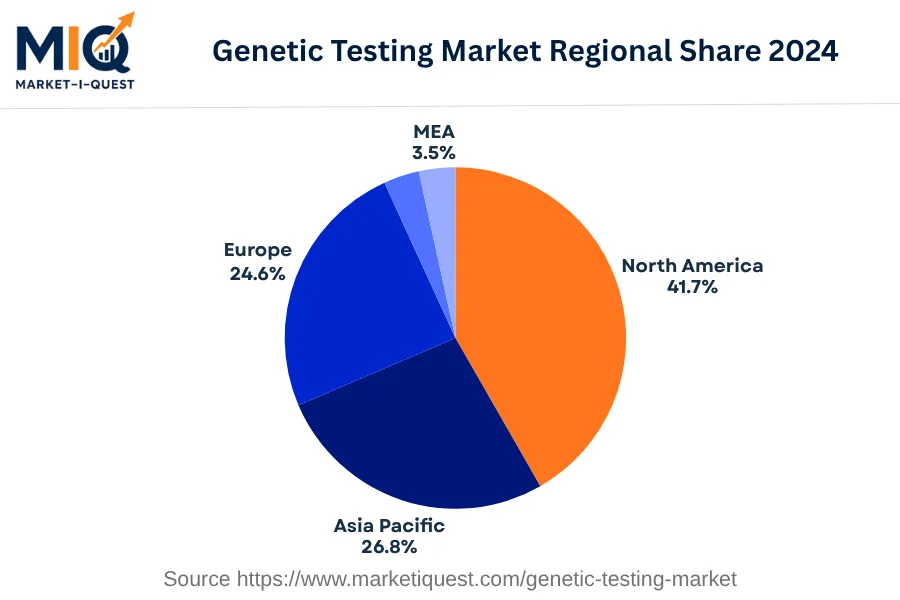
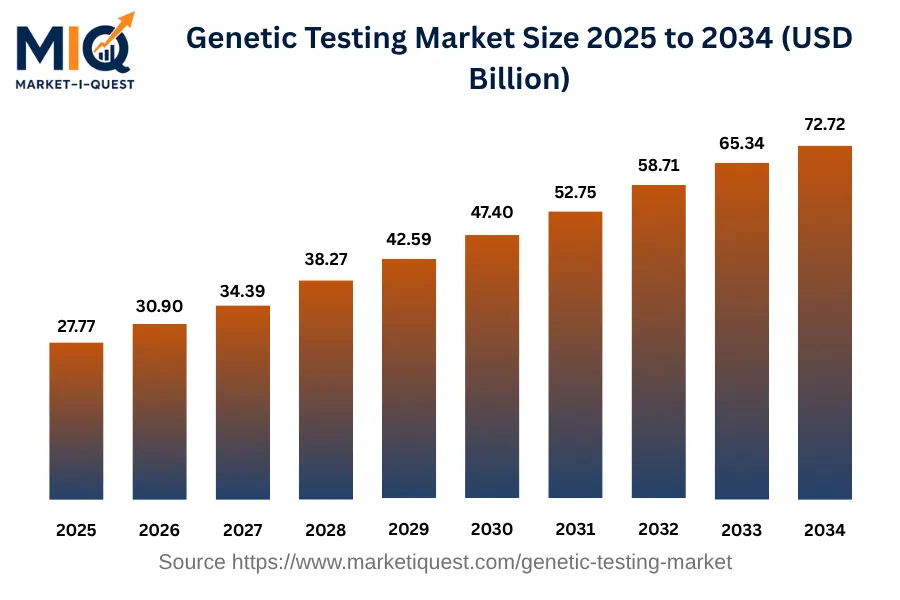
The Genetic Testing Market had a size of USD 27.77 Billion in 2025, which grew from USD 24.95 Billion in 2024. By 2034, the market size expanded to USD 72.72 Billion, demonstrating a CAGR of 11.29%. The market's growth path was consistently upward over this decade. Contributing factors to this growth included a steady rise in demand for genetic testing and continuous growth in technological advancements in this market. As of 2024, the regional share was: North America had 41.7% of the market share, followed by Asia Pacific with 26.8%. Europe made up 24.6%, while Latin America contributed 3.4% and Middle East and Africa had a 3.5% share.

Key Takeaways

  • By Technology - Next Generation Sequencing led with a significant market share in 2024.
  • By Product - Equipment held the top position accounting for a major percentage in 2024.
  • By Channel - Offline was the leading sales platform with the largest proportion of the market in 2024.
  • By End Use - Hospitals & Clinics accounted for the biggest share in 2024.
genetic-testing-market market size

Key Driving Factors

Surge in Personalized Medicine

In recent years, there's been a swift increase in the adoption of personalized medicine approaches, specifically in the field of oncology. This is because personalized medicine facilitates the development of targeted therapies, allowing providers to offer individual treatment plans based on a patient's unique genetic makeup. Genetic testing is the foundation of this approach, used to diagnose specific conditions, guide treatment decisions, and even assess patients' risks of developing certain diseases. As an instance, BRCA1 and BRCA2 mutation testing guide the clinician's decision for prostate cancer treatment, thereby personalized therapy design results in better patient outcomes. Therefore, the demand surge in personalized medicine is driving the genetic testing market globally.

Legislation Mandating Newborn Screening

Several countries have legislation in place mandating newborn screening for a specific set of diseases, which significantly drives demand in the genetic testing market. For instance, in the United States, newborn screening is mandated by law in all fifty states, though the list of diseases screened for can vary between states. Such tests range from screenings for conditions like cystic fibrosis to more rare and unusual disorders. Implementing these programs at a national level enhances early detection, allowing treatment for identified conditions to start immediately after birth, which can drastically impact the health trajectories of affected infants. Therefore, the implementation of newborn screening laws contributes significantly to the genetic testing market's growth.

Market Evolution by Timeline

2019-2023
In this period, Europe and North America led the demand for genetic testing for health risk prediction, early disease detection, or pregnancy screening. Supply-side collaboratives such as the All of Us Research Program in the US launched, offering large-scale genetic testing. Integration maturity remained a constraint, with tests not seamlessly flowing into routine clinic workflows. Regulatory bodies, such as the FDA in the US, expanded frameworks for the regulation of genetic health risk tests, fostering market adoption. Genetic testing was typically priced based on scope and complexity of the test. Partnerships, like those between LabCorp and 23andMe, facilitated direct-to-consumer marketing. Risks included incorrect or misinterpreted results and privacy concerns, managed through increased transparency and consent procedures.
2024
In 2024, Asian countries, led by China and India, showed an increase in demand for genetic testing, driven by an upsurge in awareness about genetic diseases. The integration of artificial intelligence in gene sequencing proliferated, speeding up genetic profiling. The European Union's Medical Device Regulation came into full effect, standardizing genetic test approval procedures across member states. Pricing of genetic testing saw an overall drop due to technological advancements, and commercial collaborations such as the one between Google and the Broad Institute facilitated data handling and interpretation. Data insecurity remained a prominent risk, and ongoing efforts for legislative revisions attempted to address this concern.
2025-2029
The demand for genetic testing extended to lifestyle improvements and fitness optimization, especially in developed regions. Companies such as Illumina and F. Hoffmann-La Roche Ltd extended their product lines, offering personalized genetic testing solutions. The Global Alliance for Genomics and Health's 'Framework for Responsible Sharing of Genomic and Health-Related Data' saw increased adoption, promoting data sharing whilst ensuring privacy. Genetic testing became more accessible through subscription models, with Babylon Health's digital health subscription as a model. Data breach remained a risk, mitigated by stricter regulatory standards and practices.
2030-2034
During this period, emerging economies in Africa are expected to contribute to the demand for genetic testing, particularly for infectious disease management. Innovation in gene editing technology, highlighted by CRISPR advancements, could alter the capabilities of genetic testing. The USD$215 Million 'Transformative Genetic Disease Testing' project launched by the Australian Genomics Health Alliance could establish new testing standards. Pricing could be impacted due to global initiatives for affordable healthcare, and companies like 23andMe and AncestryDNA would likely continue strategic partnerships for market share. Unauthorized access and misuse of genetic data remains a risk and calls for enhanced global regulation.

Future Market Outlook

Future Opportunities

The evolving landscape of genetic testing reveals multiple avenues for growth. A 2023 report from the National Institutes of Health highlighted the increased interest in pharmacogenomic testing, which tailors medications based on individual genetic profiles; this presents opportunities for healthcare providers to enhance patient care. With ongoing partnerships between pharmaceutical companies and genetic testing labs, such as the collaboration between Roche and Myriad Genetics established in 2022, there is a clear path for integrating genetic testing into drug development pipelines. Additionally, government initiatives aimed at recognizing and regulating genetic testing are gaining traction globally. For instance, in November 2023, Australia announced new funding for genetic research as part of its health strategy, spotlighting opportunities for local startups to engage in genetic innovations. The expansion of telemedicine also presents a substantial opportunity; remote consultations increase the reach of genetic testing services in underserved regions, a strategy already being implemented by firms like Invitae. Additionally, as awareness of hereditary diseases continues to grow, public health campaigns advocating for genetic screenings are likely to bolster demand. Consequently, collaborations between technology firms and healthcare providers can optimize test utilization, highlighting the intersection of technology and personalized medicine as a significant future opportunity in the genetic testing realm.

Segmentation Analysis

By Technology

The market is divided into subsegments including Next Generation Sequencing, Array Technology, PCR-Based Testing, FISH, and others, with Next Generation Sequencing accounting for the largest revenue share, while PCR-Based Testing is expected to grow at the fastest CAGR during the forecast period.

Largest Revenue Share

Next Generation Sequencing

Market Share Leader

Next Generation Sequencing (NGS) dominates in revenue terms within the technology segment. This is majorly driven by its wide applications in genetic testing, cancer genomics, and personalized medicine. A large portion of this market share can be attributed to the increasing prevalence of genetic diseases and growth in research on cancer genomics, as NGS provides high throughput, scalability, and speed, all crucial for such studies. The surging demand from various geographies is another factor, particularly from developed regions with technological advancements and high healthcare expenditures. Government regulations actively promoting genomics research also play a pivotal role in the growth of this segment. Furthermore, purchasing criteria such as accuracy and affordability make NGS a preferred choice over other technologies, leading to higher market share against FISH, PCR-Based Testing, Array Technology and others. It's important to note that, these evaluations are based on the common market dynamics and may deviate under special circumstances.

Fastest CAGR

PCR-Based Testing

Forecast Period Growth Leader

PCR-Based Testing is expected to be the fastest-growing sub-segment within the technology market. Its growth is fueled by several factors including its speed, accuracy, and versatility, which result in its high demand for diagnostic and forensic purposes. Barriers to its adoption are primarily the requirement for highly-skilled personnel and sophisticated infrastructure, which are gradually being mitigated with increased investment and technological advancements. Catalysts fueling its growth include ongoing technological innovations and partnerships leading to new product introductions and better utilisation of this technology. An increase in capital expenditure in biotechnology and pharmaceutical industries with policies promoting growth of precision medicine is acting as a further stimulant to this sector. Near-term risks may include regulatory changes, which could affect its expansion. Nevertheless, as a base assumption derived from the current market performance, PCR-Based Testing is projected to register the highest growth rate in the coming years.

By Product

The market is divided into subsegments including Consumables, Equipment, and Software & Services. Out of these, in the base year 2024, Equipment accounted for the largest revenue share while Software & Services are expected to grow at the fastest CAGR during the forecast period.

Largest Revenue Share

Equipment

Market Share Leader

Frequently, the Equipment subsegment is at the forefront in terms of revenue generation. This is typically driven by the sheer price-per-unit of each equipment piece compared to consumables or services. The procurement of equipment becomes indispensable as they contribute significantly towards operational efficiency, ensuring the smooth functioning of business operations. Geographically diverse markets also significantly contribute to this revenue as technology needs are virtually universal. Furthermore, stringent industry regulation and compliance standards equate to essential purchases, thus maintaining a steady revenue stream for the equipment subsegment. Multiple purchasing factors, such as durability, lifespan, and aftermarket service of equipment, also play into the decision-making process. Despite the substantial upfront investments required, the switching costs associated with swapping out existing equipment and training users on new devices often deter businesses from making frequent changes. Hence, once a piece of equipment is purchased, the revenue is likely secure and the market continues to trend upwards.

Fastest CAGR

Software & Services

Forecast Period Growth Leader

While the Equipment subsegment might lead in terms of revenue, the subsegment projected to have the fastest growth rate is Software & Services. This trend is propelled by the ongoing digital transformation across various businesses, where the demand for advanced software and related services is skyrocketing. Technological advancements act as a catalyst driving businesses to invest more heavily in software and service solutions, reflecting in the surge in compound annual growth rate. Barriers to the adoption of such services no longer pose as significant a problem as previously with the advent of user-friendly, easy-to-adopt SaaS models. Near-term risks may arise from data security and privacy concerns but are generally mitigated by advanced security systems. Partnerships formed between software solution providers and businesses enable the sharing of resources, knowledge, and risk which further drives growth in the market. It's expected that this subsegment will continue to see accelerated growth over the coming years.

By Channel

The market is divided into subsegments including Online and Offline channels. The Offline channel accounted for the largest revenue share while the Online channel is expected to grow at the fastest CAGR during the forecast period.

Largest Revenue Share

Offline

Market Share Leader

For the time being, the Offline channel reigns supreme in terms of revenue. This is predominantly driven by the consumer's preference for in-person experiences, especially when purchasing tangible products. Brick and mortar stores consistently offer customers the benefit of a 'look and feel' experience, enabling them to make more informed purchasing decisions. It's also worth noting that some markets, primarily emerging ones, still lack sufficient internet access, thereby relying heavily on traditional shopping methods. While e-commerce is certainly in a state of ascendancy, retail shops, outlets, and other offline channels still comprise major sales channels, especially those dealing with high-value or luxury goods. Additional regulatory implications, such as online fraud and data privacy concern, also contribute to the hesitance to shift fully to online marketplaces. Lastly, established supply chains and the immediacy of service offered by offline channels are factors contributing to this subsegment's dominance in revenue share.

Fastest CAGR

Online

Forecast Period Growth Leader

Despite Offline channels leading in revenue, it is the Online segment that is poised to register the fastest growth. This growth projection is anchored on multiple aligned drivers. Key among them is the pervasive penetration of internet services coupled with rising digital literacy levels across the globe. Consumer behavior is rapidly evolving, with more people favoring the convenience and variety that online shopping offers. The onset of the Covid-19 pandemic also accelerated the shift to e-commerce, catalyzing changes in shopping habits that are expected to persist post-pandemic. Technology advancements, such as AR/VR, AI, and chatbot customer services, have vastly improved the online shopping experience, boosting consumer confidence and willingness to purchase online. It's important to note, however, that the success of this fast-growing subsegment is not without challenges. Cybersecurity threats, data privacy, and logistical difficulties in reaching remote locations are potential obstacles on the path of online market growth.

By End Use

The market is divided into subsegments including Hospitals & Clinics, Diagnostic Laboratories, and Others. The Hospitals & Clinics subsegment accounted for the largest revenue share while Diagnostic Laboratories subsegment is projected to witness the fastest CAGR during the forecast period.

Largest Revenue Share

Hospitals & Clinics

Market Share Leader

Hospitals & Clinics is the dominating subsegment in terms of revenue. This prominence is due to a multitude of reasons. Firstly, hospitals have a large and concentrated patient base, resulting in high demand for a wide variety of treatments. The increasing prevalence of chronic diseases worldwide is driving the need for advanced healthcare facilities, further increasing patient visits to hospitals. Additionally, hospitals generally have a higher purchasing power and financial resources allowing them to invest in state-of-the-art technologies and treatment modalities. Alongside this, the rise of healthcare coverage and policies promoting access to hospital care contributes to increased hospital visits, driving subsequent revenue growth. Geographically, this subsegment's significant revenue can be attributed to densely populated regions where large hospitals serve an extensive patient base. Thus, the concentration of hospitals, higher patient populace, and remarkable healthcare expenditure in these regions drive the sizeable revenue share for this subsegment.

Fastest CAGR

Diagnostic Laboratories

Forecast Period Growth Leader

The Diagnostic Laboratories subsegment is slated to expand at the fastest rate during the forecast period. This rapid growth is anticipated on account of increasing reliance on diagnostic tests for detecting and managing diseases, especially amidst a global shift towards personalized medicine. Technological advancements in diagnostic equipment and methods have improved effectiveness and speed, catalyzing the subsegment growth. A significant proliferation of diagnostic laboratories, especially in urban areas, also fuels this growth. Interestingly, the COVID-19 pandemic has highlighted the crucial role of diagnostic laboratories in identifying and controlling disease outbreaks, further promoting their expansion. However, certain barriers to adoption exist, including high setup costs and the need for skilled personnel. Essentially, the shift toward detailed diagnostics, coupled with improving technology and escalated demand for laboratory services, is fostering this segment's rapid growth while potential barriers should be considered for sustainable and inclusive expansion.

Competitive Analysis

Key Market Players

Manufacturers / OEMs

Illumina, Inc.
US
Thermo Fisher Scientific Inc.
US
Agilent Technologies, Inc.
US

Key Suppliers & Raw Materials

Roche Diagnostics
Switzerland
QIAGEN N.V.
Netherlands
Promega Corporation
US

Distributors, Integrators & Channel Partners

Genomic Health, Inc.
US
Bio-Rad Laboratories, Inc.
US
PerkinElmer, Inc.
US

Porter’s Five Forces Analysis

A comprehensive analysis of the competitive intensity and attractiveness of the Genetic Testing Market.

Supplier Bargaining Power

Medium

Suppliers have moderate power due to the specialized nature of testing equipment and reagents.

Buyer Bargaining Power

Low

Buyers have low power due to the technical complexity and lack of alternatives in genetic testing.

Threat of Substitutes

Low

Low substitute threat due to the unique, specialized nature of genetic testing services.

Threat of New Entrants

Medium

Entry barriers like R&D costs and regulatory compliance create a medium entry threat.

Competitive Rivalry

High

Intense competition due to the increasing number of providers and technological advancements.

Regional Analysis

Geographic market dynamics and growth opportunities across key regions

Global Market Outlook

genetic-testing-market market regional share

North America

In 2024, the North American genetic testing market retained its position as a significant contributor in the global healthcare sector due to continuous advancements in the medical field. Predominant drivers for this market growth included escalating demand for personalized medicine, increased early disease detection aided by genetic testing, and robust growth in genetics research funded by government and private institutions alike. Regulatory policies such as the U.S. Genetic Information Nondiscrimination Act served to further bolster market behavior by protecting individuals against genetic discrimination. Technological adoption was paramount as new platforms emerged, improving both the speed of genetic testing and data analysis capability.

Market trends prominently showcased a move toward direct-to-consumer genetic testing services – with companies like 23andMe leading the way – eliminating the need for a healthcare provider intermediary. Aggressive mergers and acquisitions happened in the space, a notable example being Illumina’s purchase of GRAIL, reinforcing the demand for cancer detection advances. Meanwhile, implementation of stringent standards and policy enforcement by governmental bodies maintained control over market operations and ensured quality in testing procedures. Both the private sector, especially healthcare and research entities, and governmental bodies were key customer groups, identified by a trend towards increased investment in genetics research and a shift in consumer behavior towards preemptive health management.

Asia Pacific

In the base year of 2024, Genetic Testing Market in Asia Pacific made significant strides, powered by adoption of advanced technologies and favorable regulatory landscape. The demand in countries such as China, India and Australia displayed a sharp increase, propelled by escalating prevalence of genetic disorders and investment in genetic research and development. Regulatory laws like China's Genetic Engineering feature, aimed at bolstering biotechnology infrastructure, further drove market growth. Additionally, improvement in genetic testing techniques and resultant precision of results stimulated market interest. Reduced prices of genetic tests in India because of local manufacturing propelled the market even further. On the supply side, increased availability of genetic tests due to investment in laboratory infrastructure in Australia and Japan fostered market growth.

During the same year, trends were evident with a noticeable shift towards direct-to-consumer genetic testing across Asia Pacific. Inserting piecemeal genetic testing into routine check-ups became increasingly popular in healthcare providers in South Korea. Also, partnerships between genetic testing tech-companies and hospitals proliferated. Standardization efforts around genetic testing were prominent with government bodies across the APAC region implementing unified regulations to boost market transparency. In the healthcare sector, customized treatment based on genetic testing data was adopted widely. Driven by legislation and curiosity awareness, consumer engagement in understanding their genetic makeup was heightened, transforming the genetic testing market in Asia Pacific.

Europe

In 2024, the European Genetic Testing Market demonstrated substantial growth and development. Increasing awareness about personalized medicine, along with growing healthcare infrastructure, were significant drivers. Primarily serving the healthcare sector, stringent regulations across countries, such as the United Kingdom and Germany, encouraged the rising need for genetic testing. Moreover, the steady investment and swift adoption of advanced technologies fueled the market expansion. Pricing dynamics uniquely favored the market growth, especially in countries like Spain and Italy showing affordability of these tests.

Consequently, potential customers' behavior shifted towards using these tests as a preventive measure rather than a diagnostic tool. Novel product and technology shifts were observable, chiefly in the Nordics and Benelux region, where individualized treatment plans based on genetic testing results were gaining favor. There was an increasing emphasis on partnerships and M&As, with prominent healthcare organizations targeting this promising sector. The enforcement of rigorous standards and policies by government bodies across Core and Eastern Europe further mapped out a strong market landscape. Overall, the European Genetic Testing Market in 2024 showcased a blend of consumer-driven demand, regulatory pressure, and industry innovation, making it a pivotal moment for genetic testing across the region.

Latin America

In 2024, the Latin American (LATAM) genetic testing market demonstrated a remarkable growth trajectory, propelled by several potent dynamics. A surge in technological adoption resulting from the amplified healthcare investments across LATAM countries, specifically in Brazil, Mexico, and Argentina, propelled this growth. Additionally, governing regulations in Colombia boosting preventive healthcare initiatives heightened the demand for predictive and diagnostic genetic tests. Remarkable trends also emerged in LATAM's genetic testing landscape, affecting both the market stakeholders and customer behaviors. A newfound preference for direct-to-consumer (DTC) testing kits became apparent throughout LATAM, principally in Chile and Peru. This shift followed the growing public awareness regarding genetic disorders and the benefits of early detection. Also noteworthy is the proliferating collaboration between healthcare sectors and tech firms, stimulated by the need to speed up product development and ensure accurate diagnoses.

Customarily recognized customers in the LATAM region remained largely in the healthcare sector, especially in disease diagnostics and treatment planning. Furthermore, alliances across sectors, particularly between pharmaceutical and biotech enterprises, were key to embracing advanced technologies and enhancing genetic diagnostic capabilities. In essence, the LATAM genetic testing market in 2024 was driven by dynamic healthcare investments, supportive regulations, and informed consumer choices, flourishing amid cross-sector collaborations and technology integrations.
Middle East & Africa

In the base year 2024, the genetic testing market in the Middle East and Africa exhibited a notable upturn. A primary driver was the surging demand for personalized medicine, particularly in Israel and the United Arab Emirates, sparked largely by technological advancements and capital inflow into healthcare services. Regulatory changes, such as more lenient biosafety laws in Egypt and South Africa, incentivized the genetic testing market expansion. Massive investments from government bodies and private entities also fostered technological adoption and improved supply dynamics. However, the relatively high genetic testing pricing in countries like Saudi Arabia and Kenya affected the market negatively.

Key trends included a significant shift towards non-invasive prenatal testing, particularly in nations like Qatar, recognized for its innovative healthcare sector. Consolidation activity heightened, especially defined by the partnership between Nigeria's largest public healthcare provider and a renowned international genetic testing firm. Meanwhile, there was an enforcement of standards in genetic data protection across countries, notably in Israel, pushing companies to ensure patient confidentiality. In Egypt, digital retail channels became the go-to platforms for genetic testing services, reflecting the broadening influence of e-commerce on healthcare. The customer base, primarily within healthcare and pharmaceutical sectors, also expanded into sectors such as academic research institutions and biotechnological enterprises.

Recent Industry Developments

Latest market innovations, product launches, and strategic initiatives

January 2026

Arkansas enacted legislation requiring health benefit plans to provide coverage for genetic testing for inherited gene mutations and evidence-based cancer imaging, effective January 1, 2026.

June 2025

MGI Tech announced a strategic collaboration with GenePoweRx to deliver AI-powered genomic solutions for predictive healthcare, precision medicine, and longevity science through cutting-edge sequencing and AI-powered analytics.

Frequently Asked Questions