Liquid Biopsy Market Snapshot

Key Players

  • Guardant Health (US)
  • Biocept Inc. (United States)
  • F. Hoffmann-La Roche AG (Switzerland)
  • Qiagen N.V. (Netherlands)
  • Becton Dickinson and Company (US)
  • Thermo Fisher Scientific Inc. (US)
  • Bio-Rad Laboratories Inc. (US)
  • Myriad Genetics Inc. (US)
  • Menarini Silicon Biosystems (Italy)

Market Size

Base Year 2024
$7.69 Bn
CAGR
18.42%
Forecast 2034
$41.70 Bn

Market Segments

By Sample Type
Blood, Urine, Saliva, Pleural Fluid, Cerebrospinal Fluid
By Technology
Next Generation Sequencing (NGS), Digital PCR, Microfluidics, Exosome Isolation, Circulating Tumor Cells (CTCs)
By Application
Cancer Diagnosis, Treatment Monitoring, Recurrence Monitoring, Clinical Trials, Research Applications
By End Use
Hospitals, Diagnostic Laboratories, Research Institutes, Pharmaceutical Companies

Market Dynamics

Drivers
  • Rising prevalence of cancer
  • Technological advancements in diagnostics
Restraints
  • High cost of procedures
  • Regulatory challenges
Opportunities
  • Rising cancer prevalence
  • Technological advancements in diagnostics

Market Size

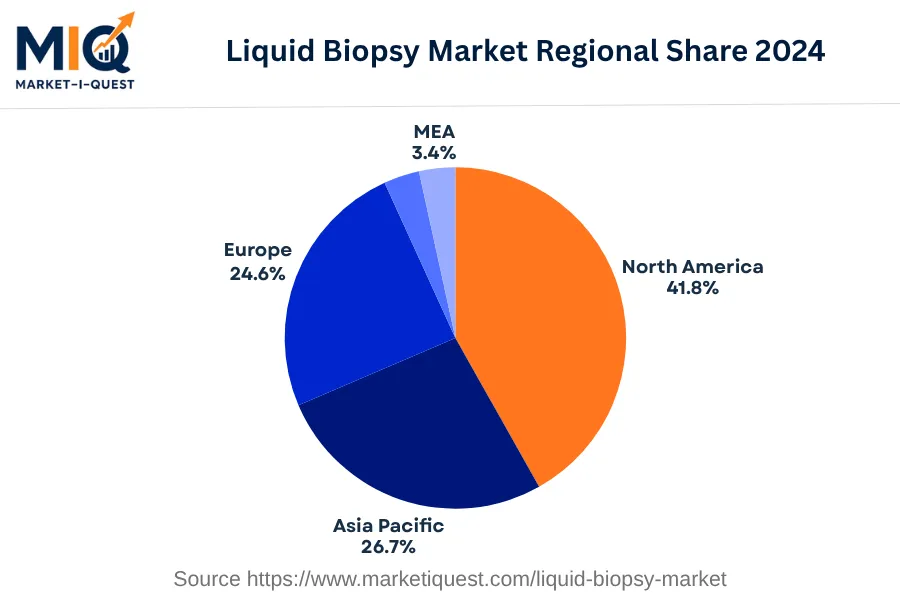
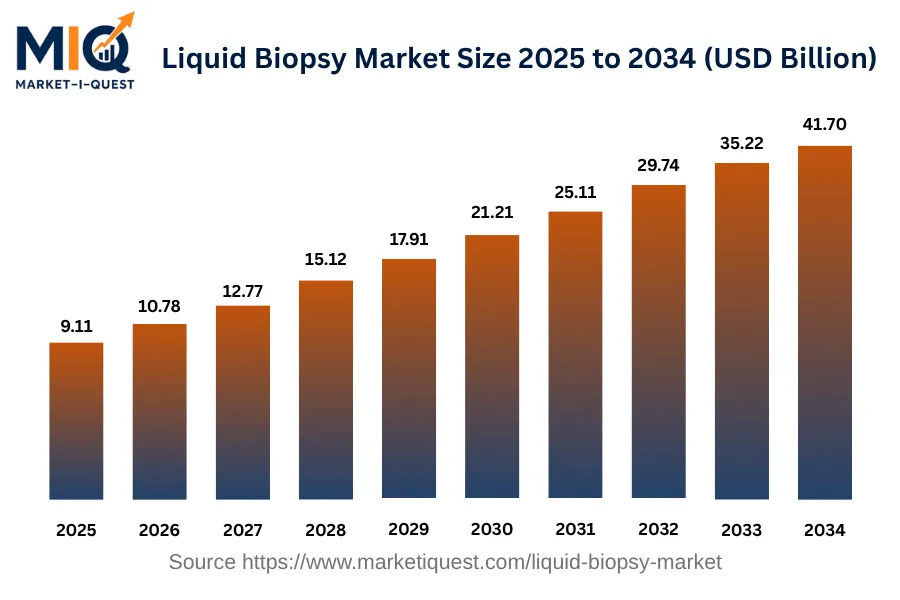
The Liquid Biopsy Market size in 2025 is anticipated to be $9.11 billion, up from $7.69 billion in 2024. By 2034, the market size is projected to expand up to $41.70 billion, representing a compound annual growth rate (CAGR) of 18.42% from 2025 to 2034. Throughout the decade, the market will experience steady and substantial growth attributed to this high CAGR. The regional share distribution in 2024 unfolds as follows: North America with the highest at 41.8%, followed by Asia Pacific at 26.7%, Europe at 24.6%, Latin America at 3.4% and Middle East & Africa at 3.4%. This presents a broad spectrum of market potential with North America in the lead and the other regions following.

Key Takeaways

  • By Sample Type - Blood had a dominant presence accounting for the highest market share in 2024.
  • By Technology - Next Generation Sequencing (NGS) led the market holding the majority of the industry share in the base year.
  • By Application - Cancer Diagnosis accounted for the major portion of the Liquid Biopsy Market in 2024.
  • By End Use - Hospitals held the leading position being responsible for a significant percentage of the market in 2024.
liquid-biopsy-market market size

Key Driving Factors

Rampant Growth of Non-Invasive Testing

One distinct force propelling the liquid biopsy market forward is the rampant growth of non-invasive testing. As medical professionals increasingly lean towards less invasive methods due to their favorable risk-benefit profiles, liquid biopsies have become a compelling diagnostic tool, especially in the field of oncology. Reduction in potential complications tied to surgical biopsies, along with faster turnaround times for results, make this technique preferable for patient monitoring and treatment adjustment. Furthermore, the capability of liquid biopsies to trace mutations over time also offers cleaner insights into disease progression, pushing massive acceptance in the clinical community.

Implementation of Precision Medicine Initiatives

Another key driver of growth in the liquid biopsy market is the implementation of precision medicine initiatives on a global scale. Precision medicine aims to customize healthcare, tailoring treatment plans as per individual genetic makeup. This requires identifying genetic mutations which fuel disease progression, and liquid biopsies are turning out to be a cardinal component in this process. Specifically, in cancer treatment, liquid biopsies help identify mutations that cause resistance to specific drugs. This timely identification aids in adjusting the therapeutic strategy, aiming to improve treatment outcomes. Across different regions, numerous research institutes, academic centers, and pharmaceutical companies are vigorously implementing precision medicine, thus propelling the demand for liquid biopsies.

Market Evolution by Timeline

2019-2023
During 2019–2023, the Liquid Biopsy Market witnessed significant utilization in the medical sector for non-invasive cancer diagnostics. Key buyers were primarily from developed regions, including North America and Europe due to higher cancer prevalence. Illumina, Guardant Health, and Biocept were the principal suppliers of liquid biopsy solutions, pushing forward the techniques and technologies for ctDNA and CTC detection. The industry faced the challenge of obtaining sufficient biopsy samples and integrating new technologies into clinical practice. HIPAA regulations in the United States enforced strict patient data privacy rules impacting the procedures for sample collection and data analysis. Commercial models featured service-based pricing with partnerships between healthcare providers and liquid biopsy companies. Key risks included avoiding contamination and ensuring high sensitivity and specificity in detecting cancer-specific mutations.
2024
In 2024, the market saw an increased adoption in Asia due to a rise in healthcare expenditures and cancer diagnoses. Technology improved with a focus on increasing the sensitivity of mutation detection. There was a shift to next-generation sequencing (NGS) technology, enhancing the detection of low-frequency mutations. Regulatory bodies, particularly the FDA, began approving more liquid-based tests, which boosted market confidence. Commercial contracts primarily involved partnerships with hospitals, providing comprehensive diagnostic service packages. Challenges persisted in balancing diagnostic accuracy and cost-effectiveness.
2025-2029
During 2025–2029, liquid biopsy technology further matured with more personalized therapies becoming available. Demand elevated from emerging markets including Latin America and Africa, driven by increasing cancer awareness and healthcare infrastructure. Companies like GRAIL and Thrive Earlier Detection shipped innovative blood tests capable of detecting multiple types of cancer. Regulatory standards evolved with the EU's in-vitro diagnostic regulation (IVDR) system requiring stringent clinical validation. Business models trended toward a combination of a service fee for biopsy analysis and a separate charge for genomic data interpretation services. Collection, transportation, and storage of samples remained a practical challenge.
2030-2034
From 2030 to 2034, liquid biopsy was largely adopted for early cancer detection, monitoring treatment response, and minimal residual disease assessment. Demand expanded to private clinics and research centers worldwide. Artificial Intelligence entered the supply chain, improving the interpretation of genomic data. Policies gravitated towards reimbursement plans, with models like 'pay-for-performance' gaining traction in the U.S. and Europe. Private insurance companies also started covering liquid biopsy costs in their plans. Despite technological leaps, the risk of false positives and negatives remained, highlighting the need for further refining the data analysis processes.

Future Market Outlook

Future Opportunities

The demand for liquid biopsies presents considerable opportunities for companies specializing in molecular diagnostics as seen with Illumina's partnership with GRAIL in 2020, aiming to enhance cancer detection capabilities. Current research indicates potential applications in prenatal screening, with tests like Panorama highlighting pathways for the development of non-invasive prenatal testing. Additionally, advancements in next-generation sequencing technologies open up avenues for expanded applications across multiple cancer types. As countries like Germany and the United Kingdom champion initiatives for earlier cancer detection, there is a concurrent push for integrating liquid biopsies within standard care protocols. In 2021, the European Union launched the Beating Cancer Plan, which emphasizes the importance of innovative screening methods, creating a favorable regulatory environment for liquid biopsy adoption. Collaborations between academia and industry are on the rise, exemplified by numerous partnerships such as that of Caris Life Sciences and various cancer centers worldwide, further driving innovation. Furthermore, the integration of liquid biopsies with existing diagnostic frameworks is being explored, as evidenced by studies aimed at combining imaging technologies with blood-based biomarkers. As healthcare systems globally seek to improve patient outcomes and reduce invasive procedures, liquid biopsies stand to play an instrumental role in shaping the future of diagnostic and treatment paradigms across oncology and other diseases.

Segmentation Analysis

By Sample Type

The market is divided into subsegments including Blood, Urine, Saliva, Pleural Fluid, and Cerebrospinal Fluid. Blood accounted for the largest revenue share while Saliva is expected to grow at the fastest CAGR during the forecast period.

Largest Revenue Share

Blood

Market Share Leader

Leading the market with the highest revenue share, the Blood subsegment dominates due to a number of factors. Foremost among these is the extensive range of diagnostic tests that rely on blood samples, as blood holds a considerable amount of information about a person's overall health status. Routine blood tests such as complete blood count (CBC), metabolic panels, and tests to monitor disease progression or treatment efficacy are frequently conducted across the globe. This makes the blood testing market a crucial segment. Procedural ease and standardization of blood collection also contribute to the significant revenue. Moreover, the global emphasis on preventative medicine and regular health checkups propels the demand for blood tests, driving revenue growth. Geographically, developed regions with a robust healthcare infrastructure contribute the majority of this segment's revenue, though emerging markets are steadily gaining ground in blood-test adoption due to accessibility improvements and increased healthcare expenditure.

Fastest CAGR

Saliva

Forecast Period Growth Leader

Saliva is anticipated to mark the fastest growth trajectory in the coming years. The growth impetus for this subsegment lies essentially with innovation and technical advancements. Salivary tests are non-invasive, easy to administer, and have applications in identifying systemic diseases, genetic disorders, and drug monitoring, among others. Despite being a relatively new field, the quickly evolving diagnostic innovation landscape is fostering a more extensive adoption of saliva-based tests. Increasing patient preference for non-invasive tests, combined with technological advancements in salivary diagnostics, is expected to serve as a growth catalyst. Partnerships between diagnostic companies for developing enhanced saliva-based testing kits are also fueling expansion. However, there might be minor adoption hurdles due to relative novelty and awareness about salivary diagnostics among healthcare professionals. In the near term, the limited reliability of saliva tests may pose some risk, but this is likely to diminish as technology advances.

By Technology

In terms of technology, the market is divided into subsegments including Next Generation Sequencing (NGS), Digital PCR, Microfluidics, Exosome Isolation, and Circulating Tumor Cells (CTCs). In the base year 2024, Next Generation Sequencing (NGS) accounted for the largest revenue share while Digital PCR is expected to grow at the fastest CAGR during the forecast period.

Largest Revenue Share

Next Generation Sequencing (NGS)

Market Share Leader

Next Generation Sequencing (NGS) is leading in terms of revenue due to its widespread application in various fields such as genetics, oncology, and agrigenomics. The increasing efficiency and declining cost of NGS have made it a go-to technology for researchers and clinicians alike. Technological advancements have enhanced the speed, accuracy, and affordability of NGS, which in turn has expanded its applicability to new areas, such as human genome sequencing and disease diagnostics. Add to this, the increasing prevalence of chronic diseases worldwide, necessitating the need for effective diagnostic procedures, has further propelled the demand for NGS. Increased investment in research and development, especially in developed regions like North America and Europe, has also been a major contributing factor to the dominance of NGS segment. Future prospects look promising as further technological advancements and wider acceptance in lower-income countries are set to expand the market further.

Fastest CAGR

Digital PCR

Forecast Period Growth Leader

Despite accounting for lesser revenue share, Digital PCR is projected to exhibit the fastest growth rate, driven by multiple factors. Its extreme sensitivity and accuracy make it an essential tool in the field of genetics, making it preferred for the detection and quantification of low abundance targets, rare allele detection, and copy number variation. Coupling this with recent advancements that have made dPCR highly spectrally efficient and massively parallel, the demand for Digital PCR is set to surge. DPCR is also favored for its simplicity compared to other methods and the absence of a need for a standard curve for quantification. However, the high initial cost and the requirement of expert handling may act as potential barriers. Additionally, the market is set to be catalyzed with ongoing investments in research and development, partnership agreements among key players, and favorable regulations in developed geographies, which can mitigate these barriers.

By Application

The market is divided into subsegments, including Cancer Diagnosis, Treatment Monitoring, Recurrence Monitoring, Clinical Trials, and Research Applications. As of 2024, the Cancer Diagnosis subsegment accounted for the largest revenue share while Clinical Trials is expected to grow at the fastest CAGR during the forecast period.

Largest Revenue Share

Cancer Diagnosis

Market Share Leader

The Cancer Diagnosis segment leads the market in revenue, largely due to the increasing incidence of cancer globally. Rapid urbanization, lifestyle changes, and aging populations contribute to an increased number of cancer cases, subsequently driving demand for diagnosis. The heightened awareness about early cancer detection also plays a significant role in the segment's robust performance as early diagnosis can significantly enhance the effectiveness of treatment. Geographically, developed countries account for a larger share in revenue due to the availability of sophisticated healthcare infrastructure and a higher prevalence of cancer. Regulations favoring regular cancer screenings further contribute to the revenue surge in these regions. The purchasing criteria typically revolve around the accuracy, sensitivity, and speed of diagnostic tests, with customers often showing a willingness to pay a premium for higher quality.

Fastest CAGR

Clinical Trials

Forecast Period Growth Leader

The Clinical Trials segment is projected to have the fastest CAGR, driven by an increased focus on breakthrough therapies for cancer treatment. Biotechs and pharmaceutical companies are investing heavily in cancer research, leading to a rise in clinical trials. Collaborations and partnerships among these companies, research institutions, and government bodies are acting as catalysts for segment growth. Advances in technology, such as AI and machine learning, are further supporting the acceleration of clinical trials by improving data collection and analysis. However, there are several growth barriers to consider. Regulatory hurdles and the high costs associated with clinical trials might hinder adoption. Near-term risks include an uncertain economic landscape and the potential impacts of the global pandemic on research activities. But, overall, signs point to sustained growth in this subsegment.

By End Use

The market is divided into subsegments including Hospitals, Diagnostic Laboratories, Research Institutes, and Pharmaceutical Companies. In 2024, Hospitals accounted for the largest revenue share, while Diagnostic Laboratories are expected to grow at the fastest CAGR during the forecast period.

Largest Revenue Share

Hospitals

Market Share Leader

In 2024, hospitals lead in revenue generation due to several factors. A prominent driver is the increasing patient population requiring various diagnostic procedures, surgeries and treatments which are majorly facilitated through hospitals. Large-scale hospitals, particularly in developed regions, are well-equipped with advanced technologies thereby charting a higher degree of revenue. Additionally, the regulatory environment in many countries supports hospital spending enabling upgrades in technology and infrastructure. Furthermore, hospitals are typically the primary purchasers of high-value equipment and services that drive market growth. As the first point of contact for a significant portion of patients, hospitals are heavily reliant upon this sector. Advanced diagnostic and treatment options give hospitals a strategic advantage over other healthcare providers, further bolstering their market dominance. These factors along with any potential increase in the patient population imply this dominance in revenue generation is set to persist.

Fastest CAGR

Diagnostic Laboratories

Forecast Period Growth Leader

Diagnostic Laboratories are forecasted to grow at the fastest pace due to growing demand for early disease detection, regular health check-ups, and diagnostic services, driven by increasing health awareness among consumers. Another factor contributing to this growth is an increased focus on personalized medicine, which requires extensive diagnostic testing. With the advancements in technology, a surge in the adoption of automation in laboratories is observed that provides faster and more efficient analysis. Yet, the high cost of advanced diagnostic machinery and stringent regulatory procedures are potential barriers to entry. In the near future, investments into the diagnostic market, technological innovations, and strategic partnerships with healthcare providers may likely negate these challenges by funding capex and easing regulatory bottlenecks. However, near-term risks include fluctuating economic stability in various regions and uncertainty in reimbursement policies, which may affect the growth rate of the diagnostic laboratory subsegment.

Competitive Analysis

Key Market Players

Manufacturers / OEMs

GRAIL, Inc.
US
Roche Diagnostics
Switzerland
Bio-Rad Laboratories, Inc.
US

Key Suppliers & Raw Materials

Thermo Fisher Scientific
US
Qiagen
Germany
Illumina, Inc.
US

Distributors, Integrators & Channel Partners

Genetron Health
China
LabCorp
US
Guardant Health
US

Porter’s Five Forces Analysis

This analysis provides insights into the competitive dynamics of the Liquid Biopsy Market.

Supplier Bargaining Power

Medium

Major lab equipment businesses monopolize, but interchangeable supplies limit power.

Buyer Bargaining Power

High

Large health institutions, research facilities & private labs hold significant power due to high purchase volumes.

Threat of Substitutes

Low

Limited substitutes due to unique nature and accuracy of liquid biopsy technology.

Threat of New Entrants

Medium

Initial capital & technological capabilities are high barriers, but market growth is attractive to new entrants.

Competitive Rivalry

High

Competition is intense with numerous global players and constant technological advancements.

Regional Analysis

Geographic market dynamics and growth opportunities across key regions

Global Market Outlook

liquid-biopsy-market market regional share

North America

In 2024, North America's Liquid Biopsy Market experienced accelerated growth in response to increasing demand across the healthcare sector. The growth drivers include regulatory approvals, such as those given by the FDA for advancing liquid biopsy tests that influenced R&D investments and increased adoption of this technology across healthcare institutions in the U.S., Canada, and Mexico. The surge in cancer incidence fueled demand for early & accurate diagnosis and treatments, thereby amplifying the uptake of liquid biopsy. Another key driver involved price dynamics, as providers worked to make these screening methods more affordable and consequently more accessible to a larger audience.

On the trends front, the market witnessed significant shifts in buyer behavior in the healthcare sector, as there was a marked preference for non-invasive and quick diagnostic methods like liquid biopsy. Technological advancements led to a rise in partnerships and M&A activities among publicly-traded and private biotech companies to expand their portfolio of liquid biopsy tests. The policy enforcement for precision in diagnostics and surveillance increased, leading to a higher reliance on advanced methods, thus benefiting the liquid biopsy market. In 2024, the North American Liquid Biopsy Market highlighted an inevitable intersection of advancing technological parameters, policy enforcements, and revolving buyer behavior contributing to the market's growth narrative.

Asia Pacific

In 2024, the liquid biopsy market in Asia Pacific demonstrated notable growth, driven largely by technological advancements, growing incidence of cancer, and increased funding for genomics research. The adoption of non-invasive diagnostics in countries such as China, India, and Japan accelerated, fueled by demand for cost-effective cancer screening. In South Korea and Australia, government-backed initiatives aimed at precision medicine encouraged the development and adoption of liquid biopsy technologies, boosting both supply and demand dynamics. Trends indicated a shift towards collaboration among academia, biotechnology firms, and pharmaceutical enterprises, particularly visible in the China and key ASEAN markets.

This was reflected in an upward trend in co-developed genomic databases and joint research initiatives. Furthermore, technological advancement led to an increased preference for liquid biopsy over conventional tissue biopsies among healthcare providers due to its potential for early cancer detection. The standardization of liquid biopsy procedures in countries like Japan and South Korea has played a pivotal role in increasing its adoption, while in India and Australia, policy enforcement in genomic data privacy was a key trend. Consequently, major customer sectors included healthcare, pharmaceutical, and research institutions. This suggests that both supply and demand dynamics in the Asia Pacific region in 2024 were geared towards integrating liquid biopsy technology into routine clinical practice methods.

Europe

The Liquid Biopsy Market in Europe experienced robust expansion in the base year 2024. This growth was primarily driven by heightened adoption of this innovative diagnostic method across dynamic healthcare sectors in countries such as Germany, the United Kingdom, France, and Italy. Patient preference for non-invasive diagnostic procedures, stringent regulatory frameworks mandating early cancer detection, and substantive investments in technological advancement catalysed market growth. Furthermore, heightened public awareness of the utility of liquid biopsies for early-stage cancer diagnosis significantly impacted supply dynamics and effected competitive pricing strategies.

Exploring key market trends, discernable shifts in buyer behaviour manifested through a heightened preference for precision oncology consultations, favoring liquid biopsy industry actors. In terms of technology, the integration of big data analytics and AI in liquid biopsy interpretation accelerated in a bid to increase diagnostic accuracy. Channel dynamics saw an increasing reliance on partnerships and M&A activities among key industry players to optimise market positioning and operational efficiency, such as the strategic alliances in the Benelux and the Nordics. Enforcement of policies incentivising industry-wide standardisation became a prevalent trend in major European markets, including Central and Eastern Europe. This bolstered sector credibility and further spurred adoption rates amongst healthcare providers.

Latin America

In 2024, the Liquid Biopsy Market in Latin America (LATAM) is thriving, marked by substantial developments in Brazil, Mexico, Argentina, Colombia, Chile, and Peru. Influencing the growth is increased healthcare investment, boosting the availability of advanced diagnostic tools. The adoption of cutting-edge technologies, such as next-generation sequencing (NGS) and rising awareness of the benefits of early cancer detection, specifically propels demand in Argentina and Chile. Brazil's robust medical tourism industry encourages the proliferation of liquid biopsy, further stimulating market growth. However, limited insurance coverage for such tests in Colombia and Mexico challenges market expansion.

Patient preference for non-invasive diagnostic procedures is a distinct trend in 2024. In Peru and Mexico, this preference guides the shift from traditional biopsies to liquid biopsies, advancing market maturation. A significant increase in partnerships within healthcare and biotech sectors is noted, with key players collaborating to enhance liquid biopsy technology capabilities. Stringent policy enforcement in Brazil and Argentina ensures the safety and efficacy of these diagnostic tools, impacting market dynamics positively. Despite the variability of regulations across countries, the commitment to early and accurate cancer detection remains a universal priority in LATAM's Liquid Biopsy Market in 2024.

Middle East & Africa

In 2024, the Liquid Biopsy Market in the Middle East and Africa displayed a heightened dynamism driven by various factors. Demand for non-invasive diagnostic techniques escalated, particularly in healthcare-focused economies like Saudi Arabia and South Africa due to the rising burden of cancer. The implementation of comprehensive healthcare policies endorsed the adoption of liquid biopsy across countries like Egypt and Israel, while substantial investment in healthcare technology by UAE and Qatar boosted the supply dynamics. Additionally, affordability coupled with improved accuracy spurred the market growth.

Patient-friendly solutions became a dominant trend, as they reduce the stress associated with invasive procedures. The shift toward minimally invasive or non-invasive diagnostics was evident in Kenya and Nigeria. There was an increased interest from healthcare providers in using liquid biopsy tests for early detection and monitoring, especially in oncology. M&As amongst the key players were instrumental in expanding their footprints across the region. The Israeli Health Ministry’s standards impacted the increased use of liquid biopsy tests in Israeli hospitals. The enforcement of these reformative policies led to the gradual acceptance and integration of liquid biopsy in disease diagnosis and monitoring in respective healthcare sectors.

Recent Industry Developments

Latest market innovations, product launches, and strategic initiatives

July 2026

The U.S. FDA approved Guardant360 CDx for use as a companion diagnostic to identify patients with BRAF V600E-mutant metastatic colorectal cancer who could derive benefit from treatment with encorafenib (Braftovi) in combination with cetuximab (Erbitux) and chemotherapy.

September 2025

Guardant Health received FDA approval for its Guardant360 comprehensive genomic profiling liquid biopsy test as a companion diagnostic to identify patients eligible for Eli Lilly's breast cancer treatment Inluriyo (imlunestrant).

Frequently Asked Questions