In-Vitro Diagnostics Market Snapshot

Key Players

  • Roche Diagnostics (Switzerland)
  • Siemens Healthineers (Germany)
  • Abbott Laboratories (United States)
  • Becton Dickinson and Company (United States)
  • BioMérieux (France)
  • Sysmex Corporation (Japan)
  • QIAGEN (Netherlands)
  • Thermo Fisher Scientific (United States)
  • Danaher Corporation (United States)
  • Bio-Rad Laboratories (United States)

Market Size

Base Year 2024
$107.64 Bn
CAGR
5.87%
Forecast 2034
$190.42 Bn

Market Segments

By Test Type
Laboratory, Point-of-Care Testing
By Offering Type
Reagents, Instruments, Services
By Therapeutic Area
Autoimmune Diseases, Cardiovascular Disorders, Diabetes, Infectious Diseases, Renal Disorders, Oncological Disorders, Others
By Technology
Clinical Chemistry, Hematology, Immunoassay, Molecular Diagnostics, Others
By End User
Hospitals, Diagnostic Laboratories, Academic & Research Institutes, Pharmaceutical & Biotechnology Companies

Market Dynamics

Drivers
  • Rising prevalence of chronic diseases
  • Technological advancements in diagnostics
Restraints
  • Regulatory hurdles
  • High equipment costs
Opportunities
  • Increasing chronic disease prevalence
  • Technological advancements in diagnostics

Market Size

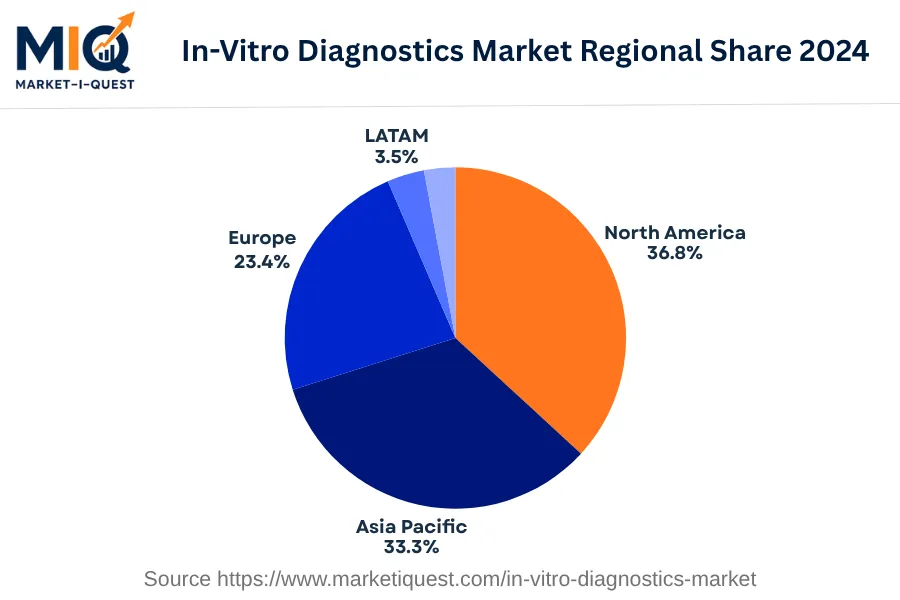
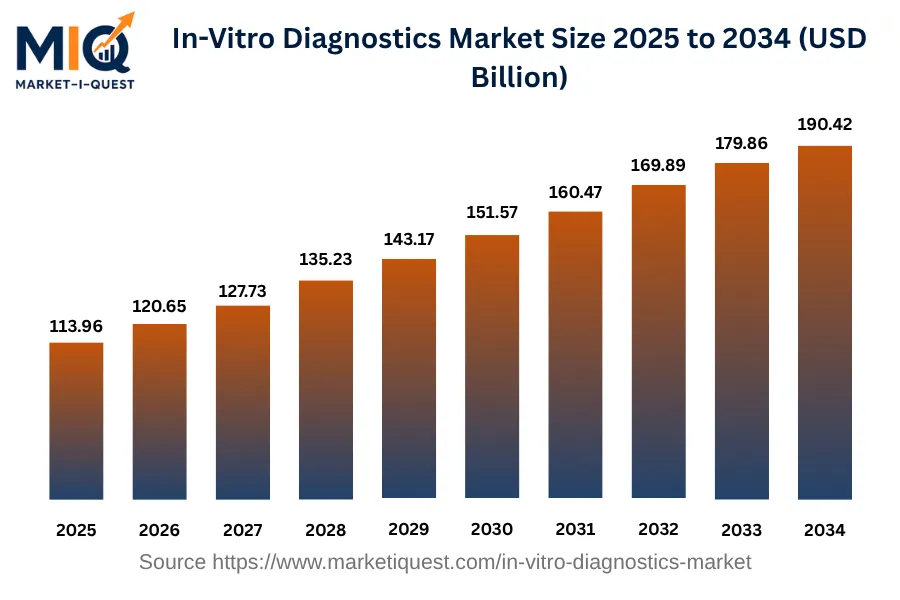
The In-Vitro Diagnostics Market stood at USD 107.64 billion in 2024, rising to USD 113.96 billion in 2025, and estimated to reach USD 190.42 billion in 2034. This reflects a Compound Annual Growth Rate (CAGR) of 5.87% from 2025 to 2034. The market’s steady increase over the decade is largely due to the rising application of in-vitro diagnostics in detecting various diseases and medical conditions at an early stage, enabling timely treatment interventions. Moreover, advancements in technology related to in-vitro diagnostics contributed to the evident market growth. Regarding regional distribution in 2024, North America had a share of 38.5%, followed by Asia Pacific at 30.2%, Europe at 24.3%, LATAM at 3.8%, and the MEA region taking up 3.2% of the total market. Therefore, the prominent role goes to North America and Asia Pacific commanding over two-thirds of the market share, which demonstrates their dominant standing in the In-Vitro Diagnostics Market.

Key Takeaways

  • By Test Type - Laboratory Testing held a significant part in the market in the base year.
  • By Offering Type - Reagents led with the highest market share in the past year.
  • By Therapeutic Area - Oncological Disorders held the top position in the last fiscal year.
  • By Technology - Molecular Diagnostics emerged as the fastest-growing segment.
  • By End User - Hospitals led the market accounting for a notable share in the base year.
in-vitro-diagnostics-market market size

Key Driving Factors

Implementation of Precision Medicine Initiative

The Precision Medicine Initiative rolled out by governments in various countries such as the U.S. is a pivotal cause for the expansion of the In-Vitro Diagnostics (IVD) market. As defined by the initiative, diagnostics should be tuned towards individualized treatment plans, based on the genetic and biological profile of the patient. IVD plays a vital role in achieving these precision-based results, creating its demand in the market. More specifically, molecular diagnostic tests, one subcategory of IVD tests, are used in determining genetic and molecular aspects of a patient's disease, thus acutely driving the market growth.

Integration of Artificial Intelligence in IVD

The integration of Artificial Intelligence (AI) into IVD workflows is another instrumental driver of the market's growth. AI, especially Machine Learning algorithms, can analytically interpret the rich data harvested by these diagnostic tests. Such interpretation assists in enhancing test accuracy, speeding up result time, and improving overall efficiency of the IVD process. Specifically, companies like Roche Diagnostics and Zebra Medical Vision are actively incorporating AI in their IVD processes; the former for improved cancer diagnostics, and the latter for detection of diseases like liver fibrosis. These AI-IVD integrative efforts by key players indicate a promising direction for the market's expansion.

Market Evolution by Timeline

2019-2023
In this period, healthcare providers and patient groups, predominantly in developed regions (North America and Europe), were primary buyers of in-vitro diagnostics (IVD). A rising incidence of chronic diseases and increase of aging population were key drivers. IVD manufacturers mainly focused on new product launches and improvements on existing products. Challenges existed in integrating IVD devices into general practice due to data handling and analysis issues. Policies like the EU's In Vitro Diagnostic Regulation (IVDR) imposed stringent compliance requirements for manufacturers with a focus on safety, performance, and quality. The commercial model was conventional with manufacturers setting prices and hospitals and labs being the paying customers. While risks included stringent regulatory compliance and technological hitches, companies generated consistent revenue.
2024
In 2024, increased demand came from Asia due to growing healthcare expenditure and awareness about early disease detection. The suppliers focused on portable, user-friendly IVD devices to reach a wider audience, yet faced challenges due to fragmented markets and varying healthcare infrastructure. The World Health Organization's Essential Diagnostics List impacted product design, necessitating affordable, easy-to-use products. Commercial models moved towards affordability and accessibility, often driven by public-private partnerships. In-vitro diagnostics was marked by increased competition and price sensitivity. As risks, uncertainty around regulations in emerging markets and adequate product support remained prevalent.
2025-2029
During this period, emerging markets, particularly in Asia and Africa, created substantial demand for IVD. Causes included expanded healthcare coverage and increased focus on preventive healthcare. Miniaturization of devices improved integration into healthcare systems, but supply chain disruptions were a common constraint. Regulations like China's Medical Devices Amendment accentuated quality control and safety measures. Bundled pricing models prevailed with IVD tests often being part of larger diagnosis or treatment packages. The primary risk was managing the balance between product affordability and profitability against a backdrop of more stringent regulations and beginner end-users.
2030-2034
By this period, home-based healthcare and self-testing were driving IVD demand globally. Technological advancements saw integration of AI and machine learning in diagnostics, although concerns around data security were magnified. Several countries adopted standards from the International Medical Device Regulators Forum (IMDRF). While manufacturers and healthcare providers partnered more closely, pricing pressures led to increased usage of value-based contract models. A major risk was investing in tech advancements amidst pricing pressures and cybersecurity threats. Additionally, ensuring consistent product quality and timely adoption of international regulatory standards remained crucial.

Future Market Outlook

Future Opportunities

The future of the IVD market presents multiple avenues aligned with current technological advancements and evolving healthcare needs. The increasing demand for remote patient monitoring has prompted companies like Siemens Healthineers to explore telehealth integrations within their diagnostic platforms. Additionally, the rise in chronic diseases necessitates the development of innovative biomarkers, as highlighted during the 2023 Global Healthcare Innovation Summit, where leading researchers discussed the potential for novel assays to facilitate early detection. With regulatory bodies like the FDA issuing guidelines that streamline pathways for novel test approvals, there is a clear opportunity for new entrants to penetrate the market with cutting-edge solutions. Collaborations between biotechnology firms and traditional diagnostic companies are anticipated to expand the spectrum of testing options available. For instance, the partnership between Thermo Fisher Scientific and various academic institutions is focused on advancing liquid biopsy technologies. Furthermore, as countries intensify efforts towards personalized medicine, regulatory frameworks will likely adapt to accommodate emerging testing methodologies like next-generation sequencing. This confluence of technology, evolving regulations, and heightened awareness of disease prevention creates an environment ripe for innovation, ensuring that diagnostic solutions remain at the forefront of public health strategies as they develop in the coming years.

Segmentation Analysis

By Test Type

The market is divided into subsegments including Laboratory and Point-of-Care Testing. Laboratory testing accounted for the largest revenue share while Point-of-Care Testing is expected to grow at the fastest CAGR during the forecast period.

Largest Revenue Share

Laboratory

Market Share Leader

In the test type segment, Laboratory subsegment holds the largest share of revenue based on the year 2024 statistics and considering the industry norms. There are several reasons why laboratory testing holds the dominant position. First, laboratory tests are the cornerstone of diagnosing a wide range of diseases and medical conditions, establishing their extensive necessity in healthcare. Second, they offer better precision and accuracy compared to other types of tests. Laboratories are equipped with state-of-the-art technology and skilled personnel, enabling precise results. It's also pertinent that laboratories have a comprehensive offering, performing a range of tests not possible in other venues. Regulations also favor laboratory testing. Several tests are stipulated by regulatory bodies to be conducted in laboratory settings only, enhancing revenue generation. Geographic diversity of laboratories contributes as well to the high revenue due to their spread in urban and semi-urban areas. The purchasing criteria leans towards laboratory testing as it is trusted by medical professionals owing to its reliability and history of proven results.

Fastest CAGR

Point-of-Care Testing

Forecast Period Growth Leader

Point-of-Care Testing (POCT) is anticipated to register the fastest growth in the forecast period. The drive for this rapid growth comes from several factors. A critical growth driver for POCT is its convenience. Unlike laboratory testing, POCT provides results almost immediately without requiring transportation to a separate testing facility. This speed and convenience are crucial in emergencies, making POCT a penetrating option across care settings. Technological advancements act as a catalyst for POCT growth. Ongoing innovations in microfluidics, nanotechnology, and molecular diagnostics have considerably improvized POCT, making it more reliable and versatile. Policies supporting decentralized healthcare are another catalyst. Capital expenditure is lower due to the portability and lesser infrastructure requirements of POCT, hastening its adoption. As for near-term risks, inaccurate results due to user error or hardware failure are certain challenges. However, continual technological innovations are predicted to mitigate these risks and escalate the adoption rate in the foreseeable future.

By Offering Type

The market is divided into key subsegments that include Reagents, Instruments, and Services. In the base year of 2024, Reagents accounted for the largest revenue share while Services is expected to grow at the fastest CAGR during the forecast period.

Largest Revenue Share

Reagents

Market Share Leader

The Reagents subsegment dominates the market revenue-wise due to their indispensable role in various laboratory and industrial processes. The continual need for high-quality, precise reactions across the pharmaceutical, healthcare, and biotechnology sectors adds to the demand for reliable and effective reagents. Additionally, stringent regulations concerning substance use and efficacy promote the wide usage of recognized and standardized reagents, thereby driving market growth. Geographically, strong industrial and healthcare sectors in North America and Europe contribute markedly to demand. The continual replacement needs, associated with the limited shelf-life, further drive the reagent market. Another critical driver is the consistent expansion of research and development facilities globally necessitating regular and healthy supply of various reagents.

Fastest CAGR

Services

Forecast Period Growth Leader

Services are predicted to show the fastest growth due to the increasing need for specialized and expert help in laboratory and industrial settings. Technological advancements are becoming more complex, often requiring professional maintenance, operation, and troubleshooting that only expert service providers can deliver. Furthermore, with such advancements, companies are making significant capital investments in cutting-edge instruments that require maintenance services, further driving this subsegment. The surge of private-public partnerships, aiming to improve infrastructure and reduce research costs, is also acting as a growth catalyst. However, there are adoption barriers such as the reluctance to outsource critical processes to third parties, which could affect short-term growth. Nevertheless, the immediate benefits of focused abilities, productive capacities, and cost-effectivity tend to outweigh these inhibitions, promising robust segment growth.

By Therapeutic Area

The market is divided into subsegments including Autoimmune Diseases, Cardiovascular Disorders, Diabetes, Infectious Diseases, Renal Disorders, Oncological Disorders, and Others. Of these, Oncological Disorders accounted for the largest revenue share while Infectious Diseases is expected to grow at the fastest CAGR in the forecast period.

Largest Revenue Share

Oncological Disorders

Market Share Leader

Oncological Disorders, or cancers, are identified as a significant revenue contributor in the therapeutic market, particularly in 2024. This dominance can be attributed to rising prevalence and incidence of different types of cancers globally. Factors such as aging population, unhealthy lifestyles and habits, and genetic predispositions contribute to this surge. Alongside, advancements in technologies and treatments have led to increased demand for cancer therapies. Efforts toward early detection and prevention have also fueled the market growth, with a range of diagnostic tests and screenings becoming more accessible and widely adopted. Furthermore, supportive government policies and funding toward cancer research amplify this trend. However, high costs associated with treatments, uneven distribution of therapeutics, and strict approval norms can challenge growth in certain regions.

Fastest CAGR

Infectious Diseases

Forecast Period Growth Leader

Infectious Diseases are forecasted to grow at the fastest CAGR. The growth is driven by the cyclic nature of outbreaks and the continual emergence of new pathogens. Recent times have seen a substantial surge in such diseases due to increasing global travel, urbanization, and changing climate patterns. The COVID-19 pandemic is a stark example of this phenomena, and such global health crises necessitate rapid development and deployment of treatments. Equally important are the international collaborations and partnerships in the biopharmaceutical industry, contributing substantially toward the fast-paced growth. Advances in diagnostic technology facilitating accurate and timely disease identification also catalyze the Infectious Diseases market. Risks could include antimicrobial resistance, limited disease understanding, and complexities in vaccine development, constituting crucial barriers to the growth of this sub-segment.

By Technology

The market is divided into subsegments including Clinical Chemistry, Hematology, Immunoassay, Molecular Diagnostics, and Others. Clinical Chemistry accounted for the largest revenue share while Molecular Diagnostics is expected to grow at the fastest CAGR during the forecast period.

Largest Revenue Share

Clinical Chemistry

Market Share Leader

Clinical Chemistry dominates the technology market largely due to its ubiquity in medical diagnostics. It serves a crucial function in a plethora of medical applications, from general health checkups to identifying critical illnesses. Significant factors driving growth include the rising demand for early disease detection, increasing geriatric population and the surge in lifestyle-related diseases such as diabetes and cardiovascular disorders – all requiring clinical chemistry-based diagnostics. Another contributing factor is the technological advancement in clinical diagnostic techniques, which has resulted in faster and more accurate results. The availability and ease of use of these diagnostic tests have led to their widespread adoption. Geographically also, adoption rates of clinical chemistry testing have been impressive, particularly in developed regions such as North America and Europe, because of high awareness, the prevalence of target diseases, and strong healthcare infrastructure - driving up revenue in this subsegment.

Fastest CAGR

Molecular Diagnostics

Forecast Period Growth Leader

Despite accounting for a smaller revenue share currently, Molecular Diagnostics is foreseen to experience the fastest growth rate. Several factors are fueling this growth outlook. Firstly, the rise of personalized medicine and the need for early detection of diseases are increasing the demand for this sophisticated diagnostic approach. Technological advancements are making molecular diagnostics more efficient and cost-effective, prompting healthcare providers to favor this method. Another catalyst for growth is the upswing in partnerships among hospitals, diagnostic laboratories, and academic institutes to enhance their testing capabilities. Public policies that encourage diagnostic test development are also accelerating Molecular Diagnostics' growth. However, high initial costs and the required level of technical expertise may act as temporary barriers to adoption. Risk remains in regulatory uncertainty but this is mitigated by the sector's overall trend towards more personalized, precise, and speedy diagnosis.

By End User

The end user market is divided into subsegments including Hospitals, Diagnostic Laboratories, Academic & Research Institutes, Pharmaceutical & Biotechnology Companies, with Hospitals accounting for the largest revenue share while Pharmaceutical & Biotechnology Companies is expected to grow at the fastest CAGR during the forecast period.

Largest Revenue Share

Hospitals

Market Share Leader

In the base year 2024, the hospitals subsegment emerged as the segment with the largest revenue share. Hospitals, being the first point of contact for most patients and the largest consumers of healthcare services, face significant demand for diagnostic and therapeutic interventions. The need for efficient and accurate diagnostic tools and technologies is rampant in hospitals for patient screening, monitoring, and treatment purposes. The existence of well-equipped facilities and the availability of advanced medical equipment further enhance the revenue generation capacity of this subsegment. Additionally, regulatory norms necessitate periodic updating of hospital equipment, which contributes to consistent demand. High patient flux, coupled with the delivery of extensive medical services, underpins the substantial purchasing power of hospitals which drives this segment.

Fastest CAGR

Pharmaceutical & Biotechnology Companies

Forecast Period Growth Leader

On the other hand, the Pharmaceutical & Biotechnology Companies subsegment is poised for the fastest growth. The rise in chronic diseases globally necessitates the development of novel therapies and drugs, intensifying the demand for high-end research and diagnostics to understand disease mechanisms. This elevates the role of pharma and biotech companies, driving up their market share. These companies are also progressively investing in cutting-edge technology and research facilities, further accelerating demand. Overcoming barriers such as stringent regulatory processes, availability of capital for investment in advanced technologies, and intellectual property rights are crucial for sustained growth in this segment. Additionally, partnerships with academic and research institutes for drug discovery add impetus to the segment's growth. However, near-term risks include compliance with stringent regulations and the high cost of failure in drug discovery.

Competitive Analysis

Key Market Players

Manufacturers / OEMs

Roche Diagnostics
Switzerland
Abbott Laboratories
US
Siemens Healthineers
Germany

Key Suppliers & Raw Materials

Becton, Dickinson and Company
US
Bio-Rad Laboratories
US
Ortho Clinical Diagnostics
US

Distributors, Integrators & Channel Partners

Thermo Fisher Scientific
US
Danaher Corporation
US
QIAGEN
Germany

Porter’s Five Forces Analysis

An analysis of the competitive forces in the In-Vitro Diagnostics Market.

Supplier Bargaining Power

Medium

Limited suppliers of key diagnostic components, but also some options for substitution.

Buyer Bargaining Power

High

Large, consolidated healthcare providers with good access to comparison and switch options.

Threat of Substitutes

Low

Advanced technological nature of In-Vitro testing offers few direct alternatives.

Threat of New Entrants

Medium

Regulatory approval and high development costs present barriers, however, increases seen from tech and healthcare companies.

Competitive Rivalry

High

Numerous well-established companies fighting for market share in a growing market.

Regional Analysis

Geographic market dynamics and growth opportunities across key regions

Global Market Outlook

in-vitro-diagnostics-market market regional share

North America

In 2024, North America's In-Vitro Diagnostics (IVD) market witnessed a surge based on technological adoption and regulatory compliance. Persistent demand for IVD was driven by the growing healthcare sector in the United States, with a focus on partially automated systems and high sensitivity diagnostic tools. Regulatory requirements, such as compliance with U.S. Food and Drug Administration standards for IVD products, acted as a significant market driver across the region. Investment in IVD technology grew substantially, particularly in Canada and Mexico, due to government and enterprise focus on early disease detection.

Speaking to market trends, a shift towards personalized medicine in the U.S. led to increased use of IVD in genetic testing and cancer screening. Telehealth trend adoption resulted in growth for home-based IVD, supported by partnerships and mergers among healthcare and tech firms. In terms of standards, the implementation of the Diagnostic Accuracy and Innovation Act (DAIA) brought changes to IVD product development, further affecting the market's product landscape. Finally, policy enforcement regarding lab testing protocols in response to public health emergencies solidified IVD’s position in routine clinical use market-wide. These varying factors in 2024 provided distinct opportunities and challenges for businesses within North America's In-Vitro Diagnostics market.

Asia Pacific

In 2024, the In-Vitro Diagnostics (IVD) Market in the Asia Pacific demonstrated vigorous growth, driven by an aging population, increasing disease prevalence, government investment in healthcare infrastructure, and the advancement of healthcare technology. This, coupled with the rise of personalized medicine, propelled the demand for IVD tests in areas including microbiology, immunology, and molecular diagnostics in China, India, Japan, South Korea, Australia, and key ASEAN markets. Investments into health technology infrastructure, especially in China and Australia, fueled sufficient supply of IVD products and services. Meanwhile, relaxed regulation around diagnostic tests in India, facilitated faster market access for new IVD products. Further, pricing dynamics turned favorable due to Japanese government's cost containment policies, leading to increased accessibility of these services.

The evolution of buyer behavior was evident as more patients sought at-home testing options, thereby accelerating the growth of the point-of-care testing market. Stricter enforcement of diagnostic standards and regulations in Asia Pacific markets emerged as a key trend, as did partnerships and M&A activities, especially in the molecular diagnostics sector in South Korea. Technological innovations, such as Next-Generation Sequencing (NGS), witnessed increased uptake among healthcare institutions, and the settings for IVD tests expanded from central labs to include smaller clinical labs, hospitals, and at-home testing - highlighting the trend towards decentralization.
Europe

In 2024, the In-Vitro Diagnostics (IVD) market in Europe was noted for its vigorous dynamics. A critical driver for this market was the growing prevalence of chronic diseases such as diabetes and cardiovascular disorders, especially in the United Kingdom, France, and Germany. Regulations related to the implementation of IVD across Europe played a significant role as well. For instance, the introduction of the IVD Regulation (IVDR) in Europe enhanced the reliability of diagnostics tests, propelling market growth. Investment in the healthcare sector, particularly in the Nordics and Benelux regions, supported technology adoption, while an increased focus on personalized medicine in Italy and Spain encouraged new innovations in the IVD market.

Trends observed in 2024 included an upsurge in the use of point-of-care devices, driven by advances in microfluidic technology. The adoption of automation in laboratories in Central & Eastern Europe facilitated growth in the diagnostics sector. The rise of public-private partnerships, like the one between the UK government and Roche Diagnostics, improved IVD accessibility. There was also a policy enforcement focus on ensuring the proper alignment of laboratory services with the EU's overarching healthcare objectives. The shift towards a patient-centric approach in the healthcare sector marked another trend, impacting the diagnostics area by emphasizing early and accurate diagnosis, which was primarily driven by IVD tests.

Latin America

In 2024, the In-vitro Diagnostics (IVD) market in LATAM significantly revolved around improving patient outcomes and healthcare efficiency. The adoption of advanced technologies in diagnostics and a substantial surge in investment in healthcare infrastructure by leading economies such as Brazil, Mexico, and Argentina were crucial drivers. Notably, government regulations in countries such as Chile and Peru played a vital role in driving the IVD market, with stringent requirements for validation and accreditation of diagnostic tests. The market witnessed increased demand for personalized medicines, driven predominantly by an aging population and growing healthcare concerns, invoking greater acceptance of point-of-care testing (POCT) solutions. Public-private partnerships collaborated to adopt advanced IVD technologies, enabling the development of rapid diagnostic solutions for infectious diseases. The enforcement of policies such as Brazil's "Mais Medicos" prompted a significant shift towards a more community-based approach to healthcare, where in-vitro diagnostics played a critical role.

Dominant players focused on providing extensive solutions, including laboratory-based information systems and middleware. Enterprise and government sectors progressively turned towards these solutions for an effective and integrated approach, attributing to a heightened demand in the IVD market. The retail channel witnessed a boost, owing significantly to the escalated sales of self-test IVD products, in pursuit of enhanced disease monitoring.

Middle East & Africa

In 2024, the In-Vitro Diagnostics (IVD) market in the Middle East and Africa experienced notable growth, spurred by progressive healthcare policies and rapid advancements in technology. Key drivers of growth include increased health expenditure in Saudi Arabia, UAE, and Qatar, where government-led efforts to improve healthcare infrastructure have resulted in increased uptake of IVD services. Furthermore, a surge in lifestyle diseases in South Africa, Nigeria, and Kenya has heightened demand for diagnostic procedures, while regulatory reforms in Israel have facilitated a more conducive environment for IVD businesses.

At the same time, several trends have shaped the IVD market landscape. In Saudi Arabia, UAE, and Egypt, the widespread adoption of automated laboratory systems reflects a shift towards efficient and streamlined diagnostic services. In other regions such as South Africa and Nigeria, partnerships between local IVD providers and international healthcare companies have led to enhancement of product portfolios, catering for the diverse needs of local populations. Additionally, the emergence of stringent quality standards and policy enforcement in Israel and Kenya has served to improve overall industry credibility and foster further growth. Across all markets, digital innovations in healthcare, such as telemedicine and health informatics, are paving the way for the future of the IVD sector.

Recent Industry Developments

Latest market innovations, product launches, and strategic initiatives

May 2026

RealBio signed a strategic agreement with Thermo Fisher Scientific in Shanghai to collaborate on comprehensive quality control solutions for in vitro diagnostics, combining Thermo Fisher's global standards with RealBio's strengths in local translation, regulatory support, and IVD raw material development.

July 2025

Vela Diagnostics announced a strategic channel partnership with ABL Diagnostics, making ABL the exclusive distributor of Vela's CE-IVD automated PCR and NGS platforms across Europe, the Middle East, and Africa starting in January 2026.

Frequently Asked Questions