Immunoassay Market Snapshot

Key Players

  • Roche Diagnostics (Switzerland)
  • Abbott Laboratories (United States)
  • Siemens Healthineers (Germany)
  • BioMérieux (France)
  • Sysmex Corporation (Japan)
  • Ortho Clinical Diagnostics (United States)
  • Quidel Corporation (United States)
  • Bio-Rad Laboratories (United States)
  • Becton Dickinson and Company (United States)

Market Size

Base Year 2024
$39.64 Bn
CAGR
6.75%
Forecast 2034
$76.18 Bn

Market Segments

By Type
Enzyme-Linked Immunosorbent Assay (ELISA), Radioimmunoassay, Fluorescent Immunoassay, Chemiluminescent Immunoassay, Western Blot
By Technology
Automated Immunoassay, Point-of-Care Immunoassay, Lateral Flow Assay
By Application
Clinical Diagnostics, Drug Development, Environmental Testing, Food Safety Testing
By End Use
Hospitals, Diagnostic Laboratories, Pharmaceutical Companies, Academic Research Institutions

Market Dynamics

Drivers
  • Growing demand for diagnostics
  • Advancement in Immunoassay technologies
Restraints
  • High equipment costs
  • Complex operational procedures
Opportunities
  • Rising prevalence of chronic diseases
  • Technological advancements in immunoassay systems

Market Size

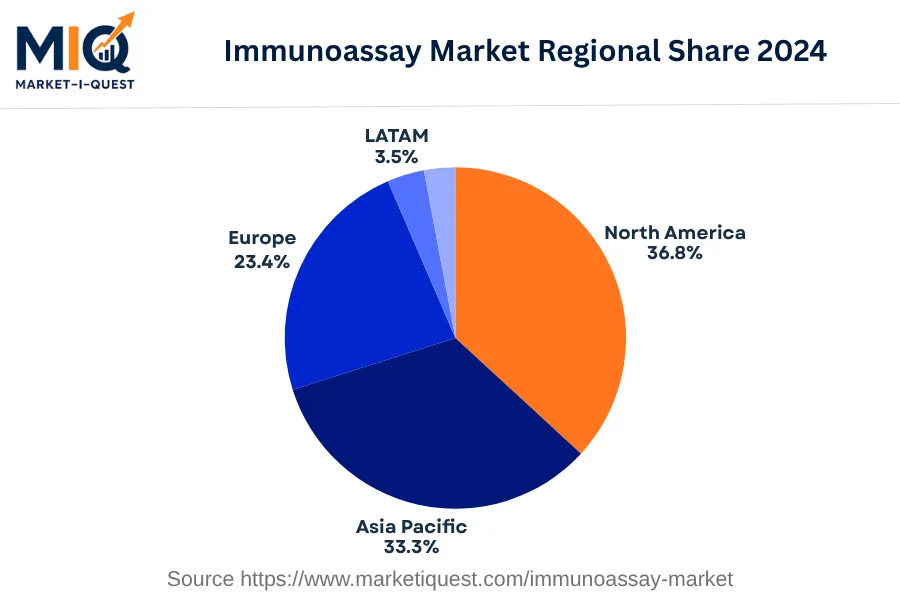
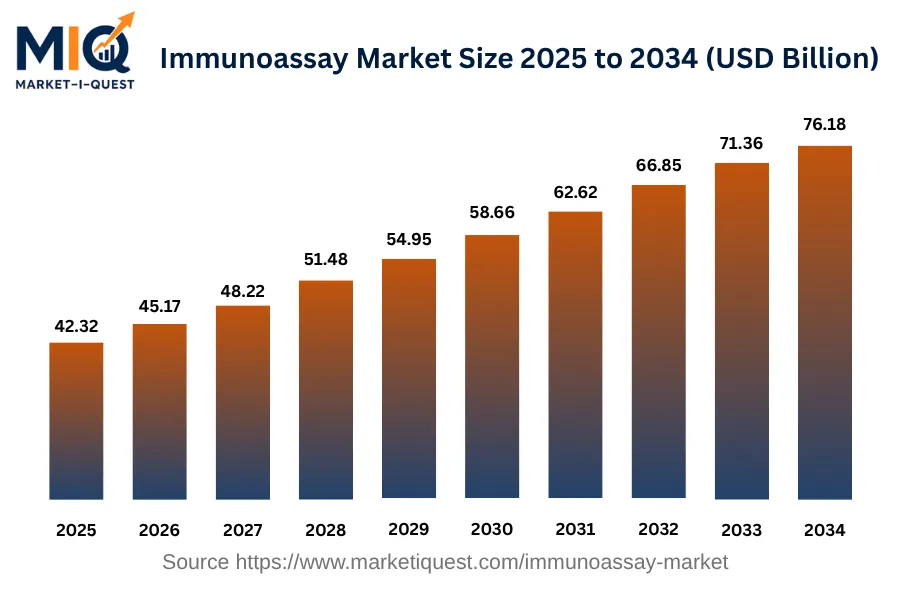
The Immunoassay Market size is projected to be USD 42.32 Billion in 2025 and expected to increase to USD 76.18 Billion by 2034, growing at a CAGR of 6.75%. Starting from a market size of USD 39.64 Billion in 2024, the growth path over the coming decade indicates a substantial upward trajectory, with key growth milestones observable across the forecast period. These growth figures are resulting mainly from an increasing incidence of chronic and infectious diseases, technological advancements in immunoassay instruments, and growing use of immunoassay-based quick diagnostics for point-of-care testing services. On a regional basis in 2024, North America constituted 38.62% of the Immunoassay market, followed by Asia Pacific at 29.36%, Europe at 24.48%, Latin America at 3.88%, and the Middle East and Africa at 3.66%. This regional share mix gives a clear indication of market distribution on a global scale.

Key Takeaways

  • By Type
  • the Enzyme-Linked Immunosorbent Assay (ELISA) led in terms of usage
  • accounting for the highest share in the Immunoassay Market.
  • By Technology
  • Automated Immunoassay held a significant position in the market due to its high efficiency.
  • By Application
  • Clinical Diagnostics dominated as the most common use-case for Immunoassay.
  • By End Use
  • Hospitals remained at the forefront
  • making the most of the Immunoassay methods in patient care.
immunoassay-market market size

Key Driving Factors

Emergence of Novel Biomarkers

Biomarkers play a significant role in diagnosing diseases and this has led to an increase in immunoassay tests. They are increasingly used for identifying and measuring the levels of specific biomarkers in patients. For instance, troponin tests are a type of immunoassay used in identifying heart attacks by detecting proteins released into the blood. The ongoing research to discover new biomarkers is thus driving the expansion of the immunoassay market. It's creating opportunities that revolve around the development of immunoassay technologies, such as enzyme-linked immunosorbent assays (ELISA), radioimmunoassays (RIA), and rapid tests, leading to increased market growth.

Adoption of Point-of-care Testing

The immunoassay market is also witnessing growth due to the escalated adoption of point-of-care (POC) testing. POC testing refers to medical diagnostic testing conducted close to the patient. The convenience offered by POC testing, such as faster results and user-friendly test kits, directly contributes to the market expansion. Rapid immunoassays are a notable type of POC testing, which can easily be conducted by individuals at home and physicians at healthcare centers for immediate diagnosis and real-time monitoring. Hence, increased preference towards POC testing has triggered the demand for immunoassay test kits, subsequently contributing to the market's active growth.

Market Evolution by Timeline

2019-2023
During this period, the primary buyers of immunoassay products were hospitals, diagnostic laboratories, and research institutions, primarily in North America and Western Europe. Demand was driven by the need for fast and reliable diagnostic tools for diseases such as cancer and COVID-19. Newly introduced chemiluminescence immunoassay and multiplex immunoassay technologies became widely adopted due to their improved sensitivity and ability to detect multiple targets in a single run. Despite supply chain disruptions triggered by the pandemic, manufacturers like Roche Diagnostics and Siemens Healthineers managed to maintain production. Regulatory frameworks like the EU In Vitro Diagnostic Regulation influenced manufacturers to improve product quality and patient safety. Flat-fee contracts became prevalent, allowing buyers guaranteed access to supplies. However, the complexity and high costs of testing equipment were major challenges to market growth.
2024
In 2024, increasing demand from Asia-Pacific region expanded the immunoassay market, attributed to growing healthcare infrastructure and rise in prevalent diseases. Manufacturers introduced advanced immunoassay systems using AI and machine learning to interpret results, reducing the reliance on skilled personnel. However, challenges remained in integrating these technologies into existing systems. Governments established standards for digital health, including the usage of AI in immunoassays, promoting the adoption of innovative technologies. Performance-based contracts increasingly replaced flat-fee contracts. Risks prevailed in the form of stringent regulatory compliance, especially regarding the use of artificial intelligence in diagnostics, adding to the cost of product development.
2025-2029
Throughout this period, immunoassay manufacturers' focus shifted towards developing personalized diagnostic solutions to cater to the growing demand in precision medicine. This transformation was brought about by the emergence of next-gen technologies like genomics and proteomics. Consequently, universities and biotechnology firms became significant buyers. Countries across the globe initiated programs like the UK's Genomics England to grow their genomic medicine capabilities. The United Nations' Universal Health Coverage agenda encouraged more affordable pricing models, thus opening up new markets in low- and middle-income countries. Manufacturers continued to struggle to keep pace with constantly evolving regulatory requirements, impacting product development timelines.
2030-2034
The period saw the broad integration of immunoassay technologies into wearable devices, increasing the buying interest among consumer electronics companies. User-friendly point-of-care testing solutions accelerated by IoT and 5G technology grew in demand, particularly in remote areas. Supply was affected by the unprecedented surge in demand for bio-sensors in consumer wearables. EU's Digital Health Data and Services policy influenced the deployment of a secure data transfer mechanism in these devices. Manufacturers faced challenges to scale production and maintain product quality, given the unexpected spike in demand. New business models emerged involving partnerships with tech companies to combine diagnostics, consumer technology, and data services.

Future Market Outlook

Future Opportunities

The current landscape of the immunoassay market is rich with opportunities driven by various factors, including rising global health challenges and technological innovations. The ongoing increase in autoimmune disease prevalence has led to heightened demand for specific diagnostic assays, prompting companies to diversify their product portfolios. For example, the American Autoimmune Related Diseases Association reported in 2022 that approximately 50 million Americans are currently affected by autoimmune diseases, underscoring the need for efficient diagnostic tools. Furthermore, the integration of artificial intelligence in diagnostic workflows presents a pivotal opportunity; companies like Siemens Healthineers are investing in AI technologies to enhance data interpretation in immunoassays, promising improved outcomes for clinicians and patients. Moreover, the trend towards personalized medicine is creating a push for developing tailored immunoassays that address individual patient profiles, with regulatory bodies, including the European Medicines Agency, actively supporting this direction. Collaborations among pharmaceutical firms and diagnostics companies are expected to facilitate these advances, as seen in 2023 with Roche's partnership with Genentech to advance precision diagnostics. Additionally, expanding into emerging markets, particularly in the Asia-Pacific region, offers significant growth prospects as healthcare infrastructures evolve. The anticipated increase in public and private healthcare spending globally is expected to further bolster investment in immunoassay innovations, actively shaping the market dynamics in the coming years.

Segmentation Analysis

By Type

The market is divided into subsegments including Enzyme-Linked Immunosorbent Assay (ELISA), Radioimmunoassay, Fluorescent Immunoassay, Chemiluminescent Immunoassay, and Western Blot. The Enzyme-Linked Immunosorbent Assay (ELISA) accounted for the largest revenue share while the Chemiluminescent Immunoassay is expected to be the fastest-growing subsegment during the forecast period.

Largest Revenue Share

Enzyme-Linked Immunosorbent Assay (ELISA)

Market Share Leader

Enzyme-Linked Immunosorbent Assay (ELISA) is currently leading the segment in terms of revenue generation. This dominance can be attributed to several factors. First is its broad range of applications in diagnosing various diseases like cancer, infectious diseases, and autoimmune disorders. This wide-ranging utility ensures the steady demand for ELISA kits. Additionally, ELISA provides cost-effective solutions for mass screenings, thus making it a preferred choice among healthcare providers. Developed economies that heavily invest in healthcare infrastructure predominantly contribute to the revenue, although emerging markets are catching up, given the increasing awareness and improving healthcare facilities. Regulatory bodies' endorsement and supply chain efficiency of ELISA kits enhance its market position. The key purchasing criteria include reliability, sensitivity, and specificity of the assay, and ELISA delivers on these fronts, explaining its largest revenue share.

Fastest CAGR

Chemiluminescent Immunoassay

Forecast Period Growth Leader

Despite not leading in terms of current revenue generation, Chemiluminescent Immunoassay (CLIA) exhibits the fastest Compound Annual Growth Rate (CAGR), owing to several growth drivers. CLIA provides higher sensitivity and specificity compared to traditional immunoassays, thus attracting more adoption. Technological advancements and incorporation of automation in CLIA have reduced its turnaround times and increased throughput, making it a preferred choice for high volume samples. Additionally, increased capital investments and partnerships between diagnostic companies and research institutes for the development of enhanced CLIA kits fuel market growth. However, there are barriers to its rapid adoption such as the higher cost compared to other immunoassays and need for skilled personnel to interpret results. It is crucial to mitigate these challenges for sustained growth. A potential risk in the short term could be regulatory changes impacting the speed of approvals for CLIA kits.

By Technology

The technology market is divided into subsegments including Automated Immunoassay, Point-of-Care Immunoassay, and Lateral Flow Assay. In 2024, the Automated Immunoassay subsegment accounted for the largest revenue share, while the Point-of-Care Immunoassay is expected to grow at the fastest CAGR during the forecast period.

Largest Revenue Share

Automated Immunoassay

Market Share Leader

The Automated Immunoassay segment leads in revenue due to its widespread acceptability globally and more advanced and precise nature. Given the high sensitivity, accuracy and specificity of automated immunoassays, hospitals, diagnostic labs, and research institutions favor them. The heightened automation reduces the possibility of human error, making this technology a preferred option for large-scale or serial testing. Furthermore, the regulation and supply chain have evolved to support the efficient use of automated systems in laboratories. The result is a reliable, streamlined supply chain that ensures this technology's steady availability. The low switching costs make it desirable for end users who seek to upgrade their testing techniques without significant financial implications. With the established purchasing channels for automated immunoassays, the segment enjoys a steady stream of revenue.

Fastest CAGR

Point-of-Care Immunoassay

Forecast Period Growth Leader

The Point-of-Care Immunoassay segment is expected to experience the most rapid growth. The primary growth drivers being the convenience of testing at the point-of-care and the increase in the need for rapid diagnostic procedures. Their portable nature and shorter assay time make them vital tools in critical and emergency situations where time is of the essence. Adopting these technologies, however, faces some barriers like high initial capita expenditure, lack of regulatory knowledge, and the need for specific storage conditions. However, advancements in tech, the rise in healthcare expenditure, multiple supplier partnerships are creating a favorable environment for market penetration. Near-term risks include the emergence of superior technologies and strict regulatory hurdles. Overall, despite these challenges, the adoption of Point-of-Care Immunoassay will continue to grow in importance due to its critical role in timely and efficient healthcare delivery.

By Application

The market segments primarily into applications like Clinical Diagnostics, Drug Development, Environmental Testing, and Food Safety Testing. Out of these, Clinical Diagnostics accounted for the largest revenue share, whereas Drug Development is projected to grow at the fastest rate during the forecast period.

Largest Revenue Share

Clinical Diagnostics

Market Share Leader

The Clinical Diagnostics subsegment commands the highest revenue share due to its significant role in healthcare and demand from the growing global health-conscious consumer base. This segment's essential status in the biomedical field and surgeries, coupled with the necessity to detect a wide variety of diseases, enhances its market presence. Geographically, most sales are driven by developed countries with high emphasis on advanced healthcare facilities. Also, the rise in public awareness regarding preventive care has led to increased regular diagnostic tests. Regulations in many countries mandate certain diagnostic evaluations before treatment, further amplifying this segment's growth. Moreover, the presence of leading diagnostic companies introduces technologically advanced products, reinforcing the subsegment's market command.

Fastest CAGR

Drug Development

Forecast Period Growth Leader

The Drug Development subsegment is recognized as the fastest-growing market segment due to technology advances, a shift towards personalized medicine, and an increase in partnerships between major pharmaceutical companies and research institutes. An additional accelerant is the rising prevalence of chronic diseases globally that demands new effective treatments. Adoption barriers, however, do lie within stricter regulatory policies for drug approval, high associated costs, and long timeframes for development. But, the advent of new technologies such as AI for research and development is breaking these barriers and speeding up drug discovery processes. This, accompanied with the significant capital investments, is likely to amplify the pace of growth for this sector in the coming years. Despite anticipated growth, potential risks include policy changes and the shift towards alternative medicine.

By End Use

The market is divided into subsegments including Hospitals, Diagnostic Laboratories, Pharmaceutical Companies, and Academic Research Institutions. The Hospitals subsegment accounted for the largest revenue share while the Pharmaceutical Companies subsegment is expected to grow at the fastest CAGR during the forecast period.

Largest Revenue Share

Hospitals

Market Share Leader

Hospitals are at the core of the healthcare industry and tend to draw the largest share of revenue in the market. The key drivers for the substantial revenue generation of this subsegment are the high volume of medical procedures conducted and the wide variety of healthcare services offered. Hospitals deliver an extensive range of services spanning from primary care to advanced surgical procedures. This results in them utilizing a diverse selection of medical supplies, machinery, and medications, contributing immensely to their leading position in revenue generation. Regulations also play a role in this, with certain procedures and medications being restricted for use solely within a hospital setting. Furthermore, the purchasing decision in hospitals is typically oriented towards quality and reliability, as the consequences of equipment failure can be dire, leading to high-value purchases. However, a key challenge lies in budget constraints, especially for public hospitals, which may limit high expenditures despite strong demand.

Fastest CAGR

Pharmaceutical Companies

Forecast Period Growth Leader

Pharmaceutical Companies are forecasted to be the fastest-growing subsegment. Much of this growth is fueled by the increasing prevalence of diseases and the ongoing need for innovative medications. Increased funding for R&D, public-private partnerships for drug development, and a surge in venture capital investments are key elements propelling the expected rapid growth. Technological advancements, such as the integration of AI in drug discovery, have also catalyzed the pace of pharmaceutical innovation. Furthermore, significant capital expenditure in the pharma sector is expected to sustain this momentum. However, stringent regulations, high costs associated with drug discovery and development, and the uncertainty surrounding approval timelines are anticipated risks that might inhibit the speed of acceleration. Nonetheless, considering the ever-growing global demand for effective treatments and preventive medication, the outlook remains promising.

Competitive Analysis

Key Market Players

Manufacturers / OEMs

Roche Diagnostics
Switzerland
Abbott Laboratories
US
Siemens Healthineers
Germany

Key Suppliers & Raw Materials

Thermo Fisher Scientific
US
Merck Group
Germany
Bio-Rad Laboratories
US

Distributors, Integrators & Channel Partners

Techcomp Ltd.
China
Cardinal Health
US
McKesson Corporation
US

Porter’s Five Forces Analysis

This analysis evaluates the competitive environment and potential profitability of the Immunoassay Market.

Supplier Bargaining Power

Medium

Suppliers exert moderate power due to the specialized nature of immunoassay reagents and equipments.

Buyer Bargaining Power

High

Buyers, mainly healthcare providers, have high bargaining power due to the availability of multiple immunoassay vendors.

Threat of Substitutes

Low

The threat from substitutes is low as immunoassays are highly specific and reliable testing methods.

Threat of New Entrants

Medium

Entry barriers like high R&D expenditures, regulatory approvals make it moderately difficult for new entrants.

Competitive Rivalry

High

Intense rivalry due to presence of multiple large-scale companies and constant innovation in this market.

Regional Analysis

Geographic market dynamics and growth opportunities across key regions

Global Market Outlook

immunoassay-market market regional share

North America

In 2024, the North American Immunoassay Market represented a significant sector within the broader healthcare industry. A primary market driver was the increased prevalence of chronic diseases in the U.S., Canada, and Mexico. This trend, alongside aging populations, heightened demand for early and accurate diagnostic services. Regulatory changes, such as the United States' Protecting Access to Medicare Act (PAMA), also influenced market dynamics, incentivizing investment in improved diagnostic assays. Additionally, accelerated adoption of advanced technologies like chemiluminescent immunoassays (CLIA) brought step-changes in supply side competencies and efficiencies, positively impacting the market.

Consumer behaviour was shaped by an increased prioritization of preventive healthcare, which amplified demand for immunoassay diagnostic tests. Concurrently, shifts towards automated and multiplexed immunoassays were observed, propelled by their improved efficiency and accuracy. Unanticipated challenges were met by partnerships and M&A activity, especially between healthcare providers and diagnostic centers, ensuring adequate access to immunoassay services. In the sectors of policy enforcement, the rigorous application of Clinical Laboratory Improvement Amendments (CLIA) standards bolstered trust in immunoassay products. These factors overall reinforced the immunoassay market stability in North America in 2024.

Asia Pacific

In 2024, the Immunoassay market in Asia Pacific was substantial and dynamic, characterized by high levels of competition and innovation. Steered by aging population demographics, advances in technology, and increased investments in healthcare infrastructure, countries such as China, India, and Japan experienced spikes in demand for Immunoassay products, with an emphasis on infectious disease diagnostics. Government regulations actively promoting the use of accurate testing procedures further supported market growth. Significant shifts in buyer behavior could also be spotted; Asian healthcare providers displayed an increased preference for automated systems, reflecting a wider trend towards embracing technological integration. This was primarily driven by the benefits of automation, such as improved efficiency, faster results, and minimized likelihood of errors.

Market trends also showed a gradual shift away from traditional purchasing channels, with online procurement portals gaining traction. This reflected a greater market adaptation to e-commerce trends among a majority of customers, including healthcare and manufacturing sectors. The competitive landscape of this market also witnessed a surge in strategic partnerships and mergers, with significant players in China and Japan entering into collaborations to expand their product portfolios or to capitalize on technological advances. Lastly, increasing regulatory scrutiny, notably in South Korea and Australia, underlined the importance of adhering to set standards in immunoassay product quality and effectiveness.

Europe

In 2024, Europe's immunoassay market held an influential position in the healthcare industry. Driven by the rise in chronic diseases like cancer and diabetes, there was a heightened demand for quick, accurate testing mechanisms, notably in Germany and France. The European Union's stringent health regulations also increased dependence on immunoassays for disease diagnosis and therapeutic drug monitoring. Massive investments by pharmaceutical companies in the United Kingdom and Italy towards developing innovative tests amplified the market's momentum. Faster technology adoption, especially in the Nordics, Benelux, and Central & Eastern Europe, enhanced the supply dynamics.

Consumer inclination towards non-invasive testing techniques marked a prominent shift in buying behavior. There was a noticeable move towards multiplex immunoassays for increased efficiency, reflected in the market's product dynamics. Government policy enforcement in the region also steered organizations towards automated, high-throughput systems. Simultaneously, the rise in Telehealth services in Spain realigned channel distribution, increasing dependence on online channels. Collaborations and acquisitions were also noted, with large enterprises partnering with research facilities for enhanced immunoassay development, adding a new facet to the prevailing trends in the enterprise sector. The burgeoning biotechnology industry in Europe observed high consumption, emphasizing the role of immunoassays in manufacturing and research applications.

Latin America

In 2024, the Immunoassay Market in Latin America (LATAM), specifically in countries like Brazil, Mexico, Argentina, Colombia, Chile, and Peru, has emerged as a vital segment in the healthcare industry due to factors such as increased demand, advancements in technology, and favorable regulations. One of the most substantial drivers of this growth has been the escalating demand for cost-effective, accurate diagnostic methods across the healthcare sector. Moreover, significant investment in biotechnology and pharmaceutical research and development has added impetus to the market’s expansion. On the regulatory front, the encouragement of technological adoption in healthcare systems by LATAM governments has been instrumental.

Regarding trends, a prominent one is the shift in buyer behavior, with an increased preference for rapid, POC (Point-of-Care) immunoassay tests. Secondly, technological advancements such as automation and miniaturization of immunoassays have led to significant improvement in patient outcomes. In addition, the market has seen a rise in partnerships and mergers, especially in the pharmaceutical sector, to facilitate the advancement of novel immunoassay techniques. The primary customers span across healthcare utilities, research organizations, and pharmaceutical companies. For instance, the Brazilian government has been advocating the use of rapid immunoassay tests in public healthcare units, while the Mexican pharmaceutical sector has seen a surge in collaborations to create innovative assays.

Middle East & Africa

In 2024, the immunoassay market in the Middle East and Africa displayed considerable dynamism driven by various factors. Regulatory policies favouring the healthcare sector, coupled with significant investments from governments and private operators in Saudi Arabia, United Arab Emirates, Qatar, and South Africa, fuelled its expansion. Technology adoption increased especially in Nigeria and Kenya, where the development of telehealth and remote diagnostic tools spurred immunoassay utilization. Supply dynamics also evolved as both international and domestic manufacturers aimed to meet growing demand, thereby enhancing pricing competitiveness.

Trends in 2024 reflected changing structures and behaviours within the market. Increasingly health-conscious consumers particularly in Israel and South Africa favoured advanced and precise immunoassay tests driving product innovation. Shifts in technology saw the rise of portable and automated immunoassay instruments in hospitals and labs across Egypt and Saudi Arabia. Market synergy was observed with a surge in partnerships among research institutes, manufacturers, and healthcare providers, such as hospital chains, to increase product accessibility. In terms of policy, stricter enforcement of quality and safety standards across the region fuelled demand for certified immunoassay equipment. The key sectors impacted comprised of healthcare, government, and manufacturing with enhanced focus on diagnostics and preventative care.

Recent Industry Developments

Latest market innovations, product launches, and strategic initiatives

June 2026

The FDA granted 510(k) clearance to EUROIMMUN's automated chemiluminescence-based immunoassay (ChLIA) test for free testosterone, which runs on random-access iSYS or i10 instruments.

November 2025

Medispec India and Mabtech AB announced an exclusive partnership to bring the EYRA multiplexing platform and EYRAplex kits to India, expanding access to advanced multiplex immunoassay technologies across India's academic and biopharmaceutical research communities.

Frequently Asked Questions