Immunoassay Instruments Market Snapshot

Key Players

  • Roche Diagnostics (Switzerland)
  • Abbott Laboratories (US)
  • Siemens Healthineers (Germany)
  • Danaher Corporation (US)
  • BioMérieux (France)
  • Ortho Clinical Diagnostics (US)
  • Sysmex Corporation (Japan)
  • Thermo Fisher Scientific (US)
  • Agilent Technologies (US)

Market Size

Base Year 2024
$8.63 Bn
CAGR
6.93%
Forecast 2034
$16.87 Bn

Market Segments

By Instrument
  • Immunofluorescence
  • ELISA
  • Radioimmunoassay
  • Chemiluminescence
  • Others
By Application
  • Infectious Diseases
  • Autoimmune Diseases
  • AIDS
  • Endocrinology
  • Drug Monitoring
  • Others

Market Dynamics

Drivers
  • Rising prevalence of chronic diseases
  • Advancements in immunoassay technologies
Restraints
  • High initial equipment cost
  • Inadequate reimbursement policies
Opportunities
  • Growth in clinical diagnostics
  • Technological advancements in immunoassay instruments

Market Size

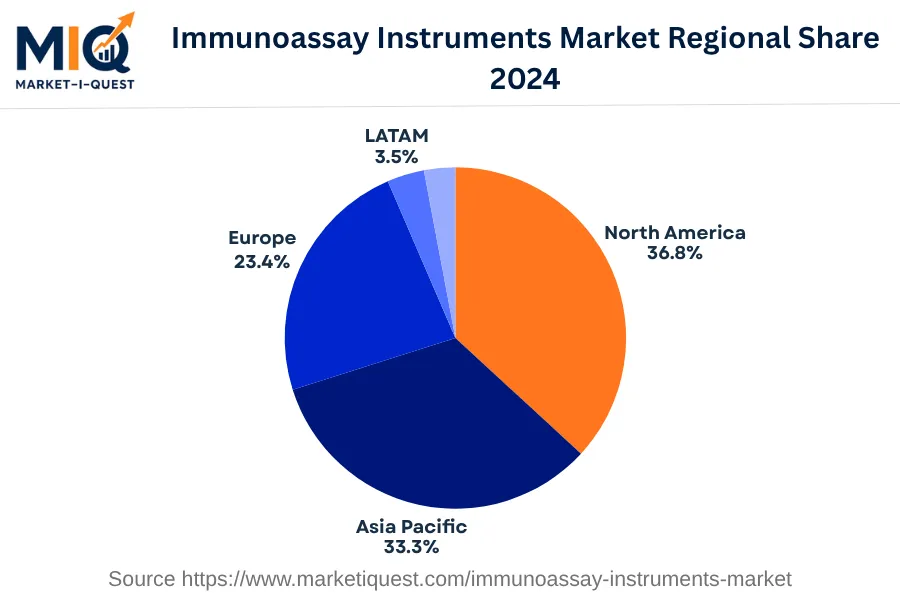
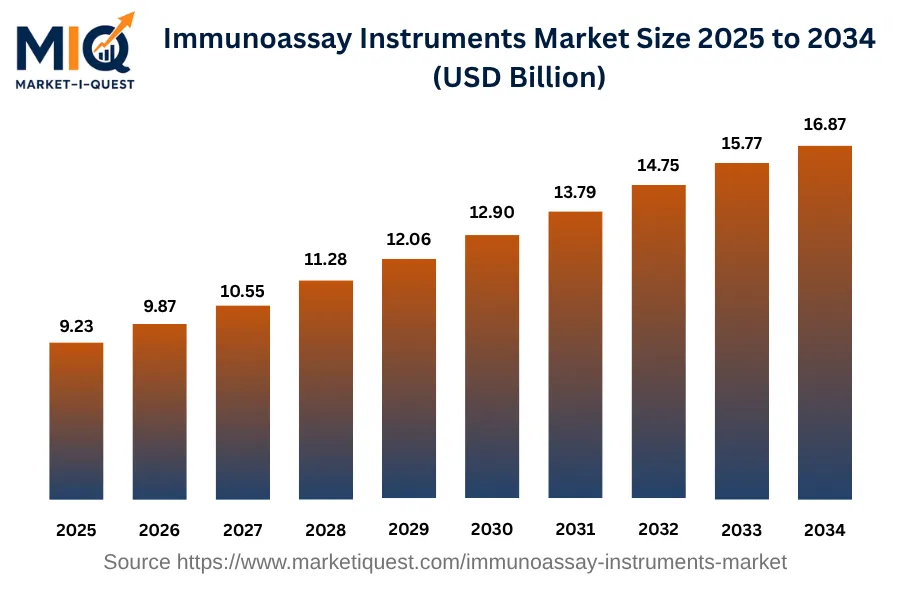
The Immunoassay Instruments Market was valued at 9.23 billion USD in 2025, following an initial size of 8.63 billion USD in 2024. Over the subsequent decade, this market is forecast to grow to a size of 16.87 billion USD by 2034, exhibiting a compound annual growth rate (CAGR) of 6.93%. This growth is principally driven by increasing demand arising from varied sectors relying heavily on immunoassay instrument technologies and the continual advancements in these instruments. Further impetus for the market expansion comes from increasing funding for R&D activities in this field and rising immersive applications of these instruments. In terms of regional market shares in 2024: North America held 39.18%, Asia Pacific accounted for 28.84%, Europe had 24.63%, while Latin America and the Middle East & Africa (MEA) held the smaller shares with 3.74% and 3.61% respectively.

Key Takeaways

  • By Instrument - ELISA held a leading position in the Immunoassay Instruments market in 2024.
  • By Application - Infectious Diseases led commanding a significant market share in the same year.
immunoassay-instruments-market market size

Key Driving Factors

Adoption of Immunoassay Systems in Diagnostic Laboratories

The Immunoassay Instruments Market is largely driven by their increasing usage in diagnostic laboratories. These systems are highly adopted due to their efficiency in identifying infectious diseases, endocrine disorders, oncology, and cardiology issues. Particularly during the COVID-19 pandemic, immunoassay systems demonstrated their worth by quickly and accurately detecting viral proteins or patient antibodies against viruses. Diagnostic laboratories, including those in hospitals, have thus recognized the necessity of these instruments, enhancing the market growth of immunoassay instruments.

Efficient Drug Monitoring through Immunoassay Instruments

A significant factor fueling the Immunoassay Instruments Market is their critical role in therapeutic drug monitoring (TDM). Effective TDM isn't achievable without reliable immunoassay equipment to measure drug concentrations in patients' blood. This monitoring is particularly vital for patients who use drugs with a narrow therapeutic range, like immunosuppressive drugs for transplant recipients, where a slight overdose may cause toxic side effects. Health practitioners are therefore increasingly procuring immunoassay instruments to improve treatment outcomes, driving market growth in the process.

Market Evolution by Timeline

2019-2023
During this period, main demand for immunoassay instruments came from diagnostic laboratories, particularly in North America. Their usage related primarily to infectious diseases, cancer, cardiac disorders, and autoimmune disorders. The instruments available mostly focused on chemiluminescence and fluorescence. Supply constraints were around integration with information systems. The U.S Food and Drug Administration's more stringent inspection rules led to a slowing product introduction rate during this period. Pricing typically was set on a per-test basis, with many manufacturers creating partnerships with labs to provide instruments at a discounted rate. However, the complexity and high-cost of operation acted as barriers.
2024
In 2024, focus shifted toward Asia-Pacific due to expanded healthcare infrastructure. Point-of-care testing also emerged as a common use case, particularly in primary care settings. Radioimmunoassay became more prevalent, helping tackle supply constraints. Regulatory approvals sped up, attributed to improved alignment between manufacturers and regulatory body expectations. The commercial model shifted to lease agreements or reagent rental agreements with manufacturers. Still, limited understanding of immunoassay tests and the necessity for skilled professionals remained challenges in this year.
2025-2029
Through these years, global market expansion was significant, driven by rising healthcare expenditure and an aging population. Demand was on the rise, with hospital labs being the primary buyers because of the rise in chronic illnesses. Enzyme immunoassays gained prominence during this period, aiding in the resolution of previous supply complexities. The introduction of ISO 15189 for medical laboratory quality played a role in standardizing quality control. The rental approach was widely adopted in this period, with an arising trend of pay-per-test models. Despite advancements, the lack of established formal training remained a problem.
2030-2034
The immunoassay instruments market further spread across developing nations due to increased investment in healthcare infrastructure by governments. There was higher uptake by pharmaceutical and biotechnology companies for drug discovery applications. Immuno-PCR use grew due to its high sensitivity and specificity. The EU's stricter In-Vitro Diagnostic Medical Devices Regulation was fully in place, driving higher product safety. Revenue sharing schemes became more common, offsetting high instrument cost. But the need for constantly updated assays due to the emergence and progress of diseases was a significant risk.

Future Market Outlook

Future Opportunities

The outlook for the immunoassay instruments market is being positively influenced by ongoing research and development initiatives across various regions. In 2023, the U.S. National Institutes of Health awarded grants to several institutions for the exploration of novel immunoassay technologies targeting autoimmune disorders, reflecting heightened interest and investment in this area. Furthermore, the aging global population is driving higher demand for diagnostic solutions, particularly in countries like Japan, which is recognized for its increasing geriatric demographic. Collaborations among biotech firms and healthcare institutions are creating a fertile ground for product innovation; in late 2022, Siemens Healthineers partnered with a research institute in Germany to explore advanced immunoassay applications. Additionally, the integration of wearable technology with immunoassay applications presents an opportunity for real-time monitoring of health conditions; initiatives are underway in the U.S. to develop wearables that utilize immunoassay principles for continuous health assessments. As regulatory frameworks evolve to support innovative diagnostics, including the potential implementation of the European Commission’s new IVD regulation set to take effect in 2024, market players are likely to seize these opportunities for growth. This evolving landscape posits a promising future for immunoassay instruments, underscoring the need for ongoing innovation and adaptation to meet health demands effectively.

Segmentation Analysis

By Instrument

The market is divided into subsegments including Immunofluorescence, ELISA, Radioimmunoassay, Chemiluminescence, and Others. The ELISA subsegment accounted for the largest revenue share while Chemiluminescence is expected to grow at the fastest CAGR during the forecast period.

Largest Revenue Share

ELISA

Market Share Leader

The ELISA (Enzyme-Linked Immunosorbent Assay) subsegment holds the most significant revenue share based on its wide range of applications across various fields, including diagnostics and clinical research. Its robust growth can be attributed to its high sensitivity and specificity. ELISA finds extensive use in detecting and quantifying proteins, hormones, and antibodies, offering comprehensive and precise results which leads clinicians to make accurate applications such as infectious disease diagnosis, and this has garnered considerable customer traction. Since antibodies and antigens involvement is crucial in many life-threatening diseases' diagnosis, the demand for ELISA has increased, driving revenue growth. Geography-wise, developed countries like the USA and Germany are leading in ELISA usage due to the high presence of established research and medical institutes. Moreover, while regulations might pose a challenge, they have also ensured quality and safety, thereby promoting trust and further adoption. The purchasing criteria favor the ELISA subsegment due to its cost-effectiveness and ease of use, with minimal switching costs, further driving its demand.

Fastest CAGR

Chemiluminescence

Forecast Period Growth Leader

Chemiluminescence is predicted to show the fastest CAGR over the forecast period. Providing higher sensitivity over traditional immunoassays and fluorescence detection methods combined with lower background signal, it is emerging as the preferred choice in multiple fields. The growth accelerants behind Chemiluminescence are primarily its broad range of application in research and diagnostics, drug discovery, and forensic testing. While adoption might have been slightly hindered by the higher initial capital expenditure, the improved efficiency and high-throughput capability it offers are ensuring that barriers to adoption are quickly overcome. Technological advancements, particularly in the automation of chemiluminescence immunoassays procedures, are expected to act as a significant growth catalyst. Likewise, policies promoting advanced diagnostic solutions could propel its growth further. Potential short-term risks include market penetration in traditional sectors that are dominated by well-established methods, yet the promise of higher sensitivity and specificity is an irresistible draw for many, indicating a bright future ahead for Chemiluminescence.

By Application

The market is divided into subsegments including Infectious Diseases, Autoimmune Diseases, AIDS, Endocrinology, Drug Monitoring, Others among which Infectious Diseases accounted for the largest revenue share while AIDS is expected to grow at the fastest CAGR during the forecast period.

Largest Revenue Share

Infectious Diseases

Market Share Leader

Infectious Diseases ranks first in terms of revenue generation. This is largely due to the ongoing global effort to combat various forms of infectious diseases continually emerging and re-emerging. Many infectious diseases, ranging from influenza to the Ebola virus , are global, unified threats that command huge attention and resources. This leads to an influx of investment, driving research, development and commercialization of tests, treatments and preventive measures, thereby generating revenues. Patients in developing regions often add to the revenue because infection rates are typically higher due to factors such as limited access to clean water, high population density, and lack of immunization. Furthermore, most regulatory environments worldwide encourage the development and provision of solutions for infectious diseases to protect public health. Lastly, the purchasing criteria for infectious disease solutions typically prioritize effectiveness and quick results, and the significant stakes involved limit switching costs.

Fastest CAGR

AIDS

Forecast Period Growth Leader

Despite the substantial revenue generated by the Infectious Diseases segment, the AIDS subsegment is projected to grow at the fastest CAGR. The main growth drivers are the universally recognized urgency to tackle HIV/AIDS, the stigma associated with the disease, the constant investment in research and development, and the international cooperation to find a cure. HIV/AIDS remains a global public health issue, and its treatment solutions have been the focus of policies and funding. Challenges for this subsegment include availability and access to treatment, especially in developing regions. Various partnerships are formed, such as pharmaceutical companies with NGOs or governmental organizations, to enlarge the reach of anti-AIDS campaigns, test kits, and treatments, thus, spurring substantial growth. However, near-term risks involve new variants of the virus and loss of funding due to economic downturns or changes in government policy.

Competitive Analysis

Key Market Players

Manufacturers / OEMs

Roche Diagnostics
Switzerland
Siemens Healthineers
Germany
Abbott Laboratories
US

Key Suppliers & Raw Materials

Thermo Fisher Scientific Inc.
US
Bio-Rad Laboratories, Inc.
US
Agilent Technologies, Inc.
US

Distributors, Integrators & Channel Partners

Beckman Coulter, Inc.
US
Becton, Dickinson and Company
US
DiaSorin S.p.A
Italy

Porter’s Five Forces Analysis

A comprehensive analysis of the competitive forces and industry dynamics within the Immunoassay Instruments Market.

Supplier Bargaining Power

Medium

Controlled by few manufacturers, yet competition and availability of various technologies moderate their power.

Buyer Bargaining Power

High

Buyers, mainly healthcare facilities and labs, have high bargaining power due to multiple alternatives and low switching costs.

Threat of Substitutes

Medium

Rapid technological advancements allow potential for substitutes, though regulatory barriers restrict easy acceptance.

Threat of New Entrants

Low

High investment costs, stringent regulations, and complex technology complexity deter new entrants.

Competitive Rivalry

High

The market features aggressive competition, with key vendors often involved in mergers and product innovations.

Regional Analysis

Geographic market dynamics and growth opportunities across key regions

Global Market Outlook

immunoassay-instruments-market market regional share

North America

In 2024, the North American Immunoassay Instruments market demonstrated robust vigor, comprising manufacturers, distributors, and end-users across the healthcare, manufacturing, and research sectors, mainly in the US, Canada, and Mexico. Key market drivers were the escalating demand for early and accurate diagnosis, federal regulations promoting advanced diagnostic procedures, and heightened investments in healthcare infrastructure. Advances in technology fostered swift adoption of automated immunoassay analyzers showcasing high-throughput capabilities, while intensified competition stoked supply dynamics and competitive pricing.

Trending in the market, consumer demand for rapid, user-friendly, and highly sensitive immunoassay instruments gained traction, transmuting product technological paradigms. A surge in online sales channels reflected a shift in buying behavior with an uptake of remote procurement over traditional means. Cross-sector partnerships, escalating mergers and acquisitions activity, underscored a strategic shift to consolidate market position and widen footprints. The implementation of the Protecting Access to Medicare Act in the US engendered stricter quality norms, thereby influencing design and manufacturing standards toward high-performing, error-resistant instruments. Within the healthcare sector, diagnostics centers and hospitals remained dominant consumers, while the usage in the biotechnological and pharmaceutical industries marked a notable rise.

Asia Pacific

In the base year 2024, the Immunoassay Instruments Market in Asia Pacific witnessed stable growth, underpinned by regulatory changes and technological advancements in the healthcare sector. Regulatory reforms in Australia and China's increased support for healthcare infrastructure created a more conducive environment for the market development. India's surge in clinical trial investment and Japan's advanced healthcare technology adoption expedited this growth further. The competitive pricing in South Korean and ASEAN markets also stimulated demand, fostering a healthy supply dynamic region-wide.

Buyer behavior trends in the healthcare and manufacturing sectors showed a growing preference for immunoassays with enhanced accuracy and shorter turnaround times. The rise of automated immunoassay instruments, particularly in Australia and Japan's healthcare facilities, marked a significant shift. Channel dynamics in 2024 illustrated the increasing prowess of e-commerce platforms as a distribution channel for immunoassay instruments, particularly in China and India. Additionally, there were stronger alliances and M&As among major market players across the region to gain a competitive edge. A tighter policy enforcement in the region safeguarded the quality of immunoassay instruments, setting higher standards for manufacturers.

Europe

In 2024, the European immunoassay instruments market experienced significant activity, shaped heavily by regulatory adjustments, technological advancements, and diverse demand dynamics. Health reforms, such as the instantiation of the EU's In Vitro Diagnostic Medical Devices Regulation, stimulated the market to introduce improved diagnostic tools; clear guidelines encouraged investment and increased confidence in product quality. Similarly, technological adoption was pronounced, with key markets in Germany, France, and the UK leading the uptake of automated systems; efficiency gains drove widespread interest in implementing these platforms. Demand was particularly robust from the healthcare sector, a response to the pressure on clinical laboratories resulting from increasing chronic disease prevalence.

Trends showed a notable lean towards personalized medicine, accelerating software integration within immunoassay systems for more comprehensive and patient-specific data analysis. The consolidation in the market, evident in Merck's acquisition of Sigma-Aldrich, affected product availability and competition dynamics. Retail channels also evolved, with increasing online tool procurement due to convenience and timesaving benefits. Market trends were again directed by regulatory policy, with stringent confidentiality and data protection standards fostering data encryption and security improvements within immunoassay systems. The 2024 European immunoassay instruments market was characterized by a fusion of evolving healthcare demands, regulatory guidance, and technology-led transformations.

Latin America

In 2024, Immunoassay Instruments Market in Latin America witnessed noticeable growth due to several drivers and trends. This progress was majorly driven by increasing disease prevalence, government investments in health infrastructure and technological advancements across countries like Brazil, Mexico, Argentina, Colombia, Chile, and Peru. Increasing demand stemmed predominantly from the healthcare sector due to the rising disease prevalence, necessitating the improvement in diagnostic accuracy. As a consequence, governments across the region infused substantial investments into developing sound health infrastructure, especially in Brazil and Mexico, creating a favorable market scenario for Immunoassay instruments. Widespread adoption of advanced technology further boosted the market. However, the non-uniformity of regulatory requirements hampered the supply dynamics.

In terms of trends, changing buyer behavior resulted in a preference shift towards reliable and sensitive immunoassay instruments, favoring third-generation methodologies. Evolving product technology witnessed an increased inclination towards miniaturization of instruments, streamlining operations, and reducing the turnaround time. There was a noticeable rise in partnerships and mergers, predominantly in Colombia and Peru, aimed at achieving a wider market presence. This year also saw the enforcement of stricter quality control policies, mandating the use of accredited instruments, in Argentina and Chile. The Immunoassay Instruments market space was thus primarily dominated by healthcare sector customers in these nations, with noticeable participation from retail customers as well.

Middle East & Africa

In the base year 2024, the Immunoassay Instruments market in the Middle East and Africa gained significant momentum due to key demand factors and technology adoption. Growth drivers include increased healthcare investments particularly in affluent countries like Saudi Arabia, United Arab Emirates, and Qatar, where government-funded projects have rapidly advanced the medical sector. Furthermore, there has been a high prevalent rate of infectious diseases like HIV/AIDS in countries like South Africa, Nigeria, and Kenya, leading to demand spikes. Also, regulatory support for diagnostics and personalized treatment in Israel has enhanced technology adoption in the region.

Trends transforming this market involve changes in buyer behavior and product development. The healthcare sector is experiencing a shift towards fully automated immunoassay instruments, brought on by the demand for fast turnaround times in diagnostic centers in Egypt and Nigeria. The rising pandemic crises have also driven a trend towards highly sensitive diagnostic tools. The market also witnessed increased M&A activity, particularly within the retail sphere, as companies aimed to leverage their mutual strengths for better market positioning. Generally, the enforcement of stricter quality standards in countries like Qatar and UAE is driving a surge in demand for high-quality medical devices, hugely impacting the growth of the Immunoassay Instruments Market in these countries.

Recent Industry Developments

Latest market innovations, product launches, and strategic initiatives

June 2026

The FDA granted 510(k) clearance to EUROIMMUN’s automated chemiluminescence‑based immunoassay (ChLIA) test for free testosterone. The assay runs on random‑access iSYS or i10 instruments, providing quick turnaround with superior accuracy and reliability.

November 2025

Shanghai KHB (Kehua Bio‑engineering) showcased its Polaris V150 Automatic Chemiluminescence Immunoassay Analyzer at MEDICA 2025. With a footprint of only 0.36 m², the compact analyzer features a built‑in touchscreen and requires no external devices, making it suitable for laboratories seeking high‑performance immunoassay capability in limited spaces.

Frequently Asked Questions